1/31/2006: Justice Samuel Alito takes oath.

The post Today in Supreme Court History: January 31, 2006 appeared first on Reason.com.
from Latest https://ift.tt/D0x4JvE
via IFTTT
another site
1/31/2006: Justice Samuel Alito takes oath.
The post Today in Supreme Court History: January 31, 2006 appeared first on Reason.com.
from Latest https://ift.tt/D0x4JvE
via IFTTT

Almost lost in recent hubbub over claims that the Swift–Kelce romance is a CIA psyop, the likelihood the leading presidential candidates are mental turnips, and the tussle between the federal government and Texas over border control is the fact that the feds are spying on us and want authorization to continue snooping. Debate last year over renewing Section 702 of the Foreign Intelligence Surveillance Act held Congress and the president to a brief extension before the holidays. That leaves legislators arguing the law’s fate before an April deadline, with none of the controversy over spying and privacy yet settled.
“I…thank the Congress for its extension of title VII of the Foreign Intelligence Surveillance Act,” read a White House statement on President Joe Biden’s December 22 signing of the National Defense Authorization Act. “My Administration looks forward to working with the Congress on the reauthorization of this vital national security authority as soon as possible in the new year. While I am pleased to support the critical objectives of the NDAA, I note that certain provisions of the Act raise concerns.”
“Raise concerns” is putting it mildly. Congress did no more than kick the can on extending sunsetting FISA powers to April 19 because the surveillance authorized by the law is deeply intrusive and worries civil libertarians in the ranks of Democrats and Republicans, in both the legislative and executive branches, and among the public at large. Those “concerns” may, if we’re lucky, torpedo the whole law.
Nominally, Section 702 of the Foreign Intelligence Surveillance Act (FISA) “enables the Intelligence Community (IC) to collect, analyze, and appropriately share foreign intelligence information about national security threats,” according to the Office of the Director of National Intelligence. But, like so many powers government officials find useful, it’s been applied far beyond its original justification over the years, including to the communications of Americans here at home.
Last April and July, the Republican-controlled House Judiciary Committee held hearings to examine “the FBI’s abuses of its Foreign Intelligence Surveillance Act (FISA) authorities, discuss the FBI’s failures to implement meaningful reforms to prevent its abuses, and address the broad issue of warrantless mass surveillance on American citizens.”
A week after the second hearing, declassified documents offered glimpses of how FISA is misused, including improper FBI surveillance of a U.S. senator, a state lawmaker, and a judge.
“The revelation that 702 is used against ‘foreign governments and related entities’ directly impacts Americans’ privacy, as American journalists, businesspeople, students and others all have legitimate reason to communicate with foreign governments,” Sen. Ron Wyden (D–Ore.) responded. “The fact they can be swept up in 702 collection further highlights the need for reforms to protect their privacy.”
Then, in September, the U.S. government’s Privacy and Civil Liberties Oversight Board (PCLOB) weighed in with a report raising concerns about the use and abuse of FISA’s Section 702.
“The Board finds that Section 702 poses significant privacy and civil liberties risks, most notably from U.S. person queries and batch queries” in which multiple search terms are run through the system as part of a single action, according to the board’s Report on the Surveillance Program Operated Pursuant to Section 702 of the Foreign Intelligence Surveillance Act. “Section 702’s targeting presents a number of privacy risks and harms by authorizing surveillance of a large number of targets, providing only programmatic review of a surveillance program, allowing extensive incidental collection, and causing inadvertent collection.”
How significant are those risks? The FBI has searched its gathered information millions of times for information on “U.S. persons” including citizens, residents, and businesses. “For example, in the twelve-month period ending November 30, 2021, FBI reported 3,394,053 U.S. person queries consisting of 2,964,643 unique query terms, approximately 1.9 million of which were associated with a single cyber threat,” noted the PCLOB.
While FISA is supposed to be directed at foreign threats and only incidentally implicate Americans, some of the queries found by the report were explicitly domestic in nature, including those “related to instances of civil unrest and protests.” The PCLOB, though divided, called for reforms.
The White House National Security Council promptly rejected suggestions that searches about U.S. persons should require court approval, claiming such a safeguard would be “operationally unworkable.” That just added to concerns. After all, if people repeatedly point out abuses of a foreign intelligence law to conduct domestic snooping, and officials deny that’s a problem worth addressing, then the existence of the law and the powers it authorizes should be reconsidered.
“Section 702 is set to expire at the end of 2023. We call on Congress to significantly reform the law, or allow it to sunset,” urged the ACLU.
“Congress must end or radically change the unconstitutional spying program enabled by Section 702 of the Foreign Intelligence Surveillance Act (FISA),” agrees the Electronic Frontier Foundation (EFF).
Promising vehicles for reforming the surveillance law are found in the Government Surveillance Reform Act and the Protect Liberty and End Warrantless Surveillance Act, both of which enjoy bipartisan support in Congress.
“The Government Surveillance Reform Act would prohibit warrantless queries of information collected under Section 702 to find communications or certain information of or about U.S. persons,” explains EFF. The group says the Protect Liberty and End Warrantless Act does much the same as well as “prohibit law enforcement from purchasing Americans’ data that they would otherwise need a warrant to obtain” and it also limits surveillance authority renewal to three years.
“A warrant requirement would amount to a de facto ban, because query applications either would not meet the legal standard to win court approval; or because, when the standard could be met, it would be so only after the expenditure of scarce resources,” objected FBI Director Christopher Wray when he addressed the Senate Intelligence Committee in December.
Wray may not have made quite the point that he intended. A de facto ban on abusive domestic surveillance? That sounds like a good start for reforming a law that’s been put to bad use.
The post Controversial Surveillance Law Up for Renewal (Again) in April appeared first on Reason.com.
from Latest https://ift.tt/yxAqc6F
via IFTTT
Boeing Shares Rally After Beleagured Planemaker Pulls Guidance
Boeing announced better than expected revenue, profits, and cash-flow for Q4…
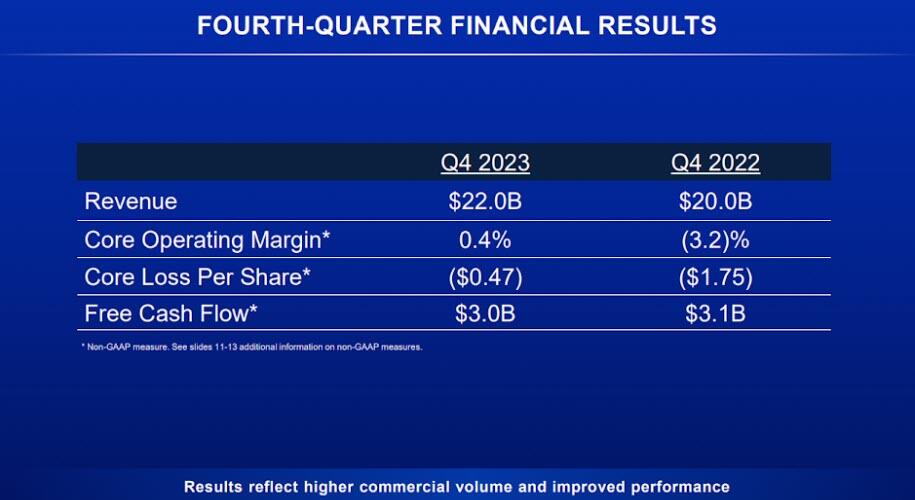
All sectors of its business beat top-line expectations:
Revenue $22.02 billion, estimate $21.06 billion
Commercial Airplanes revenue $10.48 billion, estimate $10.04 billion
Defense, Space & Security revenue $6.75 billion, estimate $6.17 billion
Global Services revenue $4.85 billion, estimate $4.84 billion
But, that good news was dominated by news that the beleaguered planemaker pulled guidance…
“While we often use this time of year to share or update our financial and operational objectives, now is not the time for that,” Chief Executive Officer Dave Calhoun told employees in a memo.
“We will simply focus on every next airplane while doing everything possible to support our customers, follow the lead of our regulator and ensure the highest standard of safety and quality in all that we do.”
And the result of that… shares are rising…
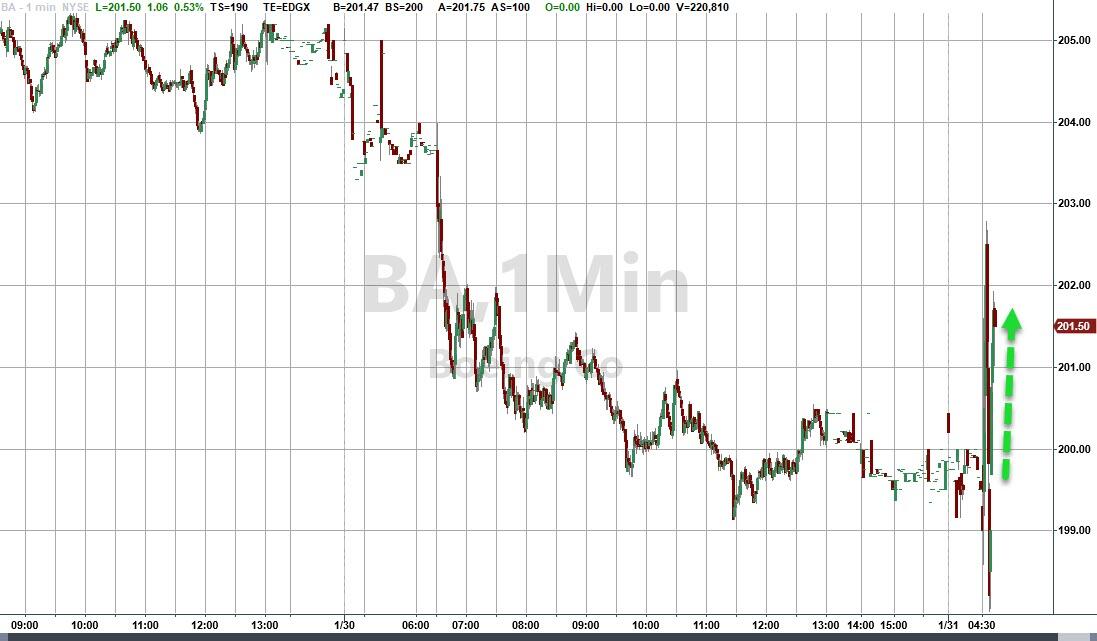
…presumably, no guidance is not bad guidance?
And finally there’s this…
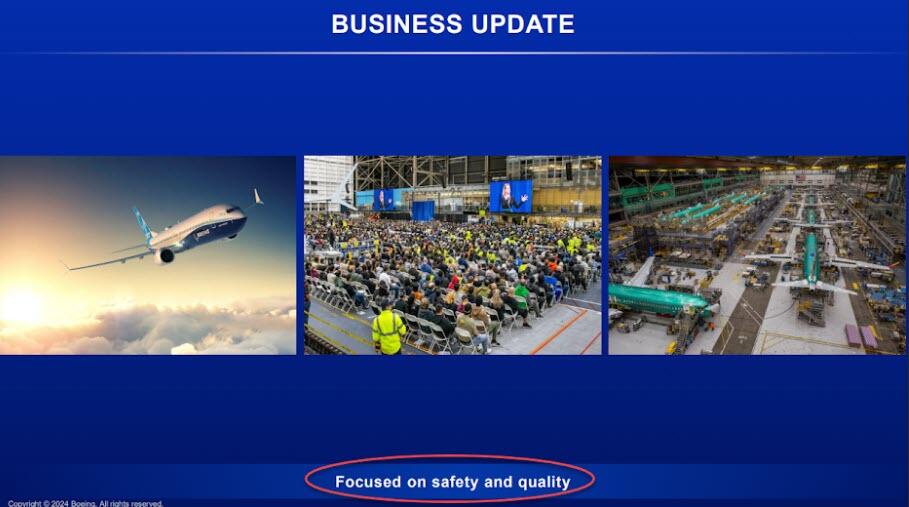
…as opposed to “focused on DEI”?
Tyler Durden
Wed, 01/31/2024 – 07:47
via ZeroHedge News https://ift.tt/o0zXJtu Tyler Durden
Paramount Shares Jump After Report Says Media Mogul Byron Allen Makes $14 Billion Offer
Paramount Global Class B shares rocketed higher in premarket trading after a report from Bloomberg specified media mogul Byron Allen offered $14.3 billion to purchase all of Paramount Global’s outstanding shares.

The report, citing “people familiar with the terms,” said Allen offered $28.58 for each voting shares of Paramount, a 50% premium versus non-voting shares. Including debt, the deal’s total value is worth about $30 billion.
Around 0700 ET, Paramount’s non-voting shares jumped 17% and soared as high as 22% earlier this morning. If the gains hold into the cash session, this would be the largest intraday move for the stock since March 2020.
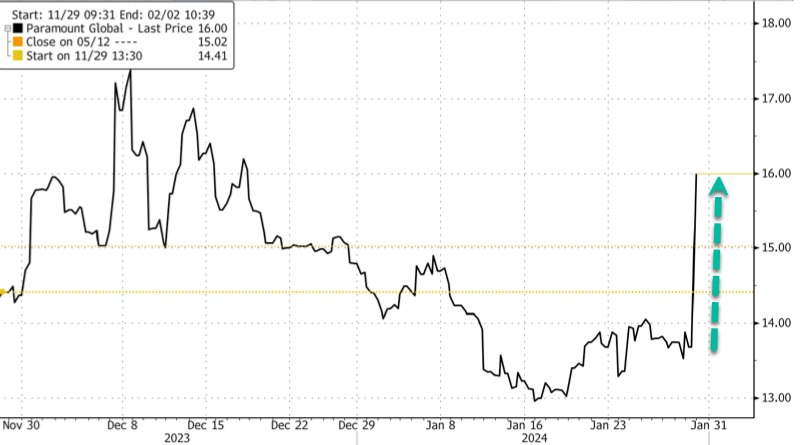
Bloomberg confirmed with Allen’s firm, Allen Media Group, that the centimillionaire (near billionaire) made an offer:
“This $30 billion offer, which includes debt and equity, is the best solution for all of the Paramount Global shareholders, and the bid should be taken seriously and pursued,” Allen’s company said in the statement.
People familiar with the deal said Allen plans to sell the Paramount film studio, real estate, and other intellectual property. He wants to keep TV channels, including the Paramount+ streaming service, but the people did not explain why.
Paramount owns major brands, including CBS, Showtime Networks, Paramount Pictures, Nickelodeon, MTV, Comedy Central, BET, Paramount+, and Pluto TV.
Bloomberg noted Allen “sent Walt Disney Co. Chief Executive Officer Bob Iger a text offering $10 billion, albeit tentatively, for Disney’s flagship ABC broadcast network as well as the FX and National Geographic cable channels. Iger, who had previously suggested he’d considered offers, later said he didn’t want to sell.”
It’s unclear what Allen’s precise plan is. He seems to be focusing on either media entertainment outlets or news stations. The coincidence of his offer with the beginning of the presidential election cycle might hint at his intentions.
Tyler Durden
Wed, 01/31/2024 – 07:45
via ZeroHedge News https://ift.tt/vtfIDcN Tyler Durden
The Value Of Diamonds Sinks As Gold Stays Strong
Valentine’s Day is here and you might find yourself buying (or wishing you had remembered to buy) a Valentine’s Day present. A classic romantic present involves gold, diamonds, and sometimes both. And both diamonds and gold seem at first blush to have a lot in common.

Both are or at least can be beautiful. Diamonds are one of the shiniest gemstones (high refractive index if you’re science-minded) and can be perfectly clear or come in a wide range of colors. Gold is of course famously appealing to look at. Both diamonds and gold convey luxury and wealth, and both are regularly used to make luxury products such as rings, bracelets, watches, and earrings.
The expense of both diamonds and gold is one reason why it’s so common for both diamonds and gold to be part of an engagement ring- the expense of these materials makes engagement rings expensive which helps them serve as a costly sign of commitment.
Some have argued that the similarities between diamonds and gold are even greater, given that some are turning to diamonds as a store of value and as an investment. But this overlooks why gold has historically been preferred as a store of value to diamonds, and how new technological developments have made the differences between diamond and gold even greater.
First, diamonds lack the history of gold. While gold has spontaneously emerged as a treasured metal and as a store of value or as a currency from civilization to civilization, the emergence of diamonds as a valuable commodity is much more recent and historically contingent. While diamonds were always recognized as gemstones, broad-based demand for diamonds did not emerge in the West until the 1800s and their famous role as the central stone in an engagement ring did not emerge until the mid 1900’s due to savvy marketing campaigns.
So demand for gold is more stable and organic than the demand for diamonds. When central banks look to preserve the value of their currency, they often increase strategic gold reserves, not strategic diamond reserves.
While diamonds and gold might be seen as similar because both have industrial uses as well as usage in jewelry and investment, that overlooks the fact almost all gold is used for jewelry or as an investment while 80% of diamonds are used by industry. While every single ounce of gold could be used in industry, jewelry, or as an investment, because gold is fungible and divisible, the opposite is true for diamonds. Diamond value varies dramatically between individual stones. The value of a diamond depends on its size, its color, its clarity, and its cut. Many diamonds are worthless for any non-industrial purposes. While gold can be used as bullion converted to jewelry then melted back into bullion, cutting a diamond over and over would destroy its value. Demand for gold is driven by every sector. Demand for small industrial diamonds is not driven by demand for large diamonds that could feature in jewelry, and vice versa.
Both gold and (gemstone quality) diamonds are valuable because of their relative rarity compared to demand. Gold is rare because the element, gold, is genuinely rare. Diamonds have been rare, because while they are made of carbon, a common element, the specific arrangement of carbon atoms that make up a diamond is rarely produced in nature, at least not in the form of large diamonds.
But advances in technology have changed that. It is now much cheaper to buy a lab-grown diamond for an engagement ring than to buy a diamond mined out of the earth. And these lab-grown diamonds are not stones that happen to resemble diamonds such as cubic zirconia, they are genuine diamonds created in a lab. Advances in technology have driven down the prices of both lab-grown and naturally mined diamonds. The value of lab-grown diamonds is down by over 70% since the start of 2016 and even natural mined diamonds have fallen by over 25%. It is unlikely that technological improvements in creating lab-grown diamonds will stop improving meaning lab-grown diamonds will be able to supply diamonds to both the industrial market and the jewelry market.
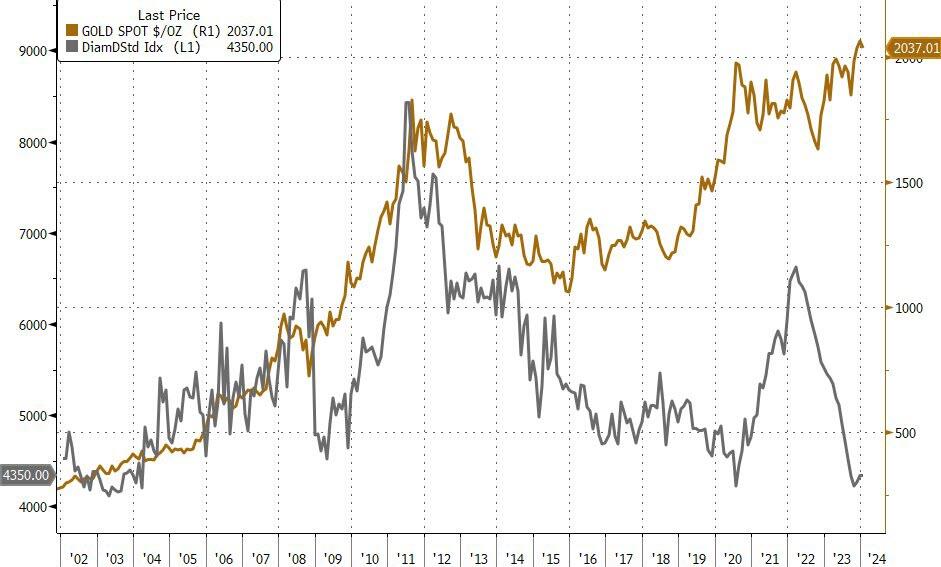
If you think diamonds are prettier than gold, I wouldn’t argue. But I know which one I would rather have as part of my investment portfolio.
Tyler Durden
Wed, 01/31/2024 – 07:20
via ZeroHedge News https://ift.tt/zoaVqLB Tyler Durden
NatGas Pipeline Erupts In 500-Foot Fireball In Western Oklahoma
On Tuesday night, a massive explosion was reported on part of a natural gas pipeline near the Texas-Oklahoma border.
Local media KVII-TV reports emergency responders from across the area, including the Booker Fire Department in neighboring Texas, responded to the pipeline fire near Laverne, Oklahoma, around 9:45 pm local time.
“Crews from several departments are staged at a safe distance until the gas can be turned off,” Booker Fire Department said in an update.
Footage uploaded on social media shows the pipeline fire. Several media outlets have said flames reached as high as 500 feet.
🚨#BREAKING: Significant gas pipeline has exploded releasing massive flames hundreds of feet into the sky ⁰⁰📌#Elmwood | #Oklahoma
Currently, numerous emergency crews and authorities are on-site in Elmwood Oklahoma, responding to a significant uncontrolled gas pipeline… pic.twitter.com/YB7P8Brjv8
— R A W S A L E R T S (@rawsalerts) January 31, 2024
🚨#UPDATE: Here is a Nest Cam video capturing the moment when the pipeline explosion initially occurred. pic.twitter.com/Fn71VUnz24
— R A W S A L E R T S (@rawsalerts) January 31, 2024
Good question.
Is it infrastructure sabotage season?
— Marc 🇺🇸 (@gopher_marc) January 31, 2024
According to the fire department, the affected part of the NatGas pipeline must be depressurized before fire crews can combat the fire.
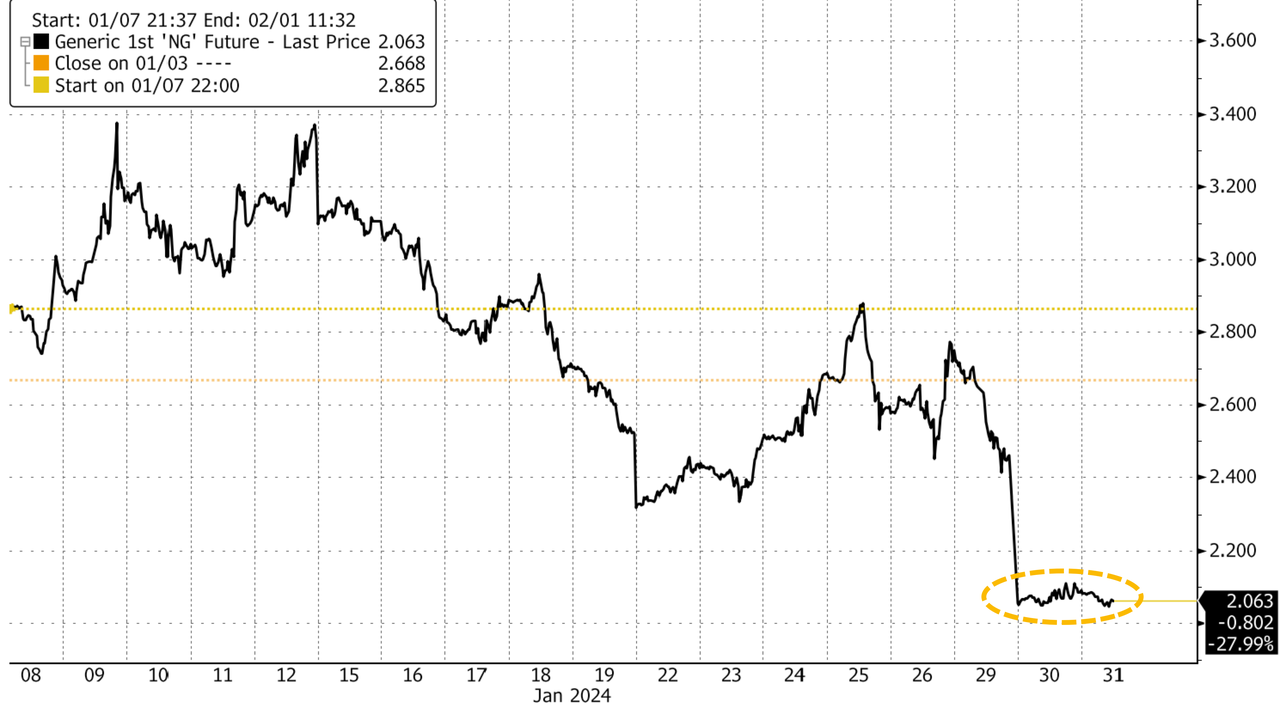
US NatGas futures held steady around $2/MMBtu as the pipeline situation did not concern traders. Prices are under pressure on milder weather trends for the Lower 48 through the first half of February.
The cause of the pipeline fire remains unclear.
Tyler Durden
Wed, 01/31/2024 – 06:55
via ZeroHedge News https://ift.tt/KMF0Ije Tyler Durden
Shipping Faces Lengthy Disruptions As Middle East Fallout Worsens
By Greg Miller of FreightWaves
The Red Sea crisis — and the Middle East situation in general — is worsening. There’s growing conviction that shipping diversions around the Cape of Good Hope will increase in scope and last much longer than initially expected. That should be good news for shipping stocks over time, due to durably longer voyage distances.

The Houthis hit the JP Morgan-owned product tanker Marlin Luanda with a ballistic missile on Friday, setting a cargo tank on fire. The tanker was chartered by trading house Trafigura and loaded with Russian naphtha. The fire was extinguished on Saturday, with all crew safe.
On Sunday, a drone attack by an Iranian-backed militia killed three U.S. service members and injured at least 40 more at a U.S. military site in Jordan. The Biden administration has vowed to respond, raising the specter of a wider Middle East conflict.
“Red Sea diversions are on the rise as continued attacks on vessels in the region are prompting more shipping companies to avoid transiting the area,” said Jefferies shipping analyst Omar Nokta in a client note on Monday.
The vast majority of larger container ships already avoid the Red Sea, and detours are rapidly spreading to bulk commodity shipping.
Citing data from Clarksons, Nokta said that crude tanker transits of the region are now down 22% versus their 2023 average; at the beginning of this year, they were down 5% from last year’s average. Product tanker transits are down 51% versus 2023, after being down 29% versus last year’s average at the beginning of the year, with liquefied natural gas carrier transits down 87% (from 36%) and liquefied petroleum gas carrier transits down 62% (from 23%).
Nokta significantly upgraded his view on Israeli container liner operator Zim, maintaining that “the script has flipped” and Houthi attacks turned Zim’s business “from cash burn to cash machine.”
Nokta had previously estimated that Zim would post adjusted net losses of $260.1 million this year and $506.3 million next year.
His new forecast is drastically different. He projects adjusted net income of $751 million this year, followed by losses of $337 million next year.
“Red Sea diversions are likely to continue for an extended period, tightening capacity for longer,” he said.
Zim’s stock closed up 7.5% on Monday, on a day when most shipping equities ended in the red.
According to Evercore ISI shipping analyst Jonathan Chappell, “The adage is that one should stock up on canned beans in times of war. We clearly do not make light of these tragedies, but tanker equities should also be added to the list.”
Chappell noted that in periods of geopolitical risk, shipping stocks provide material beta (a measure of volatility versus the broader market). He presented data on outsized tanker stock gains versus the S&P 500 since the invasion of Ukraine and the Hamas attacks on Israel.
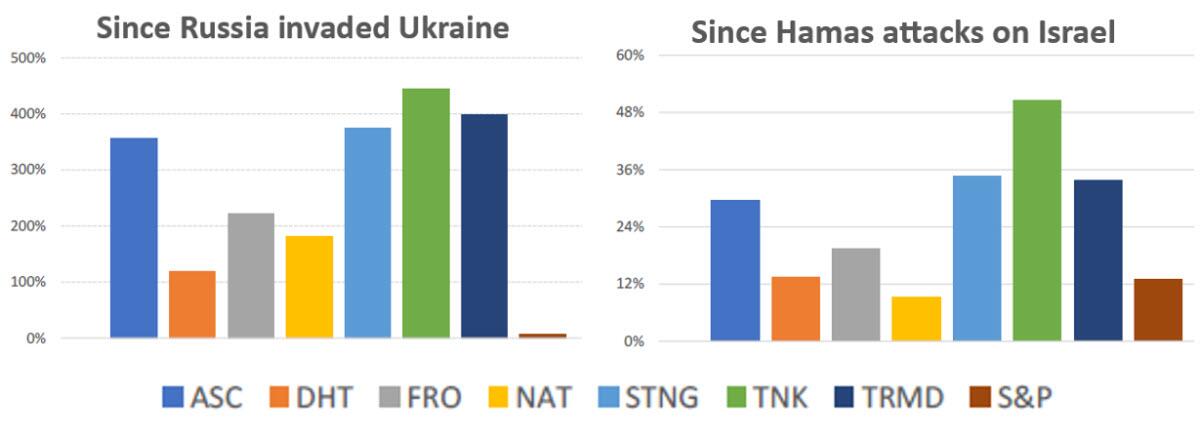
Deutsche Bank analysts Amit Mehrotra and Chris Robertson wrote: “We believe the recent attacks will result in even more ship owners and operators diverting vessels from the area, which could put further upward pressure on spot rates in the coming week.”
“We believe the companies with exposure to the mid-sized crude and product tanker segments will benefit the most from the disruptions,” they said, pointing to Frontline, International Seaways and Scorpio Tankers.
Tyler Durden
Wed, 01/31/2024 – 06:30
via ZeroHedge News https://ift.tt/Q26jVhs Tyler Durden
A Fed Pivot While Lamborghini Sees Full Order Books Doesn’t Compute
Did the Federal Reserve jump the gun on the pivot?
Last month, investors cheered after the Fed announced that interest-rate cuts are coming in 2024. Since then, the S&P 500 has powered to new record highs, and technology stocks have gone bananas.
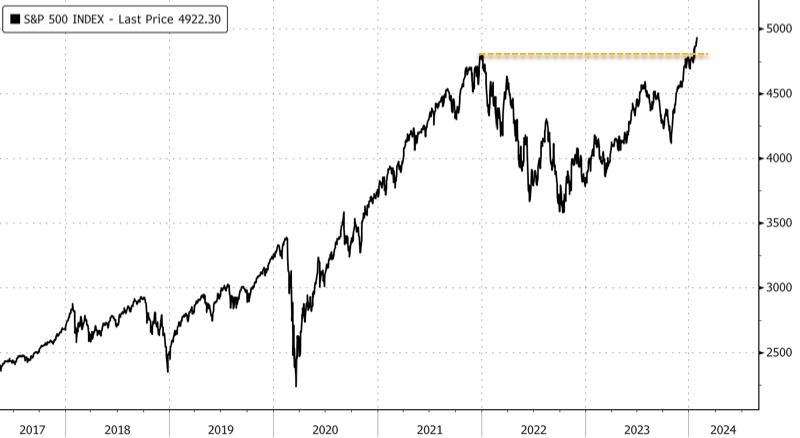
The latest swap contracts tracking Fed meeting dates for the full year 2024 showed 70% odds for 5.2 cuts.
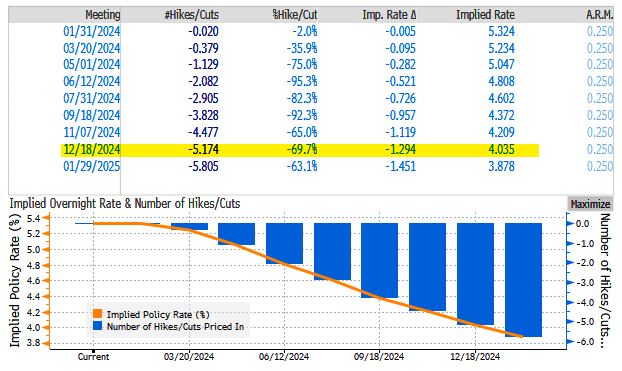
The unexpected pivot (as outlined earlier) might be premature and may have been a gift to the Biden administration in an election year.
An example of a premature pivot and no impending economic doom could be news from Lamborghini on Tuesday that supercars are sold out until 2026.
“It’s a bit early to give a prognosis, but we have no sign of weakness in the market,” Chief Executive Officer Stephan Winkelmann told reporters on a call.
According to Bloomberg, the Italian supercar maker logged over 10,000 vehicle sales last year. Its first plug-in hybrid model, the Revuelto, was a massive hit with the rich, with two years of backlog orders.

The trend of ultra-wealthy elites splurging on supercars indicates that the economy isn’t slowing down as quickly as thought, suggesting that an imminent need for rate cuts might be unnecessary.
Tyler Durden
Wed, 01/31/2024 – 05:45
via ZeroHedge News https://ift.tt/rSc1quh Tyler Durden
Massive New Russian Natural Gas Pipeline To China Faces Delays
By Tsvetana Paraskova of OilPrice.com
Russia and China are still at odds over the costs and delivery prices of a new major Russian natural gas pipeline to China, which could lead to delays in construction, according to the prime minister of Mongolia, which is planned to host a section of the infrastructure.

“The Chinese and Russian sides are still doing the calculations and estimations and they are working on the economic benefits,” Mongolia’s Prime Minister Luvsannamsrai Oyun-Erdene told the Financial Times in an interview published this weekend.
“Those two sides still need more time to do more detailed research on the economic studies,” the Mongolian official told FT.
The delay in the agreements suggests that Russia would have to wait more years than originally anticipated in order to have a larger gas pipeline outlet in China that could partly replace the gas volumes it has lost on the European market.
Currently, Russia supplies pipeline gas to China via the Power of Siberia pipeline, one of the biggest projects recently completed by Gazprom and the first conduit for Russian gas to China. Now, there’s talk about the Power of Siberia 2, but negotiations between Russia and China haven’t progressed much. An agreement on the Power of Siberia 2 has not been reached yet due to some sticking points, including the prices at which Gazprom will deliver the gas.
The Power of Siberia 2 pipeline was designed to ship gas from Russia’s Western Siberia Altai region to northeast China via Mongolia.
Russia could launch construction of the Mongolia section of the major natural gas pipeline to China as early as in the first quarter of 2024, Russian Deputy Prime Minister Viktoria Abramchenko said at the end of last year.
The design for the Mongolian section of Power of Siberia 2, Soyuz Vostok, is expected to be approved in the first quarter of 2024 and construction could begin then, Deputy Prime Minister Abramchenko said in October 2023, as quoted by Russian news agency TASS.
Tyler Durden
Wed, 01/31/2024 – 05:00
via ZeroHedge News https://ift.tt/IFXcEsN Tyler Durden
The State Of The World’s 7,168 Languages
What are the roots of a living language, and how many are at risk of extinction?
This graphic via Visual Capitalist, from Stephen Jones, CEO of Derivation.co, shows the state of living languages around the world.
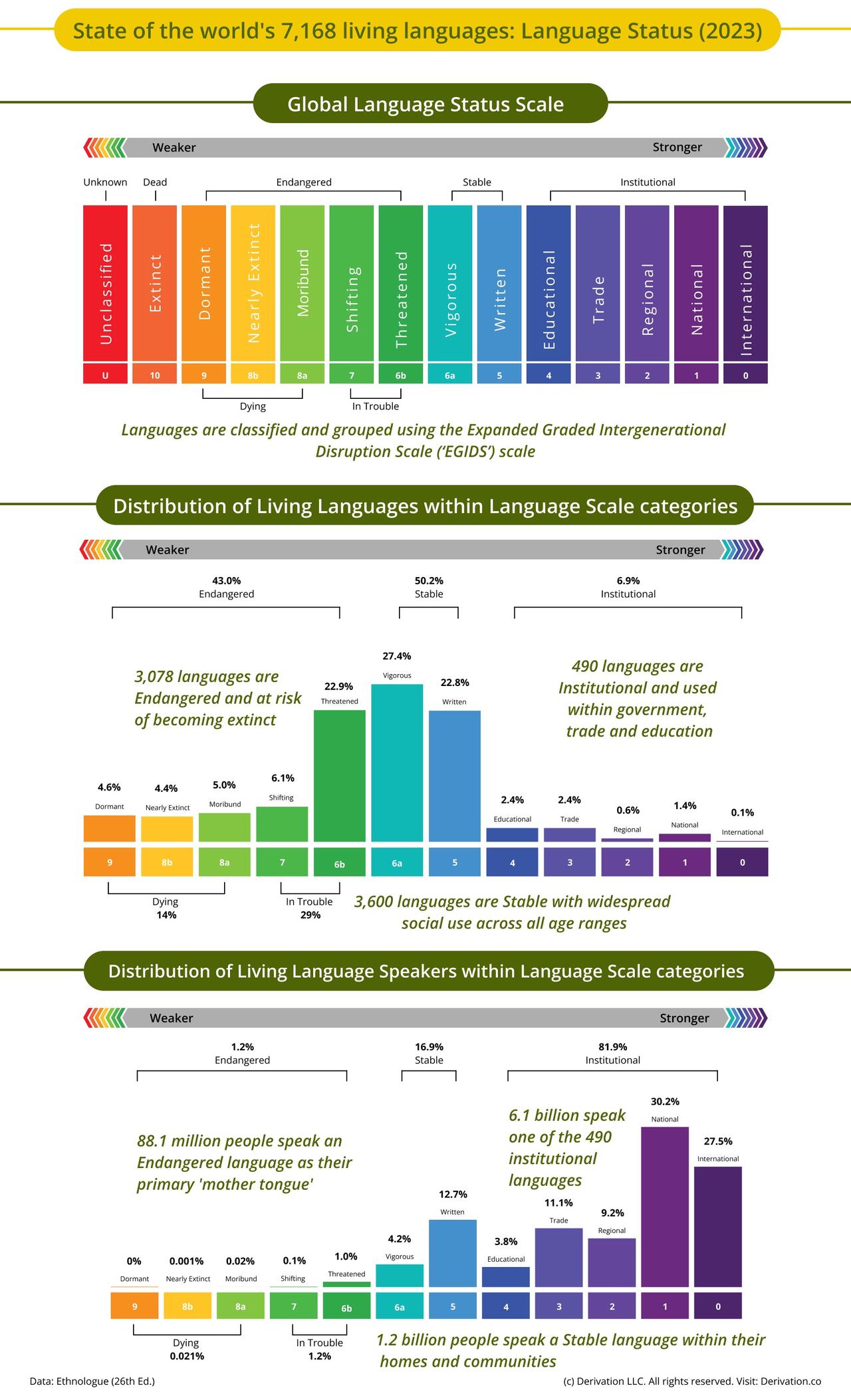
Across the 7,168 living languages today, 43% are at risk of being endangered.
In fact, a language dies off every 40 days. The vast majority of endangered languages are found in Indigenous communities, which risk the loss of culture and knowledge that they contain. At current rates, 90% of the world’s languages could disappear over the next 100 years.
According to data from Ethnologue, languages are classified across 12 states of vitality and three broader categories:
Endangered: Children do not learn and use the language, it is no longer the norm.
Stable: A language is used in the home and community, all children learn the language, but it is not formally used in institutions.
Institutional: A language is used beyond the community across institutions.
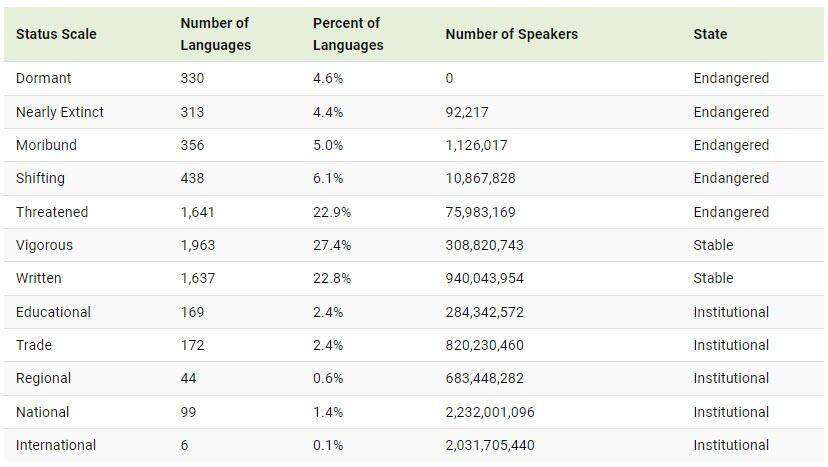
Today, over 88 million people speak endangered languages.
The region of Oceania has the largest density of endangered languages, with 733 at risk. With a population of 8.8 million, Papua New Guinea is home to the most languages in the world. Often, small linguistic communities will have only a couple hundred people speaking the language.
Africa has 428 that are endangered, many which are clustered around the equator. Displacement, drought, and conflict are some of the key reasons that languages risk being endangered.
In North and Central America, 222 languages are at risk of extinction. In fact, 98% of Indigenous languages in the U.S. are endangered, one of the highest rates in the world.
On the other end of the spectrum, there are 490 institutional languages with 6.1 billion speakers worldwide.
Thanks to key initiatives, languages can be preserved.
For instance, during the 1970s, the Māori language was spoken by just 5% of Māori schoolchildren. Fast forward to today, and 25% speak the language, driven by efforts from the Māori, leading the government to protect it by law.
In Hawaii, just 2,000 people spoke the native language in the 1970s. After the government ensured it was taught in schools, the number of speakers jumped to 18,700 in 2023.
Advancements in AI are also providing tools to preserve languages. Google and Microsoft, for instance, are developing AI tools that can translate languages at impressive speeds, allowing for dying languages to become more accessible so they are not erased.
Tyler Durden
Wed, 01/31/2024 – 04:15
via ZeroHedge News https://ift.tt/w1l0auK Tyler Durden