A Missouri judge has upheld the state’s law that bans transgender procedures for children.
In a ruling handed down on Monday, Judge R. Craig Carter of the Circuit Court of Cole County, Missouri, said the challenge failed to substantiate multiple arguments, including that there exists a medical consensus on whether using drugs and surgeries to treat adolescent gender dysphoria is ethical.
“Regarding the ethics of adolescent gender-affirming treatment, it would seem that the medical profession stands in the middle of an ethical minefield, with scant evidence to lead it out,” Carter wrote.
“States do have abiding interest in protecting the integrity and ethics of the medical profession.”
The law in question, officially known as the Save Adolescents from Experimentation (SAFE) Act,forbids health care providers from prescribing puberty blockers and cross-sex hormones or performing transgender surgeries for individuals younger than 18. Those who were already prescribed the so-called “gender-affirming” medications prior to Aug. 28, 2023, may continue to receive them.
The law also gives patients 15 years after their treatment ends or 15 years after their 21st birthday, whichever is later, to file a civil lawsuit against the medical provider. Patients who are harmed—defined as infertility caused by transgender procedures—may be awarded a minimum of $500,000 with no maximum, and the burden of proof is on the medical provider.
Missouri Gov. Mike Parson signed the law in June 2023, saying that children lack the capacity to provide informed consent for irreversible treatments they might regret later in their lives.
“These decisions have permanent consequences for life and should not be made by impressionable children who may be in crisis or influenced by the political persuasions of others,” Parson said at the time.
The Challenge
The law faced a legal challenge in July 2023, just before it took effect in August. A coalition of LGBT activists, health care providers, and three Missouri families of gender-dysphoric children sued the state, arguing that the SAFE Act violates parental autonomy—the fundamental right of parents to seek and follow medical advice to safeguard their children’s health and well-being.
“The Act’s prohibition on providing evidence-based and medically necessary care for transgender adolescents with gender dysphoria stands directly at odds with parents’ fundamental right to make decisions concerning the care of their children, particularly when it aligns with the adolescent’s liberty interests and right to autonomy in healthcare,” their complaint read.
Carter rejected that argument, saying that the state is acting reasonably to shield children from treatments that could severely disrupt their natural growth, even if the treatments are initiated by parents.
“There is a good reason that state and federal law does not allow minors to make certain decisions, and it stands to reason that parents might be statutorily prevented from taking a child to a care clinic and having a son or daughter undergo these medical and surgical treatments,” he wrote.
The case went through a nine-day trial in September. Among the witnesses testifying for the states were Chloe Cole, a California woman who had her breasts removed at the age of 15 and has since spoken publicly about her regrets; and Jamie Reed, who testified that a St. Louis children’s gender clinic treated many patients without first giving them proper mental health evaluations.
“Her testimony does not arise from any ideological or other bias,” Carter wrote of Reed. “In fact, she is married to a transgender individual.”
The Missouri chapter of the American Civil Liberties Union (ACLU) and Lambda Legal, which argued the case against the state, said in a joint statement that they are “extremely disappointed” in this decision and will appeal.
“The court’s findings signal a troubling acceptance of discrimination, ignore an extensive trial record and the voices of transgender Missourians and those who care for them,” they said in a joint statement.
Missouri Attorney General Andrew Bailey welcomed the ruling.
“The state has a role to play to determine what systems need to be in place to protect the kids and ensure that the adults and the patients understand the lack of science and medicine behind certain recommended procedures,” he said on X.
In a recent Commentary- MicroStrategy Is A Leveraged ETF In Disguise – we discussed the company’s business model, which revolves almost entirely around highly speculative bitcoin and leverage. To wit:
So, what is MicroStrategy? It’s a leveraged Bitcoin fund disguised as a non-profit technology company.
Regarding leverage and speculation, we also recently discussed the surging use of options, particularly those with short time frames.
Options employ significant leverage.
Thus, record options volume, especially in calls with short periods until expiration, is another sign that speculation is rising.
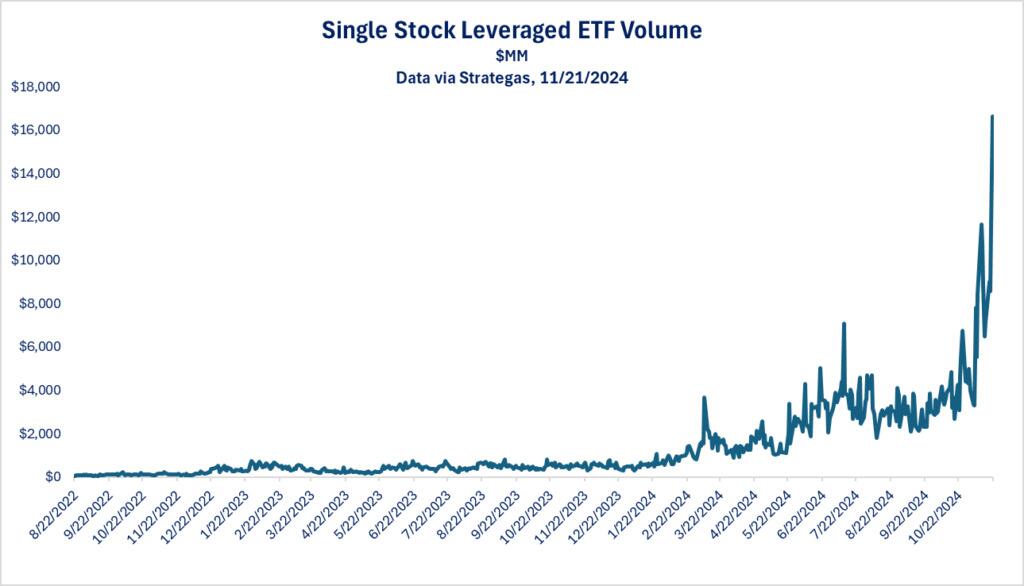
In addition to the two examples of growing leverage and market speculation, we see surging volume in leveraged single-stock ETFs.
An example of such an ETF is Granite Shares NVDL. The ETF offers a 2x leveraged holding of Nvidia shares. If Nvidia falls by 3%, the ETF will decline by 6%. Conversely, if Nvidia rises by 5%, the ETF will climb 10%. Accordingly, leveraged single-stock ETFs can be incredibly speculative. Furthermore, the massive surge in volume in such ETFs, as we share below, further confirms speculative behaviors are growing.
Leverage and speculation can drive markets higher than most investors forecast. However, in the process, they create a divergence between fundamentals and valuations, thus exposing the markets to risk.
Increased leverage and speculation are not reasons to sell immediately, but they indicate that markets are getting frothy, warranting our close attention.
Yields At Session Low After Solid 7Y Auction Stops Through
After a stellar 2Y, and a solid 5Y auction earlier this week, today’s sale of $44 billion in 7Y paper closed out the week’s accelerate coupon issuance, and it did so in style, with another solid auction.
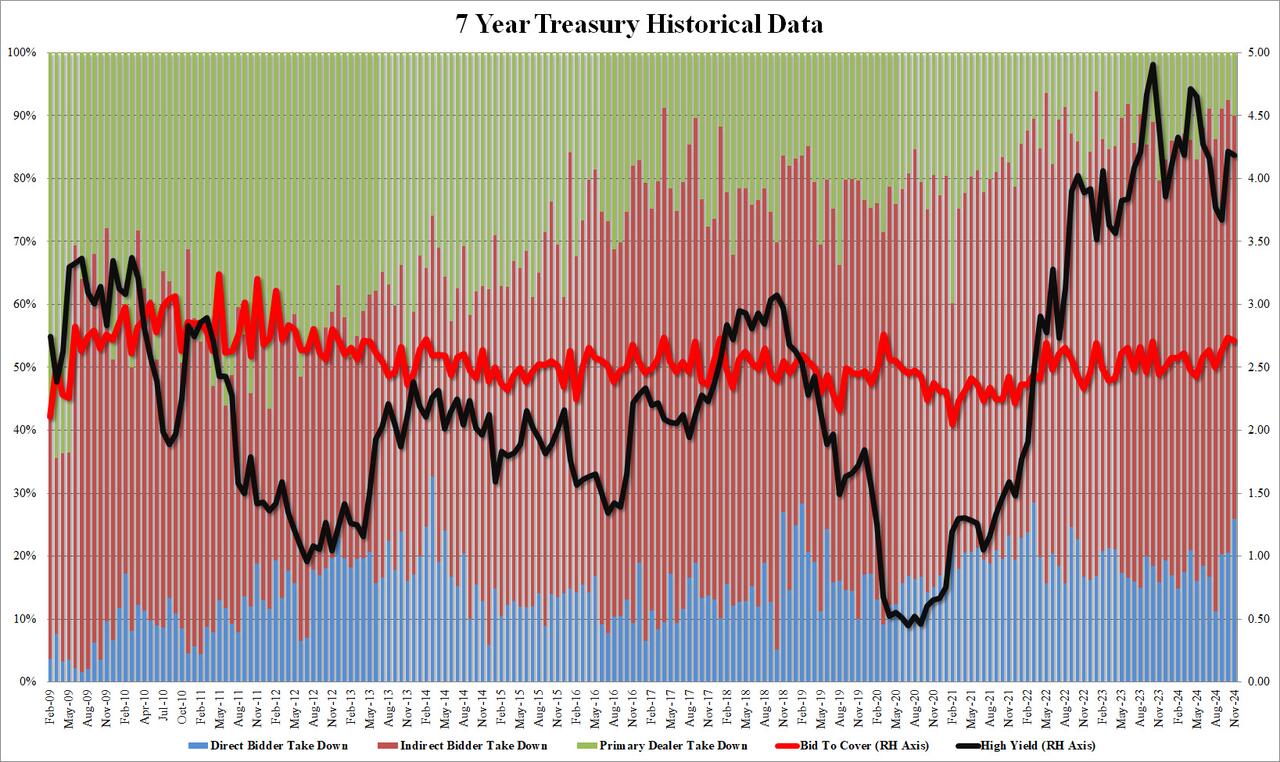
The auction prices at a high yield of 4.183%, down from 4.215% last month and stopping through the When Issued 4.197% by 1.4bps, the third consecutive stop through in a row.
The bid to cover was 2.709, down from 2.737 but above the 2.585 six auction average.
The internals were weaker with Indirects taking down 64.1%, down from last month’s 71.2% and below the recent average of 72.3%. However, the foreign demand was more than made up by Directs who, like yesterday, saw a surge in demand and took down 25.9% of the auction, the highest since March 2022.
Overall, this was a solid if not spectacular result, yet the big stop through was enough to leave the 10Y flat near session lows, and about 6bps below Tuesday’s close.
NATO Flotilla Surrounds Chinese Ship Suspected Of Sabotaging EU Undersea Baltic Cables
A flotilla of NATO warships has surrounded a Chinese bulk carrier transporting Russian fertilizer for one week amid suspicions of its involvement in sabotaging two undersea fiber optic cables connecting Finland, Germany, Sweden, and Lithuania across the Baltic Sea.
According to The Wall Street Journal, the 225-meter Yi Peng 3 bulk carrier is at the center of the sabotage investigation and threatens to push the limits of maritime law after investigators believe the ship deliberately drug its anchor along the Baltic seabed for more than 100 miles.
Chinese Ship Suspected of Deliberately Dragging Anchor for 100 Miles to Cut Baltic Cables: WSJ
NATO warships surround Yi Peng 3, a Chinese bulk carrier at the center of an international probe into suspected sabotage: WSJ
Yi Peng 3 departed from the Russian Baltic port of Ust-Luga on Nov. 15. Investigators have shifted focus on whether Russian intelligence officials influenced the captain of the Chinese-owned ship to carry out sabotage on Europe’s critical infrastructure.
One senior European investigator said, “It’s extremely unlikely that the captain would not have noticed that his ship dropped and dragged its anchor, losing speed for hours and cutting cables on the way.”
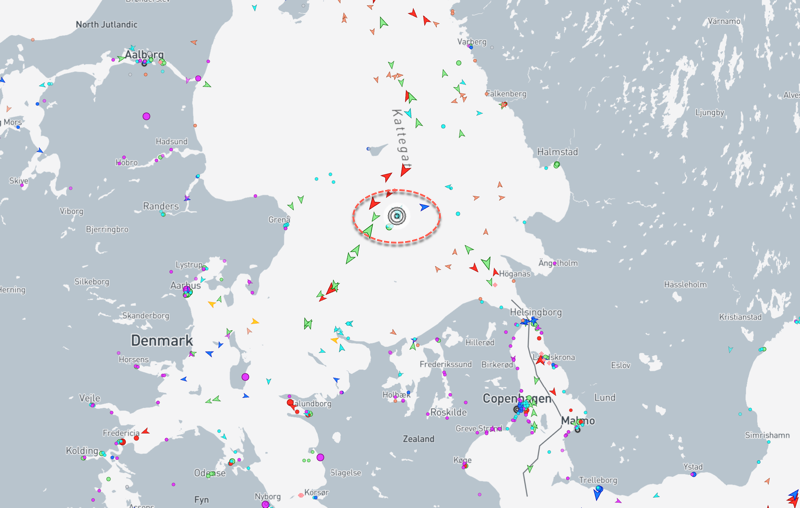
The ship tracking website MarineTraffic shows four NATO ships have surrounded the bulk carrier in the Kattegat Strait.
Two critical undersea fibre optic #cables in the #BalticSea—linking Sweden to Lithuania and Finland to Germany—were severed on November 17th and 18th, raising serious security concerns. The Chinese-flagged bulk carrier YI PENG 3 is suspended for its potential involvement.… pic.twitter.com/XRikzko8Pw
WSJ noted during the incident, “The ship’s transponder, which charts its movements on the so-called Automatic Identification System, shut down in what is known as a “dark incident”… and the “ship then continued even as the dragging anchor greatly reduced its speed, according to satellite and other data reviewed by investigators.”
“Given the mild weather conditions and manageable wave heights, the likelihood of accidental anchor dragging appears minimal,” analytics company Kpler wrote in a report to WSJ.
Western intelligence officials don’t believe Beijing was involved in the incident. Instead, they suspect Russian intelligence agencies…
In response to the incident, the Kremlin press office told the Journal, “These are absurd, unsubstantiated accusations.”
More about the ongoing investigation from WSJ:
Under international maritime law, NATO ships can’t force the Yi Peng 3 to sail into one of their ports. Swedish and German authorities are negotiating with the ship’s owner to obtain access to the vessel and question its crew.
German police also dispatched the Bamberg, a patrol vessel, to investigate one of the incidents with underwater drones. Swedish and Danish ships have also examined the sites on the seabed.
European authorities must tread carefully because of their commitment to the freedom of navigation and upholding international law that underpins global trade, according to several European politicians, as well as security and law-enforcement officials familiar with the probe.
The incident in the Baltics comes just over a year after a Chinese-registered commercial vessel, the Newnew Polar Bear, severed the Balticconnector gas pipeline and fiber optic lines connecting Finland and Estonia with its anchor.
A male athlete who identifies as a transgender woman can participate in a women’s volleyball tournament starting on Nov. 27, a federal appeals court ruled on Tuesday.
The athlete has been playing since 2022, undercutting an emergency motion for an injunction pending appeal, according to judges on the U.S. Court of Appeals for the 10th Circuit.
“The district court concluded that granting the requested injunctive relief at this late hour would be highly prejudicial and harmful to the defendants. Notwithstanding plaintiffs’ contentions to the contrary, that conclusion appears well supported by the district court’s factual analysis,” U.S. Circuit Judges Nancy L. Moritz and Carlos F. Lucero said.
The player is on the San Jose State University women’s volleyball team, which is taking part in the Mountain West Conference tournament that starts on Wednesday.
A U.S. district judge earlier in the week turned down an emergency request from female players and coaches, including a different player on San Jose State, to block the player from participating in the tournament on the grounds the participation violates federal law guaranteeing equal opportunities in sports.
The players and coaches “have failed to meet their burden to show irreparable harm, a likelihood of success on the merits, or that the balance of harms or equities is in their favor,” U.S. District Judge Kato Crews ruled on Nov. 25.
In an emergency motion to the 10th Circuit, lawyers for the players and coaches said that the case was not brought until recently because the Mountain West Conference (MWC) handbook did not include a “Transgender Participation Policy” (TPP) until Sept. 27.
“Plaintiffs acted appropriately by publicly protesting to bring attention to their concerns through a series of lawful boycotts. Only when the MWC ignored them did Plaintiffs bring a lawsuit, and they did so expeditiously with sufficient time for their claims to be considered in advance of the MWC tournament,” the lawyers said.
The rulings from Crews and the 10th Circuit judges only deal with the emergency motions. The case is still progressing and could lead to a ruling in favor of the plaintiffs.
“Plaintiffs’ claims appear to present a substantial question and may have merit. But plaintiffs have not established clear entitlement to relief, and however potentially meritorious, their showing does not rise to the level of clear entitlement under the appropriate standard,” Moritz and Lucero said.
William Bock, an attorney for the plaintiffs, told news outlets in a statement, “The Court of Appeal’s statement that the Plaintiffs appear to have presented a substantial and meritorious legal claim calls into question the legal reasoning of the district court and confirms Plaintiffs’ conviction that the harm caused to numerous women and women’s teams by a trans-identifying male competing in Mountain West Conference women’s college volleyball stems from illegal Conference and NCAA rules which are resulting in substantial and continuing violations of federal law.”
The National Collegiate Athletics Association (NCAA) rules allow athletes who identify as transgender to compete, provided they meet certain criteria. The MWC policy permits athletes who identify as transgender and are deemed eligible by the NCAA to compete in intraconference competitions. The policy also states that if a conference team refuses to participate in a contest due to the inclusion of a transgender athlete, the team that refuses forfeits the contest. Recently, multiple teams have forfeited matches against San Jose State.
Brock added, “Plaintiffs look forward to ultimately receiving justice in this case when they prove these legal violations in court, and Plaintiffs look forward to the day when men are no longer allowed to wreak havoc in women’s sport.”
A scheduling conference in the case has been set for Jan. 13, 2025.
A spokesperson for San Jose State told news outlets in a statement, “San Jose State University will continue to support its student-athletes and reject discrimination in all forms.”
Conference officials said in a statement earlier in the week that they are “satisfied with the denial of the preliminary injunction and will continue to uphold the policies put in place by our Board of Directors which directly align with NCAA and USA Volleyball.”
Marc Andreessen Describes “Alarming” Meeting With Biden Admin That Prompted His Trump Endorsement
Marc Andreessen, the billionaire investor and co-founder of the influential Silicon Valley venture capital firm Andreessen Horowitz, revealed in a new episode of Joe Rogan’s podcast that after an “alarming” meeting with Biden administration officials earlier this year was the moment he would have no other choice but to support Donald Trump.
For decades, Andreessen has supported Democrats, including Bill Clinton, Al Gore, John Kerry, Barack Obama, and Hillary Clinton. However, a troubling spring meeting with Biden administration officials caused major concerns. During the meeting, officials explained their plan to control AI through government regulatory capture—a strategy reminiscent of Communist policies in China.
“We had meetings [Biden officials] this spring that were the most alarming meetings I’ve ever been in. Where they were taking us through their plans, and it was – basically just full government – full government control – like this sort of thing, there will be a small number of large companies that will be completely regulated and controlled by the government, they told us. They said don’t even start startups – there’s just no way that they can succeed – there’s no way that we’re going to permit that to happen.”
In mid-July, Axios reported that Marc Andreessen and Ben Horowitz had donated to President-elect Trump’s campaign. At the time, their support was attributed to Trump’s pro stance on crypto and AI regulation. It’s another telling example of just how far-left Democrats in the White House spooked Silicon Valley heavy hitters, such as Elon Musk.
Back to the podcast, Rogan asked Andreessen: “When you leave a meeting like that, what do you do?”
Andreessen responded: “You endorse Donald Trump.”
X user Ben Averbook condensed Rogan’s three-hour podcast into a series of the most important highlights:
Andreessen told Rogan about the federal government’s rogue “Operation Choke Point.” He described it as a move by the Department of Justice that initially targeted marijuana businesses and gun manufacturers. He said under Biden, it was then weaponized to destroy political opponents, tech founders, and the crypto community.
Rogan and Andreessen discussed the government workforce dilemma.
The government workforce has been exposed:
• Half never returned to the office after COVID.
• Some show up just one day a month.
• Yet, they still collect full DC-level salaries. pic.twitter.com/MCzNZJIC6x
Andreessen spoke about Elon Musk and Vivek Ramaswamy’s newly created Department of Government Efficiency (DOGE) and how they may have devised a plan to reduce the government workforce.
.@pmarca tells @joerogan that it’s highly likely there will be a YouTube Files: “This new administration is probably going to carve all of this stuff open.” pic.twitter.com/7NcwHMp9Z4
Attorneys for the Department of Justice (DOJ) and Google made their final arguments on Nov. 25 in a high-profile antitrust case that questions whether the tech giant violated federal law through its digital advertising practices.
The case started last year when the DOJ filed a complaint alleging that Google had engaged in anticompetitive conduct with its advertising technology platforms like Google Ads.
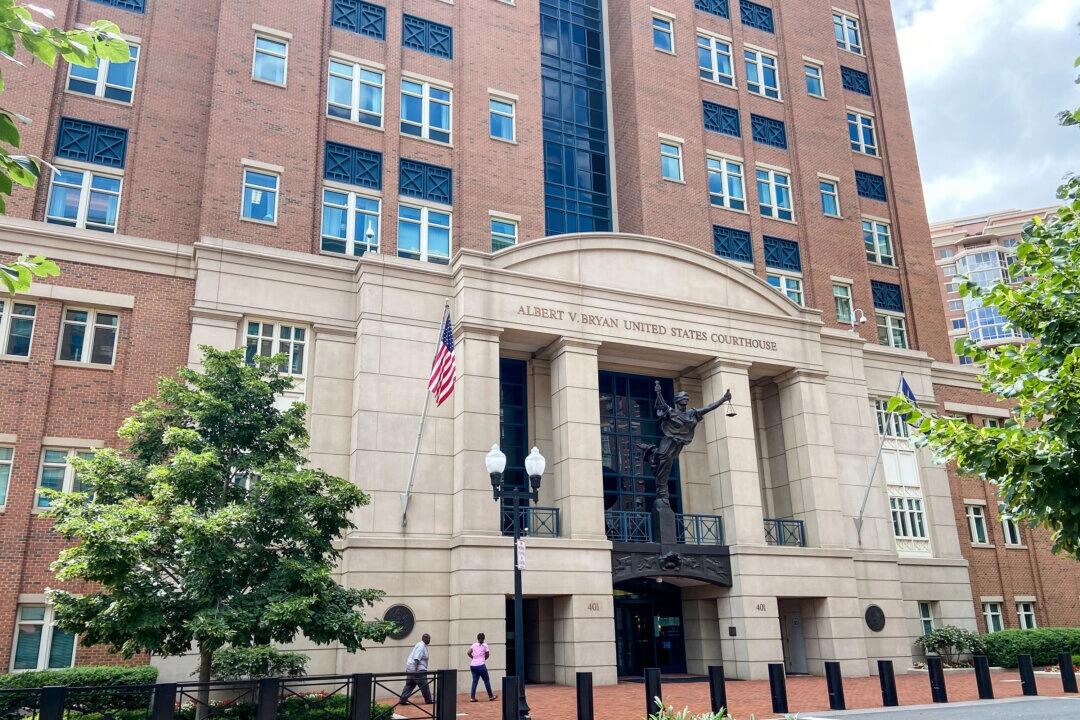
Closing arguments on Nov. 25 came at the end of a bench trial in Virginia that started in September and followed a major ruling against Google across the river in Washington. Both cases could bring major changes for Google and inform how future courts handle antitrust claims.
DOJ lawyer Aaron Teitelbaum told Eastern District of Virginia Judge Leonie Brinkema that Google rigged the rules of advertising auctions and generally perpetrated anticompetitive conduct across three technologies that facilitate digital ad sales.
In its closing argument, the DOJ used statements from Google employees in an attempt to show that they were focused on dominating the market in an unfair way. Among other things, Teitelbaum argued that Google pulled the levers of its various advertising technologies to strengthen its dominance and forced businesses to work with them in order to access a vast pool of demand.
Karen Dunn, a partner at Paul Weiss, represented Google and said that the DOJ had used “cherry-picked” communications from the tech giant’s employees. Overall, she said, Google’s record showed innovation in the advertising technology space in response to competitive forces.
Google’s prices decreased, she said, alongside an increase in ad spending and the number of quality transactions.
Each side clashed over whether social media platforms like Facebook represented the type of competition in advertising technology that would undermine the idea that Google exercised monopoly power.
Much of the closing arguments focused on whether the DOJ was even presenting Brinkema with the right categorization of markets for deciding whether Google engaged in anticompetitive conduct.
Brinkema, Dunn said, would have to overrule Supreme Court precedent in order to rule in favor of the plaintiffs, which includes the DOJ and various states.
According to Dunn, the plaintiffs had failed to define the relevant market and alleged conduct that was legal under antitrust precedent—namely, that Google was refusing to deal with competitors in certain ways. She also accused the DOJ of attempting to “gerrymander” out substitutes for Google’s technology in the markets they were proposing.
Teitelbaum, meanwhile, described Google’s view of the market as amorphous and argued against taking a more theoretical approach to defining the market.
At one point, Brinkema questioned Dunn’s attempt to apply the Supreme Court’s 2018 decision in Ohio v. American Express to Google’s behavior. She noted that the case, which centered on credit card transactions, didn’t feature the same kind of dynamic or programmatic purchasing facilitated by Google’s advertising technology.
Dunn disagreed and said that in both Google’s case and that of American Express, the market involved various tools facilitating transactions between buyers and sellers.
In that case, the Supreme Court said that “credit-card networks are best understood as supplying only one product—the transaction—that is jointly consumed by a cardholder and a merchant.”
“Accordingly, the two-sided market for credit-card transactions should be analyzed as a whole,” it said.
The two sides also disagreed over whether Google’s conduct fell within what the Supreme Court considered companies’ right to refuse to deal with others. The DOJ instead proposed three markets in the advertising technology space—“publisher ad servers,” “ad exchanges,” and “advertiser ad networks.”
It’s unclear how Brinkema will rule but if she agrees that Google violated antitrust law, the company could face remedial measures. Closing arguments came as the DOJ told D.C. Judge Amit Mehta this month that Google should divest from its web browser Chrome as part of remedies in its search case.
Teitelbaum said on Nov. 25 that the plaintiffs were merely asking the court to hold Google accountable for purportedly anti-competitive conduct and denied that it would have to engage in some kind of central planning.
The DOJ’s complaint in the ad tech case, filed in January last year, requested an order requiring Google to divest from its ad manager suite, which included multiple technologies mentioned during closing arguments on Nov. 25.
It also requested “any other preliminary or permanent relief necessary and appropriate to restore competitive conditions in the markets affected by Google’s unlawful conduct.”
Despite the Israel-Lebanon truce holding (for now), oil prices inched higher overnight after API reported a sizable crude draw and on speculation that OPEC+ will delay restoring output.
“On one hand, OPEC+ appears to be reluctant to unwind, given concerns over weak oil demand and market consensus that 2025 looks like a surplus year for oil balances,” Citigroup Inc. analysts including Eric Lee wrote in a note.
“On the other hand, deeper cuts also seem unlikely, with prices still above $70 Brent, global observable oil inventories relatively low, and some geopolitical risk still in the market.”
Will the official data confirm API’s?
API
Crude -5.9mm
Cushing -734k
Gasoline +1.8mm
Distillates +2.5mm
DOE
Crude -1.844mm
Cushing -909k
Gasoline +3.314mm
Distillates +416k
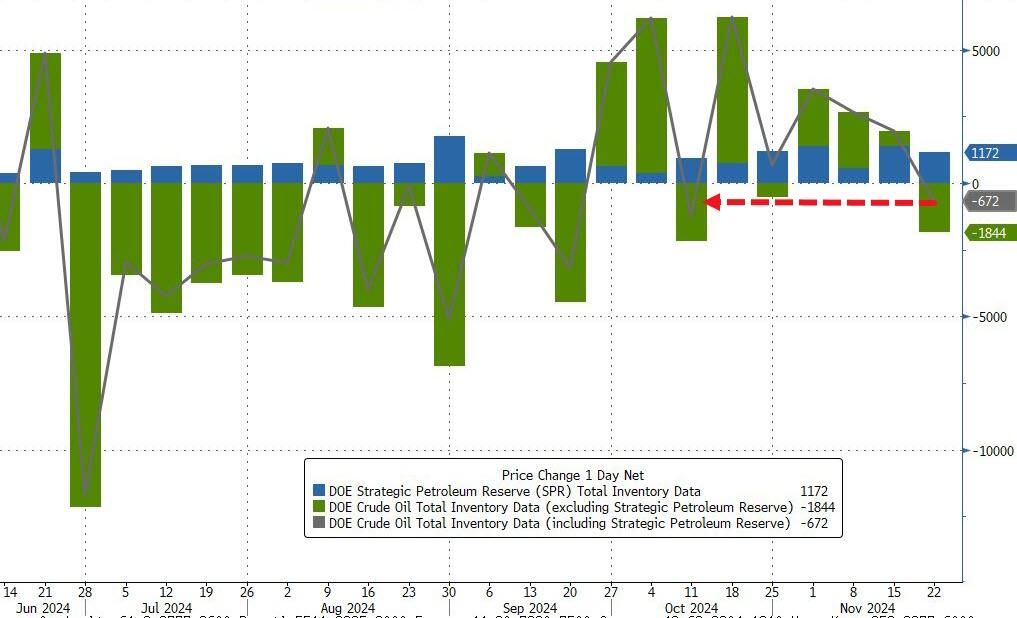
The official data confirmed a drawdown in crude stocks and at the Cushing hub while Gasoline inventories rose the most since July…
Source: Bloomberg
Overall, including a 1.17mm barrel add to SPR, crude inventories declined 672k barrels – the most since the second week of October…
Source: Bloomberg
After last week’ dip, US crude production ramped back up to record highs this week…
Source: Bloomberg
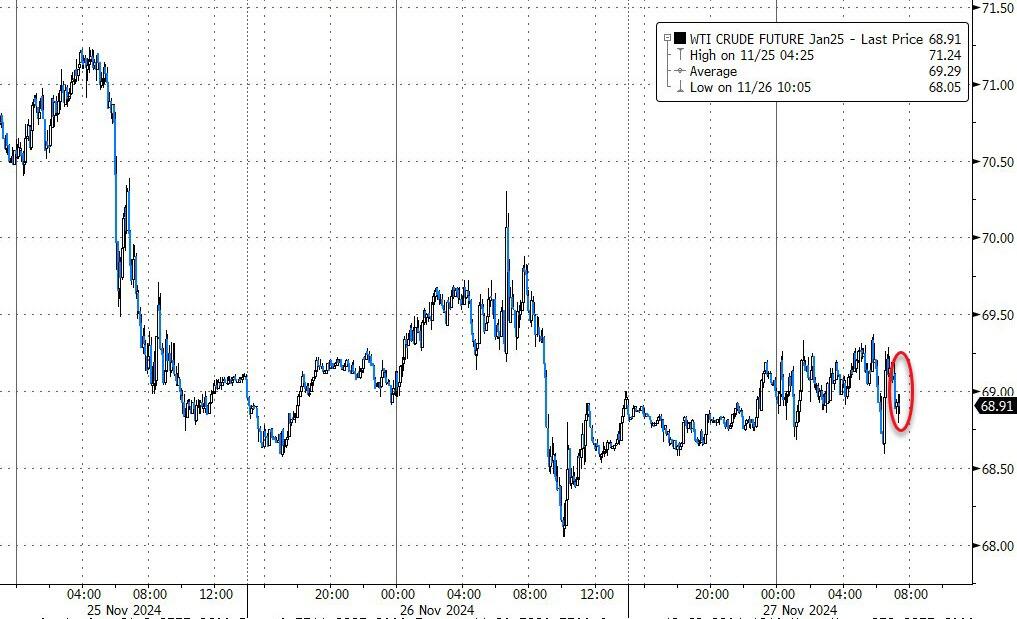
WTI dipped on the smaller than expected crude draw..
Source: Bloomberg
Price moves were exacerbated by thin pre-holiday trading, with open interest hovering near monthly lows.
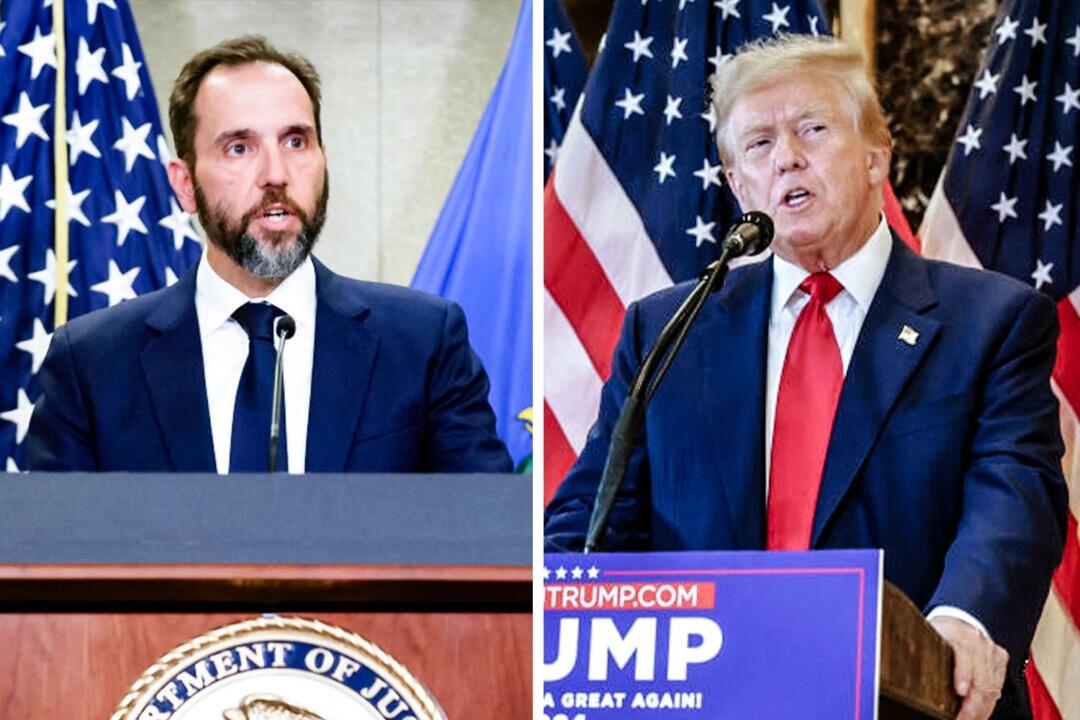
With special counsel Jack Smith’s decision to drop his election case and classified documents appeal against President-elect Donald Trump, the soon-to-be 47th president’s legal woes appear to be mostly behind him.
Smith’s decision on Nov. 25 caps a tumultuous two-year period for Trump, who was charged in four separate jurisdictions with felony counts.
Washington: Prosecutor Moves to Dismiss
In a Washington federal court, Smith filed a motion to dismiss the election case, which has to first be approved by the judge, and cited longstanding Department of Justice policy stipulating that the criminal prosecution of a sitting president would violate the U.S. Constitution by undermining the ability of the country’s chief executive to function.
“Based on the Department’s interpretation of the Constitution, the Government moves for dismissal without prejudice of the superseding indictment,” the court documents filed by Smith on Nov. 25 state.
In the case, Smith had charged Trump in Washington over his alleged efforts to overturn the 2020 election results and for his activity pertaining to the breach of the U.S. Capitol building on Jan. 6, 2021.
The president-elect’s attorneys had sought to delay the release of case materials because of the proximity of the election. However, U.S. District Judge Tanya Chutkan denied their requests, allowing Smith’s team in October to unseal a 165-page filing in the case that outlined Trump’s alleged activities after the 2020 contest.
“Working with a team of private co-conspirators, the defendant acted as a candidate when he pursued multiple criminal means to disrupt, through fraud and deceit, the government function by which votes are collected and counted—a function in which the defendant, as President, had no official role,” Smith’s office wrote.
Trump had pleaded not guilty to the charges, arguing that they were politically driven and designed to interfere with the Nov. 5 election. At the time, Trump spokesman Steven Cheung said the brief was “falsehood-ridden” and accused Smith of being “hell-bent on weaponizing the Justice Department in an attempt to cling to power.”
On social media platform Truth Social, meanwhile, Trump said the case would end with his “complete victory” during the 2024 election.
The Smith case ultimately culminated in a U.S. Supreme Court ruling in July that found that presidents should be rendered partially immune from prosecution for their official acts and duties. But Smith ultimately retooled the indictment and argued that Trump was acting in his private capacity in the election case.
Florida: Prosecutor Moves to Drop Appeal
Also on Nov. 25, Smith filed papers in an appeals court asking to dismiss an appeal of U.S. District Judge Aileen Cannon’s July order tossing the case that had accused Trump of illegally retaining classified documents after leaving the White House.
“Dismissing the appeal as to defendant Trump will leave in place the district court’s order dismissing the indictment without prejudice as to him,” Smith’s Nov. 25 filing states. However, his appeal concerning two other defendants in the case, Walt Nauta and Carlos de Oliveira, “will continue because, unlike defendant Trump, no principle of temporary immunity applies to them.”
Cannon dismissed the charges against Trump, Nauta, and de Oliveira, after agreeing with their arguments that Smith was not lawfully appointed under the U.S. Constitution.
“In ruling otherwise, the district court deviated from binding Supreme Court precedent, misconstrued the statutes that authorized the Special Counsel’s appointment, and took inadequate account of the longstanding history of Attorney General appointments of special counsels,” Cannon wrote at the time.
Weeks later, Smith filed an appeal in the U.S. Court of Appeals for the 11th Circuit to reverse Cannon’s order; Trump’s lawyers had opposed the reversal in subsequent court filings.
Cannon wrote in her order, which came after U.S. Supreme Court Justice Clarence Thomas had cast doubt in July about Smith’s appointment, that Smith was an officer of the United States, which requires that Congress authorize the attorney general to appoint Smith as special counsel.
Before Smith was named special counsel, the FBI searched Trump’s Mar-a-Lago property in August 2022 in a bid to look for classified materials. At about the same time, Trump argued that, as president, he had declassified the documents.
After Smith brought the charges against Trump, the president-elect pleaded not guilty and also accused the Justice Department of launching a politically motivated case against him.
New York: Postponed Indefinitely
A case brought against Trump in Manhattan by District Attorney Alvin Bragg, an elected Democrat, resulted in the president-elect being convicted by a jury on May 30 of 34 counts of falsifying business records. Trump had pleaded not guilty in the case and accused prosecutors, the presiding judge, and the judge’s staff of holding a bias against him.
During most of the trial, Judge Juan Merchan had a gag order in place that barred Trump from speaking about certain witnesses, the judge’s family, court staff, and Bragg’s staff—which Trump said was election interference. The president-elect had written on social media that Merchan’s daughter was a consultant for several Democratic Party heavyweights, including Vice President Kamala Harris.
On Nov. 22, Merchan indefinitely delayed sentencing for Trump in the business records case, after the president-elect’s attorneys called for its immediate dismissal because of the election results.
“Immediate dismissal of this case is mandated by the federal Constitution, the Presidential Transition Act of 1963, and the interests of justice, in order to facilitate the orderly transition of Executive power following President Trump’s overwhelming victory in the 2024 Presidential election,” Trump’s attorneys stated in a letter dated Nov. 19.
Sentencing in the case was initially scheduled for mid-July but was postponed until Nov. 26. In his order on Nov. 22, Merchan wrote that he was granting a request to adjourn that sentencing date as well.
Trump was charged with falsifying business records in connection with payments that he made years ago to adult film actress Stormy Daniels, which prosecutors alleged were designed to interfere in the 2016 election. During the trial, Daniels gave testimony in the case about an alleged affair, which Trump has categorically denied.
Georgia: Still Unclear
In Fulton County, Georgia, Trump and more than a dozen others were charged with election interference-related charges and racketeering in 2023 for their activity following the 2020 election. While several of his co-defendants, including lawyers Sidney Powell and Jenna Ellis, entered into plea agreements with Fulton County District Attorney Fani Willis’s office, a Trump co-defendant in January filed court papers revealing that Willis was in a relationship with her top prosecutor in the case.
Other notable co-defendants listed in the Georgia case include several former Trump advisers and lawyers, including former New York City Mayor Rudy Giuliani and former White House chief of staff Mark Meadows.
During a contentious court hearing, Willis confirmed that she was in a relationship with her special counsel in the case, Nathan Wade, but the pair denied claims that either had financially benefited from the arrangement. They also denied claims that their relationship took place before Wade was named as special prosecutor by Willis, although a witness who had been Willis’s landlord had testified otherwise.
Months later, Fulton County Judge Scott McAfee ruled that either Willis or Wade must leave the case, resulting in Wade’s departure soon after. In his ruling, McAfee wrote that several outstanding claims made against Willis and Wade were not resolved, saying that an “odor of mendacity“ remained over the case.
Trump and several of his co-defendants appealed McAfee’s order to the Georgia Court of Appeals, which placed the matter on pause while it hears arguments on whether to dismiss Willis.
On Nov. 18, the state appeals court canceled upcoming oral arguments that were scheduled for next month.
New York: Civil Case Still Pending
In addition to Trump’s four criminal indictments, a judge earlier this year ordered Trump to pay a $454 million penalty, ruling in a civil fraud lawsuit that he had lied about his wealth for years as he built the real estate empire that vaulted him to stardom and the White House.
Trump had appealed Judge Arthur Engoron’s Feb. 16 decision. The judge found that Trump, his company, and executives, including his sons Eric and Donald Trump Jr., schemed to pad his net worth by billions of dollars on financial statements given to banks, insurers, and others to make deals and secure loans.
In oral arguments held in September, several New York appeals court judges signaled that Engoron’s ruling could be reversed.
Members of the five-judge panel on the Appellate Division, the mid-level state appellate court hearing arguments in Trump’s appeal, had appeared concerned about possible overreach by New York Attorney General Letitia James, who brought the case.
“Every case that you cite involves damage to consumers, damage to the marketplace,” Justice David Friedman told Judith Vale, the attorney arguing on behalf of James’s office.
“We don’t have anything like that here,” Friedman said, saying that nobody “lost any money.”
The Associated Press and Reuters contributed to this report.
Savings-Rate Revisions Erase $140BN In American’s Wealth As Fed’s Favorite Inflation Indicator Jumps To 6-Month High
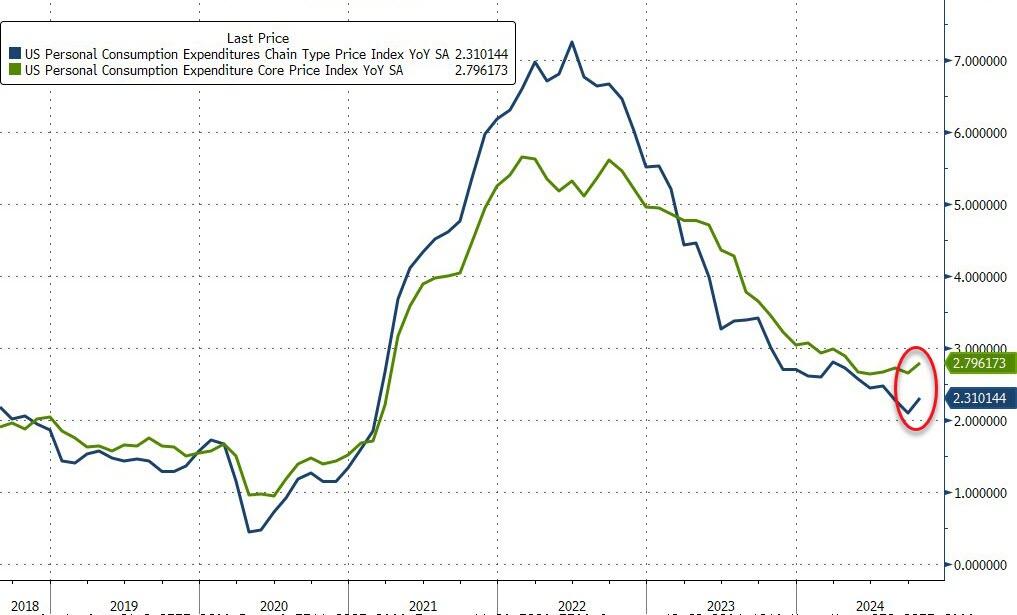
The Fed’s favorite (when it’s going down) inflation indicator – Core PCE – ticked up noticeably in October to +2.8%, the highest since April…
Source: Bloomberg
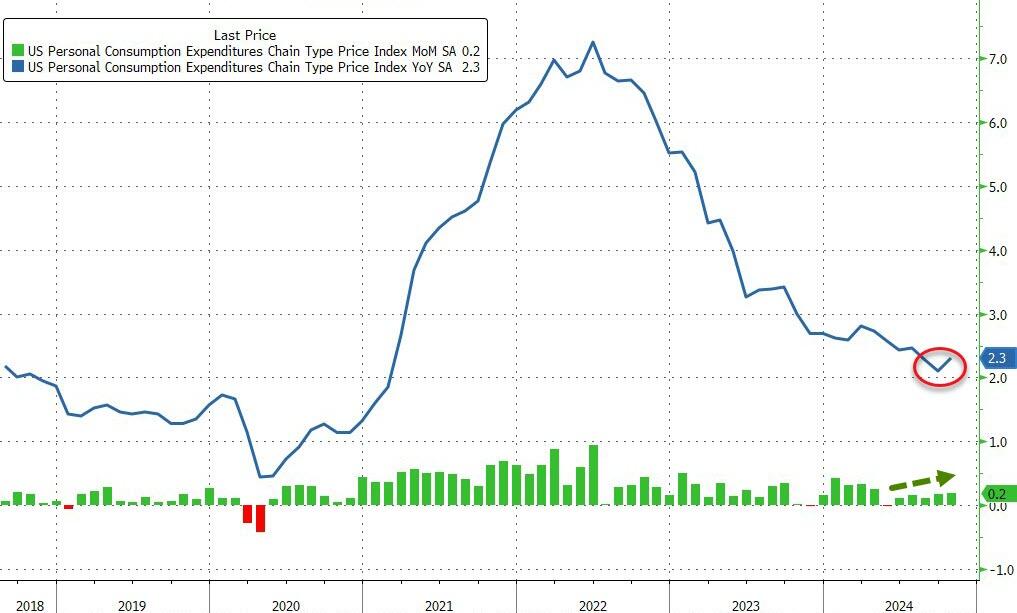
Headline PCE rose 0.2% MoM (as expected) lifting it 2.3% YoY (up from +2.1% YoY prior)…
Source: Bloomberg
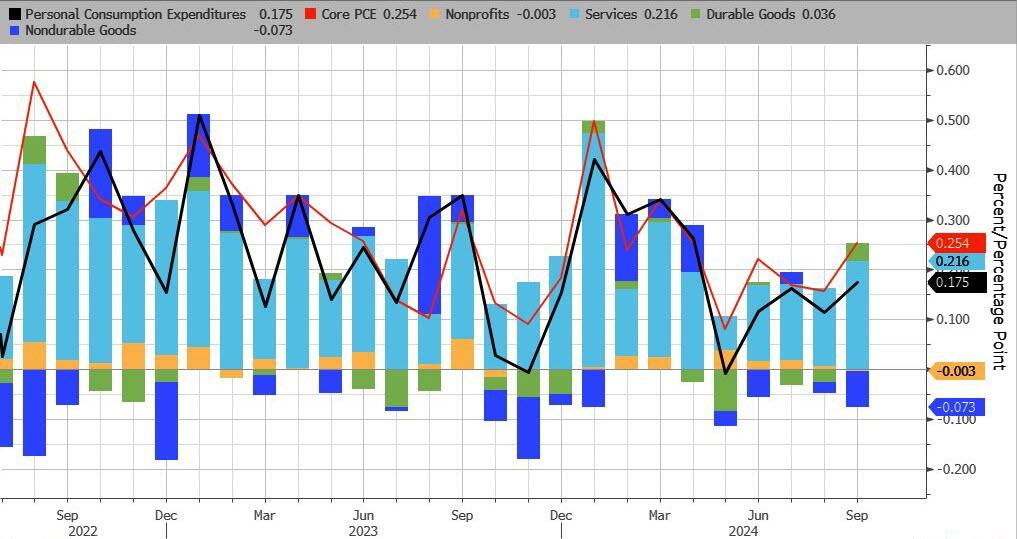
A jump in Services and Durable Goods costs drove the reignition of inflation…
Source: Bloomberg
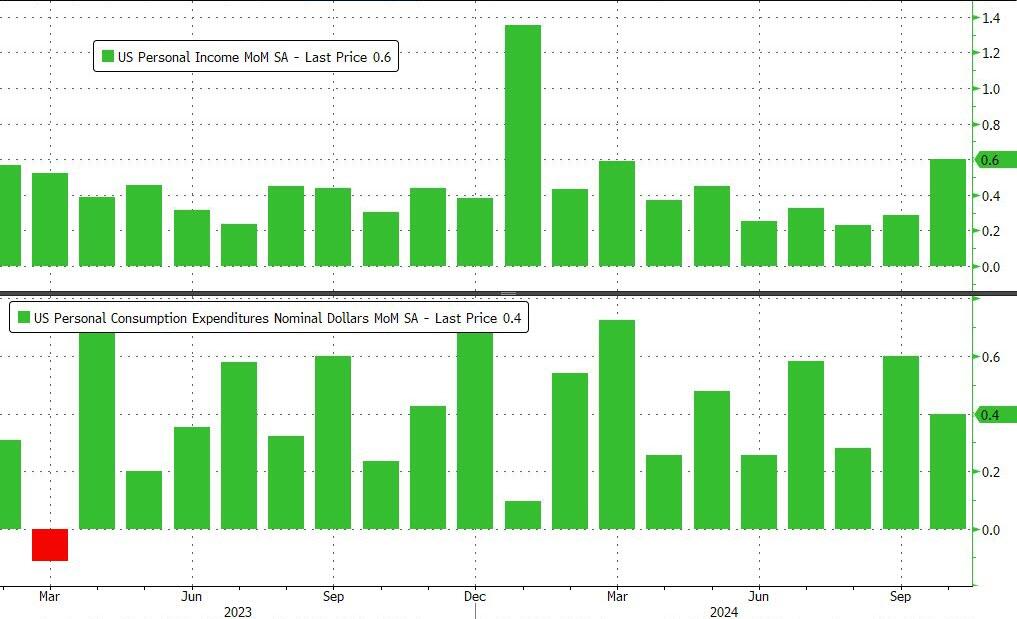
Incomes – for once – grew at a faster rate than spending (+0.6% MoM vs +0.4% MoM respectively)….
Source: Bloomberg
…and while that bumped up the savings rate MoM, thanks to massive revisions, Americans lost $140BN in personal savings… out of nowhere…
Oh look, the savings rate was just revised sharply lower for most of 2024 and some $140BN in personal savings was magically erased. pic.twitter.com/T3lGgLCIEQ
Remember when they revised it from 2.4% to 5.0% in late September to bump up GDP? Well, we guess Kamala isn’t president.. so all bets (adjustments) are off…
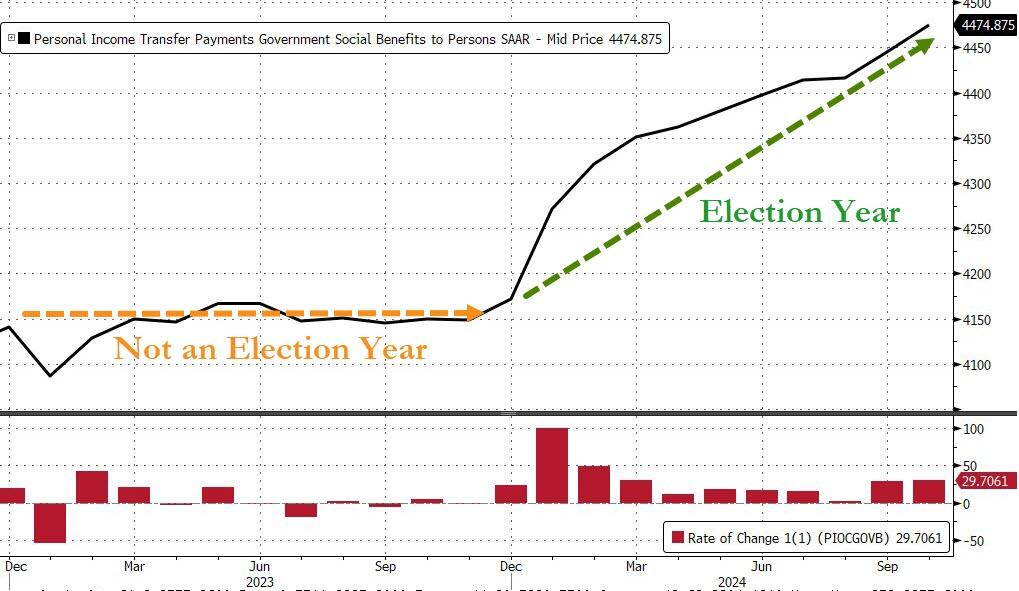
And finally, imagine how bad things would be if the government wasn’t handing over billions to ‘we, the people’ all of a sudden…