Why Trump’s Election Case Was Dismissed ‘Without Prejudice’

Why Trump’s Election Case Was Dismissed ‘Without Prejudice’

Authored by Sam Dorman via The Epoch Times (emphasis ours),

District of Columbia Judge Tanya Chutkan dismissed the election interference case against President-elect Donald Trump on Nov. 25, bringing an end to a highly contentious prosecution and raising questions about whether the charges could once again surface.

Special counsel Jack Smith prepares to speak about an indictment against former President Donald Trump in Washington on Aug. 1, 2023. Drew Angerer/Getty Images

Chutkan’s dismissal was entered “without prejudice,” which means the charges can hypothetically be brought against Trump at a later date.

Special Counsel Jack Smith based his request for a dismissal on longstanding Department of Justice (DOJ) policy that says prosecution of a sitting president would violate the constitution. Smith’s motion added that “although the Constitution requires dismissal in this context, consistent with the temporary nature of the immunity afforded a sitting President, it does not require dismissal with prejudice.”

Analysts say it’s unlikely, however, that Smith’s indictment would be filed again given that the statute of limitations will run out before the expected end of Trump’s second term in 2029.

“The fact is that asking the judge to dismiss the case without prejudice is common practice,” John Shu, a constitutional law expert who served in both Bush administrations, told The Epoch Times. “The government wants to keep all of its options open, even if those options are remote or if it’s likely that the options will expire because of the statute of limitations.”

Smith’s reference to temporary immunity was about a type of immunity that was separate from what the special counsel’s office and Trump’s attorneys were debating in recent months. That litigation focused on immunity that stemmed from the Supreme Court’s decision in Trump v. United States.

That decision held that presidents enjoy varied levels of immunity from criminal prosecution for actions they engage in during their tenure, including for former officeholders like Trump.

Smith’s argument about the DOJ’s longstanding policy, by contrast, focused on the prosecution of a sitting president. Smith added that his request for dismissal was “not based on the merits or strength of the case against the defendant.”

Shu told The Epoch Times that Smith’s motion pointed to an attempt by him to preserve other future prosecutions.

“Smith and the DOJ are not just thinking about the current case, they’re thinking about future cases,” he said. “They still want to keep the option open of prosecuting in the future—not Trump but, in the future, some former president, even though the Supreme Court made that significantly harder with its presidential immunity opinion.”

In her opinion explaining the dismissal, Chutkan said her decision was consistent with Smith’s interpretation of Trump’s immunity while in office. She also said that dismissing without prejudice was appropriate in this case because “there is no indication of prosecutorial harassment or other impropriety underlying the [motion to dismiss].”

Even if Trump left office early and the prosecution resumed, it’s unclear how successful it would be.

The Supreme Court’s decision on Trump v. United States arose from an appeal of Smith’s prosecution, which has been mired in a delayed pre-trial process since he brought the initial indictment last year. Chutkan’s court was headed towards deliberations over how that decision applied more specifically to Trump’s actions.

Besides the immunity issue, Trump also sought to challenge the case on statutory grounds and the legitimacy of Smith’s appointment as special counsel.

The latter issue is the subject of an appeal by Smith in the U.S. Court of Appeals for the 11th Circuit, which is reviewing Florida Judge Aileen Cannon’s decision that constitutional issues surrounding Smith’s appointment meant his classified documents case against Trump should be dismissed.

Smith filed a motion on Nov. 25 to dismiss his appeal as it related to Trump but sought to leave it in place for two other defendants involved. The 11th circuit granted Smith’s motion on Nov. 26. Also on Nov. 26, Smith’s team filed a brief defending Smith’s appointment as legal.

Tyler Durden
Wed, 11/27/2024 – 18:30

via ZeroHedge News https://ift.tt/Cg3sKfz Tyler Durden

“Significant Uptick” In M&A Rumors Observed In News Cycle Ahead Of 2025 

“Significant Uptick” In M&A Rumors Observed In News Cycle Ahead Of 2025 

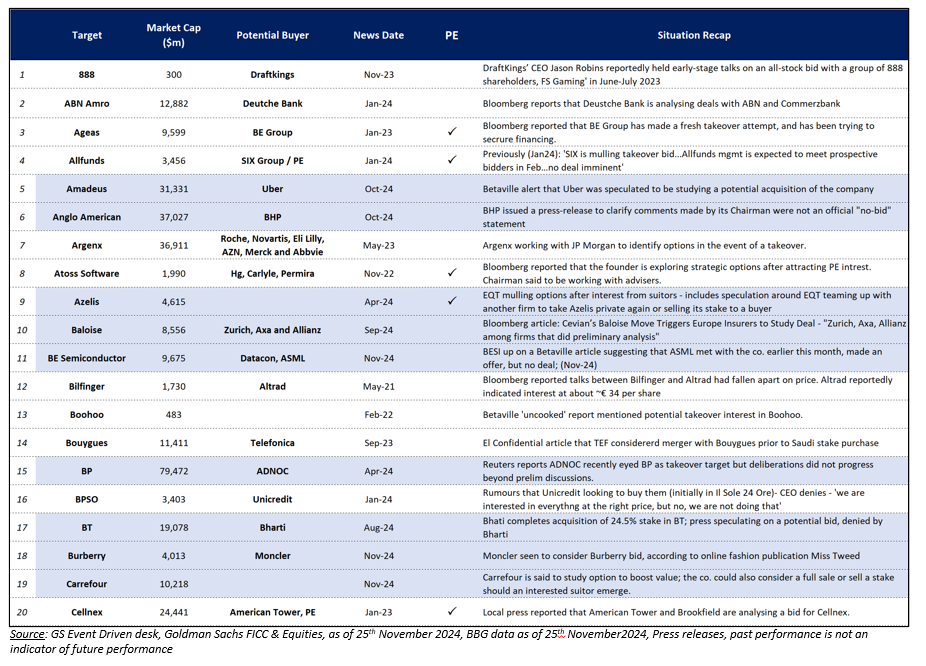
Goldman Sachs analysts have noted a “significant uptick” in merger and acquisition rumors in the press over the past six weeks. The investment bank forecasts positive M&A growth trends over the next 12 months, signaling a potential rebound in dealmaking activity. 

Analysts Matt Michon and Hannah Taylor penned a note Wednesday to clients about the surge in M&A headlines.

“In the last six weeks, there has been a significant uptick in M&A “rumours” relative to the prior three-quarters so hopefully an encouraging sign that corporate activity is picking-up…!” they said. 

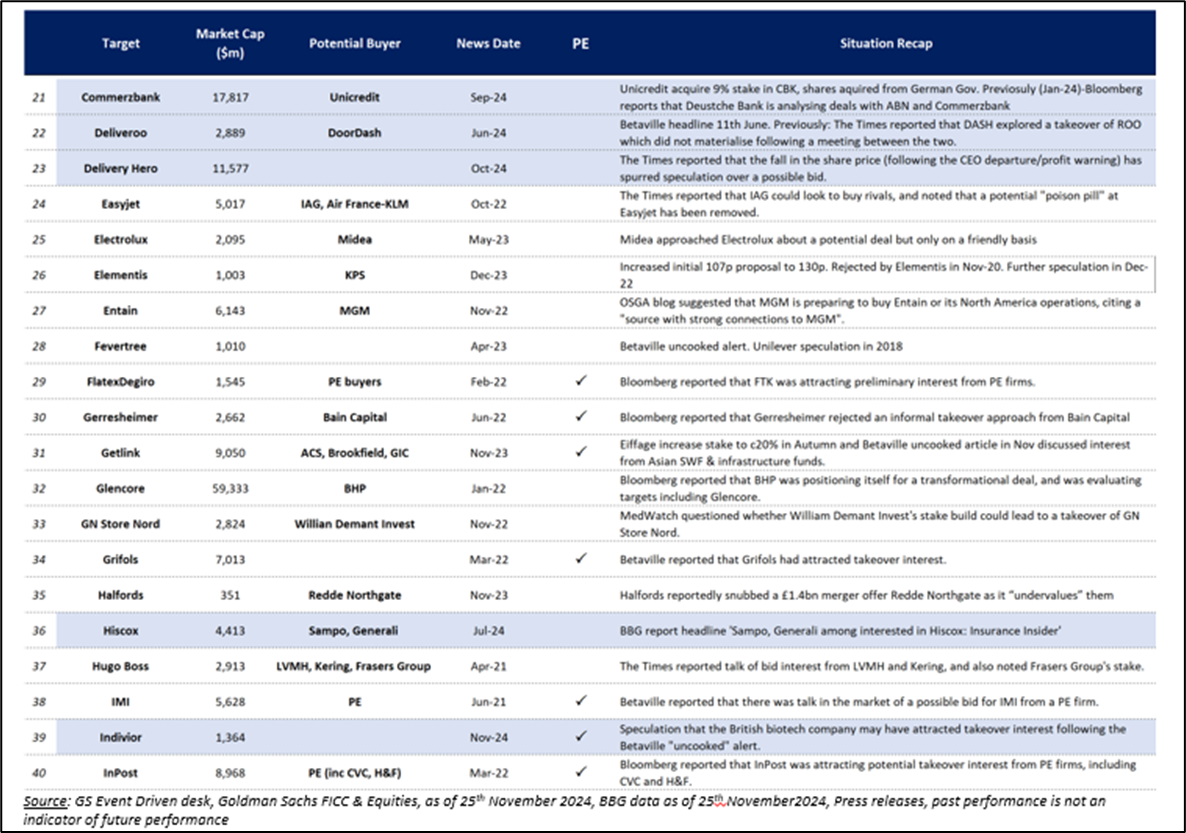
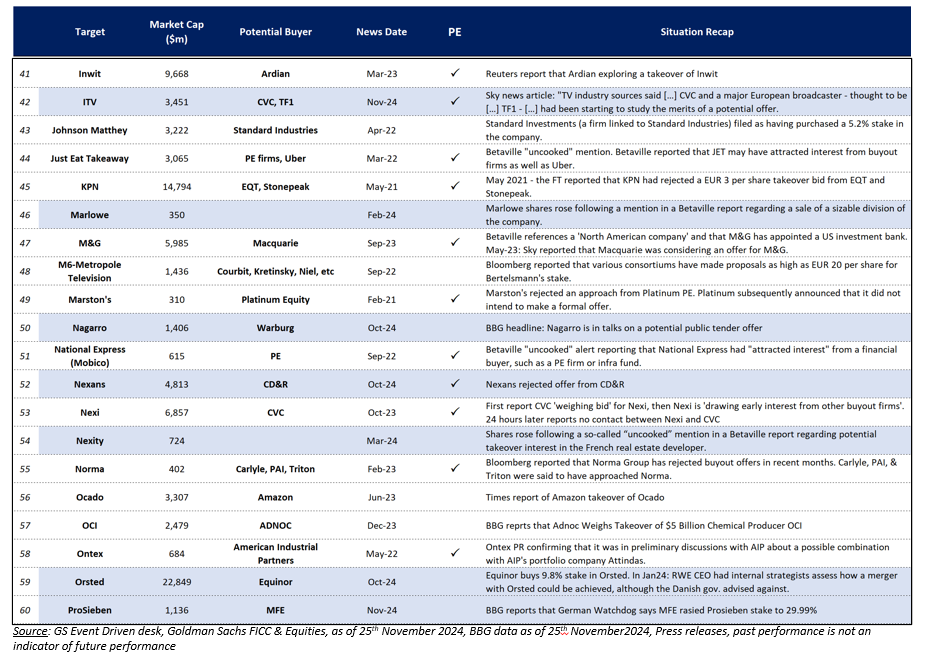
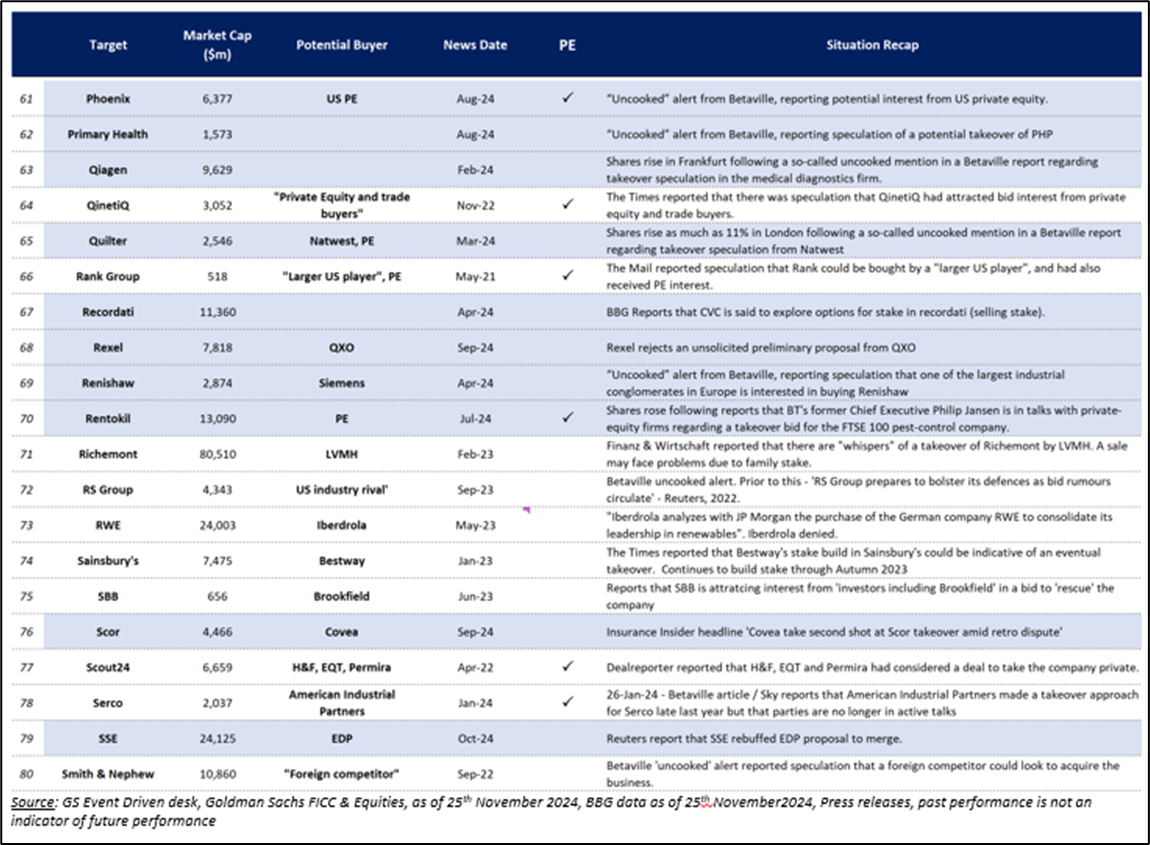
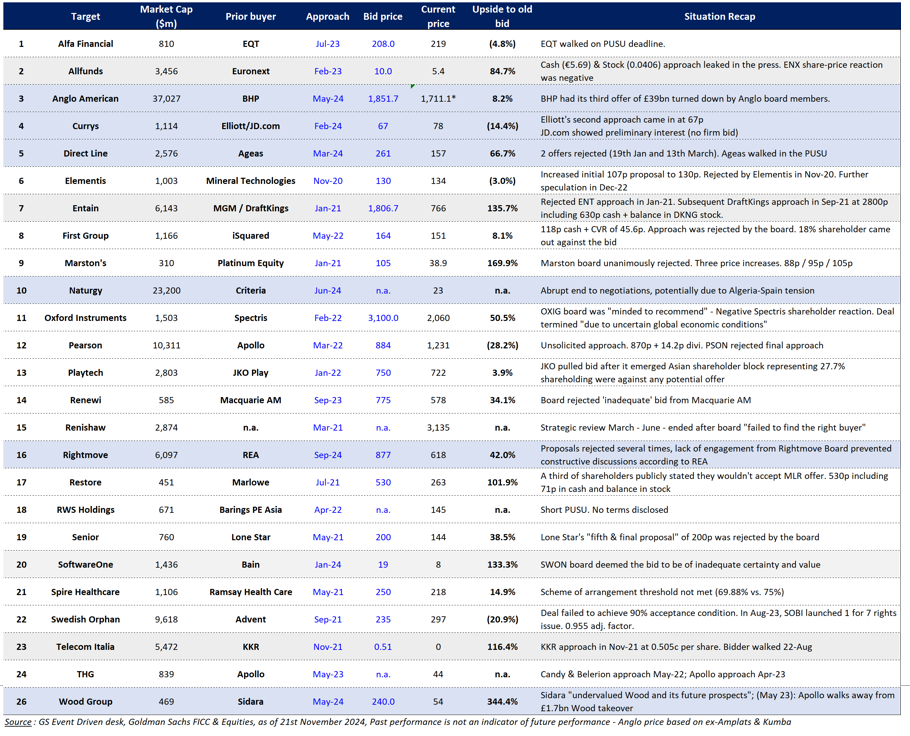
The list of companies below is part of the desk’s M&A monitor, which shows “potential M&A situations reported through the press” and also “highlighted in blue are those with news updates since our last note.” A list of failed M&A approaches was also recorded. 

Most recent M&A headlines… 

Failed M&A approaches. 

In a separate but recent note, Goldman analysts James Yaro and Richard Ramsden told clients that internal leading indicators “forecast 20% M&A growth over the next twelve months.”   

The latest remarks from the FOMC Minutes suggest that Fed officials are leaning toward a more gradual interest rate-cutting cycle. One that could certainly provide relief to corporates… 

Tyler Durden
Wed, 11/27/2024 – 18:00

via ZeroHedge News https://ift.tt/8ghowMB Tyler Durden

US To Deepen Footprint In Lebanon As Part Of Ceasefire Deal

US To Deepen Footprint In Lebanon As Part Of Ceasefire Deal

Via Middle East Eye

The US is set to deepen its footprint in Lebanon as part of a ceasefire deal aimed at ending more than a year of fighting between Israel and Hezbollah. According to details of the agreement shared with Middle East Eye by current and former US and Arab officials, the 60-day ceasefire will see all Israeli forces withdraw from Lebanon in phases, with Hezbollah moving north of the Litani River.

The deal which was announced late Tuesday is broadly based on UN Security Council Resolution 1701, which ended the 2006 war between Israel and Hezbollah and was supposed to see the Lebanese army and the United Nations Interim Force in Lebanon (Unifil) deployed to southern Lebanon.

As per the deal, the Lebanese army, with assistance from Unifil, will be deployed to the south to ensure that Hezbollah does not re-enter the area between the Israeli border and the Litani.

Via Reuters

“By day 60 there will be no Israeli or Hezbollah troops in southern Lebanon,” a senior Arab official told Middle East Eye. 

The agreement, which seeks to end more than a year of fighting that has claimed more than 3,700 lives in Lebanon, will also see the US deploy technical military advisers to Lebanon and see Washington provide additional funds to the Lebanese army.

The US will also provide oversight on Hezbollah’s withdrawal and a military official – likely from Central Command (Centcom) – will head an international committee that will coordinate with hundreds of soon-to-be-deployed French soldiers as part of a beefed-up UN peacekeeping mission.

A senior US official told MEE that Israel will not be granted the right to attack Lebanon based on any suspicious movements. Israel will have to report any movement it deems suspicious to the international committee, which in turn will inform the Lebanese army to take the necessary action.

If the Lebanese army fails to act after receiving a complaint regarding suspicious activities south of the Litani or in any Lebanese area, Israel will consider the agreement void and resume its attacks on Lebanon.

The US is not expected to deploy additional troops on the ground. Instead, the pending ceasefire is set to expand the 10,000-strong Unifil peacekeeping mission. Hundreds of French soldiers are expected to deploy to Lebanon as part of Unifil, according to the former US and Arab official. 

The agreement will also deepen the US’s ongoing efforts to support the Lebanese military. The US started funding the Lebanese army in 2005 after a protest movement prompted the withdrawal of Syrian troops from the country.

In the last 20 years, Washington has been the army’s largest donor, giving more than $2.5bn in support to the military, which is seen as a national institution that crosses sectarian and political divides.

The sources told MEE that the army has already recruited 1,500 troops and seeks to bring on board roughly 3,500 more in the next four months. 

Via Middle East Eye (MEE)

The US will also beef up training, equipment and reimbursement funds to the army. Washington is also speaking with Saudi Arabia and Qatar about providing funds to the Lebanese forces to pay additional salaries. Qatar already provides funds to the cash-strapped Lebanese army, pledging $60m in 2022 to support soldiers’ salaries.

Lebanon was in the midst of a disastrous financial crisis before Hezbollah began launching missiles and drones at Israel on 8 October 2023 in solidarity with Palestinians under attack in Gaza.

The ceasefire will also include a renewed commitment to several other UN Security Council resolutions, including 1559 and 1680, which call for the disarmament of Hezbollah. 

Unlike other Lebanese armed groups, Hezbollah kept its weapons after the 1975-90 civil war so it could continue to fight against Israel’s occupation of south Lebanon. Though Israel mostly withdrew in 2000, it continues to occupy the Shebaa Farms, which Hezbollah says are Lebanese.

Hezbollah’s year-long attacks have displaced around 60,000 Israelis from their homes in northern Israel. Meanwhile, Israeli bombardment and the ground invasion launched in October have forced more than a million people in Lebanon to flee.

Tyler Durden
Wed, 11/27/2024 – 17:40

via ZeroHedge News https://ift.tt/FRPV7Av Tyler Durden

Chinese Automakers Are Dethroning Their Once-Dominant Japanese Competitors

Chinese Automakers Are Dethroning Their Once-Dominant Japanese Competitors

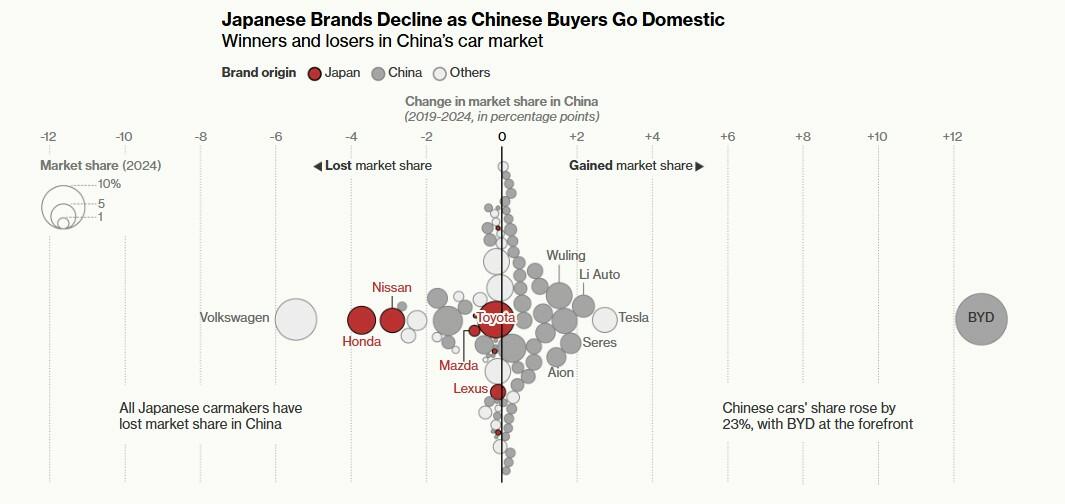
China is doing the unthinkable and dethroning once dominant Japanese automakers, who are struggling to compete in China.

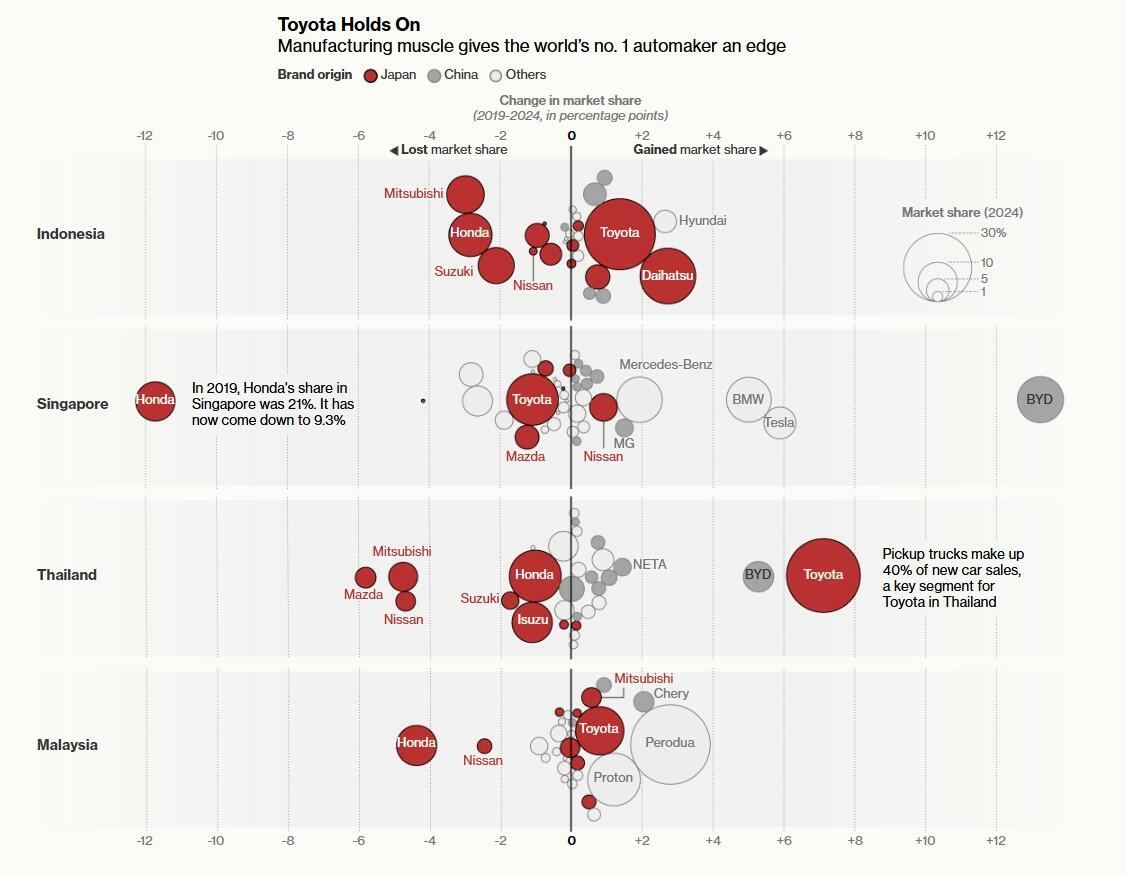
China is the world’s largest car market and domestic brands are dominating with a surge of electric vehicles. Chinese companies are also expanding into Southeast Asia, challenging the long-standing dominance of brands like Toyota, Honda, and Mitsubishi, according to w new report by Bloomberg.

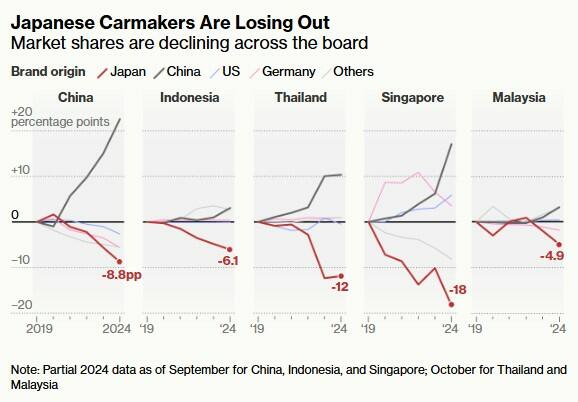
Between 2019 and 2024, Japanese automakers experienced the steepest market share declines in China, Singapore, Thailand, Malaysia, and Indonesia, according to Bloomberg’s analysis of sales and registration data.

Japanese automakers are losing ground across Asia, with all six tracked by Bloomberg experiencing declines in China. Even Toyota, the global leader in car volume, has seen its sales stagnate. In Southeast Asia, a traditional stronghold for Japanese brands, market share has dropped sharply.

In Thailand and Singapore, Japanese carmakers now control just 35% of the market, down from over 50% in 2019, while streets once dominated by Nissan and Mazda are increasingly filled with Chinese brands.

The Bloomberg profile notes that Toyota remains competitive in some segments, like pickups, but the broader outlook is troubling for automakers once renowned for efficiency and reliability. Their slow pivot to fully electric vehicles puts them at risk of falling behind in a market driven by advanced battery technology and smart software.

Although Chinese automakers face high tariffs in Europe and the U.S., the erosion of Japanese dominance in Asia could signal wider challenges ahead.

Toyota’s stronghold in Southeast Asia is supported by regional production of gasoline cars with larger engines, appealing to local preferences. In 2023, Thailand and Indonesia accounted for nearly 10% of Toyota’s 11 million global vehicle output. However, other Japanese brands, like Nissan, are struggling.

Nissan’s outdated lineup and lack of hybrids contributed to profit losses and production cuts, with its presence in Jakarta now fading.

Meanwhile, Chinese automaker BYD has rapidly gained traction in Indonesia, ranking as the sixth top-selling brand just months after delivering its first vehicles. Its $40,000 Seal EV is proving especially popular.

Japan’s global auto production share has dropped from over 20% two decades ago to 11%, while China has surged to dominate, now accounting for nearly 40% of worldwide car manufacturing. Chinese automakers are leveraging their expertise in low-cost batteries and flexible supply chains to expand into Southeast Asia, the Middle East, and Africa, further challenging Japan’s dominance in these markets.

Tyler Durden
Wed, 11/27/2024 – 17:20

via ZeroHedge News https://ift.tt/pmZkStD Tyler Durden

How Trump Voters Learned To Love, And Turn Out, The Mail-In Ballot

How Trump Voters Learned To Love, And Turn Out, The Mail-In Ballot

Authored by Philip Wegmann via RealClearPolitics,

In the spring, James Blair, political director for the Trump campaign, called a meeting in West Palm Beach. The occasion: Marc Elias had changed the world.

It was Elias who had petitioned the Federal Election Commission at the beginning of the year to allow a George Soros-funded political action committee to coordinate with campaigns. And the Democratic super lawyer had won. A nine-page advisory opinion followed in March. For the first time, the FEC ruled that federal candidates could coordinate with outside organizations. And now politics would change forever.

Blair sensed opportunity. All he had to do, the reason he gathered the most loyal MAGA captains of the biggest grassroots armies around a conference table inside Trump campaign headquarters last April, was convince them to accept a little heresy. The political director had to teach them to love the mail-in ballot.

Trump had taught his base to hate mail balloting, a practice he blamed for his loss in 2020. Now Blair was urging the former president’s most faithful followers to embrace what was previously verboten. According to sources inside the room that day, the conversion did not go smoothly.

Charlie Kirk, founder of Turning Point USA, balked. A confidant of the Trump family, Kirk and his lieutenant Tyler Bowyer were allegedly “horrified” by the idea of pushing absentee ballots for fear of alienating MAGA diehards. Ned Ryun, CEO of American Majority Action, insisted absentee ballots were half the battle, arguing that Republican hopes would languish in long lines on Election Day without them. One source described the mood that day as “snippy.”

Turning Point spokesman Andrew Kolvet dismissed that characterization and told RealClearPolitics the organization was making plans as early as 2022 to “hammer home” the early vote.

There were skeptics,” Blair said in retrospect. Without singling anyone out, he told RCP that “less sophisticated” operatives on the right still subscribed to “this theory that ‘well, if the votes come in early, then [Democrats] know how many they need to cheat.’” His counter-argument as he showed the grassroots the math: “No, once a vote is banked, that’s good.”

This was easier said than done, as Trump had hardwired a deep distrust into the minds of millions of Republicans by arguing that anything other than same-day voting was synonymous with fraud. “We have to get rid of mail-in ballots,” Trump said during his January victory speech after winning the Iowa caucuses. As he began his easy march through the GOP primary field, Trump added, “Once you have mail-in ballots, you have crooked elections.”

Data alone would not be enough to convince the base to abandon that belief. Only Trump could change their minds. “He had to create the permission structure for his voters,” Blair explained, “which is that voting early, whether by mail or in person, can be a pathway to victory, not to defeat.”

Clearing a primary field of Republican challengers too afraid to attack him was one thing. Unseating an incumbent president would be another. Enter Susie Wiles.

She came from Florida, just like Blair, where Republicans had built majorities for decades despite being outnumbered by Democrats on registered voter rolls. As campaign co-chair, she had just helped Trump brush aside the primary challenge of Florida’s own governor. Then Wiles looked to the general election, directing Blair to draft a memo outlining a new Trump way to win. In short, they planned to export the Florida model.

They laid out the data, pointed to successful case studies, and ran sophisticated election simulations. But the final argument that changed Trump’s mind? “Look, sir,” the former president was told, according to sources familiar with the discussions, “people are really excited to vote for you, and they want to vote for you as soon as they have the chance to vote.” On the evening of April 19, in characteristic all caps, Trump did something very uncharacteristic: He reversed himself and blessed the mail ballot. Wrote the former president on his social media website Truth Social:

ABSENTEE VOTING, EARLY VOTING, AND ELECTION DAY VOTING ARE ALL GOOD OPTIONS. REPUBLICANS MUST MAKE A PLAN, REGISTER, AND VOTE!

Once the green light was given, the Trump machine kicked into another gear. They would still drive turnout on Election Day, but they would work just as hard to bank votes in advance. This has an obvious tactical advantage. Every supporter who cast their ballot early represented one less voter the campaign had to spend time and resources on getting to the polls on November 5. All campaigns do this. But the FEC decision that allowed federal candidates to coordinate with outside groups, the one ushered in by liberal lawyer Marc Elias, turbocharged everything. Tim Saler, chief data consultant for the Trump campaign, took full advantage.

Saler was the analytical brain behind the GOP’s ground game juggernaut. Despite all the massive reporting from the Associated Press to the New York Times suggesting the opposite, he insisted in an interview with RCP that Trump actually had one. “It was not outsourced at all,” Saler said of the get-out-the-vote apparatus. “It was coordinated.”

Flashback to Florida. Many of the groups inside Trump headquarters, almost a dozen in total, were already planning their own canvassing programs. Some had more experience than others.

Turn Out for America, a political action committee bankrolled by conservative billionaire Dick Uihlein, was on board from the beginning and widely considered among Trump operatives as “the gold standard.”

American Majority Action, Ryun’s group, had just run two pilot programs the year before, one in Louisiana and another in Virginia. Ryun was convinced Republicans could win by banking votes. “We had faith in what they did,” said a source with direct knowledge of the Trump operation. The newest addition: Turning Point Action.

Kirk and Bowers leveraged their influence with millions of conservative students to create a turnout machine. “Turning Point will just need to keep evolving,” a Trump operative said of the newest edition while stressing that their efforts were welcome and helpful.

America PAC, the Elon Musk upstart that would eclipse all the rest in spending, would come later.

Saler loves them all and says each did good work. Ahead of Election Day, the first order of business was making sure the assorted groups “did no harm.” Under the new FEC paradigm, and for the first time, the campaign could communicate priorities, coordinate strategy, and share best tactics. Hence the second priority discussed at the West Palm Beach meeting: A data-sharing agreement.

There was a real misnomer, or just a false attack, that we didn’t have a field program,” Saler said of the idea “that our field program had been farmed out.” The campaign already had in-house volunteers, a program called Trump Force 47, that fanned out to all 50 states and knocked on millions of doors on its own. What the new coordination rules provided for was the creation of the outside armies fanning out to each of the seven battleground states in search of the all-important low-propensity voter.

“The president’s coalition is more rural, lower propensity, and more down scale,” Saler explained. “Think a 35-year-old man who turns a wrench in small-town, central Wisconsin, who never engages face-to-face with anybody in politics.”

To turn out a coalition like no other, Saler had to assemble an apparatus like no other. The campaign would be at the center. They shared targeting priorities with the outside groups, who then sent their people into the field to find and identify Trump voters, building a real-time data loop. They didn’t just go where other GOP presidential campaigns had been in years past. Because of the new canvassing rules, Trump HQ could send outside groups, not just to big population centers, but door to door even in the most rural areas. On front porches, outside grocery stores, and everywhere in between, canvassers sought out the MAGA faithful, registered them to vote, and pushed them to do it early.

“The president is a unique character in American history; He is the champion of the forgotten man and woman,” Saler said before adding that the campaign was just as unique. “We also didn’t forget them.” In the moment, though, skepticism abounded. Some Republicans, many of them on the outside looking in, questioned the wisdom of relying so heavily on mercenary doorknockers ahead of what was sure to be a make-or-break election. Even Ben Shapiro was worried. In an October interview, Shapiro warned the former president that he was hearing mixed reviews about the ground game. Was his campaign up to the job? Trump avoided the question. In the final stretch, no one had a definitive answer.

A team of rivals, meanwhile, was working on his behalf in pursuit of low-propensity voters.

A staple on the college circuit, Kirk focused on the youth vote while directing his organization’s political arm, Turning Point Action, to decamp from campus and field an army of more than a thousand paid doorknockers across each of the swing states in pursuit of low-propensity voters overall. A spokesman denied that there was any hesitation about registering voters for absentee ballots. Instead, the organization modeled its early-vote strategy off of the Democratic playbook while making accommodations for lingering concerns over mail-in ballots.

The emphasis was on early voting, but if a voter preferred to cast their ballot in person on Election Day, the organization was ready to drive them to the polls. Explained Turning Point spokesman Andrew Kolvet, “We only care about getting ballots in the box.”

At times, the organization took “low propensity” to the extreme. Scott Presler, a conservative activist who partnered with Turning Point in Pennsylvania, courted a normally apolitical and untapped constituency: the Amish. 

That community’s aversion to politics wasn’t the chief obstacle. It was the calendar. “Get this,” he told RCP, “Amish get married on Tuesdays in November.” Otherwise, they generally match the voter profile of a normal social conservative, he reported. Armed with that information, Presler parachuted into rural farming communities west of Philadelphia and north of Pittsburgh with absentee and mail-in ballot applications.  

While Turning Point and their partners earned praise for that kind of innovation, elsewhere, some questioned the efficiency of their organization. One Turning Point intern attracted online criticism when he bragged in a social media post that he knocked on just 500 doors over the course of nine weeks, a seemingly low number. Another paid Turning Point Action employee, currently under contract in Wisconsin through November, told RCP that management had set a daily goal of just 10 voter contacts.

We set out on a mission to chase low-prop and first-time voters across the country,” Kirk wrote in a social media post the week after the election. Across four states (Arizona, Michigan, Nevada, and Wisconsin), according to their internal numbers, Turning Point Action had helped no less than 300,000 low-propensity voters cast their votes. “Mission accomplished,” he wrote.

American Majority Action took a more traditional approach with Ryun at the helm. The hard-nosed operative, who helped former Wisconsin Gov. Scott Walker become just the second state executive to survive a recall 13 years prior, had raised and deployed as many grassroots armies in the time since. The difference this time? Ever since the “Red Wave” fizzled in the 2022 midterms, Ryun had been on a one-man crusade to force Republicans to embrace absentee and early voting in earnest.

After running two successful pilot programs in state races, he was convinced the GOP could take the approach national. Trump supporters would learn to love the mail-in ballot, he was convinced, once they won with it. Toward that end, American Majority picked four targets: Arizona, Nevada, North Carolina, and Wisconsin. They hired 1,600 staff, drilling into each canvasser two numbers: Seven and nine. Between seven and nine is how many times a single low-propensity voter, on average, must be contacted before they will return a mail-in ballot. A blunt Ryun calls it “targeted harassment.”

According to an after-action report, the group made more than 11 million phone calls in support of Trump and sent just shy of four million texts to voters in each of their four target states. They knocked on nearly 2 million doors.

On the eve of the election, Ryun wrote in an op-ed for “American Greatness” that Republicans had experienced their fair share of growing pains. It would take time for the GOP to catch up to Democrats on the early voting front, but overall, the conservative movement earned a passing grade: “A solid B to B+ level with lots of room for growth.”

America PAC was the last big group to arrive. Elon Musk endorsed Trump after the first assassination attempt, and while Republicans welcomed the many millions of dollars from the world’s richest man, the political novice attracted his fair share of scrutiny. His group planned to compete in all seven battleground states. They initially hired just a handful of vendors to execute a one-size-fits-all, top-down strategy.

By the end of the summer, though, Musk fired his initial team and hired Genera Peck and Phil Cox, veterans of the defunct DeSantis campaign, to put together a national plan with individual directors in each of the battleground states. They took a tailored approach, and by the end, Musk lent his celebrity to the Pennsylvania campaign, a state he often told voters was the key to the whole election. His group spent north of $200 million, a deep war chest that lent itself to sending canvassers nearly everywhere.

The scope of all of this was relatively new territory. Few national, grassroots organizations previously had the resources and expertise to chase votes across multiple states concurrently. Each additional battleground added another level of complexity and difficulty. But it wasn’t all top-down. A patchwork of groups supplemented the work in the individual swing states.

Motivated by the frustration that the right had “yielded voter registration to the left,” former Georgia Sen. Kelly Loeffler launched “Greater Georgia” in the Peach State. The group identified tens of thousands of conservative Georgians and helped get them registered to vote. Another state-specific get-out-the-vote engine to the north: PA Chase. Founded by Cliff Maloney, that organization canvassed throughout Pennsylvania in search of low-propensity voters in need of a mail-in ballot. “We’re finally catching up to the Democrats,” Maloney said of his efforts before Election Day. “This is straight out of their playbook, right?

In this way, the Trump campaign and its allies chased the low-propensity voter. And it worked. He not only swept each swing state on his way to becoming just the second president in history to win non-consecutive terms, but Trump also won the popular vote, something Republicans haven’t achieved since 2004. Said Saler of the electorate that returned the former and future president to the Oval Office, “He created them.” Many were first-time voters. Some voted only for him. Now every Republican operative involved in planning for the midterms and the next general election is focused on one question: How to keep these voters in the GOP fold? It will likely include a heavy emphasis on the early vote.

Trump World, even in victory, sees the mail-in ballot as a pragmatic necessity, not an ideal way to vote. “Look, they’re not perfect, and if we could just do away with them, we probably would, but that’s not the world we live in,” Blair said. “They exist. So, it is what it is.”

For his part, Ryun has become their biggest apostle of early voting and the mail-in ballot. After Republicans won big, he isn’t in a hurry to see the GOP set them aside. “I’m telling you, this works, and this should be our game planning forward,” he said, before adding that a more pressing question for the right was discerning which groups did real work and which did little more than gobble up donor dollars.

“There are some vaporware organizations, like Turning Point, that I’m afraid were not as effective as they could have been because they were on a journey of self-discovery in politics,” Ryun said. “My concern for the future is, how do we make sure that some of these voters who turned out for Trump-only become consistent Republican voters.”

A Turning Point spokesman dismissed that criticism. Said Kolvet, “We’re not in the business of getting down in the mud.” The results, he said, speak for themselves. “The campaign, which knows the data and accomplishments well, knows how successful our program was,” the spokesman concluded.

Republicans will have their work cut out for them in the midterms. They have historically underperformed whenever Trump is not on the ballot. The coordination between federal candidates and outside groups – that the FEC allowed at the insistence of Democrats like Elias – will not change. It was central to a Trump victory.

“Thank you, Marc,” quipped Saler, the Trump data consultant who helped engineer the former, and future, president’s comeback. “We appreciate you.”
Tyler Durden
Wed, 11/27/2024 – 17:00

via ZeroHedge News https://ift.tt/FHyCcOi Tyler Durden

Exxon Pours Cold Water On Trump’s “Drill, Baby, Drill” Plans

Exxon Pours Cold Water On Trump’s “Drill, Baby, Drill” Plans

Contrary to expectations for a self-defeating flood of new energy production under the second Trump admin, Exxon’s Upstream President Liam Mallon said that oil and gas producers in the US will not raise output significantly in the coming years despite calls from President-Elect Donald Trump to “drill, baby, drill.”

“I think a radical change is unlikely because the vast majority, if not everybody, is primarily focused on the economics of what they’re doing,” Mallon said on Tuesday at a conference in London, according to Bloomberg.

Trump is expected to open up federal lands for more oil and gas drilling, in part to execute on Scott Bessent’s “3-3-3 plan” which envisions boosting US oil production by an addition 3 million barrels per day (from the current record 13.3 million), but much of the land in the country’s largest oil and gas producing state, Texas, is private. Still, there’s plentiful federal land in neighboring New Mexico which includes the oil- and gas-rich Permian Basin.

“If those rules were substantially changed, you would be able to drill more, assuming you have the quality and met your economic threshold,” Mallon said. “But I don’t think we’re going to see anybody in the drill, baby, drill mode. I really don’t.”

Exxon’s European rival TotalEnergies is also skeptical of Trump’s vow to open US taps.

“Maybe he has a magic recipe to push them to drill like mad,” TotalEnergies CEO Patrick Pouyanne said at the conference. He cited US producers’ commitment to return cash to shareholders and said “it’s not only decisions by politicians” that drive American output.

The US is pumping more than 13 million barrels of crude a day, exceeding every other nation and up almost 45% in the past decade. With a surplus looming next year, the global oil market is watching to see at what rate American explorers drill new wells. Many of the biggest US operators are taking a long-term approach to production, weighing when to bring certain wells online against their overall inventory. Many have throttled their output to maximize shareholders returns (i.e. higher prices) over total production (higher volumes).

Mallon’s comments mark the second time since the election that the largest US oil company has diverged from Trump’s policies. CEO Darren Woods discouraged the president-elect from withdrawing the US from the Paris climate pact, arguing that it’s better to participate and push for “common sense” carbon-cutting policy.

Mallon reinforced Woods’s recent remarks supporting the US Inflation Reduction Act, which Trump has characterized as Washington’s “green new scam.” Some IRA incentives — including tax credits for capturing carbon, producing hydrogen and making sustainable aviation fuel — are particularly popular with oil companies.

“Our position on the IRA is very good,” Mallon said. “We strongly believe in what it is, what it stands for and the incentives it’s providing.”

Tyler Durden
Wed, 11/27/2024 – 16:40

via ZeroHedge News https://ift.tt/SOBRho3 Tyler Durden

What Ails America… And How To Fix It

What Ails America… And How To Fix It

Authored by Jeffrey Sachs via CommonDreams.org,

When a nation is very sick, we need multiple and overlapping remedies…

America is a country of undoubted vast strengths—technological, economic, and cultural—yet its government is profoundly failing its own citizens and the world. Trump’s victory is very easy to understand. It was a vote against the status quo. Whether Trump will fix—or even attempt to fix—what really ails America remains to be seen.

The rejection of the status quo by the American electorate is overwhelming. According to Gallup in October 2024, 52% of Americans said they and their families were worse off than four years ago, while only 39% said they were better off and 9% said they were about the same. An NBC national news poll in September 2024 found that 65% of Americans said the country is on the wrong track, while only 25% said that it is on the right track. In March 2024, according to Gallup, only 33% of Americans approved of Joe Biden’s handling of foreign affairs.

At the core of the American crisis is a political system that fails to represent the true interests of the average American voter. The political system was hacked by big money decades ago, especially when the U.S. Supreme Court opened the floodgates to unlimited campaign contributions. Since then, American politics has become a plaything of super-rich donors and narrow-interest lobbies, who fund election campaigns in return for policies that favor vested interests rather than the common good.

Two groups own the Congress and White House: super-rich individuals and single-issue lobbies.

The world watched agape as Elon Musk, the world’s richest person (and yes, a brilliant entrepreneur and inventor), played a unique role in backing Trump’s election victory, both through his vast media influence and funding. Countless other billionaires chipped into Trump’s victory.

Many (though not all) of the super-rich donors seeks special favors from the political system for their companies or investments, and most of those desired favors will be duly delivered by the Congress, the White House, and the regulatory agencies staffed by the new administration. Many of these donors also push one overall deliverable: further tax cuts on corporate income and capital gains.

Many business donors, I would quickly add, are forthrightly on the side of peace and cooperation with China, as very sensible for business as well as for humanity. Business leaders generally want peace and incomes, while crazed ideologues want hegemony through war.

There would have been precious little difference in all of this with a Harris victory. The Democrats have their own long list of the super-rich who financed the party’s presidential and Congressional campaigns. Many of those donors too would have demanded and received special favors.

Tax breaks on capital income have been duly delivered by Congress for decades no matter their impact on the ballooning federal deficit, which now stands at nearly 7 percent of GDP, and no matter that the U.S. pre-tax national income in recent decades has shifted powerfully towards capital income and away from labor income. As measured by one basic indicator, the share of labor income in GDP has declined by around 7 percentage points since the end of World War II. As income has shifted from labor to capital, the stock market (and super-wealth) has soared, with the overall stock market valuation rising from 55% of GDP in 1985 to 200% of GDP today!

The second group with its hold on Washingtons is single-issue lobbies.

These powerful lobbies include the military-industrial complex, Wall Street, Big Oil, the gun industry, big pharma, big Ag, and the Israel Lobby. American politics is well organized to cater to these special interests. Each lobby buys the support of specific committees in Congress and selected national leaders to win control over public policy.

The economic returns to special-interest lobbying are often huge: a hundred million dollars of campaign funding by a lobby group can win a hundred billion of federal outlays and/or tax breaks. This is the lesson, for example, of the Israel lobby, which spends a few hundred million dollars on campaign contributions, and harvests tens of billions of dollars in military and economic support for Israel.

These special-interest lobbies do not depend on, nor care much about, public opinion. Opinion surveys show regularly that the public wants gun control, lower drug prices, an end of Wall Street bailouts, renewable energy, and peace in Ukraine and the Middle East. Instead, the lobbyists ensure that Congress and the White House deliver continued easy access to handguns and assault weapons, sky-high drug prices, coddling of Wall Street, more oil and gas drilling, weapons for Ukraine, and wars on behalf of Israel.

These powerful lobbies are money-fueled conspiracies against the common good. Remember Adam Smith’s famous dictum in the Wealth of Nations (1776): “People of the same trade seldom meet together, even for merriment and diversion, but the conversation ends in a conspiracy against the public, or in some contrivance to raise prices.”

The two most dangerous lobbies are the military-industrial complex (as Eisenhower famously warned us in 1961) and the Israel lobby (as detailed in a scintillating new book by historian Ilan Pappé).

Their special danger is that they continue to lead us to war and closer to nuclear Armageddon. Biden’s reckless recent decision to allow U.S. missile strikes deep inside Russia, long advocated by the military-industrial complex, is case in point.

The military-industrial complex aims for U.S. “full-spectrum dominance.” It’s purported solutions to world problems are wars and more wars, together with covert regime-change operations, U.S. economic sanctions, U.S. info-wars, color revolutions (led by the National Endowment for Democracy), and foreign policy bullying. These of course have been no solutions at all. These actions, in flagrant violation of international law, have dramatically increased U.S. insecurity.

The military-industrial complex (MIC) dragged Ukraine into a hopeless war with Russia by promising Ukraine membership in NATO in the face of Russia’s fervent opposition, and by conspiring to overthrow Ukraine’s government in February 2014 because it sought neutrality rather than NATO membership.

The military-industrial complex is currently—unbelievably—promoting a coming war with China. This will of course involve a huge and lucrative arms buildup, the aim of the MIC. Yet it will also threaten World War III or a cataclysmic U.S. defeat in another Asian war.

While the Military-Industrial Complex has stoked NATO enlargement and conflicts with Russia and China, the Israel Lobby has stoked America’s serial wars in the Middle East. Israel’s Benjamin Netanyahu, more than any U.S. president, has been the lead promoter of America’s backing of disastrous wars in Iraq, Lebanon, Libya, Somalia, Sudan, and Syria.

Netanyahu’s aim is to keep the land that Israel conquered in the 1967 war, creating what is called Greater Israel, and to prevent a Palestinian State. This expansionist policy, in contravention of international law, has given rise to militant pro-Palestinian groups like Hamas, Hezbollah, and the Houthis. Netanyahu’s long-standing policy is for the U.S. to topple or help to topple the governments that support these resistance groups.

Incredibly, the Washington neocons and the Israel Lobby actually joined forces to carry out Netanyahu’s disastrous plan for wars across the Middle East. Netanyahu was a lead backer of the War in Iraq. Former Marine Commander Dennis Fritz has recently described in detail the Israel Lobby’s large role in that war. Ilan Pappé has done the same. In fact, the Israel Lobby has supported U.S.-led or U.S.-backed wars across the Middle East, leaving the targeted countries in ruins and the U.S. budget deep in debt.

In the meantime, the wars and tax cuts for the rich, have offered no solutions for the hardships working-class Americans. As in other high-income countries, employment in U.S. manufacturing fell sharply from the 1980s onward as assembly-line workers were increasingly replaced by robots and “smart systems.” The decline in the labor share of value in the U.S. has been significant, and once again has been a phenomenon shared with other high-countries.

Yet American workers have been hit especially hard. In addition to the underlying global technological trends hitting jobs and wages, American workers have been battered by decades of anti-union policies, soaring tuition and healthcare costs, and other anti-worker measures. In high-income countries of northern Europe, “social consumption” (publicly funded healthcare, tuition, housing, and other publicly provided services) and high levels of unionization have sustained decent living standards for workers. Not so in the United States.

Yet this was not the end of it.

Soaring costs of health care, driven by the private health insurers, and the absence of sufficient public financing for higher education and low-cost online options, created a pincer movement, squeezing the working class between falling or stagnant wages on the one side and rising education and healthcare costs on the other side.

Neither the Democrats nor Republicans did much of anything to help the workers.

Trump’s voter base is the working class, but his donor base is the super-rich and the lobbies. So, what will happen next? More of the same—wars and tax cuts—or something new and real for the voters?

Trump’s purported answer is a trade war with China and the deportation of illegal foreign workers, combined with more tax cuts for the rich. In other words, rather than face the structural challenges of ensuring decent living standards for all, and face forthrightly the staggering budget deficit, Trump’s answers on the campaign trail and in his first term were to blame China and migrants for low working-class wages and wasteful spending for the deficits.

This has played well electorally in 2016 and 2024, but will not deliver the promised results for workers in the long run. Manufacturing jobs will not return in large numbers from China since they never went in large numbers to China. Nor will deportations do much to raise living standards of average Americans.

This is not to say that real solutions are lacking. They are hiding in plain view—if Trump chooses to take them, over the special interest groups and class interests of Trump’s backers.

If Trump chooses real solutions, he would achieve a strikingly positive political legacy for decades to come.

  • The first is to face down the military-industrial complex. Trump can end the war in Ukraine by telling President Putin and the world that NATO will never expand to Ukraine. He can end the risk of war with China by making crystal clear that the U.S. abides by the One China Policy, and as such, will not interfere in China’s internal affairs by sending armaments to Taiwan over Beijing’s objections, and would not support any attempt by Taiwan to secede.

  • The second is to face down the Israel lobby by telling Netanyahu that the U.S. will no longer fight Israel’s wars and that Israel must accept a State of Palestine living in peace next to Israel, as called for by the entire world community. This indeed is the only possible path to peace for Israel and Palestine, and indeed for the Middle East.

  • The third is to close the budget deficit, partly by cutting wasteful spending—notably on wars, hundreds of useless overseas military bases, and sky-high prices the government pays for drugs and healthcare—and partly by raising government revenues. Simply enforcing taxes on the books by cracking down on illegal tax evasion would have raised $625 billion in 2021, around 2.6% of GDP. More should be raised by taxation of soaring capital incomes.

  • The fourth is an innovation policy (aka industrial policy) that serves the common good. Elon Musk and his Silicon Valley friends have succeeded in innovation beyond the wildest expectations. All kudos to Silicon Valley for bringing us the digital age. America’s innovation capacity is vast and robust and an envy of the world.

The challenge now is innovation for what? Musk has his eye on Mars and beyond. Captivating, yet there are billions of people on Earth that can and should be helped by the digital revolution in the here and now. A core goal of Trump’s industrial policy should be to ensure that innovation serves the common good, including the poor, the working class, and the natural environment. Our nation’s goals need to go beyond wealth and weapons systems.

As Musk and his colleagues know better than anybody, the new AI and digital technologies can usher in an era of low-cost, zero-carbon energy; low-cost healthcare; low-cost higher education; low-cost electricity-powered mobility; and other AI-enabled efficiencies that can raise real living standards of all workers. In the process, innovation should foster high-quality, unionized jobs—not the gig employment that has sent living standards plummeting and worker insecurity soaring.

Trump and the Republicans have resisted these technologies in the past. In his first term, Trump let China take the lead in these technologies pretty much across the board. Our goal is not to stop China’s innovations, but to spur our own. Indeed, as Silicon Valley understands while Washington does not, China has long been and should remain America’s partner in the innovation ecosystem. China’s highly efficient and low-cost manufacturing facilities, such as Tesla’s Gigafactory in Shanghai, put Silicon Valley’s innovations into worldwide use … when America tries.

All four of these steps are within Trump’s reach, and would justify his electoral triumph and secure his legacy for decades to come. I’m not holding my breath for Washington to adopt these straightforward steps. American politics has been rotten for too long for real optimism in that regard, yet these four steps are all achievable, and would greatly benefit not only the tech and finance leaders who backed Trump’s campaign but the generation of disaffected workers and households whose votes put Trump back into the White House.

Tyler Durden
Wed, 11/27/2024 – 16:20

via ZeroHedge News https://ift.tt/pHIYCVn Tyler Durden

Biden Ramps Up Pressure On Ukraine To Lower Conscription Age From 25 To 18

Biden Ramps Up Pressure On Ukraine To Lower Conscription Age From 25 To 18

The Ukrainian military accepts voluntary enlistments from those 18 and older. However, in stark contrast to Americans’ experience with military drafts, Ukraine had long exempted men under 27 from being conscriptedThe country’s legislature last April finally moved to lower the minimum draft age to 25.

Last spring on one of his many visits to Ukraine, hawkish Senator Lindsey Graham expressed shock upon learning that men in their early 20s in Ukraine cannot be drafted. “I would hope that those eligible to serve in the Ukrainian military would join. I can’t believe [conscription age starts] at 27,” he said at the time. “You’re in a fight for your life, so you should be serving — not at 25 or 27.” 

When President Volodymyr Zelenskiy soon after this statement signed a bill into effect to lower the mobilization age for combat duty from 27 to 25, this took some of the pressure off for the time being.

AFP/Getty Images

This debate has now been renewed as President Biden, on his way out of office, is ramping up the pressure on Kiev to drastically change things.

The Associated Press reports Wednesday:

President Joe Biden’s administration is urging Ukraine to quickly increase the size of its military by drafting more troops and revamping its mobilization laws to allow for the conscription of troops as young as 18.

A senior Biden administration official, who spoke on the condition of anonymity to discuss the private consultations, said Wednesday that the outgoing Democratic administration wants Ukraine to lower the mobilization age to 18 from the current age of 25 to help expand the pool of fighting-age men available to help a badly outnumbered Ukraine in its nearly three-year-old war with Russia.

The official said “the pure math” of Ukraine’s situation now is that it needs more troops in the fight.

As the outgoing Biden administration is asking Congress to soon approve billions more for Ukraine, this conscription age change policy could serve as the quid pro quo being requested of Kiev from Washington, in order to keep the billions in arms and aid flowing.

The AP further cites an official who says the Ukrainians “believe they need about 160,000 additional troops, but the U.S. administration believes they probably will need more than that.”

In the early days of the war, some US hawks admitted their view is that Ukraine would be willing to “fight to the last person” as long as the US continued to provide the weapons. These politicians don’t seem to actually care about Ukrainians and their future in making remarks like this.

Tyler Durden
Wed, 11/27/2024 – 15:45

via ZeroHedge News https://ift.tt/P27UNDL Tyler Durden

‘Conservative’ Outfits Are ‘Scouring’ Because Journalists Won’t

‘Conservative’ Outfits Are ‘Scouring’ Because Journalists Won’t

Authored by Michael Chamberlain via RealClearPolicy,

The other day I acquired a new title: “Scourer.” My organization, Protect the Public’s Trust (PPT), was among the groups mentioned in a Politico article the outlet’s X account promoted as “Conservative outfits are scouring feds’ emails.”

I know “scouring” isn’t meant as a compliment, but I’m happy to take it that way. As stated in the article, PPT has made more than 1,600 Freedom of Information Act (FOIA) requests of the Biden-Harris administration. We’ve done so because the journalists and watchdog groups so enthusiastic about policing the Trump administration seem to have decided sometime around January 20, 2021, that their vigilance was no longer needed.

I have no issue with how I and PPT were portrayed in Robin Bravender’s report, but the piece’s framing and marketing were a bald attempt to whip up fear inside the Beltway of a Trump II purge of the bureaucracy. Bravender quoted the overwrought words of the Environmental Protection Network’s Jeremy Symons: “This abuse of the FOIA system is to intimidate civil servants and pave the way for hit lists in the event that Trump takes office.” 

I can only speak for PPT, but that’s certainly not something we’ve focused on. We’ve found that there are more than enough conflicts and ethics problems with Biden-Harris political appointees to keep us busy. Our work mentions career civil servants when necessary, but PPT doesn’t target them and we keep no lists.

Career bureaucrats should not be above scrutiny, however. Transparency is not for certain classes of government employees. Civil servants must be accountable to the people who pay their salaries … and who elect their boss.

Symons told Bravender that the Trump administration would seek “excuses to get rid of anybody of significance and importance, so that the only people left in the agency are political hacks that are loyal to the president.”

No doubt, that would be bad. But, as long as we’re being reductive, wouldn’t it be just as bad to countenance “political hacks” who actively oppose the president? Those hacks would be flouting the will of the majority that elected the president and thus subverting “our democracy.”

The article states that the FOIAs “are causing concern among government employees and their allies.” That government employees have or need allies means they have adversaries, which, whatever their personal politics, civil servants shouldn’t have. Presidents serve at the pleasure of the electorate. Political appointees serve at the pleasure of the president. Career bureaucrats serve at the pleasure of … whom?

It recently surfaced, thanks to a whistleblower, that in the aftermath of Hurricane Milton, a career FEMA supervisor in Florida directed workers to avoid houses with Trump signs. That certainly sounds like a situation in need of scouring.

All federal employees, appointed or career, work for the taxpayers. They use taxpayer-provided resources to spend taxpayer-provided money. There is nothing sinister about insisting that the taxpayers have the right to know what they are getting for the salaries they pay and the resources they provide.

There was a time when scouring legally obtained public documents was also known as journalism – a noble and necessary role in a functioning republic. Journalists could and sometimes did shine light into the career bureaucracy. Few seem interested in doing that anymore, so it falls to others – some of whom journalists ascribe politics they dislike. That’s the price of abandoning the field.

But since there will be a second Trump administration, we can expect journalists and erstwhile “watchdogs” to rediscover their curiosity. Maybe “scouring” will no longer be a term of derision.

For our government to function for the maximum benefit of the American people, transparency is paramount. And nobody in government should be immune to scrutiny.

Michael Chamberlain is the Director of Protect the Public’s Trust, a watchdog organization focused on ethics and transparency.

Tyler Durden
Wed, 11/27/2024 – 15:25

via ZeroHedge News https://ift.tt/QYZX3bB Tyler Durden

China Releases 3 Detained Americans In Rare Prisoner Swap

China Releases 3 Detained Americans In Rare Prisoner Swap

In what could be an effort of China to make nice with Trump before he returns to the Oval Office (or at least aiming to slightly improve relations during the final days of Biden), the Chinese government has released three American citizens from prison who were deemed by Washington as wrongfully detained

The White House confirmed on Wednesday that the three – Mark Swidan, Kai Li and John Leung – are returning home. All of them had already served years in detention. “Soon they will return and be reunited with their families for the first time in many years,” the Biden White House said in a statement.

White House national security adviser Jake Sullivan & Chinese President Xi Jinping in August. via Politico

Li and Leung had both been accused of espionage, while Swidan was convicted on drug charges and faced a possible death sentence.

Politico is reporting that it was the result of a prisoner swap for unidentified Chinese citizens in US custody. An unnamed admin official said it was part of “years of work” by US diplomats and the State Department’s Office of the Special Presidential Envoy for Hostage Affairs.

“President Biden brought this up when he met with President Xi in Peru two weeks ago and Jake Sullivan brought this up when he was in Beijing [in September] and Secretary Blinken also pushed for this really hard in September at UNGA with [Chinese Foreign Minister] Wang Yi,” the official described.

Li had immigrated from China, after which he founded an export company, but upon visiting Shanghai in 2016 he was detained by Chinese police, having been accused of giving state secrets to the FBI. He received a ten-year long prison sentence.

Leung had been sentence to life in prison after authorities accused him of having worked for US intelligence since 1989. As for Swidan, reports offer the following details

Chinese police arrested Swidan, a native of Texas, in November 2012 for allegedly manufacturing and trafficking narcotics despite what the San Francisco-based prisoner release nonprofit Dui Hua Foundation has described as an absence of substantive evidence. A court in Guangdong province —after a 5½-year trial—sentenced Swidan to death with a two-year reprieve in January 2020. The court upheld that sentence last year. The U.N. declared Swidan a victim of “arbitrary detention” in 2020.

US officials hope that this rare swap with China will pave the way for negotiations toward further releases of Americans in Chinese custody.

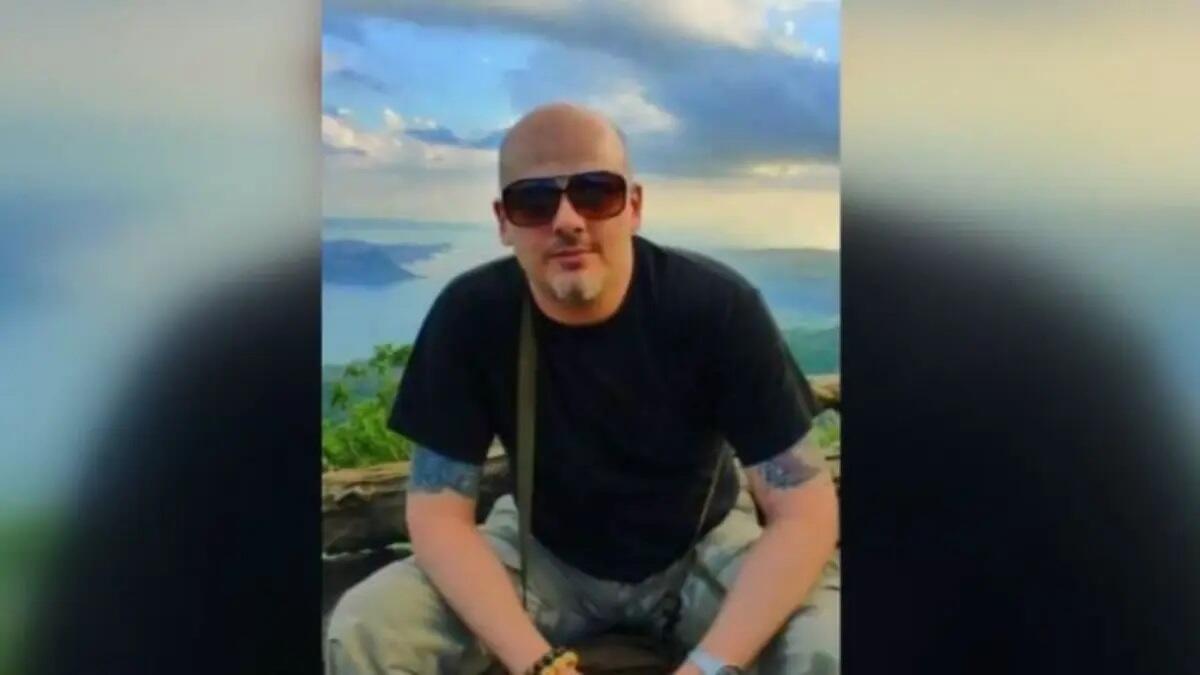
Mark Swidan spent over a decade in Chinese prison…

Image source: Fox News/Swidan Family

Both countries routinely spy on the other, and people in positions from academia to technology to engineering sometimes come under suspicion of espionage by either side. Stealing trade secrets and sensitive technology has been a pattern in recent years, especially by the Chinese side.

Tyler Durden
Wed, 11/27/2024 – 15:05

via ZeroHedge News https://ift.tt/mB5hCcD Tyler Durden