The Hatchet-Wielding-Hitchhiking-Murderer-Unsuccessful-Intellectual-Property-Litigant

From McGillvary v. Hartley, decided Tuesday by Judge Ashley Royal (M.D. Ga.):

Pro se Plaintiff Caleb McGillvary is currently serving a 57-year sentence for first-degree murder. In February, 2013, McGillvary rose to internet fame as the “hatchet wielding hitchhiker” after he gave interviews to a local Fresno, California KMPH Fox News TV reporter in which McGillvary described “smash, smash, suh-mash[ing]” Jett Simmons McBride three times over the head with a hatchet after McBride crashed his car into a group of pedestrians and attacked bystanders at the scene (“KMPH Clip”). Fresno authorities concluded that Plaintiff used justifiable force in protection of the bystanders and cleared him of any wrongdoing.

Three months later, after gaining media notoriety for viral news interviews and media appearances, including an interview on Jimmy Kimmel Live!, Plaintiff was arrested for and ultimately convicted of murdering Joseph Galfy, Jr., a New Jersey attorney. Plaintiff’s arrest was unrelated to the hatchet incident.

On January 10, 2023, Netflix released a documentary about McGillvary entitled The Hatchet Wielding Hitchhiker that described his background; interviewed those around him during his rise to fame; and detailed his subsequent murder conviction (the “Documentary”). Five days before the Documentary was released, on January 5, 2023, Defendants created and published an episode on their YouTube channel, “The Behavior Panel,” wherein they analyzed the KMPH Clip and made statements about Plaintiff based on their assessment of his body language and behavior (the “YouTube Video”). This suit arises out of the comments made in the YouTube Video….

There’s a lot more in the opinion, but here’s a short excerpt of the legal analysis:

Defamation …

Plaintiff alleges Defendants made 28 “slanderous and libelous statements with reckless disregard for and/or knowledge of their falsity, with actual malice intending the harm that would result therefrom.” Defendants’ allegedly defamatory statements include telling viewers they will analyze Plaintiff’s body language and behavior from the News Clip to determine whether Plaintiff is a “sociopath” or “psychopath”; commenting on Plaintiff’s “odd behavior for someone who’s killed somebody in the last three hours”; questioning whether Plaintiff has a “personality disorder” and lacks language and relationship skills; questioning the relationship between Plaintiff and McBride, the driver of the car, “be it a drug deal, be it a prostitution situation, whatever was happening there”; commenting that Plaintiff was trying to be a “hero”; calling Plaintiff a “drifter” and a “vigilante”; suggesting because Plaintiff stated in the News Clip he was from “Dogtown,” Plaintiff was “kind of suggesting that he’s a mutt out of the back streets … a bit of a mongrel from the backstreets”; opining that Plaintiff “probably has done some things. We know he gets convicted of murder later …. I don’t think what we’re seeing here is the Johnny Appleseed of goodness running around the country beating up bad guys. I think this was opportunistic…. I’m not sure whether this is a true story of being a savior or it was an opportune moment to be violent with somebody, if it indeed happened”; opining Plaintiff has “been in a whole lot more trouble than we’re aware of at this point with local authorities”; stating he was accused of “killing a guy he had consensual sex with”; and opining that Plaintiff and McBride got into a fight before McBride ran into the crowd of people. Plaintiff contends Defendants’ analysis falsely implies that he is a sociopath or psychopath; he killed someone within three hours before the news interview; he lacks the interpersonal skills, language capacity, and intelligence that would make him a good business partner or leader; he was criminally culpable in his use of force on McBride; he lied about the events and therefore committed perjury at McBride’s arraignment; he is “some kind of glory hog who interjected himself into the interviewer’s dialogue in an act of self-aggrandizement”; that people did not like him because he was a drifter; he promoted vigilantism; he was a prostitute who engaged in a “prostitution situation” with McBride; that his identity is synonymous with that of a mutt or mongrel from the backstreets; and that he engaged in a pattern of criminal activity before the incident….

Here, the context of Defendants’ statements establish that they are rhetorical hyperbole. All reasonable viewers understand Defendants’ comments as expressing their beliefs about Plaintiff’s actions based on their subjective assessments of his body language actions, not as literal assertions….

Misappropriation of Likeness …

“Georgia recognizes a right of publicity to protect against ‘the appropriation of another’s name and likeness … without consent and for the financial gain of the appropriator … whether the person whose name and likeness is used is a private citizen, entertainer, or … a public figure who is not a public official.'” …

“In order to navigate between the competing constitutionally protected rights of privacy and publicity and the rights of freedom of speech and of the press, the courts have adopted a ‘newsworthiness’ exception to right of publicity.” “[W]here an incident is a matter of public interest, or the subject matter of a public investigation, a publication in connection therewith can be a violation of no one’s legal right of privacy.” “[W]here a publisher may be precluded by the right of publicity from publishing one’s image for purely financial gain, as in an advertisement, where the publication is newsworthy, the right of publicity gives way to freedom of the press.” …

Here, all factors weigh against Plaintiff and establish that he cannot maintain a claim for a violation of his right to publicity as a matter of law. The YouTube Video did not intrude on Plaintiff’s private affairs; Plaintiff voluntarily placed himself in the position of public notoriety; and the information is a matter of public record. Defendants analyzed the KMPH news Clip, a matter of public record that Plaintiff acknowledges in his Amended Complaint went viral. There can be “no liability when the defendant merely gives further publicity to information about the plaintiff which is already public.” Plaintiff voluntarily placed himself before the public, allowing the news reporter to interview him and later voluntarily appearing on the late-night television show Jimmy Kimmel Live!. Indeed, Plaintiff acknowledges in his Amended Complaint that he is “famous and widely recognized.”

Plaintiff contends Defendants used his identity solely to further their own commercial efforts to market their YouTube channel and sell its products. But, having analyzed the Video, it is clear Plaintiff’s identity is not being used to sell a product in an advertisement. Defendants do not use Plaintiff’s identity on merchandise. And any use of Plaintiff’s identity to attract web traffic to Defendants’ YouTube channel is merely incidental to the use of Plaintiff’s identity. Defendants do not use Plaintiff’s identity to endorse or sell their products. The “fact that the publisher or other user seeks or is successful in obtaining a commercial advantage from an otherwise permitted use of another’s identity does not render the appropriation actionable.” …

[Trademark] …

Even assuming Plaintiff has a trademark ownership in the words “Smash, Smash, SUH-MASH!” and/or the moniker “Kai the Hatchet Wielding Hitchhiker,” Plaintiff cannot show consumers were likely to believe that Plaintiff approved, sponsored, was affiliated, or was the origin of the YouTube Video. The YouTube Video is not a copy of Plaintiff’s work. Defendants used the public KMPH news Clip to analyze Plaintiff’s body language and behavior….

“[L]ikelihood of confusion occurs when a later user uses a trade-name in a manner which is likely to cause confusion among ordinarily prudent purchasers or prospective purchasers as to the source of the product.” Plaintiff has not pled nor can he establish that any ordinarily prudent purchaser or prospective purchaser would have any confusion that Plaintiff approved, sponsored, endorsed, was affiliated, or was the source of Defendants’ YouTube Video analyzing his body language and behavior….

Copyright …

Plaintiff alleges he created and performed the “dramatic work and spoken words” he used during the KMPH news interview on February 1, 2013. He alleges he registered his copyright to the “dramatic work ‘Smash, Smash, SUH-MASH!'” …

[But plaintiff] has no ownership in the KMPH Clip…. “As a general rule, the author is the party who actually creates the work, that is, the person who translates an idea into a fixed, tangible expression entitled to copyright protection.” … Plaintiff was an interview subject of the KMPH news interview. He played no role in fixing the clip into tangible expression; KMPH employees “fixed” McGillvary’s performance—recording him using KMPH controlled and operated equipment. Plaintiff consented to the live media interview when speaking with the KMPH Fox News reporter, engaging in a question-and-answer format, wherein he recounted the events on February 1, 2013….

Defendants are represented by Pamela Grimes (Wilson, Elser, Moskowitz, Edelman & Dicker LLP).

The post The Hatchet-Wielding-Hitchhiking-Murderer-Unsuccessful-Intellectual-Property-Litigant appeared first on Reason.com.

from Latest – Reason.com https://ift.tt/C6WTOsw
via IFTTT
Boeing Gets Contract To Replace Bunker Busting Bombs The US Dropped On Iran

Boeing Gets Contract To Replace Bunker Busting Bombs The US Dropped On Iran

Authored by Dave DeCamp via AntiWar.com,

Boeing is set to receive a contract worth up to $123 million to replace the massive 30,000-pound bunker-busting bombs that the US dropped on Iranian nuclear facilities in June as part of the 12-day US-Israeli war against Iran, Bloomberg reported on Tuesday.

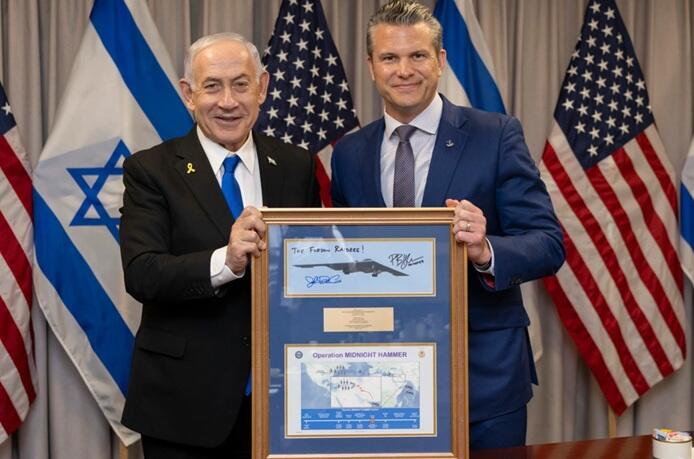
On June 22, US B-2 Spirit bombers dropped 14 GBU-57 Massive Ordnance Penetrator (MOP) bombs on Iran’s Fordow and Natanz nuclear sites, marking the first time the weapon was used in combat. A US submarine also fired Tomahawk missiles in strikes on an Iranian nuclear facility in Isfahan.

DoD image

The attack, dubbed “Operation Midnight Hammer,” was launched on behalf of Israel. The Bloomberg report said that a Pentagon budget document from August says that funds are being shifted from operations and maintenance accounts to Air Force munitions procurement as “funds are required to replace GBU-57 munitions expended in Operation Midnight Hammer in support of Israel.”

Replacing the MOPs is just a fraction of the cost of the war against Iran, as the US used a significant number of interceptors to defend Israel throughout the 12 days.

US officials told The Wall Street Journal that the US fired more than 150 THAAD interceptors during the war, accounting for about one-quarter of the Pentagon’s total stock of the interceptors and costing about $2 billion.

The US military also engaged in its largest use of Patriot missiles to repel the Iranian attack on the Al Udeid Air Base in Qatar, which Iran launched in retaliation for the bombing of its nuclear sites.

Bloomberg previously reported that the Pentagon was planning to spend at least $3.5 billion replenishing weapons it had used defending Israel before the 12-Day War.

Stillframe showing test of GBU-57 Massive Ordnance Penetrator (MOP)

Most of the cost was related to the US defense of Israel when Iran launched an attack in April 2024 in retaliation for Israel bombing its consulate in Damascus.

Tyler Durden
Thu, 10/02/2025 – 08:00

via ZeroHedge News https://ift.tt/72sQiDl Tyler Durden

Medvedev Again Trolls Trump: US Submarines A ‘Black Cat In A Dark Room’

Medvedev Again Trolls Trump: US Submarines A ‘Black Cat In A Dark Room’

Outspoken Russian hawk and firebrand Dmitri Medvedev has not stopped trolling Trump over the US nuclear submarine deployment, and the US President’s annoyance over the issue continues to show.

The former Russian president and current Security Council Deputy Chairman has said in fresh remarks tinged with sarcasm that the situation brings to mind the saying about a black cat in a dark room.

“Donald Trump is once again talking about the submarines he moved ‘over to the coast of Russia,” this time noting that they are ‘totally’ undetectable,” he wrote on social media.

That’s when he joked: “It’s hard to find a black cat in a dark room, especially if there is no cat” – suggesting the notion that American nuclear subs are patrolling waters off Russia is a ruse.

AFP/Getty Images

This was an apparent response to Trump’s words to a large gathering of US generals and admirals gathered from across the world at Quantico, wherein the US commander-in-chief boasted he had moved “a submarine or two” to the coast of Russia, before saying the word “nuclear” can never be said.

“I call it the N word. There are two N words, and you can’t use either of them,” he said. All of this hearkens back to the initial very public spat between Trump and Medvedev. To review of the early August exchange:

The day before, Trump had issued an ultimatum to Russia: If it does not agree to a ceasefire by next Friday, August 8, he will impose a package of economic sanctions.

The next day, Medvedev posted on social media, describing Trump’s threat as “a step towards war”. He wrote that Trump was “playing the ultimatum game with Russia”.

In a post on Truth Social, Trump responded: “Words are very important, and can often lead to unintended consequences, I hope this will not be one of those instances.”

Thankfully it has all so far been confined to social media barbs, and not any clear instance of either side’s strategic forces being placed on emergency alert.

The US Navy’s submarine fleet moves across the world mostly undetectable, and ideally at least – untraceable. But Medvedev is claiming Trump’s boasts concerning a pair of nuclear submarines is empty and without evidence.

However, hopefully he doesn’t provoke Trump too much at this ultra-sensitive moment of soaring tensions between Moscow and NATO. Of note is that Trump in his Tuesday speech at Quantico said that the US is about 20 years ahead of Russia in terms of nuclear technology and development.

Tyler Durden
Thu, 10/02/2025 – 07:15

via ZeroHedge News https://ift.tt/cfVkFCY Tyler Durden

D.C. Circuit Rejects Journalist’s Privilege Claim in Privacy Act Case Involving Fox News

From Chen v. FBI, decided Tuesday by D.C. Circuit Judge Gregory Katsas, joined by Judges Michelle Childs and Harry Edwards:

Yanping Chen alleges that federal officials violated the Privacy Act by disclosing records about her compiled as part of an FBI investigation. The records were published by Fox News. In discovery, Chen sought to compel Catherine Herridge—one of the journalists involved in publishing the records—to identify who had leaked them. Herridge invoked a First Amendment reporter’s privilege to avoid being compelled to testify….

{We recite the facts as alleged in the complaint. Yanping Chen was born in China. In 1987, she moved to the United States to study at George Washington University, from which she eventually obtained graduate degrees. Chen became a lawful permanent resident in 1993 and a citizen in 2001.

In 1998, Chen founded the University of Management and Technology (UMT), an educational institution headquartered in Arlington, Virginia. Until January 2018, UMT participated in the Department of Defense’s “Tuition Assistance Program,” which pays a portion of tuition expenses for military students.

In 2010, the Federal Bureau of Investigation began investigating Chen for statements made on her immigration forms. [Details omitted. -EV] In 2016, the U.S. Attorney’s Office for the Eastern District of Virginia decided not to file charges against Chen.

In 2017, Fox News aired a report alleging that Chen had concealed her prior work for the Chinese military. The network later published [various FBI documents]…. The print versions of these reports were authored by Catherine Herridge.

In 2018, DoD terminated UMT’s participation in the Tuition Assistance Program. That decision, along with a broader hit to UMT’s reputation, caused its enrollment and revenue to fall sharply. These losses impacted Chen’s income and the value of her personal investment in UMT.} …

In Zerilli v. Smith (D.C. Cir. 1981), this Court recognized a “qualified reporter’s privilege” based on the First Amendment. Where it applies, the privilege allows reporters to resist civil discovery into the identity of their confidential sources. We identified two considerations as being “of central importance” in determining whether the privilege applies—the litigant’s “need for the information” and her efforts “to obtain the information from alternative sources” [the latter being called the “exhaustion requirement”-EV] We further noted that the “equities weigh somewhat more heavily in favor of disclosure” if, as in libel cases, the journalist is a party and successful assertion of the privilege “will effectively shield him from liability.” …

In Lee v. Department of Justice (D.C. Cir. 2005), this Court held that a litigant may overcome the privilege by showing centrality and exhaustion—even in a case where the reporter is not a party. Like this case, Lee involved an appeal by non-party journalists held in contempt for refusing to identify their confidential sources in Privacy Act litigation.

Applying Zerilli‘s “two guidelines [for] determining when a court can compel a non-party journalist to testify about a confidential source,” we held that the district court had not abused its discretion in requiring the reporters to testify. First, the plaintiff had shown that the information he sought went to the “heart” of the case, given the difficulty in proving intent or willfulness without knowing the identity of the leakers. Second, by deposing numerous witnesses before seeking to compel the reporters’ testimony, the plaintiff had met his burden to exhaust reasonable alternative sources of information.

For the Lee Court, that was the end of the matter. We expressly declined to engage with Zerilli‘s distinction between journalists who are parties to a lawsuit and those who are not, since all the journalists in the case before the court were non-parties. And in response to an objection that we were leaving journalists without enough protection, we explained that a litigant’s power to subpoena a journalist remains constrained by the requirements of centrality and exhaustion, which are not perfunctory, and by “the usual requirements of relevance, need, and limited burdens on the subpoenaed person” embodied in federal procedural and evidentiary rules….

On appeal, Herridge does not contest the district court’s determination that Lee‘s centrality and exhaustion requirements for overcoming the privilege were satisfied. Herridge nonetheless asks us to rule in her favor because … Chen’s Privacy Act claim is frivolous or meritless ….

We reject Herridge’s contention that the Privacy Act claim here is frivolous. Herridge presses two main points: “most” of Chen’s alleged damages were caused by DoD’s independent decision to cut off funds to UMT, and “almost all” of Herridge’s reporting came from sources other than Privacy Act information. But “most” is not all, and Chen does seek damages not flowing from a loss of business after DoD severed its ties with UMT.

Likewise, even if Herridge collected “almost all” of her information from material that was already in the public domain, Chen plausibly alleges that some of it had to have come from Privacy Act violations—such as the disclosure of photographs seized from Chen’s home during the FBI search. And so long as Chen establishes that some Privacy Act violation harmed her, she may recover actual or statutory damages if it was willful….

Herridge more broadly urges that Chen’s claim is simply not that important. In Herridge’s view, regardless of centrality and exhaustion, the reporter’s privilege should prevail if a court determines that the social importance of the news story outweighs the plaintiff’s personal interest in vindicating her claim. Here, for example, Herridge argues that “the public’s interest in protecting journalists’ ability to report without reservation on sensitive issues of national security” should outweigh Chen’s merely private interest in recovering perhaps as little as $1,000 in statutory damages.

Herridge’s proposed balancing test echoes the view advanced by the judges dissenting from denial of rehearing en banc in Lee. As they were in dissent, we are left simply to apply the Lee panel opinion…. Lee held that a district court permissibly found a reporter’s privilege overcome based on findings of centrality and exhaustion in a Privacy Act case, without any broader balancing of private and public interests. And that suffices to foreclose Herridge’s privilege claim here….

Finally, Herridge urges us to recognize, as a matter of federal common law, a reporter’s privilege broad enough to permit the case-by-case interest balancing urged by the Lee dissentals. We decline this invitation to end-run our precedent.

Rule 501 of the Federal Rules of Evidence authorizes federal courts to recognize new privileges “in the light of reason and experience.” But Herridge has provided little cause to think that “reason and experience” support the privilege that she propounds. As to reason, the First Amendment analysis in cases like Zerilli and Lee thoroughly lays out the competing considerations of encouraging newsgathering while also respecting the elemental principle that “the public has a right to every man’s evidence.”

As to experience, Herridge contends that virtually every state has recognized some form of a reporter’s privilege. She attached to her opening brief a chart summarizing the relevant law in every state. But as this chart demonstrates, the privilege varies widely in its scope from state to state, both in the abstract and on the question whether case-by-case interest balancing is appropriate. In short, if the First Amendment itself does not entitle Herridge to disobey discovery obligations imposed on every other citizen in the circumstances of this case, we see little reason to create that entitlement as a matter of judge-made common law.

Andrew Phillips represents Chen.

The post D.C. Circuit Rejects Journalist's Privilege Claim in Privacy Act Case Involving Fox News appeared first on Reason.com.

from Latest – Reason.com https://ift.tt/g6xAi7I
via IFTTT

After 20 Years as Chief Justice, John Roberts Is Now Friend and Foe to Executive Power


A black and white image of John Roberts in the foreground and the United States Supreme Court building in the background | Illustration: Eddie Marshall | BONNIE CASH | UPI | Newscom | Midjourney

It has now been just a little over 20 years since John Roberts was sworn in as chief justice of the United States back on September 29, 2005. So let’s mark this two-decade milestone by taking a closer look at Roberts’ jurisprudence and the mark it has left on American law, especially when it comes to the powers of the president.

Characterizing Roberts’ judicial philosophy is no simple task. Is it accurate to say that he practices judicial restraint by deferring to the policy choices made by elected officials? Yes, we can accurately say that, but only sometimes.

In one of his most famous majority opinions, Roberts led the Supreme Court in upholding the Patient Protection and Affordable Care Act, also known as Obamacare. “It is not our job,” Roberts declared in National Federation of Independent Business v. Sebelius (2012), “to protect the people from the consequences of their political choices.” In other words, the argument went, because Obamacare represented the will of the people as expressed via the agenda of a popularly elected president, the unelected judiciary had no business standing in the way.

Yet Roberts has also led the Supreme Court in thwarting the agendas of popularly elected presidents in other high-profile cases. In Department of Homeland Security v. Regents of the University of California (2020), Roberts wrote the majority opinion stopping President Donald Trump from rescinding the Deferred Action for Childhood Arrivals (DACA) program. In Biden v. Nebraska (2023), Roberts blocked President Joe Biden from imposing his student debt cancellation plan. No deference for either president in those important cases.

But Roberts has also led the Supreme Court in massively expanding executive power, most notably in Trump v. United States (2024), which granted the president broad immunity from criminal prosecution.

So, while both Biden and Trump saw some of their signature presidential policies struck down, the signature policy of President Barack Obama was upheld on deferential grounds, and the presidency itself has emerged stronger than ever in other crucial ways, all thanks to decisions written by Roberts.

Is there a through line connecting such cases? Is there a clear judicial philosophy that accounts for the results? I’ve been following Roberts’s tenure for much of the last two decades, and I’m not sure that there is. Roberts has long extolled the virtues of judicial deference, yet he only does the deferring in select cases. Roberts has put a stop to presidential overreach (sometimes), yet he has also placed a vast protective shield over presidential misconduct. To be generous, I suppose we might say that Roberts’s judicial philosophy contains multitudes.

Next week, the Supreme Court will kick off its 2025–2026 term, and the docket is already packed with momentous cases dealing with the powers of the president. That means that all eyes will be on the chief justice, who may well be in the position to tip the balance in one or more of these matters.

Will we get the version of Roberts that’s more likely to defer to Trump or the one that’s more likely to curtail Trump? Which one of Roberts’s judicial multitudes will step to the fore?

For better or worse, we’re about to find out.

The post After 20 Years as Chief Justice, John Roberts Is Now Friend and Foe to Executive Power appeared first on Reason.com.

from Latest – Reason.com https://ift.tt/ODxJosv
via IFTTT

Tether Expands Hard Asset Strategy With More Bitcoin, Gold, And Land

Tether Expands Hard Asset Strategy With More Bitcoin, Gold, And Land

Authored by Will Izuchukwu via TheMerkle.com,

Tether has purchased another 8,888 BTC, increasing its total on-chain holdings to 86,335 BTC. At current prices, that’s worth over $9.7 billion, according to CoinMarketCap.

The company, however, claims its real stash is much larger. Tether reports holding over 100,000 BTC along with 50 tons of gold. It has also committed 15,000 BTC into Bitcoin XXI, a treasury management firm focused on Bitcoin strategies.

This steady accumulation shows how Tether is doubling down on Bitcoin as a reserve asset. While most stablecoin issuers remain tied to U.S. Treasuries, Tether is openly diversifying into scarce digital and physical stores of value.

Investment in South American Agriculture

Beyond Bitcoin, Tether has been moving aggressively into traditional hard assets. The company owns 70% of Adecoagro, a major agricultural group in South America.

Adecoagro operates more than 210,000 hectares of farmland across Argentina, Brazil, and Uruguay. The land produces crops, dairy, and bioenergy, giving Tether direct exposure to food production and commodities.

This move highlights a long-term play. Instead of only relying on cash reserves, Tether is positioning itself in sectors that generate real-world value. Owning farmland in some of the most fertile regions of the world aligns with the company’s strategy to hedge against inflation and currency volatility.

A Push Into Hard Assets

This accumulation of Bitcoin, gold, and farmland fits a clear pattern. In May, Tether reported holding 100,000 BTC and 50 tons of gold in reserves. The firm has been public about its desire to move beyond just U.S. Treasuries and money market funds.

For Tether, hard assets mean stability. Bitcoin offers scarcity in the digital realm. Gold provides centuries of recognition as a safe haven. Land, particularly farmland, delivers both security and productive yield. Together, these holdings paint a picture of a company preparing for long-term resilience.

Stablecoin Market Nears $300 Billion

While Tether diversifies reserves, the broader stablecoin market is also expanding fast. According to data shared, stablecoin supply is on track to approach $300 billion.

This growth has been fueled by supportive policies from the new crypto-friendly administration in Washington. Regulators are encouraging integration of stablecoins into global finance, making them a key liquidity tool for crypto adoption.

More issuance means more liquidity. And more liquidity tends to boost trading volumes, DeFi activity, and token valuations. For Tether, which remains the largest stablecoin issuer, this environment provides a strong foundation to expand its influence.

Tether’s Strategy Compared to Rivals

Tether’s approach stands out compared to competitors. Other issuers like Circle focus mainly on short-term Treasuries and cash equivalents. Tether, however, is building a diversified portfolio of both digital and physical assets.

By doing so, it positions itself not only as a financial player but also as a resource-backed institution. This strategy can help protect USDT holders against systemic risks while creating long-term value.

Tether’s CEO has consistently argued that the company does not want to rely solely on the U.S. financial system. The investments in gold and farmland prove this point. The purchase of additional Bitcoin reinforces it further.

 Why It Matters for Crypto Markets

Tether is more than just a stablecoin issuer. With USDT commanding the highest market share in the sector, its balance sheet decisions carry weight for the entire crypto ecosystem.

When Tether buys Bitcoin, it reduces supply on the market. When it invests in farmland or gold, it signals confidence in real-world hard assets. These moves can influence not only investor sentiment but also broader discussions on what makes a reserve truly “stable.”

The stablecoin sector now represents a critical backbone of crypto liquidity. If Tether’s hard asset strategy proves successful, other issuers may follow. That could shift the reserve composition of the entire industry away from being dollar-centric toward more diversified, global holdings.

Tether’s next steps will be closely watched. Will the company continue scaling its Bitcoin reserves past 100,000 BTC? Will it increase gold holdings beyond 50 tons? Could it expand farmland operations to other regions?

For now, the pattern is clear. Tether is building a reserve that blends digital scarcity, natural resources, and financial instruments. The result is a hybrid model, part crypto-native, part old-world stability.

As the stablecoin market edges closer to $300 billion, Tether is ensuring that it remains more than just a liquidity provider. It is positioning itself as a heavyweight treasury with hard assets at its core.

For crypto investors, this strategy underlines a broader message: stability in the future may not come from dollars alone, but from a mix of Bitcoin, gold, and land.

Tyler Durden
Thu, 10/02/2025 – 06:30

via ZeroHedge News https://ift.tt/DgdUz1p Tyler Durden

Germany Says It Busted Up Hamas Terror Plot Targeting Jews

Germany Says It Busted Up Hamas Terror Plot Targeting Jews

German prosecutors announced in a statement Wednesday that authorities have apprehended three suspected Hamas members who were allegedly procuring weapons “for assassinations targeting Israeli or Jewish institutions.”

The trio has been charged with membership in a foreign terrorist organization and preparing an act of violence endangering the state, in a somewhat rare case, given Hamas does not tend to operate transnationally – especially in moments of direct, intensified war with the Israel Defense Forces (IDF).

However, the three – so far only identified by the first names and last initials, are not Palestinian. Two are said to be German, while the third was born in Lebanon. They are set to appear before a judge on Thursday.

Via Reuters

The men identified as Abed Al G, Wael F M and Ahmad I were arrested in Berlin, which notably came a day before Yom Kippur, the holiest day of the Jewish calendar.

CNN has cited a prosecutor statement as saying, “Since at least the summer of 2025 the three have been involved in procuring firearms and ammunition” for Hamas.

Police found “various weapons, including an AK 47 assault rifle and several pistols, and a considerable amount of ammunition.” during raids on their homes during the arrest.

By this statement, it doesn’t appear as if they had yet acquired too big of an arsenal, but the prospect of random acts of terror and the potential for mass shootings by Islamist operatives remains a significant danger to Europe.

Interestingly, Hamas is not claiming responsibility for the alleged attack plot, but has instead denied that these men are its operatives and rejected that it conducts attacks on European soil:

Hamas said in a statement that the allegations against it were “baseless” and aimed to “undermine the German people’s sympathy for the Palestinian people”.

The group added that it had a policy of limiting its activities to what it considers Palestinian territory.

Back in December 2023, German and Dutch authorities arrested four people accused of plotting to attack Jewish institutions in Europe – but in such instances it remains murky whether the plotters were directly members or Hamas or else ‘Hamas-inspired’ or loosely linked.

Hezbollah too, out of Lebanon, is a group which is not known for conducting attacks on an international level, but typically stays confined to south Lebanon or the Mideast region, carrying out anti-Israel operations and missile strikes along the border.

Tyler Durden
Thu, 10/02/2025 – 05:45

via ZeroHedge News https://ift.tt/dPwWQeN Tyler Durden

Netherlands’ Top Pension Fund Dumps Caterpillar Over Gaza Demolitions

Netherlands’ Top Pension Fund Dumps Caterpillar Over Gaza Demolitions

Via The Cradle

The Netherlands’ largest pension fund, ABP, announced Wednesday that it had divested from US manufacturer Caterpillar, citing concerns over the use of its equipment by Israeli forces in Gaza.

ABP, which manages investments on behalf of three million government and education employees, confirmed it had sold its stake worth around $454 million as of late March.

Getty Images

“Our investment approach must ensure good returns while being socially responsible,” the fund said in a statement to AFP.  It added that when companies fail to meet its standards, discussions are held, but “if these do not lead to the desired results, ABP will stop investing in these companies.”

While declining to disclose decisions about individual firms, ABP acknowledged that “the composition of our investment portfolio is evolving, particularly in Israel–Gaza.” AFP said Caterpillar had been contacted for comment but offered no response.

The Dutch fund’s withdrawal came as European institutions were intensifying divestments from companies tied to Israel’s genocide in Gaza and its settlement drive in the occupied West Bank.

In late August, Norway’s $2-trillion sovereign wealth fund – the largest in the world – announced it had excluded Caterpillar and five Israeli banks after an ethics review concluded they were enabling grave violations of international law. 

The Council on Ethics said Caterpillar’s bulldozers and heavy machinery were deployed in “extensive and systematic violations of international humanitarian law,” including the destruction of Palestinian homes and property

It stressed that Caterpillar had failed to act against the weaponization of its equipment. The same review led to the exclusion of Hapoalim, Leumi, Mizrahi Tefahot, First International Bank of Israel (FIBI), and FIBI Holdings for underwriting and financing settlement construction, described as a “necessary prerequisite” for sustaining an illegal occupation.

Fund chief Nicolai Tangen described the divestments as “extraordinary measures” taken in response to the worsening humanitarian disaster in Gaza. He noted that exposure to Bet Shemesh Engines – a jet engine manufacturer servicing Israeli warplanes bombing Gaza – had triggered the review. 

President Trump has openly criticized nations and funds that boycott the Texas-based company.

Norwegian Prime Minister Jonas Gahr Store called the investment “worrying.” Earlier in August, the Norwegian fund confirmed it had already dropped 11 Israeli companies, underscoring a broader retreat by European investors from firms complicit in Israel’s military campaign and settlement expansion.

Tyler Durden
Thu, 10/02/2025 – 05:00

via ZeroHedge News https://ift.tt/0YRMASW Tyler Durden

Iran Says No Limits On Missile Program After Europe Demands It Curb Reach

Iran Says No Limits On Missile Program After Europe Demands It Curb Reach

Amid UN snapback sanctions targeting Tehran, Europe has also been calling for Iran to curb its missile program, but obviously the country just came under unprovoked Israeli and US attack last June, and launched dozens or possibly hundreds of ballistic missiles on Tel Aviv and other locations in Israel.

“Our missiles will reach the range that they need to,” a military official on behalf the elite Islamic Revolutionary Guard Corps (IRGC) has responded, according to Fars news agency.

Deputy commander of the Khatam al-Anbiya Central Military Headquarters, Mohammad Jafar Asadi, indicated Wednesday said Tehran would increase the range of its missiles “to wherever necessary” in order to do whatever it takes to defend the country.

He described further that “with the resources we have, we are 100% ready; however we will not be the first to start a war, but if anyone invades our country we will respond decisively.”

Source: West Asia News Agency

And in particular he responded to European demands to place more limits on the range of its missile arsenal by saying, “I can only say they were wrong” to issue such demands.

Mideast analysts have recently speculated that Israel could be preparing for another attack on Iranian missile and nuclear sites, though Netanyahu is unlikely to want to anger Trump, or engage in any new strikes without his approval. Trump has hailed his ‘truce’ deal which ended the 12-day June war, and probably doesn’t want to jeopardize it.

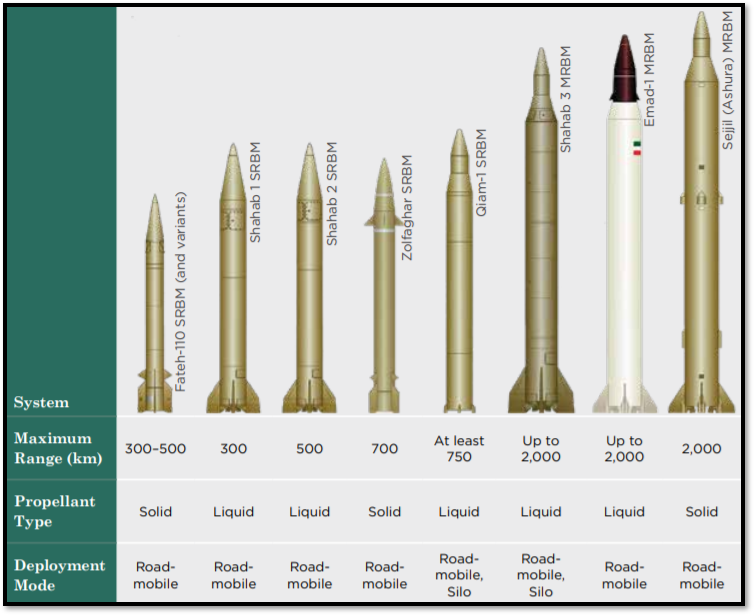
It’s widely believed that Iranian missiles have a maximum range of 2,000 km, which covers the distance to Israel – Iran’s number one foe – but the Iranians are hinting at increasing this range. For example, missiles launched from the eastern half of the country, which are more protected from Israeli attacks, would of necessity be extended in range.

A recent missile tests suggests that the Iranians are indeed moving forward with extending the ranges of their missiles, as the Washington think tank FDD observes:

Late last week, Iranians took to social media to post pictures and video of what appeared to be the plume, or the high-temperature exhaust gases, of a ballistic missile in flight. The unpublicized nature of the launch by Iranian authorities, coupled with various images of the projectile’s odd trajectory, led to a guessing game as to whether the test failed and what kind of projectile was deployed. Was this an older missile with a poor flight-test track record, a newer missile with a different warhead, a space-launch vehicle (SLV), or, as one parliamentarian alleged, an intercontinental ballistic missile (ICBM)?

More recent open-source analysis indicates that the launch was an SLV test from a known space launch pad in Semnan province, while the projectile’s white plume points to the use of solid-propellant, a type of fuel for missiles that Israel targeted in the past due to its military utility.

Several angles of the projectile’s flight path, coupled with images of small bursts of smoke seen dotting the sky, hint at a technical malfunction, namely combustion issues. But even a failed test provides Tehran with information about the performance and reliability of its projectiles, while also signaling a continued interest in growing its missile program following the 12-Day War with Israel.

Like Israel, the Islamic Republic is seeking to rapidly replace the firepower it lost due to missile exchanges with Israel this past summer. FDD continues:

Beyond serving as the delivery vehicle for a potential nuclear weapon, Iran’s ballistic missiles play a key role in the Islamic Republic’s defense and security strategy, enabling it to deter and coerce adversaries. According to U.S. intelligence estimates, Tehran has long been home to the largest arsenal of ballistic missiles in the Middle East, most of which are road-mobile and stored in underground bunkers dispersed across Iran. Prior to the 12-Day War, Iran possessed an arsenal of roughly 2,500-3,000 ballistic missiles of various ranges and propellant types, as well as around 300-400 transporter erector launchers (TELs) used to move and fire these weapons.

After the war, Iran’s launchers and missiles were cut by roughly half, with a TEL count now estimated at 150-200, and an overall ballistic missile stockpile of about 1,300-1,500. Recent reports indicate that Iran is undertaking a sustained effort to restore its ballistic missile production facilities that Israel destroyed.

Recent past: DIA estimate of Iran’s missile inventory (2019)

The Europeans led the way to impose snapback sanctions on Iran last week related to its nuclear program, leaving Tehran outraged, and so at this point it has little incentive to conform to Western demands. Instead it has every reason to want to bulk up its missile program, for the next potential round of fighting with Israel, amid continued tensions.

Meanwhile, US Treasury Secretary Bessent says that Treasury is targeting “Iranian weapons procurement networks that help maintain its ballistic missile and military aircraft program” in new punitive US action.

Tyler Durden
Thu, 10/02/2025 – 04:15

via ZeroHedge News https://ift.tt/qciHOug Tyler Durden