Stocks Hit Record Highs Around The Globe As AI Mania Hits Escape Velocity

Stocks Hit Record Highs Around The Globe As AI Mania Hits Escape Velocity

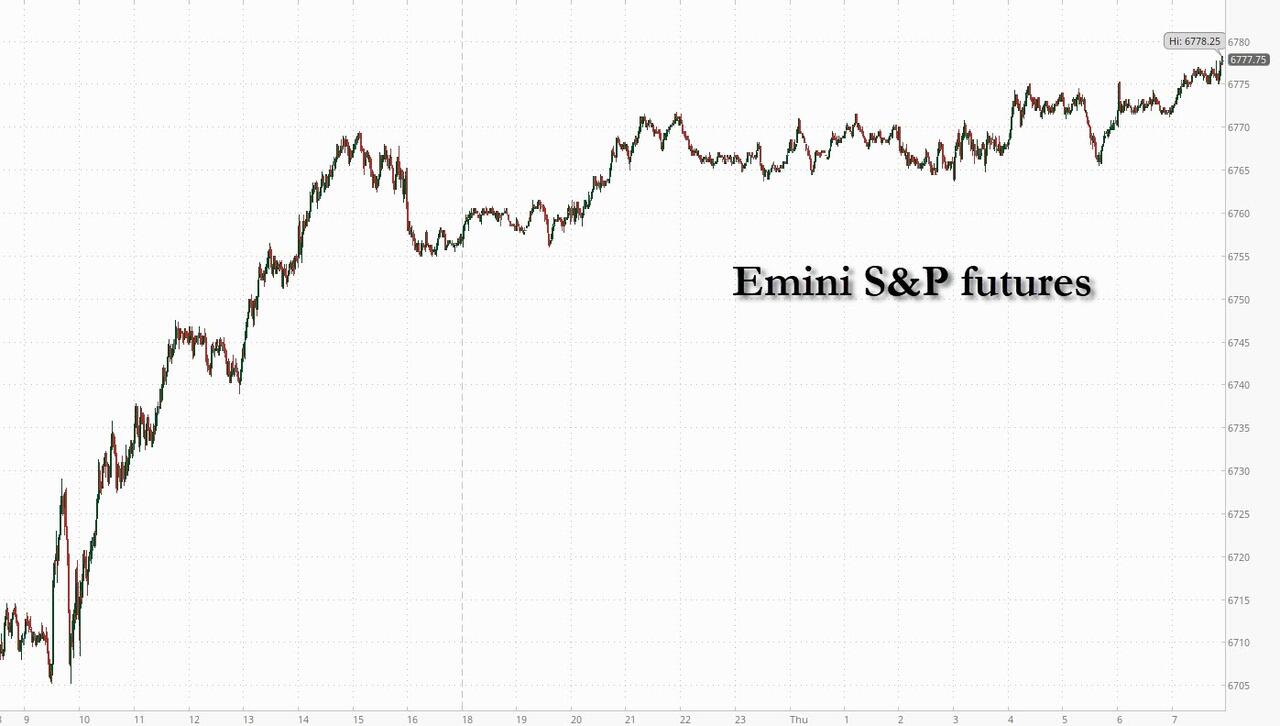
US equity futures are higher with tech and small caps both outperforming as the screaming AI euphoria drove global indexes to fresh highs after an OpenAI share sale valued the company at an eye-popping $500 billion, catapulting the firm to become the world’s most valuable startup, surpassing SpaceX. As of 8:00am ET,  S&P futures were 0.2% higher, trading at a fresh all time high, and Nasdaq 100 futures climbed 0.5%, putting the gauge on track for a fifth straight gain. Pre-market, Mag7 tech are mostly higher led by NVDA (+1.3%) and TSLA (+1.5%); global chipmakers soared and energy REIT Fermi jumped for a second day after its IPO. We have also seen overnight outperformance in both European and Asian markets despite relatively muted incremental news flows: Europe’s Stoxx 600 also hit a record after rising 0.8%, led by an advance of more than 2% in technology shares. In Asia, equities rose past last month’s record close as chipmakers rallied. MSCI’s global index also notched a fresh high. Bond yields are unchanged; USD is lower; Oil is lower, while metals are higher. Today’s Initial and Continuing Claims data will be delayed due to the shutdown; we should get the final August Durables/Factory orders prints at 10am.
In premarket trading, Mag7 stocks are mostly higher (Tesla +1.7%, Nvidia +1.3%, Meta +0.7%, Apple +0.4%, Amazon +0.3%, Alphabet -0.09%, Microsoft -0.2%).

  • Absci (ABSI) is up 4% after JPMorgan initiates at overweight, saying the biotech company’s unique expertise in the computational space could change how new therapeutics are found.
  • AngioDynamics (ANGO) rises 11% after the medical-device maker boosted its net sales guidance for the full year.
  • Edison International (EIX) falls 1.8% after Jefferies downgraded the utility to hold, citing a higher risk profile.
  • Equifax (EFX), a credit-reporting company, drops 11% and TransUnion (TRU) falls 10% after Fair Isaac Corp. announced a new program giving mortgage lenders the option to calculate and distribute FICO scores directly to customers. Shares of Fair Isaac Corp. (FICO) are up 20%.
  • Fermi (FRMI) rises 16% after the Texas-based real estate investment trust rallied 55% in its market debut on Wednesday.
  • Shoals Technologies Group Inc. (SHLS) climbs 8% after Barclays upgraded the renewable-energy equipment company to overweight, citing growth potential.
  • Stellantis (STLA) gains 7% after the maker of Jeep SUVs reported a gain in third-quarter US deliveries, sparking optimism on the group’s turnaround prospects.

The US govt shutdown quietly entered its shutdown for a second day and markets could care less. Strategists noted that past shutdowns have typically had little macroeconomic impact, and judging by recent history, have actually pushed stocks higher. At a White House press conference on Wednesday, Vice President JD Vance said he doesn’t anticipate a long shutdown, adding that layoffs will come if it lasts for days or weeks. 

“This is all very much a storm in a teacup,” wrote Michael Brown, a senior market strategist at Pepperstone. “The government has shut down 20 times in the past, and reopened 20 times as well – this time will not be different.”

OpenAI’s valuation soared to $500 billion after current and former employees sold about $6.6 billion of stock. In wave of good news that swept along semiconductor and AI companies, the ChatGPT owner also forged agreements with South Korean firms. Separately, OpenAI also released a social app for sharing AI Videos and inked a deal with Samsung and Hynix to supply its ambitious Stargate datacenter project. Apple has paused a planned overhaul of its Vision Pro headset to focus on developing smart glasses that can rival Meta’s products.

The AI boom has powered global stocks to successive highs, with a resumption of interest-rate cuts and resilient earnings adding to the bullish momentum. For now, investors also see limited risk from the political impasse in Washington, which has triggered the first government shutdown in nearly seven years.

“The tech sector is so large and it’s doing so well,” said Marija Veitmane, senior multi-asset strategist at State Street Global Markets. “The reason the market is prepared to pay those high valuations for the tech sector is really because we don’t see good growth opportunities outside tech.”

In the latest tariff news, the EU plans to hike duties on its steel imports to 50%, according to a draft proposal. As for macro data, the government shutdown and other challenges at the government statistics bureaus means clear signals about the economy are difficult to assess. 

A relentless buying spree in US equities dominated quarter-end pension rebalancing, overwhelming projected net selling, according to the trading desk at Goldman Sachs. Bank of America derivatives strategists see scope to use options to bet on further gains for tech. If a 45% rally in the sector since early April looks like a bubble, it probably won’t burst any time soon, they said. Also top of mind is the fast-approaching 3Q reporting season. Earnings outlook momentum remains positive although has trended lower in recent weeks, according to Citi’s earnings revisions index.

Turning to the data, the Bureau of Labor Statistics’ nonfarm payrolls data on Friday will likely be delayed, as well as the weekly initial jobless claims numbers usually due Thursdays. Still, figures from outplacement firm Challenger, Gray & Christmas showed US employers dialed back hiring plans in September, even though they also announced fewer job cuts. Even without the data however, money markets are almost fully pricing a quarter-point Fed cut at the end of the month and see an 80% chance of another in December to support the labor market.

“If you really dig into the labor market data, it’s not just an AI structural story, it’s not just a lower immigration story, you are seeing that cyclical demand weakness,” Kim Crawford, global rates portfolio manager at JPMorgan Asset Management, told Bloomberg TV. “The clearest part to this puzzle is wage growth, there is a lack of wage growth in the US.”

European stocks rally to a new record on a boost for tech and car stocks. Tech optimism is bolstered by OpenAI raising funds to value the firm at $500 billion. The Stoxx 600 is up 0.7% and the Euro Stoxx 50 by 1.3% while a gauge of EM stocks hit the highest since 2021 on the AI-driven optimism. Here are some of the biggest movers on Thursday:

  • Stellantis shares gain as much as 7.6% in Milan after the maker of Jeep SUVs reported a gain in third-quarter US deliveries, sparking optimism about turnaround prospects.
  • European semiconductor stocks lead a broader market rally on Thursday, following gains among US peers late in Wednesday’s trading.
  • Rational shares rise as much as 7.4% after the professional kitchen equipment maker was upgraded by Barclays on valuation grounds, while Bernstein lifted its price target to a new Street-high.
  • Tesco shares rise as much as 4.2% after Britain’s biggest supermarket reported first-half profit that beat estimates and boosted its adjusted operating profit forecast for the year.
  • Hochtief gains as much as 6.8%, hitting a new record high, as BofA double-upgrades to buy from underperform, citing the construction and infrastructure firm’s attractive growth story.
  • Novo rises as much as 4.8% while Roche gains as much as 1.5% after the pair were upgraded to buy from hold at HSBC, while AbbVie was downgraded to a hold from buy.
  • Piaggio shares gain as much as 5.2%, the most since late July, after Italian Cycle and Motorcycle Association data showed a rebound in the two-wheeler market.
  • Sobi climbs as much as 5.2%, in a fourth straight day of gains, as Danske Bank says there may be scope for the Swedish biopharma company to upgrade its guidance at the upcoming third-quarter results.
  • Morgan Sindall jumps 13% to a record high as the construction group says it is performing “significantly ahead of previous expectations” after business at its Fit Out division continued to strengthen.

Earlier in the session, Asian shares advanced for a fourth day, turbocharged by technology firms after a deal between OpenAI and South Korean chipmakers brightened the outlook of artificial intelligence. The MSCI Asia Pacific Index rose as much as 1.2%, the most in nearly four weeks. TSMC was among the biggest contributors, along with Alibaba and SK Hynix.  The Kospi was the region’s top performer, jumping 2.7% to a fresh record, following Samsung Electronics and SK Hynix’s deal to supply chips to OpenAI’s Stargate project. Benchmarks in Taiwan, Australia and Singapore all climbed over 1%. The tech rally has been underpinning the recent strength of Asian stocks, as investors brushed off geopolitical risks and the first US government shutdown in seven years. An informal survey by Bloomberg also shows that strategists expect the region to outperform the US in the current quarter on attractive valuations and earnings prospects. Chinese stocks listed in Hong Kong jumped as trading resumed after a public holiday. Alibaba was among the lead gainers after JPMorgan boosted its price target by 45%, citing an improved outlook for cloud revenue and growing synergy between its AI and e-commerce operations. Mainland Chinese and Indian markets were shut for a holiday.

In FX, the Bloomberg Dollar Spot Index down 0.2%; kiwi and the yen outperforming.

In rates, treasuries mostly held Wednesday’s gains, with the yield on 10-year notes steady at 4.09%. After Fed rate-cut expectations pulled yields down from January’s high near 4.80%, traders are now contending with a temporary blackout in economic data amid the government shutdown.

In commodity markets, gold extended its record-breaking rally while oil fell for a fourth consecutive day. West Texas Intermediate slid toward $61 a barrel, touching the lowest level in four months as expectations of OPEC+ restoring more idled supply deepened fears of a global glut. 

Looking at today’s calendar, the 8:30am jobless claims data will be delayed. Factory orders, durable goods and cap goods for August are all due at 10 am New York, but the government shutdown may affect the release of economic data

Market Snapshot

  • S&P 500 mini +0.1%
  • Nasdaq 100 mini +0.3%
  • Russell 2000 mini +0.3%
  • Stoxx Europe 600 +0.7%
  • DAX +1.3%
  • CAC 40 +1.1%
  • 10-year Treasury yield -1 basis point at 4.09%
  • VIX -0.2 points at 16.06
  • Bloomberg Dollar Index -0.2% at 1198.34
  • euro +0.2% at $1.1757
  • WTI crude -0.5% at $61.48/barrel

Top Overnight News

  • The shutdown entered a second day with little sign of a breakthrough. The White House is looking to cancel infrastructure projects in Democratic-leaning states. Jobless claims data won’t be released today, a Labor Department spokesman said. BBG
  • The US will lose $15 billion in GDP each week during a shutdown, Politico reported, citing a White House memo. BBG
  • Global chipmakers saw their market value soar as investors rushed to get exposure to artificial intelligence, the latest sign of a frenetic bull run that is pushing tech stocks to all-time highs. The combined market capitalization of the Philadelphia Stock Exchange Semiconductor Index and a gauge tracking Asia chip stocks went up by just over $200 billion in the latest session. BBG
  • Trump said Wednesday that soybeans will be a “major” topic in his meeting with Chinese counterpart Xi Jinping later this month, pledging aid for American farmers after Beijing halted purchases of the staple amid trade tensions. Nikkei
  • OpenAI’s valuation reached $500 billion, a person familiar said, surpassing SpaceX as the world’s largest startup. Employees sold about $6.6 billion of stock to investors including Joshua Kushner’s Thrive Capital and SoftBank. BBG
  • Apple (AAPL) has shelved its headset revamp to prioritise Meta-style AI glasses: Bloomberg.
  • The U.S. will provide Ukraine with intelligence for long-range missile strikes on Russia’s energy infrastructure, American officials said, as the Trump administration weighs sending Kyiv powerful weapons that could put in range more targets within Russia. WSJ
  • The EU is planning to join US and Canadian efforts to tackle cheap Chinese steel imports by reducing import quotas and increasing tariffs. The European industry commissioner promised industry bosses and unions to levy tariffs of up to 50% on foreign steel at an emergency meeting on Wed. FT
  • Japanese business mood is improving and corporate profits remain high even as U.S. tariffs weigh on exports, Bank of Japan Deputy Governor Shinichi Uchida said, signalling confidence that conditions for another interest rate hike was falling into place. RTRS
  • Japan’s bonds fell after an auction of 10-year notes saw the bid-to-cover ratio drop from last month, in a show of weak demand. BBG
  • Fed’s Goolsbee (2025 voter) said he is starting to get more concerned about inflation moving the wrong way and that counting on it being transitory makes him nervous. He noted that with the BLS down, there are limited indicators on inflation, said he hopes tariff impacts will prove transitory, and added that while the underlying economy is strong enough to allow rates to come down a fair amount, the Fed should be careful: RTRS
  • Trump’s Administration is reportedly working with Pharma, AI, Energy, Ship Building, Battery Products and other sectors: Reuters 

US Govt Shutdown

  • US President Trump plans to cancel Western hydrogen hubs amid the government shutdown fight, according to Bloomberg.
  • US President Trump posted that Republicans must use the Democrat-forced closure to clear out dead wood, waste, and fraud, adding that billions of dollars can be saved, via Truth Social.
  • S&P warned that the US government shutdown adds uncertainty to the economic outlook, with extended delays in key economic data releases potentially complicating Fed monetary policy decisions. The agency estimated the shutdown could reduce GDP growth by 0.1–0.2 ppts per week.

Trade/Tariffs

  • Preparations for US President Trump’s visit to Asia have ground to a halt amidst the government shutdown, Nikkei reported, with officials at the embassies of Malaysia, Japan, and South Korea scrambling to gather information ahead of his visit in just over three weeks.
  • South Korea’s Foreign Minister said South Korea and the US have broadly reached an agreement in the security sector, Yonhap reported.
  • Brazil and the US are working to arrange an in-person meeting between Presidents Lula and Trump, according to Bloomberg.
  • Japan and US reportedly arranging a visit by US President Trump to Japan on October 27, according to Japanese press.
  • The EU plans to hike steel import tariffs to 50%, according to a draft proposal seen by Bloomberg.

A more detailed look at global markets courtesy of Newsquawk

APAC stocks were firmer, with gains across the board following a positive handover from Wall Street, where tech outperformed, whilst the US jobs reports this week look set to be delayed after CR votes failed again on Wednesday, as expected. ASX 200 was propped up by strength in gold and mining names while defensive sectors lagged, with no reaction seen to the RBA Financial Stability Review, which suggested Australia’s financial system remains well positioned to navigate a period of elevated global uncertainty. Nikkei 225 saw upside led by metals and pharma stocks, though gains were capped as the JPY trimmed earlier losses. Hang Seng conformed to regional gains and played catch-up to yesterday’s price action during the National Day closure, though momentum was limited by the absence of Stock Connect, with Mainland China remaining shut until next Thursday. KOSPI outperformed and hit a fresh record high, overlooking stronger-than-expected CPI, with gains driven by surges in SK Hynix and Samsung Electronics after both firms partnered with OpenAI under the Stargate initiative. Sentiment was also supported by news that South Korea and the US agreed on a basic security framework.

Top Asian News

  • The RBA’s Financial Stability Review said Australia’s financial system remains well positioned to navigate elevated global uncertainty, with the largest risks to stability coming from abroad, including high and rising government debt in major economies, stretched asset valuations and leverage in global markets, and heightened geopolitical and operational risks. The RBA said most households with mortgages are keeping up with repayments and have built savings buffers, many businesses have established financial buffers, and Australian banks continue to maintain high levels of capital and liquidity. It underscored the importance of maintaining prudent lending standards and strengthening operational resilience via the RBA.
  • A BoK official said the significant impact of US tariffs on exports has not yet been observed, but effects are expected to become more apparent next year, according to Reuters.
  • BoJ’s Uchida says Tankan survey showed positive business sentiment as US tariff outlook recedes; BoJ to raise rates if economic outlook is realised.

European bourses are mostly higher as the solid start to Q4 continues, Euro Stoxx 50 +1.3%. FTSE 100 -0.1% is the main outlier after the healthcare and energy-led gains seen on Wednesday. From a macro perspective, it is very much a case of more of the same as incremental drivers remain light aside from the overhang of the US government shutdown. Sectors mostly firmer, Tech outperforms after the strength on Wall St.; Autos firmer with heavyweight Ferrari supported by a broker upgrade. Luxury also strong after Brunello Cucinelli numbers, supporting peers.

Top European News

  • BoE DMP: Expectations for year-ahead CPI inflation rose by 0.1 percentage points to 3.4% in the three months to September. The corresponding measure for three-year ahead CPI inflation expectations also remained unchanged at 2.9% in the three months to September.

FX

  • DXY is currently lower for a 5th consecutive session. Continued focus on the shutdown, which has trimmed the data docket, as such other prints e.g. the Chicago Fed measure may draw greater attention. DXY has delved as low as 97.53 but is holding above yesterday’s trough @ 97.46.
  • Euro is a touch firmer after a choppy Wednesday. Specifics very light. EUR/USD is currently contained within yesterday’s 1.1715-79 range.
  • Sterling also slightly firmer against the UST but relatively even against the EUR. The latest BoE DMP report showed firms year-ahead own-price inflation was unchanged at 3.7%, whilst expectations for year-ahead CPI inflation rose by 0.1 percentage points to 3.4%. Cable has moved back onto a 1.35 handle but is yet to approach yesterday’s best @ 1.3527.
  • JPY firmer, with USD/JPY down to a 146.61 low before returning to a 147 handle. Attention on BoJ’s Uchida who noted that the Bank will keep hiking rates if the economic outlook is realised.
  • Antipodeans both in the green but the Kiwi is currently leading. Specifics light thus far, particularly with China away.

Fixed Income

  • JGBs hit overnight by a weak 10yr tap. No followthrough to remarks from BoJ’s Uchida thereafter, though his positive lens on the Tankan survey underscores the narrative that a hike at the October meeting is the more likely outcome as things stand.
  • USTs contained in a very narrow range. Specifics unsurprisingly light with the US government shutdown still underway. Currently, USTs chop around the unchanged mark in a 112-25+ to 112-30+ band, entirely within but at the upper end of yesterday’s 112-12 to 112-31 parameters.
  • EGBs saw a slightly softer start to the day, though within recent parameters. Specifics light aside from supply. Overall, the auctions were slightly soft but still the passing of the morning’s docket was sufficient to bring the benchmarks back to earlier highs and marginally firmer, with gains of a handful of ticks in Bunds at best.
  • Gilts spent the morning near-enoguh flat into supply. A few updates around the Autumn Budget beforehand, but nothing that shifts the dial. Supply on face value was ok, though the cover was the lowest since 2022.
  • Japan sold JPY 2.6tln 10yr JGB; b/c 3.34x (prev. 3.92x), average yield 1.6350% (prev. 1.6120%)

Fixed Income

  • Crude spent the morning in a thin c. USD 0.60/bbl bound. However, the complex came under some modest pressure to respective lows of USD 61.22/bbl and USD 64.80/bbl for WTI and Brent respectively, nothing fresh behind the pressure.
  • Overnight, a spike to session highs occured around an hour after a more modest move higher on reports in the WSJ that the US is to provide Ukraine with intelligence for missile strikes deep inside Russia, and are asking NATO allies to provide similar insight.
  • Spot gold taking a slight breather from its recent rally, though it remains near the USD 3895/oz ATH into a thinner than usual docket.
  • Base metals continue to gain despite the absence of its largest buyer, China. 3M LME Copper extended above USD 10.40k/t during APAC trade, a move that has continued to a USD 10.51k/t peak.
  • Goldman Sachs said upside risks have intensified further for their mid-2026 and Dec-2026 gold price forecasts of USD 4,000/oz and USD 4,300/oz respectively, and reiterated that gold remains their highest-conviction long commodity recommendation, according to Reuters.
  • Kazakhstan’s Energy Minister says they are doing everything possible to implement compensation plan; sees Kazakhstan oil output at 90mln tons in 2026

Geopolitics

  • The US will provide Ukraine with intelligence for missile strikes deep inside Russia, and US officials are asking NATO allies to provide similar support, via WSJ.
  • The G7 agreed on the importance of trade measures, including tariffs and import–export bans, to curb Russian revenue, according to Reuters.

US Event Calendar

  • 7:30 am: Sep Challenger Job Cuts YoY, prior 13.3%
  • 8:30 am: Sep 27 Initial Jobless Claims, est. 225k, prior 218k
  • 8:30 am: Sep 20 Continuing Claims, est. 1931k, prior 1926k
  • 10:00 am: Aug Factory Orders, est. 1.4%, prior -1.3%
  • 10:00 am: Aug F Durable Goods Orders, est. 2.9%, prior 2.9%
  • 10:00 am: Aug F Durables Ex Transportation, est. 0.4%, prior 0.4%
  • 10:00 am: Aug F Cap Goods Orders Nondef Ex Air, est. 0.58%, prior 0.6%
  • 10:00 am: Aug F Cap Goods Ship Nondef Ex Air, est. -0.3%, prior -0.3%

Central Bank Speakers

  • 10:30 am: Fed’s Logan Speaks at University of Texas conference
  • 2:30 pm: Fed’s Goolsbee Speaks on Fox Business

DB’s Jim Reid concludes the overnight wrap

US markets kicked off Q4 as they ended Q3, with the S&P 500 (+0.34%) reaching another record high despite the shutdown noise and an ADP report showing a contraction in private payrolls. At the same time, fresh fears over the US labour market saw Treasury yields decline sharply as investors priced in more rate cuts. Europe also saw an optimistic session, as positive data helped to push the STOXX 600 (+1.15%) to a new record of its own, finally surpassing its previous peak in early March. Remember that German fiscal stimulus started this week and from my experience of talking to investors around the world in recent weeks, people have largely forgotten about the story, so once you see the impact in the data we might be set for further advances in German and European risk assets all other things being equal. 

Meanwhile, the US shutdown remains a huge story, and there’s still no sign of a climbdown from either side. Yesterday the continuing resolution proposal that was earlier approved by Republicans in the House again failed to muster the 60 voters necessary to override the filibuster in the Senate. Just as the previous day, the vote ended five votes short at 55-45 as three Democrats supported the bill while Senator Rand Paul of Kentucky was the lone Republican to vote against. We are unlikely to get another vote today as we have Yom Kippur with the Senate traditionally not sitting given how many of its members celebrate the day.   

In terms of expectations, the current view on Polymarket is that it’ll likely be resolved in the next two weeks, with a 34% prospect of the shutdown lasting beyond October 15. Meanwhile, we heard that the administration was using the shutdown to halt federal funding for infrastructure and energy projects in New York City and more than a dozen Democrat-leaning states.

From a market perspective, the most tangible impact is that we won’t get the weekly jobless claims data today, or the jobs report tomorrow. So that’s led investors to put a lot more focus on the private sector data releases, which are generating an outsize market impact as a result. In fact, yesterday we had the ADP’s report of private payrolls, which as we all know pretty much always comes out two days before payrolls, and isn’t too much of a market mover. But this time around, the print caused a significant reaction, as it underwhelmed at -32k (vs. +51k expected), and it raised fears that the next jobs report (whenever we get it) would disappoint like the last two. So investors dialled up their expectations for rate cuts yesterday, with the amount priced in by the June meeting up a sizeable +7.7bps on the day to 90.7bps. And in turn, front-end Treasuries posted a decent decline, with the 2yr yield (-7.4bps) falling to 3.53%, and the 10yr yield (-5.2bps) falling to 4.10%. We are broadly unchanged in Asia trading.  

In the latest Fed news, the Supreme Court rejected President Trump’s demand to immediately remove Fed Governor Lisa Cook from her post. Cook can thus remain in her post at least until the Supreme Court hears the arguments in the case in January. So that eased some immediate concerns about White House influence over the Fed. 

The ADP release initially weighed on equities, but the S&P 500 again recovered as the day went on to close +0.34% higher. In part that was as the weakness in the ADP report wasn’t echoed elsewhere, and the ISM manufacturing came in broadly as expected at 49.1 (vs. 49.0 expected). New orders disappointed (48.9 vs 50.0 expected) but the employment component surprised to the upside (45.3 vs 44.3 expected) and prices paid fell to an 8-month low of 61.9 (vs 62.7 expected). While most of the S&P 500 were lower on the day, specific sectors helped drive the overall advance. Tech outperformance helped the Mag-7 (+0.61%) to a new all-time high, while the healthcare sector (+3.01%) was the outstanding performer in the S&P. That followed news the previous evening that Pfizer had negotiated a 3-year reprieve on pharma tariffs with the White House, leaving investors more confident that US drugmakers would be able to avoid major levies. Pfizer rose +6.79%, with other major pharma companies including Ely Lilly (+8.18%) and Merck (+7.39%) also seeing outsized gains. 

Over in Europe, there was an even more robust tone, with equities rising across the board. So that saw the STOXX 600 (+1.15%) and the FTSE 100 (+1.03%) both hit new highs, whilst Spain’s IBEX 35 (+0.41%) moved up to a post-2007 high as well. In part, sentiment was lifted by some robust numbers from the final manufacturing PMIs. So the Euro Area number was revised up three-tenths from the flash print to 49.8, and the German number was revised up a full point to 49.5. 

Alongside the PMIs, the latest Euro Area inflation numbers also settled in line with expectations, which eased fears that the ECB might need to pivot more hawkishly. So the flash CPI print was at +2.2%, and the core CPI print at +2.3%, only modestly above the ECB’s target. In turn, that helped front-end sovereign bonds to rally, with yields on 2yr bunds (-0.9bps) and OATs (-1.2bps ) moving lower, though yields were little changed at the 10yr point (+0.1bps for bunds, -0.4bps for OATs).

Italian bonds outperformed (-0.8bps on 10yr) as Bloomberg reported that the country’s draft budget put the deficit at 3% of GDP already this year, matching the EU limit. If realised, that would be the first sub-3% deficit since 2019 before the Covid pandemic. It also contrasts with the French situation, where even former PM Bayrou’s proposals to reach a 3% deficit by 2029 were unable to pass. So that’s coincided with the Italian 10yr yield falling beneath France’s in recent weeks, and yesterday it closed 0.4bps beneath France’s.

Asian equity markets are rallying this morning with the KOSPI (+3.01%) standing out as the top performer, reaching a record high, propelled by significant increases in Samsung Electronics, which is surging +4.50% to approach a six-year peak, and SK Hynix soaring +10.69% to a record high. This is following their preliminary agreement to supply chips to the artificial intelligence leader OpenAI. Elsewhere, the Hang Seng (+1.32%) is also trading significantly higher after resuming trading post holiday helped by a rally in key Chinese internet stocks. Mainland China remains closed. In other markets, the Nikkei (+0.89%) is also climbing along with the S&P/ASX 200 (+1.08%), supported by robust performance in local mining stocks. Meanwhile, trading volumes across the region have remained subdued due to a week-long holiday in mainland Chinese markets. S&P 500 (+0.10%) and NASDAQ 100 (+0.19%) futures are also both edging up. 

In early morning data, South Korea’s consumer inflation accelerated in September, rising by +2.1% year-on-year, slightly exceeding the +2.0% forecast, and recovering from a nine-month low of +1.7% recorded the previous month. 

To the day ahead now, and central bank speakers include the Fed’s Logan, ECB Vice President de Guindos, the ECB’s Makhlouf and Villeroy, and BoJ Deputy Governor Uchida.

Tyler Durden
Thu, 10/02/2025 – 08:22

via ZeroHedge News https://ift.tt/dbRKPlT Tyler Durden

Low-Speed Collision Between Two Delta Jets At LaGuardia

Low-Speed Collision Between Two Delta Jets At LaGuardia

A low-speed collision between two Delta Air Lines regional jets occurred in the overnight hours on a taxiway at New York’s LaGuardia Airport.

Endeavor Flight 5155 was taxiing for departure when its wing struck the cockpit of Flight 5047, which had just arrived from Charlotte, North Carolina. Flight 5155 was preparing to depart for Roanoke, Virginia.

We have two CRJs on (taxiway) M that collided,” one of the pilots of Flight 5047 told LaGuardia ground controller in recorded audio found on website LiveATC.net. The pilot continued, “Their right wing clipped our nose and the cockpit wind screens.”

Delta responded to the incident, saying, “Delta teams at our New York-LaGuardia hub are working to ensure our customers are taken care of after two Delta Connection aircraft operated by Endeavor Air were involved in a low-speed collision during taxi. Delta will work with all relevant authorities to review what occurred as safety of our customers and people comes before all else. We apologize to our customers for the experience.” 

The incident occurred at around 9:56 p.m. local time. The pilot in command of Flight 5155 is ultimately responsible for the low-speed collision. No deep dives (yet) from internet sleuths to suggest DEI was involved…

As a reminder, regional airlines are often operated by younger or less-experienced pilots (remember this) who are building flight hours before transitioning to major carriers and larger aircraft, such as the Boeing 737 or Airbus A320. 

Tyler Durden
Thu, 10/02/2025 – 08:20

via ZeroHedge News https://ift.tt/Mh1Nftx Tyler Durden

The Stunning Math Behind The AI Vendor Financing “Circle Jerk”

The Stunning Math Behind The AI Vendor Financing “Circle Jerk”

“If something cannot go on forever, it will stop” – Charles P Kindleberger, “Manias, Panics, and Crashes: A History of Financial Crises”, 1978

Every six months it happens like clockwork. 

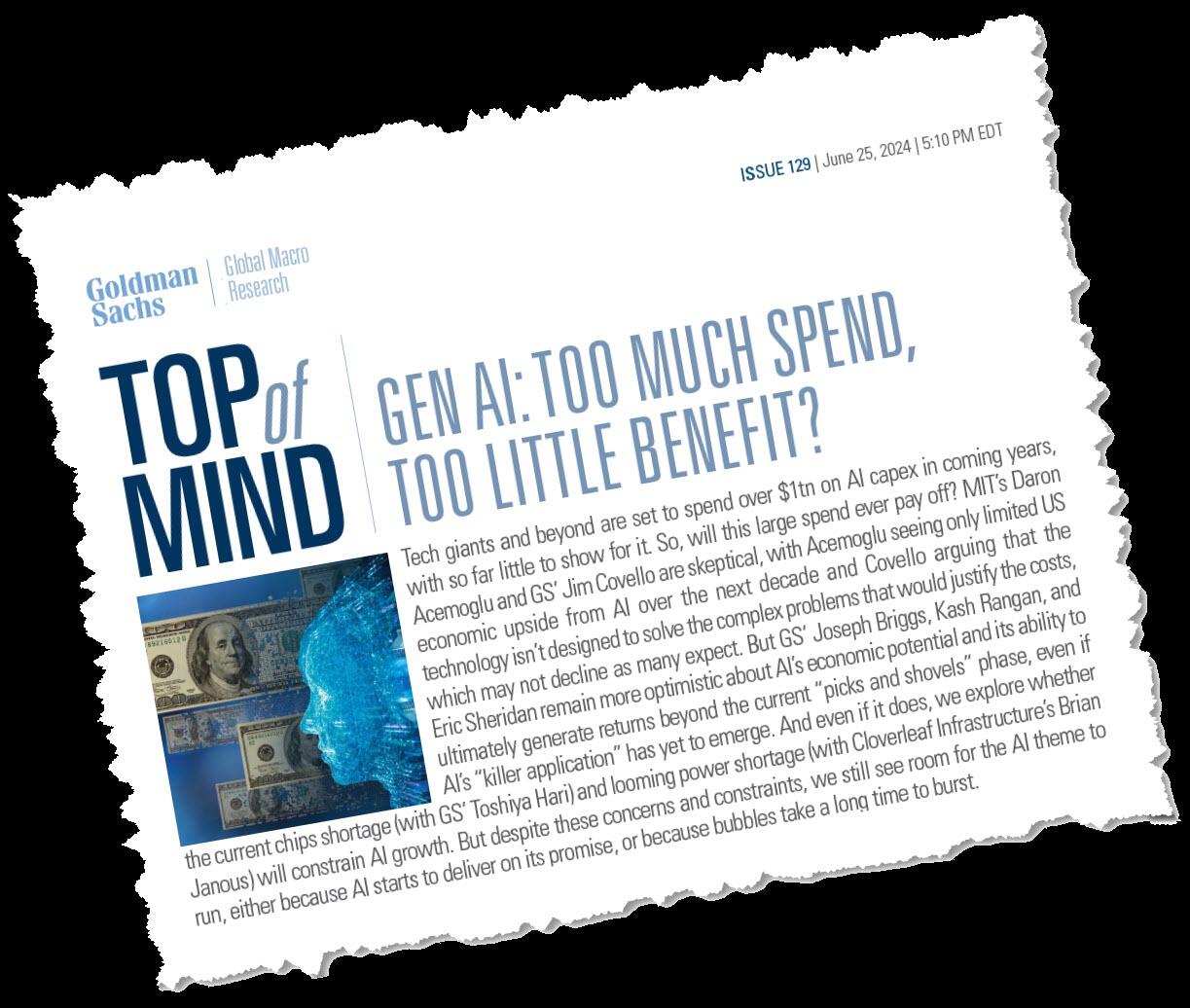
The first time the AI sector was rocked over fears of low/zero ROI, and gargantuan cash burn with nothing to show for it, was June 2024, when Goldman asked point blank if Gen AI was nothing more than “too much spend, too little benefit.” i.e., a giant capital drain that will never lead to positive long-term returns for investors. 

Source: Goldman Sachs (available to pro subs)

As Goldman’s concern gained prominence, the tech/AI/ hyperscaler, etc sector saw its first major selloff in years, but since the market was already so flooded with liquidity, dip buyers quickly emerged and the brief tremor was quickly forgotten even as Goldman’s question was never answered; instead it was assumed that sophisticated, super smart corporate CFOs could not possibly be so dumb as to allocate trillions in capex for what is ultimately a $20/month chatbot used primarily by college-age kids to cheat on their essay writing skills. Fear not, they said, a huge and much more expensive use case will eventually emerge, they said.

Unfortunately, 6 months later – when another $100 billion in capex had already been burned “perfecting” the world’s most expensive chatbots/essay cheating platforms, no such use case had emerged. What did emerge however, was a major scare out of China which developed its notorious DeepSeek LLM, which was not only opensourced and massively cheaper than similar US offerings, but required far cheaper equipment than the latest NVDA superdupercard to run efficiently. Around this time we also got a handful of reports that companies like MSFT, GOOGL and META were quietly pulling back on their Capex spending (they were), and it all combined to result in the next big AI selloff, one which started in late January and continued until April, when everything collapse on Trump’s Liberation Day meltdown… and which also promptly sparked the biggest rally in stock market history after Trump realized he likes his stocks higher than his tariff revenues. Nonetheless, it was the first time we reminded readers that what is happening in the sector AI is not that different at all from what we saw during the build out phase of the first dot com bubble, when companies like Global Crossing were all the rage for 15 minutes… and then they went bankrupt.

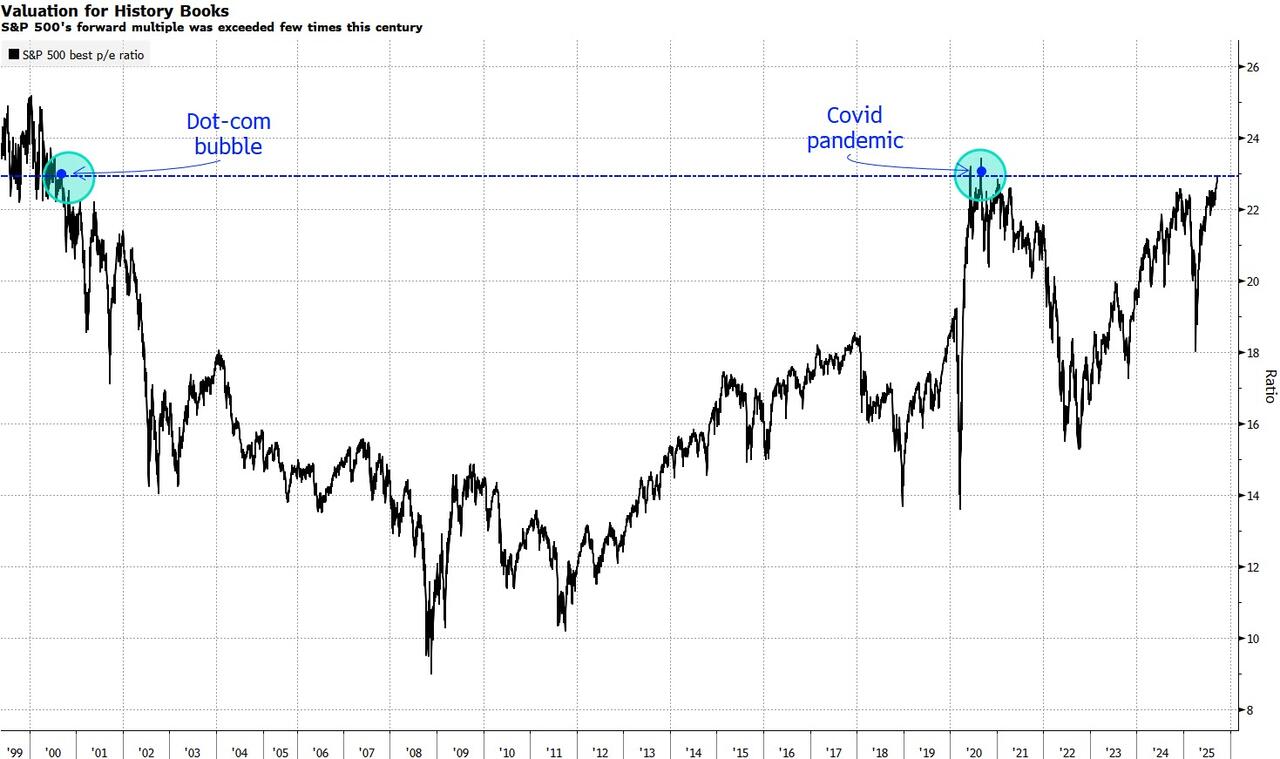
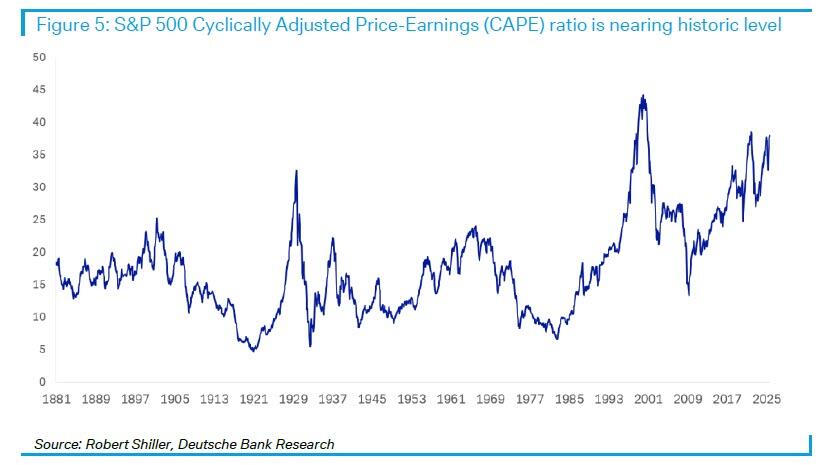
Which brought us to September when, with the AI bubble fully raging and singlehandedly pushing stocks to their highest valuation since the dot com bubble…

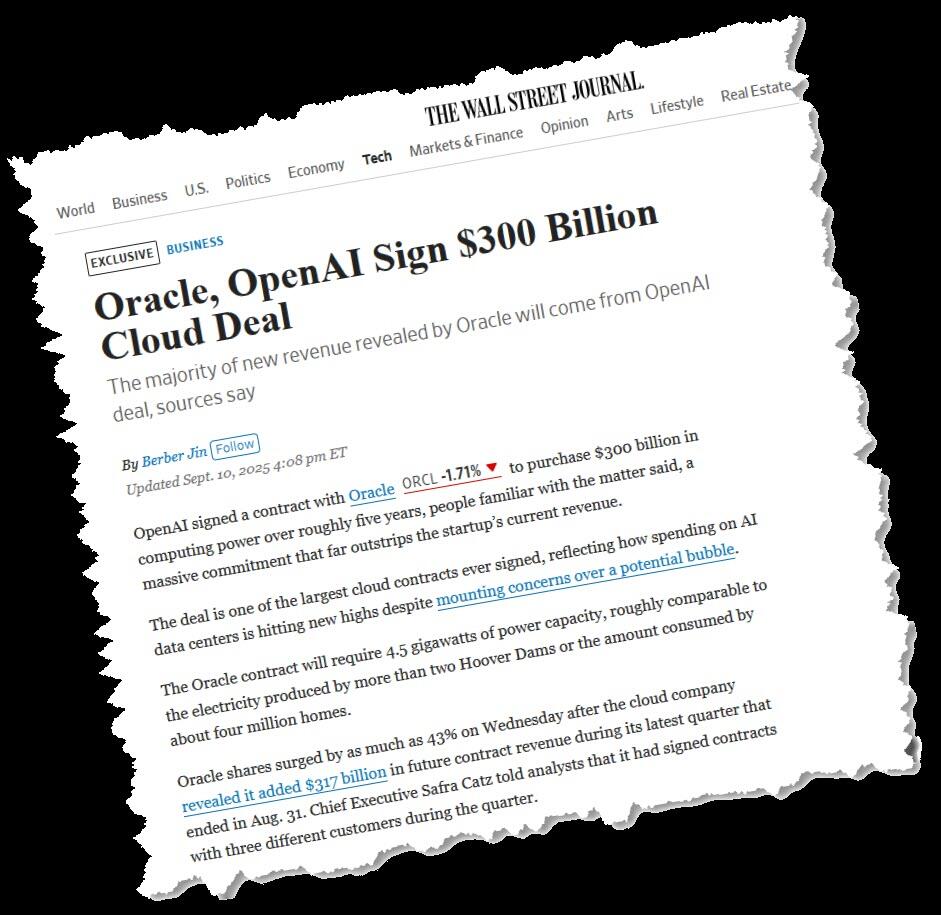
… Oracle crashed the AI bubble party on Sept 10 with all the grace of a bull in a China shop, when it unveiled one of the biggest circle jerk vendor financing deals of all time (more below), announcing a massive $300 billion, five-year cloud computing deal with OpenAI.

Source: WSJ

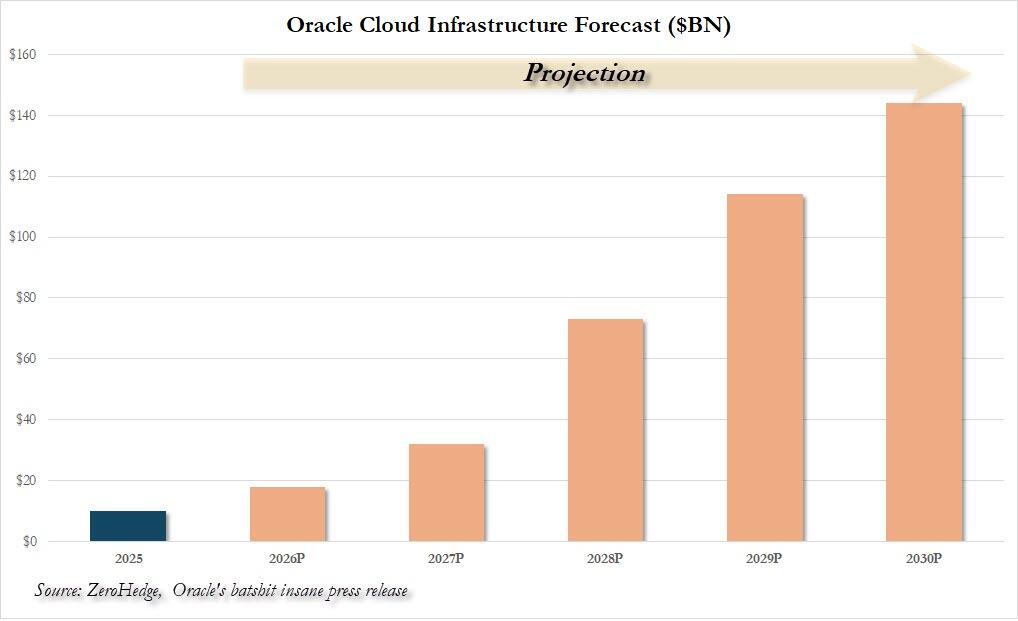
In retrospect, Oracle – which has since erased all of its gains from its deal announcement and almost all gains from its “batshit insane” hockeystick revenue projections which revealed the company added a mindblowing $317 billion in future contract revenue with just three different customers…

… could have been less painful had Oracle also not reminded everyone that it, drumroll, doesn’t actually have the money to pay for this spending orgy which is now projected to last well into the 2030s (without any recession on the horizon, of course, because nobody ever forecasts a recession).

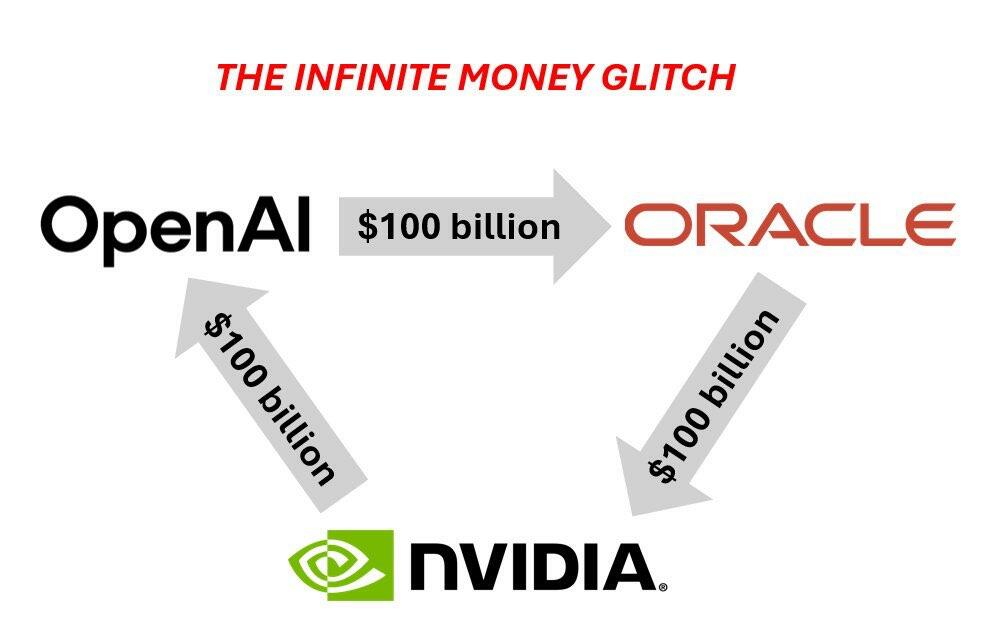
Ah yes: vendor financing with cash from operations is one thing. Vendor financing with cash from debt is something totally different, and as luck would have it, one of the most erudite voices on Wall Street, JPMorgan’s Michael Cembalest did a very fine job of describing in simple terms what many of his peers have come to call the infinite money glitchcircular economy” of AI, and which looks something like this.

This is what Cembalest said in his latest Eye on the Market note (available here):

The Blob: the AI and data center takeover

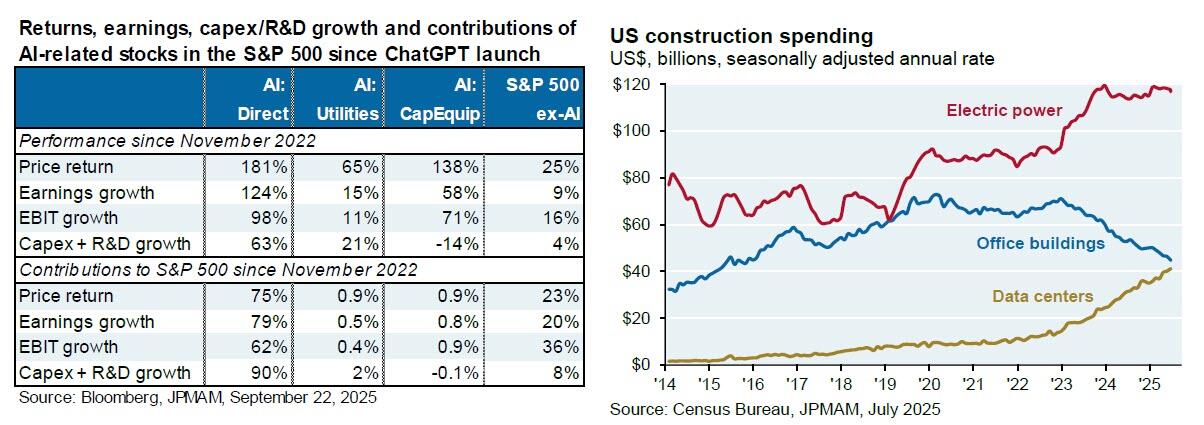
I think this is well understood, but just to reinforce the point: AI related stocks (1) have accounted for 75% of S&P 500 returns, 80% of earnings growth and 90% of capital spending growth since ChatGPT launched in November 2022. AI is showing up other places as well. Data centers are eclipsing office construction spending and are coming under increased scrutiny for their impact on power grids and rising electricity prices.

Specialized power rates for most data centers aren’t enough to cover costs of a new natural gas plant (leaving other customers to foot part of the bill), and in the PJM region, 70% of last year’s increased electricity cost was the result of data center demand. The biggest medium-term risk I can think of for top-heavy US equity markets: China’s Huawei and SMIC pierce the $6.3 trillion NVIDIA-TSMC-ASML moat by creating their own supernode computing clusters and deep-ultraviolet lithography machines of comparable quality.

Which brings us to the stunning punchline:

Other recent AI news: Oracle’s stock jumped by 25% after being promised $60 billion a year from OpenAI, an amount of money OpenAI doesn’t earn yet, to provide cloud computing facilities that Oracle hasn’t built yet, and which will require 4.5 GW of power (the equivalent of 2.25 Hoover Dams or four nuclear plants), as well as increased borrowing by Oracle whose debt to equity ratio is already 500% compared to 50% for Amazon, 30% for Microsoft and even less at Meta and Google.

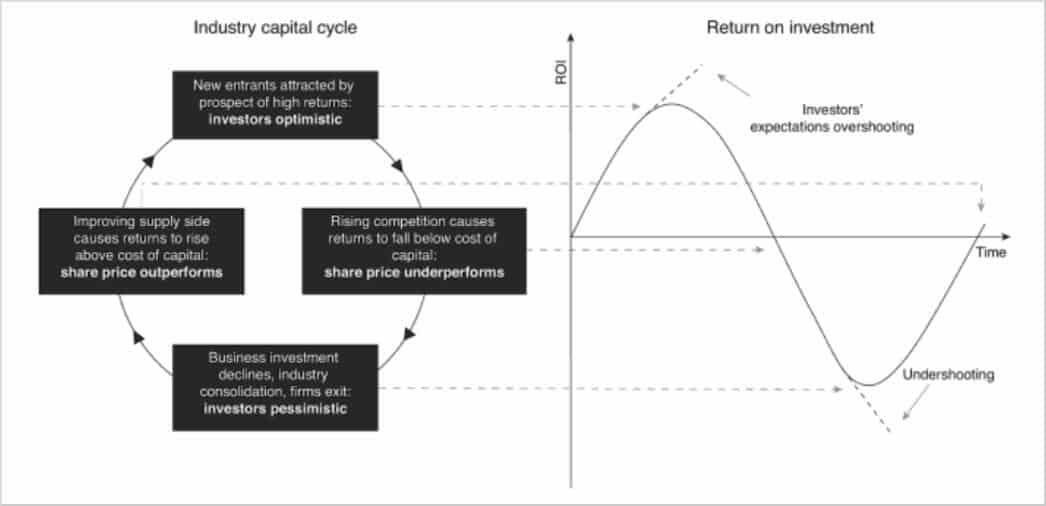
In other words, the tech capital cycle may be about to change.

Cembalest closes with the following quote from Doug O’Laughlin’s Fabricated Knowledge substack

Capital Cycles and Debt: There is no way for Oracle to pay for this with cash flow. They must raise equity or debt to fund their ambitions. Until now, the AI infrastructure boom has been almost entirely self-funded by the cash flows of a select few hyperscalers. Oracle has broken the pattern. It is willing to leverage up to hundreds of billions to seize a share. The stable oligopoly is cracking…The implications are profound. Amazon, Microsoft and Google can no longer treat AI infrastructure as a discretionary investment. They must defend their turf. What had been a disciplined, cash-flow-funded race may now turn into a debt-fueled arms race. 

Others, such as Goldman’s head of Delta One trading Rich Privorotsky, have been less polite when he describing what is essentially the same circular scheme:

As to the question where the funding for this AI revenue circle jerk will come from, regular ZH readers are aware that there is no such thing as a free lunch, and certainly no free data center. To be sure, there was a time when the growth in CapEx could be funded from Free Cash Flow, but now that CapEx has to grow at an ever exponential-er pace just to impress markets, the wheels are starting to fall off the bus. 

Enter private credit. 

While much of Wall Street is only now doing the analysis of comparing future free cash flow with projected capex, it was back in July that we wrote “The Shocking Math: Paying For AI Capex Will Require Over $1 Trillion In New Debt By 2028 (note available to pro subs) in which we quoted some stunning numbers from Morgan Stanley:

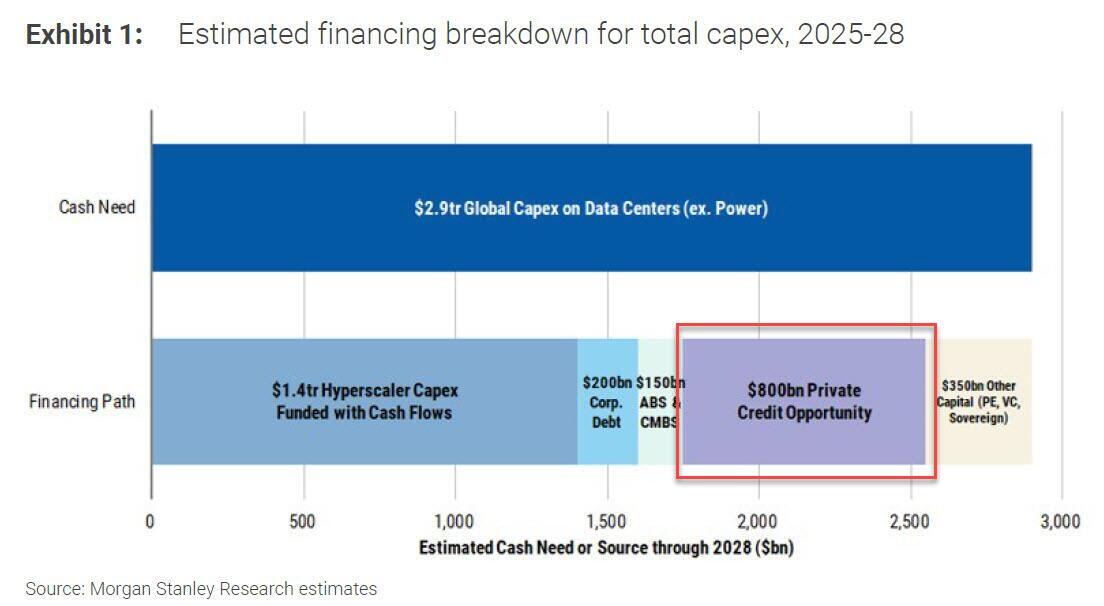
We forecast roughly $2.9 trillion of global data center spend through 2028, comprising $1.6 trillion on hardware (chips/servers) and $1.3 trillion on building data center infrastructure, including real estate, build costs, and maintenance.

This translates into investment needs of over $900 billion in 2028. For context, the total capex spending by all companies in the S&P 500 index combined was about $950 billion in 2024.

Such large potential spending has significant macro consequences as well. Our economists expect that investment spending related to data center  construction and power generation will add up to 40bp to US real GDP growth between 2025-26.

That’s the good news… which many will say is already largely priced in. The bad news, again, is who pays for all of this. And Morgan Stanley admitted as much:

By any measure, the capital requirements to support this level of investment are staggering, and mobilizing efficient and scalable capital  becomes increasingly critical. We did a deep dive into this topic, exploring alternative avenues of capital to finance this expenditure, in a collaborative report published a few days ago. The key takeaway from the report is that credit markets – secured, unsecured, and securitized in both public and private markets – will play a growing role in financing data centers.

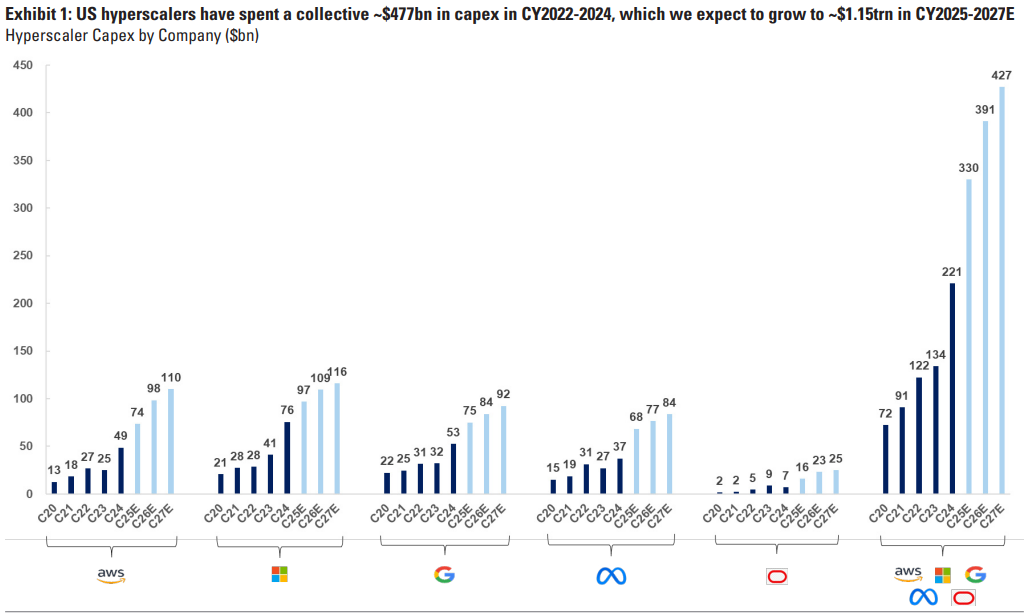
To be clear, capex related to AI and data centers has been in motion for the last few years. Spending from the hyperscalers alone has gone from ~$125 billion two years ago to ~$200 billion in 2024 and the consensus expectation is that it exceeds $300 billion in 2025.

Internal operating cash flows from the hyperscalers have been the source of this spending. However, our equity analysts expect the investment needs for data centers to rise sharply over the next few years. While cash flows from hyperscalers will remain a key source of capital to  finance data center-related spending, these alone will no longer be adequate, after accounting for cash build and shareholder  capital returns. Leveraging our equity analysts’ projections, we estimate that $1.4 trillion of hyperscaler capex may be self-funded with cash flows, leaving a sizable $1.5 trillion financing gap.

We think that credit markets, broadly defined to encompass both public and private markets of different flavors, will gain traction as more efficient providers of capital to bridge this gap. There is a favorable alignment of significant and growing dry powder across credit markets with attractive real yields on offer with appeal to a sticky end-investor base (e.g., insurance, sovereign wealth funds, pension funds, endowments and high net worth retail) looking for scalable, high-quality asset exposures that can provide diversification benefits. We think that this alignment of needs of capital and investment will pave the way for bridging the $1.5 trillion financing gap.

We size the different financing channels as follows: unsecured corporate debt issuance from issuers in the technology sector (~$200 billion); securitized markets in the form of data center ABS and CMBS (~$150 billion), private credit markets in the form of asset-based financing (~$800 billion), and other capital sources across sovereign, private equity, venture capital, and bank lending (~$350 billion). Of these, we think that private capital – in particular credit – will play a key role in meeting a majority of the remaining financing gap as it sits optimally at the intersection of significant expansion in AUM in a higher rate environment and the complex, global, and customized financing needs that are associated with AI build-out. 

As MS concludes, “the point we want to drive home is that credit markets will play a major role in enabling AI-driven technology diffusion” and of all the available sources of credit, the chart below shows just how big the debt hole is that private credit will have to plug.

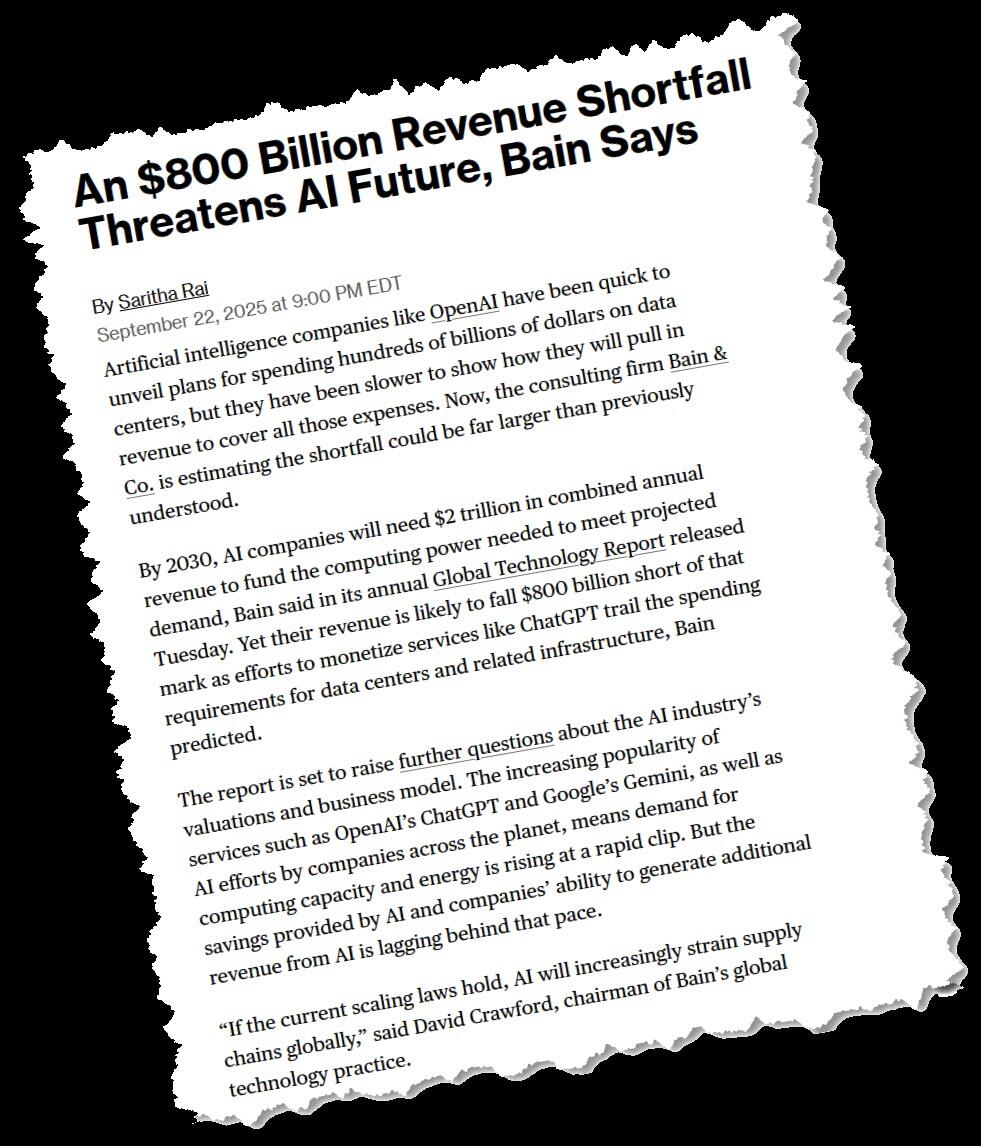
Incidentally it was about two months after we first highlighted the staggering $800 billion funding gap (which private credit will need to fill) when consulting giant Bain reached the same conclusion.

Source: BBG

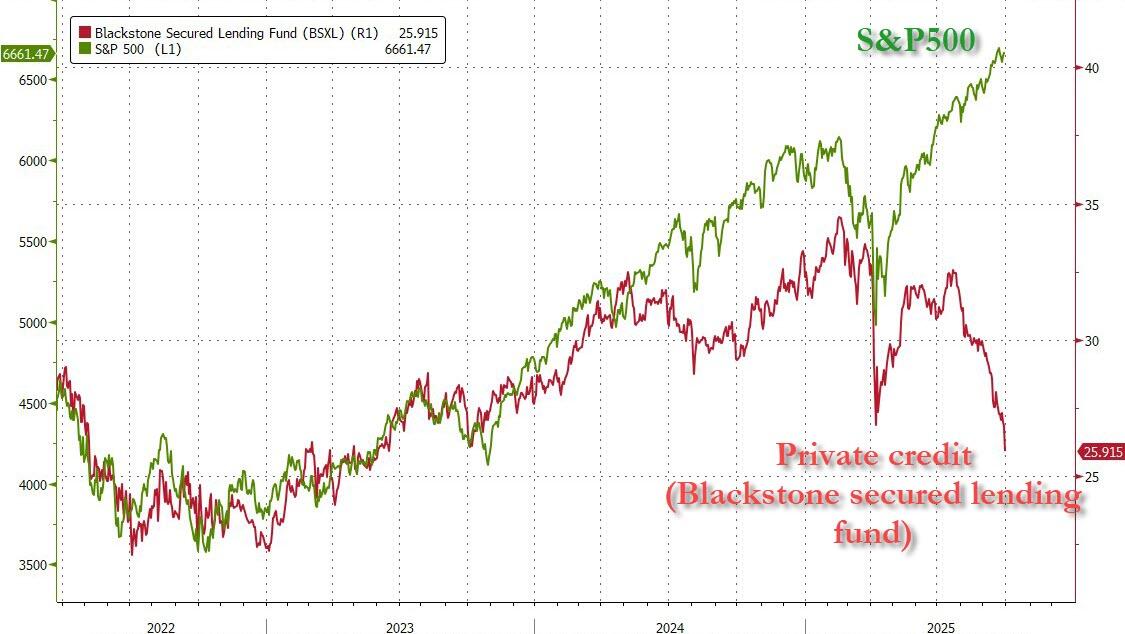
It is here that we encounter the first not so small problem: while one can pretend that equity growth is infinite, at least for the AI equity universe which as Cembalest above noted has contributed 75% of all S&P500 market cap gains since Nov 2022, when it comes to the fundamental analysis that at least some have done on the private credit backing these castles in the sky, things are turning very, very ugly: presenting exhibit A: the stock price of Blackstone’s Private Credit BDC, i.e. the Blackstone Secured Lending Fund: today, BXSL just hit a 2025 low taking out the April Liberation Day bottom and is at the lowest level in over two years, having massively diverged with the S&P.

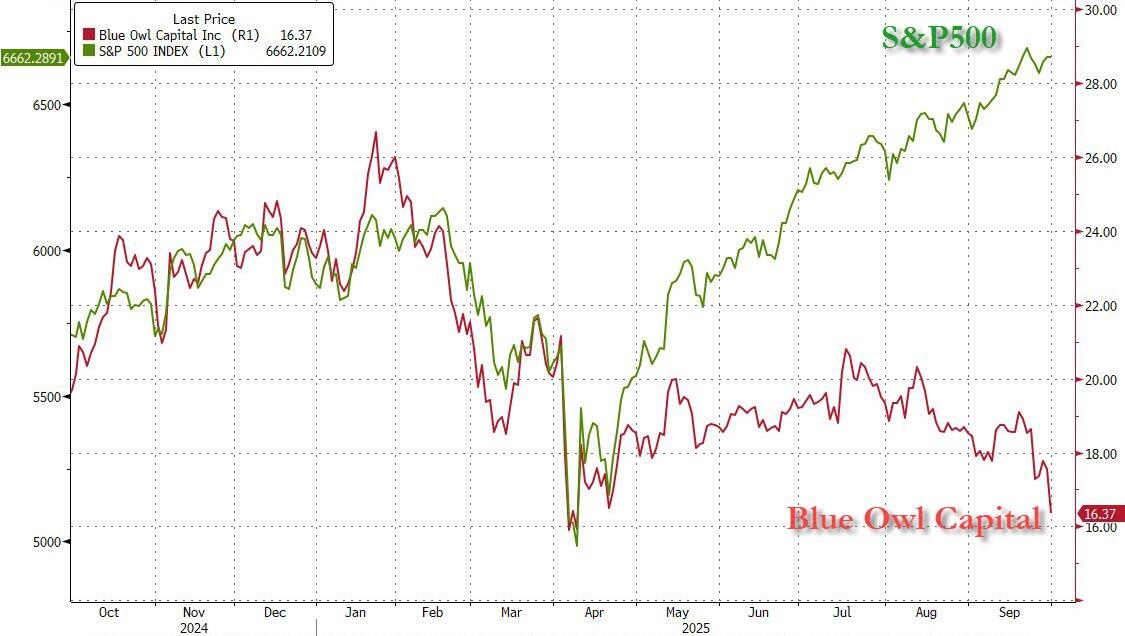
It’s not just Blackstone: the big kahoona of private credit, Blue Owl, looks like it is about to fall off a cliff, having just traded at 2025 lows as well!

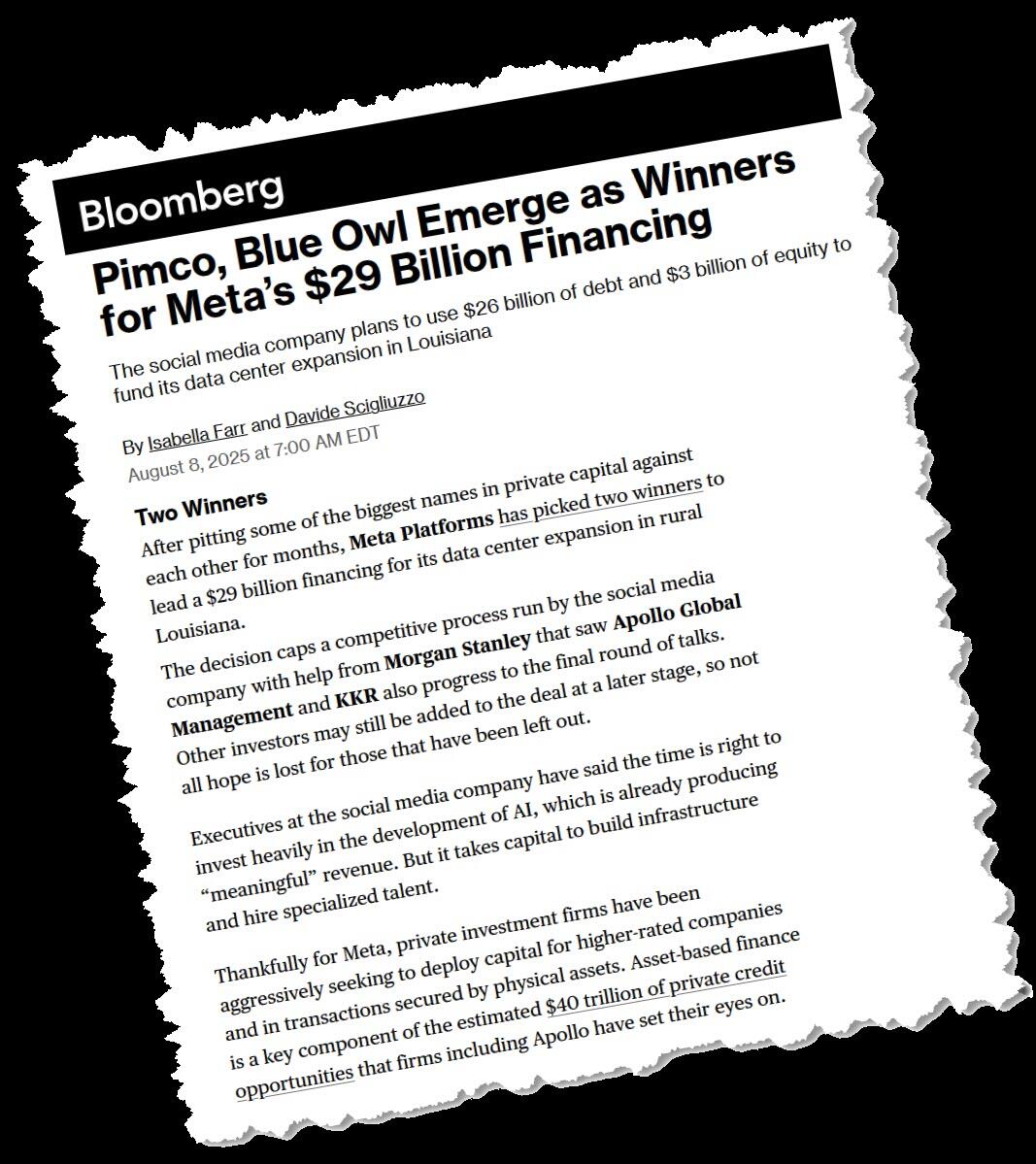
Blue OwlBlue Owl…why does that name sound familiar? Oh that’s right: the AI circle jerk is already aggressively using it to fund its multiple exploits:

Source: Bloomberg

The problem for Blue Owl, Blackstone and all the other key players that will soon be expected to provide no less than $800 billion to keep the AI circle jerk alive, is that – as their stock prices makes clear – they have much bigger problems than just funding some data centers. Perhaps the biggest problem, as we noted last week, is that these private credit giants are already massively exposed to the weakest link in the US economy, the US consumer, and especially the low-income US consumer, that BNPL expert whose NPLs (ironic that you can’t spell BNPL without NPL) are about to skyrocket (especially now that student loans have to be repaid). No wonder why the Financial Review recently wrote that “Private equity is sitting on $5 trillion of existential dread” adding that “a staggering 18,000 private capital funds are trying to raise trillions of dollars. Something’s got to give, according to the industry’s biggest players.

Judging by the accelerating plunge in the stock prices across private credit lenders, we won’t have long to wait. However, it begs the question: what happens to all the massive projected debt that private credit is supposed to provide if and when the entire industry is forced to shut down. 

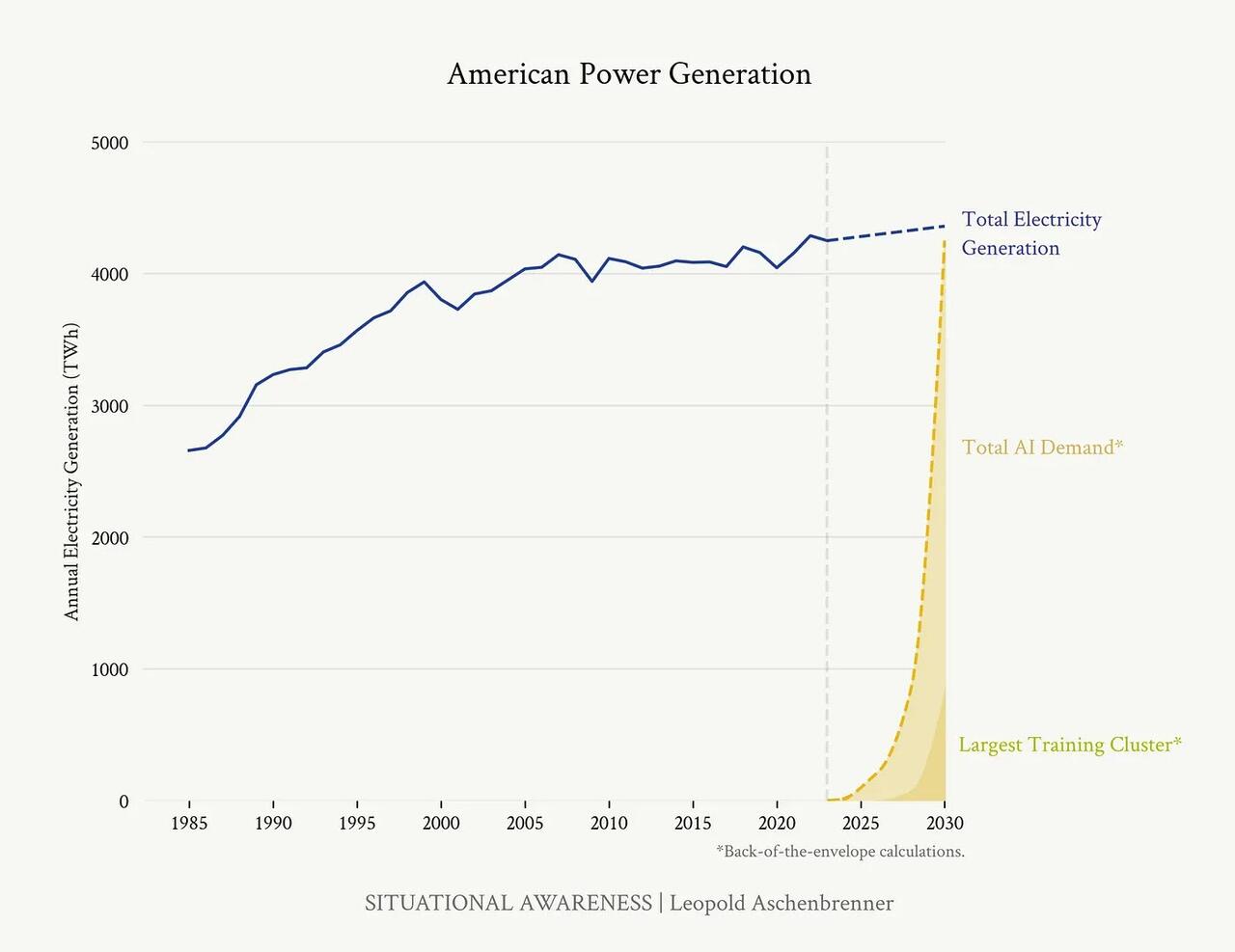
Keep in mind nowhere in the above analysis did we touch on the absolutely staggering funding needs to reboot  America’s ancient power grid which is woefully insufficient and inadequate to fire up the dozens of data centers which will be needed across the country in as little as 3-4 years if any of the stratospheric AI revenue projections are to come true…

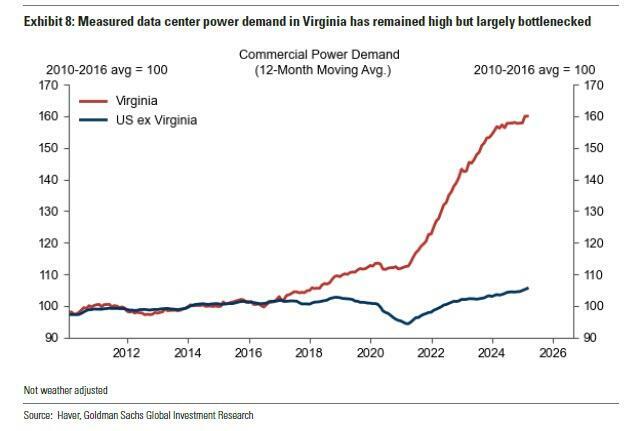
… and if the rest of the US has any hope of catching up to the state better known as “data center alley.” 

But don’t worry, we will cover all of this in a subsequent post and make it clear how absent trillions in government spending starting yesterday, there is zero chance of any of these pie in the sky forecasts ever coming true. 

One thing we did want to cover in this post before we go, is whether we are living in a bubble (arguably the biggest bubble in history) and whether the AI bubble will burst any time soon. The honest answer: we don’t know – with Nvidia stock just hitting a new record high, and its market cap rising to a staggering $4.5 trillion, clearly the AI thesis is still being bought. 

Yet one bubble that has certainly burst is the the bubble in saying there’s a bubble.

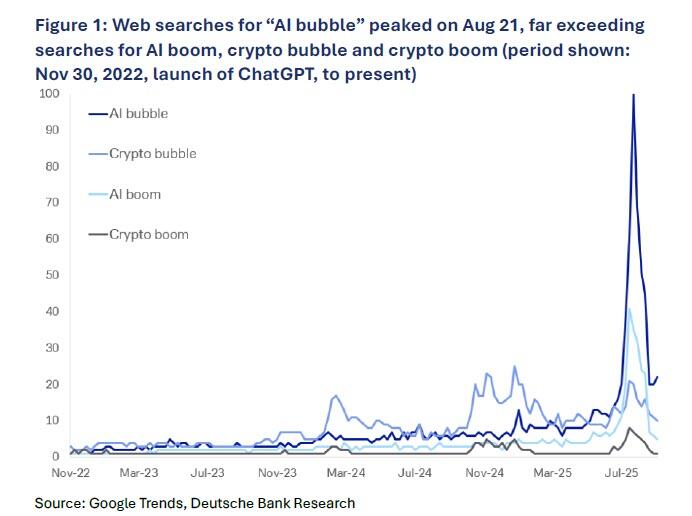
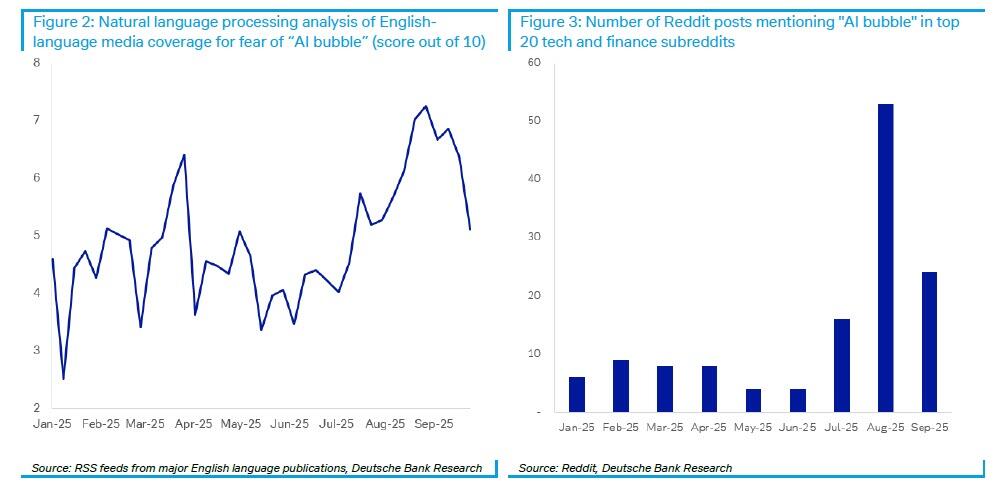
As DB’s Adrian Cox writes today, the number of web searches for “AI bubble” has plummeted in the past month according to Google Trends.

Peak “AI bubble” was on Aug 21, shortly after a little-understood report from MIT appeared to suggest that hardly any organizations were getting a return from their investment in AI, and OpenAI CEO Sam Altman said investors might be getting “over excited”, prompting a 3.8% pullback in the Magnificent Seven tech stocks over five days (of course, that pullback is now long forgotten).

Since then, the number of web searches worldwide for “AI bubble” has fallen to 15% of that level. “AI boom” reached its own high a week earlier, at 40% of the “AI bubble” peak. Meanwhile, the bubble in “crypto bubble” references topped out in late January at a mere quarter of the AI version.

For some perspective, DB examined how the bursting of the “AI bubble” bubble reflects the pattern of past bubbles, why it might be happening now, how hard it is to time the market, what might be a better alternative, and how long this bubble may last unless, of course, “this time it’s different”.

The AI boom will stop but it may not pop. And while there may be a bubble, the moment everyone spots it may be the moment it is least likely to burst.

The internet is awash with reports and articles from experts, media organizations and – even – sell-side research houses offering variations on the theme “Is AI a bubble?”. For a sharp analysis, take a look at DB’s interview with leading AI expert Azeem Azhar at our recent technology conference – AI is not a bubble (yet) amid surging demand – and his original report here. The bank also wrote recently in “The Summer AI Turned Ugly: Part 2” about whether valuations were excessive by various metrics.

However, web search data seems to indicate that the broader public has already moved on.

DB confirmed this with an AI-assisted natural language analysis of English language publications since the start of the year. AI-related investment concerns in technology articles reached a high point of 7.3 on a 10-point scale in the last  week of August and have since subsided to 5.1. (The previous high of 6.4 was around the US Liberation Day tariffs in March.) DB’s analysis of technology and finance Reddit posts mentioning an “AI bubble” showed the same trend.

Here, an old cliche: “identifying a bubble is almost impossible”, not least because no one agrees exactly what it is – typically it’s something like “when asset prices rise significantly above intrinsic values” – nor what the correct intrinsic values are, even after it bursts. Concern may act as a pressure valve, lowering valuations and encouraging a whole new round of bargain hunting.

It’s a twist on the Hawthorne effect, where workers in an Illinois factory almost exactly 100 years ago appeared to be more productive under different lighting but turned out to be instead picking up the pace when they were aware they were being observed.

“This is a serious bubble. It makes biotech in 1991 look like a picnic”: Michael Murphy, Murphy Investment Management, Nov 19, 1998

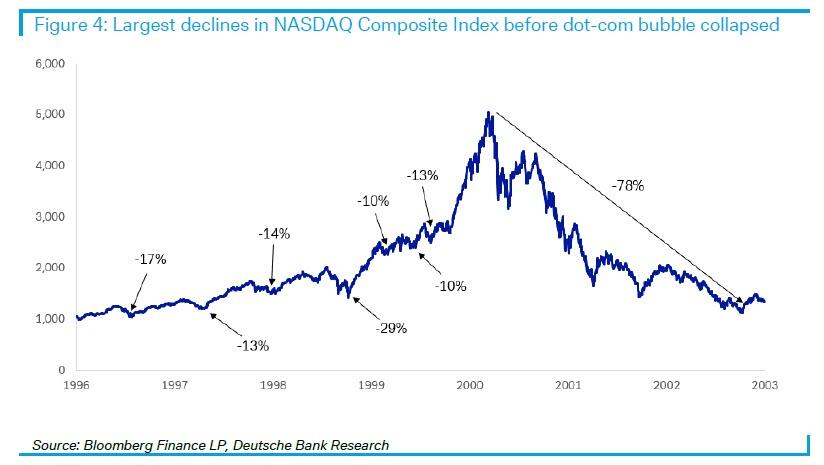
Bubbles are not neat linear processes. They typically inflate in several waves interspersed by dramatic falls. Looking at the dot-com bubble, the Nasdaq technology index surged and fell back by 10% or more seven times in the five years before it peaked on March 10, 2000. It also carried on shooting into the stratosphere well after talk of a bubble became
commonplace, doubling in the year to October 1999, then almost doubling again over the following five months until it turned.

Indeed, Bloomberg published a story on Amazon and Yahoo’s holiday earnings on Nov 19, 1998, quoting Michael Murphy, chief investment officer at Murphy Investment Management: “This is a serious bubble. It makes biotech in 1991 look like a picnic.”

That was when the Nasdaq was at less than 2,000, sixteen months before the bubble finally popped at over 5,000.

The decline of the Nasdaq from its peak was also far from linear or immediate. The index fell by more than a third in 10 weeks, then recovered two thirds of its losses before finally declining in a saw-tooth pattern to a 78 percent peak-to- trough loss in October 2002.

“The only thing we have to fear is fear itself”: Franklin D. Roosevelt, US President, 1933

There are four forces in the recent bursting of the “AI bubble” bubble:

1. New realism about what AI can and can’t do

OpenAI’s much-anticipated launch of GPT-5 in August turned out to be a dud, giving a slightly better user experience rather than the glimpse of artificial general intelligence that had been implied. Expectations got ahead of reality and the goalposts shifted. Capabilities that would have been greeted with astonishment 18 months ago were greeted with a shrug.

2. Infrastructure bottlenecks ahead

The rollout of AI has been faster than any previous technology, with ChatGPT getting 100 million users in two months and now on course for one billion weekly users by the end of the year. The basic foundations are in place and it is easy for consumers to use. Yet it will only pay off when enterprises can use it at scale, which depends on building – and financing – the most complex infrastructure ever created, comprising chips, data centres and energy.

3. Implementation depends on systems

A new technology itself is not enough. The hard yards are ahead in implementing it. That involves integrating it into well-governed enterprise systems that employees actually use. Evidence is still emerging of where the dollar and cents of value will come.

4. Human psychology: “that don’t impress me much”

There is an inevitable reaction to new technology reflected in the much-quoted Gartner hype cycle: innovation, inflated expectations, disillusionment, enlightenment and, finally, new productivity. In reality, these stages overlap and churn, with periods of overshoot followed by reality checks, after which the cycle resumes. Early humans probably had the same reaction to the wheel.

“The stock market has predicted nine of the last five recessions”: Paul Samuelson, economist, 1966

Vigilance is both prudent and a reminder of how hard it is to time the market.

Leading AI sceptic Gary Marcus predicted in 2022 that AI was “hitting a wall”. The WSJ, which published a report at the end of last week asking when the surge in AI spending will pay off, already ran a story called “Is the AI Boom Heading for a Bust?” in March and “Can AI Startups Outrun Dot-Com Bubble Comparisons?” last June.

Others are asking similar questions as various indicators flash warning signals, like the Cyclically Adjusted Price-Earnings (CAPE) ratio for the S&P 500, which is approaching a near-historic 38, albeit below the 44 it hit in January 2000.

Bridgewater Associates founder Ray Dalio told the Financial Times in January that there was already a “bubble” similar to 1998 or 1999 while Greenlight Capital founder David Einhorn said on Friday that expenditure on AI infrastructure is “so
extreme” that there is a “reasonable chance that a tremendous amount of value destruction is going to come through this cycle”.
 

“Markets can remain irrational longer than you can remain solvent”: John Maynard Keynes, economist 

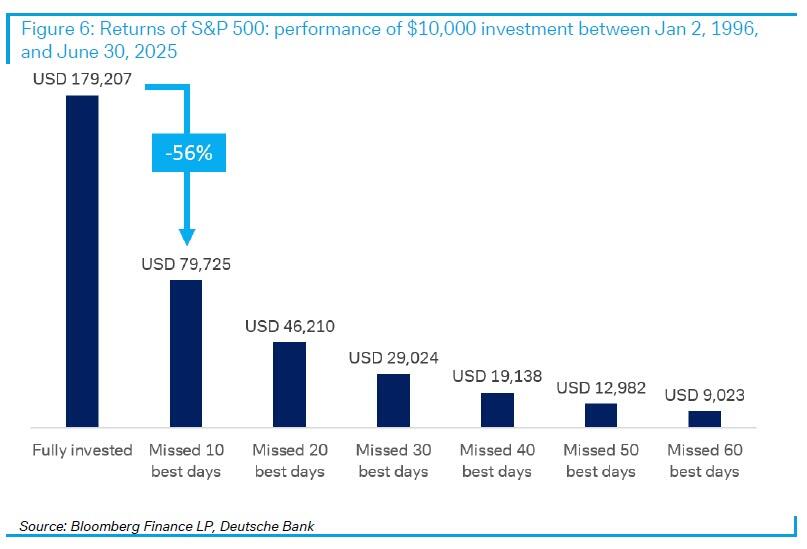
Timing the markets is notoriously hard. Evidence suggests that staying invested over a long time horizon seems to be the best way to capture the risk premium required to compensate equity investors for their risk.

Falls are rarely consistent as heightened emotions lead to volatility in both directions. If you had invested $10,000 at the start of 1996 it would have been worth more than $170,000 by the end of this June, but less than half as much if you’d missed the 10 best days and a quarter as much if you’d missed the 20 best days.

Indeed, five of the 10 best days from the start of 1996 to the end of June occurred within just one week of seven of the worst 10 days.


Stock prices have reached “what looks like a permanently high plateau”: Irving Fisher, economist, Oct 15, 1929, nine days before the Wall Street Crash

Earlier booms and busts followed similar patterns. The “railway mania” of the UK in the 1830s was derailed temporarily by the “Panic of 1837” emanating from the US, but then gathered steam once more en route to the bigger “collective hallucination” and crash of the 1840s. Likewise, the collapse of the “tronics” boom in 1962 was just a warmup for the meltdown in computing stocks at the end of the decade.

Radio was a 1920s analogue to the internet, spurring a race to invest in RCA and other technology companies more broadly, with companies such as General Electric, Dupont, Maytag, Chrysler and GM more than tripling between 1926 and 1929. The enthusiasm for the new technology was justified but premature, given that the network required a significant installed base of radios as well as broadcast networks and advertising to become commercially viable.

Bubbles have a variable lifespan, with the South Sea bubble blowing itself out in seven months while the dot-com bubble took five years to pop.

The question on everyone’s lips: how long until the AI bubble, arguably the biggest bubble of all, does the same?

* * * 

Much more in the full JPM, Morgan StanleyDB and Goldman notes referenced above, available to pro subs.

Tyler Durden
Thu, 10/02/2025 – 06:44

via ZeroHedge News https://ift.tt/nlHckO9 Tyler Durden

How To Fix College


College campus | Arsty/Dreamstime.com

Trump asks colleges to get serious: Yesterday, the White House sent 10-page compacts to nine of colleges and universities—Vanderbilt University, Dartmouth College, the University of Pennsylvania, the University of Southern California, Massachusetts Institute of Technology, the University of Texas, the University of Arizona, Brown University, and the University of Virginia—asking them to assent to certain commitments in order to receive access to a wider array of federal funding.

Called the “Compact for Academic Excellence in Higher Education,” most of the asks are eminently reasonable, and would make it so colleges now conform with the law instead of flouting it outright.

“The memo demands that schools ban the use of race or sex in hiring and admissions,” reports The Wall Street Journal. It also calls for schools to “freeze tuition for five years; cap international undergrad enrollment at 15%; require that applicants take the SAT or a similar test; and quell grade inflation.”

But the memo also asks that universities abolish any departments that “purposefully punish, belittle, and even spark violence against conservative ideas” and strengthen policies meant to deter such ideological conformity. Of course, “institutions of higher education are free to develop models and values other than those below, if the institution elects to forego federal benefits,” reads the document.

“The first round of schools received the compact along with a letter that frames the pledge as an opportunity to proactively partner with the administration and its effort to shift the ideological tilt of the higher education system,” per The New York Times. Interestingly, “the demands in the compact also include providing free tuition to students studying math, biology, or other ‘hard sciences’ if endowments exceed $2 million per undergraduate.”

In a sense, this is federal government intrusion into the affairs of universities. Who is a federal bureaucrat to decide how many international students a college ought to admit, when the college should be able to decide what’s in their best interest and what’s not? It’s not like a system of arbitrary nationality limits is especially meritocratic. But the case made by Trump administration officials like May Mailman is that we don’t get to pour tons of American taxpayer dollars into the higher education system and then routinely educate the world’s students; that’s not a good return on investment or aligned with what’s in the nation’s best interest.

The solution Mailman and the Trump administration more broadly offer is, I think, sound: If you’re a university that doesn’t want to sign onto these demands, you may forego federal funding and retain full independence. But if you’d like to dip into federal coffers, you must agree to certain standards and maintain environments that foster more intellectual diversity. We’ll see whether this holds up whenever it’s challenged in court.

Also, I think it’s interesting—and a welcome development—that the administration also snuck in some lines about tuition-freezing. Ballooning cost of attendance has been a huge problem for years, and shedding light on administrative bloat and wasteful spending is surely in the American public’s best interest.


Scenes from New York: Last night, I hosted a book party for Leah Libresco Sargeant at my home in Brooklyn, alongside my dear friend Nicole Ruiz. We had in attendance homemakers, journalists from The Dispatch and The Atlantic, a pastor’s wife and mother of five, and a woman who detransitioned (and wrote about it), among many others. An eclectic bunch for sure.

Liz Wolfe

Leah’s book, The Dignity of Dependence, is premised on two claims: The first, that “women’s equality with men is not premised on our interchangeability with men”; the second, that “dependence on others is not a temporary embarrassment at the beginning (and end) (and much of the middle) of our lives but the pattern for how we live together.” I highly recommend it.


QUICK HITS

  • If you enjoy this newsletter, would you do me the extraordinary favor of forwarding it to a friend? (Ideally with accompanying text like “I think you’d enjoy this newsletter that keeps me informed in a crowded and ever-stupider news environment” not “this libertarian chick belongs in the loony bin.”)
  • “They say my generation is wasting our lives watching mindless entertainment,” writes Freya India at Jonathan Haidt’s After Babel. “But I think things are worse than that. We are now turning our lives into mindless entertainment. Not just consuming slop, but becoming it.…Someday this generation, these influencers, will discover with dread what every celebrity and contestant and cast member has realized before them. That after offering everything up, every inch of their lives, every finite moment on this Earth, it does not matter how much they stage, how much they rehearse, how much they trade, how long they leave the cameras rolling, we will always wonder, eventually, what else is on?
  • “The White House is halting $18 billion in New York infrastructure funding due to concerns over diversity and inclusion practices and as the first day of a federal shutdown grinds government work to a halt,” reports Bloomberg. Honestly, fair. Why should the rest of the country subsidize my state and city? And why should the city let so many residents off scot-free—i.e. rampant fare evaders—instead of choosing to enforce laws and improve the city’s fiscal situation?
  • “The Supreme Court on Wednesday ruled Federal Reserve governor Lisa Cook can remain in her job for now and announced it will hear a case in January over President Donald Trump’s attempt to remove her,” reports The Washington Post. “The temporary ruling lasts until the justices hear the administration’s appeal of a lower court’s decision to allow Cook to remain on the job. The Trump administration had asked the high court to remove Cook immediately.”
  • Speaking of the Post:

  • “More than two years into a conservative takeover of New College of Florida, spending has soared and rankings have plummeted, raising questions about the efficacy of the overhaul,” notes Inside Higher Ed. “While state officials, including Republican governor Ron DeSantis, have celebrated the death of what they have described as ‘woke indoctrination’ at the small liberal arts college, student outcomes are trending downward across the board: Both graduation and retention rates have fallen since the takeover in 2023. Those metrics are down even as New College spends more than 10 times per student what the other 11 members of the State University System spend, on average. While one estimate last year put the annual cost per student at about $10,000 per member institution, New College is an outlier, with a head count under 900 and a $118.5 million budget, which adds up to roughly $134,000 per student.”
  • Yep:

  • I mostly agree with Aella, but grad school? Let’s maintain some standards.

The post How To Fix College appeared first on Reason.com.

from Latest – Reason.com https://ift.tt/EupZ3fH
via IFTTT

Marking 50th Anniversary of Our Arrival in the U.S., with a Free-Speech-Related Matter

On Oct. 8, 1975, my parents brought my brother Sasha and me to the U.S. As one might gather, Oct. 8 (and June 13, the anniversary of the day we left the Soviet Union earlier that year) are the most significant holidays on our family calendar.

I’m therefore particularly delighted that, by sheer coincidence, I’ll be doing something related to my research on free speech on the 50th anniversary of that day: I was asked to testify at a Senate Committee on Commerce, Science, and Transportation hearing on free speech and government pressure on social media platforms. Should be an interesting program, which I’m honored to be a part of.

The post Marking 50th Anniversary of Our Arrival in the U.S., with a Free-Speech-Related Matter appeared first on Reason.com.

from Latest – Reason.com https://ift.tt/BX8VTwp
via IFTTT

Marking 50th Anniversary of Our Arrival in the U.S., with a Free-Speech-Related Matter

On Oct. 8, 1975, my parents brought my brother Sasha and me to the U.S. As one might gather, Oct. 8 (and June 13, the anniversary of the day we left the Soviet Union earlier that year) are the most significant holidays on our family calendar.

I’m therefore particularly delighted that, by sheer coincidence, I’ll be doing something related to my research on free speech on the 50th anniversary of that day: I was asked to testify at a Senate Committee on Commerce, Science, and Transportation hearing on free speech and government pressure on social media platforms. Should be an interesting program, which I’m honored to be a part of.

The post Marking 50th Anniversary of Our Arrival in the U.S., with a Free-Speech-Related Matter appeared first on Reason.com.

from Latest – Reason.com https://ift.tt/BX8VTwp
via IFTTT

The Hatchet-Wielding-Hitchhiking-Murderer-Unsuccessful-Intellectual-Property-Litigant

From McGillvary v. Hartley, decided Tuesday by Judge Ashley Royal (M.D. Ga.):

Pro se Plaintiff Caleb McGillvary is currently serving a 57-year sentence for first-degree murder. In February, 2013, McGillvary rose to internet fame as the “hatchet wielding hitchhiker” after he gave interviews to a local Fresno, California KMPH Fox News TV reporter in which McGillvary described “smash, smash, suh-mash[ing]” Jett Simmons McBride three times over the head with a hatchet after McBride crashed his car into a group of pedestrians and attacked bystanders at the scene (“KMPH Clip”). Fresno authorities concluded that Plaintiff used justifiable force in protection of the bystanders and cleared him of any wrongdoing.

Three months later, after gaining media notoriety for viral news interviews and media appearances, including an interview on Jimmy Kimmel Live!, Plaintiff was arrested for and ultimately convicted of murdering Joseph Galfy, Jr., a New Jersey attorney. Plaintiff’s arrest was unrelated to the hatchet incident.

On January 10, 2023, Netflix released a documentary about McGillvary entitled The Hatchet Wielding Hitchhiker that described his background; interviewed those around him during his rise to fame; and detailed his subsequent murder conviction (the “Documentary”). Five days before the Documentary was released, on January 5, 2023, Defendants created and published an episode on their YouTube channel, “The Behavior Panel,” wherein they analyzed the KMPH Clip and made statements about Plaintiff based on their assessment of his body language and behavior (the “YouTube Video”). This suit arises out of the comments made in the YouTube Video….

There’s a lot more in the opinion, but here’s a short excerpt of the legal analysis:

Defamation …

Plaintiff alleges Defendants made 28 “slanderous and libelous statements with reckless disregard for and/or knowledge of their falsity, with actual malice intending the harm that would result therefrom.” Defendants’ allegedly defamatory statements include telling viewers they will analyze Plaintiff’s body language and behavior from the News Clip to determine whether Plaintiff is a “sociopath” or “psychopath”; commenting on Plaintiff’s “odd behavior for someone who’s killed somebody in the last three hours”; questioning whether Plaintiff has a “personality disorder” and lacks language and relationship skills; questioning the relationship between Plaintiff and McBride, the driver of the car, “be it a drug deal, be it a prostitution situation, whatever was happening there”; commenting that Plaintiff was trying to be a “hero”; calling Plaintiff a “drifter” and a “vigilante”; suggesting because Plaintiff stated in the News Clip he was from “Dogtown,” Plaintiff was “kind of suggesting that he’s a mutt out of the back streets … a bit of a mongrel from the backstreets”; opining that Plaintiff “probably has done some things. We know he gets convicted of murder later …. I don’t think what we’re seeing here is the Johnny Appleseed of goodness running around the country beating up bad guys. I think this was opportunistic…. I’m not sure whether this is a true story of being a savior or it was an opportune moment to be violent with somebody, if it indeed happened”; opining Plaintiff has “been in a whole lot more trouble than we’re aware of at this point with local authorities”; stating he was accused of “killing a guy he had consensual sex with”; and opining that Plaintiff and McBride got into a fight before McBride ran into the crowd of people. Plaintiff contends Defendants’ analysis falsely implies that he is a sociopath or psychopath; he killed someone within three hours before the news interview; he lacks the interpersonal skills, language capacity, and intelligence that would make him a good business partner or leader; he was criminally culpable in his use of force on McBride; he lied about the events and therefore committed perjury at McBride’s arraignment; he is “some kind of glory hog who interjected himself into the interviewer’s dialogue in an act of self-aggrandizement”; that people did not like him because he was a drifter; he promoted vigilantism; he was a prostitute who engaged in a “prostitution situation” with McBride; that his identity is synonymous with that of a mutt or mongrel from the backstreets; and that he engaged in a pattern of criminal activity before the incident….

Here, the context of Defendants’ statements establish that they are rhetorical hyperbole. All reasonable viewers understand Defendants’ comments as expressing their beliefs about Plaintiff’s actions based on their subjective assessments of his body language actions, not as literal assertions….

Misappropriation of Likeness …

“Georgia recognizes a right of publicity to protect against ‘the appropriation of another’s name and likeness … without consent and for the financial gain of the appropriator … whether the person whose name and likeness is used is a private citizen, entertainer, or … a public figure who is not a public official.'” …

“In order to navigate between the competing constitutionally protected rights of privacy and publicity and the rights of freedom of speech and of the press, the courts have adopted a ‘newsworthiness’ exception to right of publicity.” “[W]here an incident is a matter of public interest, or the subject matter of a public investigation, a publication in connection therewith can be a violation of no one’s legal right of privacy.” “[W]here a publisher may be precluded by the right of publicity from publishing one’s image for purely financial gain, as in an advertisement, where the publication is newsworthy, the right of publicity gives way to freedom of the press.” …

Here, all factors weigh against Plaintiff and establish that he cannot maintain a claim for a violation of his right to publicity as a matter of law. The YouTube Video did not intrude on Plaintiff’s private affairs; Plaintiff voluntarily placed himself in the position of public notoriety; and the information is a matter of public record. Defendants analyzed the KMPH news Clip, a matter of public record that Plaintiff acknowledges in his Amended Complaint went viral. There can be “no liability when the defendant merely gives further publicity to information about the plaintiff which is already public.” Plaintiff voluntarily placed himself before the public, allowing the news reporter to interview him and later voluntarily appearing on the late-night television show Jimmy Kimmel Live!. Indeed, Plaintiff acknowledges in his Amended Complaint that he is “famous and widely recognized.”

Plaintiff contends Defendants used his identity solely to further their own commercial efforts to market their YouTube channel and sell its products. But, having analyzed the Video, it is clear Plaintiff’s identity is not being used to sell a product in an advertisement. Defendants do not use Plaintiff’s identity on merchandise. And any use of Plaintiff’s identity to attract web traffic to Defendants’ YouTube channel is merely incidental to the use of Plaintiff’s identity. Defendants do not use Plaintiff’s identity to endorse or sell their products. The “fact that the publisher or other user seeks or is successful in obtaining a commercial advantage from an otherwise permitted use of another’s identity does not render the appropriation actionable.” …

[Trademark] …

Even assuming Plaintiff has a trademark ownership in the words “Smash, Smash, SUH-MASH!” and/or the moniker “Kai the Hatchet Wielding Hitchhiker,” Plaintiff cannot show consumers were likely to believe that Plaintiff approved, sponsored, was affiliated, or was the origin of the YouTube Video. The YouTube Video is not a copy of Plaintiff’s work. Defendants used the public KMPH news Clip to analyze Plaintiff’s body language and behavior….

“[L]ikelihood of confusion occurs when a later user uses a trade-name in a manner which is likely to cause confusion among ordinarily prudent purchasers or prospective purchasers as to the source of the product.” Plaintiff has not pled nor can he establish that any ordinarily prudent purchaser or prospective purchaser would have any confusion that Plaintiff approved, sponsored, endorsed, was affiliated, or was the source of Defendants’ YouTube Video analyzing his body language and behavior….

Copyright …

Plaintiff alleges he created and performed the “dramatic work and spoken words” he used during the KMPH news interview on February 1, 2013. He alleges he registered his copyright to the “dramatic work ‘Smash, Smash, SUH-MASH!'” …

[But plaintiff] has no ownership in the KMPH Clip…. “As a general rule, the author is the party who actually creates the work, that is, the person who translates an idea into a fixed, tangible expression entitled to copyright protection.” … Plaintiff was an interview subject of the KMPH news interview. He played no role in fixing the clip into tangible expression; KMPH employees “fixed” McGillvary’s performance—recording him using KMPH controlled and operated equipment. Plaintiff consented to the live media interview when speaking with the KMPH Fox News reporter, engaging in a question-and-answer format, wherein he recounted the events on February 1, 2013….

Defendants are represented by Pamela Grimes (Wilson, Elser, Moskowitz, Edelman & Dicker LLP).

The post The Hatchet-Wielding-Hitchhiking-Murderer-Unsuccessful-Intellectual-Property-Litigant appeared first on Reason.com.

from Latest – Reason.com https://ift.tt/C6WTOsw
via IFTTT

D.C. Circuit Rejects Journalist’s Privilege Claim in Privacy Act Case Involving Fox News

From Chen v. FBI, decided Tuesday by D.C. Circuit Judge Gregory Katsas, joined by Judges Michelle Childs and Harry Edwards:

Yanping Chen alleges that federal officials violated the Privacy Act by disclosing records about her compiled as part of an FBI investigation. The records were published by Fox News. In discovery, Chen sought to compel Catherine Herridge—one of the journalists involved in publishing the records—to identify who had leaked them. Herridge invoked a First Amendment reporter’s privilege to avoid being compelled to testify….

{We recite the facts as alleged in the complaint. Yanping Chen was born in China. In 1987, she moved to the United States to study at George Washington University, from which she eventually obtained graduate degrees. Chen became a lawful permanent resident in 1993 and a citizen in 2001.

In 1998, Chen founded the University of Management and Technology (UMT), an educational institution headquartered in Arlington, Virginia. Until January 2018, UMT participated in the Department of Defense’s “Tuition Assistance Program,” which pays a portion of tuition expenses for military students.

In 2010, the Federal Bureau of Investigation began investigating Chen for statements made on her immigration forms. [Details omitted. -EV] In 2016, the U.S. Attorney’s Office for the Eastern District of Virginia decided not to file charges against Chen.

In 2017, Fox News aired a report alleging that Chen had concealed her prior work for the Chinese military. The network later published [various FBI documents]…. The print versions of these reports were authored by Catherine Herridge.

In 2018, DoD terminated UMT’s participation in the Tuition Assistance Program. That decision, along with a broader hit to UMT’s reputation, caused its enrollment and revenue to fall sharply. These losses impacted Chen’s income and the value of her personal investment in UMT.} …

In Zerilli v. Smith (D.C. Cir. 1981), this Court recognized a “qualified reporter’s privilege” based on the First Amendment. Where it applies, the privilege allows reporters to resist civil discovery into the identity of their confidential sources. We identified two considerations as being “of central importance” in determining whether the privilege applies—the litigant’s “need for the information” and her efforts “to obtain the information from alternative sources” [the latter being called the “exhaustion requirement”-EV] We further noted that the “equities weigh somewhat more heavily in favor of disclosure” if, as in libel cases, the journalist is a party and successful assertion of the privilege “will effectively shield him from liability.” …

In Lee v. Department of Justice (D.C. Cir. 2005), this Court held that a litigant may overcome the privilege by showing centrality and exhaustion—even in a case where the reporter is not a party. Like this case, Lee involved an appeal by non-party journalists held in contempt for refusing to identify their confidential sources in Privacy Act litigation.

Applying Zerilli‘s “two guidelines [for] determining when a court can compel a non-party journalist to testify about a confidential source,” we held that the district court had not abused its discretion in requiring the reporters to testify. First, the plaintiff had shown that the information he sought went to the “heart” of the case, given the difficulty in proving intent or willfulness without knowing the identity of the leakers. Second, by deposing numerous witnesses before seeking to compel the reporters’ testimony, the plaintiff had met his burden to exhaust reasonable alternative sources of information.

For the Lee Court, that was the end of the matter. We expressly declined to engage with Zerilli‘s distinction between journalists who are parties to a lawsuit and those who are not, since all the journalists in the case before the court were non-parties. And in response to an objection that we were leaving journalists without enough protection, we explained that a litigant’s power to subpoena a journalist remains constrained by the requirements of centrality and exhaustion, which are not perfunctory, and by “the usual requirements of relevance, need, and limited burdens on the subpoenaed person” embodied in federal procedural and evidentiary rules….

On appeal, Herridge does not contest the district court’s determination that Lee‘s centrality and exhaustion requirements for overcoming the privilege were satisfied. Herridge nonetheless asks us to rule in her favor because … Chen’s Privacy Act claim is frivolous or meritless ….

We reject Herridge’s contention that the Privacy Act claim here is frivolous. Herridge presses two main points: “most” of Chen’s alleged damages were caused by DoD’s independent decision to cut off funds to UMT, and “almost all” of Herridge’s reporting came from sources other than Privacy Act information. But “most” is not all, and Chen does seek damages not flowing from a loss of business after DoD severed its ties with UMT.

Likewise, even if Herridge collected “almost all” of her information from material that was already in the public domain, Chen plausibly alleges that some of it had to have come from Privacy Act violations—such as the disclosure of photographs seized from Chen’s home during the FBI search. And so long as Chen establishes that some Privacy Act violation harmed her, she may recover actual or statutory damages if it was willful….

Herridge more broadly urges that Chen’s claim is simply not that important. In Herridge’s view, regardless of centrality and exhaustion, the reporter’s privilege should prevail if a court determines that the social importance of the news story outweighs the plaintiff’s personal interest in vindicating her claim. Here, for example, Herridge argues that “the public’s interest in protecting journalists’ ability to report without reservation on sensitive issues of national security” should outweigh Chen’s merely private interest in recovering perhaps as little as $1,000 in statutory damages.

Herridge’s proposed balancing test echoes the view advanced by the judges dissenting from denial of rehearing en banc in Lee. As they were in dissent, we are left simply to apply the Lee panel opinion…. Lee held that a district court permissibly found a reporter’s privilege overcome based on findings of centrality and exhaustion in a Privacy Act case, without any broader balancing of private and public interests. And that suffices to foreclose Herridge’s privilege claim here….

Finally, Herridge urges us to recognize, as a matter of federal common law, a reporter’s privilege broad enough to permit the case-by-case interest balancing urged by the Lee dissentals. We decline this invitation to end-run our precedent.

Rule 501 of the Federal Rules of Evidence authorizes federal courts to recognize new privileges “in the light of reason and experience.” But Herridge has provided little cause to think that “reason and experience” support the privilege that she propounds. As to reason, the First Amendment analysis in cases like Zerilli and Lee thoroughly lays out the competing considerations of encouraging newsgathering while also respecting the elemental principle that “the public has a right to every man’s evidence.”

As to experience, Herridge contends that virtually every state has recognized some form of a reporter’s privilege. She attached to her opening brief a chart summarizing the relevant law in every state. But as this chart demonstrates, the privilege varies widely in its scope from state to state, both in the abstract and on the question whether case-by-case interest balancing is appropriate. In short, if the First Amendment itself does not entitle Herridge to disobey discovery obligations imposed on every other citizen in the circumstances of this case, we see little reason to create that entitlement as a matter of judge-made common law.

Andrew Phillips represents Chen.

The post D.C. Circuit Rejects Journalist's Privilege Claim in Privacy Act Case Involving Fox News appeared first on Reason.com.

from Latest – Reason.com https://ift.tt/g6xAi7I
via IFTTT

After 20 Years as Chief Justice, John Roberts Is Now Friend and Foe to Executive Power


A black and white image of John Roberts in the foreground and the United States Supreme Court building in the background | Illustration: Eddie Marshall | BONNIE CASH | UPI | Newscom | Midjourney

It has now been just a little over 20 years since John Roberts was sworn in as chief justice of the United States back on September 29, 2005. So let’s mark this two-decade milestone by taking a closer look at Roberts’ jurisprudence and the mark it has left on American law, especially when it comes to the powers of the president.

Characterizing Roberts’ judicial philosophy is no simple task. Is it accurate to say that he practices judicial restraint by deferring to the policy choices made by elected officials? Yes, we can accurately say that, but only sometimes.

In one of his most famous majority opinions, Roberts led the Supreme Court in upholding the Patient Protection and Affordable Care Act, also known as Obamacare. “It is not our job,” Roberts declared in National Federation of Independent Business v. Sebelius (2012), “to protect the people from the consequences of their political choices.” In other words, the argument went, because Obamacare represented the will of the people as expressed via the agenda of a popularly elected president, the unelected judiciary had no business standing in the way.

Yet Roberts has also led the Supreme Court in thwarting the agendas of popularly elected presidents in other high-profile cases. In Department of Homeland Security v. Regents of the University of California (2020), Roberts wrote the majority opinion stopping President Donald Trump from rescinding the Deferred Action for Childhood Arrivals (DACA) program. In Biden v. Nebraska (2023), Roberts blocked President Joe Biden from imposing his student debt cancellation plan. No deference for either president in those important cases.

But Roberts has also led the Supreme Court in massively expanding executive power, most notably in Trump v. United States (2024), which granted the president broad immunity from criminal prosecution.

So, while both Biden and Trump saw some of their signature presidential policies struck down, the signature policy of President Barack Obama was upheld on deferential grounds, and the presidency itself has emerged stronger than ever in other crucial ways, all thanks to decisions written by Roberts.

Is there a through line connecting such cases? Is there a clear judicial philosophy that accounts for the results? I’ve been following Roberts’s tenure for much of the last two decades, and I’m not sure that there is. Roberts has long extolled the virtues of judicial deference, yet he only does the deferring in select cases. Roberts has put a stop to presidential overreach (sometimes), yet he has also placed a vast protective shield over presidential misconduct. To be generous, I suppose we might say that Roberts’s judicial philosophy contains multitudes.

Next week, the Supreme Court will kick off its 2025–2026 term, and the docket is already packed with momentous cases dealing with the powers of the president. That means that all eyes will be on the chief justice, who may well be in the position to tip the balance in one or more of these matters.

Will we get the version of Roberts that’s more likely to defer to Trump or the one that’s more likely to curtail Trump? Which one of Roberts’s judicial multitudes will step to the fore?

For better or worse, we’re about to find out.

The post After 20 Years as Chief Justice, John Roberts Is Now Friend and Foe to Executive Power appeared first on Reason.com.

from Latest – Reason.com https://ift.tt/ODxJosv
via IFTTT