Minors and Addiction to Speech and Press

I’m finishing serializing my forthcoming Emory Law Journal article titled Addiction to Constitutionally Protected Activity: Speech, Press, and Religion. In my earlier posts, I argued that concerns about psychological addiction can’t justify restrictions that interfere with behavior presumptively protected by the Free Exercise Clause. I then turned to arguing that these concerns likewise generally can’t justify restrictions with behavior presumptively protected by the Free Speech or Press Clause. Today, I close with the question whether some such restrictions may be upheld when focused on speech that reaches minors.

[* * *]

Perhaps because of the First Amendment concerns mentioned above, much of the discussion of regulating addictive technologies has focused on regulating use by minors, not by adults.[115]

The Court has generally concluded that minors have largely the same First Amendment rights as adults,[116] with the historically grounded exception of access to sexually themed material.[117] Justice Thomas has recently taken the view that the Free Speech Clause “does not include a right to speak to minors (or a right of minors to access speech) without going through the minors’ parents or guardians”;[118] but no other Justices have joined him.

In particular, the Court has held that minors have the same rights as adults to engage in political speech, including campaign contributions.[119] Presumably that would extend to consumption of political commentary and other opinion on public issues on social media. Minors also have the same rights as adults to access nonsexual entertainment,[120] including supposedly harmful material such as violent video games:[121]

Minors are entitled to a significant measure of First Amendment protection, and only in relatively narrow and well-defined circumstances may government bar public dissemination of protected materials to them. No doubt a State possesses legitimate power to protect children from harm, but that does not include a free-floating power to restrict the ideas to which children may be exposed. Speech that is neither obscene as to youths nor subject to some other legitimate proscription cannot be suppressed solely to protect the young from ideas or images that a legislative body thinks unsuitable for them.[122]

This logic would presumptively extend, I think, to attempts to protect the young from social media or video game design features that a legislative body (or a court applying common law rules) “thinks unsuitable for them.”[123]

To be sure, this caselaw was developed with regard to content-based restrictions, which the Court has long viewed especially skeptically. Perhaps the analysis may differ as to modest content-neutral “manner” restrictions that leave open ample alternative channels. In particular, perhaps the objection to free speech paternalism should be less when we’re dealing with attempts to protect minors from their risky choices than with attempts to protect adults.[124]

Still, paternalism—especially when it comes to the First Amendment—is generally the province of the pater (and of course, today, equally the mater). And while the Court has been open to the view that the law may try to facilitate parental control over their children’s exposure to speech, it has stressed that this can only support parents’ authority, not substitute the state’s decision for such authority. To again quote the violent video game case,

[W]e note our doubts that punishing third parties for conveying protected speech to children just in case their parents disapprove of that speech is a proper governmental means of aiding parental authority. Accepting that position would largely vitiate the rule that only in relatively narrow and well-defined circumstances may government bar public dissemination of protected materials to minors. . . .

[T]he Act’s purported aid to parental authority is vastly overinclusive. Not all of the children who are forbidden to purchase violent video games on their own have parents who care whether they purchase violent video games. While some of the legislation’s effect may indeed be in support of what some parents of the restricted children actually want, its entire effect is only in support of what the State thinks parents ought to want. This is not the narrow tailoring to “assisting parents” that restriction of First Amendment rights requires.[125]

As with the violent video game case, this suggests that the government might need to use a less restrictive alternative, such as requiring parental controls,[126] or expecting parents to use (if they want to) the parental controls that social media platforms and video game provides already include:

California cannot show that the Act’s restrictions meet a substantial need of parents who wish to restrict their children’s access to violent video games but cannot do so. The video-game industry has in place a voluntary rating system designed to inform consumers about the content of games. . . . This system does much to ensure that minors cannot purchase seriously violent games on their own, and that parents who care about the matter can readily evaluate the games their children bring home. Filling the remaining modest gap in concerned parents’ control can hardly be a compelling state interest.[127]

To be sure, the focus on what minors “bring home,” from an era where games were bought in stores, needs to be updated to a time when everything is downloaded. But the basic point remains: Because of the diversity in parental views, laws aimed at shielding minors from constitutionally protected speech have to focus on promoting parental control mechanisms, not on categorically limiting access by minors.

Indeed, the Court held this in Brown while striking down a law that merely limited sales of violent video games to children, and left parents free to buy the games themselves. That law thus already left open room for expressly parentally approved consumption of speech—yet it was still held to be unconstitutional. The Court expressly rejected the view that “the state has the power to prevent children from hearing or saying anything without their parents’ prior consent.”[128] That suggests that categorical bans on minors’ access to certain social media or video game features would be even more clearly unconstitutional.

Of course, none of this is certain. Perhaps the Court will conclude that content-neutral restrictions on, say, infinite scroll are so modest that they pass intermediate scrutiny, even though the content-based restrictions on violent video games failed strict scrutiny.

Or perhaps the 15 years since the violent video game cases have provided, in the Justices’ view, more evidence that communications technology poses real threats to children. Maybe the Court today will therefore be more convinced of the need to shield children from supposedly addictive expression than the 2011 Court was as to supposedly violence-promoting expression.

Indeed, three of the Court’s currently sitting Justices (Thomas, Roberts, and Alito) were open in Brown to restrictions on minors’ access to violent video games, and only two (Sotomayor and Kagan) were in the Brown majority. Maybe some of the new conservative Justices (Kavanaugh, Gorsuch, Barrett, or Jackson) will take the Thomas/Roberts/Alito view from Brown rather than the Scalia/Kennedy view. Likewise, maybe Justice Jackson will side more with her former boss, Justice Breyer, who dissented in Brown, than with the other liberal Justices (Ginsburg, Sotomayor, and Kagan).

Still, there is reason to doubt that the Court—or lower courts, following Brown—will be willing to uphold restrictions on supposedly addictive communications design features, even as to minors, and even as to the content-neutral restrictions.

Conclusion

The government’s power to restrict liberty—the liberty of both providers and consumers—in order to prevent addiction has to be sharply limited when the supposed addiction is to First-Amendment-protected material. I have argued that this is true even when speech, press activity, or religious practice is seen as manipulative or fostering of compulsion. And it is true even when the actions affect people’s neutrotransmitter systems, as much speech and religious activity likely does.

The matter is especially clear as to religion. It may involve all sorts of techniques and practices that “foster compulsion” to continue in the faith, and to do things that outsiders may see as psychologically and even physically harmful. But the government generally cannot try to restrict such techniques in order to prevent “addiction to religion.”

And I think the same is true as to social media platforms’ and video games’ speech or press activities. There may be some latitude for content-neutral restrictions on some such techniques, especially when the users are minors. But even that is far from certain.

[* * *]

[115] Lawsuits that sought modifications to the game for all users, including adults, have at times been rejected precisely on the grounds that the government lacks an adequate basis for regulating adult access. See, e.g., Courtright v. Epic Games, Inc., No. 2:‌‌24-CV-04055-BCW, 2025 WL 2319148, at *8 (W.D. Mo. Aug. 11, 2025) (“Preventing future addiction in children is compelling, yet the changes that are requested would apply to all users of the games and is therefore not narrowly tailored for children.”).

[116] Brown v. Ent. Merchants Ass’n, 564 U.S. 786, 794–75 (2011) (noting that “only in relatively narrow and well-defined circumstances may government bar public dissemination of protected materials to them,” and citing Erznoznik v. City of Jacksonville, 422 U.S. 205, 212–13 (1975), which made clear that those circumstances related to sexually themed material).

[117] Free Speech Coalition, Inc. v. Paxton, 145 S. Ct. 2291, 2303 (2025).

[118] Brown, 564 U.S. at 821 (Thomas, J., dissenting).

[119] McConnell v. FEC, 540 U.S. 93, 231–32 (2003).

[120] Erznoznik v. City of Jacksonville, 422 U.S. 2015, 212–13 (1975).

[121] Brown, 564 U.S. at 794.

[122] Id. (cleaned up) (largely relying on Erznoznik).

[123] See, e.g., NetChoice v. Carr, No. 1:‌‌25-CV-2422-AT, 2025 WL 1768621 (N.D. Ga. June 26, 2025) (striking down a law regulating children’s access to certain social media that use supposedly addictive techniques, on the grounds that it “would dramatically curb minors’ ability to speak and access to speech” and that “[t]he Supreme Court has, for decades, affirmed the importance of the First Amendment rights of young people”), appeal pending; see also Computer & Commc’ns Indus. Ass’n v. Uthmeier, No. 4:‌‌24CV438-MW/‌MAF, 2025 WL 1570007, at *16–17 (N.D. Fla. June 3, 2025) (applying much the same logic, even under intermediate scrutiny).

[124] See, e.g., Langvardt, supra note 103, at 148; Computer & Commc’ns Indus. Ass’n, 2025 WL 1570007, at *15.

[125] Brown, 564 U.S. at 802–03 (cleaned up).

[126] See, e.g., In re Soc. Media Adolescent Addiction/‌Pers. Inj. Prods. Liab. Litig., 702 F. Supp. 3d 809, 836 (N.D. Cal. 2023) (allowing addictive design claim to go forward based on a theory that the products hadn’t provided adequate parental controls).

[127] Brown, 564 U.S. at 803 (cleaned up).

[128] Id. at 795 n.3. The Court concluded that the state may have “the power to enforce parental prohibitions—to require, for example, that the promoters of a rock concert exclude those minors whose parents have advised the promoters that their children are forbidden to attend.” But it concluded that it could not, for instance, be made criminal to admit persons under 18 to a political rally without their parents’ prior written consent.” Id.

The post Minors and Addiction to Speech and Press appeared first on Reason.com.

from Latest – Reason.com https://ift.tt/VN8Hilz
via IFTTT

The Heritage Guide to the Constitution: Essay Nos. 126–150

To continue my preview of The Heritage Guide to the Constitution, which will ship on October 14, here are the authors of essays 126–150.

  • Essay No. 126: The Judicial Power—Ambassadors Clause —Christopher T. Landau & Chase T. Harrington
  • Essay No. 127: The Judicial Power—Admiralty Clause —Thomas H. Lee
  • Essay No. 128: The Judicial Power—Federal Party Clause —Judge Kenneth K. Lee
  • Essay No. 129: The Judicial Power—Interstate Controversies Clause —Judge Steven J. Menashi & Eli Nachmany
  • Essay No. 130: The Judicial Power—State-Citizen Diversity Clause —Ernest A. Young
  • Essay No. 131: The Judicial Power—Diversity Of Citizenship Clause —Stephen E. Sachs
  • Essay No. 132: The Judicial Power—Land Grant Jurisdiction Clause —Judge Lawrence Vandyke & Ethan Foster
  • Essay No. 133: The Judicial Power—Foreign Diversity Clause —Seth J. Lucas
  • Essay No. 134: The Original Jurisdiction Clause —Chief Judge William H. Pryor Jr., Nathaniel Sutton, & William Strench
  • Essay No. 135: The Appellate Jurisdiction Clause —Chief Judge William H. Pryor Jr.
  • Essay No. 136: The Criminal Trials Clause —Judge Kurt D. Engelhardt, Jacob J. Thackston, & Dexter Webster
  • Essay No. 137: The Treason Clause —Joyce Lee Malcolm
  • Essay No. 138: The Punishment Of Treason Clause —Joyce Lee Malcolm
  • Essay No. 139: The Full Faith And Credit Clause —Stephen E. Sachs
  • Essay No. 140: The Privileges And Immunities Clause —David R. Upham
  • Essay No. 141: The Fugitive From Justice Clause —Zack Smith
  • Essay No. 142: The Fugitive Slave Clause —Bradley Rebeiro
  • Essay No. 143: The Admissions Clause —Gary S. Lawson
  • Essay No. 144: The Territories Clause —Gary S. Lawson
  • Essay No. 145: The Property Clause —Judge Ryan T. Holte
  • Essay No. 146: The Claims Clause —Zack Smith
  • Essay No. 147: The Guarantee Clause —Robert G. Natelson
  • Essay No. 148: Amendments—Congressional Proposal Clause —Robert G. Natelson
  • Essay No. 149: Amendments—Convention Proposal Clause —Robert G. Natelson
  • Essay No. 150: Amendments—Ratification Process —Robert G. Natelson

The post The Heritage Guide to the Constitution: Essay Nos. 126–150 appeared first on Reason.com.

from Latest – Reason.com https://ift.tt/AT7FEgJ
via IFTTT

Starting Today, Electric Vehicle Buyers No Longer Get a Federal Tax Credit

Yesterday was the last day to get a tax credit for buying an electric vehicle (E.V.), and motorists were apparently buying them like crazy before the credit expired. The expiration is bad news if you were about to get rid of your gas-burning car, but it’s good news for the American taxpayer.

In 2022, then-President Joe Biden signed the Inflation Reduction Act (IRA) into law. One of its provisions, a “clean vehicle credit,” awarded up to $7,500 for purchasing an electric vehicle. A similar program had existed since 2010, but automakers were limited to 200,000 credits; the IRA removed that cap. The program was set to last until December 31, 2032, but the One Big Beautiful Bill Act, which President Donald Trump signed into law in July, changed the termination date to September 30, 2025.

In 2023, U.S. motorists received $3.3 billion in E.V. credits, and as the Brookings Institution noted, the IRA was estimated to cost as much as $780 billion in total green energy credits by 2031.

If it gets more people driving cars that put less pollution into the air, it’s worth it, right? Not exactly, as it turns out.

A 2024 working paper from the National Bureau of Economic Research found that, compared to the previous E.V. credits, the IRA’s E.V. credits generated $1.87 of benefit to the U.S. economy for every dollar spent. But when compared against having no E.V. credits, the IRA credits only generated $1.02 for every dollar spent. The study further found each credit cost U.S. taxpayers around $32,000, because around 75 percent of them went to people who would have bought an E.V. anyway.

Tax credits can also artificially inflate prices, since sellers can charge more if the government will shoulder a portion of the bill. Under the previous version of the program, when Tesla and General Motors hit the sales cap and their E.V.s were no longer eligible for the credits, each company lowered prices.

E.V.s are already more expensive than other vehicle types. Cox Automotive reported earlier this month that “the price premium over [internal combustion engine] vehicles increased to $9,066.” Automakers clearly priced their vehicles so as to qualify for credits: When Tesla introduced its Cybertruck in 2023, it priced the all-wheel-drive model starting at $79,990—just $10 shy of the tax credit’s cutoff.

Citing Morning Consult survey data, Cox reported last week that 65 percent of people curious to purchase E.V.s “still say they would consider buying an electric vehicle despite the phasing out of the Inflation Reduction Act tax rebates. Access to charging, vehicle performance, cost savings and environmental concerns all ranked higher in purchase consideration than rebates.”

In 2018, the Pacific Research Institute found that in 2014, under the previous E.V. tax credit program, nearly 80 percent of the credits went to households with an adjusted gross income of at least $100,000, with more than half reporting incomes over $200,000. J.D. Power reported last year that among surveyed buyers, “federal tax credits have played a critical role in consumer decisions to purchase an EV.” But the numbers were higher among more expensive manufacturers, with 81 percent of Volkswagen and 72 percent of Tesla buyers citing the tax credit as a factor in their decision, as opposed to just 24 percent of Kia and 21 percent of Toyota buyers.

Consumers benefit from a range of vehicle options. But those options should be determined by the market. Motorists have expressed at least some willingness to switch to electric vehicles, and the government should let them decide what to buy without giving them taxpayer money.

The post Starting Today, Electric Vehicle Buyers No Longer Get a Federal Tax Credit appeared first on Reason.com.

from Latest – Reason.com https://ift.tt/isB05oF
via IFTTT

China Halts All New BHP Iron Ore Cargoes As Traders Brief Goldman On Situation

China Halts All New BHP Iron Ore Cargoes As Traders Brief Goldman On Situation

Bloomberg reports that China Mineral Resources Group has temporarily halted purchases of all dollar-denominated seaborne iron ore cargoes from BHP Group vessels.

The trade suspension follows failed talks between CMRG (the world’s largest iron ore buyer) and BHP (the world’s largest listed miner) and builds on earlier restrictions targeting BHP’s Jimblebar blend fines. CMRG has now barred mills from taking Jimblebar cargoes at ports or purchasing them in the yuan spot market, forcing some steelmakers to source ore elsewhere. 

Would China have done this a decade ago, when it heavily depended on imports? No way,” Panmure Liberum analyst Tom Price wrote in a note, adding that the difference now is that Chinese steel demand is sluggish and new supplies from the giant Simandou mine in Guinea are near.

The suspension highlights Beijing’s efforts to exert greater influence in global iron ore markets, shifting power away from global miners (BHP, Rio Tinto, Vale) toward China’s steel industry.

Goldman analyst James McGeoch spoke with traders to gather more insight into the situation.

Here’s what McGeoch told clients earlier:

Press is reporting that “China” halts purchases of “ALL” BHP iron ore ore, traders tell me they see two agendas:

  1. Commercial term improvement (the majority of the friction, like 90%) and

  2. a desire to shift some sales to RMB denomination (10%).

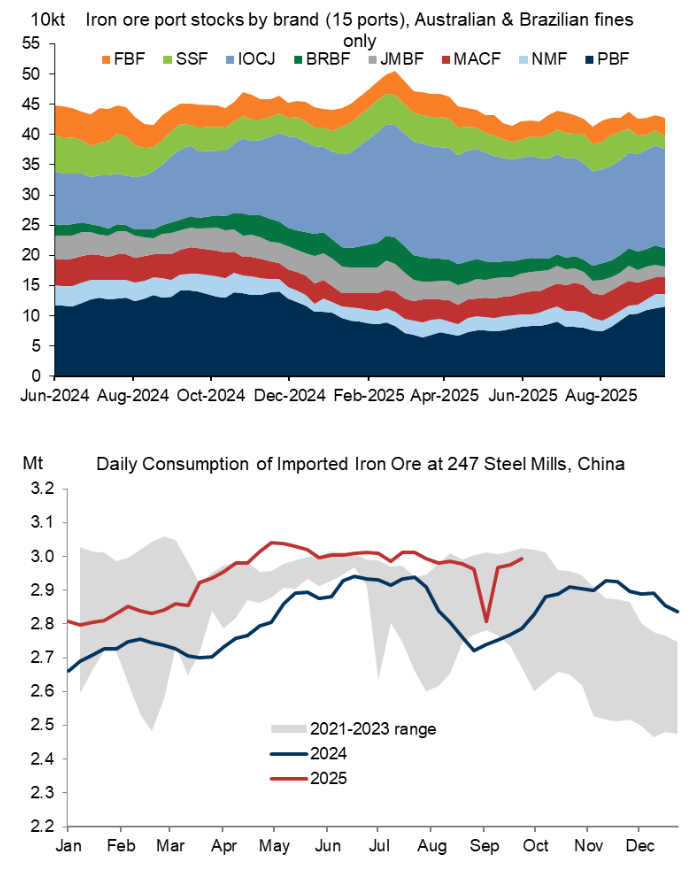
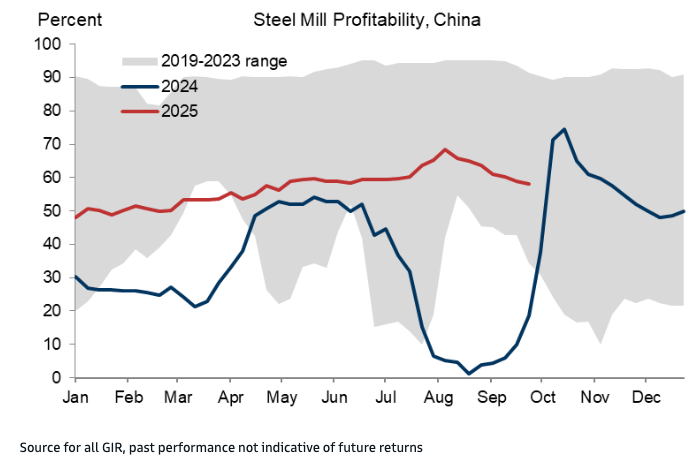
Brief background:  I wrote the below last Monday  “last week it was reported (19 Sept) that Chinas CMRG halting some BHP product link, at the time we understood it related to Jimblebar fines, these acct for c.14mt annually. There is 2mt reported at port, which would be the number to focus on right now. Traders tell me BHP won’t sign a discounted supply deal, so the games begin as CMRG gets bigger. RIO as I understand recently signed a deal floating price deal to year end. Until Simandou comes on and the mkt rebalances those tonnes everyone is nervous and China smells that fear, CMRG is doing exactly what people believe it was designed for….”… This may be a misplaced comment, however its always been my personal impression that BHP’s MOU is to be the best producer,  let the mkt clear at the most efficient price. Its black and white. CMRG is introducing shades of grey and BHP are holding the line….

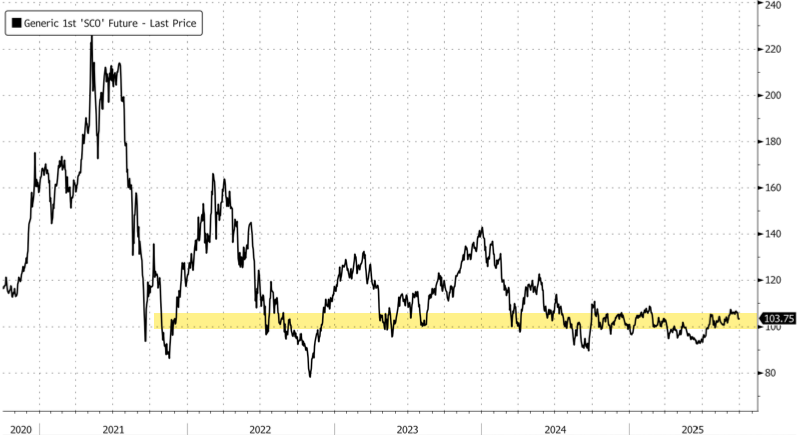
Making sense of the iron ore market, McGeoch published a few charts for clients:

Iron Ore does tend to trend higher into year-end

Singapore iron ore futures rose about 1% to $104 a ton. BHP shares in London fell 2%. 

Last month, BHP reported annual profit that slid to the lowest level in half a decade, as dismal demand from China’s sluggish economic recovery weighed on iron ore prices and prompted a cut in capital and exploration spending. 

Related:

. . . 


Tyler Durden
Wed, 10/01/2025 – 07:15

via ZeroHedge News https://ift.tt/vkO6SFH Tyler Durden

Climatism In Europe Is Dying

Climatism In Europe Is Dying

Via eugyppius.com,

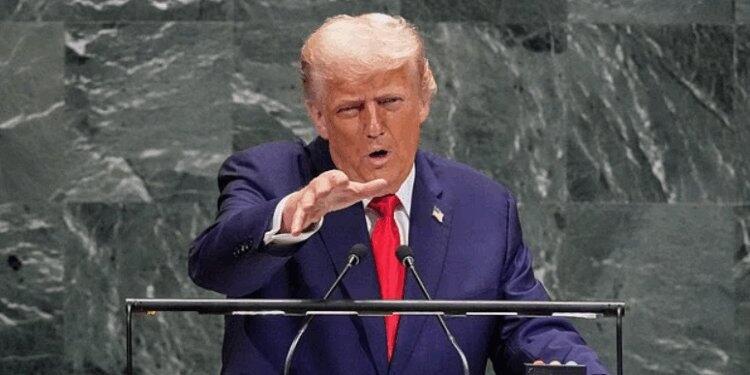
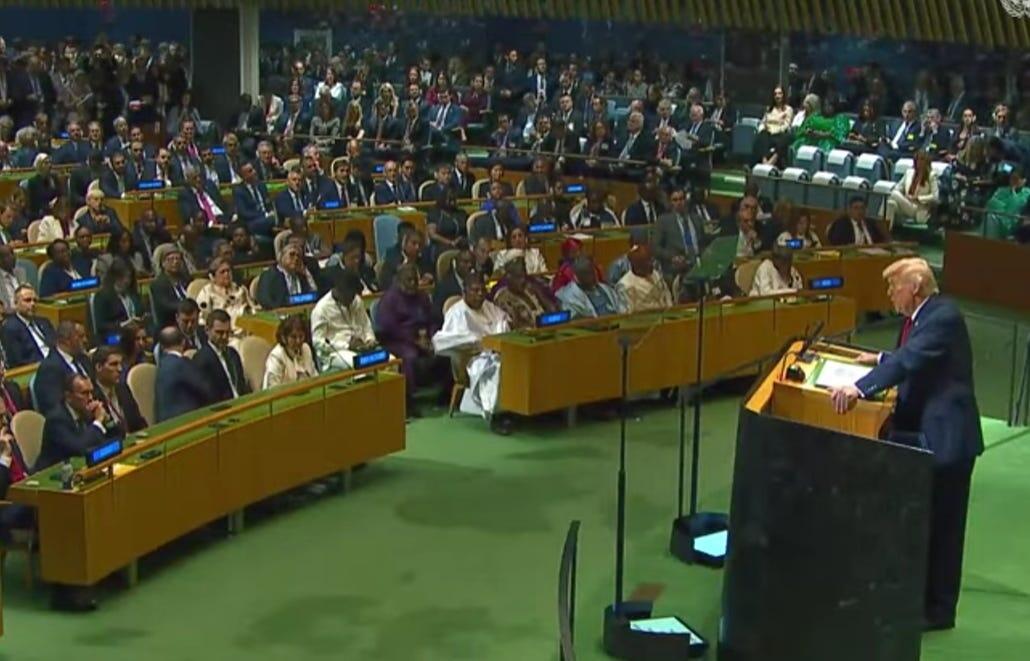
On September 25th 2018, US President Donald Trump delivered his first speech before the United Nations General Assembly.

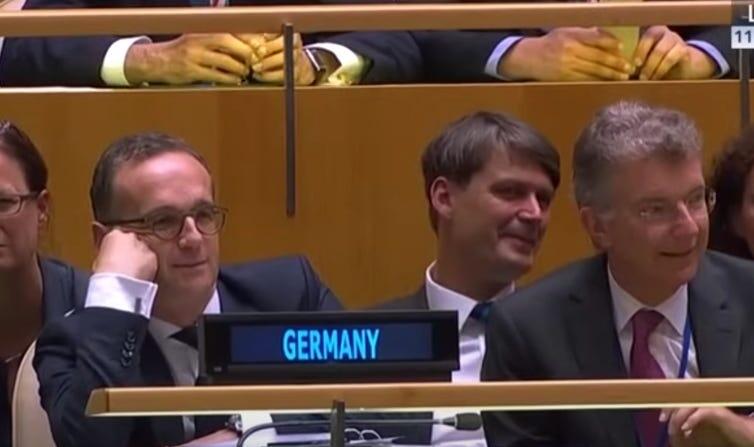
At one point he warned Germany about its plans for Nord Stream 2, which he said would make the country “totally dependent on Russian energy if it does not immediately change course”. German Foreign Minister Heiko Maas (SPD) and Permanent UN Representative Christoph Heusgen laughed in his face.

These clowns thought they had it all figured out back then. We would build a lot of wind turbines and install a lot of photovoltaic panels and make up the difference with Russian natural gas. It would be cheap, it would keep the climatists happy and also too a lot of special interests could profit.

Nobody is laughing anymore.

The entire strategy has collapsed, because without Russian gas the energy transition is hopeless. It can never succeed, it will never go anywhere and the only question is how long we will persist in destroying our economy for no reason. The highly intelligent, extremely mature and deeply far-sighted adults of the German political establishment are facing a slow-burning economic and political emergency, and they are utterly unprepared even to acknowledge it, let alone do anything about it.

This would be why, when Trump returned last week to deliver a second speech to the UN General Assembly, nobody laughed. With an eye towards Europe, Trump said that “Your countries are going to hell”, before deploring particularly what he called the “double-tailed monster” of mass migration and climatism. He said all of this while standing directly in front of the President of the General Assembly, who just happens to be the arch-Green environmentalist bimbo Annalena Baerbock.

I have transcribed his most important statements on climatism and the energy transition:

Energy is another area where the United States is now thriving like never before.

We’re getting rid of the falsely named renewables. By the way, they’re a joke. They don’t work. They’re too expensive. They’re not strong enough to fire up the plants that you need to make your country great. The wind doesn’t blow. Those big windmills are so pathetic and so bad, so expensive to operate, and they have to be rebuilt all the time and they start to rust and rot. Most expensive energy ever conceived. … You’re supposed to make money with energy, not lose money. You lose money, the governments have to subsidise. You can’t put them out without massive subsidies. And most of them are built in China, and I give China a lot of credit. They build them, but they’re very few wind farms. So why is it that they build them and they send them all over the world, but they barely use them? You know what? They use coal, they use gas, they use almost anything, but they don’t like wind, but they sure as hell like selling the windmills.

In 1982, the executive director of the United Nations Environmental Programme predicted that by the year 2000, climate change would cause a global catastrophe. He said that it will be irreversible as any nuclear holocaust would be. This is what they said at the United Nations. What happened? Here we are. Another UN official stated in 1989 that within a decade, entire nations could be wiped off the map by global warming. Not happening. All of these predictions made by the United Nations and many others, often for bad reasons, were wrong. They were made by stupid people. …

I’m telling you that if you don’t get away from the green energy scam, your country is going to fail. … I’m the President of the United States, but I worry about Europe. I love Europe. I love the people of Europe, and I hate to see it being devastated by energy and immigration. This double-tailed monster destroys everything in its wake, and they cannot let that happen any longer. You’re doing it because you want to be nice, you want to be politically correct and you’re destroying your heritage.

They must take control strongly and immediately of the unmitigated immigration disaster and the fake energy catastrophe before it’s too late. The carbon footprint is a hoax made up by people with evil intentions and they’re heading down a path of total destruction. …

Europe reduced its own carbon footprint by 37%. Think of that. Congratulations Europe. Great job. You cost yourself a lot of jobs, a lot of factories closed, but you reduced the carbon footprint by 37%. However, for all of that sacrifice and much more, it’s been totally wiped out and then some by a global increase of 54%, much of it coming from China and other countries that are thriving around China, which now produces more CO2 than all the other developed nations in the world. So all of these countries are working so hard on the carbon footprint, which is nonsense by the way. It’s nonsense. …

The whole thing is crazy. The primary effect of these brutal green energy policies has not been to help the environment, but to redistribute manufacturing and industrial activity from developed countries that follow the insane rules that are put down, to polluting countries that break the rules and are making a fortune. They’re making a fortune.

European electricity bills are now four to five times more expensive than those in China, and two to three times higher than the United States. … The entire globalist concept of asking successful, industrialised nations to inflict pain on themselves and radically disrupt their entire societies must be rejected immediately, and it must be immediate.

A day after these devastating remarks, Wopke Hoekstra, the European Union Climate Commissioner, betook himself to the New York Times to assure progressive Americans that “the world isn’t slowing on climate”. That is only true on a very superficial level. Ideologically, climatism is finished. All of its grassroots support is gone, and it persists only because of institutional inertia, as a complex array of technocratic grifting operations. The German Greens have bled almost all their support beyond their terminally committed base of clueless urbanite dead-enders. They are on the verge of disappearing from the state parliaments of East Germany entirely, and in the West they’re also taking a powerful beating. The voters in Nordrhein-Westfalen have just sent most of the Green mayors of major municipalities packing. Across the Federal Republic, Leftist energy has moved to the hardcore socialists of Die Linke.

Four days after Trump’s speech, the German climatoids of Fridays for Future held a nationwide ‘climate strike’ of the kind they once conducted every Friday afternoon in 2019. These events used to bring hundreds of thousands of naïve university women, befuddled bureaucratic Gutmenschen and school children to the streets. Now the protests are only nominally a strike; they had to move their big event to a Saturday, because nobody wants to waste working hours on this shit anymore.

At Apollo News, Marius Marx writes of ‘The Quiet Downfall of the Climate Movement‘:

The images from the weekend speak volumes: In Berlin, even according to the organisers’ own figures, only 4,300 people turned up, while the police counted just 3,000.

In Hamburg, there were around 2,500 demonstrators, in Munich around 1,500. And in Potsdam, where celebrities Luisa Neubauer and climate researcher Stefan Rahmstorf were present, there were only a few hundred. Nationwide, fewer than 50,000 people took part. … By way of comparison, in 2019, when the demonstrations initiated by Greta Thunberg took place every Friday, hundreds of thousands took to the streets in Berlin alone.

What was once a widely courted and naïvely idealised mass movement with broad social impact… has become a small splinter group ideologically walled up in its own worldview: the climate movement has long since shrunk to a core of radical dreamers. Even Greta Thunberg, the former climate icon, has moved on to newer, more current concerns.

The slogans on the banners alone show how far the movement has strayed from its original cause.

That’s Luisa Neubauer herself, marching with a smattering of leftist activists in Potsdam. The banner behind her reads: “For climate justice. Do you get it?” Since the war in Gaza we hear a lot more about “climate justice” than we do about “climate change”, because the climatoids are no longer leading the eternal Leftist protest. Anticolonialism is more important; CO2 only matters to the extent it represents a Western injustice imposed upon brown people somewhere. In fact, on the Left, climatism is taking a back seat to all kinds of other concerns. This would be why our climatoids have pasted their logo onto the trans flag and why they have to march alongside activists carrying banners complaining about ‘the rich’ and taking potshots at ‘Nazis’. The whole movement is devolving into the standard Leftoid grievance gruel.

The weekend has shown that Fridays for Future has lost its mass base, and that climate as a political issue has lost its mobilising potential. While the general public is discussing a return to climate-friendly nuclear power, the home heating policies, electricity prices and mobility, the German climate movement is marching through city centres with placards whose messages clearly have nothing to do with the everyday lives of most citizens. For this reason, and because some of the 2019 protesters have probably come to understand that Fridays for Future may say climate protection, but in reality means degrowth, deindustrialisation and deliberate destruction of prosperity, the movement is now on the verge of insignificance.

Climatism always had two parts.

  • The first part was a hysterical narrative about how industrialisation is destroying the atmosphere via carbon emissions, how the coral reefs are dying, the polar ice caps are melting and the oceans are rising.

  • The second part was the energy transition – a package of ominous policies that together spell deindustrialisation for any nation that dares to implement them seriously, but that have no hope of ameliorating even the slightest bit of the panic narrative from the first part.

If you were to reduce this nonsense to a Venn diagram, you would see two non-intersecting circles. The activist Left hyped the hysteria panic narrative of the first part while supporting the catastrophically destructive policies of the second part (if occasionally complaining that these policies did not go far enough). The technocracy hyped the catastrophically destructive policies of the second part and supported (if often tacitly) the hysteria of the first part.

This deviously incoherent ideological system is entirely broken. The activists are pushing a whole myriad of grievances about global injustice that have very little to do with technocratic policies, and the technocrats continue to deindustrialise Germany in the absence of any ideological support or justification from the Left – and sometimes even in opposition to a traditional and resurging Leftist anti-elitism. (Few ideologies, after all, embody elite concerns as clearly and with as little regard for the economically disadvantaged as climatism.) It is the beginning of a general climatist disintegration.

While the Eurocrats presently pursuing climatism are well-insulated from shifts in the popular mood, they cannot ignore these indefinitely. The policies at the centre of climatism of course have a deeper purpose that is largely distinct from the panic narrative sold by the activists. If the Eurocrats continue to pursue these policies, they will have to come up with new stories about why the economic destruction they are wreaking is necessary. Thus far, they show no interest in that kind of ideological invention. The stories they are telling right now are of an entirely different flavour. They are about foreign threats and domestic wreckers, about the grave dangers posed by the Russians abroad and the fascists at home. In retrospect, I think climatism was an ideology crafted for a world bereft of concrete villains – a world where industrial processes and gases were the only conceivable enemies. We’re not in that world anymore, and that is why climatism is finished.

Tyler Durden
Wed, 10/01/2025 – 06:30

via ZeroHedge News https://ift.tt/tl7LTRO Tyler Durden

Michael Jordan’s Lawsuit Against NASCAR Could Upend Motorsports

Just imagine it: the roar of 40 overpowered sedans—plastered in vinyls hawking everything from fast food to faith, weed to Creed—bumping and banging at 200 mph. NASCAR has always drawn in unlikely characters. Beyond big screen portrayals by Tom Cruise and Will Ferrell, it has lured celebrity team owners like Pitbull, Super Bowl coach Joe Gibbs, and, most improbably, Michael Jordan. But unlike the others, Jordan has taken his endless hunt for an edge to court—the federal kind, not the hardwood.

Jordan is suing NASCAR for monopoly. His 23XI Racing team, along with Bob Jenkins’ Front Row Motorsports, has hauled NASCAR into federal court, claiming new changes to the sport’s charter system are unfair to teams. For most fans, the surprise isn’t the lawsuit’s details but the casting. Jordan, a global icon and owner of one of NASCAR’s newest teams, is playing the part of underdog, slinging stones at the France family dynasty that built stock-car racing from a Daytona beach into a billion-dollar circuit.

Jim France is heir to a three-generation fiefdom that’s been steering NASCAR for 77 years. His family controls the sanction, the schedule, the rulebook, and many of the tracks themselves. They aren’t beloved by fans, but they’ve kept the show running, and lately, the sport’s been more competitive than ever. The charter system, introduced in 2016, is central to that shift: Buy in and you’re guaranteed a start in every race, resale value in the tens of millions, and a share of the TV money. Under the current $7.7 billion media deal, tracks receive about 65 percent, teams split 25 percent, and NASCAR takes the rest.

That framework has changed the sport. NASCAR was once dominated by dynasties: Richard Petty, Dale Earnhardt, Jimmie Johnson—great drivers who won so much they nearly smothered the product. Watching them was like watching Jordan himself drop 70 points every night; thrilling in isolation, deadening for a league. The France family’s reforms broke that cycle. The charter system works like revenue sharing, and the Next Gen car functions like a salary cap. Together, they’ve produced a level of parity NASCAR has never seen. Jordan himself is proof: 23XI Racing launched in 2021, won in its first season, and has since won eight more races.

But Jordan and Front Row Motorsports say the numbers are still stacked. Even with last-place charter payouts climbing to about $8.5 million annually, NASCAR controls the lion’s share of the media haul and directs most of it to tracks it owns. The contracts, they argue, come bound with gag clauses and noncompetes that give teams no real choice but to sign and stay silent. Refuse, and you’re stripped of your charter, relegated to “open” status with smaller purses and no guaranteed grid spot.

So far, the courts aren’t buying the arguments from Jordan and Front Row Motorsports. They filed their suit in October 2024 after refusing to sign NASCAR’s new charter deal. They briefly won an injunction, letting them race as charter teams, but in June, the 4th Circuit tossed it, saying their case wasn’t strong enough. NASCAR agreed not to sell the disputed charters this season and tweaked rules so their cars can keep racing as “open” entries, though for less money. Trial is set for December 1, with the judge warning that if the plaintiffs prevail, “NASCAR will look much different by 2026.”

Strip away the filings and the spectacle is absurd: Imagine Jerry Jones storming out of the NFL, claiming Commissioner Roger Goodell runs a monopoly. Yes—that’s the point. Every league is a closed system. Your house is a monarchy, your office a dictatorship, and NASCAR a monopoly unto itself. That’s how order is kept, parity enforced, and the game protected from chaos. The grown-up way to change the earnings split is called negotiation. The childish way is to sue and beg a federal judge to strong-arm your partner.

The moment you move from the negotiating table to the courtroom, you stop being a partner. You prove yourself a bad-faith actor, conscripting the government to dictate terms by fiat. That doesn’t just tilt a revenue split, it undermines the entire structure of the league. Why would tracks invest if payouts can be rewritten in court? Why would sponsors commit if contracts can be overturned by a judge? Once antitrust litigation becomes a substitute for bargaining, the league doesn’t bend—it breaks.

Teams do have other options. Tony Stewart’s SRX series may have been a sideshow compared to NASCAR, but it landed a TV deal and packed short tracks on Thursday nights. Dale Earnhardt Jr.’s CARS Racing Tour gives drivers and sponsors another outlet. They’re smaller, scrappier, and nowhere near NASCAR’s scale—but that’s the point. If you don’t like the house rules, you can always start your own game. What you don’t get to do is drag the government in to rewrite the rulebook of someone else’s league.

To let courts dictate the terms of a private league is to declare that nothing built can ever belong to its builders. The France family turned a regional curiosity into a national spectacle. If antitrust prevails, they’ll be reduced to tenants in their own house. And for what? So Michael Jordan can pose as the underdog in a sport that made him competitive overnight. That isn’t justice—it’s vandalism dressed up as fairness.

For this Chicago sports fan, it’s a bit hard to watch. Six championships earned him a bit of grace and that global trademark: “Air Jordan.” This little antitrust sideshow might just ground him.

The post Michael Jordan's Lawsuit Against NASCAR Could Upend Motorsports appeared first on Reason.com.

from Latest – Reason.com https://ift.tt/q7BJ8gd
via IFTTT

Deploying Federal Troops Is Not a Sustainable Solution to Crime in American Cities

He looked young, standing with his feet apart on the upper level of the Dupont Circle Metro station, half in shadow and head to toe in camo. A National Guard member. And in his hand: a tiny packet of Cheetos. He dug into the crinkly bag for the last crumbs as commuters streamed past—ignoring him, pretending not to notice, or nervously pretending they weren’t pretending. You’re not allowed to eat in the D.C. Metro. It’s a rule locals tend to take oddly seriously, like standing on the right of the escalator. But the guardsman wasn’t from here. He didn’t know the rules. He was just a guy from South Carolina or Mississippi or Ohio having a quick snack in a place where he has no business being.

“I am not a dictator,” Trump declared in an August Cabinet meeting. But when it comes to fighting crime, he asserted he has “the right to do anything I want to do,” because “if I think our country is in danger—and it is in danger in these cities—I can do it.”

The president and his administration have offered a mishmash of legal justifications for the National Guard and federal presence in cities over his two terms, including Los Angeles and, in the near future, Chicago.

The president’s assertion that he can do “anything I want to do” with the Guard sidesteps both the Posse Comitatus Act of 1878, which prohibits the use of the military for domestic law enforcement, and the 10th Amendment, which reserves powers to the states. His administration has floated the Insurrection Act of 1807, which permits military force when “unlawful obstructions,
combinations, or assemblages” prevent enforcement of federal law, and it has argued that Guard units are exempt from Posse Comitatus limits because, while federally funded, they remain technically under state control. Courts, however, have warned these deployments stretch the law past its breaking point, with a federal judge recently blocking a California deployment as an “unlawful use of troops” that violated constitutional boundaries.

D.C.’s unusual status makes it soft ground for testing the limits of federal incursions in cities, as does our spineless mayor. The administration has cited Section 740 of the Home Rule Act, which allows the president to take control of the Metropolitan Police and the D.C. National Guard during a declared emergency. So here we are, facing masked federal officers at checkpoints and watching armed young men eat junk food in our subways.

It’s “working.” The presence of federal law enforcement can drive crime down, at least in the short term. In neighborhoods
where the Guard and federal police have flooded in, carjackings, assaults, and homicides dropped. Polls show that many citizens, tired of theft and violence, welcome the uniforms. To dismiss that desire for order as illegitimate is unserious. People want to be safe, or at least feel safer.

And it’s popular. An August Associated Press–NORC poll found that 81 percent of respondents view crime as a “major problem” in America’s large cities, while 66 percent view it as a “major problem” nationwide. A full 82 percent of Republicans, and 55 percent of respondents overall, consider it “completely or somewhat acceptable” for the military and National Guard to assist local police.

But a military occupation of American cities is neither constitutionally sound nor fiscally viable. Legally and logistically, you can’t solve deep social and policing problems with Humvees parked at intersections forever. These deployments tend to devolve into a high-risk form of political theater, rewarding mayors and presidents who want to look tough while leaving communities no closer to a lasting solution and America one step closer to authoritarian rule.

The idea of uniformed federal agents patrolling city neighborhoods as if they were appropriate for everyday law enforcement feels profoundly out of step with the spirit of America’s founding values as we approach the semiquincentennial. The Constitution’s architecture was designed to prevent just this kind of centralization where a standing force functions not as a last resort but as a default mode. Letting soldiers or masked federal officers replace traditional policing undermines the boundary between citizen and subject.

The Cheetos guardsman at Dupont Circle is the perfect symbol of our era: a kid far from home, overdressed, tasked with a job he shouldn’t have, bored and a little hungry. A nation that chooses this as its answer to crime has lost the thread of both constitutional limits and sustainable governance.

The post Deploying Federal Troops Is Not a Sustainable Solution to Crime in American Cities appeared first on Reason.com.

from Latest – Reason.com https://ift.tt/C6a9WhX
via IFTTT

Exxon Planning To Cut 2,000 Jobs Worldwide

Exxon Planning To Cut 2,000 Jobs Worldwide

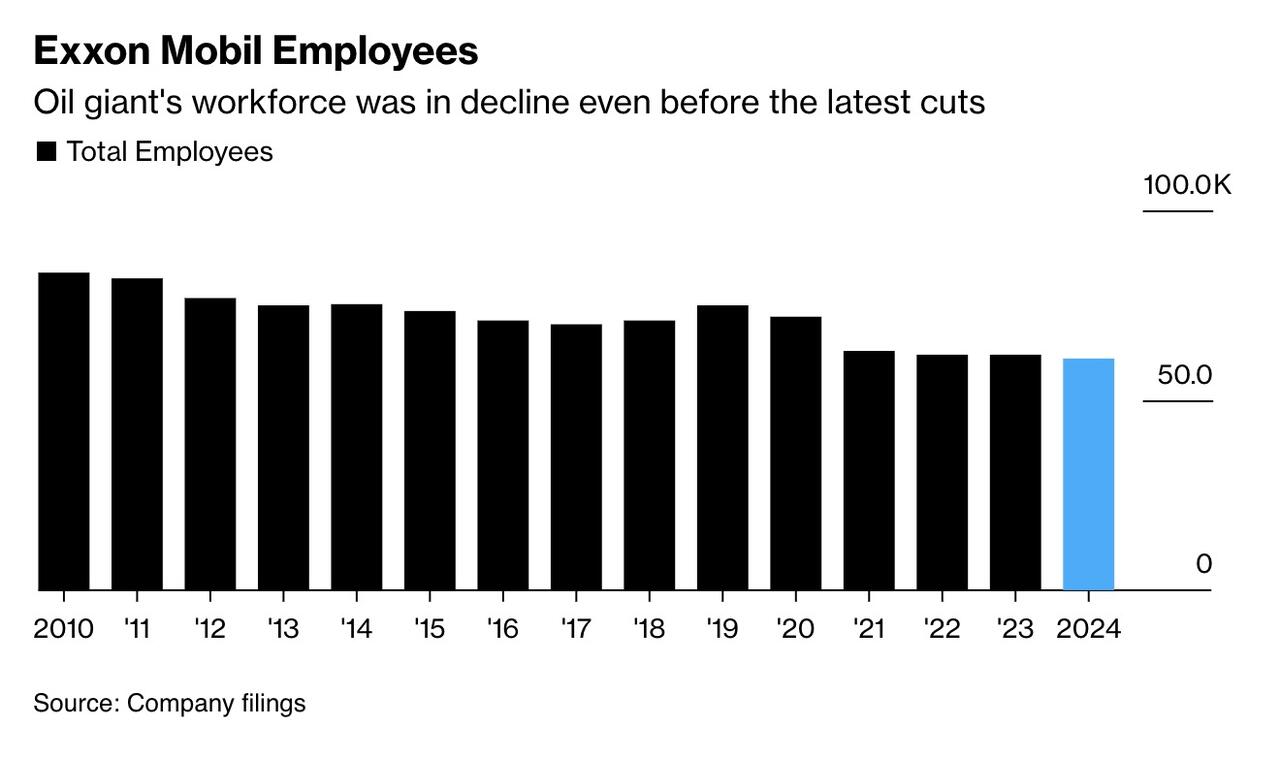
Exxon plans to cut about 2,000 jobs worldwide as part of its years-long effort to streamline operations and consolidate smaller offices into regional hubs, according to Bloomberg.

The reductions, equal to roughly 3%–4% of its workforce, were announced in a memo to employees from CEO Darren Woods on Tuesday.

Bloomberg writes that Exxon received attention Monday when Imperial Oil Ltd. — nearly 70% owned by Exxon — disclosed it would reduce its workforce by 20%. Combined, the moves highlight a sweeping restructuring effort that Woods has pursued since 2019 to simplify Exxon’s sprawling global footprint, a legacy of its merger with Mobil two decades ago.

Woods said the company is making “tough decisions” to sharpen competitiveness. “The changes we’ve announced today will further strengthen our advantages and grow the gap with our competition, helping to keep us in the lead for decades to come,” he told employees.

The company declined to comment beyond the memo, but noted that its new hubs will focus on growth areas like oil in Guyana, liquefied natural gas along the Gulf Coast, and global trading. As part of the shift, employees in Brussels and Leatherhead, U.K., are being moved to central London to align with the firm’s trading operations.

When Woods took over in 2017, Exxon had nine semi-independent units that created layers of bureaucracy and duplication. Now the company operates with three divisions — production, refining, and low-carbon — supported by shared services such as IT and engineering. That structure has already helped Exxon cut $13.5 billion in annual costs, more than all other international oil majors combined. The company, which employed 61,000 people at the end of 2024, expects to boost savings another 30% by 2030.

Exxon is hardly alone in trimming staff. As we have noted over the past few months…Chevron, ConocoPhillips, and BP have also each announced thousands of job cuts in recent months as crude prices faltered under pressure from OPEC and its allies.

Tyler Durden
Wed, 10/01/2025 – 05:45

via ZeroHedge News https://ift.tt/kmfXCeO Tyler Durden

Leaked Police Call Reveals Migrant Gangs Have Led To No-Go Zones For Authorities In Catalonia

Leaked Police Call Reveals Migrant Gangs Have Led To No-Go Zones For Authorities In Catalonia

Authored by Thomas Brooke via Remix News,

Torelló, a town in the Osona region of Catalonia, is facing growing insecurity after a leaked recording revealed local police officers acknowledging they are unable to control violent migrant groups gathering in certain areas, and have been laughed at and forced to retreat from dispatch calls.

The audio, verified by authorities and reported by ElCaso.cat, captures an officer telling a resident that police cannot act against around 25 rioters in Sant Josep Street because only two officers were on duty.

“They are laughing at us,” the officer said in the call. “They are throwing us out. If we don’t want to get hurt, we too [must leave],” he added, describing how officers had to withdraw after being met with hostility.

Residents say the area around the old Vitri lot has become a hotspot for antisocial behavior, fights, and intimidation.

The call has been widely circulated by neighbors, who see it as a symbol of law enforcement’s loss of control. Many have organized a rally outside the town hall for Monday evening to demand action from local authorities.

Security Councillor Elisabet Viñas, from the Republican Left, confirmed the recording’s authenticity and acknowledged the seriousness of the situation. In a private message to residents, she wrote: “The Local Police are going there, they are there and have arrested them many times. The laws are not strong enough, nor justice fast enough to get rid of these filthy people.”

She added that the problem stemmed largely from young men, “mostly foreigners from the Maghreb,” who had occupied several nearby apartments and were allegedly involved in burglaries and shop break-ins.

Municipal sources admitted the issue extended beyond Torelló. “We need stronger laws, faster justice, and more police on the streets,” one official said, noting that insecurity was a growing concern across the country. The town council has announced the creation of five new positions in the Local Police to strengthen its force.

Catalonia has become the epicenter of violent crime in Spain, with foreigners vastly overrepresented in serious offenses, according to interior ministry crime stats published in January.

The stats portal for 2023 showed that all 10 Spanish cities with the highest rates of violent robberies and intimidation are located in Catalonia, with Barcelona leading the list.

Remix News previously reported in November last year on statistics highlighting the extent of foreign overrepresentation in Catalan prisons. At the time, 50.48 percent of the inmate population comprised non-Spaniards.

Read more here…

Tyler Durden
Wed, 10/01/2025 – 05:00

via ZeroHedge News https://ift.tt/1bPJsEH Tyler Durden