Bull Vs Bear: The Pain Trade Is “Likely To Be Higher”

Bull Vs Bear: The Pain Trade Is “Likely To Be Higher”

Authored by Lance Roberts via RealInvestmentAdvice.com,

Rally Begins As Doves Emerge

Markets surged into the Thanksgiving holiday, ending the week with substantial gains across all major U.S. indexes. The S&P 500 rose by approximately 3.7%, marking one of its strongest weeks in the past six months. The catalyst was a combination of falling bond yields and increasing confidence that the Federal Reserve has completed its rate hikes. Currently, Kalshi (prediction market) is projecting an 80% chance of a rate cut in December.
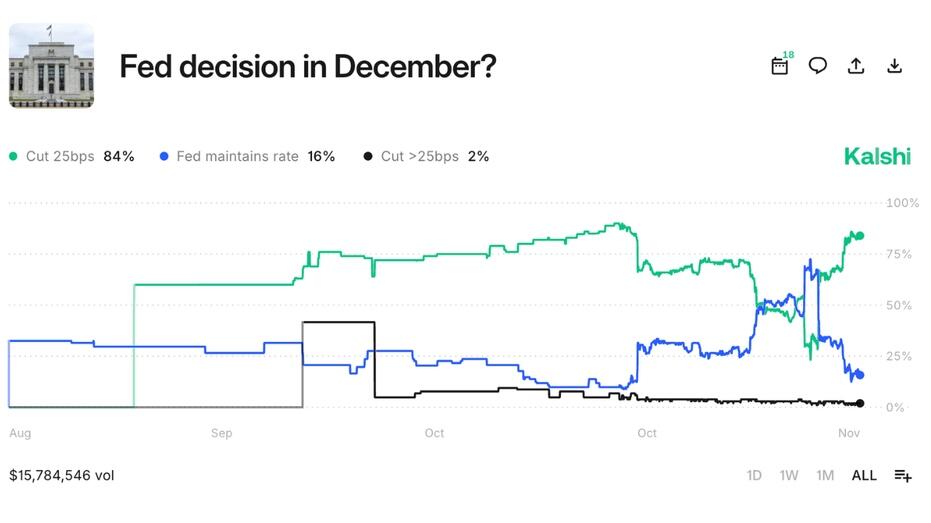
With inflation data continuing to trend lower and growth indicators remaining stable, the markets are starting to price in stronger earnings and economic growth in 2026, particularly as lower Treasury yields boosted duration-sensitive sectors and encouraged risk-on behavior.

Unsurprisingly, despite all of the recent talk of the “Death of the AI Trade,” Technology stocks once again led the charge. The AI narrative regained momentum, pulling mega-cap names higher and lifting the broader Nasdaq. Nvidia’s earnings beat helped reinforce the bull case around AI infrastructure and cloud demand. The “Magnificent Seven” tech leaders contributed outsized returns to index performance, though broader participation remained limited.

Volatility declined as technical indicators turned more supportive after the last few weeks of choppy action, which was also unsurprising. Despite the gains, many risks remain, including concentration in the market-cap-weighted index, valuations, and market breadth. However, those concerns may take a backseat temporarily following the recent correction and reversal in bullish sentiment.

Heading into December, all eyes will turn to the upcoming PCE inflation report, jobs data, and the final round of Fed comments before the blackout period. Until then, momentum favors the bulls, but the foundation remains fragile.

Year-End Rally Begins

In last week’s #BullBearReport, we discussed how the market becomes more predictable as we approach year-end. To wit:

“Heading into December, the seasonal tailwinds remain intact, as noted above. December is historically the best month for equities, with the “Santa Claus rally” often delivering average gains of 1.5% to 2.0%. With corporate buybacks in full swing, adding $5-6 billion in daily volume, investor positioning remaining stable, and professional managers underweight in exposure, particularly in technology companies, the fuel for a rally is present. However, the market also remains fragile due to poor underlying breadth and rising volatility, so caution is advised.

The near-term outlook is constructive, provided the Fed remains quiet and bond volatility remains contained. But any surprise, in inflation, growth, or geopolitics, could shift sentiment quickly. The key for investors is discipline. Don’t chase the rally blindly. Stick to quality, stay diversified, and use elevated prices to trim into strength where appropriate. While the potential for a year-end rally is higher after the recent correction, nothing is guaranteed.”
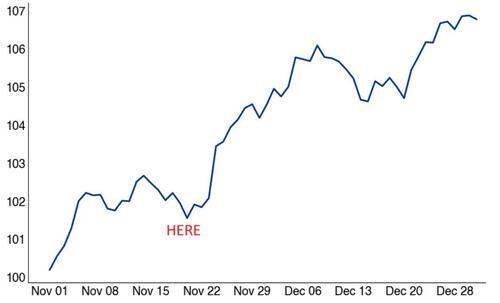
As discussed in the “Market Brief” above, the rally appears to have begun. November and December have historically shown a strong performance bias since 1950, with the S&P 500 posting gains in roughly 75% of the years. This period accounts for a disproportionately large share of annual returns.
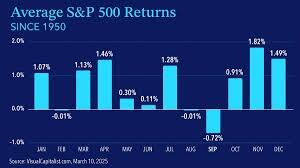
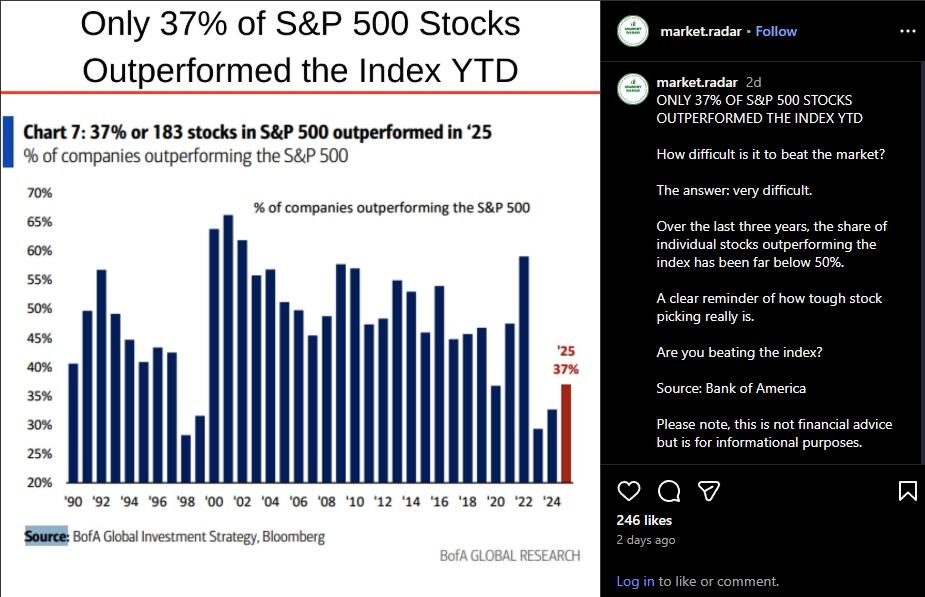
The drivers aren’t mysterious. Mutual funds and institutions close their books on the calendar, or fiscal year, so there tends to be a push to catch up on exposures to certain stocks or sectors before year-end reporting goes out. This is commonly referred to as “window dressing,”  but it does add support for the markets in the near term. Furthermore, as noted, investment managers who have underperformed try to play “catch-up,” so they rotate into the winners. “Beating the Market,” which isn’t a financial goal, has been incredibly difficult this year, as only 37% of the index is actually outperforming. As a result, mega-cap stocks and growth names are likely to be chased into the end of the year. That’s performance chasing, not investment strategy, but it still moves markets.
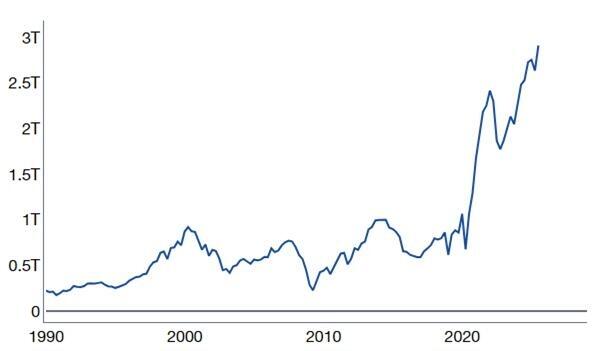
Lastly, retail flows also increase as post-October corrections tend to shake out weak hands. When that fear subsides, sidelined cash looks for a home, and retail investors tend to add to the buying pressure in November. We commented on this behavior in our October newsletter, Year-End Rally, 3-Reasons To Buy The Dips,” we said:

“Furthermore, the “retail demand” remains consistent in 2025, and every dip continues to be bought aggressively. We can visualize this retail investing “BTFD” momentum trade. The following chart shows the “buying panic” that has occurred since the “Pandemic Shutdown” for investors under the age of 40, which dwarfs all other periods in the data set. While the eventual reversion is likely massive, by year-end, there is likely very little that can break the current psychology driving markets.”
As we stated in that mid-October newsletter, investors should have expected the recent pullback.

“Strong earnings, aggressive buybacks, and trend-following behavior provide a durable backdrop for the stock market rally to continue. Pullbacks should be expected, but they are more likely to serve as buying opportunities than signals of a larger trend reversal.

That’s precisely what’s happened, and Thanksgiving week is usually the kickoff. Over the past decade, the S&P 500 has been green during Thanksgiving week in seven out of ten years. This year, that rally appears to have started early with Technology, small caps, and crypto turning higher.

As noted in the Technical Update above, the much-needed corrective action in the first half of November relieved the overbought conditions impacting the market, providing a better base for a year-end rally.

Tailwinds and Why the Correction Set Up This Move

With the majority of selling pressure having exhausted itself over the last few weeks, the backdrop for a year-end rally has improved. The setup is no longer dominated by panic-driven selling or forced de-risking, but, instead, several identifiable tailwinds are providing the necessary fuel for sustained upside. These forces don’t guarantee a rally, but they reintroduce one critical factor that had been missing: consistent buying power.

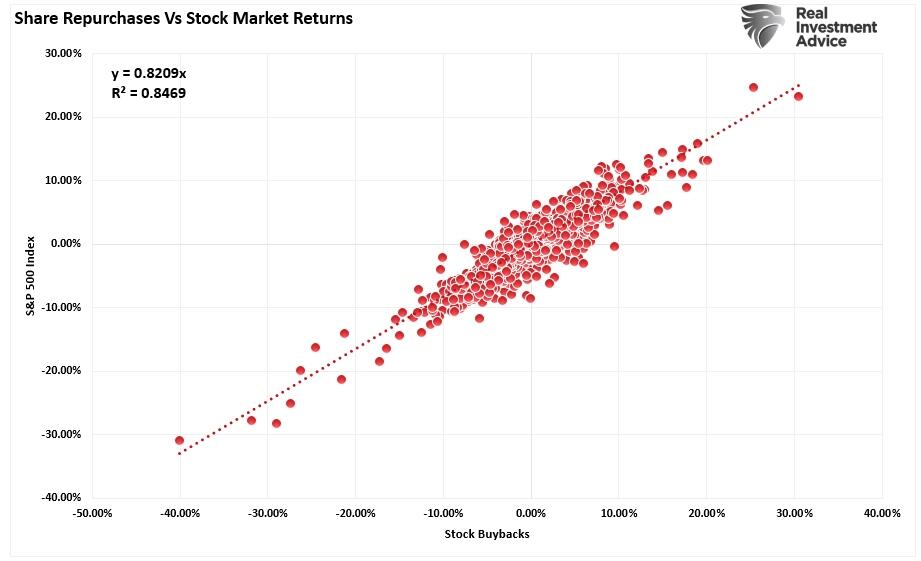
One of the most critical catalysts is the return of corporate buybacks, which, since 2000, has accounted for nearly 100% of net equity purchases. As shown, there is a very high correlation between corporate share buybacks and stock market returns. Now, with earnings season mostly complete, blackout periods have ended, and companies, particularly the mega-caps, are now stepping back in as steady buyers of their own stock. According to Goldman Sachs, daily buyback demand is expected to exceed $5 billion through early December. That kind of structural bid creates a firm floor under prices, especially in a low-volume environment.
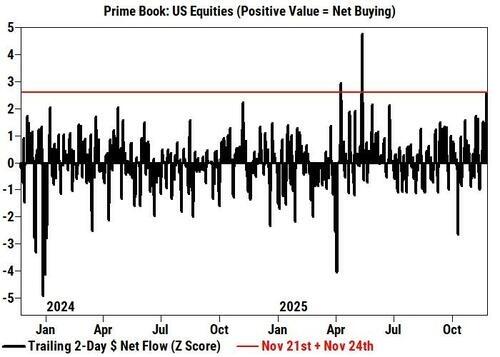
Another overlooked factor is the cessation of CTA-driven selling. These computer-driven trend followers were net sellers throughout the recent correction. As they unwind bearish positions and shift to neutral or net-long exposure, the pressure flips. What was previously a source of downside has now become a source of upward momentum. Furthermore, hedge funds have been aggressive net buyers of equities in recent days to gain exposure to the market.
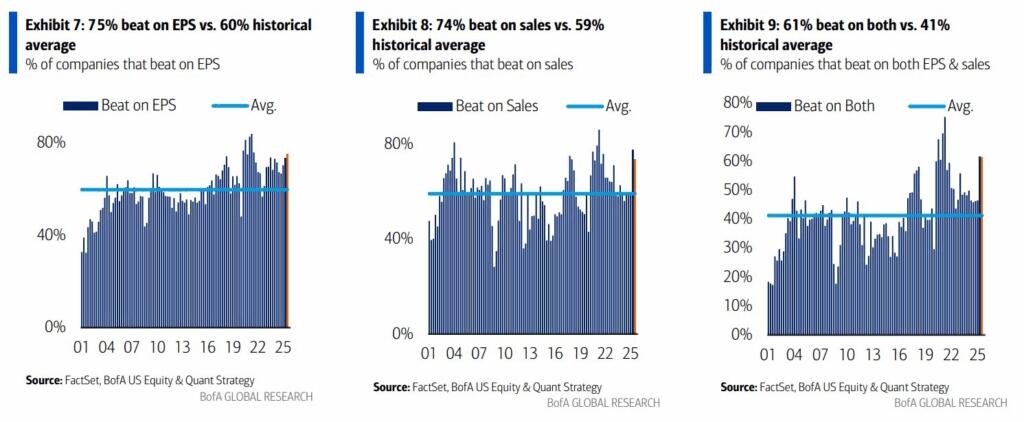
Earnings also play a key role in a year-end rally. With earnings season behind us, where expectations heading into Q3 were low, most of the bearish concerns have been laid to rest. Over 75% of companies beat estimates, 74% beat revenues, and 61% beat on both, which was well above the historical averages. More importantly, profit margins didn’t collapse, and forward guidance, while cautious, remained optimistic. That helped reset sentiment and reduce fears of an imminent earnings recession.
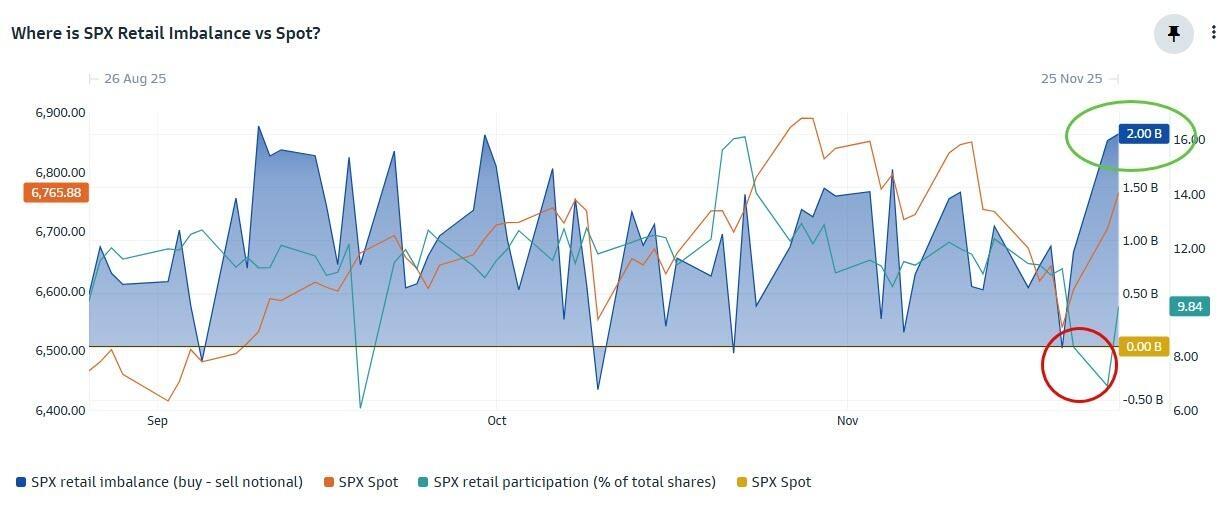
Finally, retail investors showed up to “buy the dip,” as they have done continuously this year. Such is also not surprising over a holiday-shortened Thanksgiving trading week when trading volume is lighter because institutional traders are away, leaving the “inmates to run the asylum.”
While there are undoubtedly many concerns heading into 2026 that investors should be aware of, over the next few weeks, several catalysts suggest that the “pain trade” is likely to be higher.

Is that a guarantee? Absolutely not.

Does that mean the markets can pull back in the first couple of weeks of December when mutual funds distribute their gains and incomes for the year? No.

However, the data does suggest that the market will likely have a positive bias into year-end, and dips should be used opportunistically.

Key Catalysts Next Week

Next week marks a pivotal moment for investors. The bulk of U.S. economic data is expected to resume after recent delays. Liquidity remains seasonally light. That raises the stakes. A few data points and events could drive outsized volatility. They also carry the potential to reinforce or derail the market’s year‑end setup. Below is a table of the most important market and economic events to watch.
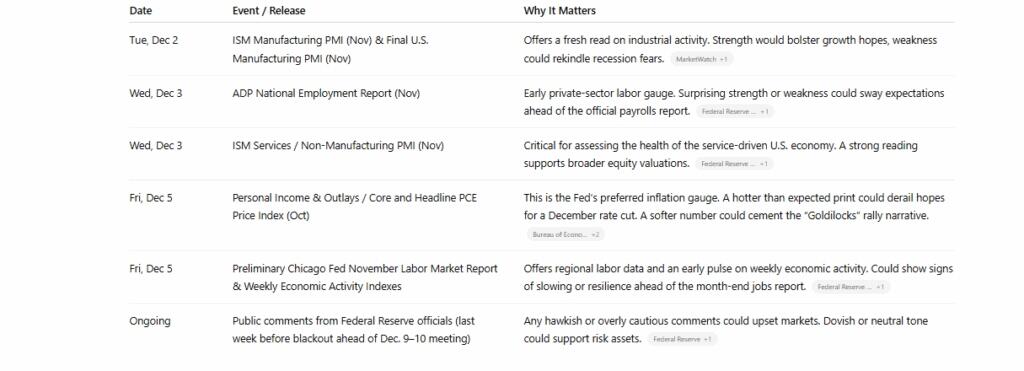
The first week of December reconnects markets with key economic data that had been delayed during the recent government shutdown. The arrival of those data releases reactivates the fundamental underpinnings of market direction. A few strong prints — on inflation, employment, manufacturing, or services — could validate a bullish year-end narrative. Conversely, any surprise weakness could derail current optimism. Inflation data is especially sensitive, and the upcoming PCE release is expected to shape market expectations ahead of the next Fed meeting on December 9–10.

Liquidity remains thin with many traders still on holiday or in partial holiday mode. In such an environment, headline‑driven moves can be magnified. That means surprises, either good or bad, have the potential to move markets significantly more than usual. Lastly, with this being the last week before the Fed’s policy blackout period, any public statements from officials carry extra weight. Market participants will scrutinize every word looking for any tone or messaging that will influence yield expectations, risk sentiment, and positioning as we head into the final stretch of the year.

Bull Vs Bear

Over the last few weeks, we discussed the risk of downside pressure in the market and that the correction set up potential for a rally during the holiday-shortened trading week. That occurred with the S&P 500 rising roughly 3.7% from last Friday’s close near 6,849. That rebound recaptured the losses from the prior AI- and rate-cut-wobble selloff and pushed the index back toward its late-October highs. On a bigger picture basis, the index remains up around 16% year-to-date and is now roughly flat for November, reflecting a strong tape that has simply been digesting earlier gains. The rally also triggered a fresh momentum “buy signal” which will be supportive of further gains into next week.
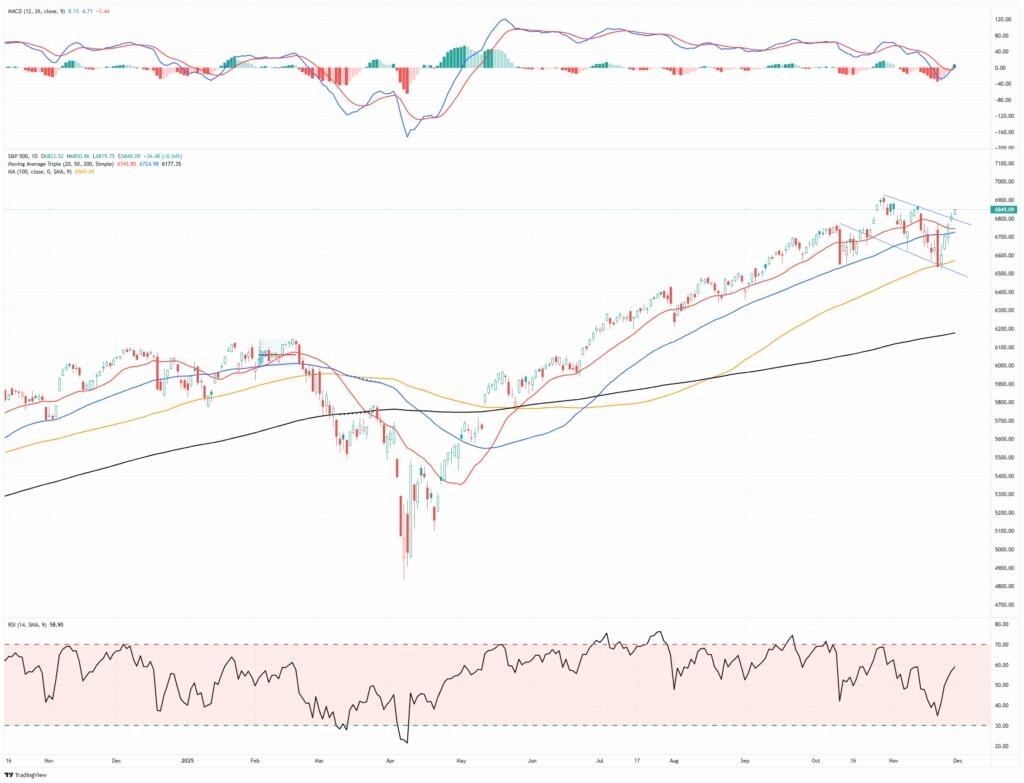
From a trend standpoint, the price remains aligned with the bulls. The S&P is trading above its rising 50- and 100-day moving averages, which sit roughly in the 6,700–6,575 zone, and well north of the 200-day moving average near 6,175. Earlier in November, the index finally broke its streak above the 50-day moving average (DMA) and corrected back to the 100-DMA, working off some of the speculative excess in AI and high-beta names. This week’s bounce off that support pulled the price back into the upper half of its recent trading range, keeping the primary uptrend intact.

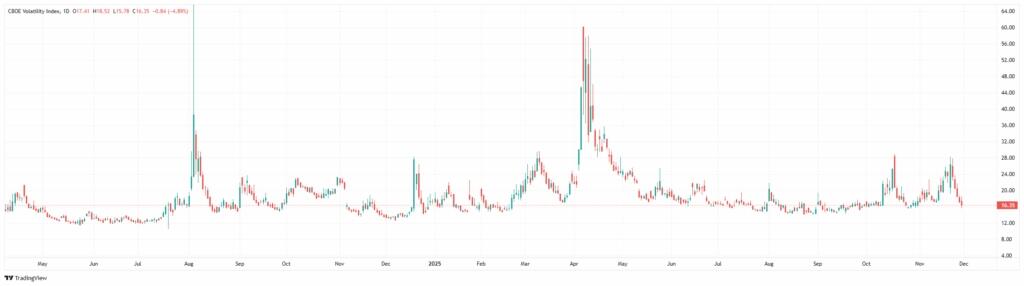
Volatility has cooled but not disappeared. After spiking into the upper 20s during the recent tech/AI downdraft, the VIX slid back into the high teens, around 16, by Friday’s close, signaling that the panic bid for protection is fading but that investors are not yet entirely complacent. That’s consistent with a market transitioning from a “shot across the bow” correction to a more typical year-end positioning grind.
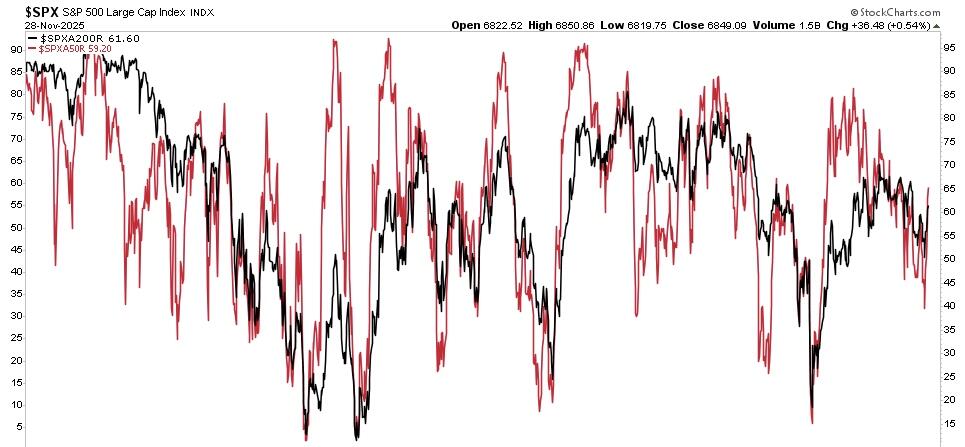
Breadth is improving, but it isn’t a blow-out green light. Roughly 59% of S&P 500 stocks are back above their 50-day moving averages, and just over 61% trade above their 200-day, a solid improvement from the trough earlier in the month but still shy of the 70%+ readings you’d expect in a truly broad-based rally. Participation has also expanded beyond mega-cap tech, with more cyclical and value names stabilizing; however, leadership remains heavily tilted toward large-cap growth and AI-adjacent beneficiaries.
Bullish case heading into December: 

Seasonality, positioning, and trend still lean in favor of the bulls. December is historically one of the stronger months for equities, particularly when the market is already up by double digits year-to-date. Expectations for a December Fed rate cut, and a gradual cooling of inflation, support the “soft-landing” narrative, while corporate buybacks and under-invested managers create fuel for a “chase into year-end” if resistance gives way. With volatility easing and breadth improving, the path of least resistance near term remains higher if key support zones are maintained.

Bearish case heading into December: 

The bears will point out that valuations in AI and growth expectations remain stretched, that volatility is still elevated compared to the summer lows, and that breadth, while improved, is not confirming a runaway advance. The recent episode, where AI leaders and other risk assets (including Bitcoin) sold off together, is a reminder that risk appetites can shift quickly when the crowd questions the durability of earnings or the timing of Fed cuts. Delayed economic releases from the earlier government shutdown create an additional wildcard: a batch of weaker-than-expected data hitting all at once could challenge the soft-landing narrative just as liquidity gets thinner into year-end.

Support and Resistance Levels

  • Near-term support:

    • ~6,725–6,750: cluster of short-term support at the 20 and 50-DMA

    • ~6,569: last week’s support at the 100-DMA.

    • Deeper support: ~6,175 (200-DMA) on any more serious risk-off move,

  • Resistance:

    • 6,867–6,909: Previous market tops in mid-October and early November.

    • 7,000: psychological round-number magnet if momentum accelerates

  • Volatility “line in the sand”:

    • VIX back above ~22–23 would signal a renewed risk-off phase; sustained readings in the mid-teens would confirm a constructive backdrop for a “Santa Rally” push.

Bottom line: the primary trend remains bullish, but the margin for error is narrowing. As we enter the final month of the year, the bulls remain in control as long as the index holds above the 50-day moving average and breadth continues to improve. A failure back below the 6,600 area, especially if accompanied by a renewed spike in volatility and renewed AI/credit jitters, would shift the balance of risk toward a deeper consolidation rather than a clean “Santa rally” into year-end.

Tyler Durden
Sat, 11/29/2025 – 18:40

via ZeroHedge News https://ift.tt/3GQwOKb Tyler Durden
Democrats Sue After Trump Cuts SNAP Benefits For Alien Migrants

Democrats Sue After Trump Cuts SNAP Benefits For Alien Migrants

It was one of the key debates that led to the longest government shutdown in US history:  The Trump Administration wanted to close the loopholes that allowed non-citizens access to government subsidies like ACA healthcare and free food through SNAP. 

Democrats claimed that “illegal migrants” don’t have access to such programs. 

Yet, the Democrats were willing to drag out the government shutdown for 35 days just to stop Trump from implementing cuts that would apparently affect no one. 

Why?

Because leftists are liars

If they are not telling a direct lie, they are lying by omission or by using semantics and carefully crafted language so that if they get caught they can say “That’s not what we meant…”  

When Republicans moved to block subsidies for migrants this included the millions of asylum seekers that entered the US illegally and then took advantage of Joe Biden’s lax policies, including “catch and release.” 

Democrats, however, categorize asylum seekers as residing in the US “legally”. 

It’s a dishonest way to bypass the debate and pretend as if Trump is living in a fantasy land.  Meanwhile, Democrats hope that the general public will not catch on to the game they are playing.  

Eventually, the truth gets out, often through self-exposure because the leftists can’t help themselves.  After months of Democrats asserting that “illegal” non-citizens don’t receive government subsidies, Oregon is suing the Trump administration over changes to the nation’s food assistance program, arguing that new federal guidance unlawfully blocks certain groups of “legal” immigrants from accessing food aid.  When Democrats mention “legal immigrants” they are referring to all asylum seekers.

Twenty-one other states joined Oregon in filing the lawsuit Wednesday in federal court in Eugene, arguing that the U.S. Department of Agriculture overstepped its authority when it issued an Oct. 31 memo telling states to cut off benefits for people who have long been eligible for the Supplemental Nutrition Assistance Program, or SNAP. 

The dispute centers on changes Congress made in July through the One Big Beautiful Bill Act, which limited SNAP eligibility for certain noncitizens in temporary immigration categories. 

In the lawsuit, Oregon Attorney General Dan Rayfield and the other Democratic attorneys general said the USDA memo goes further than what Congress approved and effectively blocks many lawful permanent residents from the SNAP program even though they qualify under the law.  Those include refugees, asylum seekers and people admitted under humanitarian programs once they obtain a green card and meet the program’s income and residency rules.

Their definition of “legal” non-citizens, however, is irrelevant.  The federal government has broad authority to determine who is here legally and who gets access to federal subsidies including SNAP.  Migrant aliens who flooded into the US during the Biden regime and took advantage of wide open asylum policies do not necessarily qualify.

Furthermore, there needs to be a national discussion about who should be allowed access to American taxpayer dollars.  Progressives exploit subsidies as a way to lure migrants to the US and buy their votes once they become naturalized.  The Democrat agenda is clearly to upend the demographics of the country in their favor.  Why would native born Americans allow their money to be used against them as a means to steal their country from them?

No migrants, legal or illegal, should ever qualify for government subsidies.  If they can’t support themselves, they should not be traveling to the US in the first place.  At the very least, there needs to be a set moratorium on immigrant applications for benefits; perhaps 5-10 years after they gain residency.  This would weed out any parasites looking to feed on the American system rather than contribute and assimilate. 

Oregon and other states are asking the court for a preliminary injunction to block the new policy while the case is heard.  AG Rayfield says the goal is “to get in front of a judge as quickly as possible to make sure that we can get this food assistance flowing again here in the near term.”

Democrats understand that they have a limited window of time – A few months without SNAP benefits and migrants will leave blue states, possibly self deporting back to their countries of origin.  The incentives to stay will be gone.  Meaning, Democrats lose their census advantage, they lose vast pool of future voters (or current voters in states without voter ID), not to mention a useful mob of thugs they can muster whenever they need to create civil unrest.   

Tyler Durden
Sat, 11/29/2025 – 18:05

via ZeroHedge News https://ift.tt/TpX2VSq Tyler Durden

Watch: ‘Seditious’ Kelly Doubles Down On Military Mutiny Call

Watch: ‘Seditious’ Kelly Doubles Down On Military Mutiny Call

Authored by Steve Watson via Modernity.news,

Arizona Sen. Mark Kelly doubled down on his call for military mutiny against President Trump during a late-night appearance with Jimmy Kimmel, insisting he’s “not backing down” from urging troops to defy “illegal orders”—yet admitting he can’t cite a single instance of that.

Kelly’s deflection, amid a DoW probe into his “serious allegations of misconduct,” fuels accusations that such rhetoric incited the D.C. shooting of two National Guards members—one fatal—by an Afghan migrant.

Kelly told Kimmel, “You can’t keep track of this guy and what he says. I’ll tell you this though, I’m not backing down. We said something very simple. Members of the military need to follow the law. We wanted to say that we have their backs. His response, kill them.”

Quite clearly Trump did not call for Kelly and the others to be killed, but this was the spin from the leftist media.

Kelly mocked the investigation into him and the other ‘seditious’ Dems, noting “This is what he can do this week, go after me under the Uniform Code of Military Justice, which is a law in the military, which is kind of wild because we recited something in the Uniform Code of Military Justice, and he is going to prosecute me under the Uniform Code of Military Justice for reciting the Uniform Code of Military Justice.”

“It is so ridiculous, it is like you can’t make this shit up.” Kelly blathered, adding “What I am worried about is the reaction and what this transmits to the military and the public, which is basically, shut up and listen to that guy. That is not the way our system works.”

He continued, “My oath and every member of the military took is loyalty to the Constitution, not to a person. He is trying to get some fear out there, and fear can be contagious, but what also can be contagious is courage and patriotism.” 

It is how democracy dies. It is right out of the playbook. The playbook of authoritarianism, that’s what they do,” Kelly further charged, adding “They try to suppress speech. Every one of us has First Amendment speech rights. I think the president is infringing on those, and he is sending a strong message, you don’t want to cross him and your loyalty should be to him. It should not. It always should be to the Constitution.”

Kelly’s Kimmel dodge, failing to name a single “illegal order” despite prodding, reduces the “Seditious Six’s” stunt to more empty ‘Trump bad’ fearmongering. On Rachel Maddow’s ratings bereft show, Kelly also conceded Trump has “only given ‘lawful’ orders.”

As we previously highlighted, former CIA agents have flagged the Dems’ video as a “handler”-driven op, asserting that it is straight out of the CIA playbook.

Air Force vet Buzz Patterson called it “treasonous and seditious,” urging prosecutions, while Press Secretary Karoline Leavitt accused Kelly of “intimidating” 1.3 million troops: “You can’t have a functioning military if there is disorder and chaos within the ranks… They can’t identify ‘illegal’ orders because there ARE NO illegal orders!”

Kelly’s defiance draws fire for fueling the D.C. ambush, where an Afghan migrant killed U.S. Army Spc. Sarah Beckstrom and critically wounded U.S. Air Force Staff Sgt. Andrew Wolfe.

Conservatives have pinned it on Democrats’ “illegal” deployment smears and mutiny video. Patterson raged: “What they did was treasonous and seditious… They are circumventing the chain of command.” Leavitt warned: “These officials are trying to sow chaos and distrust, which is a very dangerous thing to do within the military’s rank.” 

Your support is crucial in helping us defeat mass censorship. Please consider donating via Locals or check out our unique merch. Follow us on X @ModernityNews.

Tyler Durden
Sat, 11/29/2025 – 17:30

via ZeroHedge News https://ift.tt/VOEuxbS Tyler Durden

‘Self Deport’ Or Else: DHS Guts Biden’s Haitian Invasion Pipeline

‘Self Deport’ Or Else: DHS Guts Biden’s Haitian Invasion Pipeline

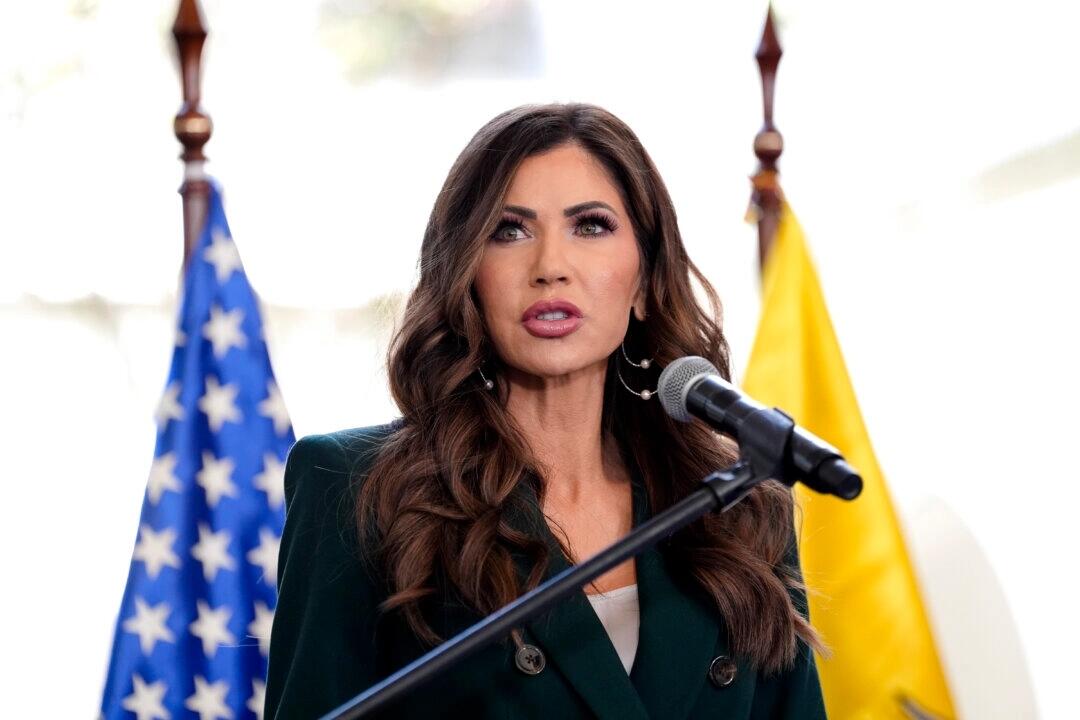
After a no-nonsense review that apparently didn’t involve the usual DEI smoke and mirrors, DHS Secretary Kristi Noem declared Haiti’s endless cocktail of chaos no longer qualifies for America’s taxpayer-funded hotel voucher program.

“Based on the Department’s review, the Secretary has determined that while the current situation in Haiti is concerning, the United States must prioritize its national interests and permitting Haitian nationals to remain temporarily in the United States is contrary to the U.S. national interest,” the DHS said in the termination notice.

Translation: Enough with the virtue-signaling; America’s sovereignty isn’t a globalist buffet.

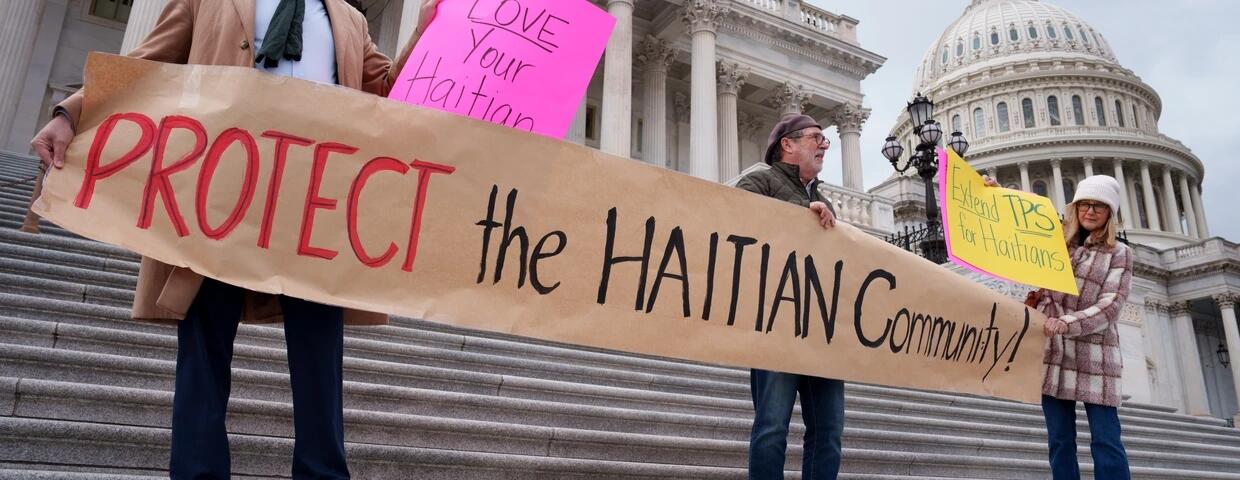
DHS pegs the current Haitian headcount at a whopping 352,959 – give or take a few who slipped in through the southern sieve – with only around 18,000 living as “lawful permanent residents.”

Homeland Security officials said that the TPS program has become a draw for illegal immigrants in recent years.

“Using TPS to grant temporary status to successive waves of new arrivals from a designated country may generate a significant pull factor for illegal immigration and act in tension with the congressional design,” the agency said.

DHS officials did not mince their words, advising Haitians to use the CBP Home app to self-deport and receive a $1,000 exit bonus.

If you are an alien who is currently a beneficiary of TPS for Haiti, you should prepare to depart if you have no other lawful basis for remaining in the United States.

You can use the CBP Home mobile application to report your departure from the United States.

This secure and convenient self-deportation process includes a complimentary plane ticket, a $1,000 exit bonus, and potential future opportunities for legal immigration to the United States.

Of course, the deep-state legal vultures have been circling. Efforts to torch TPS have sparked courtroom cage matches, but the Supreme Court just handed Trump a W last October, greenlighting the exodus of Venezuelan freeloaders.

“Limited access to critical information and significant processing delays hinder the ability of federal officials to reliably assess the criminal histories or national security threats posed by aliens attempting to enter the U.S. illegally,” DHS said Nov. 28.

“As a result, public safety and national security risks are significantly heightened in such conditions.”

As a reminder, Haitian hordes became 2024’s election piñata, with VP JD Vance and President Trump zeroing in on the Springfield, Ohio pet-eating fiasco – a microcosm of how these “protected” imports turn heartland towns into no-go zones overnight.

And just to twist the knife, Uncle Sam slapped visa sanctions this week on some shadowy Haitian bigwig accused of bankrolling the island’s gangbanger terror cells, stonewalling the “fight” against what D.C. delicately dubs “terrorist organizations.”

Because nothing screams “allies” like funding narco-thugs while your citizens flood our streets.

Tyler Durden
Sat, 11/29/2025 – 16:55

via ZeroHedge News https://ift.tt/rmVOJW4 Tyler Durden

Japan Denies Trump Asked PM Not To Provoke Beijing

Japan Denies Trump Asked PM Not To Provoke Beijing

Authored by Dorothy Li via The Epoch Times (emphasis ours),

Japan has refuted a report indicating that Prime Minister Sanae Takaichi received advice from U.S. President Donald Trump to refrain from provoking the Chinese regime over Taiwan.

Japan’s Prime Minister Sanae Takaichi answers questions from reporters about her telephone talks with U.S. President Donald Trump at the Prime Minister’s Office in Tokyo on Nov. 25, 2025. JIJI Press / AFP via Getty Images

Trump and Takaichi spoke by phone on the evening of Nov. 24, their first conversation since the Chinese communist regime ramped up its pressure campaign against Japan following Takaichi’s remarks suggesting that a crisis in Taiwan could pose a threat to Japan.

The Wall Street Journal (WSJ), citing anonymous sources, reported on Nov. 27 that Trump had advised the Japanese prime minister “not to provoke Beijing on the question of Taiwan’s sovereignty” during the call. The report described Trump’s advice as subtle, saying that he did not pressure Takaichi to withdraw her comment.

When asked about the WSJ report at a briefing on the morning of Nov. 27, Minoru Kihara, the Japanese government’s top spokesperson, declined to comment on the meeting between Takaichi and Trump, saying it’s a matter of diplomatic exchanges. 

However, at a regular press conference hours later, Kihara said he found it necessary to clarify this matter.

“In the article you mentioned, there is a description that President Trump advised not to provoke the Chinese government on the issue of Taiwan’s sovereignty, but I would like to make it clear that there is no such fact,” Kihara told reporters when asked about the WSJ report.

He confirmed that Tokyo had reached out to the U.S. media outlet regarding this article.

Kihara at the briefings on Nov. 27 was not asked about other reports containing similar claims. Those include a Reuters report saying that Trump asked Takaichi not to further escalate the dispute with Beijing, citing two unnamed Japanese government sources. The report added that Trump did not present any specific demands to Takaichi.

Japanese media outlet Kyodo News also reported that during the phone call with Takaichi, Trump advised her to refrain from escalating the row with Beijing while emphasizing the importance of managing the relationship between the two Asian neighbors, citing an unnamed government source.

The White House did not respond to a request for comment on the three reports by publication time.

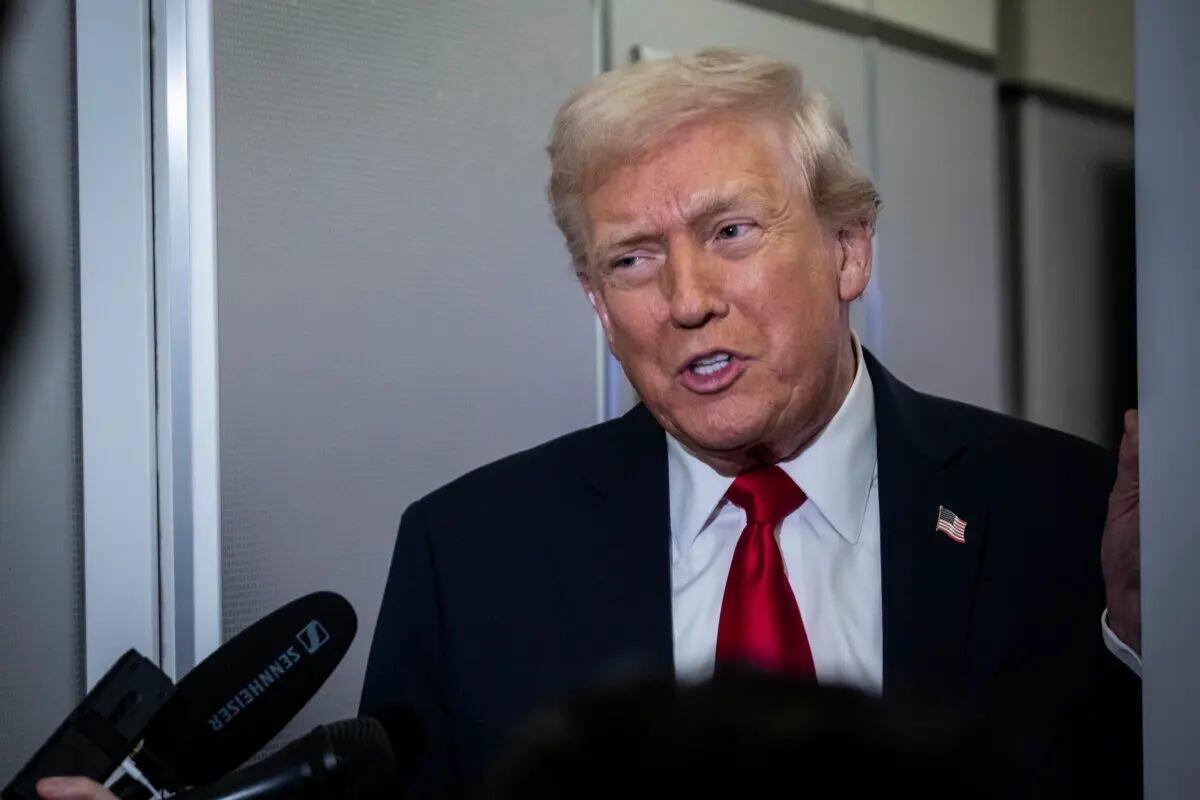
President Donald Trump speaks to the media aboard Air Force One in flight en route to Florida on Nov. 25, 2025. Pete Marovich/Getty Images

Takaichi, speaking to reporters shortly after the call with the U.S. president, said they exchanged views on a wide range of topics, including strengthening the Japan–U.S. alliance and addressing challenges facing the Indo-Pacific region.

“During the conversation, President Trump provided me with an update on the latest situation in U.S.–China relations, including the U.S.–China summit meeting held yesterday evening,” she told reporters in Tokyo. “I also responded to his question about the recent G20 summit that I attended.”

Takaichi said they affirmed the importance of continued cooperation between Tokyo and Washington under the current international situation.

“President Trump said that he would be willing to receive calls from me at any time as a close friend of his.”

Trump also said that the talk with Takaichi was “great.”

“She’s very smart, she’s very strong, and she’s going to be a great leader,” he said of the Japanese leader aboard Air Force One on Nov. 25, without disclosing the details of the exchange.

The fast-escalating spat between Tokyo and Beijing began on Nov. 7 after Takaichi, in response to a parliamentary committee question, said that a naval blockade against Taiwan may constitute a “survival-threatening situation” for Japan. She used a legal term that could enable Japan to mobilize its military.

The comments on a theoretical possibility drew furious responses and violent threats from the Chinese Communist Party (CCP), which views self-ruled Taiwan as a breakaway province to be taken by force if necessary.

China, Japan’s largest trading partner, has turned to economic measures to pressure Japan to retract the prime minister’s comments.

The regime’s foreign ministry has advised tourists against traveling to Japan, and its education ministry has asked students to plan their studies in Japan with caution. Along with postponing the release of Japanese movies in China, Beijing has stated that there is “no market” for Japanese seafood in China.

Amid a deteriorating relationship with China, Takaichi said on Nov. 26 that the government remains open to dialogue with the Chinese side.

As for a Taiwan contingency, she said the government’s stance is that it would evaluate the situation comprehensively, based on the specific circumstances that actually occurred. This position, she said, had been repeatedly stated.

She explained that her initial comments were simply to respond to a question that was limited to a Taiwan contingency and that also mentioned the blockade of sea lanes.

“Since it was asked with specific examples, I answered sincerely within that scope,” she said.

Tyler Durden
Sat, 11/29/2025 – 16:20

via ZeroHedge News https://ift.tt/OcVPjNr Tyler Durden

The ‘K-Shaped’ Economy In One Graph

The ‘K-Shaped’ Economy In One Graph

Tuesday’s weak Consumer Confidence report was a good reminder of why some economists are calling our economy the K shaped economy.

As RealInvestmentAdvice.com reports, The Conference Board Consumer Confidence Index fell 6.8 points to 88.7 in November, below expectations of 93.

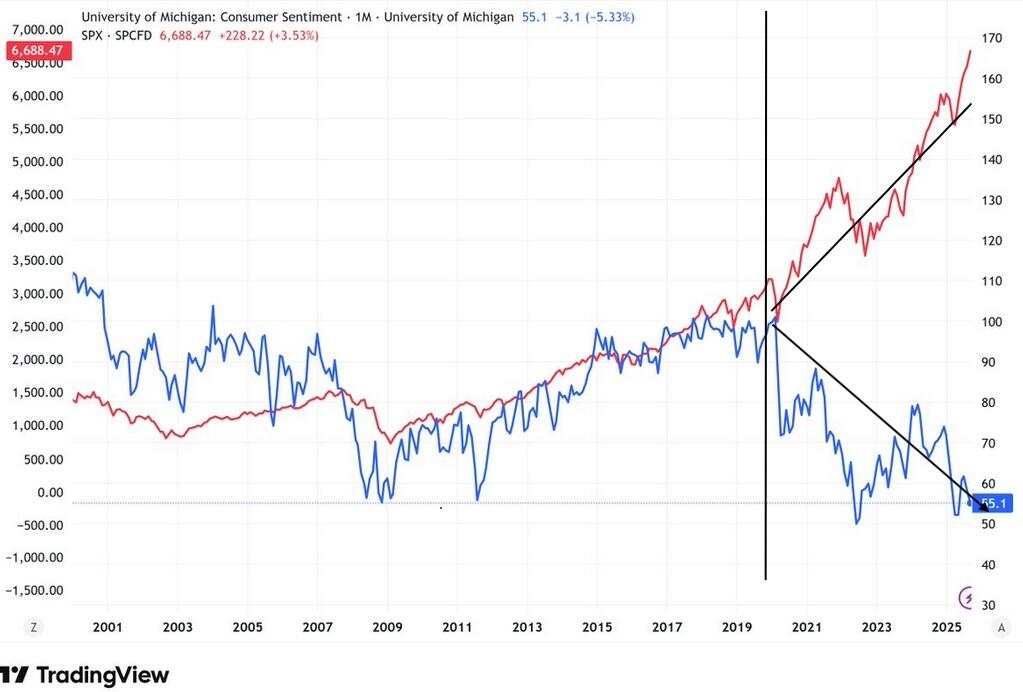
Moreover, it sits at levels similar to those of early 2020, when the pandemic shuttered the economy. Similarly, the University of Michigan Consumer Sentiment survey is slightly above 70-year lows.

Both surveys indicate that a large majority of consumers are struggling.

Within the surveys, the outlook on current jobs and job availability is low.

Inflation, tariffs, politics, and the government shutdown are also weighing on the consumer and limiting big-ticket spending plans.

A K shaped economy describes a post-crisis recovery where different parts of the economy and society are performing at sharply diverging rates, forming the two arms of the letter “K.”:

  • The upper arm (going up): Sectors, companies, assets, and people that benefit from the recovery and, in many cases, are wealthier than before the pandemic. This includes investors in technology stocks, big tech companies, the luxury sectors, high-income professionals, and asset owners.

  • The lower arm (going down): Sectors, small businesses, and people that continue to decline or stagnate even as the overall economy appears to improve. Examples include: the hospitality and travel industries, many lower-priced retail outlets, low-wage service workers, small businesses, and many middle-class and lower-income households.

The graph below showing the stark divergence between the S&P 500 and the University of Michigan consumer survey best depicts the K shaped economy.

You can make similar K shaped plots comparing stock markets, GDP, and megacap corporate profits versus small business closures, wage growth for low-income workers, and economic activity in the manufacturing sector.

The question is – how do the jaws of that widening alligator’s mouth snap shut? Sentiment surge or equity purge?

Tyler Durden
Sat, 11/29/2025 – 15:45

via ZeroHedge News https://ift.tt/IQoTYxK Tyler Durden

Documents Stuffed Into Burn-Bags At FBI HQ To Be Made Public: Kash Patel

Documents Stuffed Into Burn-Bags At FBI HQ To Be Made Public: Kash Patel

Authored by Zachary Stieber and Jan Jekielek via The Epoch Times,

Sensitive documents found in burn bags at FBI headquarters will all be made public, FBI Director Kash Patel said in a new interview with The Epoch Times.

“You’re going to see everything we found in that room in one way or another, be it through investigation, public trial, or disclosure to the Congress,” Patel told The Epoch Times’ Jan Jekielek in an exclusive interview, which is set to air on EpochTV at 5 p.m. ET on Nov. 29.

Before becoming FBI director, one of Patel’s past roles was working as a congressional investigator. He was on the House Intelligence Committee team that uncovered previously unknown information about the FBI’s probe of possible links between the 2016 campaign of President Donald Trump and Russia.

The probe and fallout over the information that emerged, including the reliance on a dossier compiled on behalf of the Hillary Clinton campaign, has come to be known as “Russia Gate.”

Patel said on X in August that “we just uncovered burn bags/room filled with hidden Russia Gate files, including the Durham annex, and declassified them.”

The declassified annex to a report from former special counsel John Durham, whose team investigated the FBI’s actions and found that the full probe was based on unverified intelligence, was released in July by Sen. Chuck Grassley (R-Iowa). It showed that the FBI did not adequately review reports showing the Clinton campaign may have been promoting a false narrative connecting Trump to Russia, Grassley said at the time.

Clinton’s office has not commented on the annex. Robby Mook, Clinton’s 2016 campaign manager, has said he believed that work done by the international law firm Perkins Coie, which paid the dossier author, “was done for the purpose of providing legal services and legal advice” to the campaign.

During a hearing in September, Rep. Scott Fitzgerald (R-Wis.) asked Patel why somebody would place documents related to the investigation into the FBI’s probe of Donald Trump and Russia in burn bags.

Patel said he could not comment on the case because it was ongoing.

“In general terms … a burn bag is what you use to put classified documents into, generally, because that is literally how you destroy them,” he said.

Patel told The Epoch Times that “when the United States government and agency heads want things to disappear and want things to be buried and hidden, they know how to do it.”

“But what they didn’t count on was President Trump winning, him electing leadership across the United States government to say, ‘Go, find out how they corrupted and weaponized law enforcement,’ and that’s what we did—that’s what we’re doing; that’s how we found it, and we’re going to continue to expose it.”

Patel said the FBI is working with partners in Congress to release documents, including those relating to the Department of Justice investigation into Trump for alleged unlawful interference with the transfer of power after the 2020 election, which involved obtaining records from senators’ phones.

While investigations are ongoing, “we are going to have full accountability and we are going to have full transparency for the American public,” he said.

Tyler Durden
Sat, 11/29/2025 – 15:10

via ZeroHedge News https://ift.tt/taS7pUZ Tyler Durden

“Intense Solar Radiation” Corrupted A320 Flight Systems, Airbus Rushes Emergency Update

“Intense Solar Radiation” Corrupted A320 Flight Systems, Airbus Rushes Emergency Update

Airbus warned Friday that “intense solar radiation” may have corrupted critical flight data in an incident involving an A320 narrow-body aircraft. While the company did not disclose which flight was affected, it was likely last month’s JetBlue Flight 1230, which suddenly dropped in altitude while en route from Newark to Cancun.

Airbus issued an Alert Operators Transmission to all airlines operating A320 Family aircraft, warning that an urgent fix is required.

The company believes this is the first time this specific problem has emerged in its fleet and says it has “proactively worked with aviation authorities… keeping safety as our number one and overriding priority,” according to CNN.

“Airbus acknowledges these recommendations will lead to operational disruptions to passengers and customers,” Airbus wrote in a statement. 

Airbus told CNN on Saturday that most of the narrow-body aircraft can be repaired in a matter of hours by simply reverting to the previous software. It said about 900 older aircraft would need more complicated fixes. 

Here’s more from the report:

American Airlines has about 209 of the aircraft which need to be updated, less than the 340 it had earlier predicted, according to a statement from the airline.

. . .

Delta Air Lines said fewer than 50 of its A321neo aircraft will be impacted and the work should be complete by Saturday morning.

. . .

JetBlue, which operates a fleet mostly made up of A320 and A321 aircraft, did not say how many of their planes needed to be fixed, but told CNN in a statement it has already started repairs.

. . .

Southwest Airlines does not have any of the impacted aircraft. Meanwhile, in the Asia-Pacific, Jetstar Airways Australia, Air New Zealand, IndiGo and Air India Express have also taken precautionary measures. 

At cruising altitude, commercial jets are exposed to 100 to 300 times more solar radiation than at ground level, and a major solar storm can push that even higher.

High-energy particles can disrupt modern avionics processors, including corrupting memory or causing a logic error. While Airbus hasn’t specified which exact flight systems were affected, here are the likely candidates:

  • Flight Control Primary Computers (FCPCs)

  • ADIRUs (Air Data & Inertial Reference Units)

  • FADEC engine control

  • Autopilot & flight director

  • Fly-by-wire actuator command modules

Latest space weather events:

Airbus’ warning is an unusual confirmation of space weather risk to the modern economy…

… something we’ve warned about for years. 

Tyler Durden
Sat, 11/29/2025 – 14:35

via ZeroHedge News https://ift.tt/et5Xnjd Tyler Durden

Trump Did It: Wasserman Schultz Accuses The President Of Causing The Shooting Of National Guard Members

Trump Did It: Wasserman Schultz Accuses The President Of Causing The Shooting Of National Guard Members

Authored by Jonathan Turley,

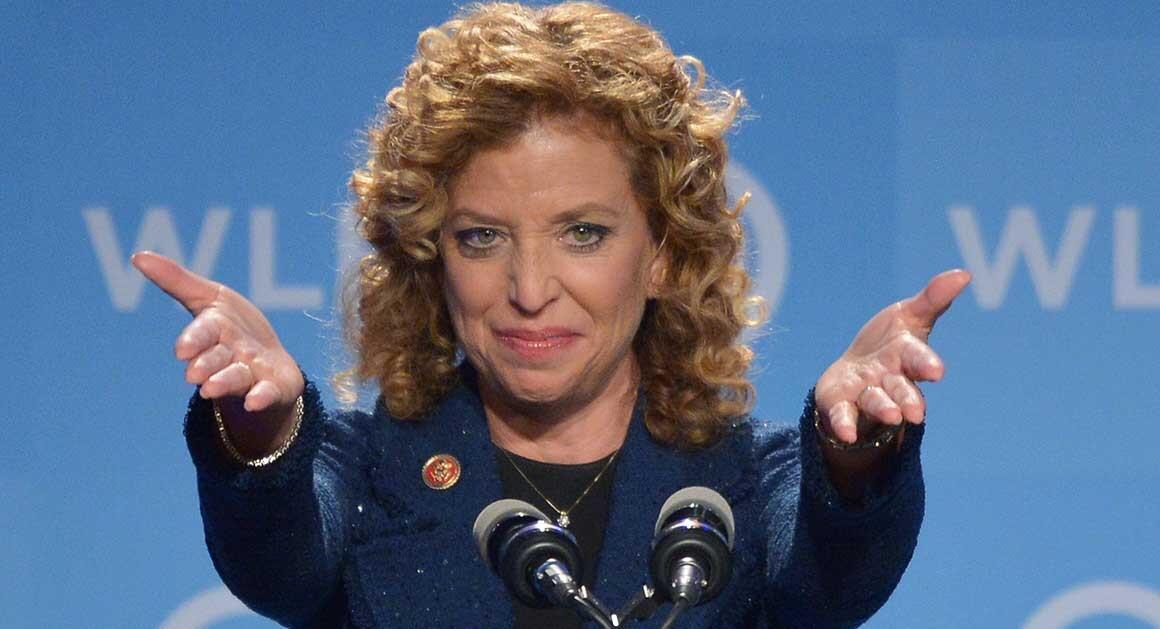
Rep. Debbie Wasserman Schultz (D-FL) has long performed a key role for many on the left. When there is an argument barred by decency or decorum, Wasserman Schultz is happy to make it, from attacking journalists in her defense of censorship to attempting to rig an election and bar Republicans from ballots as part of her defense of democracy. However, on Friday, the Florida representative set a new low in American politics: attempting to assign some of the blame for the shooting of two National Guardsmen on President Donald Trump.

On CNN’s “News Central,” Rep. Wasserman Schultz declared that

“This is a deeply concerning situation, but, you know, it’s one that I think we have to — it begs the question, would an individual have flown across the country to target law enforcement officers in Washington, D.C.? And, I mean, the answer is likely no. So why wasn‘t the president‘s first thought, ‘Wow, you know, maybe I should reconsider deploying military troops in the nation‘s capital or in any city?’ Particularly not when they haven‘t coordinated closely with the leadership of these cities and when we have law enforcement that are quite capable of handling the criminal justice issues that are — that we need law enforcement to focus on, and not our military.”

There is a good-faith debate over the deployment of National Guard personnel in cities. However, the mayor of Washington, D.C., has worked with the Administration on that deployment, and crime has fallen in the Capitol. They have been coordinating with the city.

Nevertheless, Wasserman Schultz pressed on:

“I just think, you know, the president looks everywhere except inward to blame his own policies. We need to make sure that we don‘t have our military deployed in our cities, doing — handling law enforcement responsibilities. And we need to make sure that we address gun violence. We certainly need to make sure we always have the proper and appropriate and tight, tight vetting processes, and those should be reviewed. But it‘s never the president‘s fault or his policies when it comes to his reaction, and it’s pretty disgusting.”

D.C. has some of the strongest gun control measures in the nation. Moreover, this is a crime committed with a handgun brought from another area with strong gun control, Washington State.

Wasserman Schultz is also assuming that it was the deployment that motivated the shooter, Rahmanullah Lakanwal, a 29-year-old Afghan national. Lakanwal entered the U.S. on September 8, 2021, under Operation Allies Welcome, a program established by former Democratic President Joe Biden after the U.S. military withdrawal from Afghanistan in August 2021.

The father of slain Guardsman Staff Sgt. Darin “Taylor” Hoover blamed the “feckless Biden Administration” for the death of his daughter the day of Wasserman Schultz’s statement.

Wasserman Schultz, however, does not blame former President Biden for Lakanwal’s presence in the United States. (Lakanwal, a former member of a CIA unit in Afghanistan, was reportedly granted asylum under the Trump Administration in April).

Investigators are still working to discover the motive of Lakanwal for murdering one soldier and critically wounding another. However, Wasserman Schultz feels entirely comfortable in suggesting that it was the deployment of the Guard in cities over Democratic objections. Of course, a few other possibilities come to mind. First, it could be an act of religious-based terrorism. Second, it could be an act of mental illness. Third, it could be a personal grievance with the U.S. government.

Killing soldiers in the nation’s Capitol can be appealing for any of these motivations or a combination of motivations. It is not obvious that someone travels across the country because this is where you can find personnel on the streets. After all, there are also troops deployed in other states closer to Washington state. There are also large bases in Washington state where military personnel are present in large numbers in public areas.

A shooter with any of these motivations could view the location as amplifying his grievances against the government. Wasserman Schultz seems to suggest that Trump is responsible for making troops targets due to the controversial use of the Guard and supplying targets for a terrorist.

The most important point for Wasserman Schultz is a familiar one: Trump did it.

Yet, blaming the deployment is like blaming the Republican members for the mass shooting at the 2017 softball field. After all, if they had not made themselves targets, James T. Hodgkinson would not have gone there. Hodgkinson, a former Bernie Sanders supporter, hated Republicans and would have found another gathering to carry out his murderous plan. In the same way, Lakanwal may have been on the hunt for any soldiers as a symbol of the United States in the Capitol.

The point is that we do not know. The effort to use this tragedy for political purposes is to dishonor the victims and capitalize on their deaths. Few would feel comfortable getting into the head of a homicidal madman without any evidence or support. However, that appears to be a unique skill set for Debbie Wasserman Schultz.

Tyler Durden
Sat, 11/29/2025 – 12:50

via ZeroHedge News https://ift.tt/gZAKsUo Tyler Durden

Trump Declares Airspace Above Venezuela “To Be Closed In Its Entirety”

Trump Declares Airspace Above Venezuela “To Be Closed In Its Entirety”

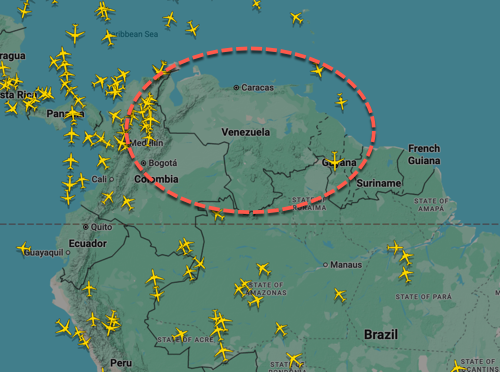
President Trump said on Saturday on X that the airspace above and surrounding Venezuela will “be closed in its entirety.” 

To all Airlines, Pilots, Drug Dealers, and Human Traffickers, please consider THE AIRSPACE ABOVE AND SURROUNDING VENEZUELA TO BE CLOSED IN ITS ENTIRETY. Thank you for your attention to this matter! PRESIDENT DONALD J. TRUMP,” Trump wrote on X. 

Earlier this month, the Federal Aviation Administration (FAA) warned pilots to “exercise caution” near Venezuela’s airspace due to the “worsening security situation and heightened military activity.

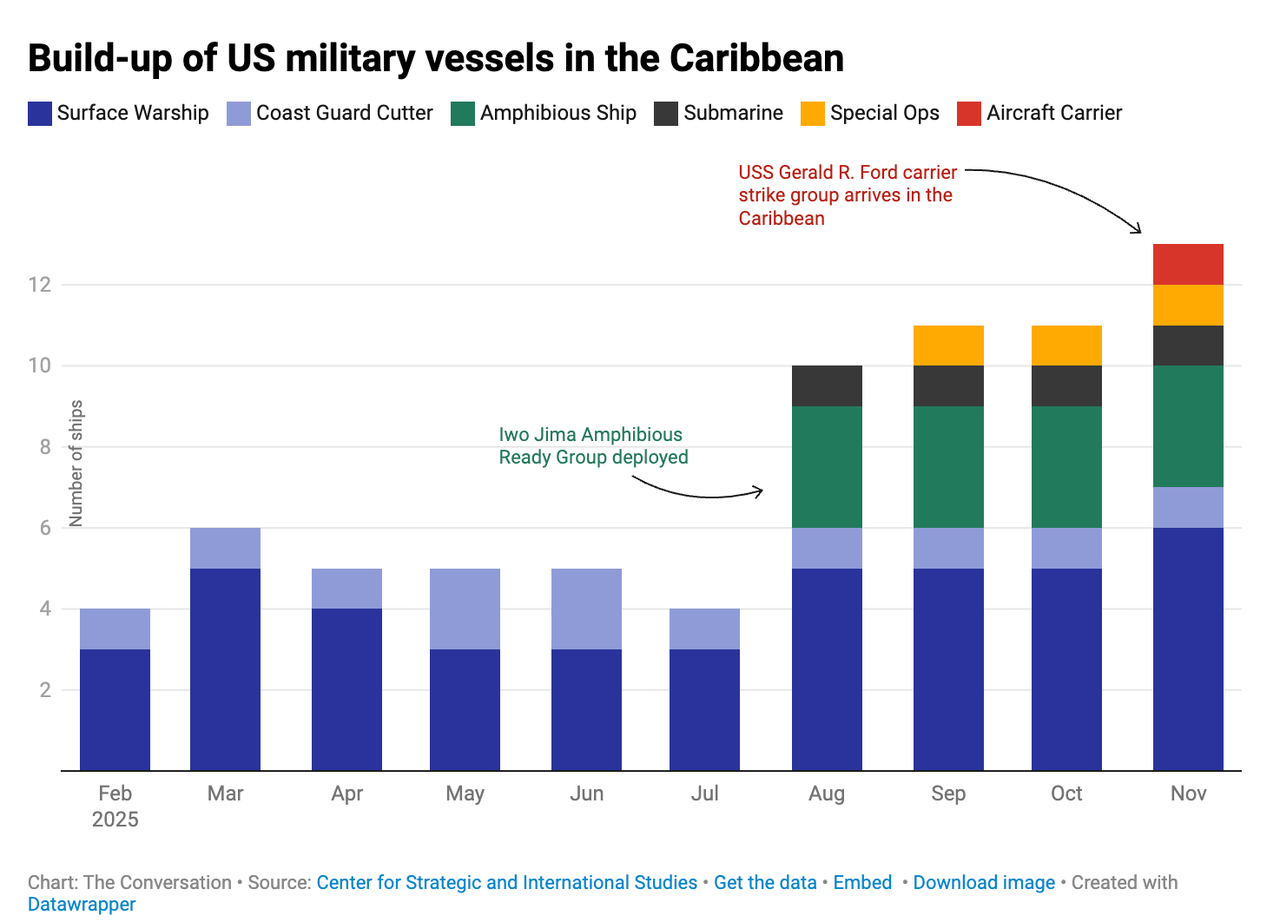
The Pentagon has been deploying warships and other military assets in the Caribbean this year. The deployment centers around bolstering Hemispheric Defense, and the Trump administration has formally characterized Nicolás Maduro as the head of a terrorist organization and considers his government illegitimate. 

Joint Special Operations Command has ordered numerous airstrikes on speed boats carrying narcoterrorists. The intent is to stop drugs, destroy narco-boats, and kill the narcoterrorists that are part of a sophisticated network pumping drugs into America, resulting in the drug death overdose crisis that kills 100,000 Americans per year – one that the Biden-Harris regime ignored by opening borders to the third world. 

On Friday, Secretary of War Pete Hegseth dismissed fake news from corporate media about recent lethal kinetic strikes. 

Hegseth explained:

As usual, the fake news is delivering more fabricated, inflammatory, and derogatory reporting to discredit our incredible warriors fighting to protect the homeland.

As we’ve said from the beginning, and in every statement, these highly effective strikes are specifically intended to be “lethal, kinetic strikes.” The declared intent is to stop lethal drugs, destroy narco-boats, and kill the narcoterrorists who are poisoning the American people. Every trafficker we kill is affiliated with a Designated Terrorist Organization.

The Biden administration preferred the kid gloves approach, allowing millions of people — including dangerous cartels and unvetted Afghans — to flood our communities with drugs and violence. The Trump administration has sealed the border and gone on offense against narcoterrorists. Biden coddled terrorists, we kill them.

Our current operations in the Caribbean are lawful under both U.S. and international law, with all actions in compliance with the law of armed conflict—and approved by the best military and civilian lawyers, up and down the chain of command.

Our warriors in SOUTHCOM put their lives on the line every day to protect the Homeland from narcoterrorists — and I will ALWAYS have their back.

Hegseth followed the post with, “We have only just begun to kill narcoterrorists.”

What the U.S. airspace shutdown over Venezuela signals:

  • Pressure Maduro into stepping down

  • Or intent to collapse the Maduro regime

  • Expectation of Russian/Iranian pushback

  • Readiness to escalate militarily

Maduro and his circle would treat this as both an existential threat, and it remains to be seen how he would respond. We guess Trump’s airspace announcement only suggests talks aren’t going well.

Tyler Durden
Sat, 11/29/2025 – 12:15

via ZeroHedge News https://ift.tt/azP7cdn Tyler Durden