Muslim Leaders In Italian City Demand Removal Of Plastic Pig From Deli Shop Window

Muslim Leaders In Italian City Demand Removal Of Plastic Pig From Deli Shop Window

Via Remix News,

A plastic pig displayed in the window of a newly opened delicatessen on the Piazza dei Signori in the Italian city of Padua has triggered a local controversy after a senior representative of the city’s Muslim community called for its removal, arguing that it is offensive and inappropriate.

The pig, placed in the window of the deli Mortadella… e Non Solo, is used to advertise the shop’s sandwiches and cured meats, which are primarily made from pork.

According to Il Giornale, Salim El Mauoed, the regional vice president of Padua’s Muslim community, urged both the shop’s owners and local authorities to intervene, describing the display as “in bad taste” and offensive to Muslims who pass through the area.

There is no legal basis requiring the business to remove the display.

The pig imagery is a central part of the shop’s branding and appears not only in the window but also in its logo, promotional materials, and merchandise shared publicly on social media.

El Mauoed’s request has drawn criticism from some politicians and residents, who argue that it amounts to interference with lawful commercial activity and undermines the principle of civil coexistence.

They contend that living together in a pluralistic society necessarily involves accepting visible expressions of different cultures, religions, and dietary traditions, particularly when those expressions are neither targeted nor discriminatory.

Il Giornale reports that some members of the local Muslim community believe symbols seen as contrary to Islamic religious precepts should be avoided in shared urban spaces.

Others, however, have warned that removing a legal and commonplace commercial symbol risks establishing a precedent in which religious objections could reshape long-established customs and everyday practices.

The newspaper also notes that the deli employs Muslim staff, some of whom have publicly defended the display, saying the plastic pig simply reflects the nature of the business and is not intended to offend anyone.

The pig remains on display for now.

Read more here…

Tyler Durden
Sat, 01/31/2026 – 08:10

via ZeroHedge News https://ift.tt/gYU1V7o Tyler Durden

Ukraine Moves To Purge Dostoevsky & Tolstoy From Public Mention

Ukraine Moves To Purge Dostoevsky & Tolstoy From Public Mention

In the latest escalation of Ukraine’s cultural purge and targeting of all things Russian, Ukraine’s Institute of National Memory has this month formally branded the famed classic Russian authors Fyodor Dostoevsky and Leo Tolstoy as vectors of “Russian imperial propaganda”.

This has included a call from the body which operates under the Cabinet of Ministers of Ukraine for all streets, monuments, and public institutions bearing their names be wiped from the map.

Image via Union of Orthodox Journalist-Ukraine

According to Interfax, commenting on the ruling, “the assignment of their names to geographical objects, names of legal entities and objects of property rights, objects of toponymy, as well as the establishment of monuments and memorial signs in their honor in Ukraine was the embodiment of Russification – Russian imperial policy aimed at imposing the use of the Russian language, promoting Russian culture as superior compared to other national languages ​​and cultures, displacing the Ukrainian language from use, and narrowing the Ukrainian cultural and information space.”

In a January 20 statement, the Institute of National Memory’s ‘expert commission’ claimed the literary legacy of both writers is “directly connected to the glorification of Russian imperial policy.” The Ukrainian officials also asserted there are signs of “Ukrainophobia” in their books.

The move was met with complete silence in Western media, and the story has gone almost completely overlooked, despite Dostoevsky and Tolstoy having long been widely studied and appreciated across the globe, and in American colleges, literary programs, theaters – and among common avid readers.

Their works, from The Brothers Karamazov to the massive War and Peace have done much to shape Western culture and higher education in the 150 years of the works’ existence. 

And yet the Ukrainian government-linked institute now claims the historic prominence of Dostoevsky and Tolstoy across Ukraine was not because it is literary art with universal appeal, but somehow part of a long-running Russification campaign designed to marginalize the Ukrainian language and culture.

Ukraine has in essence just labeled two of the world’s greatest historical authors, which far pre-date both the modern Russian Federation and Soviet Union of the 20th century, as ‘propaganda’.

The following is an actual line from the original Interfax report: “The head of the UINP, Oleksandr Alferov, states that local authorities need to check the names of their streets with these lists.”

Tyler Durden
Sat, 01/31/2026 – 07:35

via ZeroHedge News https://ift.tt/JihBtVC Tyler Durden

Next-Level Spying: How China Read The West’s Wiretaps For Years

Next-Level Spying: How China Read The West’s Wiretaps For Years

Authored by Shanaka Anslem Perera via Substack,

The four trillion dollars in institutional capital positioned for stable UK-China relations rests on an assumption that died in a Chengdu server room sometime around 2019. The assumption is that espionage between major powers operates within understood boundaries, that telecommunications infrastructure is contested but not compromised, that the surveillance systems Western governments built to watch their citizens cannot be turned around to watch them. The assumption has been falsified. What follows is the complete mechanism of how China’s Ministry of State Security achieved persistent access to the private communications of three British Prime Ministers’ closest advisers, the phones of a US President-elect, and the wiretap systems that were supposed to catch them doing it. The positioning implications are immediate. The framework is permanent.
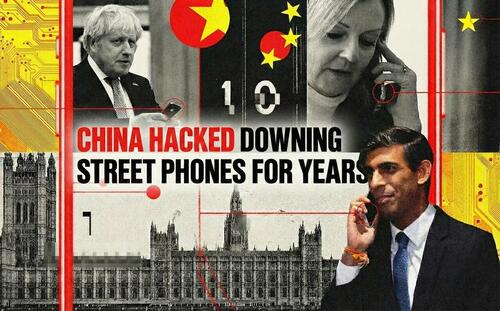
On January 26, 2026, The Telegraph disclosed that Chinese hackers had penetrated right into the heart of Downing Street, compromising mobile communications of senior officials across the Johnson, Truss, and Sunak administrations. The story was buried on page seven, treated as a technology curiosity. It was, in fact, a solvency event for the Western intelligence alliance. Not because phones were hacked, which happens, but because of how they were hacked: by weaponizing the very surveillance infrastructure that Western governments mandated for their own intelligence agencies. The Communications Assistance for Law Enforcement Act in the United States and the Investigatory Powers Act in the United Kingdom require telecommunications carriers to build backdoors into their networks for court-ordered wiretapping. Chinese state hackers found those backdoors. And walked through them.

The intelligence value is almost impossible to overstate. For approximately four years, operators linked to the MSS’s Chengdu bureau had the capability to see not just who British officials were calling, but whom the FBI was investigating, which Chinese operatives were under surveillance, what the United States knew about Beijing’s activities, and when counterintelligence was getting close. They could geolocate millions of individuals. They could record phone calls at will. They compromised the surveillance of their own surveillers, achieving the counterintelligence equivalent of reading the other side’s playbook while the game was in progress.

What follows is the institutional playbook. The positions are already being built.

The Backdoor That Swung Both Ways

The story of Salt Typhoon is not fundamentally a story about hacking. It is a story about architecture. Specifically, it is a story about what happens when governments mandate that their surveillance systems include single points of failure, then assume those points will only fail in their favor.

In 1994, the United States Congress passed the Communications Assistance for Law Enforcement Act, requiring telecommunications carriers to design their networks with built-in capabilities for government wiretapping. The law emerged from FBI concerns that digital switching technology would render traditional surveillance impossible. CALEA’s solution was elegant in its naivety: force every carrier to build a standardized interface through which law enforcement could access communications pursuant to court order. The interface would be secure because it would be secret, protected by access controls, audited by compliance regimes. No adversary would find it because no adversary would know to look.

Twenty-two years later, the United Kingdom enacted the Investigatory Powers Act 2016, colloquially known as the Snooper’s Charter. It went further than CALEA, mandating that technology companies retain communications data and provide access mechanisms for intelligence agencies. The architecture was the same: centralized access points designed for authorized users, protected by the assumption that authorized users would be the only ones using them.

Salt Typhoon was the adversarial audit that the system failed.

The Chinese operators did not need to hack individual phones, which would have been noisy and detectable. They did not need to intercept communications in transit, which would have required breaking encryption. They hacked the wiretap system itself. Once inside the CALEA infrastructure at AT&T, Verizon, and Lumen Technologies, they had access to everything the FBI had access to: call metadata showing who contacted whom and when, geolocation data derived from cell tower triangulation, the actual content of unencrypted calls and texts, and most devastatingly, the database of active surveillance requests. They could see whom the United States government was watching. They could see if they themselves were being watched.

The vulnerability was not a bug in the architecture. It was the architecture.

For decades, cryptographers and privacy advocates warned that there is no such thing as a backdoor only good guys can use. A vulnerability is a vulnerability. If it exists, a sufficiently motivated and resourced adversary will find it. The NSA and GCHQ and FBI dismissed these warnings as theoretical, academic, disconnected from operational reality. Law enforcement’s access needs are legitimate. But Salt Typhoon demonstrated empirically that the risks of mandated backdoors extend to everyone, including the governments that mandated them.

The irony approaches the unbearable. As Salt Typhoon was being discovered in late 2024, the UK government was pressuring Apple to weaken iMessage encryption under the Investigatory Powers Act. The argument was the same one that produced CALEA: law enforcement needs access, and carefully controlled access can be kept secure. Apple reportedly disabled certain features for UK users rather than comply. At precisely the same moment, as The Telegraph would later reveal, Chinese operators were reading communications from the heart of Downing Street through the access points the UK government had mandated.

The technical community has a name for this: the security paradox. Systems designed to enable surveillance become targets for adversary surveillance. The more access points you create for your own agencies, the more attack surface you expose to foreign agencies. The debate between security and privacy was always a false binary. The real tradeoff was between surveillability by your government and surveillability by everyone’s government.

Salt Typhoon collapsed that tradeoff into a single devastating data point.

The Kill Chain That Cannot Be Killed

Understanding what happened requires understanding how telecommunications networks actually function, not how they appear in policy documents.

A modern telecom network is not a monolithic system but a layered architecture spanning edge devices that connect to the public internet, core routing infrastructure that moves packets between networks, administrative systems that manage configurations and access, billing and customer data platforms, and lawful intercept systems that process surveillance requests. Each layer has its own attack surface. Salt Typhoon targeted the layer that matters most: the edge devices that control everything else.

The primary intrusion vector was a pair of vulnerabilities in Cisco IOS XE, the operating system running on millions of enterprise routers and switches worldwide. CVE-2023-20198, with a perfect 10.0 CVSS severity score, allowed an unauthenticated remote attacker to create an administrator account with Level 15 privileges, the highest access level on Cisco devices. CVE-2023-20273 enabled command injection that elevated those privileges to root access on the underlying Linux operating system. Chain them together and an attacker can create a god-mode account on any exposed Cisco device, then execute arbitrary code with full system control.

The vulnerabilities were disclosed in October 2023. Cisco issued patches. Many telecommunications operators delayed patching due to operational constraints that made rapid remediation nearly impossible.

This dynamic is not incompetence, though it resembles incompetence. Telecommunications infrastructure operates under pressures that create structural patch delays. These networks run 24 hours a day, 365 days a year. Downtime is measured in lost revenue and regulatory penalties. Patching a core router requires scheduling maintenance windows, testing updates in lab environments, coordinating with interconnected carriers, and accepting the risk that the patch itself introduces instability. For many operators, the calculation becomes: known theoretical vulnerability versus certain operational disruption. They chose the theoretical vulnerability. Salt Typhoon chose them.

Recorded Future’s Insikt Group documented the campaign exploiting over one thousand Cisco devices globally between December 2024 and January 2025. But the truly alarming finding was that attackers also exploited CVE-2018-0171, a vulnerability in Cisco Smart Install that had been patched seven years earlier. Some devices in critical telecommunications infrastructure had not been updated since 2018. The attack surface was not the frontier of zero-day exploitation. It was the accumulated technical debt of an industry that treated security as a cost center.

Once inside, Salt Typhoon deployed a sophisticated persistence mechanism designed to survive exactly the remediation attempts carriers would eventually undertake. The primary implant, documented by Trend Micro researchers under the name GhostSpider, operated entirely in memory without touching disk, evading traditional antivirus that scans for malicious files. It used DLL hijacking to execute within the context of legitimate processes, bypassing application whitelisting. Communications with command-and-control servers were encrypted and disguised as normal HTTPS traffic, blending with legitimate web activity.

The deeper persistence came from Demodex, a kernel-mode rootkit that modified the Windows operating system at its lowest level. Demodex hooked into system calls to hide its own processes, network connections, and registry entries from administrators running diagnostic commands. An operator investigating a compromised system would see nothing amiss because the rootkit was filtering what they could see. The malware achieved what the cybersecurity industry calls god-mode persistence: invisibility so complete that the only certain remediation is physical hardware replacement.

On Cisco devices specifically, the attackers exploited the Guest Shell, a Linux container environment designed for running legitimate management scripts. By injecting malicious code into this trusted container, they achieved persistence that survived standard reboots and even operating system reimaging. The infection lived below the level that normal administrators could access. It was not hiding in the house. It had become part of the foundation.

The operational sophistication extended to exfiltration. Salt Typhoon deployed a custom tool called JumbledPath that enabled packet capture across multiple network hops while simultaneously clearing logs and disabling logging along the capture path. They could intercept traffic without leaving forensic evidence of the interception. They modified Access Control Lists on compromised switches to explicitly permit their command-and-control IP addresses, ensuring their backdoors remained reachable even as security teams updated firewall rules. They created Generic Routing Encapsulation tunnels to route stolen data through compromised infrastructure, making the exfiltration appear as legitimate network traffic.

According to Cisco Talos analysis, the average dwell time before discovery was 393 days. One environment showed attackers maintaining presence for over three years. Three years of access to telecommunications infrastructure that carries the communications of governments, corporations, and private citizens. Three years of watching the watchers.

Inside the Chengdu Hacker-for-Hire Marketplace

Attribution in cyber operations is notoriously difficult. Attackers route through compromised infrastructure in multiple countries, use commodity malware available to any buyer, and deliberately plant false flags suggesting different national origins. The intelligence community has learned hard lessons about premature attribution.

Salt Typhoon attribution does not suffer these ambiguities. It is among the most thoroughly documented cases of state-sponsored cyber operations in the public record.

The US Treasury Department sanctioned Sichuan Juxinhe Network Technology Co., Ltd. on January 17, 2025, identifying it as a Chengdu-based cybersecurity company with direct involvement in the Salt Typhoon cyber group. The language was unusually specific for a sanctions designation, which typically uses more cautious phrasing. Treasury stated that the Ministry of State Security has maintained strong ties with multiple computer network exploitation companies, including Sichuan Juxinhe. The implication was unmistakable: this was not a rogue actor tangentially connected to Chinese intelligence. This was an MSS operation executed through contractor infrastructure.

Chengdu has emerged as the primary hub of China’s offensive cyber contractor ecosystem, a distinction it shares with no other Chinese city to the same degree. The reasons are structural. Sichuan University and Chengdu University of Information Technology produce a steady pipeline of computer science graduates with the technical skills offensive operations require. The provincial government offers tax incentives for high-tech enterprises that attract cybersecurity firms. The MSS’s Chengdu bureau has historically been aggressive in recruiting and contracting local talent. The result is a geographic concentration of capability that the intelligence community has tracked for over a decade.

Sichuan Juxinhe is not an isolated entity but part of an interconnected ecosystem. Treasury’s designation also referenced Beijing Huanyu Tianqiong Information Technology Co., Ltd. and Sichuan Zhixin Ruijie Network Technology Co., Ltd. as associated entities. These firms share corporate registration patterns, overlapping personnel, and technical infrastructure in ways that suggest coordinated rather than independent operation.

The ecosystem became dramatically more visible in February 2024, when over five hundred internal documents from i-SOON (Sichuan Anxun Information Technology Co., Ltd.) appeared on GitHub in one of the most significant leaks of Chinese cyber operations ever recorded. The documents revealed a hacker-for-hire marketplace where private firms bid on government contracts to compromise specific targets. Price lists showed costs for different levels of access. Marketing materials advertised tools for hacking Twitter, Gmail, WeChat, and Telegram. Target lists included governments in India, Thailand, Vietnam, South Korea, and NATO member states. The operational picture was unmistakable: China’s cyber espionage apparatus operates significantly through private contractors who compete for MSS and PLA business.

The i-SOON leak provided a Rosetta Stone for understanding how Salt Typhoon operates. Domain registration patterns used by i-SOON matched those observed in Salt Typhoon infrastructure. Malware families overlapped. The corporate relationship between i-SOON and other Chengdu firms explained how capabilities and targeting information might flow between ostensibly separate entities.

The UK government reached the same conclusion. On December 9, 2025, Foreign Secretary Yvette Cooper announced sanctions against Integrity Technology Group and Sichuan Anxun Information Technology (i-SOON) for activities against the UK and its allies that impact our collective security. The 13-nation joint advisory released in August 2025 explicitly attributed the campaign to MSS-linked private contractors, co-signed by agencies from the United States, United Kingdom, Australia, Canada, New Zealand, Germany, Japan, and five other nations.

The evidence supporting attribution is overwhelming: convergent technical indicators across multiple intelligence services, targeting patterns aligned with MSS priorities rather than financial motivation, sanctions from two G7 governments naming specific companies, a leaked document trove revealing operational details, and multi-national intelligence consensus among powers with no incentive to coordinate false attribution.

Chinese Foreign Ministry spokesperson Guo Jiakun dismissed the allegations as unfounded and irresponsible smears and slanders, claiming China stands against hacking and fights such activities in accordance with the law. Chinese state media advanced the counter-narrative that Salt Typhoon accusations represent US efforts to secure congressional appropriations rather than genuine intelligence findings. The Global Times characterized the accusations as a farce of US smear tactics against China.

These denials represent diplomatic necessities. They do not survive contact with the documented evidence.

The Crown Jewels: Three Prime Ministers’ Inner Circles Exposed

The targeting profile of Salt Typhoon reveals strategic intent far beyond conventional espionage.

In the United States, nine telecommunications carriers have been confirmed compromised: Verizon, AT&T, T-Mobile, Lumen Technologies, Spectrum (Charter Communications), Consolidated Communications, Windstream, Viasat, and at least one additional unnamed provider. Senator Mark Warner, chairman of the Senate Intelligence Committee, characterized it as the worst telecom hack in our nation’s history. The scope comparison is instructive. SolarWinds, the Russian supply chain compromise discovered in December 2020, affected approximately 18,000 organizations with deep penetration of roughly 100. Salt Typhoon compromised over 200 companies across 80 countries.

The data accessed falls into two categories with very different strategic implications.

The first category is bulk metadata: call detail records showing who contacted whom, when, and for how long, plus geolocation data derived from cell tower connections. Former Deputy National Security Advisor Anne Neuberger confirmed that attackers gained capabilities to geolocate millions of individuals. Metadata reveals patterns invisible in content alone. If a senior Treasury official calls a specific BP executive three times in one night before a North Sea oil announcement, Beijing knows the policy shift before the Cabinet does. Mapping communication networks reveals the actual decision-making structure of governments, which often differs substantially from organizational charts.

The second category is targeted content interception. Fewer than 100 individuals had actual call content and text messages directly compromised, but those individuals included Donald Trump, JD Vance, and senior staff from the Harris campaign during the 2024 presidential election. Congressional staff from the House China Committee, Foreign Affairs Committee, Armed Services Committee, and Intelligence Committee were accessed in breaches detected in December 2025, according to the Financial Times. The targeting was not random. It was surgical.

The United Kingdom penetration, disclosed by The Telegraph on January 26, 2026, reached right into the heart of Downing Street. The National Cyber Security Centre confirmed observing a cluster of activity targeting UK infrastructure since 2021. Aides to Prime Ministers Boris Johnson, Liz Truss, and Rishi Sunak had their communications compromised across a three-year period that included the COVID-19 pandemic response, the Ukraine war’s escalation, and critical UK-China trade negotiations.

Whether the Prime Ministers’ personal devices were directly compromised remains publicly unclear. The distinction may matter less than it appears. In a telecom network intrusion, attackers do not need to compromise individual devices. They compromise the network itself, intercepting communications as they transit carrier infrastructure. The Prime Minister’s phone may have been perfectly secure. The calls it made were not.

The strategic timing compounds the damage. The 2021-2024 window included decisions on Huawei’s role in UK 5G infrastructure, the AUKUS security pact formation, Hong Kong sanctions policy, and bilateral trade negotiations with Beijing. Chinese intelligence had real-time visibility into British decision-making during discussions where China’s interests were directly at stake. The information asymmetry is staggering.

Australia was similarly targeted. ASIO Director-General Mike Burgess confirmed in November 2025 that Salt Typhoon attempted to access Australia’s critical infrastructure, including telecommunications networks. Canada experienced confirmed breach of at least one unnamed telecom in February 2025. The campaign extended beyond the Five Eyes core: a South African provider was reportedly compromised via Cisco platforms, Southeast Asian telecoms detected new malware variants, and European telecommunications organizations identified intrusion attempts as late as October 2025.

The counterintelligence implications are the most damaging aspect, though the least publicly discussed.

By accessing CALEA systems, Salt Typhoon operators could see the database of active wiretap requests. They knew whom the FBI was investigating. If MSS operatives in the United States were under surveillance, Beijing could pull them out before arrests occurred. If FBI investigations were approaching sensitive Chinese assets, Beijing could warn them. If counterintelligence operations were building cases against Chinese technology companies or influence operations, Beijing could see the evidence accumulating.

This is the counterintelligence nightmare: your surveillance apparatus becomes the adversary’s intelligence source. The FBI was not just failing to catch Chinese spies. It was showing China exactly where to find its exposed spies before the FBI could catch them.

The Hidden Correlation That Risk Models Never Saw

Systems approaching critical transitions exhibit a distinctive signature that financial risk models systematically miss. Surface metrics remain stable while underlying pressure accumulates. Correlations appear benign precisely because the stress is building uniformly across connected components. Then the transition happens not gradually but all at once, in a cascade that propagates faster than response mechanisms can activate.

The physics of phase transitions describes the phenomenon with precision. Water remains liquid as it cools, molecules slowing gradually, temperature dropping predictably. Then at exactly zero degrees Celsius, the system reorganizes instantaneously into a crystalline structure. The transition is discontinuous. Nothing in the gradual cooling predicted the sudden restructuring.

Salt Typhoon’s propagation through global telecommunications followed this pattern. The Global Cyber Alliance documented 72 million attack attempts from China-origin IP addresses against telecommunications infrastructure worldwide between August 2023 and August 2025. The number is not the important part. The distribution is. Rather than concentrating on a few high-value targets, the campaign probed systematically across the entire internet-facing surface of telecom networks in 80 countries. When one vector failed, others succeeded. The attack percolated through the network of networks, finding paths of least resistance through unpatched devices, legacy systems, and accumulated technical debt.

The 80-country spread was not a bug or scope creep. It was the exploitation of network topology itself. Telecommunications providers interconnect through peering relationships, shared vendors, inherited trust, and common infrastructure. Compromising one provider creates pivot points into connected providers. The attackers did not need to breach 80 countries independently. They needed to breach enough nodes that cascade dynamics carried the compromise further.

Financial risk models trained on historical correlations would have seen nothing unusual in the period before disclosure. Telecom stocks moved with normal volatility. Cybersecurity spending followed typical budget cycles. The correlation stability that risk managers found reassuring was measuring the pressure building uniformly, not the probability of release.

The parallel to credit markets before 2008 is instructive though imprecise. Mortgage-backed securities showed stable correlations because they were all exposed to the same underlying risk. The stability was the warning, not the comfort. When housing prices turned, the correlation snapped to one and everything moved together. The diversification that looked protective turned out to be concentration disguised.

Salt Typhoon exposed a similar hidden correlation in critical infrastructure. The assumption was that a breach of Verizon had no implications for BT, that American vulnerabilities were American problems, that European telecoms operated in a separate risk regime. The assumption was wrong. The same Cisco devices run everywhere. The same CALEA architecture creates the same vulnerability everywhere its analogues exist. The same contractor ecosystem targets everyone with the same tooling. The diversification across carriers and jurisdictions was illusory. They were all one network.

Five Eyes Fractures Under Pressure

The Five Eyes intelligence alliance, comprising the United States, United Kingdom, Canada, Australia, and New Zealand, represents the deepest and most institutionalized intelligence-sharing arrangement among Western democracies. Its origins in World War II signals intelligence cooperation have evolved into comprehensive collaboration on technical collection, analysis, and counterintelligence. Salt Typhoon tested this architecture as nothing has since its formation.

The initial response demonstrated the alliance’s coordination capabilities. The December 2024 Enhanced Visibility and Hardening Guidance for Communications Infrastructure was the first joint Five Eyes response to the breach. The August 2025 advisory expanded to 13 nations, co-sealed by 22 agencies attributing the campaign to specific Chinese companies with unprecedented multinational consensus. The coordination was real and consequential.

But the fractures were also visible.

UK officials pointedly stated that had American regulations matched British standards, we would have found it faster, we would have contained it faster. The criticism was technically accurate. The UK’s Telecommunications Security Act 2021 imposed security obligations on carriers that exceed CALEA requirements. But the same UK government pursuing those regulations was simultaneously pressuring Apple to weaken encryption under the Investigatory Powers Act, replicating exactly the architectural vulnerability that Salt Typhoon exploited. The internal contradiction was not resolved so much as ignored.

The regulatory divergence reflects deeper philosophical disagreements that Salt Typhoon intensified without settling. The FBI and CISA’s December 2024 recommendation that Americans use end-to-end encrypted messaging applications represented an extraordinary acknowledgment that carrier networks cannot be trusted. Yet both agencies have historically sought encryption backdoors for law enforcement access. The cognitive dissonance remained unaddressed: advocating for encryption to protect against foreign adversaries while seeking to weaken encryption for domestic law enforcement.

The FCC’s regulatory response exemplified the policy incoherence. In January 2025, the Commission proposed mandatory cybersecurity requirements including role-based access controls, multi-factor authentication, and vulnerability patching for telecommunications carriers. Then-Chairwoman Jessica Rosenworcel stated: In light of the vulnerabilities exposed by Salt Typhoon, we need to take action. In November 2025, the reconstituted FCC voted 2-1 to revoke those rules. Chairman Brendan Carr argued for an agile and collaborative approach over regulatory mandates. Commissioner Anna Gomez dissented: This FCC today is leaving Americans less protected than they were the day this breach was discovered.

The Cyber Safety Review Board investigation, established to provide an authoritative post-mortem on Salt Typhoon, was terminated in January 2025 when the incoming administration dismissed all members before their investigation concluded. The official lessons learned process stopped before identifying lessons.

Intelligence sharing itself became contested. Reports emerged in 2025 that DNI Tulsi Gabbard barred sharing certain intelligence with Five Eyes partners. While some former officials characterized concerns as faux outrage, noting that withholding occurs routinely, others warned of a chilling effect on critical intelligence sharing at precisely the moment coordination mattered most.

From a Chinese perspective, as expressed by state media and diplomatic channels, the sanctions and coordinated Western response represent political escalation that unnecessarily heightens tensions and contradicts stated commitments to engagement. Beijing has consistently framed the accusations as evidence of anti-China bias in Western intelligence assessments rather than legitimate security concerns.

Salt Typhoon revealed that even the world’s most sophisticated intelligence alliance, facing the world’s most aggressive cyber adversary, operates with fundamental coordination failures, regulatory incoherence, and philosophical contradictions that compound rather than contain the damage.

Why Hardware Must Replace Software

The most alarming aspect of Salt Typhoon is not what happened but what continues to happen.

CISA Executive Assistant Director Jeff Greene stated plainly: We cannot say with certainty that the adversary has been evicted, because we still don’t know the scope of what they’re doing. Senator Maria Cantwell’s December 2025 assessment was equally stark: Telecom companies infiltrated in the attack have failed to prove the Chinese hackers have been eradicated from their networks.

AT&T and Verizon announced in January 2025 that they had successfully expelled the attackers from their networks, with Mandiant providing independent verification. The claims met immediate skepticism from government officials and security experts. The skepticism has not been resolved. When Senator Cantwell demanded documentation, the carriers could not provide evidence that Chinese hackers had been fully removed.

The technical reasons for persistent access are well understood.

Salt Typhoon’s persistence mechanisms, including GRE tunnels on network devices, Demodex kernel rootkits, and modified authentication server configurations, can survive standard remediation procedures. The attackers’ average dwell time of 393 days before detection, with some environments compromised for over three years, demonstrates operational security sufficient to reestablish access even after apparent eviction. If the attackers anticipated discovery, they likely created backup persistence mechanisms that remediation teams have not found.

Read the rest here and consider subscribing

Tyler Durden
Sat, 01/31/2026 – 07:00

via ZeroHedge News https://ift.tt/KczU708 Tyler Durden

Government’s Theory for Prosecuting Don Lemon as to Disruption of Minneapolis Church Service

The indictment in U.S. v. Levy-Armstrong has been unsealed; I excerpted the key allegations as to the disruption itself in this post. But what about Don Lemon, the former longtime CNN reporter who livestreamed the disruption?

If a person breaks a speech-neutral law in order to record and publish something, his motivation generally doesn’t give him any First Amendment right to break the law. That’s true as to trespass laws, wiretapping laws, and more. And that’s true whether the person is working for a professional news outlet or just acting on his own.

At the same time, the government still has to show all the elements of the crime as to each defendant, and sometimes it might be unable to do that as to the person who is just trying to report on the event. An example: The crime of burglary generally (to oversimplify) requires unlawfully entering onto property with the intent to commit a further crime there, often theft. If a gang of people break into a store in order to steal from it, they may well be guilty of commercial burglary.

But if someone else walks into the store and livestream them doing it, then the elements of commercial burglary wouldn’t be satisfied, because he didn’t enter with the intent to commit a further crime. He is therefore not guilty—not because his acting as a journalist gives him a First Amendment immunity, but because his lack of intent to steal means the elements of the crime are absent as to him.

Lemon, together with other defendants, was indicted for violating 18 U.S.C. § 241, which in relevant part makes it a crime to

conspire to injure, oppress, threaten, or intimidate any person … in the free exercise or enjoyment of any right or privilege secured to him by the Constitution or laws of the United States

and 18 U.S.C. § 248(a)(2), which in relevant part makes it a crime to

by force or threat of force or by physical obstruction, intentionally injures, intimidates or interferes with or attempts to injure, intimidate or interfere with any person lawfully exercising or seeking to exercise the First Amendment right of religious freedom at a place of religious worship.

To convict Lemon, the government has to show all the elements of the crime as to him. It has to show that he conspired with the others to oppress people in their free exercise of religion, which is to say that he entered into an express or implicit agreement with them to commit the underlying unlawful acts (§ 241). And it has to show (to oversimplify slightly) that he either personally used force or threat of force or physical obstruction to intentionally interfere with their religious worship (§ 248), or that he is guilty as a coconspirator or an accomplice.

Whether the government can do that, I assume, will be a matter for trial (or perhaps for pretrial motions practice, though I doubt that such motions will resolve the issue). Here are the government’s factual allegations as to Lemon—again recall that they largely aim to prove a conspiracy between Lemon and the others, and not (with some exceptions) specific obstructive actions by Lemon:

All defendants met at a shopping center for a pre-op briefing, during which ARMSTRONG and ALLEN advised other co-conspirators, including defendants KELLY, LEMON, RICHARDSON, LUNDY, CREWS, FORT, and AUSTIN, about the target of their operation (i.e., Cities Church) and provided instruction on how the operation would be conducted once they arrived at the Church. Once at the Church, all of the defendants entered the Church to conduct a takeover-style attack and engaged in various acts in furtherance of the conspiracy….

Overt Act# 4: At the pre-operation briefing, defendants ARMSTRONG and ALLEN advised other co-conspirators, including defendants KELLY, LEMON, RICHARDSON, LUNDY, CREWS, FORT, and AUSTIN, about the target of their operation (i.e., Cities Church) and provided instruction on how the operation would be conducted once they arrived at the Church.

Overt Act# 5: On the morning of January 18, 2026, defendant LEMON began livestreaming on his internet-based show, “TheDonLemonShow,” where he explained to his audience that he was in Minnesota with an organization that was gearing up for a “resistance” operation against the Federal Government’s immigration policies, and he took steps to maintain operational secrecy by reminding certain co-conspirators to not disclose the target of the operation and stepped away momentarily so his mic would not accidentally divulge certain portions of the planning session.

Overt Act# 6: During a discussion with defendant ARMSTRONG at the pre-op briefing, (a) defendant LEMON thanked defendant ARMSTRONG for what she was doing and assured her that he was “not saying … what’s going on” (i..e., was not disclosing the target of the operation); (b) defendant ARMSTRONG explained that “Operation Pullup” was a “clandestine” operation in which she and other agitators would “show up somewhere that is a key location, [where the targets] don’t expect us … , and we disrupt business as usual. That’s what we’re about to go do right now.”; and (c) defendant LEMON said he would see her there.

Overt Act# 7: Before heading to the Church to join his co-conspirators, defendant LEMON advised his livestream audience that, “We’re going to head to the operation. Again, we’re not going to give any, any of the information away” (i.e., operational details that would disclose where he and his co-conspirators were heading)….

Overt Act# 11: While enroute to the Church, defendant RICHARDSON told defendant LEMON that they had to “catch up” to the others, and defendant LEMON replied, “Let’s go, catch up”; and, because he was still livestreaming, LEMON instructed RICHARDSON and an unidentified male, “Don’t give anything away” (i.e., don’t divulge information about the operation), and advised his audience, “We can’t say too much. We don’t want to give it up.”

Overt Act# 12: Continuing on the morning of January 18, 2026, all of the defendants, together with other co-conspirators, entered the Church sanctuary, with the first wave positioning themselves among the congregants and the second wave, led by defendants ARMSTRONG and ALLEN, commencing the disruptive takeover operation, in which the first wave of agitators then actively joined….

Overt Act# 15: While inside the Church, defendants ARMSTRONG, ALLEN, KELLY, LEMON, RICHARDSON, LUNDY, CREWS, FORT, and AUSTIN oppressed, threatened, and intimidated the Church’s congregants and pastors by physically occupying most of the main aisle and rows of chairs near the front of the Church, engaging in menacing and threatening behavior, (for some) chanting and yelling loudly at the pastor and congregants, and/or physically obstructing them as they attempted to exit and/or move about within the Church….

Overt Act# 20: Defendant LEMON told his livestream audience about congregants leaving the Church and about a “young man” who LEMON could see was “frightened,” “scared,” and “crying,” and LEMON observed that the congregants’ reactions were understandable because the experience was “traumatic and uncomfortable,” which he said was the purpose.

Overt Act # 21: As the operation continued, defendant LEMON acknowledged the nature of it by expressing surprise that the police hadn’t yet arrived at the Church, and admitted knowing that “the whole point of [the operation] is to disrupt.”

Overt Act# 22: While the takeover operation was underway, defendant LEMON asked defendant ARMSTRONG, “Who is the person that we should talk to? Is there a pastor or something?,” and she pointed toward the front of the Church but noted the pastor “might have run away.”

Overt Act# 23: With other co-conspirators standing nearby, defendants LEMON, RICHARDSON, and FORT approached the pastor and largely surrounded him (to his front and both sides), stood in close proximity to the pastor in an attempt to oppress and intimidate him, and physically obstructed his freedom of movement while LEMON peppered him with questions to promote the operation’s message.

Overt Act# 24: While talking with the pastor, defendant LEMON stood so close to the pastor that LEMON caused the pastor’s right hand to graze LEMON, who then admonished the pastor, “Please don’t push me.”

Overt Act# 25: Although the pastor told defendant LEMON and the others to leave the Church, defendant LEMON and the other defendants ignored the pastor’s request and did not immediately leave the Church….

Overt Act# 28: At one point, defendant LEMON posted himself at the main door of the Church, where he confronted some congregants and physically obstructed them as they tried to exit the Church building to challenge them with “facts” about U.S. immigration policy….

If Lemon is found to have conspired with the other defendants, then he could be liable as to their actions as well. But I take it that these allegations are the heart of the government’s evidence that Lemon had indeed conspired with the other defendants (and, in part, that Lemon had independently engaged in obstructive actions). Consider for yourselves whether you think they suffice.

The post Government's Theory for Prosecuting Don Lemon as to Disruption of Minneapolis Church Service appeared first on Reason.com.

from Latest – Reason.com https://ift.tt/FPaUj8n
via IFTTT

Indictment Over Disruption of Minneapolis Church Service Unsealed

The indictment (in U.S. v. Levy-Armstrong) is here. The allegations are that defendants violated 18 U.S.C. § 241 which in relevant part makes it a crime to

conspire to injure, oppress, threaten, or intimidate any person … in the free exercise or enjoyment of any right or privilege secured to him by the Constitution or laws of the United States

and 18 U.S.C. § 248(a)(2), which in relevant part makes it a crime to

by force or threat of force or by physical obstruction, intentionally injures, intimidates or interferes with or attempts to injure, intimidate or interfere with any person lawfully exercising or seeking to exercise the First Amendment right of religious freedom at a place of religious worship.

(Section 248(a)(1), the most commonly used part of the same statute, prohibits the same as to “obtaining or providing reproductive health services”; the statute is called the Freedom of Access to Clinic Entrances Act, but it has always covered both abortion clinics and places of worship.)

Here is the heart of the allegations about what happened at the church. I will blog separately about how the indictment bears on Don Lemon (the former long-time CNN reporter) who livestreamed the event:

Overt Act# 12: Continuing on the morning of January 18, 2026, all of the defendants, together with other co-conspirators, entered the Church sanctuary, with the first wave positioning themselves among the congregants and the second wave, led by defendants ARMSTRONG and ALLEN, commencing the disruptive takeover operation, in which the first wave of agitators then actively joined.

Overt Act# 13: As the pastor was beginning his sermon, defendant ARMSTRONG interrupted the service with loud declarations about the Church harboring a “Director of ICE” and indicating that the time for Judgment had come, and other co-conspirators immediately joined in by yelling and blowing whistles in a takeover attack on the Church, all of which quickly caused the situation in the Church to become chaotic, menacing, and traumatizing to Church members.

Overt Act# 14: While inside the Church, defendants ARMSTRONG, ALLEN, KELLY, RICHARDSON, LUNDY, CREWS, and AUSTIN and others led and/or joined with their co-conspirators in various chants, including “ICE Out!,” “Hands Up, Don’t Shoot!,” and “Stand Up, Fight Back!,” while gesturing in an aggressive and hostile manner, which congregants and the pastor perceived as threats of violence and a potential prelude to a mass shooting.

Overt Act# 15: While inside the Church, defendants ARMSTRONG, ALLEN, KELLY, LEMON, RICHARDSON, LUNDY, CREWS, FORT, and AUSTIN oppressed, threatened, and intimidated the Church’s congregants and pastors by physically occupying most of the main aisle and rows of chairs near the front of the Church, engaging in menacing and threatening behavior, (for some) chanting and yelling loudly at the pastor and congregants, and/or physically obstructing them as they attempted to exit and/or move about within the Church.

Overt Act# 16: While inside the Church, defendant AUSTIN stood with other agitators in and around the main aisles in the Church to intimidate the Church members and obstruct and interfere with their freedom of movement, approached the pastor and congregants in a menacing manner, and, near the end of the operation, loudly berated the pastor with questions about Christian nationalism and Christians wanting to have their faith be the law of the land.

Overt Act# 17: While inside the Church, defendant LUNDY personally participated in the disruptive takeover operation with other defendants by standing in the main aisle with the others and contributing to the physical obstruction and intimidation of the congregants, participating loudly in some of the chants (e.g., one saying that the targeted ICE agent must be “Out! Out!”), and punching his fist in the air.

Overt Act# 18: While inside the Church, defendant CREWS personally participated in the disruptive takeover operation with other defendants by standing in and around the main aisle with the others and contributing to the physical obstruction and intimidation of the congregants and participating in some of the chants.

Overt Act# 19: While inside the Church, defendant KELLY (a) disrupted the service by chanting, “This ain’t God’s house. This is the house of the devil.”; (b) approached one female congregant, who was with two young children, and demanded to know in a hostile manner why she was not involved in and supportive of the takeover operation; and (c) screamed “Nazi” in congregants’ faces and asked child congregants, “Do you know your parents are Nazis? They’re going to burn in hell.”

Overt Act# 20: Defendant LEMON told his livestream audience about congregants leaving the Church and about a “young man” who LEMON could see was “frightened,” “scared,” and “crying,” and LEMON observed that the congregants’ reactions were understandable because the experience was “traumatic and uncomfortable,” which he said was the purpose….

Overt Act# 23: With other co-conspirators standing nearby, defendants LEMON, RICHARDSON, and FORT approached the pastor and largely surrounded him (to his front and both sides), stood in close proximity to the pastor in an attempt to oppress and intimidate him, and physically obstructed his freedom of movement while LEMON peppered him with questions to promote the operation’s message.

Overt Act# 24: While talking with the pastor, defendant LEMON stood so close to the pastor that LEMON caused the pastor’s right hand to graze LEMON, who then admonished the pastor, “Please don’t push me.”

Overt Act# 25: Although the pastor told defendant LEMON and the others to leave the Church, defendant LEMON and the other defendants ignored the pastor’s request and did not immediately leave the Church.

Overt Act# 26: After causing most of the congregants to flee, some of the defendants and other agitators engaged in a chant proclaiming, “Who shut this down? We shut this down!”

Overt Act# 27: As one congregant reported to responding police officers, some of the agitators blocked the stairs leading to the Church’s childcare area and made it difficult and hazardous for parents to retrieve their children, causing some to take alternative routes in or around the Church.

Naturally, the First Amendment offers no defense to charges that one has conspired to physically obstruct worship services by shouting them down on the church’s property—just as it offers no defense to charges that one has conspired to hold a demonstration inside an abortion clinic’s operating rooms. And of course this would equally apply to right-wing protesters who might want to interrupt a service at a mosque, to anti-Semitic protesters who might want to interrupt a service at a synagogue, or whoever else.

On the other hand, the charge do require (to oversimplify) a showing that each defendant conspired with the others to engage in the obstruction, or (as to § 248(a)(2)) that each defendant either personally participated in the obstruction or acted as an accomplice or a coconspirator. I take it that Don Lemon’s defense would be that he wasn’t a coconspirator who had expressly or implicitly agreed with the others to commit an unlawful act (the essence of criminal conspiracy), but rather just a journalist who was there to document what happened for his own and his viewers’ purposes. More on that in a separate post.

Note also that Dan Lennington (National Review) argues that such prosecution should be seen as outside the federal government’s limited powers:

Conservatives should be wary of supporting a federal prosecution like this, which relies on an expansive reading of the Constitution’s commerce clause. If Congress can criminalize local, noneconomic activities like church disruptions, then “the federal government is no longer one of limited and enumerated powers,” as Supreme Court Justice Clarence Thomas has warned. Regardless of the shamefulness of the underlying criminal conduct, we should all be concerned about a federal government evading limits imposed by our Constitution….

There are three possible candidates to support a prosecution under Section 241 and 248 — the 13th Amendment, the 14th Amendment, and the commerce clause — but each has a significant limitation as a source of authority for a church-disruption prosecution under federal law.

I think that’s a plausible position as a matter of first constitutional principles, but I doubt that it would prevail under current constitutional law, which reads the federal government’s powers very broadly.

UPDATE 1/31/2026 2:18 pm: I originally erroneously omitted “or laws of the United States” from the § 241 quote. That language is important because it shows that the § 241 prosecution can rest not just on a claim that defendants conspired to deny rights secured by the Free Exercise Clause (which might require a showing of governmental denial of religious freedom rights), but also that they conspired to deny rights secured by § 248. See U.S. v. Oropesa (11th Cir. 2025):

First adopted by the Reconstruction Congress in the Enforcement Act of 1870, the federal conspiracy-against-rights statute, now codified at 18 U.S.C. § 241, reaches conspiracies to violate a “right” secured by the “laws of the United States.” “The language of § 241 is plain and unlimited,” and “embraces all of the rights and privileges secured to citizens by … all of the laws of the United States.” And “laws of the United States” simply means “federal law.”

Given that the FACE Act provides a statutory right to be free from threatened and actual force while seeking “to obtain or provide reproductive health services,” and is a federal statute, Section 241’s plain text reaches a conspiracy to violate the FACE Act…. “[I]t is incumbent upon us to read § 241 with full credit to its language.”

That statutory logic of course equally applies to § 241(a)(2) (obstruction of religious worship services) as to § 241(a)(1) (obstruction of reproductive health services). My apologies for the original omission.

The post Indictment Over Disruption of Minneapolis Church Service Unsealed appeared first on Reason.com.

from Latest – Reason.com https://ift.tt/lJWA3yi
via IFTTT

Federal District Court Judge Rejects Minnesota’s Anti-Commandeering Arguments Against DHS “Operation Metro Surge” (and with Good Reason)

Speaking of commandeering, today in Minnesota v. Trump, federal district court Judge Kate Menendez rejected Minnesota’s request for an injunction against the Trump Administration’s “Operation Metro Surge” immigration enforcement initiative in Minneapolis. Unlike my co-blogger Ilya Somin, I believe Judge Menendez was entirely correct to do so, as existing law does not remotely support Minnesota’s claims.

As Judge Menendez recognized, the anti-commandeering doctrine is relatively narrow. It bars the federal government from issuing directives to state or local governments, Under the relevant cases, the federal government may not force state or local governments to administer or enforce a federal regulatory scheme or adopt federal law enforcement or regulatory priorities. For this reason, states are not obligated to assist the Department of Homeland Security in identifying, detaining, and deporting unlawfully present aliens any more than state or local law enforcement is required to assist the Drug Enforcement Agency in arresting and prosecuting those who use or possess (or even distribute) marijuana.

But the anti-commandeering doctrine does not prevent the federal government from pressuring states to cooperate, nor does it insulate states from the potentially burdensome or disruptive effects of federal law. Indeed, the relevant cases are quite clear on this. So, for example, New York v. United States held that it was permissible for the federal government to impose more stringent regulatory constraints and greater tax burdens on states that failed to address low-level radioactive waste in accord with the federal government’s preferences. Under the Clean Air Act, states that fail to adopt and maintain adequate State Implementation Plans are not subject to injunctions, but can face more stringent offset requirements and direct federal regulation that promises to be more onerous and less sensitive to local concerns than state or local regulation would be. (Threatening highway funds, on the other hand, might be a bridge to far.)

Other cases, such as Garcia v. SAMTA and Reno v. Condon also make it abundantly clear that states get no special exemption from the burdens or disruptions that may be caused by federal law. That’s the way federal supremacy works. If a given federal action is otherwise constitutional, it takes more than state or local displeasure to make the action unconstitutional. Indeed, were it otherwise state and local governments would have a de facto objectors veto (cf. heckler’s veto) over efforts to enforce federal laws to which state and local governments object.

In her opinion in Minnesota v. Trump, Judge Menendez seemed particularly concerned with the line-drawing problem: How to differentiate permissible federal enforcement decisions from those that are unconstitutionally coercive. Recognizing that the federal government is entitled to focus or concentrate federal enforcement efforts in line with federal priorities, including by focusing such efforts in non-cooperating jurisdictions, on what basis can such efforts constitute commandeering? As noted above, that such decisions may be unwelcome, burdensome, or even punitive is not enough under current law. Even in the conditional spending context it takes more than a naked threat to withdraw a large pot of money for inducement to become compulsion, such as the sort of reliance interests we saw in NFIB v. Sebelius.

None of this means that everything the Trump Administration is doing in Minnesota is lawful (let alone desirable). Congressional oversight of the Trump Administration’s immigration enforcement efforts, including (but not limited to) the tragic deaths of anti-ICE activists, is more than welcome. (Indeed, it is long overdue.) My point here is simply that whatever the legal or other problems with “Operation Metro Surge,” the idea that it constitutes unconstitutional commandeering or otherwise violates the Tenth Amendment is not among them–and even though she may not have wanted to, Judge Menendez agreed.

The post Federal District Court Judge Rejects Minnesota's Anti-Commandeering Arguments Against DHS "Operation Metro Surge" (and with Good Reason) appeared first on Reason.com.

from Latest – Reason.com https://ift.tt/fAEKWDZ
via IFTTT

Private Suit Commandeers New Hampshire Government to Maintain Vehicle Emission Inspections

This weekend car owners in New Hampshire were supposed to be done with regular automobile emission inspections. Although such inspections had been part of the New Hampshire’s State Implementation Plan (SIP) under the federal Clean Air Act, the state legislature passed a law abolishing the program last year, effective today, January 31. Now, however, the inspections may be required after all.

Gordon-Darby Holdings, which owns the company that administered the program under a contract with the state did not want the program (and its associated revenue) to go away, so it filed suit, seeking an injunction to force New Hampshire to continue requiring automobile emission inspections. According to Gordon-Darby, New Hampshire was required to maintain the program unless and until it received approval from the federal Environmental Protection Agency. On this basis, the company went to court and—quite shockingly—prevailed.

In an order issued this past Tuesday in Gordon-Darby Holdings v. NH Department of Safety, federal district court judge Landya McCafferty enjoined New Hampshire from taking any action  “to terminate, suspend, or otherwise cease implementation or enforcement” of the vehicle inspection program, on the grounds that ending the program would violate the Clean Air Act. Because the program was part of the state’s EPA-approved SIP, it was now required under federal law.

Judge McCafferty’s decision is shocking because it is well-established that the federal government cannot require that state governments adopt or enforce regulatory measures. Such “commandeering” is unconstitutional under clear and controlling Supreme Court precedent.

As the Supreme Court explained in New York v. United States¸ “the federal government may not compel the States to enact or administer a federal regulatory program.” Rather,  the federal government may offer inducements to states to encourage their cooperation. This is what is generally called “cooperative federalism.” (Whether this is “cooperative” or adversarial in practice is of course another question.)

Under the Clean Air Act, should a state fail to submit, maintain, or enforce a SIP, the federal government will regulate in its stead (through a Federal Implementation Plan or FIP), impose more stringent requirements, and perhaps withhold some sources of federal funding (although perhaps not highway funding). A federal command or court injunction, on the other hand, is not an option. Indeed, that these are the only ways to get a state to comply has been black letter law since the 1970s when the federal government briefly considered arguing that states could be required to adopt particular regulatory measures, including (as it happens) vehicle emission inspection programs.

Were this not enough, the Court has also made clear that federal law may not force a state to maintain state laws that the federal government likes. Accordingly, in Murphy v NCAA the Court rejected the federal government’s attempt to prevent New Jersey from repealing its laws no sports gambling (and on this point, no justice dissented). Congress can prohibit sports gambling if it wants to, but it cannot force states to enact or maintain such prohibitions. As the Court explained in Murphy, “A more direct affront to state sovereignty is not easy to imagine.”

Judge McCafferty’s declaration that “federal law continues to require New Hampshire to maintain an inspection program” is profoundly wrong. What is most astonishing, however, is that New Hampshire never argued otherwise. To the contrary, the state’s attorneys conceded that “the requirements of the SIP are enforceable, that the SIP requires the State to enforce and implement the I/M program[, and] that this Court is obligated to issue appropriate orders directing the State to implement and enforce the SIP.”

That a federal judge would get such a basic, and well-established, doctrine as anti-commandeering so profoundly wrong is concerning. After all, it is typically taught to first-year law students in the introductory Constitutional Law course. But the judge’s omission is far less shocking than the New Hampshire Attorney General’s office’s concession. A federal judge can be forgiven for not considering an argument that was not raised by the parties (particularly if the argument is one that may be waived). Harder to explain is why a state AG would fail to defend his state’s prerogatives in the face of an unconstitutional claim.

The court was correct that repeal of the emission inspection program renders New Hampshire’s SIP noncompliant. But so what? Under the Clean Air Act there are procedures for redressing SIP inadequacies and imposing constitutionally permissible sanctions. There are even opportunities for private interests to sue the EPA if they believe the EPA is not responding to a state’s failure with sufficient alacrity (Judge McCafferty’s claim to the contrary notwithstanding). But nothing in the Clean Air Act (let alone the Constitution) gives the federal government (including a federal district court judge) to simply command a state to maintain a given regulatory program.

Tuesday’s order only imposed a preliminary injunction against the state, so there may still be time for the state to vindicate its interest and undo this unconstitutional command. In the meantime, the state’s failure to defend its sovereign interests is leaving New Hampshire car owners holding the bag.

The post Private Suit Commandeers New Hampshire Government to Maintain Vehicle Emission Inspections appeared first on Reason.com.

from Latest – Reason.com https://ift.tt/xn2aXKT
via IFTTT

Hawaii Deceptive Election-Related Deepfake Disclaimer Requirement Struck Down,

Judge Shanlyn Park’s order yesterday in Babylon Bee, LLC v. Lopez (D. Haw.), held unconstitutional Hawaii’s Act 191. That law provided that “no person shall recklessly distribute… materially deceptive media in reckless disregard of the risk of harming the reputation or electoral prospects of a candidate in an election or changing the voting behavior of voters in an election.” “Materially deceptive media” is defined as “[a]ny information, including any video, image, or audio, that”

  1. Is an advertisement;
  2. Depicts an individual engaging in speech or conduct in which the depicted individual did not in fact engage;
  3. Would cause a reasonable viewer or listener to believe that the depicted individual engaged in the speech or conduct depicted; and
  4. Was created by [certain digital technologies].

“Advertisement” is in turn defined as “any communication, excluding sundry items such as bumper stickers, that”

  1. Identifies a candidate directly or by implication, or identifies an issue or question that will appear on the ballot at the next applicable election; and
  2. Advocates or supports the nomination, opposition, or election of the candidate, or advocates the passage or defeat of the issue or question on the ballot.

The law provides a safe harbor for people who distribute material that “includes a disclaimer informing the viewer that the media has been manipulated by technical means and depicts appearance, speech, or conduct that did not occur.” But for video and images, the disclaimer must, among other things (and to simplify slightly),

  1. Appear throughout the entirety of the video [for videos];
  2. Be in letters at least as large as the largest size of any text communication.

For pure audio, the disclaimer must be read “[a]t the beginning and end of the media in a clearly spoken manner.”

Also,

If the media was generated by editing or creating new media from an existing video, image, or audio, the media shall include a citation directing the viewer or listener to the original sources from which the unedited version of the existing videos, images, or audios were obtained or generated.

These restrictions, which carry criminal and civil penalties and also authorize private lawsuits, apply “between the first working day of February in every even-numbered year through the next general election.”

The court concluded that this was a content-based restriction on speech that didn’t fit within any First Amendment exception:

[T]he Supreme Court has “reject[ed] the notion that false speech should be in a general category that is presumptively unprotected.” U.S. v. Alvarez (2012). Instead, it has permitted restrictions on the content of speech in a “few historic and traditional categories [of expression] long familiar to the bar.” Among these categories of unprotected speech are defamation and fraud. However, unlike defamation and fraud—which typically require a showing of actual or tangible harm, Act 191 goes further to prohibit the distribution of materially deceptive media “in reckless disregard of the risk of harming the reputation or electoral prospects of a candidate in an election[.]” By its plain language, Act 191 extends beyond those traditional categories of expression, requiring only a speculative and unquantifiable “risk” of harm.

The law therefore had to pass strict scrutiny—i.e., had to be “narrowly tailored to serve a compelling state interest”—and the court concluded that the law wasn’t narrowly tailored:

To be narrowly tailored, a “curtailment of free speech must be actually necessary to the solution.” “If a less restrictive alternative would serve the Government’s purpose, the legislature must use that alternative.” …

Here, State Defendants do not contest that less restrictive, speech-neutral alternatives exist, only that such alternatives would be “less effective” than Act 191. The legislative history of Act 191 does not indicate whether the Legislature considered less restrictive alternatives in enacting Act 191. Instead, the parties rely, in large part, on evidence in the form of vying expert declarations to support their respective positions. Both parties’ experts identify counter speech and increased digital and political literacy as potential alternatives to mitigating the impacts of political deepfakes, with differing takes on their efficacy.

With respect to counter speech as a less restrictive alternative, Plaintiffs argue that Hawai’i “could counter deceptive speech with factual speech of its own,” or it could start a government database or committee dedicated to tracking and flagging materially deceptive content. The parties’ experts offer competing opinions with respect to the efficacy of counter speech as a solution. While State Defendants’ expert explains that political deepfakes are “sticky,” “highly realistic,” and can spread too quickly for counter speech to be effective post-dissemination, Plaintiffs’ expert counters that “the arguments made against political deepfakes (that they are convincing, are sticky, and spread quickly) also apply to written misinformation,” making political deepfakes nonunique from other forms of misinformation, and that studies indicate that counter speech in the form of “crowd-sourced fact checking[,] reduces engagement with and diffusion of misinformation and can help identify misinformation at scale.” Despite the competing evidence, this Court finds that targeted counter speech appears to be a viable, less restrictive alternative to Act 191 because it serves Hawaii’s purpose and would not be overinclusive.

Next, with respect to increased electoral literacy as a less restrictive alternative, Plaintiffs argue that Hawai’i could launch educational campaigns on how to spot deceptive political content. The parties’ experts appear to agree that such an alternative would be effective at mitigating the effects of political deepfakes. According to Plaintiffs’ expert, “[r]esearch suggests that promoting digital and media literacy, as well as increasing political knowledge, will likely be more effective than bans in mitigating the harms associated with false information spread through political deepfakes.”

Despite State Defendants’ contention that educational campaigns would be “less effective” than Act 191 due to the nature of political deepfakes, State Defendants’ expert agrees that “with strengthened media literacy skills and greater political sophistication, people can be more likely to identify political deepfakes and less likely to believe that they are accurate.” State Defendants’ expert’s only reservation with increased literacy as a viable alternative appears to be that developing such skills in the electorate “would require a larger investment of resources” compared to a ban. Such a reason has been rejected by the Supreme Court for it has made clear that “[t]he First Amendment does not permit the State to sacrifice speech for efficiency.” Thus, State Defendants have failed to demonstrate that increasing the digital and political literacy of the electorate through educational campaigns would be less effective than Act 191.

In addition to the less restrictive alternatives identified by the parties’ experts, Plaintiffs argue that Hawai’i also has existing laws that it could enforce to protect electoral integrity, or alternatively, that Act 191 could be amended to limit potential plaintiffs to candidates actually harmed by unprotected false speech, thereby more closely mirroring defamation law. With respect to the former alternative, Plaintiffs assert that Hawaii’s election fraud law, for example, already regulates the knowing publication and/or distribution of false information about the “withdrawal of a candidate at the election” or “about the time, date, place, or means of voting.” Plaintiffs also argue that Hawai’i has additional existing statutory causes of action—such as privacy torts, copyright infringement, or defamation—that already address some of the alleged harms that materially deceptive media pose.

State Defendants’ briefing is not directly responsive to these arguments. They, however, concede elsewhere that “much of what Act 191 restricts would also constitute unprotected defamation,” which would, in this Court’s view, conceivably be covered by the State’s existing defamation laws. Because State Defendants have introduced no evidence addressing this issue, the Court finds that they have failed to demonstrate that existing laws are insufficient to deal with the purported risk of political deepfakes and generative AI technologies on the integrity of Hawai’i elections. Altogether, this Court concludes that Act 191 fails narrow tailoring.

And the court concluded that Act 191 was also unconstitutionally vague:

At its core, Act 191 prohibits the distribution of “materially deceptive media in reckless disregard of the risk of harming the reputation or electoral prospects of a candidate in an election or changing the voting behavior of voters in an election.” The consequences of imposing a vague standard are two-fold. First, Act 191’s “reckless disregard of the risk of harming” or “changing” standard muddies the line between compliance and noncompliance by forcing speakers to base their conduct on their own risk assessment, rather than on clear, objective standards.

Second, Act 191 introduces an inherently subjective assessment for enforcement agencies. Rather than require actual harm, Act 191 imposes a risk assessment based solely on the value judgments and biases of the enforcement agency—which could conceivably lead to discretionary and targeted enforcement that discriminates based on viewpoint. In this case, the ultimate consequence of indeterminate compliance lines and the risk of discriminatory enforcement is a chilling effect on First Amendment speech.

Mathew W. Hoffmann and Philip A. Sechler (Alliance Defending Freedom) and Shawn A. Luiz represent the Babylon Bee.

The post Hawaii Deceptive Election-Related Deepfake Disclaimer Requirement Struck Down, appeared first on Reason.com.

from Latest – Reason.com https://ift.tt/TMDKCzb
via IFTTT

“I Published a Fake Paper on Pregnancy Cravings for Prime Numbers”

From Retraction Watch (Pascual Chiago); you can see the published paper here (perma.cc version in case the original gets taken down). An excerpt:

I had grown weary of the constant stream and abuse of spam invitations to submit manuscripts to journals and to attend fake conferences on the other side of the world, a trend extensively studied in academia. The last straw: a solicitation from the Clinical Journal of Obstetrics and Gynecology, well outside my work in mathematics education.

Accepting the challenge, I decided to submit a deliberately nonsensical, AI-generated manuscript in response to observe how the individuals behind these supposed journals operate.

In October 2025, I wrote to someone named Henry Jackson, who had sent the article invitation in August (despite the fact that no such person is listed on the journal’s website). I sent a manuscript generated entirely by ChatGPT to test how far a publication created with zero genuine effort could go and whether there was any filtering mechanism in place to prevent a meaningless article from being published.

I proposed the following title in my reply: “Obstetric Paradoxes and Didactic Equations: The Impact of Mathematical Teaching on Childbirth and Beyond.” The abstract read:

In an unprecedented quantum leap in interdisciplinary research, we introduce the concept of ‘Gyneco-Obstetric Algebraic Didactics’ (GOAD). This paper explores the impact of teaching mathematical models using obstetric metaphors on the cognitive flexibility of third-trimester patients and first-year mathematics students alike. Through the introduction of the Ovary-Function Theorem (OFT) and the application of the Cervix-Dilation Equation , the study reveals that explaining non-Euclidean spaces through pelvic retroversion significantly improves calculus test scores and reduces birth anxiety by 13.7%. A case study with pregnant mathematicians and aspiring gynecologists demonstrates that integrating the Fibonacci sequence into labor progression charts induces spontaneous appreciation for abstract algebra and mild cravings for prime numbers. These findings challenge the traditional boundaries between prenatal care and set theory, suggesting that mathematical didactics and obstetric gynecology, when merged, can birth new paradigms in both fields. Further research is encouraged, especially in the context of cesarean matrices and post-partum group theory.

There’s more.

Referring to our own family’s pregnancy experience, my wife has many virtues, but I regret to say that “spontaneous appreciation for abstract algebra and mild cravings for prime numbers” have not been among them. (Indeed, I’m more likely to experience mild cravings for prime numbers than she has ever been.) Maybe, though, that’s because we didn’t integrate the Fibonacci sequence into labor progression charts.

The post "I Published a Fake Paper on Pregnancy Cravings for Prime Numbers" appeared first on Reason.com.

from Latest – Reason.com https://ift.tt/CqbatL3
via IFTTT