Putin Touts Energy Ties With China, While India Still Dodges Issue Of Russian Oil Ban

Putin Touts Energy Ties With China, While India Still Dodges Issue Of Russian Oil Ban

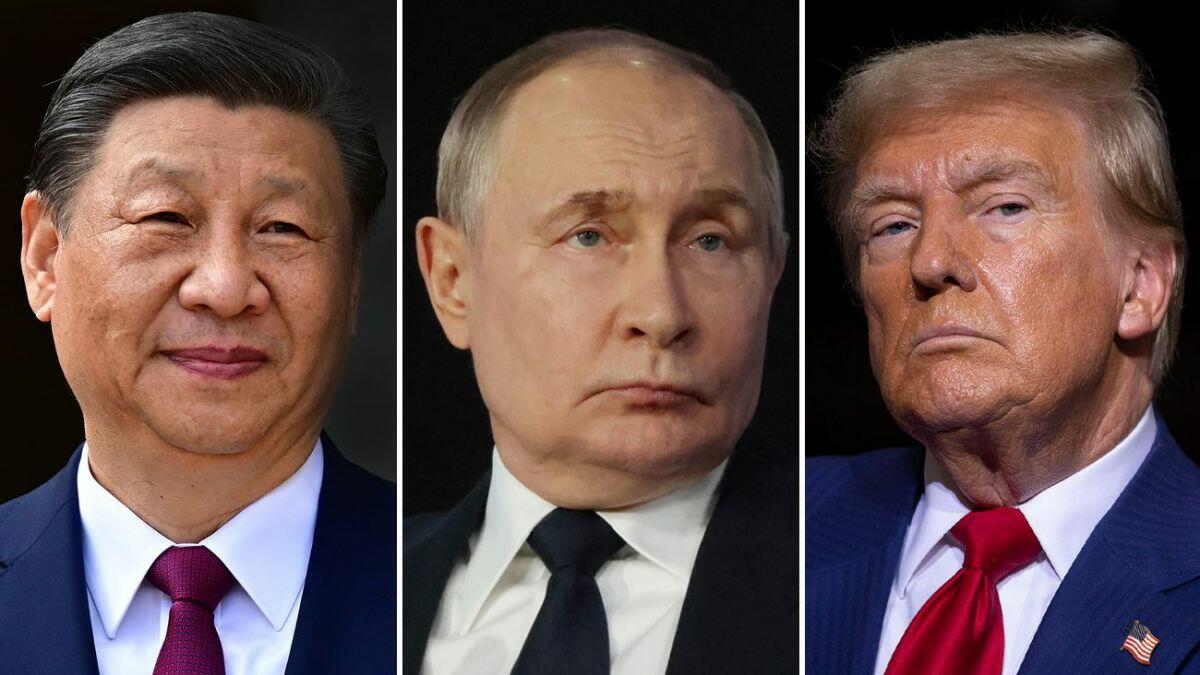
Russian President Vladimir Putin and Chinese President Xi Jinping held a video link call on Wednesday, wherein Putin hailed Russia’s energy relationship with China as “strategic” while emphasizing that Beijing has become Moscow’s top buyer of oil and gas since the Ukraine ‘special military operation’ began.

The timing is the most notable aspect, given the call came just two days after Trump announced he would cut tariffs on Indian goods in exchange for New Delhi halting purchases of Russian crude. Trump also said Washington could lift an additional 25% penalty tariff imposed over India’s energy cooperation with Moscow.

The curious thing is the lack of confirmation of the oil purchase cutoff from the Indian side. As yet, there’s no clear indicator that this key element in the Modi-Trump deal has been ratified. On Wednesday FT reports India hails Donald Trump ‘deal’ but ducks discussing Russian oil ban. The reality remains that there are also technical problems with US crude imports replacing Russian…

“WTI is simply too light to be considered as Urals replacement” for refiners in India following this week’s announcement of a US-India deal on tariffs, June Goh, an analyst at Sparta Commodities said in a note. 

And this is likely why Putin seized the opportunity to tout his energy ties with China. Kremlin aide Yury Ushakov has also reminded the world in a statement to TASS that Russia tops the list in terms of oil and pipe gas supplies to China.

“China continues to hold the first place among our foreign trade partners. Russia is fifth among the countries – trade counterparties of China. The task was set during the talk to take efforts for further development of trade and economic ties, in particular, for example, in the energy sphere. Russia is the top supplier of oil and pipe gas to China,” Ushakov said.

Kremlin estimates say China has purchased more than $230 billion worth of Russian energy since the invasion.

Putin himself in the call acknowledged that bilateral trade saw a “slight decline” last year, including a “correction in indicators,” but insisted Russia remains “among the leaders in energy supplies to China.” He vowed the two will continue to closely coordinate together on a range of issues.

As for the India trade, Reuters reported earlier that Indian refiners have yet to receive instructions to fully stop buying Russian oil and are awaiting a formal government decision. Any official halt would be followed with a transition period, no doubt. Trump’s earlier statements may have been too far out front compared to what Modi actually agreed or said yes to.

Hours after Xi and Putin spoke, President Trump also held a call with the Russian leader Wednesday. They last spoke by ‍phone in late November, at which time a conciliatory Trump praised America’s “extremely strong” relations with China. Xinhua News Agency first revealed the Trump-Xi call, but no further details have been immediately forthcoming. 

Tyler Durden
Wed, 02/04/2026 – 13:00

via ZeroHedge News https://ift.tt/tX0cjE6 Tyler Durden

NFL: ICE Will Not Be Present At Super Bowl

NFL: ICE Will Not Be Present At Super Bowl

Authored by Jill McLaughlin via The Epoch Times,

Federal immigration officers will not make an appearance at the Super Bowl this year, NFL Chief Security Officer Cathy Lanier announced at a news conference on Feb. 2.

“There are no planned ICE [Immigration and Customs Enforcement] or immigration enforcement operations that are scheduled around the Super Bowl or any Super Bowl-related events,” Lanier said during the briefing.

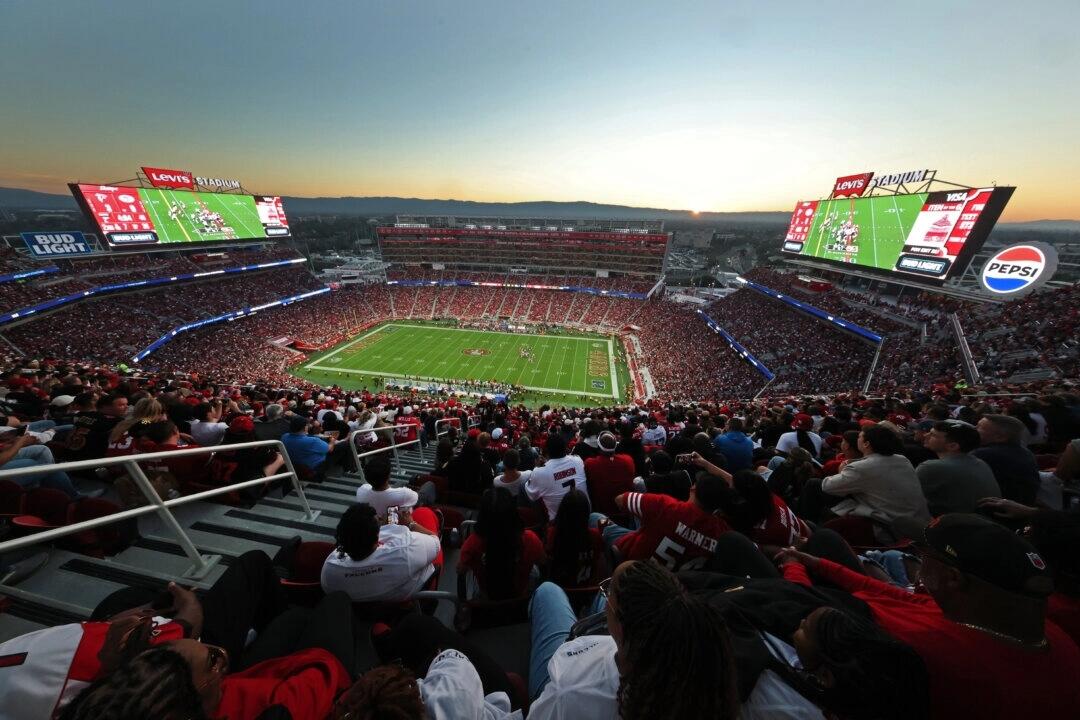
The Seattle Seahawks will face the New England Patriots in Super Bowl LX on Feb. 8 at Levi’s Stadium in Santa Clara, California, about 45 miles south of San Francisco.


The NFL’s announcement differed from an earlier statement made by Homeland Security Secretary Kristi Noem in October 2025, after Super Bowl officials announced that outspoken anti-ICE performer Bad Bunny had been selected as this year’s halftime headliner.


Noem told conservative commentator Benny Johnson on his podcast that ICE officers would be present at the event and “all over that place.”

President Donald Trump has previously criticized the artists selected to headline the Super Bowl halftime show, noting that both Bad Bunny and Green Day have been outspoken critics of him.

“I’m anti-them. I think it’s a terrible choice. All it does is sow hatred. Terrible,” Trump told the New York Post.

NFL commissioner Roger Goodell has voiced support for Bad Bunny, who won the Latin Grammy award for Album of the Year on Feb. 1.

“We’re confident it’s going to be a great show,” Goodell said. “He understands the platform that he’s on, and I think it’s going to be exciting and a united moment.”

Bad Bunny arrives at the 68th annual Grammy Awards in Los Angeles on Feb. 1, 2026. Jordan Strauss/Invision/AP

San Francisco Mayor Daniel Lurie said his priority would be public safety as the city welcomes people from around the world during the Super Bowl.

“Our city teams have been preparing for months,” Lurie posted on Feb. 2 on X.

About 1.3 million visitors are expected to attend the game or related events in the San Francisco Bay Area this weekend, the San Francisco International Airport estimated.

San Francisco police and local law enforcement are focused on protecting the public, including the right to “peaceful expression,” the mayor added.

“We will continue to uphold San Francisco’s longstanding policies that keep local law enforcement focused on keeping our city safe—not on federal immigration enforcement,” Lurie stated.

Even so, the city expects the Super Bowl to attract criminal activity, including human trafficking, according to Lurie.

The San Francisco Police Department and other authorities were conducting targeted operations to prevent exploitation of vulnerable people, he said.

Tyler Durden
Wed, 02/04/2026 – 12:40

via ZeroHedge News https://ift.tt/kcvag9X Tyler Durden

January US Jobs Report Rescheduled For February 11

January US Jobs Report Rescheduled For February 11

The government reopened after another theatrical two-day shutdown, but that doesn’t mean that Friday’s payrolls report will come when it is due (after all, it’s not like the BLS had 30 days to prepare for it, oh wait, they did). Instead, the January employment report has been rescheduled for Wednesday, Feb. 11, according to the Bureau of Labor Statistics.

The data, originally due Feb. 6, was delayed by the partial government shutdown. BLS announced the changes Wednesday, shortly after funding for a number of agencies, including the Labor Department, was restored.

January’s consumer price index report, originally due Feb. 11, is now scheduled for Friday, Feb. 13, the BLS also said.

Other BLS reports that were due this week, including December’s Job Openings and Labor Turnover Survey and the Metropolitan Area Employment and Unemployment release, were also rescheduled.

The partial shutdown ended late Tuesday after President Donald Trump signed into law a funding deal he negotiated with Senate Democrats. The Labor Department, and most other government agencies, are now funded through Sept. 30.

In addition to the usual monthly payrolls and unemployment data, the January jobs report also includes highly anticipated revisions to annual employment. Those are expected to show that job growth was notably weaker in the year through March 2025 than initially reported.

Tyler Durden
Wed, 02/04/2026 – 12:20

via ZeroHedge News https://ift.tt/C05VapT Tyler Durden

Chuck Schumer Claims Voter ID Laws Are The Return Of “Jim Crow”

Chuck Schumer Claims Voter ID Laws Are The Return Of “Jim Crow”

The Democrat Party strategy relies heavily on the tactic of associating everything they don’t like with the race-based conflicts of the past, even though they have no knowledge or understanding of basic history.  Their intention is to energize their low-IQ base with hot button rhetoric while blithely dismissing any reasonable debate on otherwise common sense policies.  

Once something is deemed “racist”, all constructive discussion goes out the window.  

It is crystal clear that the Democrats are desperate to sabotage voter ID laws at any cost.  Why?  Because they know that illegal immigrants vote despite laws against it, and they also know voter fraud is easier with mail-in ballots devoid of any concrete identification process.  In other words, Democrats know they will never win another election unless they have the option to cheat.  

It’s the obvious reason why the progressives are so hostile to bills like the SAVE Act (the Safeguard American Voter Eligibility Act) which would enforce ID requirements common to most countries in the world.  It’s also one of the reasons why NGO funded activists have become so violent in the face of mass deportations of illegals in recent months.  Democrats need to import foreigners, buy them off with subsidies and ensure voting standards remain as loose as possible.  

The only country in which voter ID is labeled “racist” is the US.  Even in the EU, 26 out of 27 member nations have some form of identification law to protect election integrity.  Democrat Senator Chuck Schumer, however, disagrees and claims voter ID is a travesty similar to the days of Jim Crow and segregation.  

Republican midterm chances are riding on the passage of the SAVE Act, not only because of potential fraud by Dems but also because conservatives are increasingly demanding action be taken to secure elections.  A failure on the SAVE Act could mean many MAGA voters stay home on November 3rd. 

Schumer’s comparison to “Jim Crow” laws is, of course, absurd, largely because Jim Crow laws had nothing to do with voter identification. 

Furthermore, some Jim Crow laws that dealt with voting were not necessarily wrong:  The requirement for voters to pass a literacy test (in English) would be more than reasonable today.  Many US states also still deny voting rights to convicted criminals guilty of certain felonies, just as they did under Jim Crow. 

If some minority groups are statistically more inclined to commit felonies, then that’s their problem and maybe they should stop if they want to vote. 

The GOP has fielded the possibility of a temporary stop on the filibuster, which would allow the passage of the SAVE Act with a simple 51 vote majority rather than 60 votes.  This is a hotly debated “nuclear option”, but it might be the only chance to get comprehensive vote ID laws in place.  Many Republican officials and the Trump Adminstration warn that another chance may never come again.  

Tyler Durden
Wed, 02/04/2026 – 12:20

via ZeroHedge News https://ift.tt/31uKkt4 Tyler Durden

No Global Recession In 2026, But Period Of Poor Growth Continues

No Global Recession In 2026, But Period Of Poor Growth Continues

Authored by Daniel Lacalle,

The IMF estimates for 2026 show no signs of recession. However, the global economy remains in a period of poor growth, high debt, persistent inflation and low productivity.

There may not be a recession, but citizens feel poorer as net real wages decline in most economies, remaining below pre-pandemic levels. Why? Because in most developed economies, GDP growth is bloated by government spending, which means high debt, followed by rising taxes that hurt investment and productivity.

The IMF has had to revise its United States estimates to more than double what they expected in early 2025, while Argentina clearly outperforms both the global and regional averages.

Global GDP growth is projected at 3.3% in 2026 and 3.2% in 2027, slightly above the October 2025 projections and broadly in line with 2025 levels.

US outperforms advanced economies

The positive surprise is the United States. Advanced economies are expected to grow by about 1.8% in 2026 and 1.7% in 2027 thanks to higher US figures, while emerging markets and developing economies reach around 4.2% and 4.1%, respectively, despite a slowdown in China.

The IMF calls this “resilient growth” after a year of warning about risks. This is surprising, because many analysts point out that we should be worried when the IMF starts giving bullish messages.

Despite the ironic comments, the IMF does warn about the poor levels of economic development in the leading economies.

The main drivers of economic strength come from AI‑related investment, accommodative financial conditions and private sector flexibility, which offset the negative impact of geopolitical risk and trade negotiations.

The US will be the only G7 economy escaping stagnation in 2025-2027

The Fund was clearly wrong about its estimates for the US economy published last year.

It now projects US growth at 2.4% in 2026, another relevant upward revision from its October 2025 forecast, considering stronger‑than‑expected 2025 data and a powerful impulse from AI‑related capital spending (data centres, chips, digital infrastructure).

For 2027, US growth is expected to moderate to about 2.0%, still above the advanced‑economy average.

The US will be the only G7 economy escaping stagnation in 2025-2027 and outperforming all its major peers with lower immigration, lower taxes and a reduction in government spending, while the major peers, Germany, Japan, France, UK and Canada, continue to disguise the private sector recession with more public spending and rising immigration.

The IMF has not admitted its mistake in assuming stagnation and elevated inflation due to tariffs and prefers to explain the massive upgrades justifying them on lower policy rates, ongoing fiscal support, and high-tech investment.

It is not important. The reality is that the US has proven wrong all the fearmongers and doom predictors and has turned into one of the main drivers of global demand in this forecast round.

Argentina: growth above global and regional averages

The IMF expects Argentina to grow by around 4% in both 2026 and 2027, clearly above the 3.3% world pace and significantly ahead of Latin America’s projected 2.2% in 2026 and 2.7% in 2027.

This comes after an estimated 4.5% expansion in 2025, following a 1.3% contraction in 2024. The International Monetary Fund explicitly links this impressive trajectory to the policies of President Milei and recent macro‑stabilisation efforts.

Argentina moves from chronic underperformer to clear outperformer in the IMF’s baseline

Argentina moves from chronic underperformer to clear outperformer in the IMF’s baseline, especially with a weak outlook for Mexico and Brazil.

Supply-side policies, private sector focus and abandoning interventionism in energy are among the factors that put a faster‑growing US and Argentina as the “pockets of strength” that allow global growth to stay around 3.3% despite the euro area and LatAm stagnation.

Low growth in Europe

For the euro area, the IMF shows moderate but gradually improving growth. However, most of it comes from Germany’s increasing debt.

Real GDP is projected to expand by 1.3% in 2026 and 1.4% in 2027, a slight upward revision versus the October 2025 outlook and consistent with the ECB’s own projections.

However, we cannot forget that this disastrous economic growth comes in the middle of the Next Generation EU stimulus plan and with rate cuts.

Germany is expected to recover from near‑stagnation towards 1.1% in 2026 and 1.5% in 2027 only due to a more than debatable public spending and indebtedness programme.

France is expected to show no real growth by about 1.0% and 1.2%, driven by government spending.

The IMF’s message is that, compared with the United States, the euro area remains a low‑growth region, constrained by weak productivity and excessive regulation and taxes.

For the United Kingdom, the Fund keeps an optimistic forecast at 1.3% growth in 2026 and 1.5% in 2027. It is said that, after the US, the UK and Canada are the fastest‑growing G7 economies.

This reminds us that net zero, high taxes and big government are the recipe for stagnation.

Canada is projected to expand by just 1.4% per year in 2026 and 2027. Japan will only show 0.7% growth in 2026 and 0.6% in 2027, according to the IMF, despite years of government spending on so-called stimulus.

In Asia, the IMF focuses its attention on the Chinese slowdown, offset by the strength in India.

China is projected to grow by 4.5% in 2026 and 4.0% in 2027, slower than its 5% growth in 2025. However, it is still one of the main engines of global expansion, despite the ongoing challenges facing the real estate sector.

India remains the fastest‑growing large economy in the IMF’s outlook, with growth around the 6% range in both 2026 and 2027, driven by domestic demand. India is, according to the IMF, the high beta growth story in Asia.

The IMF should recover economic sanity recommendations and remind governments that supply-side and market-oriented economies focused on strengthening the private sector are the drivers that the global economy requires, and that constant public sector expansion hinders growth and creates financial weakness.

We may not have a recession, but weakness in developed and emerging economies is unjustified, and the main culprit is government interventionism.
Tyler Durden
Wed, 02/04/2026 – 12:00

via ZeroHedge News https://ift.tt/LPntuBH Tyler Durden

Libel by Implication: When Is Half the Truth a Falsehood?

The Alexis Wilkins’ (FBI Director’s Girlfriend’s) Libel by Implication Suit Can Go Forward post reminded me of one of my favorite cases, Memphis Pub. Co. v. Nichols (Tenn. 1978). The Memphis Press-Scimitar (what a great newspaper name) published the following article that mentioned Mrs. Ruth Ann Nichols:

Please think briefly about the story, and then click on the MORE link below to learn what the court decided.

Did you read the story as suggesting that the shooter found her husband in a compromising position with Mrs. Nichols—perhaps having sex, or having had sex, or being just about to have sex? That’s apparently how many readers read the story as well.

But it turns out that, though each statement in the story was literally true, Mrs. Nichols was at the Nichols home together with the shooter’s husband, Mr. Nichols, and two neighbors. They were apparently all sitting in the living room, talking.

The court concluded that the story could be libelous—assuming negligence was shown on the newspaper’s part—because, even though the statements were literally true, they carried a strong implication (that the husband and Mrs. Nichols were together by themselves in a compromising position) that was false:

In our opinion, the defendant’s reliance on the truth of the facts stated in the article in question is misplaced. The proper question is whether the meaning reasonably conveyed by the published words is defamatory, “whether the libel as published would have a different effect on the mind of the reader from that which the pleaded truth would have produced.”

The publication of the complete facts could not conceivably have led the reader to conclude that Mrs. Nichols and Mr. Newton had an adulterous relationship. The published statement, therefore, so distorted the truth as to make the entire article false and defamatory. It is no defense whatever that individual statements within the article were literally true. Truth is available as an absolute defense only when the defamatory meaning conveyed by the words is true.

Such “defamation by half-truth” decisions are rare. All statements, after all, omit something, and one can always argue that the full story would convey a somewhat different message from the partial story. Usually that’s not enough to turn literal truth into libel. But in some situations, where the statement does carry a very strong implication that turns out to be false, a libel claim can indeed be brought even when the statement is literally true.

Another classic example—though just a hypothetical and not a real case—involves the first mate who, upset by his teetotaling captain, writes in the ship’s log,

Captain sober today.

The statement may be literally accurate (the captain was sober today, as on all days) but it carries a very strong implication that turns out to be false (that today was unusual in this respect).

H.P. Grice’s work on conversational implicatures, by the way, relates to this.

The post Libel by Implication: When Is Half the Truth a Falsehood? appeared first on Reason.com.

from Latest – Reason.com https://ift.tt/cGx5I0W
via IFTTT

A City Fined Her Over $100,000 for Parking on Her Own Grass. The Florida Supreme Court Won’t Hear Her Case.


Sandy Martinez stands in front of her home | Institute for Justice

What price should someone pay for three minor code violations?

For Sandy Martinez of Lantana, Florida, the answer is: over $165,000, plus interest, a sum so high that selling her house would be insufficient to pay off the debt, according to her complaint filed against the city in 2021. The Florida Supreme Court effectively closed the door on the case in December when it declined her appeal and left in place a decision that ruled the fines were not “excessive.” But Martinez’s little-known story is a microcosm of the broader debate over what, exactly, transgresses the Eighth Amendment’s prohibition on fines that are unconstitutionally severe, especially as local governments are known to rely on such penalties to raise revenue.

Whether there is a disconnect between common sense and the law is open to interpretation. The bulk of her debt—over $100,000—comes from a parking job.

Martinez shares her home, and her driveway, with her sister and two adult children, all of whom have a car. “There is no curb to park alongside, and the roadways in front of and beside the house are only wide enough to handle two-way neighborhood traffic,” notes her complaint. “If [Martinez] were to park in the street, she would completely block an entire lane of the roadway.” So the four of them park in her driveway.

Pressed for room, the outer wheels initially made contact with Martinez’s yard space, which is illegal in Lantana. She was cited in 2019—the cost would be $250 per day. “[Martinez] was notified by mail of the outcome and got the Home into compliance, at which time she sought a compliance inspection,” her attorneys write. “But getting code enforcement officials on the phone and to [Martinez’s] property was fruitless.”

Martinez did not know, she says, what that meant practically: The fines would keep accruing, day after day, despite that she had rectified the issue. She would learn the hard way upon unsuccessfully attempting to refinance the home the next year. “What could I have possibly done for a fine to be that high?” she asked in an email to a city official.

An inspector was finally dispatched in June 2020 to verify that no wheel infringed on Martinez’s grass. But 407 days had passed, and she would be on the hook for over $100,000, plus interest.

And yet that is not the only ruinous fine she is facing. For a storm-damaged fence she could not immediately afford to remedy, requiring that she wait for a slow-moving insurance claim, the city hit her with $47,375. The cost of installing an entirely new fence runs the average U.S. homeowner between $2,000 and $5,000. And for her driveway’s cosmetic cracks, also a problem she did not have the money to fix right away, she was assessed $16,125. An average new asphalt driveway costs, on average, around $5,000. Martinez, according to her complaint, makes less than $43,000 a year.

“Fines are excessive when they shock the conscience and are unreasonably harsh or oppressive penalties in proportion to the violations to be redressed,” Palm Beach County Circuit Court Judge Luis Delgado wrote in 2024, adding that “substantial deference should be given to the legislature’s determination of an appropriate fine.” All in all, he concluded, “the total sum of her fines are not grossly disproportionate to her offense,” in part because Martinez’s “violations have been enduring for a number of years”—notwithstanding the fact that they were enduring because of the financial constraints attached to addressing them. Delgado also lamented that Martinez did not challenge the “code enforcement board’s order” within 30 days of “the final decision’s execution.” But that elides the fact that the bulk of Martinez’s debt accrued over an extended period.

An appeals court affirmed. “The trial court…did not err in finding the fines were not grossly disproportionate to the violations,” ruled the Florida Fourth District Court of Appeals in April 2025.

So where does that leave Martinez? Florida’s homestead exemption protects her from foreclosure, but that is somewhat cold comfort. “Even if Martinez sold her home for top dollar, she still would not have enough money left over to pay off more than a small fraction of her debt to the City,” her complaint notes. “[Martinez] will be unable to move for many years, if ever.” When she dies, the city will be able to foreclose on the home, depriving her family of any equity she built.

Barring an extreme turn of good fortune, in other words, she is trapped in a house-arrest version of debtor’s prison, her life derailed because she parked on grass she owns. Is that “grossly disproportionate”?

The post A City Fined Her Over $100,000 for Parking on Her Own Grass. The Florida Supreme Court Won't Hear Her Case. appeared first on Reason.com.

from Latest – Reason.com https://ift.tt/hwv8oHI
via IFTTT

Judicial Misconduct Complaint Against Judge Boasberg Dismissed

On July 29, the Department of Justice filed a complaint against district court Judge James Boasberg, alleging that the Judge’s comments to the Judicial Conference suggesting he was concerned that the Trump Administration might disobey district court orders violated multiple Canons of the Code of Conduct for United States Judges.

To avoid potential conflicts within the federal courts in D.C. (where Boasberg sits), the complaint was transferred to the Judicial Council of the U.S. Court of Appeals for the Sixth Circuit.

In December, Chief Judge Jeffrey Sutton of the Sixth Circuit dismissed the complaint, and the order of dismissal was released this week.

Judge Sutton’s memorandum and order first outlines the potential bases for dismissal:

After conducting an initial review, the chief judge of a circuit may dismiss a complaint of judicial misconduct if he concludes: (A) that the claimed conduct, even if it occurred, “is not prejudicial to the effective and expeditious administration of the business of the courts”; (B) that the complaint “is directly related to the merits of a decision or procedural ruling”; (C) that the complaint is “frivolous” because the charges are wholly unsupported; or (D) that the complaint “lack[s] sufficient evidence to raise an inference that misconduct has occurred.” Judicial-Conduct Rule 11(c)(1)(A)–(D); see 28 U.S.C. § 352(a), (b).

This complaint warrants dismissal.

On the substance of the complaint, Chief Judge Sutton writes:

The primary theory of the complaint is that the judge made an improper statement at the Judicial Conference on March 11 about the risk that the Administration would not comply with federal judicial rulings. This claim fails to establish a cognizable basis of misconduct. First, it lacks “sufficient evidence” to support the allegations. Judicial-Conduct Rule 11(c)(1)(D). Here is the key allegation in the complaint: “On March 11, 2025, at one of the Conference’s semiannual meetings, Judge Boasberg disregarded its history, tradition, and purpose to push a wholly unsolicited discussion about ‘concerns that the Administration would disregard rulings of federal courts, leading to a constitutional crisis.’ By singling out a sitting President who was (and remains) a party to dozens of active cases, Judge Boasberg attempted to transform a routine housekeeping agenda into a forum to persuade the Chief Justice and other federal judges of his preconceived belief that the Trump Administration would violate court orders.” Compl. at 4. The Department identified one source of evidence, Attachment A, for the judge’s statement and for the setting in which it occurred. The complaint, however, did not include the attachment. The D.C. Circuit contacted the Department about the missing attachment and explained that, if it failed to submit the attachment, the circuit would consider the complaint as submitted. The Department did not supply the attachment.

In the absence of the attachment, the complaint offers no source for what, if anything, the subject judge said during the Conference, when he said it, whether he said it in response to a question, whether he said it during the Conference or at another meeting, and whether he expressed these concerns as his own or as those of other judges. Later in the complaint, to be sure, the Department refers to a Fox News clip discussing the same allegation. But it does not identify any source, contain any specifics, or answer any of the above questions. A recycling of unadorned allegations with no reference to a source does not corroborate them. And a repetition of uncorroborated statements rarely supplies a basis for a valid misconduct complaint. “[R]umor[s] and gossip that at most could [constitute] leads into possible misconduct” fail to carry a complaint. In re Complaint of Jud. Misconduct, 591 F.3d 638, 646 (U.S. Jud. Conf. 2009).

Second, even assuming for the sake of argument that the subject judge made this statement at some point during the Judicial Conference or its related meetings, the statement was not “prejudicial to the effective and expeditious administration of the business of the courts.” Judicial-Conduct Rule 11(c)(1)(A). The subject judge attended the Conference as one of two representatives of the D.C. Circuit, and federal law required him to be there. 28 U.S.C. § 331. The Conference acts as the policymaking body for the judiciary and consists of a diverse body of federal judges, drawn from every geographic region of the country and appointed by several different presidents. The Conference sets policy and provides guidance with respect to all manner of issues facing the judiciary—from budgets and courthouse maintenance to workplace conduct and judicial security and independence. On top of that, the formal meeting of the Conference involves presentations from invited guests from the elective branches, including the Attorney General and congressional leaders, about issues that often require coordination between the branches. A key point of the Judicial Conference and the related meetings is to facilitate candid conversations about judicial administration among leaders of the federal judiciary about matters of common concern. In these settings, a judge’s expression of anxiety about executive-branch compliance with judicial orders, whether rightly feared or not, is not so far afield from customary topics at these meetings—judicial independence, judicial security, and inter-branch relations—as to violate the Codes of Judicial Conduct. Confirming the point, the Chief Justice’s 2024 year-end report raised general concerns about threats to judicial independence, security concerns for judges, and respect for court orders throughout American history. See 2024 Year End Report on the Federal Judiciary at 5, 7–8.

To the extent the Department claims that the judge’s alleged March 11 remark amounts to a “public comment” with respect to “a matter pending or impending in any court” in violation of Canon 3(A)(6), that theory also falls short. The alleged comment does not refer to a case, and the J.G.G. action was not filed until four days later: March 15, 2025. Because the judge did not refer to a case, that all but guarantees that his comments did not “violate[] Canon 3A(6), Canon 2A, or the Judicial–Conduct Rules.” In re Charges of Jud. Misconduct, 769 F.3d 762, 788 (D.C. Cir. 2014). The comment at any rate was not a “public” one, as it was made in a closed-door meeting in which the communications are off the record and confidential. The complaint, notably, does not claim that the judge made public what was said in private at the Conference or its related meetings.

Chief Judge Sutton writes further:

The second theory of misconduct is that the judge improperly exercised jurisdiction over a case in defiance of a Supreme Court order, mistreated the Department during the case, and made other errors in handling the case. These allegations, however, “directly relate[] to the merits of a decision” and thus do not constitute judicial misconduct. 28 U.S.C. § 352(b)(1)(A)(ii); see Judicial Conduct Rule 4(b)(1). The Judicial Council is not a court and has no jurisdiction to review the merits of a subject judge’s rulings, to reverse a judge’s ruling, or otherwise to grant merits-related relief with respect to an underlying lawsuit. See In re Complaint of Judicial Misconduct, 858 F.2d 331, 331–32 (6th Cir. 1988).

This resolution of the complaint is not remotely surprising. Whatever one thinks of Judge Boasberg, or his handling of various cases involving the Trump Administration, there was not much substance to the initial complaint.

The post Judicial Misconduct Complaint Against Judge Boasberg Dismissed appeared first on Reason.com.

from Latest – Reason.com https://ift.tt/nGXdefS
via IFTTT

WTI Holds Losses As Freezing Temps Sparked Massive Drop In US Production

WTI Holds Losses As Freezing Temps Sparked Massive Drop In US Production

Crude oil prices (WTI) are trending moderately lower this morning as traders weigh geopolitical tensions in the Middle East and a report of sharply lower US stockpiles reported by API overnight.

Iranian Foreign Minister Abbas Araghchi and US envoy Steve Witkoff will hold indirect negotiations in Oman on Friday, Iran’s semi-official Tasnim reported, adding talks would be “limited to the nuclear issue and the lifting of sanctions.”

“Geopolitical tensions are really driving it,” Equinor Chief Financial Officer Torgrim Reitan said in a Bloomberg TV interview.

“The underlying balance is a lower price than there is today, but with everything going on it’s very hard to say where this will end.”

We can’t help but feel like the API reporting (and very mixed picture) was related to the impact of the freezing weather across most of the country.

API

  • Crude -11.1mm (+700k exp)

  • Cushing

  • Gasoline +4.7mm

  • Distillates -4.81mm

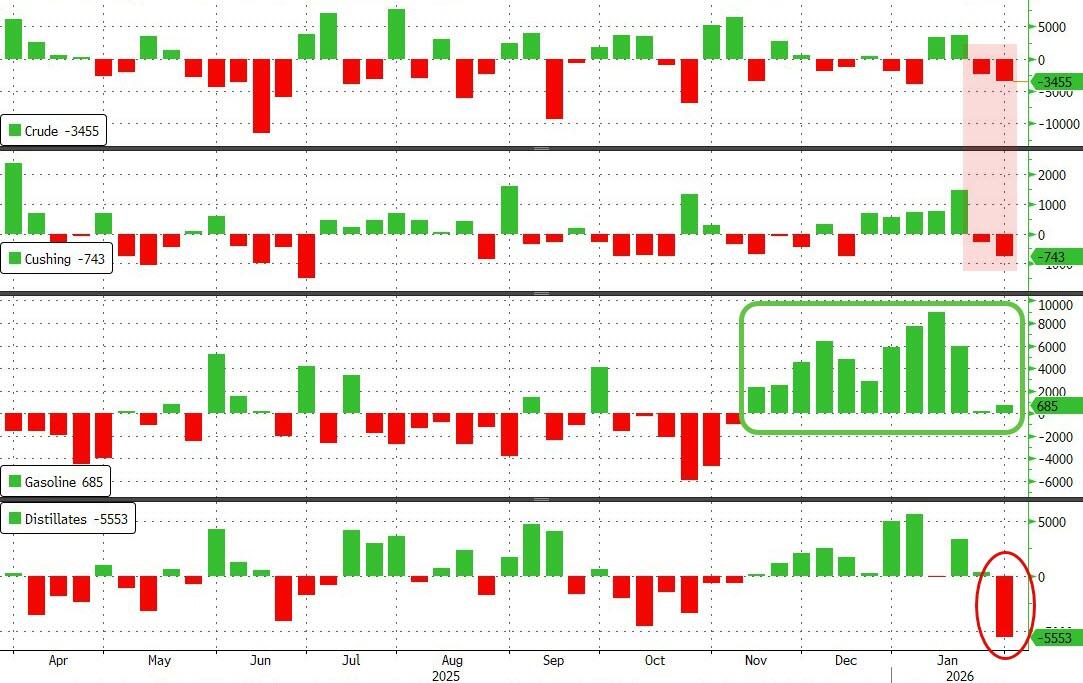
DOE

  • Crude -3.45mm (+700k exp)

  • Cushing -743k

  • Gasoline +685k

  • Distillates -5.55mm – biggest draw since Feb 2021

The official data showed a sizable crude draw (but considerably less than API reported) as distillates saw their biggest drawdown since Feb 2021. Bloomberg’s Will Zubanskuy notes that the largest portion of that distillates draw came from PADD 1, which includes the East Coast — where homes in the Northeast lean on heating oil to warm their houses in frigid temperatures. Adding to the demand, diesel and oil-fired power plants start running when the grid comes under strain and some utilities begin pulling from heating oil for certain customers instead of natural gas when supply of the latter gets tight.

Stockpiles at Cushing, Oklahoma, declined for the second straight week, bringing inventories at the storage hub to around 24 million barrels. Despite the draw, levels at Cushing remain several million barrels above where they were this time last year. Gasoline stocks rose for the 12th straight week…

Source: Bloomberg

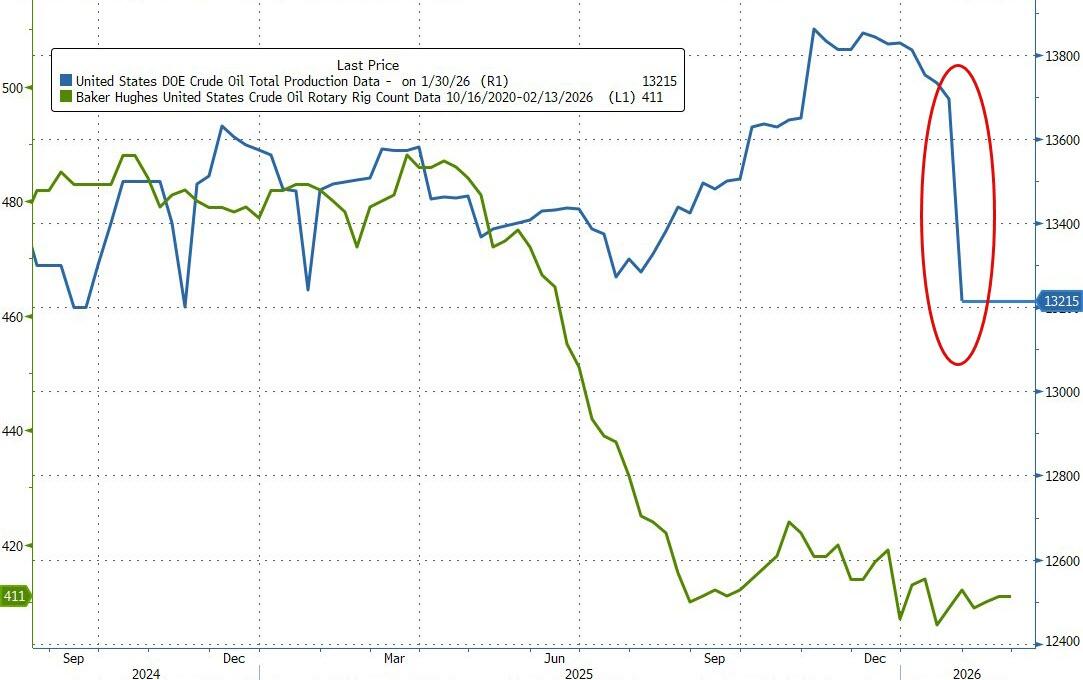
Crude production in the Lower 48 fell to the lowest since November 2024 as freezing temperatures disrupted drilling in the Permian and Bakken formations.

In the past two months, output is down by 632,000 barrels a day. Overall, production has been shaved off by 4.4 million barrels since early December. 

Source: Bloomberg

Bloomberg’s Alex Longley also noted another data point showing how much of this storm impact was centered on the gas side of the market rather than oil. While crude production was down 481k b/d versus a week earlier, NGL output tumbled 1.25m b/d. It’s the lowest since 2024 and the biggest weekly decline on record.

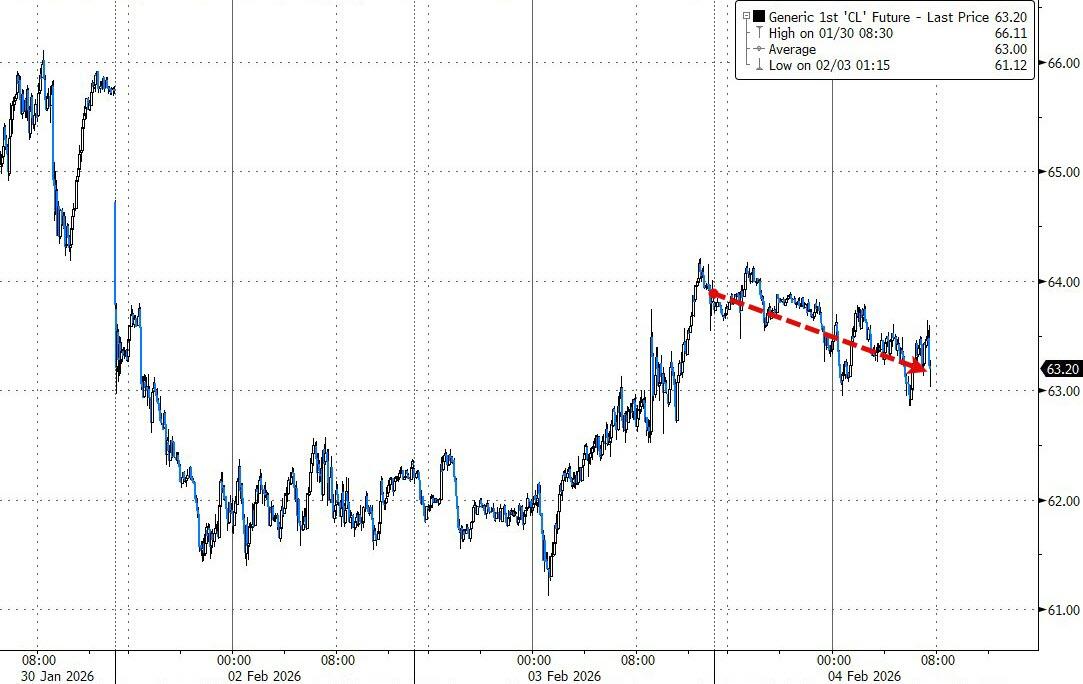
WTI prices edged lower, likely driven by the smaller draw than API reported…

Circling back to where we started, the bullish drop in inventories comes as tensions between the U.S. and Iran continue to run hot. While the U..S. Administration said negotiations over Iran’s nuclear program will start this week, U.S. naval forces sent to the Arabian Sea off Iran shot down an Iranian drone approaching an aircraft carrier 500 miles off Iran’s coast in the Arabian Sea, the BBC reported. As well, a U.S.-flagged merchant ship in the Strait of Hormuz, the choke point for more than 20-million barrels per day of Persian Gulf exports, was harassed by Iranian gun boats.

Oil would be lower without Middle Eastern sabre-rattling. Post-settlement API figures, faithfully echoing the impact of the cold spell in the US, provide additional support this morning, as crude oil stocks dropped 11 million bbls. These are extraordinary days, weeks and months, in which perceived oversupply has been overwhelmingly overlooked, yet it is still able to set a price ceiling when perceived supply disruptions are in the crosshairs of investors,” PVM Oil Associates noted.

Tyler Durden
Wed, 02/04/2026 – 10:50

via ZeroHedge News https://ift.tt/r4Rh0u7 Tyler Durden

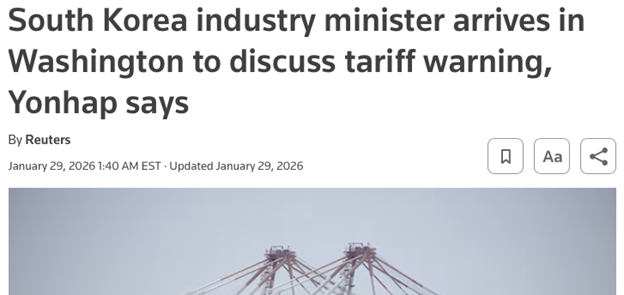
Speculation US May Announce New Nuclear Plant During Korea Trade Negotiations

Speculation US May Announce New Nuclear Plant During Korea Trade Negotiations

At a time when China, which is now leaps and bounds ahead of the US in energy generation, is building 29 nuclear power plants compared to zero for the US…

…  South Korean news agencies report that the US government is proposing South Korea build a nuclear power plant in the US as part of ongoing trade negotiations. South Korea’s Industry Minister is in the U.S. this week and is scheduled to meet with Secretary Lutnik to clarify Seoul’s position on a delayed Korea-U.S. trade deal.

Providing some added credibility to the report out of South Korea, Reuters reports the industry minister is scheduled to meet Secretary Wright as well before he departs February 5th. 

South Korea and the US are already coordinating on multiple different ventures as previously announced last year through multiple different MOUs. Korea Hydro & Nuclear Power Co. (KHNP) is working with multiple reactor developers to further develop and progress the construction of their designs. KHNP is also working with Centrus Energy to rapidly expand enrichment capacity.

Korean industrial company Doosan Enerbility is also working with Fermi America to construct a supply chain for the four AP1000 reactors to be built at the AI mega-campus in Texas.

While the reactor that will be potentially constructed by Korea has yet to be confirmed or announced by either country, it will likely be an AP1000 to strengthen a high-demand grid and stand as a signal that the U.S. government is pursuing lower energy prices for consumers. The reactor design is licensed for use by reactor owners from Westinghouse, which is owned by Canadian companies Cameco and Brookfield. 

Cameco (CCJ) happens to be Goldman Sachs’ highest conviction play for the nuclear theme as all of this goes on. Goldman also recently noted “the biggest near-term potential uplift to EBITDA forecasts as through FIDs on new AP1000s, as each reactor provides ~$225mn of EBITDA generation over a ~12-year time frame.”

The first two, and only two, AP1000 designs built in the U.S. were constructed in Georgia with both horrific cost overruns and grossly overblown timelines. The nuclear industry is desperate for the opportunity to prove it has learned its lessons and can come down the cost curve. Utilizing the most proficient nuclear power plant construction teams, outside of China, is a best case scenario. 

Tyler Durden
Wed, 02/04/2026 – 10:25

via ZeroHedge News https://ift.tt/y5szlXM Tyler Durden