Zohran Mamdani rode to victory as New York City’s mayor in part due to his audacious campaign promises around freezing the rent and offering free bus service to Big Apple residents. But perhaps no campaign promise of Mamdani’s was as bold as his “$30 by ’30” plan, which called for increasing the city’s minimum wage to $30 by 2030.
Now that Mamdani is in office, New York City Council members have introduced a bill to turn $30 by ’30 from a catchy campaign slogan into an economic reality.
But while the top-line number of $30 has received most of the attention, the fine print in the legislation may be even more alarming: It would eliminate what’s known as the tipped-wage credit for restaurants in NYC, meaning that mom-and-pop restaurants—some of the city’s smallest businesses—would find themselves on the hook for paying workers $30 an hour. Restauranteurs around the city are sounding the alarm, warning that the bill could pose a dire threat to NYC’s famed dining scene.
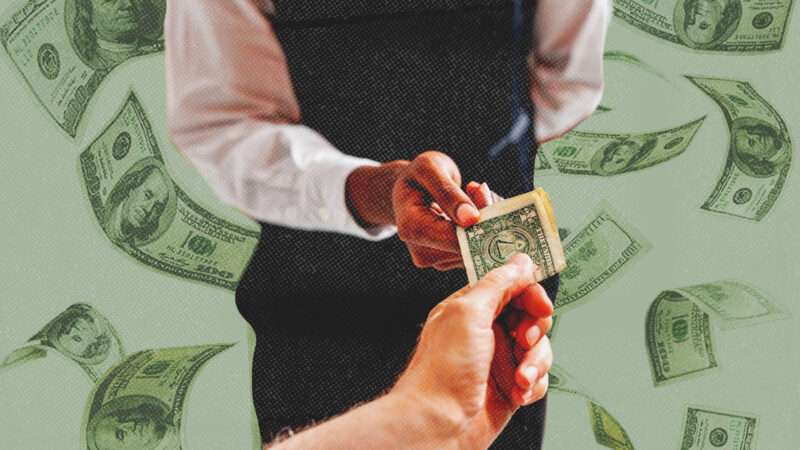
Restaurants operate under a unique wage structure in most locales across America. Rather than being subject to the traditional minimum wage, tipped employees at these establishments receive part of their compensation in the form of gratuities. A legal structure called the tipped-wage credit allows such restaurant workers to be paid below the minimum wage pre-tips; if a server’s tips still leave them below the full minimum wage, then restaurant owners are responsible for making up the difference.
The tip credit system has been in place for 60 years, allowing restaurant workers to make upwards of $30 or $40 an hour—or more—once tips are factored in, while also giving owners a way to control labor costs in an industry notorious for its tight margins.
Progressive cities like Washington, D.C. and Chicago have experimented with eliminating the tip credit system in recent years, and the results have been nothing short of disastrous. After D.C. scrapped its tip credit and required servers to be paid a traditional minimum wage, restaurant worker earnings reportedly fell in the District as restaurants cut jobs and reduced hours for staff.
Restaurants also responded by raising dining prices in the form of new “service fees,” and D.C.’s progressive city council was ultimately forced to partially reverse the tip credit’s phaseout. The experience in Chicago was similar.
But whereas D.C. and Chicago sought to scrap the tip credit system and replace it with a minimum wage around $16 to $17 per hour, NYC’s plan would nearly double this wage rate to $30. A group of about 40 independent restaurants in the Hell’s Kitchen neighborhood—known for its world-leading dining scene—are now laying out in detail what this increased minimum would mean for diners who frequent their restaurants.
By 2031, they say, a $21 hamburger would become $33; a $14 glass of wine would increase to $22; and a $24 salmon salad would spike to $37. Worse yet, these prices don’t even factor in taxes, and they are only based on a $19.33 per hour minimum wage. (The proposed legislation would gradually raise servers’ hourly wage over time, until it eventually reaches $30 per hour after 2031).
The wage hike could force restaurants to cut back on employment, too. “Places will have to cut their staff in half and use QR codes on the table,” said Sean Hayden, an owner of numerous Hell’s Kitchen restaurants, in an interview with W42ST. “It’ll be like airport service.”
These restaurant owners are hardly profit-grabbing monopolists. One establishment reported that its tipped staff members currently earn over $41 an hour on average when combining an $11.35 hourly wage and tips.
Their warnings are not merely apocalyptic doomcasting, either. Los Angeles voted in May of last year to raise the minimum wage for hotel workers to $30 an hour by 2028. The American Hotel and Lodging Association has since reported that 88 percent of hotels have experienced layoffs or reduced hours and just under 60 percent have reduced overtime availability as well as worker benefits and amenities. While various factors play into these reductions, over 90 percent of hotel owners cite the rising labor costs as a key component.
An Oxford Economics analysis forecasted that L.A.’s hotel wage mandate would lead to a reduction of over 14,000 jobs in the city. L.A.’s gradual minimum wage hikes for hotels over the years—starting in 2015—have already led to notable reductions in employment. The City of Angels can ill afford such a hit to its hospitality industry ahead of hosting the 2026 World Cup and 2028 Olympics.
For NYC’s part, Mamdani has yet to officially endorse the new legislation, although his campaign track record strongly points toward him ultimately backing it. If he does, $33 hamburgers might become the norm sooner than later.
The post A $33 Burger? As New York City Eyes $30 Minimum Wage, Restaurants Brace for Impact appeared first on Reason.com.
from Latest – Reason.com https://ift.tt/J98DA3I
via IFTTT