Israel Halts Arms Purchases From France In Rebuke For Iran War Stance

Israel Halts Arms Purchases From France In Rebuke For Iran War Stance

Israel on Tuesday took the drastic step of announcing that it will halt the acquisition of defense-related goods and services from France, according to an Israeli Defense Ministry announcement.

“The Director General of the Israel Ministry of Defense. Maj. Gen. (Res.) Amir Baram has decided to reduce all defense procurement from France to zero, replacing it with domestic Israeli procurement or purchases from allied countries,” a Defense Ministry spokesperson confirmed.

via Reuters

The move is being done in direct rebuke to France’s decision to not allow flights in its airspace which transport military items to Israel, or also American military flights which are directly connected to Iran war operations. A growing number of NATO and EU countries are doing this, also Italy, Spain, and Switzerland.

The Israeli statement said further, “France has taken a series of actions that have harmed Israel’s security and the operational capabilities of its defense industry.”

“The Israel Ministry of Defense views the French government’s policy with serious concern, as it undermines security cooperation with Israel, a country that is actively operating on the front line against Iran and protecting the security of the Western world,” it added.

Defense ties between France and Israel were already strained going back to the Gaza war:

According to a parliamentary report, France authorized more than 200 dual-use export licences to Israel in 2024 worth €76.5 million — 60 percent less than in 2023 — highlighting how limited and declining defense ties between the two countries already are.

Existing contracts are expected to be honored and private companies may still pursue deals.

Earlier in the day Tuesday, President Trump took France to task for being “very unhelpful” in Iran operations.

“The Country of France wouldn’t let planes headed to Israel, loaded up with military supplies, fly over French territory,” Trump stated on Truth Social. “France has been VERY UNHELPFUL with respect to the ‘Butcher of Iran,’ who has been successfully eliminated!”

The American president then emphasized, “The U.S.A. will remember!!!” France’s Macron has pledged his forces will “never take part in operations to open or liberate the Strait of Hormuz in the current context.” Other EU leaders have said that essentially this is “not our war”.

These same European leaders have long criticized Israel for the immense civilian death toll after two years of war in Gaza. It stands at over 70,000 killed – a figure which Israel has actually acknowledged, with the caveat that at least some one-third of these casualties were Hamas militants. Some estimates say the death toll could be higher.

Tyler Durden
Wed, 04/01/2026 – 04:15

via ZeroHedge News https://ift.tt/GpgRMLu Tyler Durden

‘A National Calamity’: 1 In 8 UK Children Reported As Disabled By Parents

‘A National Calamity’: 1 In 8 UK Children Reported As Disabled By Parents

Authored by Mary Gilleece via dailysceptic.org,

The recent news that one in eight children are now reported by their parents as being disabled ought to prompt an immediate national inquiry into what on earth is causing a large proportion of the population to sicken.

That millions of children and young people are stricken with disabilities ought to be front page news every day until it is sorted out.

The Telegraph reports:

About 12% of children – or around 1.7 million youngsters – are now living with a long-term illness, disability or impairment, according to fresh figures from the Department for Work and Pensions (DWP).

This has almost doubled since 2015, when roughly 7% of parents said their child had a disability, according to the department’s closely-watched Family Resources Survey (FRS).

It also comes amid a sharp increase in young people being diagnosed with behavioural issues as well as autism and ADHD.

Almost two-thirds of children with a disability had a “social” or “behavioural” impairment – by far the most common issue cited by parents, the FRS found.

The figures involved ought to terrify everyone for they reveal a population that is riven with ill-health and impairment. If accurate, a National Commission into ‘Physical Deterioration’ similar to the one conducted by Fitzroy in 1904 to find out what was causing the ill-health of young people is needed immediately. With such staggering levels of illness, there is no hope at all that our country will ever return to growth. The Telegraph continues:

The number of children with behavioural disorders who are eligible for disability living allowance (DLA) has almost quadrupled to 276,000 since before the pandemic. This total includes 10,000 children under five and 14 children who are less than a year old.

Roughly 16.7 million people – representing a quarter of Britons – now live with a disability. More women than men claim they have an impairment, though disability is more prevalent among boys than girls.

Scottish people are also more likely to say they are disabled than people living in England or Wales.

The figures show roughly 700,000 of children considered disabled are under 10. More people under 20 are also now in this category than Britons aged over 80.

I am appalled that no-one in politics is calling for an immediate inquiry into these dreadful illnesses destroying the health and chances of so many children. Sure Alan Milburn has been asked to look at the benefits system, but who is investigating the children themselves to find out why they are all so poorly?

The Fitzroy Report was commissioned after the Boer War when it had become apparent that large percentages of recruits were rejected from the Army physical reasons. The report sought:

(1) To furnish the Government and the Nation at large with periodical data for an accurate comparative estimate of the health and physique of the people;

(2) to indicate generally the causes of such physical deterioration as does exist in certain classes;

and (3) to point out the means by which it can be most effectually diminished.

It was thorough in its analysis and took a broad approach to finding out why children were failing to thrive. The commissioners examined such things as “cellar-based and back-to-back housing”, “the employment of mothers too soon after childbirth”, “white bread”, “abuse of tea”, “the desire for pleasure”, “hereditary taint”, “the universal preference amongst the women for factory over domestic life”, “the school system”, “incompetent care”, “parental ignorance and neglect” and “juvenile smoking”, for instance. In a foreshadowing of the current Ultra Processed Food debate, it reports:

A striking consensus of opinion was elicited as to the effects of improper or insufficient food in determining physique, and this factor was acknowledged by every witness to be prominent among the causes to which degenerative tendencies might be assigned, though in one or two cases its relative importance was thought liable to exaggeration.

These latest figures about the catastrophic ill-health of our nation’s children surely ought to demand an equivalent commission. After all, what prompted the 1904 Fitzroy Report is not far off what is happening with today’s Army recruits – growing rejection owing to feeble mental and physical health. In 2019-2020, 28.9% of applicants were rejected for medical reasons growing to 39.2% in 2022-3. Of these, 54% of medical rejections between 2020-24 were for mental health or psychiatric reasons.

This is surely terrifying stuff – our mentally enfeebled young are not fit to fight, to be in school or work. What on earth has happened?

Someone surely should be trying to work out what’s to blame. White bread? Juvenile vaping? Out of town housing estates with no public transport? Smartphones? Gaming? Parental ignorance and neglect?  Perhaps others will take up my cry for a national inquiry and calls will grow for someone like Hillary Cass or Louise Casey to get to the bottom of it all.

Or perhaps such an inquiry would discover that actually there’s nothing wrong at all with these children. Instead it will become obvious that millions of healthy children and young adults are being used in an obscene financial grift by private health and education providers, mental health charities and a gullible welfare system.

Terrifying either way.

Tyler Durden
Wed, 04/01/2026 – 03:30

via ZeroHedge News https://ift.tt/5dHfFaV Tyler Durden

Not Just Cigarettes, Vaping Likely Causes Cancer, Major Study Finds

Not Just Cigarettes, Vaping Likely Causes Cancer, Major Study Finds

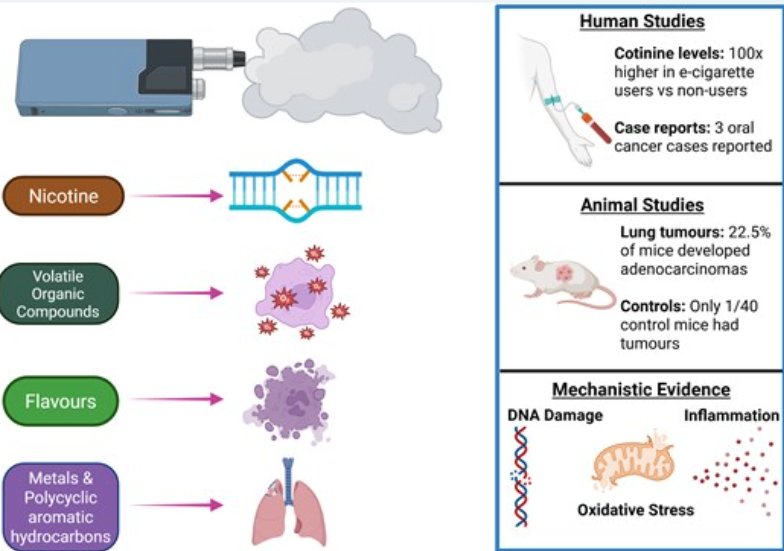
A new report from researchers at the University of New South Wales in Australia, published in Carcinogenesis, finds that nicotine-based e-cigarettes are likely to cause lung and oral cancers, a finding that may alarm the millions of young people, from high school through college, and into the professional world, who use them heavily. 

Researchers examined human studies, animal experiments, and lab tests. Together, they found signs that vaping can damage DNA, cause inflammation and oxidative stress, and expose users to harmful chemicals considered drivers of cancer. Some rodent studies also found lung tumors after vape exposure.

Nicotine-based e-cigarettes are likely to be carcinogenic to humans who use them, causing an indeterminate burden of oral cancer and lung cancer,” the researchers wrote in the report.

The researchers still don’t fully understand the long-term risks, given that vaping only entered commercial markets worldwide in the last 20 or so years. However, they say the warning signs are already present and should not be ignored as cigarette risks once were.

“Though smoking was once given the benefit of the doubt, the same should not now be accorded to vaping, given the strength of relevant carcinogenicity data,” wrote study co-authors Freddy Sitas and Bernard Stewart of UNSW in a related commentary.

Vaping in the U.S. emerged in 2007 and was widely touted as a safer way to consume nicotine than traditional methods involving inhaling smoke from burning tobacco leaves. The trend exploded in 2015 with the introduction of Juul.

Millions of Americans started vaping to quit smoking cigarettes. Instead, if the study is correct, they may actually be increasing their health risks.

Vaping is not as harmless as once thought, and the researchers’ point is that e-cigarettes should not receive the same “benefit of the doubt” cigarettes once did, because the cancer warning signs are already present.

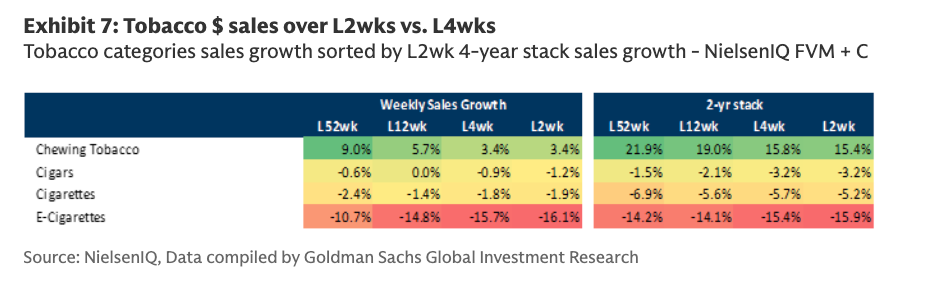
Even before the assessment was released, NielsenIQ data showed e-cigarette sales in the U.S. were weak as of March 21 (according to the Goldman report, which can be viewed in full here for Pro subscribers):

Within Tobacco, dollar sales for BAT were up 1.8% over the past four weeks, versus 1.0% last month; sales for IMB were down 3.5% over the past four weeks, versus down 3.4% last month; and sales for MO were down 2.0% over the past four weeks, versus down 3.2% last month.

The question now is whether the study will go viral and alarm consumers enough with cancer fears, and whether those fears will be enough to change spending behavior in a way that shows up in the NielsenIQ data over the coming weeks.

Tyler Durden
Wed, 04/01/2026 – 02:45

via ZeroHedge News https://ift.tt/R3znHO7 Tyler Durden

Brickbat: Cold and Callous


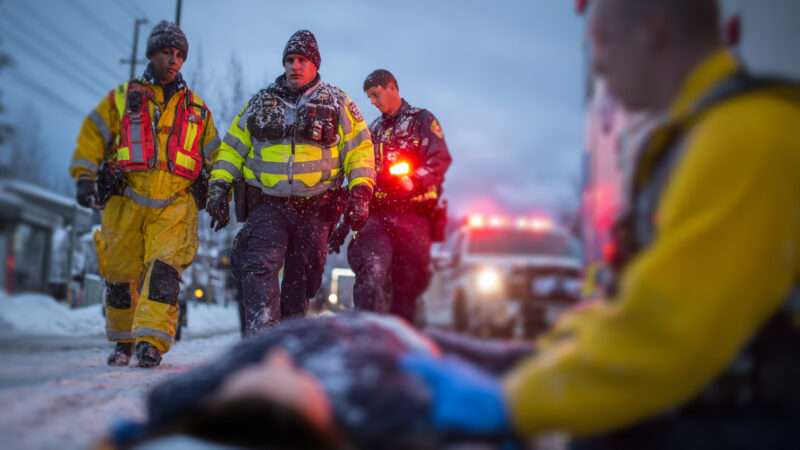
Paramedics approach someone on the ground in cold weather. | Midjourney

Alecia Lindsay froze to death in Anchorage, Alaska, after a 911 dispatcher failed to send help for over an hour. When a witness called to report Lindsay behaving erratically, including speaking incoherently and lying in the snow in clothes not suited for temperatures below freezing, the operator said help was on the way but logged the call as a disturbance, not a medical emergency. When the witness called back over an hour later, the dispatcher sent police—not paramedics—and the responding officer was the first one to alert EMS. Lindsay died of hypothermia shortly after arriving at the hospital. Her family is now suing for negligence, claiming that the city’s failure to prioritize the emergency directly caused her death from hypothermia.

The post Brickbat: Cold and Callous appeared first on Reason.com.

from Latest – Reason.com https://ift.tt/JLaRwin
via IFTTT

Justice Alito: “Just out of curiosity, do you think we should ask Claude to decide this case?”

In 2009, I launched FantasySCOTUS. At the time, the idea was novel: a league where people could predict the outcome of Supreme Court cases. I soon realized I had the makings of a nascent prediction market. We began to aggregate the votes and offer expert predictions on all of the pending cases before the Court. The best players would predict up to 85% of the cases accurately. By 2014, I partnered with colleagues to develop a machine learning algorithm that would predict Supreme Court cases. We called it {Marshall+}. At its peak circa 2016, the algorithm was nearly as accurate as our best users–approximately 70% accurate.

Admittedly, over time, interest in FantasySCOTUS has faded. I chalk it up to a few factors. First, the Supreme Court has become more predictable. With the new appointees, fewer votes are up for grabs in most cases. I think the novelty of predicting outcomes has somewhat worn off. Instead, the focus is not on affirm/reverse, but how the Court rules. Second, coding each case for our algorithm proved to be too time-consuming. The juice was no longer worth the squeeze. Third, AI has completely obliterated all of our work. It is now possible to ask an AI agent to predict a case, and that work will be far more accurate than what our algorithm might have generated with hours of preparation. I maintain FantasySCOTUS at this point mostly as a novelty. There are a dedicated group of players who still make predictions, and I am thankful for their commitment. But I doubt this league will ever return to its heyday.

In the early days, I was often asked if the Supreme Court Justices would check FantasySCOTUS. I had no way of knowing, but I would joke with reporters that Justice Kennedy might check the league to see which way to vote.

Now, it seems, things have come full circle.

On Monday, the Supreme Court heard oral argument in Jules v. Andre Balazs Properties. The question presented concerns arbitration. I won’t even pretend to understand the facts. Rather, I was intrigued by a single question asked.

Adam Unikowsky represented the Petitioners. Adam has made headlines of late for his work on AI. His most ambitious project employed Claude to automate a Supreme Court oral argument. You should listen to it. It sounds really real. And, it seems, the Justices are aware of Adam’s efforts.

During the seriatim round, Justice Alito asked Adam:

JUSTICE ALITO: Well, just out of curiosity, do you think we should ask Claude to decide this case?

The transcript notes there was “laughter.” I heard the distinct and prolonged laughs of Justices Kagan and Barrett. There may have been others.

Adam swiftly replied:

MR. UNIKOWSKY: No. I –I adhere to the wise judgment of –of this Court.

I think the effect of this joke is that lawyers will now be afraid to even suggest they use AI. But it seems clear that many lawyers are using AI to generate questions that may be posed at oral argument–though they may not admit it. I give Adam credit for being transparent with his methods. Though, Adam may have gotten burned.

For whatever it is worth, Professor Scott Dodson asked Claude to generate a opinion in the case based in the style of Justice Kagan.

The post Justice Alito: "Just out of curiosity, do you think we should ask Claude to decide this case?" appeared first on Reason.com.

from Latest – Reason.com https://ift.tt/Nr8BPA6
via IFTTT

New York’s Governor Seems Indifferent to the Health Consequences of a Steep Tax on Nicotine Pouches


New York Gov. Kathy Hochul against a background of nicotine pouches and dollar signs | Midjourney/Anthony Behar/Sipa USA/Newscom

By pushing a 75 percent wholesale tax on nicotine pouches, New York State Budget Director Blake Washington says, Gov. Kathy Hochul is trying to address “a public health concern.” That rationale is absurd on its face, since this tax would sharply raise the cost of a nicotine product that is far less hazardous than cigarettes, perversely discouraging smokers from making a switch that could save their lives.

Hochul, who seems determined to portray a money grab as a benevolent intervention, is either oblivious or indifferent to the health consequences of taxing nicotine patches at the same rate as cigarettes. “We see it as a distinction without a difference,” Washington told reporters in January.

That position ignores the huge difference between inhaling tobacco smoke, which contains myriad toxins and carcinogens, and orally absorbing nicotine from a pouch placed between the lip and gums. Hochul’s framing also contradicts what the Food and Drug Administration (FDA) said four days before the end of the Biden administration, when it authorized the marketing of Zyn nicotine pouches in two doses and 10 flavors.

That decision was based on the FDA’s determination that “the new products offer greater benefits to population health than risks.” The data, said Matthew Farrelly, director of the Office of Science at the FDA’s Center for Tobacco Products, “show that these nicotine pouch products meet that bar by benefiting adults who use cigarettes and/or smokeless tobacco products and completely switch to these products.”

Nicotine pouches contain “substantially lower amounts of harmful constituents than cigarettes,” the FDA noted. They therefore offer “a lower-risk alternative for adults who smoke cigarettes.”

How much lower? To give you a sense of the difference, the Royal College of Physicians estimates that “the hazard to health” from e-cigarettes, which likewise do not contain tobacco or burn anything but do require inhalation, “is unlikely to exceed 5% of the harm from smoking tobacco.”

Nicotine pouches “contain far, far fewer harmful constituents compared to traditional tobacco products,” notes Mary Hrywna, a tobacco control specialist at the Rutgers School of Public Health. The FDA’s Zyn decision implicitly acknowledged that nicotine pouches are “much safer than cigarettes,” says Ray Niaura, a professor at New York University’s School of Global Public Health.

Does that sound like “a distinction without a difference”? Washington conceded that cigarettes pose a much more serious cancer risk than nicotine pouches do but added that “there’s an addictive property to both,” which is “really the thrust behind” the proposed tax.

Seriously? The central problem with cigarettes is not their addictiveness, which would be of much less moment if smokers did not face a substantial danger of premature death. Other things being equal, a nicotine habit that promises to dramatically reduce that hazard surely counts as a big improvement.

The Hochul administration also argues that a hefty tax will deter teenagers from using nicotine pouches. But according to the National Youth Tobacco Survey, just 1.6 percent of middle and high school students reported past-month use of nicotine pouches last year, down from 1.8 percent in 2024.

Since selling nicotine pouches to anyone younger than 21 is already illegal, enforcing that rule seems like a more sensible way to prevent underage consumption than imposing a new financial burden on adults. That is especially true given the evidence that nicotine pouches are an appealing alternative for adults who smoke.

A 2025 study, for instance, found that “daily nicotine pouch use is most prevalent among adults who recently quit using another tobacco product.” A study considered by the FDA found that a quarter of people who initially used Zyn in combination with cigarettes, smokeless tobacco, or both had switched entirely to the nicotine pouches within 10 weeks.

A randomized trial reported in 2024 found that nicotine pouches were especially effective at reducing cigarette consumption among low-income smokers, who would be disproportionately affected by Hochul’s tax. These findings suggest that levy would undermine public health in the name of protecting it.

© Copyright 2026 by Creators Syndicate Inc.

The post New York's Governor Seems Indifferent to the Health Consequences of a Steep Tax on Nicotine Pouches appeared first on Reason.com.

from Latest – Reason.com https://ift.tt/5keMzt3
via IFTTT

Judge Leon Blocked The East Wing Ballroom Based on Offended Observer Standing

Two months ago, Chief Justice Roberts began the Court’s opinion in Bost v. Illinois State Board of Elections this way:

Under Article III of the Constitution, plaintiffs must have a “personal stake” in a case to have standing to sue. FDA v. Alliance for Hippocratic Medicine, 602 U.S. 367, 379, 144 S.Ct. 1540, 219 L.Ed.2d 121 (2024). They must, in other words, be able to answer a basic question: ” ‘What’s it to you?’ ” A. Scalia, The Doctrine of Standing as an Essential Element of the Separation of Powers, 17 Suffolk U. L. Rev. 881, 882 (1983)

These sentences should be enough to reverse Judge Leon’s injunction blocking the construction of the new East Wing ballroom.

I’m sure you’ve seen many press stories about today’s opinion, but have you actually read the standing analysis? In an earlier ruling, the court relied on a purported aesthetic injury.

A member of the National Trust regularly walks near the White House, and enjoys the beauty of the architecture. But she doesn’t like the new design. This distress, she claims, gives her Article III standing to challenge the construction at the White House. She has no monetary interest. Rather, she simply doesn’t like how the structure appears.

Hoagland intends to continue visiting President’s Park roughly once a month. Id. at 12. She asserts that construction of a ballroom of the form and scale proposed by the President would disrupt her enjoyment and use of President’s Park and cause her to “suffer both professional and personal injuries, including to [her] aesthetic, cultural, and historical interests.” Id. at 13-14. The President’s proposed ballroom would, in Hoagland’s words, “overshadow[]” the White House and “diminish [its] primacy,” thereby disrupting the message that “our president lives in a house.” Id. at 13. Based on her claims of aesthetic injury, Hoagland could sue in her own right. It is well-settled that the “desire to use or observe” something, “even for purely [a]esthetic purposes, is undeniably a cognizable interest for purpose of standing.” Lujan, 504 U.S. at 562-63.

The plaintiff is distressed by what she might have to see. To use Justice Gorsuch’s phrasing, Hogland is an “offended observer.” Here is how Gorsuch described the doctrine in American Legion:

“If individuals and groups could invoke the authority of a federal court to forbid what they dislike for no more reason than they dislike it, . . . [c]ourts would start to look more like legislatures, responding to social pressures rather than remedying concrete harms . . . .”

I am very familiar with the aesthetic injury claim. It was raised in the Mifepristone litigation. Judge Ho expressly invoked it in his concurrence.

In addition to the injuries analyzed by the majority, Plaintiffs have demonstrated another basis for Article III standing: the aesthetic injury they experience in the course of their work. See, e.g., Sierra Club v. Morton, 405 U.S. 727, 734-35, 92 S.Ct. 1361, 31 L.Ed.2d 636 (1972) (recognizing aesthetic harm as “injury to a cognizable interest”); Lujan v. Defs. of Wildlife, 504 U.S. 555, 562-63, 112 S.Ct. 2130, 119 L.Ed.2d 351 (1992) (“[T]he desire to use or observe an animal species, even for purely esthetic purposes, is undeniably a cognizable interest for purpose of standing.”); id. at 566, 112 S.Ct. 2130 (“[T]he person who observes or works with a particular animal threatened by a federal decision is facing perceptible harm.”). It’s well established that, if a plaintiff has “concrete plans” to visit an animal’s habitat and view that animal, that plaintiff suffers aesthetic injury when an agency has approved a project that threatens the animal. See Lujan, 504 U.S. at 564, 112 S.Ct. 2130. . . .

Unborn babies are a source of profound joy for those who view them. Expectant parents eagerly share ultrasound photos with loved ones. Friends and family cheer at the sight of an unborn child. Doctors delight in working with their unborn patients—and experience an aesthetic injury when they are aborted.

Plaintiffs’ declarations illustrate that they experience aesthetic injury from the destruction of unborn life.

In short, if naturalists can claim an aesthetic injury to see plants and animals, then pro-life doctors could claim a similar injury with regard to newborn babies.

On appeal, the Supreme Court could have considered AHM’s “aesthetic” standing argument raised in Judge Ho’s concurrence. But Justice Kavanaugh did not. The ground for standing was not even mentioned. Indeed, I think the Court chipped away at “offended observer” standing in Footnote 3:

The doctors also suggest that they are distressed by others’ use of mifepristone and by emergency abortions. It is not clear that this alleged injury is distinct from the alleged conscience injury. But even if it is, this Court has long made clear that distress at or disagreement with the activities of others is not a basis under Article III for a plaintiff to bring a federal lawsuit challenging the legality of a government regulation allowing those activities. See, e.g., Valley Forge Christian College v. Americans United for Separation of Church and State, Inc., 454 U. S. 464, 473, 485–486 (1982); United States v. Richardson, 418 U. S. 166, 175 (1974); Sierra Club v. Morton, 405 U. S. 727, 739 (1972).

What is the relationship between Mifepristone and the Ballroom? Are we to believe that an astute art critic can claim an “aesthetic” injury for staring at slabs of marble but a doctor cannot claim an “aesthetic” injury for seeing the miracle of life? This would be yet another asymmetry in standing. Offended liberals can always get to federal court but conservatives cannot.

I do not see how a claim for “aesthetic injury” is consistent with the Court’s recent standing cases–especially when the claim is based on subjective architectural sensibilities. To borrow from The Fountainhead, we can call this doctrine “Ellsworth Toohey” standing.

The post Judge Leon Blocked The East Wing Ballroom Based on Offended Observer Standing appeared first on Reason.com.

from Latest – Reason.com https://ift.tt/dBoVRk3
via IFTTT

Justice Alito: “Just out of curiosity, do you think we should ask Claude to decide this case?”

In 2009, I launched FantasySCOTUS. At the time, the idea was novel: a league where people could predict the outcome of Supreme Court cases. I soon realized I had the makings of a nascent prediction market. We began to aggregate the votes and offer expert predictions on all of the pending cases before the Court. The best players would predict up to 85% of the cases accurately. By 2014, I partnered with colleagues to develop a machine learning algorithm that would predict Supreme Court cases. We called it {Marshall+}. At its peak circa 2016, the algorithm was nearly as accurate as our best users–approximately 70% accurate.

Admittedly, over time, interest in FantasySCOTUS has faded. I chalk it up to a few factors. First, the Supreme Court has become more predictable. With the new appointees, fewer votes are up for grabs in most cases. I think the novelty of predicting outcomes has somewhat worn off. Instead, the focus is not on affirm/reverse, but how the Court rules. Second, coding each case for our algorithm proved to be too time-consuming. The juice was no longer worth the squeeze. Third, AI has completely obliterated all of our work. It is now possible to ask an AI agent to predict a case, and that work will be far more accurate than what our algorithm might have generated with hours of preparation. I maintain FantasySCOTUS at this point mostly as a novelty. There are a dedicated group of players who still make predictions, and I am thankful for their commitment. But I doubt this league will ever return to its heyday.

In the early days, I was often asked if the Supreme Court Justices would check FantasySCOTUS. I had no way of knowing, but I would joke with reporters that Justice Kennedy might check the league to see which way to vote.

Now, it seems, things have come full circle.

On Monday, the Supreme Court heard oral argument in Jules v. Andre Balazs Properties. The question presented concerns arbitration. I won’t even pretend to understand the facts. Rather, I was intrigued by a single question asked.

Adam Unikowsky represented the Petitioners. Adam has made headlines of late for his work on AI. His most ambitious project employed Claude to automate a Supreme Court oral argument. You should listen to it. It sounds really real. And, it seems, the Justices are aware of Adam’s efforts.

During the seriatim round, Justice Alito asked Adam:

JUSTICE ALITO: Well, just out of curiosity, do you think we should ask Claude to decide this case?

The transcript notes there was “laughter.” I heard the distinct and prolonged laughs of Justices Kagan and Barrett. There may have been others.

Adam swiftly replied:

MR. UNIKOWSKY: No. I –I adhere to the wise judgment of –of this Court.

I think the effect of this joke is that lawyers will now be afraid to even suggest they use AI. But it seems clear that many lawyers are using AI to generate questions that may be posed at oral argument–though they may not admit it. I give Adam credit for being transparent with his methods. Though, Adam may have gotten burned.

For whatever it is worth, Professor Scott Dodson asked Claude to generate a opinion in the case based in the style of Justice Kagan.

The post Justice Alito: "Just out of curiosity, do you think we should ask Claude to decide this case?" appeared first on Reason.com.

from Latest – Reason.com https://ift.tt/Nr8BPA6
via IFTTT

Restoring Meaning To American Citizenship

Restoring Meaning To American Citizenship

Authored by John Velleco via Gun Owners of America,

This week, the Supreme Court will hear oral arguments in a case that could redefine one of the most fundamental questions in American law: Who is a citizen of the United States?

Does birth on U.S. soil automatically confer citizenship, even when the parents owe allegiance to a foreign nation?
Gun Owners of America and Gun Owners Foundation, along with several others, have filed a Friend of the Court brief urging the Court to take a fresh look at that question. At issue are two cases, State of Washington v. Trump and Barbara v. Trump, challenging President Trump’s 2025 Executive Order, “Protecting the Meaning and Value of American Citizenship.”

What interest do Second Amendment rights organizations have in asking the Court to review a case that on its face deals with immigration and the practice of so-called birthright citizenship?

The answer is simple and goes to the heart of who, precisely, constitutes a nation. A nation is defined by those who pledge loyalty to it, not by those who briefly cross its borders for the sole purpose of obtaining citizenship by birth. Citizenship must reflect genuine allegiance and lasting connection, or it becomes little more than an administrative label, stripped of substance. And the rights uniquely reserved for citizens, especially the right to keep and bear arms, gradually lose the constitutional footing needed to sustain and protect them.

The Trump executive order simply reaffirms a principle that was once widely understood but has been steadily obscured: citizenship is not an accident of geography, but a solemn bond of allegiance. It directs federal agencies not to treat as U.S. citizens those born here to parents who are neither American citizens nor lawful permanent residents. This policy aligns precisely with the text and original understanding of the Fourteenth Amendment.

The Fourteenth Amendment states: “All persons born or naturalized in the United States, and subject to the jurisdiction thereof, are citizens of the United States.” That second phrase, “subject to the jurisdiction thereof,” is not a throwaway clause. It was deliberately inserted to exclude from automatic citizenship those who owe allegiance to another country.

Opponents of the Executive Order rely on the assumption that any person born on U.S. soil, apart from two narrow exceptions, is automatically an American citizen. A reexamination of the Fourteenth Amendment’s text and its framers’ words shows that this assumption rests on shaky constitutional ground.

When Congress debated the amendment in 1866, Senator Jacob Howard explained it “will not, of course, include persons born in the United States who are foreigners, aliens… but will include every other class of persons.” Senator Lyman Trumbull clarified that “subject to the jurisdiction” meant “not owing allegiance to anybody else.” Their intent was clear: the amendment was meant to ensure citizenship for freed slaves, not to create a perpetual magnet for illegal immigration or birth tourism.

Over the decades, that original understanding was gradually eroded by administrative habit and judicial drift. Judicial decisions and administrative practices have treated children born on U.S. soil to parents who are not citizens or permanent residents, including those here illegally or temporarily, as automatic U.S. citizens. That practice, unsupported by statute or constitutional text, has profound consequences.

The consequences extend far beyond immigration. Citizenship is the gateway to full political rights, responsibilities, and constitutional protections. Among these, the Second Amendment stands uniquely tied to the concept of citizenship. The Founders viewed the right to keep and bear arms as inseparable from the duties and privileges of free citizens, individuals who shared in the responsibility of defending their communities and preserving liberty.

When citizenship is detached from allegiance, the political understanding of “the people” who possess this right becomes blurred. Courts and policymakers then face pressure to reinterpret the Second Amendment in ways that weaken it for everyone. As Gun Owners of America has warned in its amicus brief, the Second Amendment does not erode all at once. It erodes gradually, as the definition of the political community itself is reshaped.

This is why the question before the Court is not merely about immigration policy. It is about the integrity of citizenship itself and the constitutional structure that depends on it.

It was the Administration of President Franklin D. Roosevelt which expanded citizenship to include virtually anyone born here, and it is President Trump who wants to return us to our historical roots.  When FDR redefined who is a citizen, he imbued them with the constitutional rights that belong only to citizens, including the Second Amendment.  However, if illegal aliens have Second Amendment Rights given to them without any duty of allegiance, those rights for all of us can be expected to be quite weak indeed. 

Restoring citizenship to its constitutional foundation does not require invention. It requires adherence to the text, history, and original meaning of the Fourteenth Amendment. Congress, not FDR and the federal agencies, possesses the authority to establish rules for naturalization. The American people, not executive policy, must determine who joins the political community.

President Trump’s executive order does not change the Constitution; it enforces it. It honors the intent of the Fourteenth Amendment framers and restores clarity to our national identity. The Court should overturn the misguided lower-court rulings, and restore the full meaning of “subject to the jurisdiction thereof.”

John Velleco is the Executive Vice President of Gun Owners of America.

Tyler Durden
Tue, 03/31/2026 – 23:05

via ZeroHedge News https://ift.tt/6MAeTH0 Tyler Durden