The post Open Thread appeared first on Reason.com.
from Latest – Reason.com https://ift.tt/gr4T63O
via IFTTT
another site
The post Open Thread appeared first on Reason.com.
from Latest – Reason.com https://ift.tt/gr4T63O
via IFTTT
After much anticipation, the Supreme Court finally decided Louisiana v. Callais. (The Chief Justice pronounced it as waylay.) I have some preliminary thoughts.
First, more than five months elapsed from the oral argument in October till decision day. The longer this case dragged on, the harder it would be for Republican legislatures to redistrict. There was some speculation that the dissenters were dragging out the case to run out the clock. Are these insinuations accurate? Justice Alito’s majority opinion in somewhat unusual in that it barely engages with the dissent. There are a few paragraphs on the penultimate page of the opinion that address the dissent. This isn’t the sort of drafting process that required many opinions going back-and-forth for revisions. Moreover, there were no concurrences. The majority opinion had six clean votes. Indeed, I suspect Justice Alito circulated this draft shortly after conference. And I can’t imagine there was much disagreement between Justices Kagan, Sotomayor, and Jackson. Is five months an unusually long period of time for a 90-page decision when the majority doesn’t respond to the dissent? Not usually, but where there is an incentive on one side to go quick, the other side may not have been in a hurry. (I will leave aside the claim in Molly Hemmingway’s new book that the Dobbs dissenters refused to expedited the release of the opinion after the leak.) Let’s wait to see what the leaks reveal.
Second, I think back to Allen v. Milligan, which was decided a few weeks before SFFA. At the time, there was speculation that Chief Justice Roberts and Justice Kavanaugh (mostly) ruled against Alabama to soften the blow of (largely) ending affirmative action. Barely three years later, the Court relies on SFFA to (arguably) scale back Milligan. On the surface at least, there is no daylight between Justice Alito and the Chief Justice. Then again, it may have been Roberts’s preference to not invalidate Section 2, to at least maintain the fiction of stare decisis. Remember, the Chief Justice knows to the decimal point what percentage of cases overrule precedents.
Third, this decision eliminates the Voting Rights Act asymmetry. Democrats will lose their bonus in conservative states. For the 2026 midterms, it is not clear how much of an impact this ruling will have. But in the long run, especially after the 2030 census, Callais will be significant. Still, I think it is shortsighted to think that political dynamics will not change. For the first time in generations, black and hispanic voters will live in districts where the winner is not preordained. Callais may shift how politicians on both sides of the aisle appeal to a demographic that historically has been neglected. Minority voters may even strategically vote in republican primaries to affect narrow races. As I often say, ignore all predictions that the sky will fall after a Supreme Court decision. Institutions can adapt to changed circumstances.
The post Waylay Callais! appeared first on Reason.com.
from Latest – Reason.com https://ift.tt/bqAPxZV
via IFTTT
I’ve finished reviewing the Supreme Court’s 92-page decision in Louisiana v. Callais (rhymes with waylay). I’ve distilled it down to about 16 pages for the 2026 Barnett/Blackman supplement. My focus here was on the ConLaw aspects of the case, so much of the history of Section 2, the 1982 amendments, and Gingles is trimmed. I also did not include the lengthy and complicated procedural posture. I’m not sure that it will matter too much as the Court found the application of the “updated” standard to be easy.
I’ll have more to say about the case in another post.
The post Edited Version of <i>Louisiana v. Callais</i> appeared first on Reason.com.
from Latest – Reason.com https://ift.tt/QsgiASt
via IFTTT
After much anticipation, the Supreme Court finally decided Louisiana v. Callais. (The Chief Justice pronounced it as waylay.) I have some preliminary thoughts.
First, more than five months elapsed from the oral argument in October till decision day. The longer this case dragged on, the harder it would be for Republican legislatures to redistrict. There was some speculation that the dissenters were dragging out the case to run out the clock. Are these insinuations accurate? Justice Alito’s majority opinion in somewhat unusual in that it barely engages with the dissent. There are a few paragraphs on the penultimate page of the opinion that address the dissent. This isn’t the sort of drafting process that required many opinions going back-and-forth for revisions. Moreover, there were no concurrences. The majority opinion had six clean votes. Indeed, I suspect Justice Alito circulated this draft shortly after conference. And I can’t imagine there was much disagreement between Justices Kagan, Sotomayor, and Jackson. Is five months an unusually long period of time for a 90-page decision when the majority doesn’t respond to the dissent? Not usually, but where there is an incentive on one side to go quick, the other side may not have been in a hurry. (I will leave aside the claim in Molly Hemmingway’s new book that the Dobbs dissenters refused to expedited the release of the opinion after the leak.) Let’s wait to see what the leaks reveal.
Second, I think back to Allen v. Milligan, which was decided a few weeks before SFFA. At the time, there was speculation that Chief Justice Roberts and Justice Kavanaugh (mostly) ruled against Alabama to soften the blow of (largely) ending affirmative action. Barely three years later, the Court relies on SFFA to (arguably) scale back Milligan. On the surface at least, there is no daylight between Justice Alito and the Chief Justice. Then again, it may have been Roberts’s preference to not invalidate Section 2, to at least maintain the fiction of stare decisis. Remember, the Chief Justice knows to the decimal point what percentage of cases overrule precedents.
Third, this decision eliminates the Voting Rights Act asymmetry. Democrats will lose their bonus in conservative states. For the 2026 midterms, it is not clear how much of an impact this ruling will have. But in the long run, especially after the 2030 census, Callais will be significant. Still, I think it is shortsighted to think that political dynamics will not change. For the first time in generations, black and hispanic voters will live in districts where the winner is not preordained. Callais may shift how politicians on both sides of the aisle appeal to a demographic that historically has been neglected. Minority voters may even strategically vote in republican primaries to affect narrow races. As I often say, ignore all predictions that the sky will fall after a Supreme Court decision. Institutions can adapt to changed circumstances.
The post Waylay Callais! appeared first on Reason.com.
from Latest – Reason.com https://ift.tt/bqAPxZV
via IFTTT
I’ve finished reviewing the Supreme Court’s 92-page decision in Louisiana v. Callais (rhymes with waylay). I’ve distilled it down to about 16 pages for the 2026 Barnett/Blackman supplement. My focus here was on the ConLaw aspects of the case, so much of the history of Section 2, the 1982 amendments, and Gingles is trimmed. I also did not include the lengthy and complicated procedural posture. I’m not sure that it will matter too much as the Court found the application of the “updated” standard to be easy.
I’ll have more to say about the case in another post.
The post Edited Version of <i>Louisiana v. Callais</i> appeared first on Reason.com.
from Latest – Reason.com https://ift.tt/QsgiASt
via IFTTT
Senate Rejects Resolution To Bar Trump From Attacking Cuba
The US Senate batted down a resolution on Tuesday that would bar President Trump from being able to attack Cuba without first obtaining Congressional approval.
After Sens. Tim Kaine (D-Va.), Adam Schiff (D-Calif.), and Ruben Gallego (D-Ariz.) invoked the 1973 War Powers Act to force the Senate vote on Tuesday (undoubtedly knowing it would fail) – citing the recent US combat operations in Venezuela and Iran, and Trump’s March comments that “Cuba’s next” – Senators voted 51-47 against advancing it to a final vote.
Similar votes related to US military actions against Venezuela and Iran have also failed in the GOP-controlled Senate in recent weeks.
As the Epoch Times notes further, U.S.–Cuba relations have remained contentious since Fidel Castro swept to power in Havana in 1959 at the head of a communist revolution.
The U.S. government led efforts to overthrow Castro in the 1960s. CIA officers helped arm and train Cuban exiles who led a failed invasion to retake the country in April of 1961. After this failed invasion attempt, the CIA continued to develop covert methods to weaken Castro’s hold on power through an effort known as Operation Mongoose.
Since the 1960s, the U.S. government has maintained pressure on Cuba through economic sanctions and trade restrictions.
Under Castro’s leadership, Cuba aligned with the Soviet Union.
Under the current leadership of Miguel Díaz-Canel Bermúdez, Cuba has continued to maintain ties with Russia, China, and Venezuela.
Havana acknowledged 32 Cuban soldiers attached to Nicolás Maduro’s security detail were killed during the Jan. 3 U.S. military raid to capture the Venezuelan leader.
Trump signed an executive order on Jan. 29 declaring Cuba “an unusual and extraordinary threat” to the national security and foreign policy of the United States. The order notes Cuba’s continued military cooperation with China, Russia, and Iran, and asserts Havana has welcomed designated terrorist groups like Hamas and Hezbollah.
As part of his Jan. 29 executive order, Trump imposed new tariffs on countries selling oil to Cuba. The Caribbean island nation has faced recent blackouts as it has struggled to maintain its energy supply.
“Donald Trump has bypassed Congress’s sole authority to declare war with attacks on Iran and Venezuela,” Schiff said ahead of the Tuesday vote. “The president’s saber rattling toward Cuba makes clear where his sights are next.”
Sen. Rick Scott (R-Fla.) took to the Senate floor to challenge the Democrat-led war powers resolution, arguing that the measure lacks relevance because U.S. troops aren’t currently deployed in Cuba.
“President Trump has never said he wants to put boots on the ground. I don’t think any of my Republican colleagues have said it. Even Lindsey Graham has not said it,” Scott said.
Though Trump recently referred to a potential “takeover” of Cuba, Gen. Francis Donovan, who oversees U.S. military operations for Latin America, testified at a March 19 Senate hearing that his command is not actively preparing for a military operation involving the island.
Tyler Durden
Wed, 04/29/2026 – 23:20
via ZeroHedge News https://ift.tt/fA2vshp Tyler Durden
US May Deploy Hypersonic Missiles Against Iran As Centcom Set To Brief Trump On New Military Options
US Central Command has asked to send the Army’s long-delayed Dark Eagle hypersonic missile to the Middle East for possible use against Iran, seeking a longer-range system to hit ballistic-missile launchers deep inside the country Bloomberg reports.
If approved, this would mark the first time the US will have deployed its hypersonic missile, which is running far behind schedule and hasn’t been declared fully operational even as Russia and China have deployed their own versions. And since Trump isn’t shy when it comes demonstrating force, it is unlikely that the request will be denied.
The military’s Request for Forces submission reportedly justifies the move by saying Iran has moved its launchers out of range of the Precision Strike Missile, a weapon that can hit targets at more than 300 miles. If approved, the deployment would also send a signal to Russia and China that the US is finally able to match a capability that they’ve long since mastered.
Dark Eagle, also known as the Long-Range Hypersonic Weapon, or LRHW, has a reported range of more than 1,725 miles, although its exact capabilities are secret. It is designed to glide to its target at more than five times the speed of sound and can maneuver to avoid interception. The missile was designed to fight Chinese or Russian advanced air defenses. The problem is that each Lockheed Martin missile costs about $15 million, and there are no more than eight missiles, so any assault using hypersonics would be rather brief. Also, since each battery will cost about $2.7 billion, according to the Government Accountability Office, they will make attractive targets for Iran’s own hypersonics.
The US already transferred most of its supplies of the stealthy JASSM-ER cruise missile, also designed for a fight with a near-peer adversary, to the Iran fight. About 1,100 of the missiles have been fired so far in the conflict.
The US has said it has local air superiority, meaning that in some parts of Iran its aircraft can operate without facing much of a threat. But dozens of MQ-9 aircraft, plus several crewed fighters, have been downed, showing that other parts of Iran’s airspace remain dangerous.
The Bloomberg report comes as Axios rehashed an earlier report, according to which President Trump will receive a briefing on new plans for potential military action in Iran on Thursday from CENTCOM Commander Adm. Brad Cooper. The briefing signals that “Trump is seriously considering resuming major combat operations either to try to break the logjam in negotiations or to deliver a final blow before ending the war.”
The report goes on to note that CENTCOM has prepared a plan for a “short and powerful” wave of strikes on Iran – likely including infrastructure targets – in hopes of breaking the negotiating deadlock. The hope would be that Iran would then return to the negotiating table showing more flexibility on the nuclear issue.
Another plan expected to be shared with Trump is focused on taking over part of the Strait of Hormuz to reopen it to commercial shipping. Such an operation could include ground forces.
A third option that has been discussed in the past and might come up in the briefing is a special forces operation to secure Iran’s stockpile of highly enriched uranium.
Tyler Durden
Wed, 04/29/2026 – 22:50
via ZeroHedge News https://ift.tt/gQLMRDW Tyler Durden
Ex-Mossad Chief Stuns By Saying Settler Violence An ‘Existential Threat’ To State Of Israel
A former head of Israel’s Mossad intelligence agency has said that settler violence against Palestinians in the occupied West Bank reminds him of the Holocaust.
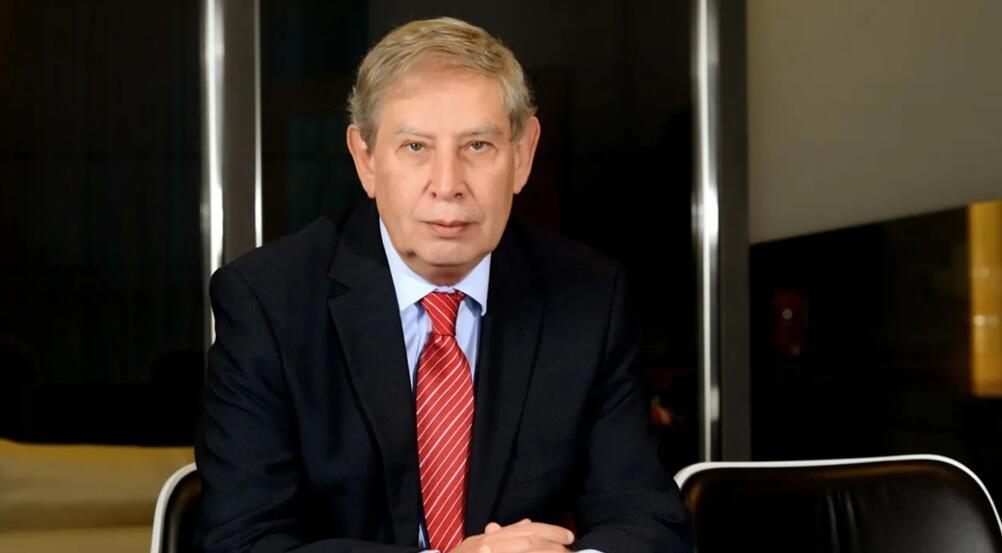
Tamir Pardo, who served as director of Mossad from 2011 to 2016, made the remarks in an interview with Channel 13 while touring Palestinian villages affected by ongoing settler attacks, alongside former Israeli army officials. “My mother was a Holocaust survivor, and what I saw reminded me of the events that happened against Jews in the last century,” he said.
“What I saw today made me feel ashamed to be Jewish.” Pardo warned that settler crimes – met with little response by authorities, which sometimes abet them – could lead to the “next October 7”.
“It will be in a different format, much more painful, because the region is much more complicated. The state has chosen to sow the seeds for the next October 7,” he said.
While he believes Israeli law enforcement is aware of the situation, Pardo suggested that it has “chosen to ignore it”.
“What I saw today is the existential threat to the State of Israel,” he said, noting that efforts to curb such attacks could come at a high cost, including the risk of civil war.
He pointed in particular to the influence of settler groups, which enjoy support at the highest levels of government, including from far-right ministers such as Bezalel Smotrich and Itamar Ben Gvir.
“If we want, we can correct this, but the price will be very high,” Pardo said. “It is very much in our interest not to reach that point.”
Pardo recalled warnings by Israeli philosopher Yeshayahu Leibowitz in 1968, who criticized the occupation of Palestinian territories and the imposition of military rule over millions of Palestinians.
In his article The Territories, Leibowitz warned that control over Palestinians would ultimately lead to the “corruption” of Israeli society. “Rule over the occupied territories would have social repercussions,” Leibowitz warned at the time.
“The corruption characteristic of every colonial regime would also prevail in the state of Israel,” he added, calling for withdrawal from occupied territories. While Pardo once believed Leibowitz was mistaken, he now says “there was a lot of truth” in his warning.
Israeli settler violence and expansion, while long-standing, have intensified sharply since October 2023, including the systematic forced displacement of Palestinians from their communities and an increased use of live fire against unarmed residents.
The Wall and Settlement Resistance Commission said Israeli settlers have killed at least 16 Palestinians so far this year.
Tamir Pardo, former Mossad Director, commented after observing settler violence in the West Bank
“My mother is a Holocaust survivor, and what I saw here reminded me of the events of the previous century against the Jews” pic.twitter.com/4SuKEEz2Ls
— Ounka (@OunkaOnX) April 28, 2026
A United Nations report released in March recorded that more than 36,000 Palestinians were displaced in the West Bank between November 2024 and October 2025 amid a surge in military and settler attacks.
During the same period, 1,732 incidents of settler violence causing casualties or property damage were documented – a 25 percent increase on the previous year.
More than 1000 Palestinians have been killed by Israeli forces in the occupied West Bank since the Hamas-led attacks on Israel in October 2023.
Tyler Durden
Wed, 04/29/2026 – 22:35
via ZeroHedge News https://ift.tt/dM1BUF2 Tyler Durden
Private Sector Struggles In Major Chinese Industrial Base As Export Orders Shrink: Local Businessmen
Authored by Alex Wu via The Epoch Times (emphasis ours),
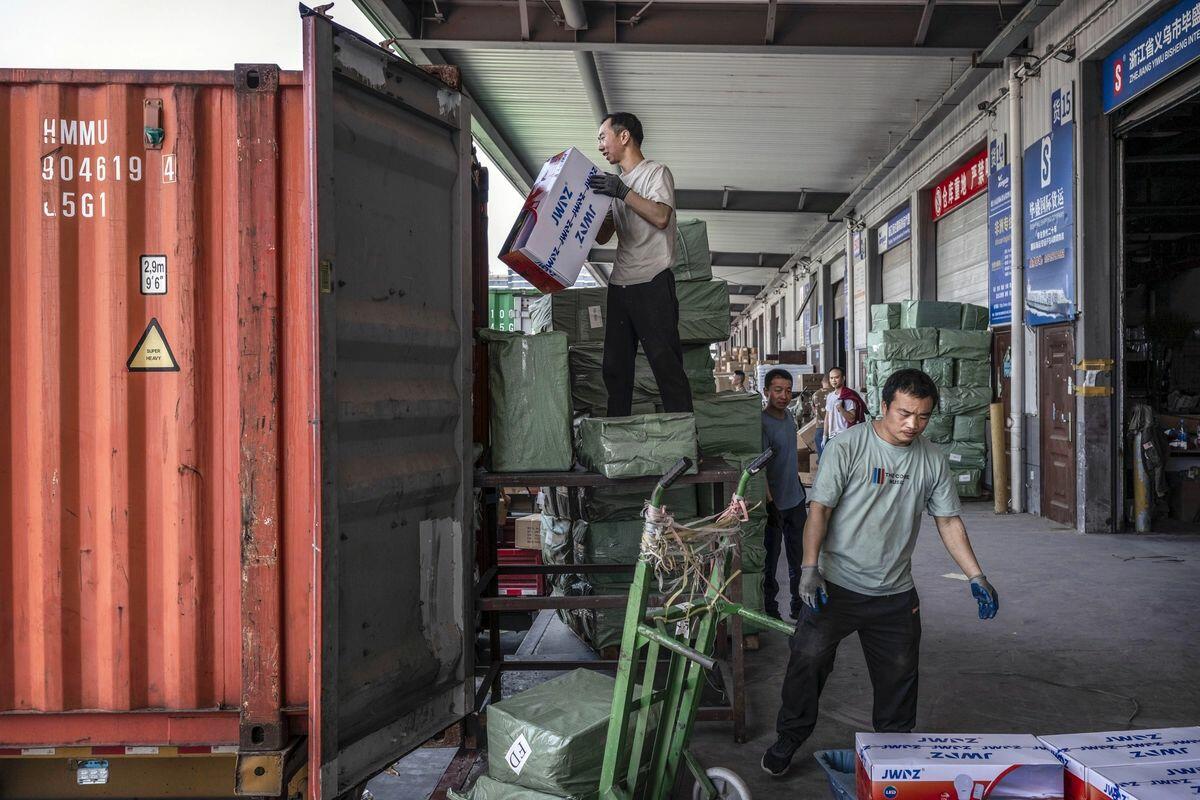
Amid China’s persistently sluggish economy, Zhejiang Province, a major production and industrial base in eastern China, is seeing a decline in trade orders as private enterprises struggle to stay afloat, according to industry professionals who spoke with The Epoch Times.
As the “hollowing out” of the private sector economy in mainland China intensifies, profit margins for industrial enterprises in Zhejiang have been under pressure since 2024, local industry insiders say.
The coastal province bordering the megacity of Shanghai is an economic powerhouse for China. It ranked fourth nationwide in gross domestic product last year, with its capital city of Hangzhou being the primary economic driver, along with other well-known commercial cities in the province such as Ningbo and Wenzhou, according to official data.
However, a large number of family-run export enterprises, which had previously served as pillars of the local county-level economies within the provinces, have had to cease operations in the face of shifting supply chains and shrinking orders over the past few years, according to Huang, an insider in Zhejiang’s textile industry who gave only her last name out of fear of reprisal from the Chinese regime.
“Profits have now dwindled to below 3 percent,” she told The Epoch Times. “Most garment factories are either operating at a loss or have gone under.”
The situation in Zhejiang has changed, Huang said.
“It is no longer the profitable place it once was,“ she said. ”For many enterprises, the issue isn’t merely low profit margins—they are actually reaching their breaking point.
“Private enterprises in the Jiangsu–Zhejiang region have long been regarded as a barometer of the economy.
“If even these firms in this region can no longer hold out and begin shutting down en masse, it signals that the problems facing the entire Chinese economy have become extremely severe.”
Although Zhejiang’s GDP growth rate appears relatively stable, “the reality is that fabricated data mask the grim operational realities faced by businesses on the ground,” Liu Mao, a businessman in Wenzhou who used a pseudonym out of fear of reprisal, told The Epoch Times.
“Foreign-invested enterprises in China face an operating environment constrained by hostility from authorities. Meanwhile, private domestic enterprises are subjected to tax audits and heavy fines. Under such layers of systematic exploitation, it is nearly impossible for any business—regardless of its nature—to survive.”
In recent years, the business environment in China has continued to deteriorate because of the Chinese regime’s inconsistent policies and tightened controls, as well as geopolitical tensions and increasing trade frictions between China and the West that have led to supply chain diversification. As a result, a significant number of foreign companies, and even some Chinese companies, have been moving their factories from China to Southeast Asian countries.
According to official data released by Hangzhou Customs, the total value of goods trade imports and exports in Zhejiang Province reached 1.38 trillion yuan (about $201.83 billion) in the first quarter of 2026, a year-on-year increase of 7.1 percent, marking the fourth consecutive quarter in which both imports and exports have registered positive growth.
However, Liu noted that the province’s export trade figures are heavily inflated.
“According to internal data I obtained from friends within the system, this year’s export volume actually declined compared to last year,“ he said. ”It certainly did not grow by 7.1 percent.
“My friends told me that the public export data reported by various localities is rife with fraud. Some regions engage in double-reporting or filing false tax returns to swindle government subsidies, while those in higher positions turn a blind eye. This country is beyond saving.”
As businesses continue to struggle, workers are facing layoffs along with increasing difficulties in finding other jobs, according to local industry professionals.
An Zhiqiang, who works in the electronics business in Hangzhou, told The Epoch Times that local private enterprises are all downsizing and laying off staff.
“Locals are unable to find work, making it even more difficult for people from other provinces,” he said.
“Since the spring, many of our local factories have had to halt production due to a lack of orders, and quite a few foreign-funded enterprises have pulled out as well.
“For instance, a Scandinavian company here that manufactures feed processing equipment has downsized its workforce from 80 employees to just 29, and further layoffs are expected.”
Amid the economic downturn characterized by reduced consumption and diminished purchasing power, the livestock industry’s demand for feed is also declining, resulting in sluggish sales for related equipment, according to An.
“Right now, industries across the board are downsizing,“ he said. ”The only places still hiring are essentially large foreign-funded enterprises—for instance, Japanese companies in Hangzhou. But they only recruit new staff to replace those who retire; consequently, only young applicants who aren’t afraid of hard work stand a chance.”
Currently, temporary workers are being paid 13 yuan ($1.91) per hour, whereas the government-mandated rate is 25 yuan ($3.66) per hour, he said.
“Although in the suburban districts of Tonglu and Chun’an, hourly rates of 22 yuan [$3.22] can still be found,” he said.
According to the latest official standards released in February, the minimum hourly wage in Hangzhou is 25 yuan ($3.66).
The current issue is not merely a shortage of jobs in Hangzhou, Liu said, “but rather that [all of] mainland China is undergoing a phase of accelerating economic downturn.”
Wang Yibo contributed to this report.
Tyler Durden
Wed, 04/29/2026 – 21:45
via ZeroHedge News https://ift.tt/Ja2F49o Tyler Durden
Governor Powell
By Philip Marey, senior US strategist at Rabobank
Summary
Introduction
As widely expected, the FOMC decided to keep the target range for the federal funds rate unchanged at 3.50-3.75% this month. Governor Miran repeated his dissent, preferring a ¼ percentage point rate cut at this meeting.
However, there were also three dissents (by Hammack, Kashkari and Logan) because they “did not support inclusion of an easing bias in the statement at this time.” This easing bias is currently expressed in the statement “In considering the extent and timing of additional adjustments to the target range for the federal funds rate…”. Since the last three adjustments were rate cuts, this sentence would suggest that the FOMC is still biased toward cutting.
In its assessment of the economy, the statement replaced “The implications of the developments in the Middle East for the U.S. economy are uncertain” by “Developments in the Middle East are contributing to a high level of uncertainty about the economic outlook”, not a major change content-wise. However, inflation is now explicitly linked to global energy prices and described as elevated rather than somewhat elevated. “Inflation is elevated, in part reflecting the recent increase in global energy prices” instead of “Inflation remains somewhat elevated” This is a clear nod to the rise in CPI inflation to 3.3% in March from 2.4% in February.
Press conference
In his prepared speech, Powell reiterated the economic assessment in the FOMC statement, including that economic activity has been expanding at a solid pace. However, after announcing that this was his last press conference as Chair, he said he would stay on as a Governor. He was encouraged by the recent developments, meaning the suspension of the criminal inquiry against him – which in a Senate Banking Committee vote earlier today was sufficient for Senator Tillis to support advancing Warsh’s nomination to the Senate floor – but he was clearly not entirely persuaded yet. Nevertheless, he promised to maintain a low profile as a Governor.
The two main topics during the Q&A were Powell’s decision to stay on as Governor and the dissents on the easing bias.
When asked why he wanted to stay on as a Governor, Powell said it was because of the legal attacks on the Fed. He added this had nothing to do with the verbal attacks. He said he will leave when he thinks it’s appropriate to do so. Powell said he was staying because of the actions that have been taken (by the administration), and he actually had planned to retire. But first he wants to see things calming down. Comparing the Fed’s independence now to when he started, he said “I think it’s at risk because of legal assaults.” When asked what he exactly needed from the DOJ, he said “for the investigation to be well and truly over with finality and transparency.” Powell did not answer the question what message he was sending to the President by staying on and said he’ll stand by what he said earlier. In response to the question whether he was going to act as a Shadow Chair, he said that was something he would never do. He intends to be a constructive (FOMC) participant out of respect for the office of the Chair.
Regarding the easing bias, Powell said that the majority in the Committee – including himself – thought there was no rush to change this language. However, Powell said that the center (of the Committee) was moving toward a more neutral place in thinking about cuts versus hikes. He also said there were non-voters who favored changing the easing bias. He stressed that monetary policy was in a good place and if necessary the FOMC could hike or cut, but nobody was calling for a hike right now. In response to a question whether he was handing over a divided Fed to Warsh, Powell said that this was an unusually difficult situation with 4 supply shocks in 5-6 years, referring to the pandemic, Ukraine, tariffs and Iran. So it’s only natural that you have a range of views.
Conclusion
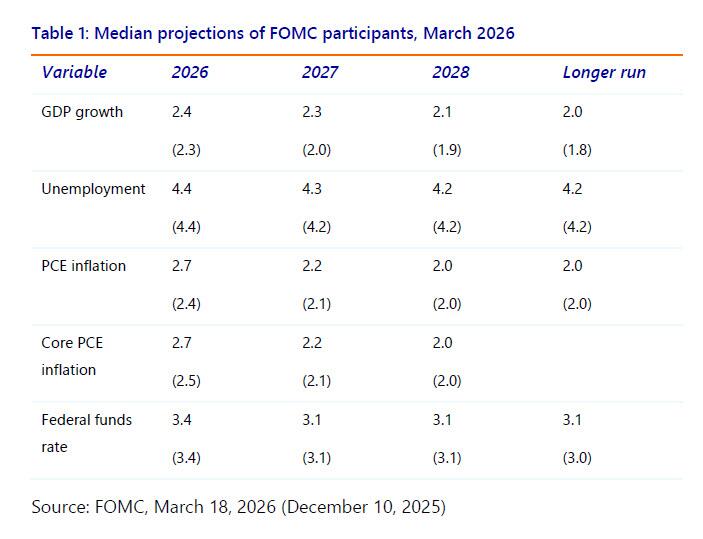
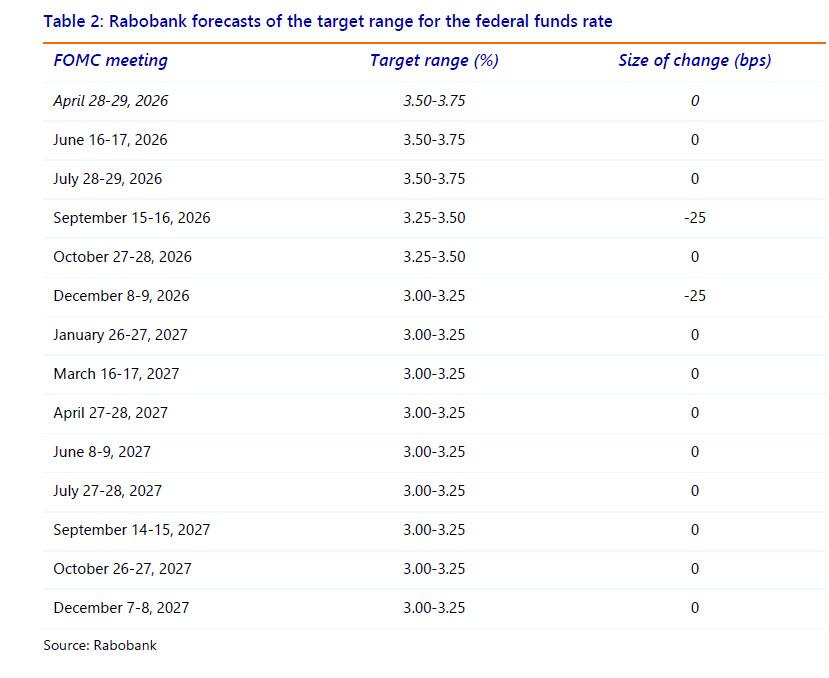
Our baseline forecast is still two rate cuts this year, one in September and one in December. Once Warsh becomes the new Chair, he will try to convince the Committee to make more than the single cut in their most recent projections. However, given the developments in the Middle East, we think that in the coming months we are more likely to drop a rate cut from our forecast than add one.
Finally, the attempts of the Trump administration to influence the Fed through legal attacks seems to have backfired, because Powell would have left on his own volition. Instead, he now intends to stay on until the legal attacks have ceased. This means that President Trump will have to delay his plan to nominate a Governor to replace Powell, which would give the Trump-loyalists a majority in the Board of Governors.
Tyler Durden
Wed, 04/29/2026 – 21:32
via ZeroHedge News https://ift.tt/ycJ7C6M Tyler Durden