Iranian Army Commandos Seize Oil Tanker Over Export Disruption Claims
The semi-official Tasnim news agency reported that Iran has seized an oil tanker, accusing it of “attempting to disrupt oil exports and the interests of the Iranian nation.”
Tasnim did not elaborate on the seizure, but Iran’s official state news agency, the Islamic Republic News Agency (IRNA), stated that the Iranian military directed the tanker to Iran’s southern coast. The report noted that the tanker was carrying Iranian crude oil.
“Army commandos seized this violating oil tanker carrying a cargo of the Islamic Republic of Iran’s oil, which was trying to harm and disrupt oil exports and the interests of the Iranian nation by exploiting regional conditions,” IRNA stated.
IRAN STATE TV SAYS FORCES SEIZED TANKER IN GULF OF OMAN
— zerohedge (@zerohedge) May 8, 2026
Earlier, US forces struck Iranian missile and drone launch sites and other military assets after CENTCOM reported that Iranian forces launched a missile and a one-way attack drone barrage at three US warships transiting the Homruz chokepoint. No US warships were hit.
Press TV reported overnight that Tehran said US forces targeted two of its oil tankers in the Hormuz area. The outlet also said the US hit civilian areas along its southern coast and on Qeshm Island “with the cooperation of some regional countries.”
‘Iranian Forces seized the offending tanker OCEAN KOI (new name JIN LI) transporting oil cargo from the Iran, which was exploiting the conditions in the region to harm and disrupt oil exports and the interests of the Iranian nation.’
Likely happened 5-6 May night. https://t.co/AjLMcorDIt pic.twitter.com/xvTH80ieLH
— MenchOsint (@MenchOsint) May 8, 2026
The United Arab Emirates, which has been hit hard by Iran’s retaliatory strikes, said earlier that its air defenses were intercepting missiles and drones targeting the country.
President Trump stated overnight that the month-long ceasefire remains in effect, but warned Tehran that future airstrikes would be harder and more violent if it does not quickly accept a peace deal to end the war and reopen the Hormuz chokepoint.
Polymarket:
Overnight geopolitical wrap:
UBS analyst Dominic Ellis provided a summary of the UBS Energy Research team’s call with Amena Bakr, head of Kpler’s Middle East and OPEC+ Research, about the UAE and OPEC:
While the UAE’s exit from OPEC erodes the group’s ability to control the oil price in the longer term (UAE is around 30% of spare capacity), there is limited risk of the group splintering, according to an expert speaking to UBS. The speaker said the Iran conflict is likely to lead to significant investment in new pipeline (and perhaps export) capacity to bypass the Strait of Hormuz, but it will take 2-3 years at least for meaningful developments. The ability to return production to pre-war levels varies significantly: Saudi Arabia and the UAE can get there within weeks, but Iraq and Kuwait might take up to 6 months given the less orderly shutdown processes they were forced into by the conflict. The speaker estimates that the UAE has capacity close to 5mb/d, versus the current 2.1mb/d, but will likely ramp up only gradually to avoid a price war with Saudi.
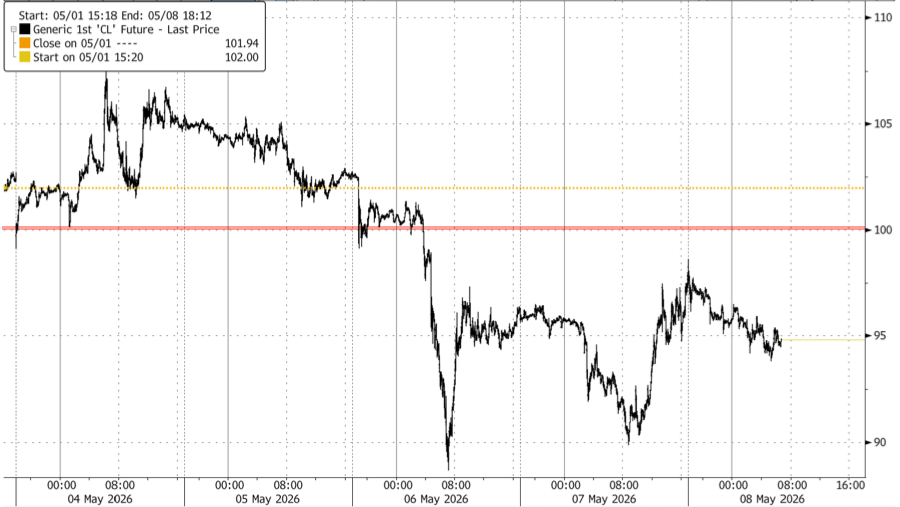
In markets, Brent crude futures are trading around $100 a barrel, while WTI futures are trading around $94 a barrel.
*Developing…
Tyler Durden
Fri, 05/08/2026 – 07:20
via ZeroHedge News https://ift.tt/3FJXUZ7 Tyler Durden