
Last year, Larry Bushart spent 37 days in a Tennessee jail because he had shared a widely circulated anti-Trump meme on Facebook. Today his attorneys announced that he had agreed to settle the resulting federal lawsuit in exchange for a payment of $835,000.
“No one should be hauled off to jail in the dark of night over a harmless meme just because the authorities disagree with its message,” said Adam Steinbaugh, a senior attorney at the Foundation for Individual Rights and Expression (FIRE), which represented Bushart along with local attorney Katherine Phillips. “We’re pleased that Larry has been compensated for this injustice, but local law enforcement never should have forced him to endure this ordeal in the first place.”
The meme in question, which Bushart posted on September 20 in response to a Facebook announcement of a candlelight vigil for slain conservative activist Charlie Kirk at the Perry County Courthouse, featured a photo of President Donald Trump flanked by a quote from a speech he gave at a campaign rally in Iowa on January 5, 2024. The day before, a gunman had killed two people and injured six others at a high school in Perry, Iowa.
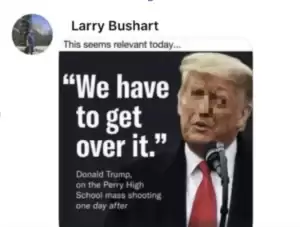
“I want to send our support and our deepest sympathies to the victims and families touched by the terrible school shooting yesterday in Perry, Iowa,” Trump said. “It’s just horrible, so surprising to see it here. But we have to get over it. We have to move forward.” The meme, which noted that Trump was talking about “the Perry High School mass shooting one day after,” quoted just six words from those remarks: “We have to get over it.” It was introduced by a comment that had been added by a previous poster: “This seems relevant today…”
The meme falsely implied that Trump had nonchalantly dismissed the murders in Perry, suggested that people likewise should not care about Kirk’s death, and could be read as an allusion to Kirk’s Second Amendment advocacy (a common theme of left-leaning commentary after his assassination). It was certainly insensitive and tendentious, but it also was indisputably speech protected by the First Amendment.
Perry County Sheriff Nick Weems, who had himself promoted the candelight vigil for Kirk, thought otherwise. He preposterously claimed that Bushart had violated a Tennessee law that applies to “a person who recklessly, by any means of communication, threatens to commit an act of mass violence on school property or at a school-related activity.” How so? Weems averred that the meme had caused “mass hysteria in our community” because people confused Iowa’s Perry High School with Tennessee’s Perry County High School.
Weems never presented any evidence of such hysteria, and he acknowledged that he understood the meme was referring to a crime that had been committed nearly two years earlier in another state. But the affidavit that he used to obtain an arrest warrant for Bushart omitted that crucial point.
That was by no means the only problem with the inartfully worded affidavit, which was written by Jason Morrow, one of Weems’ investigators, at the sheriff’s behest. Morrow said the meme was “a means of communication, via picture, posted to a Perry County, TN Facebook page in which a reasonable person would conclude could lead to serious bodily injury, or death of multiple people.” Grammatical infelicities aside, that did not make much sense, since the message itself could not possibly have injured or killed people. Although Morrow alleged that Bushart was guilty of “Threatening Mass Violence at School,” he did not explain in what sense that was true.
Nor did Morrow allege the state of mind required by the statute, which says a defendant can be guilty of this felony only if he acted “recklessly.” That is consistent with the level of culpability that the Supreme Court has said is required to convict someone of making a “true threat,” one of the few recognized exceptions to the First Amendment. “A mental state of recklessness is sufficient,” Justice Elena Kagan wrote for the majority in the 2023 case Counterman v. Colorado. “The State must show that the defendant consciously disregarded a substantial risk that his communications would be viewed as threatening violence.”
A “true threat” also requires a message that is reasonably interpreted as a “serious expression” of an intent to commit violence. On that score, too, Morrow’s affidavit was deficient, since it hinged on a highly improbable understanding of the meme.
The affidavit, in short, plainly did not meet the requirements imposed by Tennessee law and the U.S. Constitution. It nevertheless passed muster with a magistrate—”a nonlawyer with no formal legal education,” as Bushart’s attorneys noted in his December 17 lawsuit, which named Weems, Morrow, and Perry County as defendants. Based on the resulting warrant, Weems asked police in Lexington to arrest Bushart, who was then transferred to the sheriff’s custody. Because Bushart was unable to cover the staggering $2 million bond demanded for his release, he spent 37 days in jail before the district attorney for Perry County dropped the charge against him after the case drew widespread criticism.
When local police took Bushart to a jail in Lexington, an officer informed him that he was accused of “threatening mass violence at a school.” Bushart was flummoxed. “I played on Facebook,” he said. “I threatened no one.” He conceded that “I may have been an asshole, but—” The officer interjected, “That’s not illegal.” That cop seemed to have a better understanding of the law than Weems or Morrow did.
Bushart’s lawsuit alleged that Weems and Morrow violated his Fourth Amendment rights by arresting him without probable cause and violated his First Amendment rights by punishing him for constitutionally protected speech. Morrow’s affidavit “did not support a finding of probable cause to arrest Mr. Bushart because it described solely protected political speech,” Bushart’s lawyers noted. Any “reasonable police officer” would have understood that, they said, and “no reasonable officer” would have interpreted his post as “a threat of violence.” Treating protected speech as a crime was itself a violation of the First Amendment “under color of law,” the complaint argued, and given the context, it was also unconstitutional retaliation for Bushart’s exercise of the rights protected by that guarantee.
“I am pleased my First Amendment rights have been vindicated,” Bushart said. “The people’s freedom to participate in civil discourse is crucial to a healthy democracy. I am looking forward to moving on and spending time with my family.”
FIRE staff attorney Cary Davis emphasized the broader significance of the settlement. “It’s in times of turmoil and heightened tensions that our national commitment to free speech is tested the most,” she said. “When government officials fail that test, the Constitution exists to hold them accountable. Our hope is that Larry’s settlement sends a message to law enforcement across the country: Respect the First Amendment today, or be prepared to pay the price tomorrow.”
The post A Tennessee Man Jailed for 37 Days Because of an Anti-Trump Meme Will Get $835,000 for His Trouble appeared first on Reason.com.
from Latest – Reason.com https://ift.tt/uKTDsjG
via IFTTT