Oil’s Peace Dividend Is Real, But Normalization Is Not A Light Switch
Authored by Stephen Innes via The Dark Side Of The Boom,
-
Markets can remove geopolitical risk premium far faster than physical energy systems can recover.
-
The real post-war story may be strategic reserve rebuilding rather than simply falling oil prices.
-
Canada’s emerging Pacific LNG corridor highlights how Asia is increasingly seeking supply routes that bypass Hormuz altogether.
-
The shift from efficiency to resilience could become one of the most important structural drivers of oil and LNG demand over the coming decade.
-
The U.S.-Iran war may eventually end, but the infrastructure and energy-security investments it triggers could shape global markets for years to come.
Normalization Is Not A Light Switch
The market is increasingly behaving as though the U.S.-Iran war is ending and the oil market is about to return to normal. I suspect that view is only half right. The war may indeed be moving toward its final chapters, but the physical energy system does not heal as quickly as financial markets.
Traders can reprice risk in minutes, while tankers, inventories, insurance markets, refinery supply chains, LNG terminals, pipelines, export infrastructure, and strategic reserves move on an entirely different clock. That distinction may ultimately become one of the defining energy trades of the next 12 months because while markets are already beginning to price the end of the conflict, they are nowhere close to pricing what comes next.
Financial markets are discounting machines. They do not wait for events to occur; they attempt to price conditions months into the future. Once traders become convinced that the probability of a prolonged disruption to the Hormuz disruption is fading, the risk premium embedded in crude prices begins to evaporate immediately. Long positions accumulated during the height of the conflict are reduced. Hedges are unwound. Volatility sellers return. Systematic funds reverse positioning.
The market begins trading the world it expects to exist rather than the one that exists today. That process is already underway, which is why crude can fall sharply long before the physical market has actually recovered. But reopening Hormuz and normalizing the oil market are two entirely different events, and I think investors are increasingly at risk of conflating them.
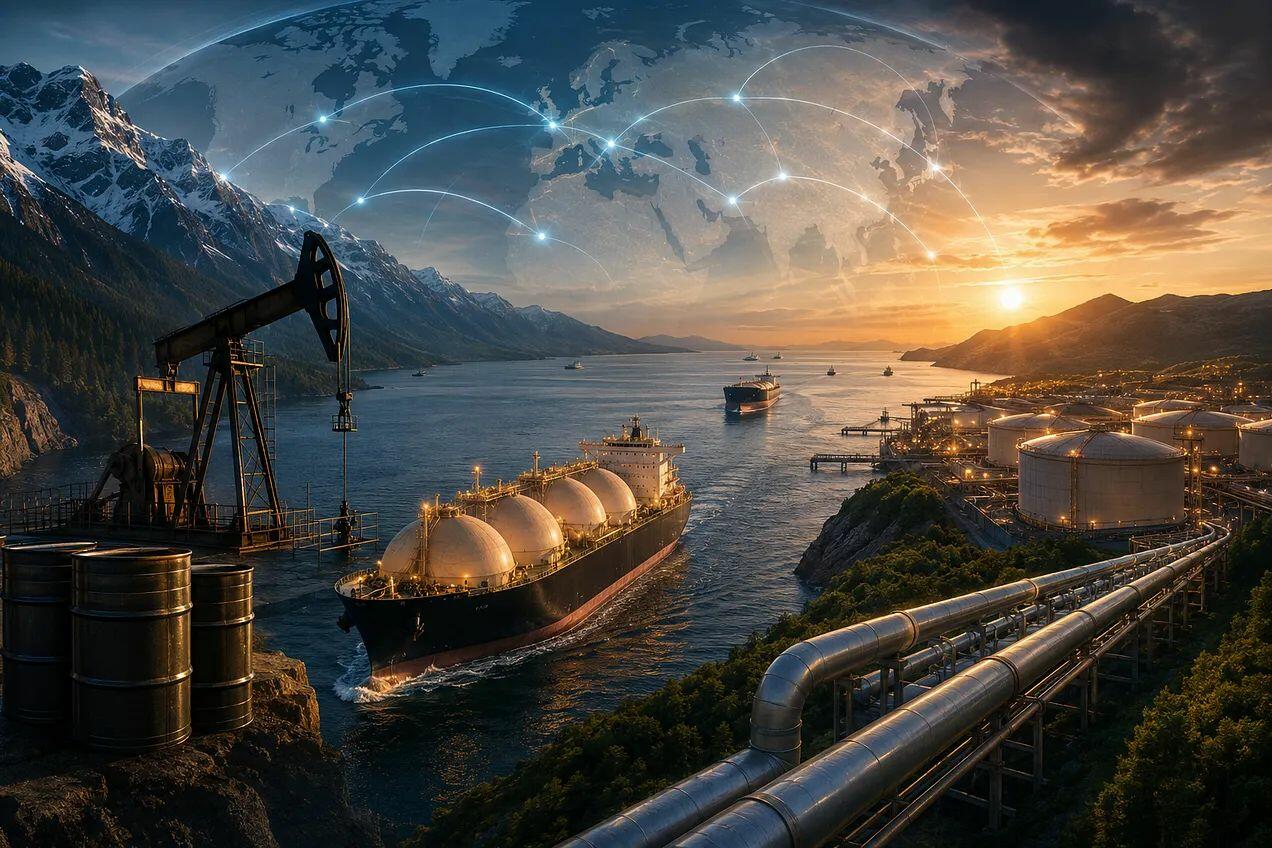
Think of the global energy system as a giant circulatory network. Hormuz is one of its major arteries. Reopening the artery is critical, but it does not instantly restore the patient’s health. During the conflict, the world did not simply lose supply. It consumed inventories as a substitute for supply. According to the IEA, global oil inventories suffered extraordinary drawdowns as the crisis unfolded.
March alone saw roughly 129 million barrels disappear from storage, followed by another 117 million barrel draw in April. Combined, nearly a quarter billion barrels were removed from global stockpiles in just two months. At the same time, global supply losses reached an estimated 12.8 million barrels per day, while Gulf production remained roughly 14.4 million barrels per day below pre-war levels. Those are not the statistics of a market that can simply flip a switch and return to equilibrium.
They are the statistics of a market that has been living off its emergency reserves.
That is why I believe many investors are focusing on the wrong milestone. The real question is not when Hormuz reopens. The real question is what happens after it reopens. Even if shipping resumes tomorrow, producers still need time to restore output. Tankers must be repositioned. Export schedules need rebuilding. Insurance markets require confidence that transit routes are secure. Refiners must recalibrate supply chains after months of operating under emergency conditions.
The entire logistical ecosystem needs time to regain rhythm. History consistently shows that restoring physical flows takes far longer than restoring access.
The tanker market itself offers an important clue. Many investors assume vessel traffic will immediately return to pre-war levels, but shipowners, insurers, cargo traders, and refiners are unlikely to behave with complete confidence simply because a ceasefire is announced. Months of elevated risk have changed behaviour. Insurance premiums remain elevated. Security assessments remain cautious. Commercial decisions tend to lag political headlines.
In fact, the first weeks following a reopening may actually produce temporary bottlenecks as vessels rush to move cargoes simultaneously. Freight rates could remain elevated even as crude prices fall, creating a market dynamic that appears contradictory on the surface but is entirely consistent with a system transitioning from crisis toward recovery. Markets may celebrate peace while the physical supply chain is still untangling months of disruption.
Yet even that may prove to be only the first chapter of the post-war story. The consensus view assumes that Asia will simply return to business as usual once the Hormuz reopens. I think that assumption misses the deeper lesson of this conflict. If there is one thing policymakers across Asia have learned over the past several months, it is that energy security can no longer be treated as a background issue.
Just as Europe never looked at Russian gas the same way after Ukraine, Asia may never look at its dependence on Middle Eastern energy the same way after Hormuz.
This is where I think the market is missing the next major theme entirely. Most investors are focused on falling oil prices, but the more important development may be what governments do after prices fall. The first phase of normalization is the removal of the geopolitical risk premium. The second phase is rebuilding commercial inventories. The third phase is strategic stockpiling.
The fourth phase is a multi-year energy-security buildout that could reshape energy demand and infrastructure investment across Asia for years to come. In other words, the market is pricing peace while potentially overlooking the structural consequences of the war itself.
For decades, governments optimized their energy systems for efficiency. Inventories were minimized. Storage costs were reduced. Supply chains were streamlined. The assumption was that global markets would always provide sufficient supply when needed. Hormuz shattered that assumption. Policymakers have now witnessed firsthand what happens when a single geopolitical chokepoint threatens the flow of energy to billions of people.
When governments experience a shock of that magnitude, they rarely conclude they need fewer reserves. They almost always conclude they need more.
China is perhaps the clearest example. Beijing was already expanding strategic petroleum reserves before the conflict, but the war has likely reinforced the urgency of that effort. Japan is expanding LNG storage capacity while reassessing its broader energy-security framework. South Korea is reviewing reserve policies and pursuing deeper regional energy cooperation. India continues expanding both crude storage and LNG import capacity.
Across Southeast Asia, governments are increasingly asking how many days of import protection they truly need in a world where energy security can disappear overnight.
But the story does not stop at inventories.
What makes this cycle different from previous oil shocks is that governments are increasingly responding not only by storing more energy but by redesigning how energy reaches them in the first place. The lesson many Asian policymakers appear to have taken from the U.S.-Iran war is that diversification is no longer simply an economic choice. It is becoming a national security requirement.
That realization is already beginning to reshape global energy infrastructure. For years, Canada possessed some of the world’s largest natural gas reserves but lacked the infrastructure to export it efficiently to Asia. Western Canadian gas was largely trapped by geography, forced to flow south into North America rather than west across the Pacific. Today, that is changing.
The completion of Coastal GasLink and the launch of LNG Canada on British Columbia’s Pacific Coast have created a direct energy corridor linking the Montney shale basin to Asian consumers. Additional projects such as Cedar LNG, Woodfibre LNG, and Ksi Lisims LNG could substantially expand Canada’s export capacity over the coming decade.
The significance extends well beyond supply growth. A cargo leaving Kitimat reaches North Asia faster than many competing export routes and, more importantly, bypasses Hormuz entirely. For buyers in Japan, South Korea, Taiwan, India, Thailand, and Southeast Asia, that is becoming a strategic advantage rather than merely a logistical one. The market keeps asking when Middle Eastern supply returns. Policymakers are increasingly asking how to reduce dependence on Middle Eastern supply altogether.
Viewed through that lens, the post-war story is no longer simply about rebuilding inventories. It is about building redundancy. China is expanding storage. Japan is expanding LNG infrastructure. South Korea is strengthening energy-security partnerships. India is increasing import flexibility. Canada is building export capacity. Utilities across Asia are locking in longer-term supply agreements. The common thread is resilience.
In many respects, this resembles what happened after the 1973 oil embargo. The crisis itself eventually faded, but the infrastructure decisions it triggered lasted for decades. Strategic petroleum reserves were created. Pipelines were built. Storage facilities expanded. Import routes diversified. Energy policy changed permanently. The same process may now be unfolding across Asia.
The U.S.-Iran war may eventually fade from the headlines, but the infrastructure investments it has triggered could shape global energy flows for the next generation.
The result is that the next source of oil and gas demand may not come from consumers driving more or factories producing more. It may come from governments buying more. Every barrel that enters a strategic reserve is a barrel removed from the spot market. Every LNG cargo redirected to storage is unavailable for immediate consumption.
Viewed through that lens, reopening Hormuz may not immediately trigger the inventory rebuild many traders expect because governments themselves could become among the largest buyers in the market. The same countries that spent the war drawing down inventories may now spend years rebuilding and expanding them.
The LNG side of the equation may be even more significant. Unlike crude oil, LNG inventories are generally smaller and less flexible. Many Asian economies maintain relatively limited emergency gas reserves. The experience of both the European gas crisis and the disruption in Hormuz has accelerated discussions around strategic LNG storage, additional regasification terminals, expanded reserve facilities, diversified import infrastructure, and longer-term supply agreements.
The conversation is no longer simply about securing the cheapest molecule. It is increasingly about securing the most reliable one.
There is another layer that markets may be overlooking. The coming decade is expected to see enormous growth in electricity demand driven by AI infrastructure, data centres, semiconductor manufacturing, and digital industrialization. Across much of Asia, LNG is expected to remain a critical bridge fuel supporting that expansion. Governments are not merely trying to secure energy for today’s economy. They are increasingly trying to secure energy for tomorrow’s AI economy.
Strategic stockpiling, infrastructure expansion, and structural demand growth may soon be pointing in the same direction.
This is why I remain cautious about the simplistic view that oil will simply collapse back to pre-war levels and stay there. Yes, the geopolitical risk premium can disappear quickly. Yes, tanker traffic can improve. Yes, physical flows can recover.
But simultaneously, inventories must be rebuilt, strategic reserves expanded, LNG security frameworks strengthened, storage facilities constructed, pipelines developed, export routes diversified, and governments across Asia will seek redundancy where previously they sought efficiency. The irony is that the market is currently celebrating the potential end of the war while largely ignoring the structural demand it may have created.
Ultimately, I think the market is still looking at this through a trader’s lens, when it should increasingly look at it through a policymaker’s lens. Traders see peace and immediately calculate how much risk premium can be extracted from the barrel. Governments see the same peace and begin calculating how many additional barrels and LNG cargoes they need to secure before the next crisis arrives. Those are not the same calculations, and they point toward very different futures.
That is why I believe the oil market is entering a far more complicated phase than many investors appreciate. The peace dividend may arrive quickly. The normalization dividend may take months. But the energy-security dividend, driven by reserve rebuilding, strategic stockpiling, LNG infrastructure expansion, pipeline development, and a region-wide reassessment of supply vulnerability, may take years to fully unfold.
By the time markets recognize that distinction, the next great source of energy demand may already be underway. The U.S.-Iran war may be ending, but the race to secure energy for the next one may just be beginning.
Tyler Durden
Sun, 05/31/2026 – 17:30
via ZeroHedge News https://ift.tt/B8CjZJQ Tyler Durden