The Department of Homeland Security (DHS) is continuing efforts to transform warehouses into large-scale immigration detention centers despite a growing number of politically motivated lawsuits.
Officials with US Immigration and Customs Enforcement (ICE) recently discussed plans to award contracts for construction and operations at warehouse sites in San Antonio and near El Paso, according to people briefed on the internal meetings. The administration is also examining how to continue work at a site near Hagerstown, Maryland, while complying with a court order limiting construction activity there.
The warehouse initiative has become a central part of the Trump administration’s broader deportation agenda, with officials arguing the facilities will allow ICE to process and detain illegal immigrants more efficiently through centralized hubs capable of housing large numbers of detainees.
Critics from both political parties have attacked the proposal, while several states have filed lawsuits claiming the administration failed to complete environmental reviews required under federal law.
Homeland Security Secretary Markwayne Mullin ordered a review of the estimated $38 billion project after taking office earlier this year. The plan was originally launched under former DHS Secretary Kristi Noem.
The administration appears determined to move forward with the project despite the legal challenges. ICE is reportedly preparing environmental assessments for the two Texas sites, with the goal of having both facilities operational by early 2027.
A DHS spokesperson said the department is reviewing policies and proposals adopted before Mullin assumed leadership and intends to work with local communities, including some in areas that strongly supported President Donald Trump.
SpaceX Reportedly Chooses Nasdaq And “SPCX” Ticker For Mega IPO
Elon Musk’s rocket company, SpaceX, has reportedly selected Nasdaq for its long-awaited IPO and is targeting a June 11 pricing, followed by a June 12 debut under the ticker “SPCX,” according to a Reuters report released late in Friday’s U.S. cash session.
Immediately after the report, odds for “SPCX” on the Polymarket bet, “What will SpaceX’s public ticker be?” soared to nearly 100%.
In April, SpaceX confidentially filed for an IPO with the SEC and is planning to disclose its prospectus as soon as next week, according to CNBC.
SpaceX’s IPO could raise upwards of $75 billion for the rocket company and dwarf Saudi Aramco’s $29 billion debut in 2019. The money raised would be used to fund an “insane flight rate” for the Starship rocket and to push ahead with deploying orbital data centers in low Earth orbit. The company’s valuation stands at around $1.75 trillion.
The timing comes amid a broader reopening of the IPO window for AI firms, with major chatbot startups such as OpenAI and Anthropic increasingly viewed as potential second-half candidates.
Goldman’s Tony Pasquariello offered additional insight on the upcoming SpaceX IPO:
In most every single client meeting that I have, the question of how the tape will absorb a series of mega IPOs comes up.
While understanding that potentially adding trillions of dollars of market cap is worth discussion, as mentioned a few times recently, I’d argue there’s good reason to be optimistic here (I’m a taker of opposing views).
I’ll add a few points to the running conversation here:
i. to level set, at $77tr of market cap, the US equity asset class is immense (the next closest country is China at $12tr).
ii. in 1999, 380 IPOs rolled off the assembly line; for 2026, GIR currently expects 100.
iii. asset size is one consideration, yet asset quality is another — I remember 1999, and let’s just say comprehensive asset quality didn’t stand the test of time.
Wall Street is certainly hungry for IPOs after a prolonged drought. This week, we saw AI chipmaker Cerebras surge nearly 70% in its debut.
SpaceX’s IPO filing could come around the 12th test flight of the Starship rocket, expected as early as next Tuesday.
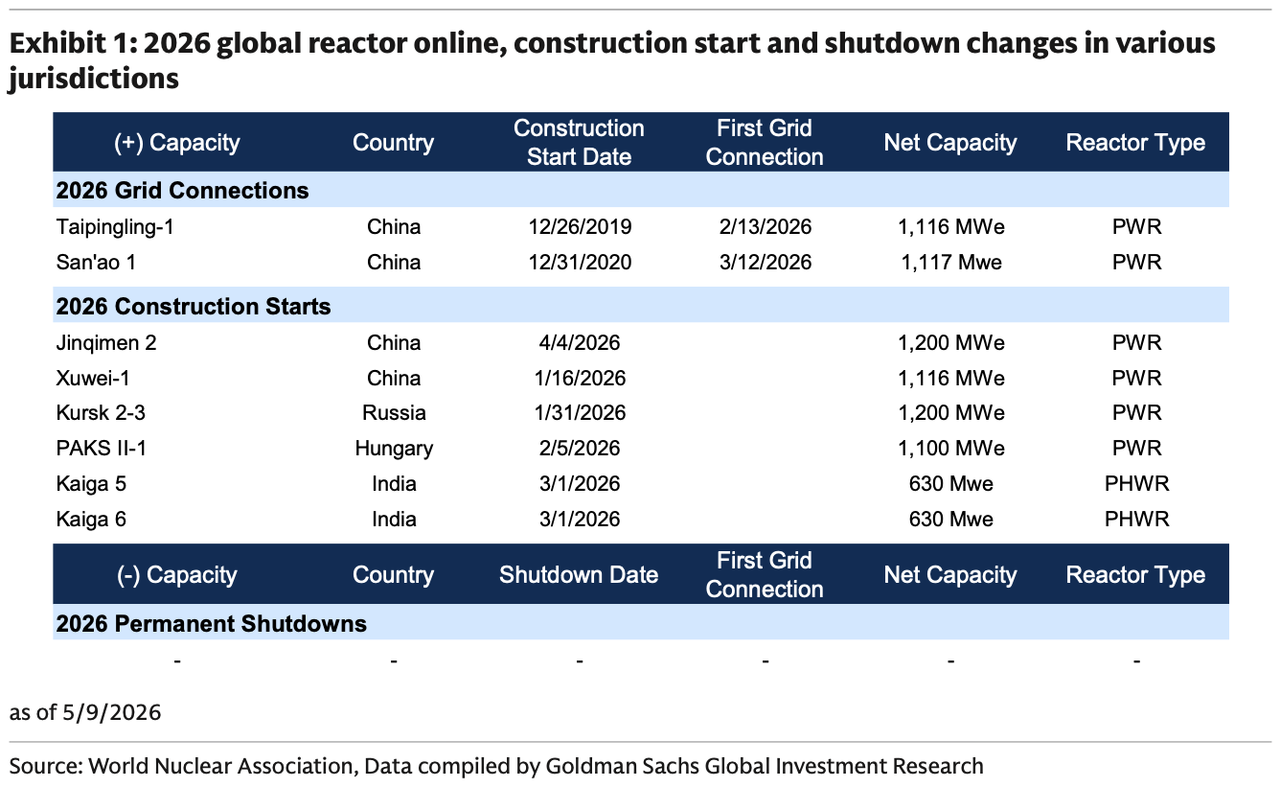
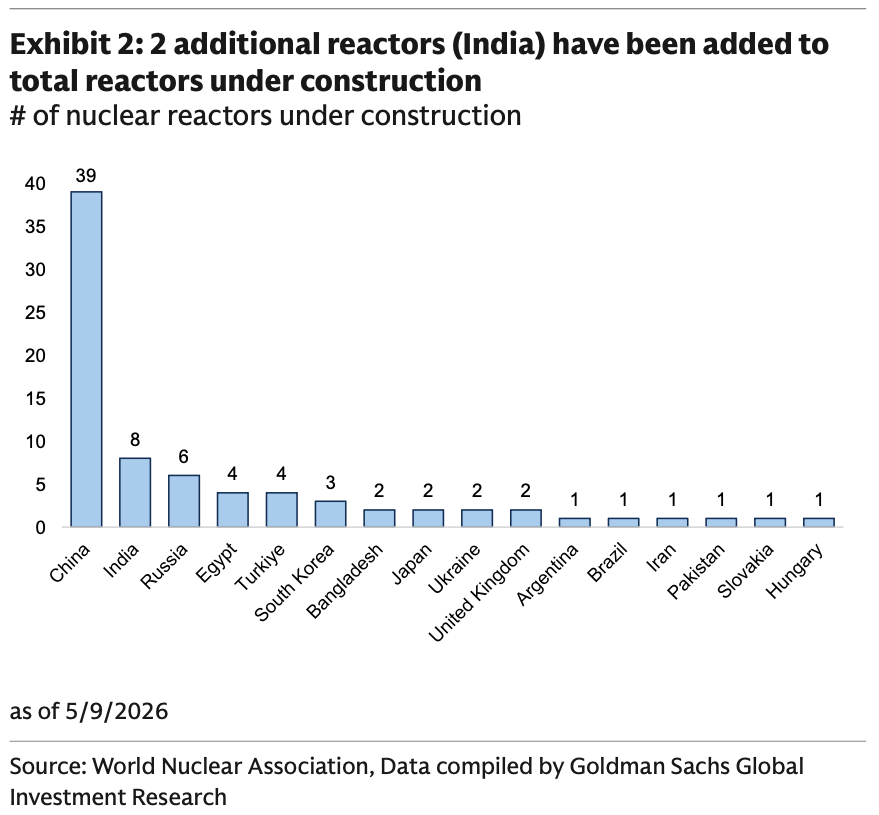
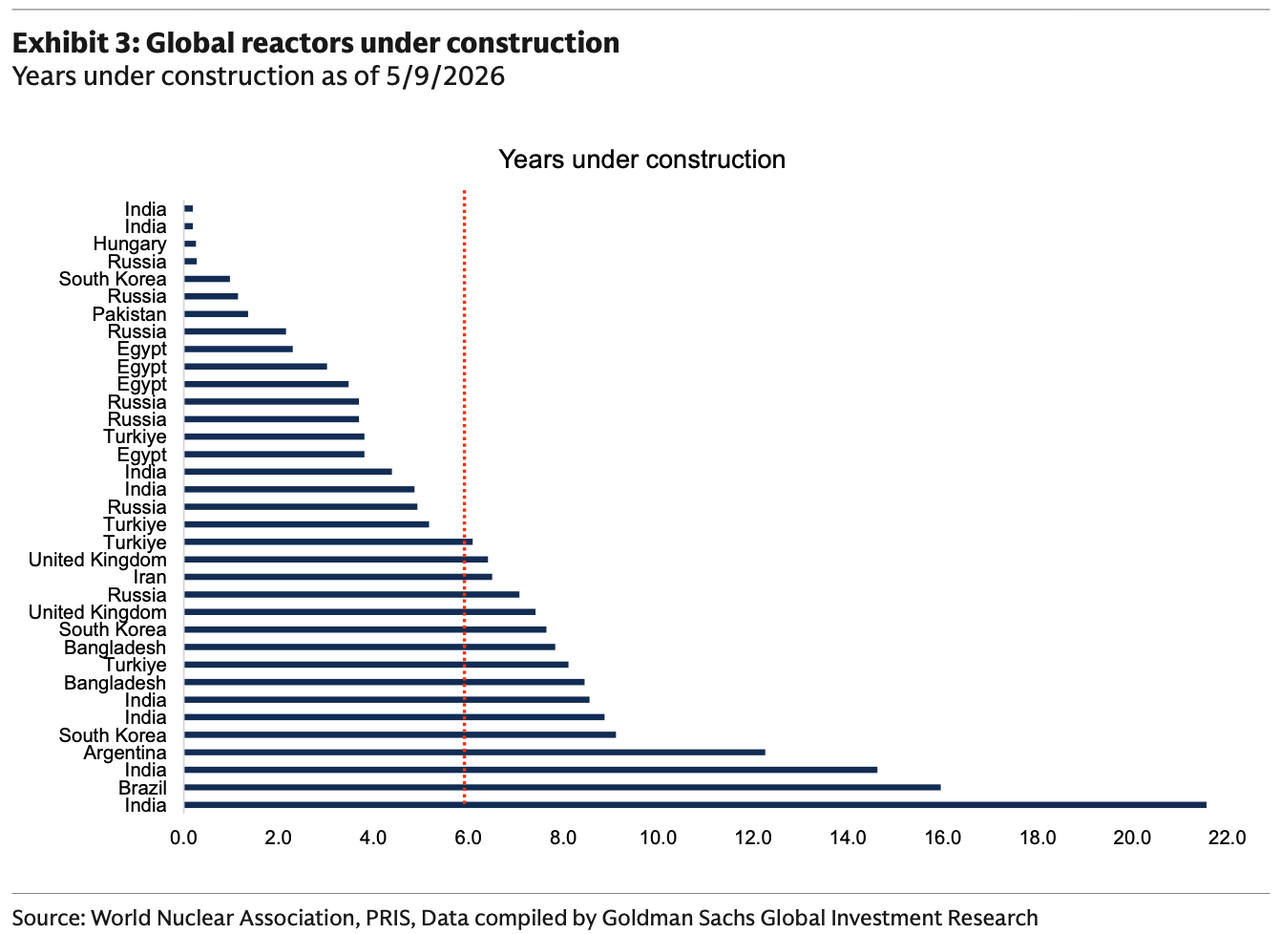
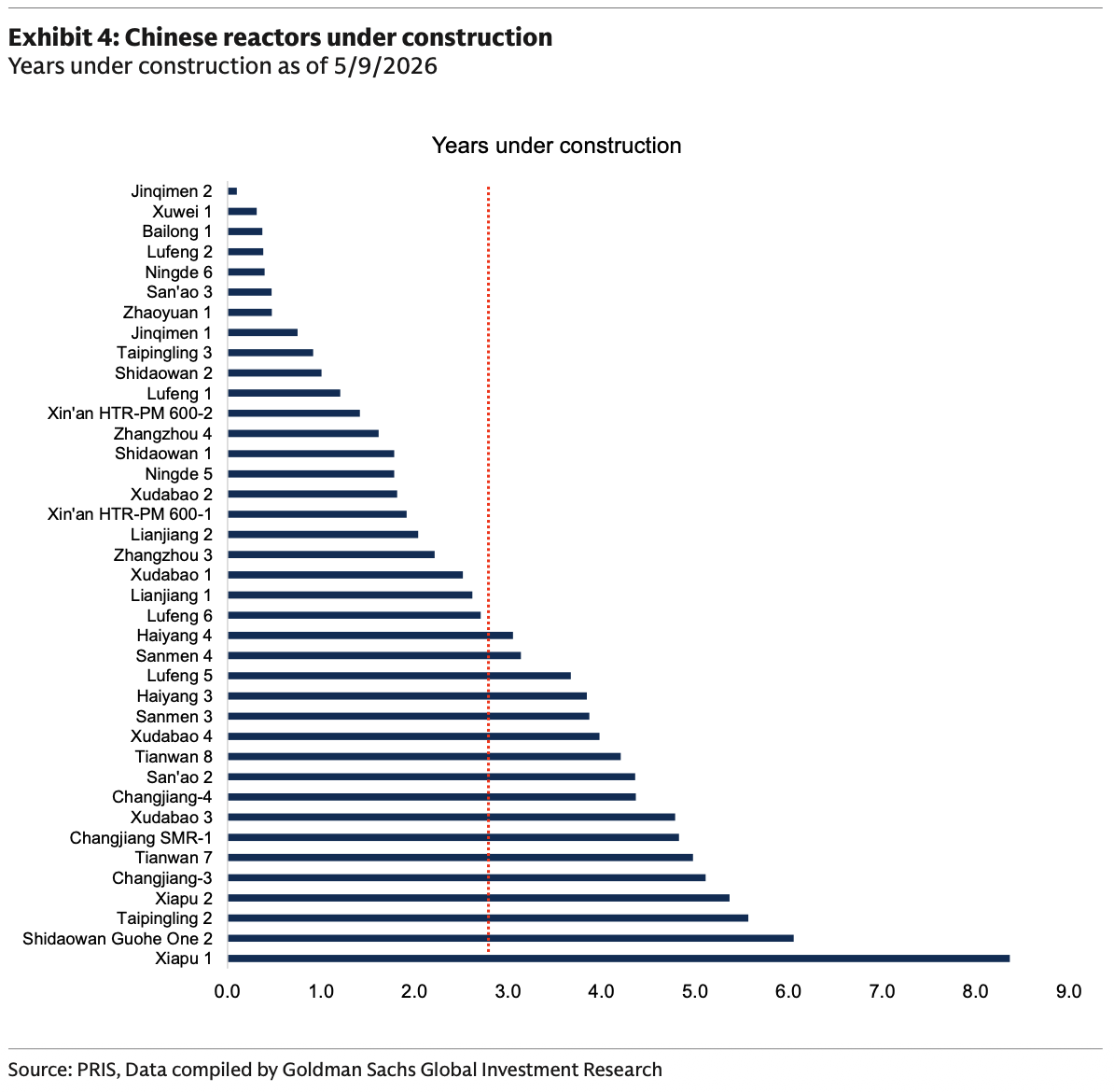
Goldman analyst Brian Lee reviews headlines across the nuclear industry for March (full note here).
New reactor progress and announcements
North America
4/16/2026 – Canada: Bruce Power has signed an MoU with SaskPower to share its experience in large-scale nuclear reactors, including project development and long-term operations, as Saskatchewan evaluates large reactor technologies alongside its SMR program. The agreement formalizes information-sharing and aligns provincial and federal nuclear strategies.
4/24/2026 – United States: Duke Energy’s Robinson nuclear power plant has been cleared for extended operation to 80 years, after the US Nuclear Regulatory Commission completed its fastest-ever subsequent license renewal review. The approval allows the 759 MW Robinson Unit 2 in South Carolina to operate until 2050, under new accelerated federal timelines.
4/29/2026 – United States: The US NRC has approved subsequent license renewals for St Lucie Units 1 and 2, clearing the Florida Power & Light plant to operate for up to 80 years, with Unit 1 licensed to 2056 and Unit 2 to 2063. The decision follows ageing-management reviews for the extended operating period and secures long-term operation of the two pressurized water reactors.
5/5/2026 – United States: Brookfield and The Nuclear Company have formed a JV to manage the potential completion of the two VC Summer AP1000 units in South Carolina, supporting due diligence and execution if the project proceeds, subject to approvals and a final investment decision.
Europe
4/10/2026 – Czechia: ČEZ is exploring extending the operating life of its four Dukovany reactors to up to 80 years, having launched a preparatory process for long-term operation beyond the current 60-year plan, while also assessing potential life extensions at Temelín, subject to ongoing safety and economic evaluations.
4/10/2026 – Lithuania: Lithuania has received regulatory approval to begin dismantling reactor channels at Ignalina Unit 2, after completing the same work at Unit 1, with dismantling and decontamination scheduled to start at end-2026 following preparatory activities by state-owned decommissioning company Altra.
4/16/2026 – Bulgaria: Bulgaria’s energy minister has said the new Kozloduy Units 7 and 8 should be built at fixed prices, citing past nuclear projects where cost overruns derailed delivery, as the government seeks tighter cost control while advancing plans for two Westinghouse AP1000 reactors at the site.
4/30/2026 – Belgium: Belgium is in talks with Engie to take over its full nuclear fleet, covering all seven reactors, with decommissioning work paused while negotiations continue. The move would allow the state to keep options open on life extensions and future nuclear capacity.
Asia and other
4/9/2026 – India: EDF and NTPC have signed a non-binding MoU to explore cooperation on new nuclear projects in India, including assessing EDF’s EPR technology, localisation opportunities, project economics, training, and potential sites, following approvals from Indian government ministries.
4/13/2026 – South Korea: Saeul Unit 3 has started up after achieving first criticality on 12 April, with KHNP confirming the APR-1400 reactor entered its initial start-up phase following completion of all required pre-operational inspections; output will be ramped up through testing ahead of commercial operation in the second half of 2026.
4/16/2026 – Japan: Kashiwazaki-Kariwa 6 has resumed commercial operation, becoming the first TEPCO-owned reactor to return to service since Fukushima, after Japan’s regulator completed final pre-operational inspections. The 1,356 MWe ABWR, offline since 2012, re-entered commercial operation on 16 April following resolution of technical issues encountered during restart testing.
4/20/2026 – Kazakhstan: Kazakhstan has adopted a nuclear strategy targeting at least three plants by 2050, with a fourth under consideration to meet rising power demand; the plan also includes assessing SMRs and replacing coal capacity with nuclear to bolster energy security and meet climate goals.
4/20/2026 – China: Taipingling Unit 1 has entered commercial operation, with CGN confirming the 1,116 MWe Hualong One (HPR1000) reactor began service on 19 April after completing commissioning tests. It is the first of six units planned at the Taipingling site in Guangdong province.
4/28/2026 – Bangladesh: Fuel loading has begun at Bangladesh’s first nuclear power plant, with 163 fuel assemblies being loaded into Rooppur Unit 1, marking the start of the reactor’s start-up and commissioning phase following issuance of its operating licence earlier in April.
4/29/2026 – Russia: Russia’s nuclear regulator Rostekhnadzor has approved the readiness of Kursk II Unit 1, issuing a certificate of compliance that confirms the 1,250 MWe VVER-TOI reactor meets safety and design requirements and is fully ready for commissioning and market entry.
4/29/2026 – China: San’ao Unit 1 has entered commercial operation, with CGN confirming the 1,116 MWe Hualong One reactor completed commissioning on 29 April 2026. It is the first of six units planned at the Zhejiang site.
5/6/2026 – China: Fuel loading has been completed at two new Chinese reactors, with 177 fuel assemblies inserted at Taipingling Unit 2 and Changjiang Unit 3, both Hualong One units, marking their transition into the nuclear commissioning phase ahead of start-up.
5/7/2026 – Turkey: Turkey’s nuclear regulator has approved commissioning work at Akkuyu Unit 2, allowing pre-fuel-loading tests to begin at the second VVER-1200 unit of the Akkuyu plant.
SMR announcement tracker
4/8/2026 – Sweden: GE Vernova Hitachi Nuclear Energy and AFRY have agreed a non-exclusive collaboration to support deployment of the BWRX-300 SMR, with AFRY providing engineering, advisory and licensing support to enable scalable SMR projects across Europe, including support for licensing in Sweden.
4/13/2026 – UK: The UK has signed a contract to deliver its first SMRs, with Great British Energy – Nuclear and Rolls-Royce SMR agreeing to begin work on three units at Wylfa (Anglesey), enabling site design and early procurement ahead of a final investment decision.
4/14/2026 – Netherlands: A Dutch nuclear new-build partnership has been announced, with Mammoet and ULC-Energy signing a cooperation agreement to streamline construction of new nuclear facilities in the Netherlands. The collaboration focuses on modular construction and heavy-lifting expertise, and is aligned with government plans for new large reactors and future SMR deployment.
4/14/2026 – United States: The US Air Force has named Buckley (Colorado) and Malmstrom (Montana) as potential microreactor sites, with deployment under the ANPI programme targeted for 2030 or earlier.
4/16/2026 – United States: The NRC has received an application to build a KRONOS microreactor at the University of Illinois, with the construction permit application filed on 31 March in partnership with NANO Nuclear Energy.
4/17/2026 – Netherlands: A Dutch consortium has signed an MoU to advance construction of Europe’s first commercial molten salt reactor, covering a non-nuclear test facility and pilot programme, a nuclear demonstrator at Petten, and a 100 MWe commercial MSR in Zeeland, targeted for operation by 2034.
4/20/2026 – Poland: OSGE has signed a letter of intent with Poland’s Industrial Development Agency to prepare a BWRX-300 SMR project at Stalowa Wola, setting the framework for a future investment agreement.
4/20/2026 – United States: Kairos Power has broken ground on the Hermes 2 demonstration reactor in Oak Ridge, Tennessee, the company’s first commercial-scale and power-producing Generation IV reactor. The project will supply up to 50 MW to the Tennessee Valley Authority grid under Kairos’s agreement with Google, and builds on lessons from the non-power Hermes 1 reactor now under construction.
4/24/2026 – United States: The US Air Force has selected Radiant, Westinghouse Government Services, and Antares as microreactor developers under the ANPI programme, pairing them with Buckley (Colorado), Malmstrom (Montana), and Joint Base San Antonio (Texas), respectively, with a goal of deploying at least one reactor by 2030 or earlier.
4/27/2026 – Czechia: ČEZ has signed an early-works contract with Rolls-Royce SMR for a proposed SMR at the Temelín nuclear site, enabling site-specific design, licensing and permitting preparation. The agreement covers early engineering only and is not a final investment decision or start of construction.
4/27/2026 – France: Stellaria and France’s CEA have signed a letter of intent to study building an experimental molten salt reactor at Cadarache, covering the 100 kW Alvin experimental MSR and a future 10 MWe prototype (MegAlvin) as part of a feasibility study for an Alpha basic nuclear installation at the site.
4/30/2026 – Canada: Canada plans to release a new Nuclear Energy Strategy by end-2026, alongside funding to assess Canadian-controlled microreactors for remote and northern defence sites, with the strategy focused on new builds, exports, fuel supply, and nuclear innovation.
5/1/2026 – Canada: OPG has installed the basemat foundation module at the Darlington SMR site, marking a key construction milestone for the G7’s first SMR. The 953-tonne modular basemat was placed 35 metres below ground, advancing construction of the first BWRX-300 unit.
5/5/2026 – Sweden: Blykalla and ABB have signed a Joint Development Agreement to deepen cooperation on lead-cooled SMRs, covering joint development of SEALER reactor elements with ABB as a key partner for automation and control systems.
5/7/2026 – United States: US pilot SMR licensing has advanced on two fronts, with the DOE approving the Documented Safety Analysis for Aalo Atomics’ Aalo-X experimental reactor, and the NRC approving the Principal Design Criteria topical report for Oklo’s Aurora powerhouse, marking key regulatory milestones for both projects.
Global reactor critical updates
In the month of April, there have been few changes to new reactor construction starts, grid connections, shutdowns, or restarts.
Global reactor construction tracker
Fuel announcements
4/8/2026 – Russia: Testing of innovative VVER fuel has begun at Russia’s Balakovo 1, where three pilot fuel assemblies with chromium-coated cladding and MOX fuel rods were loaded into a VVER-1000 reactor.
4/9/2026 – France: Framatome has signed an agreement with four EU utilities (ČEZ, Fortum, MVM Paks NPP, and Slovenské elektrárne) to develop a fully European VVER-440 fuel design, supporting fuel-supply diversification and reduced reliance on Russian fuel. First deliveries targeted for the early 2030s.
4/14/2026 – Poland: Poland’s SGE has signed cooperation agreements with Spain’s Enusa and GNF Enusa to strengthen nuclear fuel strategy, procurement, and supply-chain development in support of BWRX-300 SMR deployment across Europe.
4/17/2026 – United States: ConverDyn is studying a second US uranium conversion plant (“Metropolis 2.0”), alongside an expansion of its existing Metropolis Works facility, with feasibility work under way.
4/28/2026 – United States: Ur-Energy has begun ISR uranium mining at its Shirley Basin project in Wyoming, with production under way at Mine Unit 1.
5/1/2026 – India: India’s Atomic Energy Regulatory Board has granted an operating licence to the NFC-Kota fuel plant in Rajasthan, enabling production of ~500 tpa of natural UO₂ fuel to support indigenous 700 MWe PHWRs.
5/6/2026 – UK: Urenco has completed its first LEU+ trial run at the Capenhurst site, producing uranium enriched to ~7% U-235, confirming capability to supply LEU+ (5–10%) with commercial availability planned soon.
5/8/2026 – Japan: Japan shipped ~1.7 tonnes of HALEU to the United States, marking the largest international uranium transfer handled by the NNSA, to support the US HALEU Availability Program and advanced reactor fuel supply.
Uranium pricing and volume trackers
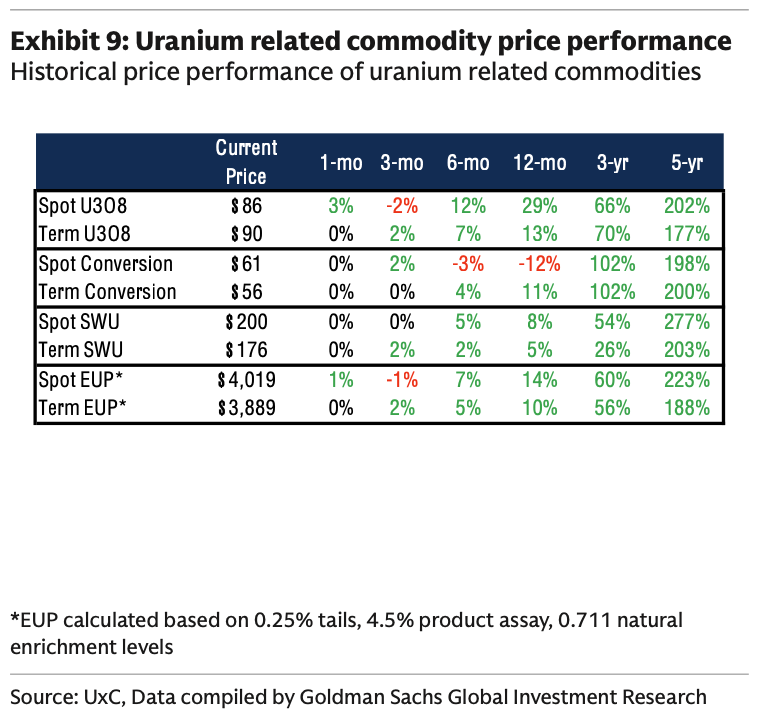
Spot pricing steadies, supported by Sprott activity. Spot U₃O₈ prices rebounded through mid April following late March softness, rising from the low $80s to the mid and high $80s, briefly touching ~$87/lb around WNFC Monaco. Momentum faded toward late April and early May, with prices drifting modestly lower into the mid $80s.
Term pricing stable. Term uranium pricing remained firm through April and into early May, holding around ~$90/lb. Market engagement stayed active, supported by ongoing utility discussions around mid and long term coverage. Floors largely holding in the mid $70s and ceilings extending into the low $130s for long dated deliveries.
Key supply/demand and pricing charts
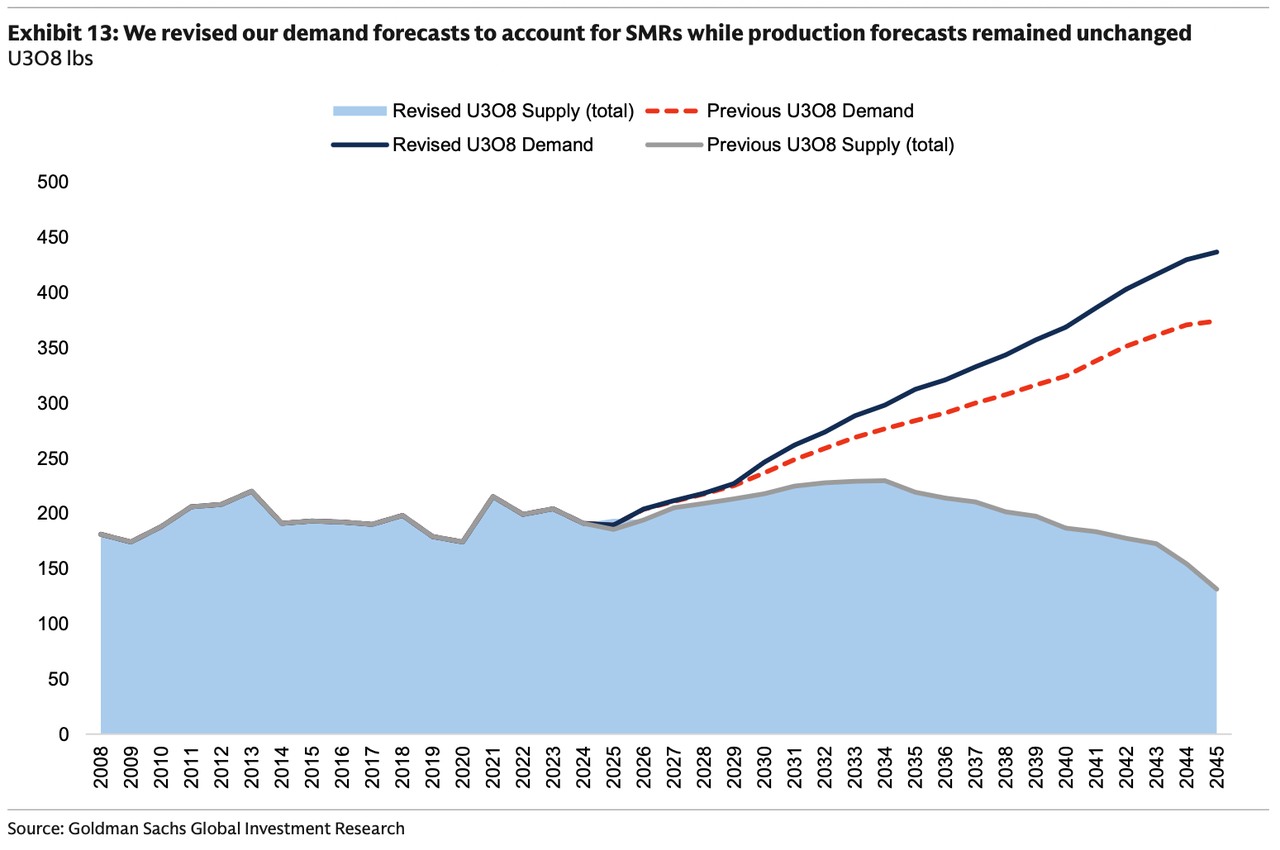
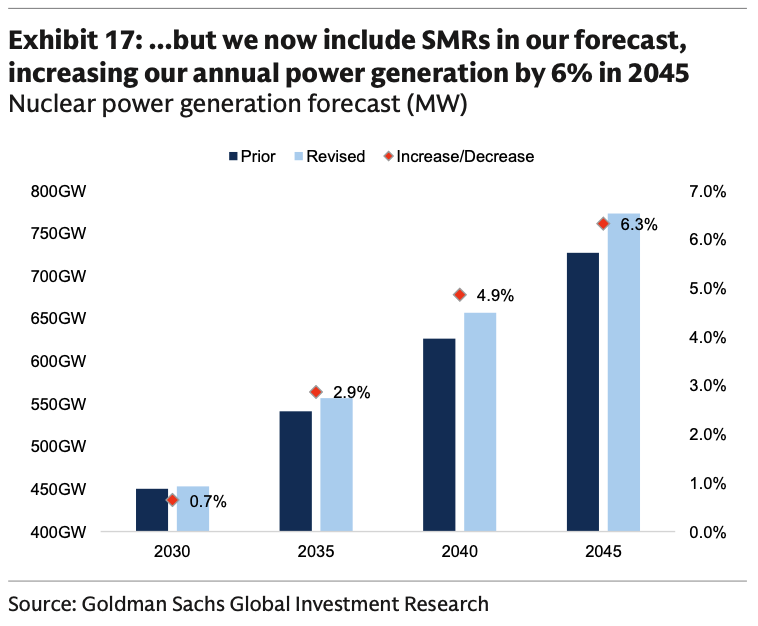
Updating supply-demand model: We update our uranium supply/demand model to include updated forecasts for SMR deployments. We are conservatively anticipating SMR deployments reach nearly 2GW in 2030, and grow at 2GW-3GW per year through 2045, representing cumulative deployments of ~46GW in 2045. This represents a 6% uplift to our 2045 nuclear power generation forecast. Based on our fuel burn assumptions, we estimate these deployments will create a uranium demand need of ~62mn lbs in 2045, or 17% upside to our 2045 forecast.
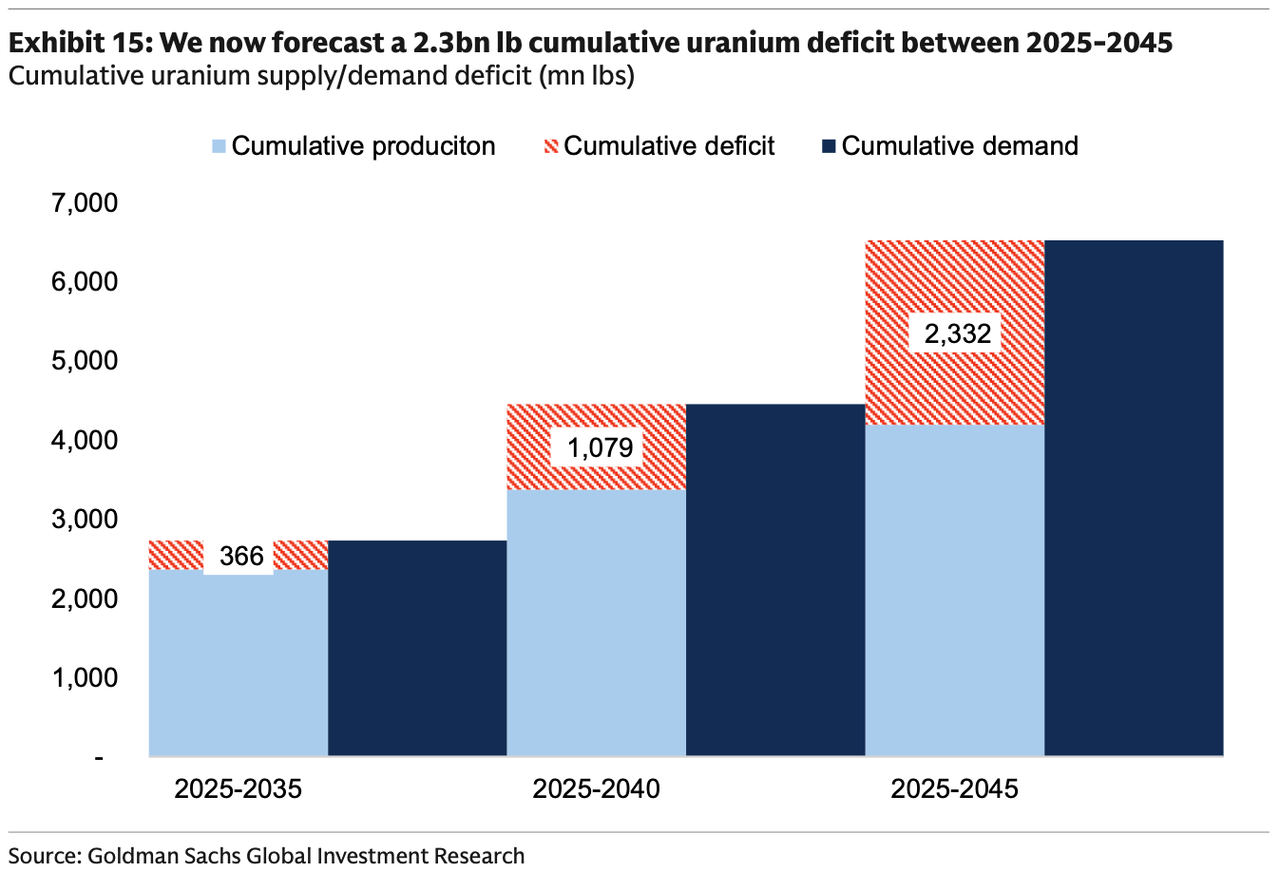
Revisions to power generation forecast. We have maintained our large reactor forecast, but now include estimates for global SMR deployments between 2026-2045. We believe these estimates are relatively conservative. As a result of our changes, we see an expanding deficit over the medium-term. Our forecast does not include nuclear uprates to existing facilities, which provides further upside.
We previously discussed a disturbing account of how medical students at the David Geffen School of Medicine at the University of California, Los Angeles (UCLA) were subjected to a bizarre class where one of the university’s “activists-in-residence” showered them with anti-Semitic postings and racist rhetoric. Now, the Justice Department has found that the university engaged in systemic racial discrimination in the admission of medical students. Given the university’s history, it is hardly surprising, but it remains unclear how the university will respond to the findings.
The DOJ’s Civil Rights Division announced that the medical school violated Title VI of the 1964 Civil Rights Act by giving preferential treatment to black and Hispanic applicants.
In the DOJ’s “Findings” letter, black and Hispanic admits in some years averaged MCAT scores in the 66th to 72nd percentile, while Asian and white students averaged scores in the mid-to-high 80th percentiles.
Assistant Attorney General Harmeet Dhillon indicated that the Justice Department found that UCLA medical school leadership discussed how to achieve “diversity goals” and other strategies after the Supreme Court ruling.
After the historic ruling in the Harvard and North Carolina cases barring the use of racial criteria in admissions, administrators and academics admitted what they had long denied: that race was having a major role in admissions.
In anticipation of the rulings, many schools, including the California system, eliminated standardized testing. Without objective scores, there is less ability to identify the use of non-scholastic criteria for admissions. By eliminating or devaluing standardized testing, admissions offices can use the more subjective essays to achieve the same race-based results.
I wrote about how administrators were already preparing to use essays as an indirect way to achieve the same identifications and preferences in admissions.
The essay “prompts” encourage students to effectively self-identify by discussing incidents where they faced discrimination.
The shift to the essays would allow the removal of high-scoring students while elevating those with lower scores. That prediction was quickly confirmed, as top candidates were rejected based on their essays, while schools used essays to flag their backgrounds.
Faculty and administrators at UCLA and other schools remain adamant in using race-based admissions. They simply justify discrimination as equity and diversity.
This is the same school that required medical students to sit through a raving lecture from “a formerly unhoused and incarcerated poverty scholar who prefers to keep their face covered in public.”
In her two-hour lecture, Gray-Garcia dismissed modern medicine as “white science” and told the medical students to engage in a prayer to “mama Earth.” Students were expected to pray and affirm that “Mama Earth was never meant to be bought, sold, pimped or played.”
The scene captured the erosion of academic integrity at schools like UCLA as woke agendas overwhelm the curriculum. After yielding to that agenda for years and allegedly struggling to evade the Supreme Court decision, UCLA remains a hardened silo of woke priorities and policies. It will take the threat of the most serious consequences to dislodge this academic administration. In the end, they may yield or draw out the conflict in the hope that a new Democratic administration will allow them to return to racially discriminatory admissions.
Last week, I recorded a We the People podcast episode for the National Constitution Center discussing the increased volume of applications and orders on the Supreme Court’s interim docket, aka the “shadow docket,” with Professor Steven Vladeck of the Georgetown Law Center, moderated by Julie Silverbrook. The podcast has now been released as is available for listen here, or on your podcast platform of choice.
From Payne v. State, decided last week, in an opinion by Justice Benjamin Land:
Hannah Payne was sentenced to life in prison plus 13 years for the murder and false imprisonment of Kenneth Herring and the possession of a firearm during the commission of a felony. In response to Payne’s motion for new trial, the assistant district attorney assigned to the case, Deborah Leslie, filed a brief that contained non-existent cases and cases that do not stand for the proposition asserted in the brief.
In an order largely prepared by ADA Leslie, the trial court denied Payne’s motion for new trial. That order contained citations to non-existent cases and cases that do not stand for the proposition asserted in the order.
In response to Payne’s appeal, ADA Leslie once again cited cases that do not stand for the proposition asserted. As a result of these filings, we have been sidetracked from our obligation of resolving the merits of Payne’s appeal and have had to devote significant time and resources to the discovery of this misconduct and deciding what to do about it. As outlined below, we admonish ADA Leslie and the Clayton County District Attorney’s office; we sanction ADA Leslie and suspend her privilege to practice in our Court; and we vacate the trial court’s order denying Payne’s motion for new trial and remand the case to the trial court with instruction that it issue a new order that does not contain the citation of fake cases or other misattributed case citations….
[On appeal,] ADA Leslie acknowledged that the case citations generated by artificial intelligence software were not independently verified before inclusion in the State’s briefs or proposed order and represented that she had implemented safeguards to ensure that fictitious or misattributed authorities would not appear in any future filings. In addition to the nine cases listed in this Court’s March 20, 2025, order, ADA Leslie identified twelve additional cases in her briefing before the trial court that she acknowledges were generated by artificial intelligence software, were not independently verified, and do not stand for the propositions for which they were offered….
We admonish ADA Leslie and the Clayton County District Attorney’s Office for failing to verify the accuracy of case citations and then including a substantial number of inaccurate case citations in their filings before this Court and the trial court. See Supreme Court Rule 7 (“Parties and counsel are responsible for ensuring that their filings with the Court, including briefs, shall be carefully checked for truthfulness and accuracy as the rules already require.”).
{We acknowledge the Clayton County District Attorney’s March 27, 2026, letter to this Court, in which the District Attorney apologized for the post-trial filings in this case, stated that her office would be “expanding [its] internet and social media use policies to specifically address the use of artificial intelligence,” and indicated that “strict disciplinary action ha[d] been taken against” ADA Leslie. The dissent relies upon this letter in support of its position that we should not admonish the District Attorney. First, we have not admonished the District Attorney individually but rather admonished her office, since ADA Leslie submitted the filings at issue on behalf of that office. Second, we are puzzled by the dissent’s reference to the District Attorney as the “elected District Attorney.” All district attorneys in Georgia are elected, and that status has no bearing on their obligations to the courts in which they practice or our obligations when faced with misconduct arising out of their offices.} …
We hereby suspend ADA Deborah Leslie’s privilege to practice before the Supreme Court of Georgia for six months…. {The sanctions imposed by this Court are case-specific and based on the information and material in the record. Nothing stated herein shall be construed to affect, in any manner, any disciplinary proceedings that may be brought by the State Bar of Georgia, the Judicial Qualifications Commission, or any other entity.} …
Because the trial court’s September 12, 2025, order denying Payne’s motion for new trial contains numerous fictitious or misattributed case citations, we hereby vacate the trial court’s order and remand the case to the trial court with instructions that it prepare and issue a new order on Payne’s motion for new trial. The trial court’s order shall not contain any fictitious or misattributed case citations, and given the unfortunate circumstances that have led us to this point, the trial court’s order shall not be prepared by counsel for either party.
We strongly encourage trial courts to carefully review proposed orders with the understanding that artificial intelligence software, with all of its potential risks and benefits, may have been used to prepare such proposed orders….
Justice Shawn Ellen LaGrua, joined by Justice Verda Colvin, dissented “as to the admonishment of the elected Clayton County District Attorney”:
In this opinion, the majority admonishes and sanctions the assistant district attorney who represents the State in this case, gives direction to the presiding judge regarding the issuance of a new order, and admonishes the elected District Attorney. While I recognize that the District Attorney’s name appears on the briefs and she ultimately bears responsibility for the actions of those who work for her, I also understand that she must be able to trust and rely upon her staff to do their jobs ethically and professionally. Every assistant district attorney takes an oath to that effect.
In this instance, the District Attorney sent a lengthy letter to this Court, copied to opposing counsel, apologizing for the conduct of the assistant district attorney and outlining the severe sanctions imposed on that attorney for her actions in this case. Additionally, the District Attorney assured this Court that she is immediately implementing policies and procedures to keep this from happening in the future. We have absolutely no reason to doubt the veracity of that letter. And I find such proactive disciplinary and preventative measures to be more than sufficient under the circumstances.
Based on the foregoing, I vehemently decline to admonish the elected Clayton County District Attorney and respectfully dissent to that portion of the majority opinion.
Please enjoy the latest edition of Short Circuit, a weekly feature written by a bunch of people at the Institute for Justice.
Good news! With near-unanimous bipartisan support, the Colorado General Assembly this week passed HB26-1250, a civil forfeiture reform bill that closes a longstanding loophole in Colorado law allowing property to be forfeited without a criminal conviction. The bill also makes Colorado one of the first states in the nation to grant forfeiture defendants the right to an attorney in civil cases. “Even after significant reforms in recent years, Colorado’s civil forfeiture laws still permit the government to permanently confiscate property without a criminal conviction,” said Alasdair Whitney, legislative counsel at the Institute for Justice. “This bill closes that loophole for good, and it also makes Colorado the first state in the nation to grant property owners the right to an attorney in the forfeiture proceeding, just like there is in criminal court.”
New on the Short Circuit podcast: Get in loser, we’re going shopping. With Roy Moore! (No, he’s not on the show. But we discuss how he was allegedly at the mall. A lot. Along with “Santa’s helper.”)
New York’s Chancellor Kent (1811): “It is a principle in the English common law, as ancient as the law itself, that a statute, even of its omnipotent parliament, is not to have a retrospective effect.” And the same is true in our new land of liberty. New York’s highest court (2025): No, actually it’s totes fine. Second Circuit (2026): And constitutional in all the ways.
The American Association of University Professors and the American Federation of Teachers sue the feds to restore grants withheld from Columbia University. The unions move for a preliminary injunction, lose, and appeal to the Second Circuit. While the appeal is pending, the unions and the feds strike a deal and the unions withdraw their claims, mooting the case. Should the denial of the preliminary injunction be vacated? Second Circuit: Yes, the parties stipulated that plaintiffs didn’t cause the mootness. Dissent: But we all know that they kinda did.
Retailers Bass Pro Shops and Cabela’s use a JavaScript code on their websites that tracks your mouse movements, clicks, scrolls, zooms, window resizes, keystrokes, and text entries, allowing them to build digital “fingerprints” of online shoppers. Aggrieved shoppers across the country sue, and their cases are consolidated in the E.D. Pa., which dismisses their claims. Third Circuit: Which was generally correct for the folks who merely browsed the websites. But the two plaintiffs who made purchases—a camp chair and a belt—have standing, because this is a little bit like the common-law tort of “intrusion upon seclusion.”
John Hancock routes customers’ calls through Amazon and another tech company, which authenticate callers based on their biometric voiceprints. Customers sue, alleging that Illinois law bans collecting their voiceprints without their consent. After a circuitous route through the state and federal courts, the Third Circuit concludes that Illinois’s law exempts financial institutions—an exemption the tech companies can invoke when authenticating people engaging in financial transactions.
Company buys contracts for motor vehicle payments, which provide it collateral and the right to take possession when the borrower defaults. At issue here are two motorcycle contracts it purchased in South Carolina, one ridden by a man killed in front of a Waffle House and one ridden by a man allegedly affiliated with Hells Angels who was charged with the murder. Sheriff seizes both motorcycles as material evidence, refuses to return to the company. Fourth Circuit: The Fourth Amendment defines the process due under the Fourteenth Amendment, and this is all above board.
Virginia undergraduate at Liberty University applies for the Virginia Tuition Assistance Grant Program. But when she changes her major from “Music Education: Choral” to “Youth Ministries” and, later, to “Music & Worship,” she’s informed she is no longer eligible for the grant, which excludes “religious training or theological education.” Fourth Circuit: Too bad for her, the Supreme Court’s 2004 ruling in Locke v. Davey—a nearly identical case upholding a similar Washington prohibition—is still good law. Concurrence: It is also a “stain on our Free Exercise jurisprudence” that the Supreme Court should “formally bur[y].”
As part of a wide and long-running program, in the 1890s the U.S. gov’t forcibly removed two Native American boys from their homes and installed them at the Carlisle Indian Industrial School in Pennsylvania. Things did not go well. both were buried over the next few years. Their bodies were later moved to a military cemetery where a sign now notes their historical significance. In 2023, their tribe asked to repatriate the remains under a 1990 law. Fourth Circuit: Repatriation is required as the remains are a “holding or collection.” Dissent: A graveyard is neither.
Michigan man, arrested following domestic disturbance, admits to having ingested several pills of unknown identity. He’s taken to the emergency room, which medically clears him for incarceration. While in pre-trial detention, he becomes lethargic and vomits. At some point in the early morning hours, he dies from what is later determined to be an overdose of antidepressants. Deliberate indifference? Sixth Circuit: Denial of qualified immunity reversed. He may have been unwell, but his need for emergency medical care was not so obvious that a layperson can be held liable.
One reason for reading a long novel is that after years of everyone’s trials and tribulations you can enjoy the villains getting their comeuppance. For example, Becky Sharp is looking pretty nifty halfway through Vanity Fair but (spoiler alert) not so sharp at the end. Sadly, civil rights stories do not always follow the same arc. But, as told by the Sixth Circuit, a $10 million judgment for prosecutorial misconduct in Detroit—concerning a guy who was framed and wrongly spent years behind bars—is roughly equivalent.
An American citizen who travels to Syria to join ISIS and in fact fights on the front lines against American-supported Kurdish troops is eventually convicted of providing material support to a terrorist organization. District court: But this wasn’t, like, terrorism-terrorism. This guy just joined an army. Sixth Circuit: Shooting people on behalf of ISIS is pretty much the definition of terrorism. Back he goes for resentencing!
The circuit splitting continues. Sixth Circuit (2-1): Non-citizens in the country who were never lawfully admitted to the country are not subject to mandatory detention without bond pending their removal proceedings.
There’s a lot of juicy morsels in this Sixth Circuit opinion about a First Amendment challenge to some of Kentucky’s judicial-campaigning rules brought by a pair of erstwhile candidates. Standing. Voluntary cessation. A dash of Pennhurst. Some Younger-abstention talk. No seriously, guys, this is a good one.
Wisconsin towing company allegedly overcharges and fails to have its employees wear reflective safety vests. It’s summarily kicked off the county’s approved towing list. A due process violation? Seventh Circuit: Nope. The phrase is “deprive any person of … property,without due process of law.” And there’s no property interest in just being on the dispatch list. Maybe under certain circumstances, but not here. Dismissal affirmed.
For some clever lawyering, check out this 2-1 decision from the Eighth Circuit. In 2024, the Supreme Court held that for a certain enhanced mandatory minimum to apply, a jury, not a judge, must find the predicate facts about a prior serious drug conviction. But a statute, 21 U.S.C. § 851, says a defendant can ask those facts to be found by a judge. Drug dealer: So that means no one can make the finding, and the enhancement can’t apply! Gov’t: That seems like it should be wrong. Eighth Circuit: He’s right! Dissent: Too clever by half. We should just remand to a jury.
Defendant in a North Dakota fraud trial wasn’t permitted to introduce statements from a recording of the gov’t preparing its star witness, a co-fraudster who received a sweetheart plea deal. Eighth Circuit: Because that video arguably showed the witness was angry with the defendant and the prosecutor suggested his account to him, it should have been allowed as relevant evidence about the witness’s bias and credibility. New trial.
In an Idaho tax-fraud trial, just as the jury is on the cusp of a verdict, one juror informs the judge that another juror made a racist comment. After interviewing all the jurors, the judge excuses the allegedly racist juror, and the remaining 11 return a guilty verdict on several charges. Ninth Circuit: There’s a strong presumption of prejudice when a racially biased juror is involved in deliberations, one the gov’t didn’t overcome here. New trial. Dissent: Most jurors didn’t even hear the offending comment, and they all said they weren’t influenced by it. The verdict should stand.
Two Georgia voters compare USPS change-of-address data to voter registrations, then sue the state alleging that it’s violating federal law by not kicking movers off the voter rolls. Eleventh Circuit: Even if your analyses “shook [your] faith in the electoral process” and “undermined [your] confidence,” that is not a sufficiently particularized injury to confer standing.
And in en banc news, the Ninth Circuit will not reconsider its decision that the University of Washington violated the First Amendment by punishing a professor for mocking land acknowledgements in his course syllabus.
And in further en banc news, the Tenth Circuit will not reconsider its decision that an officer did not violate the Fourth Amendment by peeping through a one-inch gap in a motel room’s blinds.
And in extended en banc news, the Eleventh Circuit will reconsider its decision that courts have the power to enforce the Takings Clause’s just-compensation requirement—a question on which IJ has expressed some firmly held views.
New case! After an Omaha family christened their speakeasy bar “The Barber Shop Blackstone” in honor of their dad (“Don the Barber” DiGiacomo), the Nebraska Board of Barber Examiners threatened them with criminal punishment. Why? Because—this is not a joke—the Board claims only licensed barbers can use the words “barber shop” or display a striped barber pole. This week IJ joined the family’s already filed federal lawsuit. And while it continues, they’re unveiling a temporary new name: The Censored Shop Blackstone, to avoid potentially ruinous fines and even jail time.
BWXT Holds A Realistic Path To Expanding Nuclear Capacity
Ananym Capital is urging BWXT to commercialize its reactor production capabilities. The investor is looking for BWXT to bring back one of their old small modular reactor (SMR) design, mPower, that was abandoned in 2017.
BWXT already produces one to three reactors each year for U.S. aircraft carriers and submarines. That steady cadence gives it unmatched experience turning complex nuclear hardware into delivered hardware on a predictable basis.
With only a handful of AP1000 units built worldwide, no other American players can claim comparable low technology risk when it comes to actual reactor production.
This stands in contrast to the wave of microreactor developers pitching novel concepts. Many remain years from full-scale deployment, still navigating licensing for core designs and advanced materials with minimum operating history.
BWXT does not need to invent a new reactor architecture to matter. It can adapt existing pressurized water technology it has built and serviced for decades, then apply it where demand is clearest: data centers and industrial users seeking reliable, always-on power.
Ananym is pushing the revival of an old SMR design BWXT was working on with Bechtel in the early 2000s. The project was closed down after the program struggled to bring off-takers on board.
While the idea makes sense with BWXT being one of the more experienced reactor developers in the world, it would be a far less complicated effort to simply do more of what they’re already good at.
Instead of having to design a new reactor that has not seen operations yet, the company could instead increase the production rate of their naval reactor line for use in other government applications or in the commercial industry.
The concept is not without its headaches, as we discussed previously with a similar idea from HGP Intelligent Energy. The reactors will likely require some amount of redesign to work at lower uranium enrichment levels.
Whether BWXT decides to revive the shelved SMR project or simply do more of what they already are good at, the general idea just makes too much sense: stop trying to reinvent the [nuclear] wheel.
The median home sales price in the United States jumped 2.4 percent in April from a year ago, the largest increase since March 2025, real estate brokerage Redfin said in a May 12 statement.
The company attributed the price increase to more buyers entering the housing market amid a stabilizing job market. In April, the United States added 115,000 jobs, well above the expected 62,000.
“The April jobs report showed stronger-than-expected hiring, reducing recession risk. This likely helped fuel a pop in housing demand. Pending home sales hit the highest level since February 2023 last month, rising 2 percent from the month before—the largest increase since March 2025,” Redfin said.
In addition to buyers coming off the sidelines, sellers are also doing the same, with active listings of homes for sale in April hitting the highest level since March 2020.
Lower mortgage rates are incentivizing prospective buyers to consider purchases. Last year, the weekly average rate of the 30-year fixed-rate mortgage had hit an annual peak of 7.04 percent in mid-January, according to data from Freddie Mac.
The rate has come down to 6.37 percent for the week ending May 6. It had declined below the 6 percent level in February, the first time this has happened since September 2022.
Amid the jump in home sale prices in April, discounts offered on home purchases are tapering, Redfin said.
Last month, the share of homes sold for less than their original listed price was 60.5 percent—the sixth straight month of decline. According to the brokerage, securing discounts is getting harder as demand grows and sellers price homes more competitively.
“Homebuyer demand increased significantly at the end of March following a relatively quiet period in January and February. This is the first time post-pandemic I’ve felt the frenzy and comeback of a true spring market,” said Dawn Kane, a Redfin Premier real estate agent.
“Still, sellers must maintain realistic pricing strategies. Market data and buyer activity indicate that overpriced homes remain on the market longer, while competitively priced properties sell more quickly and efficiently, often receiving multiple offers.”
In a May 6 post, real estate marketplace Zillow suggested that if mortgage rates were to fall back to the 6 percent range seen earlier this year, home sales figures could improve.
Prospective buyers who saw through last year’s markets now have more options and improved affordability while choosing their homes. Last month, the monthly mortgage payment on a typical U.S. home declined 3.4 percent year over year to $1,829, Zillow said.
Housing Construction, Improving Affordability
On the construction side, housing construction “bounced back” in March, with builders ramping up production, the National Association of Home Builders (NAHB) said in an April 29 statement.
NAHB Chairman Bill Owens said that the rebound suggests builders are responding to regional improvements in housing demand despite affordability challenges.
Privately owned housing construction starts had risen by 10.8 percent in March from a year back, according to April 29 data from the Census Bureau. This uptick in housing starts could be a positive signal that the sector may be stabilizing, Owens said.
“Single-family starts drove much of the monthly increase, indicating that builders are cautiously ramping up production to meet persistent inventory shortages in the resale market,” said Danushka Nanayakkara-Skillington, NAHB’s assistant vice president for forecasting and analysis.
“While this is an encouraging sign, the pace of construction is likely to remain measured as builders continue to navigate elevated financing costs and labor availability.”
The Trump administration has taken various measures to improve housing affordability.
In late April, the Department of Housing and Urban Development (HUD) and the Department of Agriculture revoked a policy on energy standards for newly built single-family and multifamily homes.
If the standards were enforced, home construction costs would have risen by $20,000 to $31,000, HUD said. This could have pushed many first-time buyers out of the housing market.
Last month, HUD announced that the Federal Housing Administration has joined with Fannie Mae and Freddie Mac to implement new mortgage credit score models that seek to make home buying more affordable.
“This historic move is intended to lower costs for the American people after years of rising prices under the status quo credit score system,” the department said.
Maria and Peter are students and meet up for a late dinner. Peter asks Maria whether Tom is at the party that they intend to go to after dinner. Maria answers that Tom is at the party. After all, Tom had told her that he would be at the party. When they arrive at the party, it turns out that Tom had changed his plans, and is not at the party.
This was the scenario posed to research participants in a new study by a team of European researchers. They were then asked: Was Maria’s answer true or false?
It’s pretty clear that Maria’s answer is false, at least from my point of view. In other words, I am fully embracing the correspondence theory of truth. However, the study, published in Cognition, shockingly found that only just over 50 percent of participants would agree with me. Apparently, many other people tend to identify truth with how well a statement fits within a person’s coherent set of beliefs or whether a person’s beliefs are authentic, that is, they are sincere and honest.
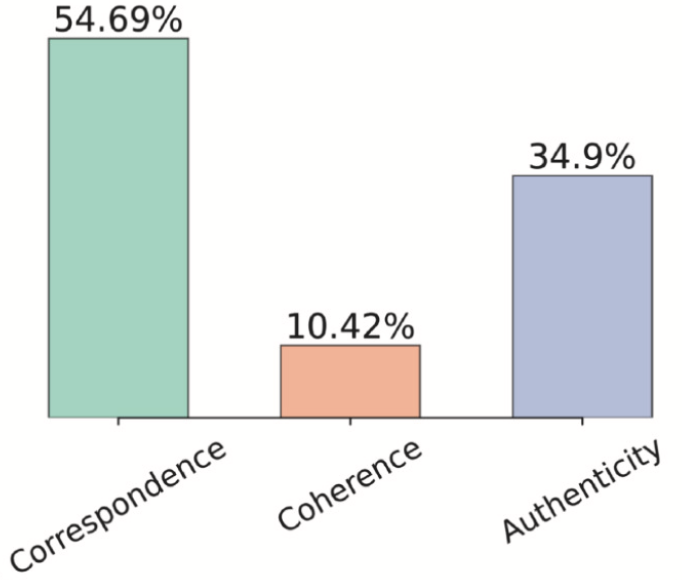
To probe how ordinary people think about what is true, the researchers first created conceptual maps of 200 participants asking how similar they think truth is to other related concepts. For example, correspondence related to “reality” and “fact”; coherence to “justification” and “reason”; and authenticity to “honesty” and “transparency.” While many participants endorsed notions relating to all three conceptions of truth, in a “winner-takes-all” summary of the judgements, 55 percent aligned most strongly with correspondence.
Reuter et al.
In other words, just a bare majority believes that truth is defined by factual reality.
The researchers then wanted to see if these concepts of the truth remained stable in individuals over time. So three months later, they managed to contact 128 of the original participants and ask them to consider what is the truth in the above Maria vignette. In this case, the choice was binary: Was Maria’s statement true or false? As the researchers explained, “A ‘true’ response reflects an authenticity- or coherence-based understanding, as it emphasizes Maria’s sincerity or justification at the time of speaking, while a ‘false’ response reflects a correspondence view, judging truth based on factual alignment with reality.” I have no trouble accepting that Maria could try to justify her sincere and honest belief that Tom was at the party, but the plain truth is that he wasn’t there.
In the later survey, it turns out that an individual’s concept of truth does modestly predict how he or she evaluates the truth of Maria’s statement. The researchers report, “Overall 68 (53.13%) participants responded that Maria’s answer was false (agreeing with correspondence theory) and 60 (46.89%) that her answer was true (agreeing with an authenticity or coherence notion of truth).” Again, a bare majority endorsed factual reality as the standard for determining what is true.
In an article describing their findings over at Psyche, the researchers outline how different conceptions of the truth can cause conflict:
Imagine someone makes a statement about climate change. The discussion unfolds predictably: one side posts links to data (correspondence), the other side cares less about data and replies with accusations of bad faith (authenticity), or they argue that the statement is untrue because it doesn’t fit everything else they already believe to be true (coherence). In such disagreements, giving more of the evidence that convinces you could risk making the conflict worse, not better.
We have all been there, haven’t we? Even for those who endorse the correspondence theory of truth must still grapple with the pervasive problem of confirmation bias.
As I reported a while back, research by the Yale law professor Dan Kahan finds that as scientific literacy goes up, so too does partisan polarization on the issue of climate change. In other words, the more science people know, the more they are able to seek out and find information justifying their beliefs.
Nevertheless, the European researchers suggest hopefully that understanding the differences in the conceptions of what is true may help us more fruitfully navigate political and policy disagreements.