StanChart CEO Scrambles Into Damage Control After “Lower-Value Human Capital” Comment Triggers Backlash

StanChart CEO Scrambles Into Damage Control After “Lower-Value Human Capital” Comment Triggers Backlash

Standard Chartered CEO Bill Winters and his team spent Wednesday in damage-control mode after the head of the London-based international bank told investors on Tuesday that artificial intelligence would be used to replace “lower-value human capital,” sparking a backlash online.

“Many of you will have seen media coverage following the Investor Event in Hong Kong, particularly the reporting around automation, AI, and workforce changes,” Winters wrote in an internal memo to employees on Wednesday that was seen by Bloomberg.

He continued, “I know this may be unsettling when reduced to simple headlines or a quote out of context.”

The outrage stems from STAN’s Tuesday announcement to cut 15% of its corporate roles (about 7,800 jobs) by 2030 as part of a broader efficiency push amid the adoption of AI.

During the investor event, Winters said, “It’s not cost-cutting, it’s replacing low-value human capital with financial and investment capital.” The substitution of workers in favor of machines “will accelerate as we go forward into AI.”

Bloomberg noted that Winters’ memo sent to workers earlier today “adopted a more empathetic tone, emphasizing the bank’s commitment to supporting its workforce during the transition.”

That memo read, “We will continue to invest in technology, platforms, and automation to improve how we operate, serve clients and position the Bank for long-term growth. I want to be absolutely clear that the future of Standard Chartered depends on the talent, judgment, relationships, and commitment of you, our colleagues.”

Socialists were not thrilled with Winters’ “lower-value human capital” comment:

Angry? You should be! This is how the employer described its staff: “lower-value human capital.”

Beyond StanChart, corporate America is losing engineers and other white-collar workers who are burdened by insurmountable student and credit card debt as AI adoption accelerates. This era will likely be remembered as the great “white-collar purge,” and the response may be continued backlash toward data centers.

Earlier today, Meta began cutting 8,000 jobs, while leaked audio of CEO Mark Zuckerberg described how AI is monitoring high-skilled employees. According to X user Official Layoff, who leaked the audio: “AI is replacing the contractor. Then the employee trains the AI. Then the AI replaces the employee.”

Tyler Durden
Wed, 05/20/2026 – 12:25

via ZeroHedge News https://ift.tt/pb6U9kW Tyler Durden

A Tennessee Man Jailed for 37 Days Because of an Anti-Trump Meme Will Get $835,000 for His Trouble


Larry Bushart | LadyJay Creations LLC/FIRE

Last year, Larry Bushart spent 37 days in a Tennessee jail because he had shared a widely circulated anti-Trump meme on Facebook. Today his attorneys announced that he had agreed to settle the resulting federal lawsuit in exchange for a payment of $835,000.

“No one should be hauled off to jail in the dark of night over a harmless meme just because the authorities disagree with its message,” said Adam Steinbaugh, a senior attorney at the Foundation for Individual Rights and Expression (FIRE), which represented Bushart along with local attorney Katherine Phillips. “We’re pleased that Larry has been compensated for this injustice, but local law enforcement never should have forced him to endure this ordeal in the first place.”

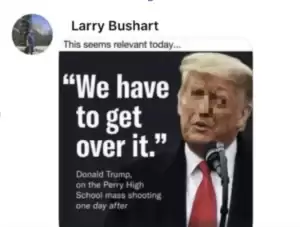
The meme in question, which Bushart posted on September 20 in response to a Facebook announcement of a candlelight vigil for slain conservative activist Charlie Kirk at the Perry County Courthouse, featured a photo of President Donald Trump flanked by a quote from a speech he gave at a campaign rally in Iowa on January 5, 2024. The day before, a gunman had killed two people and injured six others at a high school in Perry, Iowa.

The meme that Bushart shared (Facebook)

“I want to send our support and our deepest sympathies to the victims and families touched by the terrible school shooting yesterday in Perry, Iowa,” Trump said. “It’s just horrible, so surprising to see it here. But we have to get over it. We have to move forward.” The meme, which noted that Trump was talking about “the Perry High School mass shooting one day after,” quoted just six words from those remarks: “We have to get over it.” It was introduced by a comment that had been added by a previous poster: “This seems relevant today…”

The meme falsely implied that Trump had nonchalantly dismissed the murders in Perry, suggested that people likewise should not care about Kirk’s death, and could be read as an allusion to Kirk’s Second Amendment advocacy (a common theme of left-leaning commentary after his assassination). It was certainly insensitive and tendentious, but it also was indisputably speech protected by the First Amendment.

Perry County Sheriff Nick Weems, who had himself promoted the candelight vigil for Kirk, thought otherwise. He preposterously claimed that Bushart had violated a Tennessee law that applies to “a person who recklessly, by any means of communication, threatens to commit an act of mass violence on school property or at a school-related activity.” How so? Weems averred that the meme had caused “mass hysteria in our community” because people confused Iowa’s Perry High School with Tennessee’s Perry County High School.

Weems never presented any evidence of such hysteria, and he acknowledged that he understood the meme was referring to a crime that had been committed nearly two years earlier in another state. But the affidavit that he used to obtain an arrest warrant for Bushart omitted that crucial point.

That was by no means the only problem with the inartfully worded affidavit, which was written by Jason Morrow, one of Weems’ investigators, at the sheriff’s behest. Morrow said the meme was “a means of communication, via picture, posted to a Perry County, TN Facebook page in which a reasonable person would conclude could lead to serious bodily injury, or death of multiple people.” Grammatical infelicities aside, that did not make much sense, since the message itself could not possibly have injured or killed people. Although Morrow alleged that Bushart was guilty of “Threatening Mass Violence at School,” he did not explain in what sense that was true.

Nor did Morrow allege the state of mind required by the statute, which says a defendant can be guilty of this felony only if he acted “recklessly.” That is consistent with the level of culpability that the Supreme Court has said is required to convict someone of making a “true threat,” one of the few recognized exceptions to the First Amendment. “A mental state of recklessness is sufficient,” Justice Elena Kagan wrote for the majority in the 2023 case Counterman v. Colorado. “The State must show that the defendant consciously disregarded a substantial risk that his communications would be viewed as threatening violence.”

A “true threat” also requires a message that is reasonably interpreted as a “serious expression” of an intent to commit violence. On that score, too, Morrow’s affidavit was deficient, since it hinged on a highly improbable understanding of the meme.

The affidavit, in short, plainly did not meet the requirements imposed by Tennessee law and the U.S. Constitution. It nevertheless passed muster with a magistrate—”a nonlawyer with no formal legal education,” as Bushart’s attorneys noted in his December 17 lawsuit, which named Weems, Morrow, and Perry County as defendants. Based on the resulting warrant, Weems asked police in Lexington to arrest Bushart, who was then transferred to the sheriff’s custody. Because Bushart was unable to cover the staggering $2 million bond demanded for his release, he spent 37 days in jail before the district attorney for Perry County dropped the charge against him after the case drew widespread criticism.

When local police took Bushart to a jail in Lexington, an officer informed him that he was accused of “threatening mass violence at a school.” Bushart was flummoxed. “I played on Facebook,” he said. “I threatened no one.” He conceded that “I may have been an asshole, but—” The officer interjected, “That’s not illegal.” That cop seemed to have a better understanding of the law than Weems or Morrow did.

Bushart’s lawsuit alleged that Weems and Morrow violated his Fourth Amendment rights by arresting him without probable cause and violated his First Amendment rights by punishing him for constitutionally protected speech. Morrow’s affidavit “did not support a finding of probable cause to arrest Mr. Bushart because it described solely protected political speech,” Bushart’s lawyers noted. Any “reasonable police officer” would have understood that, they said, and “no reasonable officer” would have interpreted his post as “a threat of violence.” Treating protected speech as a crime was itself a violation of the First Amendment “under color of law,” the complaint argued, and given the context, it was also unconstitutional retaliation for Bushart’s exercise of the rights protected by that guarantee.

“I am pleased my First Amendment rights have been vindicated,” Bushart said. “The people’s freedom to participate in civil discourse is crucial to a healthy democracy. I am looking forward to moving on and spending time with my family.”

FIRE staff attorney Cary Davis emphasized the broader significance of the settlement. “It’s in times of turmoil and heightened tensions that our national commitment to free speech is tested the most,” she said. “When government officials fail that test, the Constitution exists to hold them accountable. Our hope is that Larry’s settlement sends a message to law enforcement across the country: Respect the First Amendment today, or be prepared to pay the price tomorrow.”

The post A Tennessee Man Jailed for 37 Days Because of an Anti-Trump Meme Will Get $835,000 for His Trouble appeared first on Reason.com.

from Latest – Reason.com https://ift.tt/uKTDsjG
via IFTTT

A Tennessee Man Jailed for 37 Days Because of an Anti-Trump Meme Will Get $835,000 for His Trouble


Larry Bushart | LadyJay Creations LLC/FIRE

Last year, Larry Bushart spent 37 days in a Tennessee jail because he had shared a widely circulated anti-Trump meme on Facebook. Today his attorneys announced that he had agreed to settle the resulting federal lawsuit in exchange for a payment of $835,000.

“No one should be hauled off to jail in the dark of night over a harmless meme just because the authorities disagree with its message,” said Adam Steinbaugh, a senior attorney at the Foundation for Individual Rights and Expression (FIRE), which represented Bushart along with local attorney Katherine Phillips. “We’re pleased that Larry has been compensated for this injustice, but local law enforcement never should have forced him to endure this ordeal in the first place.”

The meme in question, which Bushart posted on September 20 in response to a Facebook announcement of a candlelight vigil for slain conservative activist Charlie Kirk at the Perry County Courthouse, featured a photo of President Donald Trump flanked by a quote from a speech he gave at a campaign rally in Iowa on January 5, 2024. The day before, a gunman had killed two people and injured six others at a high school in Perry, Iowa.

The meme that Bushart shared (Facebook)

“I want to send our support and our deepest sympathies to the victims and families touched by the terrible school shooting yesterday in Perry, Iowa,” Trump said. “It’s just horrible, so surprising to see it here. But we have to get over it. We have to move forward.” The meme, which noted that Trump was talking about “the Perry High School mass shooting one day after,” quoted just six words from those remarks: “We have to get over it.” It was introduced by a comment that had been added by a previous poster: “This seems relevant today…”

The meme falsely implied that Trump had nonchalantly dismissed the murders in Perry, suggested that people likewise should not care about Kirk’s death, and could be read as an allusion to Kirk’s Second Amendment advocacy (a common theme of left-leaning commentary after his assassination). It was certainly insensitive and tendentious, but it also was indisputably speech protected by the First Amendment.

Perry County Sheriff Nick Weems, who had himself promoted the candelight vigil for Kirk, thought otherwise. He preposterously claimed that Bushart had violated a Tennessee law that applies to “a person who recklessly, by any means of communication, threatens to commit an act of mass violence on school property or at a school-related activity.” How so? Weems averred that the meme had caused “mass hysteria in our community” because people confused Iowa’s Perry High School with Tennessee’s Perry County High School.

Weems never presented any evidence of such hysteria, and he acknowledged that he understood the meme was referring to a crime that had been committed nearly two years earlier in another state. But the affidavit that he used to obtain an arrest warrant for Bushart omitted that crucial point.

That was by no means the only problem with the inartfully worded affidavit, which was written by Jason Morrow, one of Weems’ investigators, at the sheriff’s behest. Morrow said the meme was “a means of communication, via picture, posted to a Perry County, TN Facebook page in which a reasonable person would conclude could lead to serious bodily injury, or death of multiple people.” Grammatical infelicities aside, that did not make much sense, since the message itself could not possibly have injured or killed people. Although Morrow alleged that Bushart was guilty of “Threatening Mass Violence at School,” he did not explain in what sense that was true.

Nor did Morrow allege the state of mind required by the statute, which says a defendant can be guilty of this felony only if he acted “recklessly.” That is consistent with the level of culpability that the Supreme Court has said is required to convict someone of making a “true threat,” one of the few recognized exceptions to the First Amendment. “A mental state of recklessness is sufficient,” Justice Elena Kagan wrote for the majority in the 2023 case Counterman v. Colorado. “The State must show that the defendant consciously disregarded a substantial risk that his communications would be viewed as threatening violence.”

A “true threat” also requires a message that is reasonably interpreted as a “serious expression” of an intent to commit violence. On that score, too, Morrow’s affidavit was deficient, since it hinged on a highly improbable understanding of the meme.

The affidavit, in short, plainly did not meet the requirements imposed by Tennessee law and the U.S. Constitution. It nevertheless passed muster with a magistrate—”a nonlawyer with no formal legal education,” as Bushart’s attorneys noted in his December 17 lawsuit, which named Weems, Morrow, and Perry County as defendants. Based on the resulting warrant, Weems asked police in Lexington to arrest Bushart, who was then transferred to the sheriff’s custody. Because Bushart was unable to cover the staggering $2 million bond demanded for his release, he spent 37 days in jail before the district attorney for Perry County dropped the charge against him after the case drew widespread criticism.

When local police took Bushart to a jail in Lexington, an officer informed him that he was accused of “threatening mass violence at a school.” Bushart was flummoxed. “I played on Facebook,” he said. “I threatened no one.” He conceded that “I may have been an asshole, but—” The officer interjected, “That’s not illegal.” That cop seemed to have a better understanding of the law than Weems or Morrow did.

Bushart’s lawsuit alleged that Weems and Morrow violated his Fourth Amendment rights by arresting him without probable cause and violated his First Amendment rights by punishing him for constitutionally protected speech. Morrow’s affidavit “did not support a finding of probable cause to arrest Mr. Bushart because it described solely protected political speech,” Bushart’s lawyers noted. Any “reasonable police officer” would have understood that, they said, and “no reasonable officer” would have interpreted his post as “a threat of violence.” Treating protected speech as a crime was itself a violation of the First Amendment “under color of law,” the complaint argued, and given the context, it was also unconstitutional retaliation for Bushart’s exercise of the rights protected by that guarantee.

“I am pleased my First Amendment rights have been vindicated,” Bushart said. “The people’s freedom to participate in civil discourse is crucial to a healthy democracy. I am looking forward to moving on and spending time with my family.”

FIRE staff attorney Cary Davis emphasized the broader significance of the settlement. “It’s in times of turmoil and heightened tensions that our national commitment to free speech is tested the most,” she said. “When government officials fail that test, the Constitution exists to hold them accountable. Our hope is that Larry’s settlement sends a message to law enforcement across the country: Respect the First Amendment today, or be prepared to pay the price tomorrow.”

The post A Tennessee Man Jailed for 37 Days Because of an Anti-Trump Meme Will Get $835,000 for His Trouble appeared first on Reason.com.

from Latest – Reason.com https://ift.tt/uKTDsjG
via IFTTT

The Modern Passport Has Eliminated Fraud, Forgery, and Heroes Who Can Bend the Rules To Save Lives


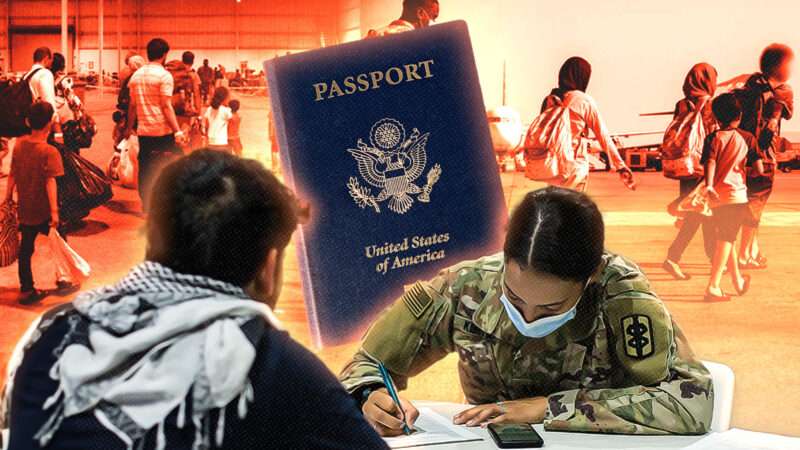
A collage of several different images: one of them a blue U.S. passport book, one of a woman in military fatigues filling out paperwork while talking to a man, the other two images are in the background with an orange tint, showing families with children walking across flat land. | U.S. Marine Corps Forces Central Command/U.S. Army/Svitlana Lutso/Dreamstime

The history of the 20th century, and especially the history of the Holocaust, is replete with bureaucratic heroes like Raoul Wallenberg, Chiune Sugihara, Frank Foley, and Aristides de Sousa Mendes, diplomats who combined to save hundreds of thousands of lives by bending the rules and issuing unauthorized passports or visas to people fleeing persecution. Now, in the 21st century, as we stand ever closer to repeating the horrors of the past century, these rule-bending insiders are nowhere to be found. It isn’t that people aren’t capable of morally taking a stand. It’s that they physically can’t do so.

I would know, because I once tried. As a midlevel visa manager at the U.S. Consulate-General in Mumbai in 2022, I tried to help an Afghan family marooned by the Taliban takeover. The parents already had U.S. visas, but when I tried to issue a visa to their baby, a computer overrode my decision. To this day, I don’t know what happened to that family. These kinds of scenes are repeating around the world, from the closed-up Rafah border crossing between Gaza and Egypt to U.S. deportation proceedings that end in shipment to Salvadoran prisons. Photographs of emaciated people peering through gates are once again becoming common—and their fate is increasingly controlled by faceless systems.

Ironically, the modern immigration system was designed to prevent the repetition of the horrors of World War II and the Holocaust. Implicit in the hopes of the founders of refugee aid societies and the legislators who wrote immigration law was that the 20th century’s mass displacement and mass murder could be made impossible via international cooperation and the codification of human rights. The much more anodyne charters of functional international organizations like the United Nations High Commissioner for Refugees and the International Civil Aviation Organization (ICAO) also carried the assumption that making things systematized and efficient was the way to do that. 

Years ago, in my diplomatic training, State Department instructors sat us down and somberly told us about what Wallenberg did in Hungary. The day might come when we have to choose between our values and the rules, they said. The stories of Sugihara, Foley, Sousa Mendes, and others are also famous in migration management circles, held up as exemplars because they were noble people who did the right thing when it mattered. How many times does a bureaucrat stamping visas get to become a moral hero?

The Diplomats Who Went Rogue

Wallenberg was a Swedish diplomat in Budapest who pushed procedure to the limit. In the bygone days of Hungary’s fascist regime, Wallenberg was creative with his embassy budget: He rented dozens of buildings around the city, declared these buildings Swedish diplomatic facilities with full diplomatic immunity, and sheltered thousands of Hungarian Jews inside. These were people who, absent Wallenberg’s absurdist rule bending and personal initiative, would have been rounded up and sent to concentration camps in a matter of days.

As an Imperial Japanese diplomatic official during World War II, Sugihara makes for an odd hero. But when he found himself in charge of visa issuance at the Japanese consulate in Lithuania, at the time occupied by the Soviet Union, he saw no harm in bending the rules to help people. Sugihara started signing transit visas (permission to travel to and pass through Japan) for basically anyone who needed to flee Lithuania. He didn’t check for onward tickets or financial means. He just stamped the passports and filled out what he had to. At first, Sugihara mostly gave these visas to middle-class businessmen and Jewish yeshiva students fleeing the Soviets, but then he gave them to anybody fleeing the Nazis. This allowed thousands of Lithuanian Jews to make their way from Japan to any country that would take them. As German troops closed in, Sugihara worked tirelessly to issue as many as he could, sometimes working for 18 hours a day. On his way out of the country, Sugihara kept filling out visas until the last possible moment, tossing his final signed and stamped passports out of the train window.

Foley was a British passport control officer in Berlin in the late 1930s who individually saved thousands of German Jews by issuing British visas in Berlin to anybody who needed them before the war even started. Nobody knew it at the time, but Foley was actually a British spy and was only given immigration responsibilities as busywork to cover his identity. That cover story ended up mattering more, for more people, than any spying he ever did.

Sousa Mendes was an aristocratic Portuguese diplomat serving as the consul-general in Bordeaux during the fall of France. In the midst of the general European refugee crisis, the fascist dictatorship of António de Oliveira Salazar issued Circular 14, an order that directed Portuguese consulates to restrict visa issuance to, among others, “Jews expelled from their countries or those from whence they issue, stateless persons, and all those who cannot freely return to the countries whence they come.” This meant essentially everyone who was crowding the streets of unoccupied France looking for visas to neutral countries. Sousa Mendes found Circular 14 disgustingly racist and tried to subvert it. He issued transit and tourist visas without waiting for proper clearance and bent the rules. 

One applicant he bent the rules for challenged him. Why just help a few? Why not everybody? The refugee, a Polish rabbi named Chaim Kruger, refused to accept his visa unless everybody got one. Sousa Mendes fell into a deep moral crisis, and when he snapped out of it, he agreed with Kruger completely. He went rogue and took the entire consulate in Bordeaux with him, completely ignoring not just Circular 14 but every law in the book. He issued visas to everyone, at times even filling out and issuing Portuguese passports to people who were not citizens. (This could be done with a pen, paper, and stamp in 1940.) When he personally drove to the Spanish border to argue with guards to let refugees through, he had gone too far. Lisbon ordered the French government to stop recognizing visas with Sousa Mendes’ signature. Sousa Mendes was recalled to Portugal, investigated by the Salazarist secret police, demoted, fired, and died in ignominious poverty in the 1950s with his own family eating at refugee soup kitchens. By best estimates he saved over 30,000 people.

How the Modern Passport Became an Unbeatable System

In 1938, the German author Irmgard Keun wrote Child of All Nations while on the run from Nazi persecution. The book follows a middle-class exile family running out of options as they flee across Europe. The child protagonist takes note: “A passport is a little booklet with stamps in. Basically, it’s to prove that you’re alive. If you lose your passport, then as far as the whole world is concerned you might as well have died.”

Keun’s child protagonist is right. If you aren’t documented, you don’t exist. This situation came into being quite recently. For most of human history, you just didn’t need a passport, and well into the 20th century, most border control was perfunctory. But passports keep becoming more important, more accurate, and harder to subvert.

Many people who have handed over their ID or passport to a government official have idly wondered what exactly the passport officer is looking at on their screen. How much does the government see about me? The modern biometric passport system is based on standards administered by ICAO, the U.N. body responsible for air travel. Malaysia was the first country to issue a biometric passport in 1998. Now after almost 30 years of regulatory effort by the ICAO, there are only a handful of in the world that don’t use them. The passport contains both a scannable data strip and an embedded chip, meaning any country on Earth can instantly pull up a traveler’s information at the border. The biometric information that’s uploaded to the chip is basically the same on the passport page: age, place of birth, name, birthday. Some countries opt to include significantly more information than that; the United States, for the time being, excludes fingerprints.

More important than the passport itself is the way it is integrated into worldwide databases. The ICAO standard was rolled out shortly before 9/11, and after the attacks, countries everywhere moved away from purely physical visa stickers or stamps to visas backstopped by centralized computer systems. You have a machine-scannable passport that correlates to a database in your home country. In that passport, you have a visa that correlates to a database in the issuing country. Everything gets cross-referenced.

The security benefits are obvious. A “fake passport” in the 21st century essentially does not exist (at least not without the resources of a state). Identity theft is much more difficult. The 21st century system also complicates espionage significantly. If an intelligence agency wants to send a spy to another country, but that person traveled there as a child, their face and fingerprints and legal name are already on file, and their fake identity will be exposed as soon as the passport is swiped at border control. After Hamas commander Mahmoud al-Mabhouh was assassinated in 2010, the Israeli assassins’ fake or stolen western passports were almost immediately unmasked by Dubai police, causing an international incident. It was enough of a cover to get into the country and choke a man to death in a hotel room, but it never fooled anyone long term.

Oversight Became a Tool of Control

The tracking and cross-referencing are deeply restrictive for bureaucrats themselves. Immigration officers and diplomats with an immigration portfolio are now cogs in the wheel of a bigger machine, with their own decisions subject to instant review. They cannot choose to look the other way to slow-roll unjust policies or let vulnerable people escape to safety. They scan passports into government software suites that have user IDs and performance metrics reports that track every action the officer takes. Their names and decisions are entered into government records and associated with the same biometric data that get tagged to the applicant.

Take this hypothetical scenario. Customs and Border Protection officer John Smith admitted traveler Mehmet Yilmaz to the United States at 8:35 a.m. last Tuesday after asking him this set of questions and recording his answers. Mehmet Yilmaz has this face and these fingerprints and this birthday and used a visa issued in the Istanbul consulate by visa officer Jane Doe two months ago with these justifications and this work history and this travel history. All of this information is instantly populated into a centralized database accessible from Washington, D.C., and if Mehmet Yilmaz feels like he’s being surveilled, maybe it gives some cold comfort to know that officers John Smith and Jane Doe are having their own decisions double-checked and assessed by their superiors every step up the chain.

This accountability can be a good thing. The State Department’s Bureau of Consular Affairs maintains its own internal “Wall of Shame” of visa officers who extorted sex or cash bribes from applicants. Due to robust internal tracking, these officers are almost always immediately caught. But the accountability only works in one direction to make the system more restrictive. If you take away individual agency, you expose everyone to the whims of executive power, centrally directed.

Years after the Holocaust, living in retirement, Sugihara mused to himself about what would have happened if his own fascist, Nazi-aligned government had discovered what he did for Lithuanian Jews. “No one ever said anything about it,” he recalled. “I remember thinking that they probably didn’t realize how many I actually issued.” He was just there at his desk in the Japanese consulate in Kaunas with his visa stamp and his pens and his conscience. That world doesn’t exist anymore.

Headquarters today would have instantly noticed the discrepancy, the lack of full vetting, and the slippage in issuance standards. Officials in an office in Tokyo could have digitally canceled every transit visa issued by Sugihara’s user ID and made it show up in other countries’ computer systems. The modern biometric passport system and ID technology foreclose the possibility of individuals of conscience acting alone to do the right thing.

How the Computer Stopped Me From a Common-Sense Solution

I saw it firsthand, soon after putting in my resignation letter from the State Department. One of my last jobs was working at an improvised call center after the U.S. evacuation from Kabul. Every visa officer there had listened to the Afghan interpreters and their family members sob over the phone as they tried to beg their way onto planes without visas, still waiting on the completion of paperwork that didn’t come in time.

Six days before my last day, one of my subordinates came to me with an Afghan baby’s passport, which had been submitted in the interview waiver drop box. (At the time, the U.S. didn’t ask toddlers to show up at visa interviews; the Trump administration changed that rule in October 2025.) “This one is strange. Check it out,” she said. We scanned the passport, and the baby’s entire story appeared. This was the child of two Afghan diplomats, posted to the former Afghan consulate in Mumbai right across town from us, whose situation was now uncertain due to the Taliban takeover. In other words, they were fellow diplomats from an allied government that no longer had a country. Both of this child’s parents had U.S. visas already. If the baby also got one, they could all go to the U.S. together and claim asylum together. Otherwise, they would potentially have to wait for years in penniless exile (or worse, in a concrete-floored Qatari processing camp without functioning toilets) while their case made its way through the shambolic U.S. program for Afghan allies.

“Just issue it,” I told my subordinate. “It’s the least we can do.”

“I’m not comfortable doing that,” she replied. “My name is going to be on the case.”

It was against the rules to issue a tourist visa if you suspect the applicant would use that visa to travel and claim asylum. She was right too; her user ID would go on the case. It would definitely be noticed, and this subordinate was a first-tour officer at the very beginning of her career.

“I quit in six days,” I told her. “I don’t have a career to lose. Hand it over.”

The first-tour officers, fresh out of training on proper procedure, were viscerally uncomfortable as I snatched the passport away from them. I walked to my desk, plugged in vague but acceptable justification notes necessary to print the visa sticker, and hit the issue button. This was my Sugihara moment, trying to throw visas out the train window. I saw a bright red warning and a grayed-out issue button that the computer wouldn’t let me press. Central counterterrorism screening in D.C. had flagged the case for further review. It did not say how or why an infant ended up on this watch list. Red button, can’t issue. I tried to call in a favor from my boss to override it, but was sympathetically told that I didn’t get to do whatever I wanted just because it was my last week. The passport was sent back with a rejection slip. I still don’t know what happened to that baby or the family of young diplomats in the end.

Even if you have nothing to lose, even if you’re in a position of authority in the bureaucratic apparatus, you can’t override the system. The world and the systems used to traverse it feel broken, much like they must have felt in the 1930s and 1940s. Most bureaucrats back then just followed the rules, as they do today. Governments still failed to save most people from the Holocaust and other atrocities. But there was at least the possibility of individual heroism. Rather than being diffused throughout the system, accountability rested directly on the shoulders of individuals in power.

Where in the world today could anyone at a camp gate or border crossing be a hero?

The post The Modern Passport Has Eliminated Fraud, Forgery, and Heroes Who Can Bend the Rules To Save Lives appeared first on Reason.com.

from Latest – Reason.com https://ift.tt/AiOP7sV
via IFTTT

The Modern Passport Has Eliminated Fraud, Forgery, and Heroes Who Can Bend the Rules To Save Lives


A collage of several different images: one of them a blue U.S. passport book, one of a woman in military fatigues filling out paperwork while talking to a man, the other two images are in the background with an orange tint, showing families with children walking across flat land. | U.S. Marine Corps Forces Central Command/U.S. Army/Svitlana Lutso/Dreamstime

The history of the 20th century, and especially the history of the Holocaust, is replete with bureaucratic heroes like Raoul Wallenberg, Chiune Sugihara, Frank Foley, and Aristides de Sousa Mendes, diplomats who combined to save hundreds of thousands of lives by bending the rules and issuing unauthorized passports or visas to people fleeing persecution. Now, in the 21st century, as we stand ever closer to repeating the horrors of the past century, these rule-bending insiders are nowhere to be found. It isn’t that people aren’t capable of morally taking a stand. It’s that they physically can’t do so.

I would know, because I once tried. As a midlevel visa manager at the U.S. Consulate-General in Mumbai in 2022, I tried to help an Afghan family marooned by the Taliban takeover. The parents already had U.S. visas, but when I tried to issue a visa to their baby, a computer overrode my decision. To this day, I don’t know what happened to that family. These kinds of scenes are repeating around the world, from the closed-up Rafah border crossing between Gaza and Egypt to U.S. deportation proceedings that end in shipment to Salvadoran prisons. Photographs of emaciated people peering through gates are once again becoming common—and their fate is increasingly controlled by faceless systems.

Ironically, the modern immigration system was designed to prevent the repetition of the horrors of World War II and the Holocaust. Implicit in the hopes of the founders of refugee aid societies and the legislators who wrote immigration law was that the 20th century’s mass displacement and mass murder could be made impossible via international cooperation and the codification of human rights. The much more anodyne charters of functional international organizations like the United Nations High Commissioner for Refugees and the International Civil Aviation Organization (ICAO) also carried the assumption that making things systematized and efficient was the way to do that. 

Years ago, in my diplomatic training, State Department instructors sat us down and somberly told us about what Wallenberg did in Hungary. The day might come when we have to choose between our values and the rules, they said. The stories of Sugihara, Foley, Sousa Mendes, and others are also famous in migration management circles, held up as exemplars because they were noble people who did the right thing when it mattered. How many times does a bureaucrat stamping visas get to become a moral hero?

The Diplomats Who Went Rogue

Wallenberg was a Swedish diplomat in Budapest who pushed procedure to the limit. In the bygone days of Hungary’s fascist regime, Wallenberg was creative with his embassy budget: He rented dozens of buildings around the city, declared these buildings Swedish diplomatic facilities with full diplomatic immunity, and sheltered thousands of Hungarian Jews inside. These were people who, absent Wallenberg’s absurdist rule bending and personal initiative, would have been rounded up and sent to concentration camps in a matter of days.

As an Imperial Japanese diplomatic official during World War II, Sugihara makes for an odd hero. But when he found himself in charge of visa issuance at the Japanese consulate in Lithuania, at the time occupied by the Soviet Union, he saw no harm in bending the rules to help people. Sugihara started signing transit visas (permission to travel to and pass through Japan) for basically anyone who needed to flee Lithuania. He didn’t check for onward tickets or financial means. He just stamped the passports and filled out what he had to. At first, Sugihara mostly gave these visas to middle-class businessmen and Jewish yeshiva students fleeing the Soviets, but then he gave them to anybody fleeing the Nazis. This allowed thousands of Lithuanian Jews to make their way from Japan to any country that would take them. As German troops closed in, Sugihara worked tirelessly to issue as many as he could, sometimes working for 18 hours a day. On his way out of the country, Sugihara kept filling out visas until the last possible moment, tossing his final signed and stamped passports out of the train window.

Foley was a British passport control officer in Berlin in the late 1930s who individually saved thousands of German Jews by issuing British visas in Berlin to anybody who needed them before the war even started. Nobody knew it at the time, but Foley was actually a British spy and was only given immigration responsibilities as busywork to cover his identity. That cover story ended up mattering more, for more people, than any spying he ever did.

Sousa Mendes was an aristocratic Portuguese diplomat serving as the consul-general in Bordeaux during the fall of France. In the midst of the general European refugee crisis, the fascist dictatorship of António de Oliveira Salazar issued Circular 14, an order that directed Portuguese consulates to restrict visa issuance to, among others, “Jews expelled from their countries or those from whence they issue, stateless persons, and all those who cannot freely return to the countries whence they come.” This meant essentially everyone who was crowding the streets of unoccupied France looking for visas to neutral countries. Sousa Mendes found Circular 14 disgustingly racist and tried to subvert it. He issued transit and tourist visas without waiting for proper clearance and bent the rules. 

One applicant he bent the rules for challenged him. Why just help a few? Why not everybody? The refugee, a Polish rabbi named Chaim Kruger, refused to accept his visa unless everybody got one. Sousa Mendes fell into a deep moral crisis, and when he snapped out of it, he agreed with Kruger completely. He went rogue and took the entire consulate in Bordeaux with him, completely ignoring not just Circular 14 but every law in the book. He issued visas to everyone, at times even filling out and issuing Portuguese passports to people who were not citizens. (This could be done with a pen, paper, and stamp in 1940.) When he personally drove to the Spanish border to argue with guards to let refugees through, he had gone too far. Lisbon ordered the French government to stop recognizing visas with Sousa Mendes’ signature. Sousa Mendes was recalled to Portugal, investigated by the Salazarist secret police, demoted, fired, and died in ignominious poverty in the 1950s with his own family eating at refugee soup kitchens. By best estimates he saved over 30,000 people.

How the Modern Passport Became an Unbeatable System

In 1938, the German author Irmgard Keun wrote Child of All Nations while on the run from Nazi persecution. The book follows a middle-class exile family running out of options as they flee across Europe. The child protagonist takes note: “A passport is a little booklet with stamps in. Basically, it’s to prove that you’re alive. If you lose your passport, then as far as the whole world is concerned you might as well have died.”

Keun’s child protagonist is right. If you aren’t documented, you don’t exist. This situation came into being quite recently. For most of human history, you just didn’t need a passport, and well into the 20th century, most border control was perfunctory. But passports keep becoming more important, more accurate, and harder to subvert.

Many people who have handed over their ID or passport to a government official have idly wondered what exactly the passport officer is looking at on their screen. How much does the government see about me? The modern biometric passport system is based on standards administered by ICAO, the U.N. body responsible for air travel. Malaysia was the first country to issue a biometric passport in 1998. Now after almost 30 years of regulatory effort by the ICAO, there are only a handful of in the world that don’t use them. The passport contains both a scannable data strip and an embedded chip, meaning any country on Earth can instantly pull up a traveler’s information at the border. The biometric information that’s uploaded to the chip is basically the same on the passport page: age, place of birth, name, birthday. Some countries opt to include significantly more information than that; the United States, for the time being, excludes fingerprints.

More important than the passport itself is the way it is integrated into worldwide databases. The ICAO standard was rolled out shortly before 9/11, and after the attacks, countries everywhere moved away from purely physical visa stickers or stamps to visas backstopped by centralized computer systems. You have a machine-scannable passport that correlates to a database in your home country. In that passport, you have a visa that correlates to a database in the issuing country. Everything gets cross-referenced.

The security benefits are obvious. A “fake passport” in the 21st century essentially does not exist (at least not without the resources of a state). Identity theft is much more difficult. The 21st century system also complicates espionage significantly. If an intelligence agency wants to send a spy to another country, but that person traveled there as a child, their face and fingerprints and legal name are already on file, and their fake identity will be exposed as soon as the passport is swiped at border control. After Hamas commander Mahmoud al-Mabhouh was assassinated in 2010, the Israeli assassins’ fake or stolen western passports were almost immediately unmasked by Dubai police, causing an international incident. It was enough of a cover to get into the country and choke a man to death in a hotel room, but it never fooled anyone long term.

Oversight Became a Tool of Control

The tracking and cross-referencing are deeply restrictive for bureaucrats themselves. Immigration officers and diplomats with an immigration portfolio are now cogs in the wheel of a bigger machine, with their own decisions subject to instant review. They cannot choose to look the other way to slow-roll unjust policies or let vulnerable people escape to safety. They scan passports into government software suites that have user IDs and performance metrics reports that track every action the officer takes. Their names and decisions are entered into government records and associated with the same biometric data that get tagged to the applicant.

Take this hypothetical scenario. Customs and Border Protection officer John Smith admitted traveler Mehmet Yilmaz to the United States at 8:35 a.m. last Tuesday after asking him this set of questions and recording his answers. Mehmet Yilmaz has this face and these fingerprints and this birthday and used a visa issued in the Istanbul consulate by visa officer Jane Doe two months ago with these justifications and this work history and this travel history. All of this information is instantly populated into a centralized database accessible from Washington, D.C., and if Mehmet Yilmaz feels like he’s being surveilled, maybe it gives some cold comfort to know that officers John Smith and Jane Doe are having their own decisions double-checked and assessed by their superiors every step up the chain.

This accountability can be a good thing. The State Department’s Bureau of Consular Affairs maintains its own internal “Wall of Shame” of visa officers who extorted sex or cash bribes from applicants. Due to robust internal tracking, these officers are almost always immediately caught. But the accountability only works in one direction to make the system more restrictive. If you take away individual agency, you expose everyone to the whims of executive power, centrally directed.

Years after the Holocaust, living in retirement, Sugihara mused to himself about what would have happened if his own fascist, Nazi-aligned government had discovered what he did for Lithuanian Jews. “No one ever said anything about it,” he recalled. “I remember thinking that they probably didn’t realize how many I actually issued.” He was just there at his desk in the Japanese consulate in Kaunas with his visa stamp and his pens and his conscience. That world doesn’t exist anymore.

Headquarters today would have instantly noticed the discrepancy, the lack of full vetting, and the slippage in issuance standards. Officials in an office in Tokyo could have digitally canceled every transit visa issued by Sugihara’s user ID and made it show up in other countries’ computer systems. The modern biometric passport system and ID technology foreclose the possibility of individuals of conscience acting alone to do the right thing.

How the Computer Stopped Me From a Common-Sense Solution

I saw it firsthand, soon after putting in my resignation letter from the State Department. One of my last jobs was working at an improvised call center after the U.S. evacuation from Kabul. Every visa officer there had listened to the Afghan interpreters and their family members sob over the phone as they tried to beg their way onto planes without visas, still waiting on the completion of paperwork that didn’t come in time.

Six days before my last day, one of my subordinates came to me with an Afghan baby’s passport, which had been submitted in the interview waiver drop box. (At the time, the U.S. didn’t ask toddlers to show up at visa interviews; the Trump administration changed that rule in October 2025.) “This one is strange. Check it out,” she said. We scanned the passport, and the baby’s entire story appeared. This was the child of two Afghan diplomats, posted to the former Afghan consulate in Mumbai right across town from us, whose situation was now uncertain due to the Taliban takeover. In other words, they were fellow diplomats from an allied government that no longer had a country. Both of this child’s parents had U.S. visas already. If the baby also got one, they could all go to the U.S. together and claim asylum together. Otherwise, they would potentially have to wait for years in penniless exile (or worse, in a concrete-floored Qatari processing camp without functioning toilets) while their case made its way through the shambolic U.S. program for Afghan allies.

“Just issue it,” I told my subordinate. “It’s the least we can do.”

“I’m not comfortable doing that,” she replied. “My name is going to be on the case.”

It was against the rules to issue a tourist visa if you suspect the applicant would use that visa to travel and claim asylum. She was right too; her user ID would go on the case. It would definitely be noticed, and this subordinate was a first-tour officer at the very beginning of her career.

“I quit in six days,” I told her. “I don’t have a career to lose. Hand it over.”

The first-tour officers, fresh out of training on proper procedure, were viscerally uncomfortable as I snatched the passport away from them. I walked to my desk, plugged in vague but acceptable justification notes necessary to print the visa sticker, and hit the issue button. This was my Sugihara moment, trying to throw visas out the train window. I saw a bright red warning and a grayed-out issue button that the computer wouldn’t let me press. Central counterterrorism screening in D.C. had flagged the case for further review. It did not say how or why an infant ended up on this watch list. Red button, can’t issue. I tried to call in a favor from my boss to override it, but was sympathetically told that I didn’t get to do whatever I wanted just because it was my last week. The passport was sent back with a rejection slip. I still don’t know what happened to that baby or the family of young diplomats in the end.

Even if you have nothing to lose, even if you’re in a position of authority in the bureaucratic apparatus, you can’t override the system. The world and the systems used to traverse it feel broken, much like they must have felt in the 1930s and 1940s. Most bureaucrats back then just followed the rules, as they do today. Governments still failed to save most people from the Holocaust and other atrocities. But there was at least the possibility of individual heroism. Rather than being diffused throughout the system, accountability rested directly on the shoulders of individuals in power.

Where in the world today could anyone at a camp gate or border crossing be a hero?

The post The Modern Passport Has Eliminated Fraud, Forgery, and Heroes Who Can Bend the Rules To Save Lives appeared first on Reason.com.

from Latest – Reason.com https://ift.tt/AiOP7sV
via IFTTT
America’s Highway Fund Is Running Out of Money. Congress Wants To Spend New Funds on Not Fixing Highways.


A booth in an Amtrak train car | Illustration: Midjourney

As the national debt rises ever higher, Congress is gearing up to pass an enormous infrastructure spending bill.

Earlier this week, the House Transportation and Infrastructure Committee released the BUILD America 250 Act. The sprawling 1000-page bill combines some hits—including provisions to streamline environmental reviews of infrastructure projects—with some obvious misses.

Lawmakers claim that the bill would strengthen the Highway Trust Fund, which pays for both road maintenance and mass transit investments, by levying a new registration fee on electric vehicles (E.V.) and plug-in hybrids. But Marc Scribner, senior transportation policy analyst at Reason Foundation (the nonprofit that publishes this site), tells Reason that it “won’t come close to eliminating the revenue-outlay gap,” since the bill fails to rein in the “irresponsible spending” that has doomed the fund to insolvency by 2028. Scribner’s assessment seems to be shared by the Committee for a Responsible Federal Budget, which finds that although the E.V. fee could raise around $30 billion in the next decade, “the Highway Trust Fund will remain severely out of balance.”

“This may well be the last federal highway bill,” Scribner warns.

If it is, then Congress sure isn’t making the most of it. Throughout the bill, there are several provisions that have little to do with building smooth roads and sturdy bridges.

For instance, in its current form, the BUILD America 250 Act would legally require any public-facing establishment larger than 800 square feet to allow commercial delivery drivers to use its bathroom. If a store’s owner had an employee-only policy for their toilet, or were worried about the cleaning costs associated with its use by delivery drivers, or were just plain stingy and particular about who they wanted on their property, they would be out of luck. This might sound like an odd matter for Congress to involve itself in, with the full weight of the law behind it, but Scribner assures Reason that, “yes, the bathroom access thing is real.” And the exemptions it outlines, he says, are “pretty narrow”—bathroom access would be required as long as it “would not pose an obvious security risk to the…establishment.”

Even more astounding, Scribner says, is “the perennial congressional interest in Amtrak food and beverage service.” Indeed, the bill would require the comptroller general to conduct a review of Amtrak’s snack offerings, including their adherence to the new Make America Healthy Again (MAHA) dietary guidelines and “the feasibility of providing traditional dining to all passengers” on Amtrak trains. After the comptroller general files her report, Amtrak would be required to review it in an internal committee made up of delegates from the company itself, organized labor, “nonprofit organizations representing Amtrak passengers,” and state governments.

In an email to Reason, Ross Marchand, executive director of the Taxpayers Protection Alliance, characterizes the food-and-beverage review as “a complete waste of taxpayer dollars” and thinks “lawmakers should have Amtrak focus less on tinkering with its current fresh vegetable crudité offerings and more on its $47 billion repair backlog.”

And then there’s the yellow paint. Tucked in the bill is a provision that directs the transportation secretary to study the feasibility of buying solely American-made yellow paint for road and highway markings, in line with federal Buy American requirements. With only one factory in the country that makes the right kind of paint for the job, this part of the bill—if passed—would amount to a handout for Sun Chemical and its facility in Muskegon, Michigan. In February, John Nichols, the union president at the plant, told the local ABC affiliate that these Buy American provisions would bring 20 new jobs to the factory.

Marchand says that “paint-specific figures are hard to come by, but…because domestic procurement requirements result in a 5.6 percent increase in taxpayer costs, a wider push toward ‘Buy American’ for pavement marking would put taxpayers on the line for an extra $200 million per year.”

However, Scribner cautions that mere “studies” like the one in this bill are often an indication that “the supporters of whatever measure…being studied lost the debate for inclusion.” So it may be a while before Congress actually appropriates the money to buy the paint.

Given the sorry state of the Highway Trust Fund, one might expect lawmakers to apply serious fiscal discipline or try novel ways to fund road and bridge upgrades. Instead, Congress seems intent on maintaining the status quo with another piece of legislation that authorizes wildly reckless spending and threatens more in the future.

The post America's Highway Fund Is Running Out of Money. Congress Wants To Spend New Funds on Not Fixing Highways. appeared first on Reason.com.

from Latest – Reason.com https://ift.tt/QjIulRe
via IFTTT

There Was No Delcy Rodríguez in Iran


President Donald Trump, with background photo of U.S. battleships | Illustration: Adani Samat. Photo: U.S. CENTCOM/Sipa USA/Newscom

The operation to oust Venezuelan President Nicolás Maduro in January was as successful as it could have been. U.S. operatives seized Maduro from his palace without losing a single man, and Venezuelan Vice President Delcy Rodríguez has been completely compliant with U.S. demands since then. Earlier this week, she handed over former Industry Minister Alex Saab to face trial in the U.S. for financial crimes.

U.S. President Donald Trump said publicly that he was expecting the same thing to happen when he attacked Iran alongside Israel, which assassinated Iranian Supreme Leader Ali Khamenei, in February. “What we did in Venezuela, I think, is the perfect, the perfect scenario,” Trump told the New York Times a few days into the war. A couple of days after that, he said that he would be involved in picking Iran’s new leader, “like with Delcy in Venezuela.” An administration official told The Wall Street Journal that the new model for U.S. intervention would be called “decapitate and delegate.”

Trump did not, in fact, get to choose Iran’s new leader. The Iranian government crowned Khamenei’s son Mojtaba the new supreme leader, which Trump said he was “not happy” with. The administration had originally hoped that Iran’s National Security Council Secretary Ali Larijani could be a “transitional candidate,” a source told CNN, but decided to kill him after he led Iran’s retaliation in the war. Later, administration officials told Politico that they were “testing” whether Speaker of Parliament Mohammad Bagher Ghalibaf could be the Delcy of Iran.

However U.S. officials try to spin it, the Trump administration simply does not control Iran like it controls Venezuela. For nearly three months, the Trump administration has tried using a combination of carrots and sticks to get Iran to accept U.S. demands. On Sunday, the United Arab Emirates blamed Iran for a drone attack near an Emirati nuclear power plant. The next day, Trump said that he was delaying a planned attack on Iran at the request of Arab states, including the Emirates.

Why hasn’t the Trump administration been able to repeat the Venezuelan model in Iran? In short, it’s because Trump didn’t actually try to “decapitate and delegate” in Iran. Unlike the U.S. operation in Venezuela, which was aimed at the man in charge and left the political regime intact, the U.S. campaign in Iran was a war against the entire Islamic Republic. While Trump’s specific demands of Iran have shifted around quite a bit, he has consistently asked for a public, humiliating surrender.

Some observers—from Mehdi Parpanchi, editor of the opposition outlet Iran International, to Danny Citrinowicz, former head of Iranian affairs for Israeli military intelligence—have tried to claim that a Venezuelan scenario was always impossible in Iran, because the Islamic Republic is too ideologically entrenched. But that ignores important overlaps between the two countries. Maduro also had an army of ideological enforcers, which Rodríguez now has to wrangle. And plenty of Iranian insiders were disillusioned enough with Islamist ideology to look for an exit or even spy for foreign powers.

The core issue is that Trump attacked the interests of the Iranian state in ways that go beyond ideology. His opening message of the war told every Iranian in uniform, from high commanders to cops on the street, that they were a target for “certain death.” That message also hinted that the U.S. was going to foment revolution in Iran. A few days into the war, the administration began telling the media about a plan to use Kurdish rebels to get the uprising rolling. 

The U.S.-Israeli attacks killed hundreds of Iranians, both military and civilians, in the first two days alone. Trump himself admitted that some of them were “the people we had in mind” to lead Iran. An Israeli military operation to free former Iranian President Mahmoud Ahmadinejad from captivity nearly killed him, too.

Although U.S. Secretary of State Marco Rubio blamed Iran’s intransigence on the Islamic Revolutionary Guard Corps, the elite branch of the military, Trump’s proudest attacks were on the Iranian air force and navy, part of the regular conscript military that dates back to before the Islamic Revolution.

In other words, the entire Iranian elite (and a good chunk of the rank-and-file) had their backs to the wall. The Delcy of Iran was dead before she could even cut a deal. And if they weren’t killed by foreign bombs, these leaders might face a firing squad for their role in suppressing the January 2026 uprising, which Trump was promising to avenge.

As the war dragged on, the U.S.-Israeli military campaign began to target infrastructure that any Iranian government—whether Islamist or secular, dictatorial or democratic—would need to run the country. Bombs destroyed Iranian steel mills, railroads, bridges, and even college campuses as Trump threatened to do the same to the country’s electrical infrastructure. It doesn’t take a true believer in political Islam to want to deter these attacks from happening again.

The Trump administration was right to see Larijani and Ghalibaf as “pragmatists.” Larijani reportedly presented Khamenei with a plan for Chinese-style reforms after violently putting down protests, and Ghalibaf is a ruthless, transactional operator who has constantly shifted his public image depending on the ideology of the moment. But “pragmatic” doesn’t mean “pushover.” Precisely because these men wanted to save their own skins and preserve their power, they had to play hardball with the United States. The same cost-benefit calculation that led Rodríguez to submit would lead Iran’s leaders to resist.

Rather than asking why Iran wasn’t like Venezuela, the question should be why Trump thought that the scenario would turn out that way. For all the contradictory reporting on what Trump’s advisers did or didn’t tell him, it’s important to bear in mind that the Biden administration was also considering an attack on Iran at the end of its term. Iran had been shockingly passive while suffering setback after setback in its post–October 2023 conflicts with Israel. Expert warnings about a regional war were proven wrong.

And the high of Maduro’s overthrow was intoxicating. The success of that operation seemed to show that anything was possible, and the January 2026 uprising in Iran presented an opportunity to rack up a streak of wins, caution be damned. Despite setbacks in Iran, the inner circle of foreign policy elites may still be chasing opportunities to repeat the Venezuelan model. Trump administration sources told Politico that it is seriously considering a military attack on Cuba, which would present a much weaker target than Iran.

“The initial idea on Cuba was that the leadership was weak and that the combination of stepped-up sanctions enforcement, really an oil blockade, and clear U.S. military wins in Venezuela and Iran would scare the Cubans into making a deal,” one of the sources said. “Now Iran has gone sideways, and the Cubans are proving much tougher than originally thought. So now military action is on the table in a way that it wasn’t before.”

The post There Was No Delcy Rodríguez in Iran appeared first on Reason.com.

from Latest – Reason.com https://ift.tt/Q1EjPxk
via IFTTT

Why Populism Leads to Decline

Today’s guest is Johan Norberg, a senior fellow at the Cato Institute and the author of Peak Human: What We Can Learn From the Rise and Fall of Golden Ages.

He talks with Nick Gillespie about the historical patterns behind flourishing civilizations, from the Roman Republic to modern America. Norberg argues that societies thrive when they remain open to trade, immigration, experimentation, and new ideas, but begin to decay when fear and nostalgia push them toward protectionism, centralization, and tribal politics.

They also discuss the resurgence of populism in the United States and Europe, why tariffs and anti-globalization politics keep returning throughout history, and whether America is becoming more risk-averse and nativist. Norberg explains why he believes optimism and innovation can still win, explores the promise of artificial intelligence, and reflects on whether China is entering a new golden age or repeating the mistakes that led past civilizations into decline.


0:00—Why open societies thrive

3:07—The Roman Republic

10:05—America as a creedal nation

11:57—The rise of nativism

16:15—The dangers of nostalgia

20:31—What sparks renaissance?

26:40—Are older societies more risk averse?

28:33—Populism and Viktor Orbán’s defeat

32:04—Left-wing populism

34:10—Javier Milei

35:42—Tariffs and free trade

40:28—Is China in a golden age?

The post Why Populism Leads to Decline appeared first on Reason.com.

from Latest – Reason.com https://ift.tt/ePUvaD4
via IFTTT

Three Supertankers Carrying 6 Million Barrels Exit Strait Of Hormuz

Three Supertankers Carrying 6 Million Barrels Exit Strait Of Hormuz

Three commercial supertankers carrying a combined 6 million barrels of Middle East crude oil have successfully exited the Strait of Hormuz, according to Reuters.

The vessels departed the strategic waterway on Wednesday, after being stranded inside the Persian Gulf for over two months, lending hope to an end to the closure of the strait.

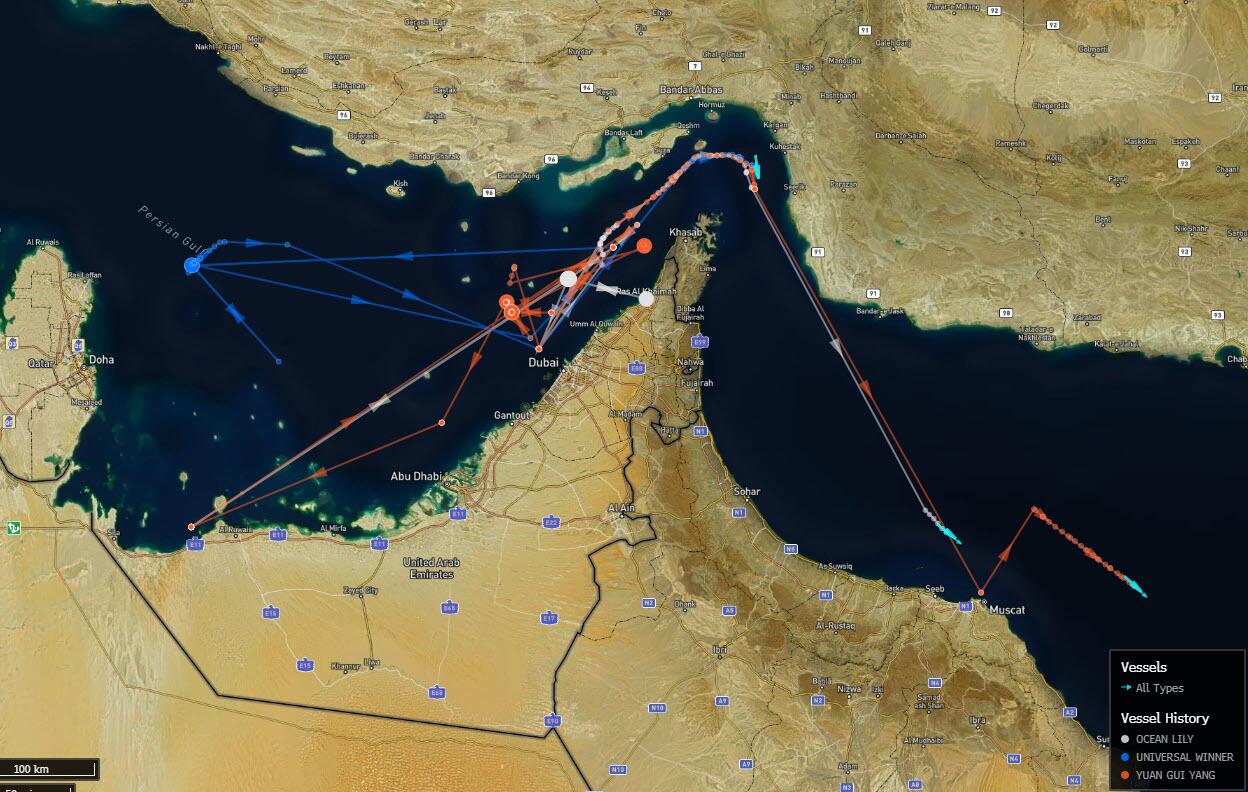
The crude cargoes were split evenly among three Very Large Crude Carriers (VLCCs) heading to Asian refining hubs. The first was Universal Winner, a South Korean-flagged supertanker carrying 2 million barrels of Kuwaiti crude oil. Shipping data on LSEG and Kpler showed that the vessel is currently en route to Ulsan, South Korea, to discharge at an SK Energy facility by June 9.

The second VLCC was Yuan Gui Yang, a Chinese-flagged vessel hauling 2 million barrels of Iraqi Basrah crude. Chartered by Unipec (the trading arm of Sinopec), the supertanker is heading toward Guangdong province with an expected arrival on June 4.

Finally there was Ocean Lily, a Hong Kong-flagged tanker loaded with 2 million barrels split evenly between Qatari al-Shaheen and Iraqi Basrah crude. Owned by Sinochem, the vessel is tracking toward Fujian province for a June 5 arrival.

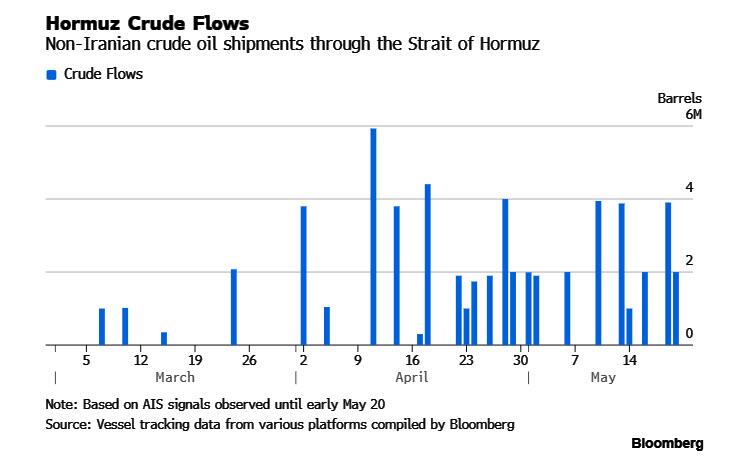
Combined, the trio have about 6 million barrels of crude on board — one of the biggest oil flows in a single 24 hour period in over a month.

All three vessels switched off their digital transponders before exiting. Two have since transited the strait and were sighted near Oman while the status of the third is unclear. It also remains to be seen if they all can get past a seaparte US blockade. The supertanker heading to South Korea, the Universal Winner, is the first observed sailing by a VLCC to the Asian country since the war began.

Iran’s state TV underscored that the country now appears to be in sole control over who crosses the strait and who doesn’t. “Today other countries like South Korea, taking their example from the Chinese, coordinated with the IRGC navy and arranged the passage of their ships through the Strait of Hormuz,” the TV correspondent says in report from near the strait. “Coordination increased today and it’s expected to increase further tomorrow”

The correspondent said he witnessed five oil supertankers passing the strait with IRGC coordination, without giving further details

Meanwhile, following the footsteps of China and South Korea, India is preparing to send its own vessels through the Strait of Hormuz to load up energy cargoes from suppliers in the Middle East, Bloomberg reported; it would be the first time since the Iran conflict began that the country will do so.

State-owned Shipping Corp. of India is ready to go back to the Persian Gulf once it has approval from the Indian Navy and it has business from oil refiners, one of the people said. 

Shipping through Hormuz, which handles roughly a fifth of global oil flows, has been virtually halted since the Iran war began at the end of February, causing major disruptions and price shocks for countries like India, the world’s third-largest crude importer. It’s unclear whether Iran or the US, which are separately blockading the strait and surrounding waters amid the war, have given India a green light to send ships through the waterway. Their agreement will be critical for the plan to work. 

India’s External Affairs Minister Subrahmanyam Jaishankar met his Iranian counterpart Abbas Araghchi in New Delhi on the sidelines of a BRICS summit last week.

Recent White House briefings indicated potential progress toward an agreement to de-escalate hostilities, giving energy markets hope for a more permanent reopening of the chokepoint. Details on permanent enforcement or full reopening conditions remain sparse despite reports of Washington and Tehran having allegedly engaged in productive conversations via mediators, often with contradictory statements.

Few ships have so far managed to break through the Strait of Hormuz, with regional oil exports currently well below pre-war baselines.

Energy analysts emphasize that even if the conflict ends immediately, a backlog of structural damages and shuttered upstream infrastructure means market normalization will likely take three to four months and high oil prices are likely to persist.

Tyler Durden
Wed, 05/20/2026 – 11:45

via ZeroHedge News https://ift.tt/EmUj6BJ Tyler Durden

The AI Economy, Part 1: Looking Beyond The Facade

The AI Economy, Part 1: Looking Beyond The Facade

Authored by Michael Lebowitz via RealInvestmentAdvice.com,

The US economy’s curb appeal looks great. Consider that gasoline prices are nearly $5, crude oil is trading above $100, consumer sentiment is at historically low levels, and mortgage and other interest rates have remained relatively high. Yet, despite the worrisome headwinds, the US consumer-driven economy continues to expand. However, as with a house’s curb appeal, it’s not just the headline data that defines an economy. Equally important is its supporting structure. Let’s open the door to our economy to better appreciate how AI is currently impacting it and how it may change in the future.  

The question we explore here is whether the AI investment boom is genuinely broadening this country’s economic footing or weakening the labor force, the foundation of the economy.

We separate the article into two parts. Part one is the optimistic case: an AI-induced, productivity-led economic boom in which the benefits spread quickly to society.  Part Two will address a more bearish outlook: the possibility of a large gap in the distribution of AI’s productivity benefits, accruing to corporations much more quickly than to employees.  

AI Spending Drives GDP

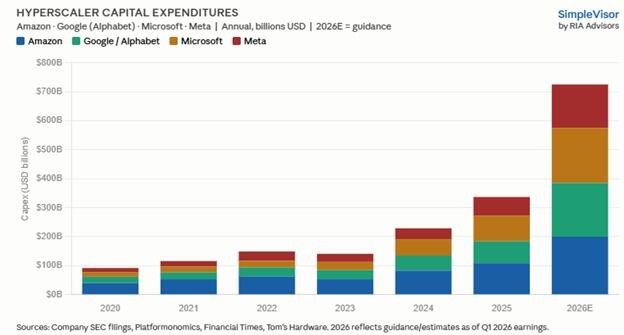
The amount of capital flowing into AI infrastructure development and thus GDP is enormous. As shown in the graph below, the capital expenditures (Capex) of just four companies, Amazon, Google, Microsoft, and Meta, are now over $700 billion annually, roughly 7x what they were five years ago. Based on the 2026 Capex expectations, a third of GDP growth could come from the four companies.

The AI buildout extends well beyond the four balance sheets noted above. Every dollar of Capex spent by the large hyperscalers creates demand across a wide supply chain. For example, construction firms are building data center campuses the size of small cities, utility companies are scrambling to add generation capacity, domestic semiconductor producers are ramping up output, and fiber optic and networking suppliers have multi-year order backlogs. The electrical grid is facing its first sustained demand growth in two decades, driven almost entirely by data center power requirements, which are projected to more than double by 2030.

Historical Context

The scale of today’s AI buildout has historical precedent. For instance, the railroad expansion of the mid-1800s involved more extreme infrastructure investment, with railway Capex estimated to have consumed as much as 10-20% of GDP at its peak. A more recent and appropriate comparison is the telecom buildout of the late 1990s, when Capex peaked at roughly 1.0-1.2% of US GDP. Today’s AI infrastructure spending by just the four companies has recently surpassed that telecom figure.

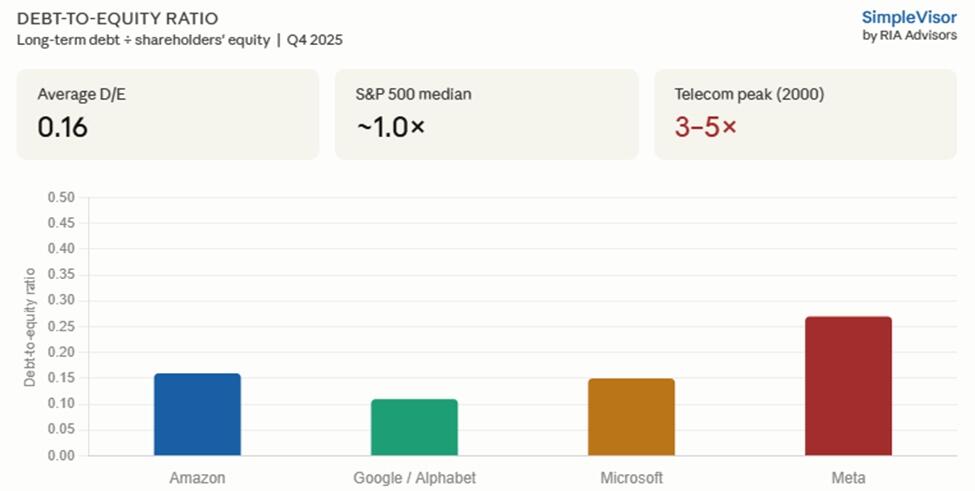
But unlike the debt-fueled telecom boom, today’s AI spending has thus far been funded almost entirely by the cash and cash flows of extremely profitable corporations. While the composition of funding is shifting from cash and free cash flow to debt, the companies noted above have debt-to-equity ratios well below the S&P 500 average and significantly lower than during the telecom buildout. Moreover, earnings from other highly profitable business lines will continue to provide them with substantial cash for investment.

The Consumer Is Resilient But Running Thin

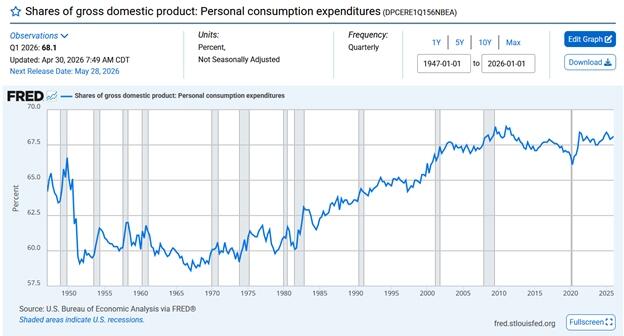
While AI spending is tremendous and boosting the economy, some argue that it is masking weaknesses in consumer spending, which is the most important contributor to economic growth.  The graph below shows that consumer spending accounts for about 67% of GDP, as it has since 2001. There has been no discernible change over the last few years since the advent of AI.

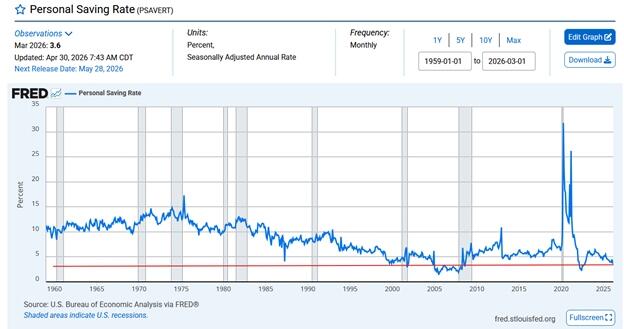
While the recent contribution of consumer spending has not changed meaningfully, its sustainability is a key factor driving future growth. While consumption is holding, there are signs that the means to spend are deteriorating. For instance, the personal savings rate has fallen to near its lowest level since 1960, as shown below. This suggests that a growing share of personal consumption is being funded by drawing down savings rather than by current earnings.

Such behavior is not unusual during periods of strong employment, as consumers spend more when they are confident about their job and wage prospects. That said, a low savings rate is a yellow flag, but it has coexisted with healthy economic expansions before.

The more important gauge of future consumption is wages, which leads us to the labor market

A Churning Labor Market

AI will swallow up jobs, some pessimists say. Thus far, that is not the case. For instance, in 2025, nearly 55,000 of 1.17 million layoffs were directly attributed to AI, according to Challenger, Gray & Christmas. Other estimates peg the number higher at 200,000–300,000 positions in 2025. While that estimate is more concerning, it is only about 0.15–0.20% of total nonfarm employment.

Looking forward, the outlook gets murky. Goldman Sachs has a dire outlook with 300 million jobs globally at risk. But that only tells half the story. The World Economic Forum (WEF) estimates that AI will create 170 million jobs globally.

There is no doubt that AI will have significant impacts on the economy, labor market, and many individuals. Prior innovations are proof. To wit, about two-thirds of US jobs in the 1940s no longer exist. The replacement jobs were enabled by new innovations.

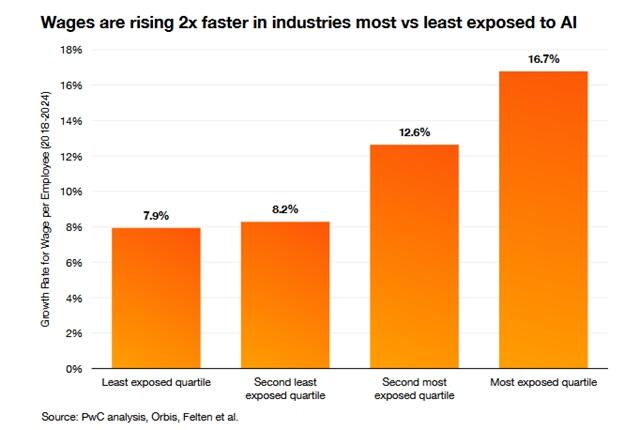
While the future remains uncertain, the past relationship between job growth, wages, and productivity is encouraging. As we share below, PwC claims “wages are rising 2x faster in industries most vs least exposed to AI.”

Productivity Gains Will Spread

Economic growth and wage growth are a direct function of productivity. Productivity measures the amount of leverage an economy can generate from its two primary inputs, labor and capital. Without productivity, an economy is solely reliant on two limited inputs. Thus, without productivity growth, economic growth is unlikely over the long run.

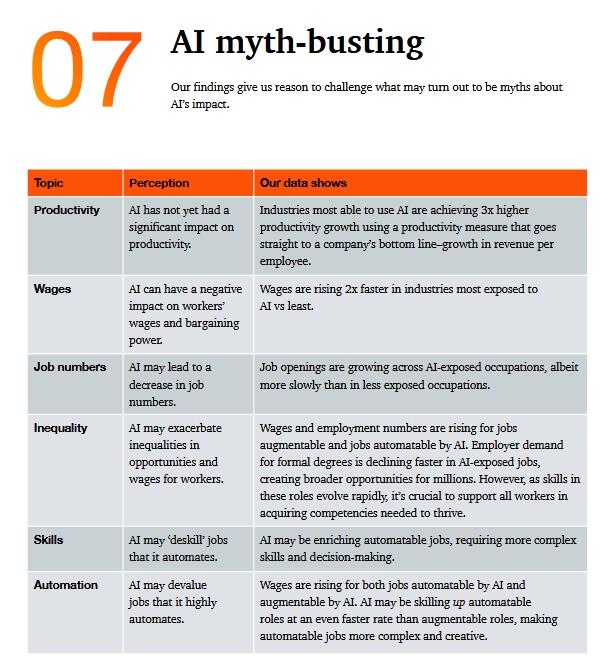
Therefore, it’s critical to discuss how much productivity AI will generate and how it will be distributed.  The first part, how much, is nearly impossible to assess today. That said, PwC estimates that productivity growth has nearly quadrupled in AI-exposed industries since 2022. Further:

Is AI really the cause of this surge in productivity? We can’t prove causation with certainty, but we do know that revenue growth in AI-exposed industries accelerated sharply in 2022, the year that the launch of ChatGPT 3.5 awakened the world to AI’s power. Since then, as companies have raced to leverage this technology, the value created in industries best positioned to use AI has skyrocketed. In the space of two years, industries most able to use AI have changed from productivity laggards to leaders, suggesting that investments in AI are paying off. AI’s promise is proving to be real, and we are only in the early days of AI adoption.  

Regarding the distribution of productivity, some pessimists argue that AI’s productivity gains are flowing overwhelmingly to high-income knowledge workers. While that is currently true, that has also been the case with every major technology wave in its early phase. Factory automation initially benefited capital owners. Personal computers initially benefited white-collar workers. The internet initially benefited the educated and connected. But over time, prices fall, adoption rates grow, and the benefits spread across the entire workforce.

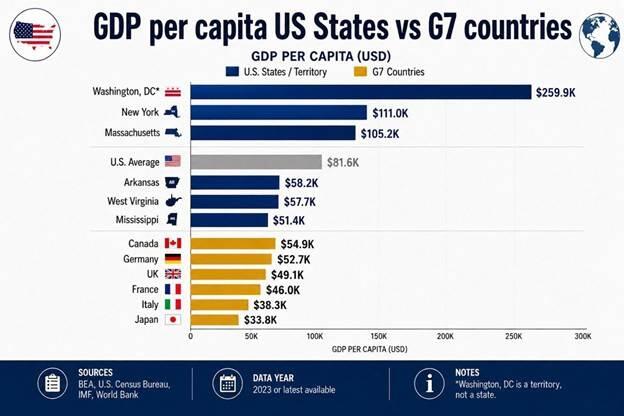
History’s verdict is consistent: the benefits start narrow and ultimately spread wide across the economy. As we share in the graphic below, as a result of the US being a global leader in innovation, our poorest states, Mississippi, West Virginia, and Arkansas, have a similar or higher GDP per capita than other large nations.

Summary

While still early in the AI revolution, the economic data points to genuine economic momentum. Whether AI productivity benefits can become more broadly based across the economy is the question that Part Two of this article addresses.

Before we present the other side, we will leave you with a PwC table that addresses concerns about productivity and the labor market.

Tyler Durden
Wed, 05/20/2026 – 11:25

via ZeroHedge News https://ift.tt/z4dijos Tyler Durden