America’s Highway Fund Is Running Out of Money. Congress Wants To Spend New Funds on Not Fixing Highways.


A booth in an Amtrak train car | Illustration: Midjourney

As the national debt rises ever higher, Congress is gearing up to pass an enormous infrastructure spending bill.

Earlier this week, the House Transportation and Infrastructure Committee released the BUILD America 250 Act. The sprawling 1000-page bill combines some hits—including provisions to streamline environmental reviews of infrastructure projects—with some obvious misses.

Lawmakers claim that the bill would strengthen the Highway Trust Fund, which pays for both road maintenance and mass transit investments, by levying a new registration fee on electric vehicles (E.V.) and plug-in hybrids. But Marc Scribner, senior transportation policy analyst at Reason Foundation (the nonprofit that publishes this site), tells Reason that it “won’t come close to eliminating the revenue-outlay gap,” since the bill fails to rein in the “irresponsible spending” that has doomed the fund to insolvency by 2028. Scribner’s assessment seems to be shared by the Committee for a Responsible Federal Budget, which finds that although the E.V. fee could raise around $30 billion in the next decade, “the Highway Trust Fund will remain severely out of balance.”

“This may well be the last federal highway bill,” Scribner warns.

If it is, then Congress sure isn’t making the most of it. Throughout the bill, there are several provisions that have little to do with building smooth roads and sturdy bridges.

For instance, in its current form, the BUILD America 250 Act would legally require any public-facing establishment larger than 800 square feet to allow commercial delivery drivers to use its bathroom. If a store’s owner had an employee-only policy for their toilet, or were worried about the cleaning costs associated with its use by delivery drivers, or were just plain stingy and particular about who they wanted on their property, they would be out of luck. This might sound like an odd matter for Congress to involve itself in, with the full weight of the law behind it, but Scribner assures Reason that, “yes, the bathroom access thing is real.” And the exemptions it outlines, he says, are “pretty narrow”—bathroom access would be required as long as it “would not pose an obvious security risk to the…establishment.”

Even more astounding, Scribner says, is “the perennial congressional interest in Amtrak food and beverage service.” Indeed, the bill would require the comptroller general to conduct a review of Amtrak’s snack offerings, including their adherence to the new Make America Healthy Again (MAHA) dietary guidelines and “the feasibility of providing traditional dining to all passengers” on Amtrak trains. After the comptroller general files her report, Amtrak would be required to review it in an internal committee made up of delegates from the company itself, organized labor, “nonprofit organizations representing Amtrak passengers,” and state governments.

In an email to Reason, Ross Marchand, executive director of the Taxpayers Protection Alliance, characterizes the food-and-beverage review as “a complete waste of taxpayer dollars” and thinks “lawmakers should have Amtrak focus less on tinkering with its current fresh vegetable crudité offerings and more on its $47 billion repair backlog.”

And then there’s the yellow paint. Tucked in the bill is a provision that directs the transportation secretary to study the feasibility of buying solely American-made yellow paint for road and highway markings, in line with federal Buy American requirements. With only one factory in the country that makes the right kind of paint for the job, this part of the bill—if passed—would amount to a handout for Sun Chemical and its facility in Muskegon, Michigan. In February, John Nichols, the union president at the plant, told the local ABC affiliate that these Buy American provisions would bring 20 new jobs to the factory.

Marchand says that “paint-specific figures are hard to come by, but…because domestic procurement requirements result in a 5.6 percent increase in taxpayer costs, a wider push toward ‘Buy American’ for pavement marking would put taxpayers on the line for an extra $200 million per year.”

However, Scribner cautions that mere “studies” like the one in this bill are often an indication that “the supporters of whatever measure…being studied lost the debate for inclusion.” So it may be a while before Congress actually appropriates the money to buy the paint.

Given the sorry state of the Highway Trust Fund, one might expect lawmakers to apply serious fiscal discipline or try novel ways to fund road and bridge upgrades. Instead, Congress seems intent on maintaining the status quo with another piece of legislation that authorizes wildly reckless spending and threatens more in the future.

The post America's Highway Fund Is Running Out of Money. Congress Wants To Spend New Funds on Not Fixing Highways. appeared first on Reason.com.

from Latest – Reason.com https://ift.tt/QjIulRe
via IFTTT

There Was No Delcy Rodríguez in Iran


President Donald Trump, with background photo of U.S. battleships | Illustration: Adani Samat. Photo: U.S. CENTCOM/Sipa USA/Newscom

The operation to oust Venezuelan President Nicolás Maduro in January was as successful as it could have been. U.S. operatives seized Maduro from his palace without losing a single man, and Venezuelan Vice President Delcy Rodríguez has been completely compliant with U.S. demands since then. Earlier this week, she handed over former Industry Minister Alex Saab to face trial in the U.S. for financial crimes.

U.S. President Donald Trump said publicly that he was expecting the same thing to happen when he attacked Iran alongside Israel, which assassinated Iranian Supreme Leader Ali Khamenei, in February. “What we did in Venezuela, I think, is the perfect, the perfect scenario,” Trump told the New York Times a few days into the war. A couple of days after that, he said that he would be involved in picking Iran’s new leader, “like with Delcy in Venezuela.” An administration official told The Wall Street Journal that the new model for U.S. intervention would be called “decapitate and delegate.”

Trump did not, in fact, get to choose Iran’s new leader. The Iranian government crowned Khamenei’s son Mojtaba the new supreme leader, which Trump said he was “not happy” with. The administration had originally hoped that Iran’s National Security Council Secretary Ali Larijani could be a “transitional candidate,” a source told CNN, but decided to kill him after he led Iran’s retaliation in the war. Later, administration officials told Politico that they were “testing” whether Speaker of Parliament Mohammad Bagher Ghalibaf could be the Delcy of Iran.

However U.S. officials try to spin it, the Trump administration simply does not control Iran like it controls Venezuela. For nearly three months, the Trump administration has tried using a combination of carrots and sticks to get Iran to accept U.S. demands. On Sunday, the United Arab Emirates blamed Iran for a drone attack near an Emirati nuclear power plant. The next day, Trump said that he was delaying a planned attack on Iran at the request of Arab states, including the Emirates.

Why hasn’t the Trump administration been able to repeat the Venezuelan model in Iran? In short, it’s because Trump didn’t actually try to “decapitate and delegate” in Iran. Unlike the U.S. operation in Venezuela, which was aimed at the man in charge and left the political regime intact, the U.S. campaign in Iran was a war against the entire Islamic Republic. While Trump’s specific demands of Iran have shifted around quite a bit, he has consistently asked for a public, humiliating surrender.

Some observers—from Mehdi Parpanchi, editor of the opposition outlet Iran International, to Danny Citrinowicz, former head of Iranian affairs for Israeli military intelligence—have tried to claim that a Venezuelan scenario was always impossible in Iran, because the Islamic Republic is too ideologically entrenched. But that ignores important overlaps between the two countries. Maduro also had an army of ideological enforcers, which Rodríguez now has to wrangle. And plenty of Iranian insiders were disillusioned enough with Islamist ideology to look for an exit or even spy for foreign powers.

The core issue is that Trump attacked the interests of the Iranian state in ways that go beyond ideology. His opening message of the war told every Iranian in uniform, from high commanders to cops on the street, that they were a target for “certain death.” That message also hinted that the U.S. was going to foment revolution in Iran. A few days into the war, the administration began telling the media about a plan to use Kurdish rebels to get the uprising rolling. 

The U.S.-Israeli attacks killed hundreds of Iranians, both military and civilians, in the first two days alone. Trump himself admitted that some of them were “the people we had in mind” to lead Iran. An Israeli military operation to free former Iranian President Mahmoud Ahmadinejad from captivity nearly killed him, too.

Although U.S. Secretary of State Marco Rubio blamed Iran’s intransigence on the Islamic Revolutionary Guard Corps, the elite branch of the military, Trump’s proudest attacks were on the Iranian air force and navy, part of the regular conscript military that dates back to before the Islamic Revolution.

In other words, the entire Iranian elite (and a good chunk of the rank-and-file) had their backs to the wall. The Delcy of Iran was dead before she could even cut a deal. And if they weren’t killed by foreign bombs, these leaders might face a firing squad for their role in suppressing the January 2026 uprising, which Trump was promising to avenge.

As the war dragged on, the U.S.-Israeli military campaign began to target infrastructure that any Iranian government—whether Islamist or secular, dictatorial or democratic—would need to run the country. Bombs destroyed Iranian steel mills, railroads, bridges, and even college campuses as Trump threatened to do the same to the country’s electrical infrastructure. It doesn’t take a true believer in political Islam to want to deter these attacks from happening again.

The Trump administration was right to see Larijani and Ghalibaf as “pragmatists.” Larijani reportedly presented Khamenei with a plan for Chinese-style reforms after violently putting down protests, and Ghalibaf is a ruthless, transactional operator who has constantly shifted his public image depending on the ideology of the moment. But “pragmatic” doesn’t mean “pushover.” Precisely because these men wanted to save their own skins and preserve their power, they had to play hardball with the United States. The same cost-benefit calculation that led Rodríguez to submit would lead Iran’s leaders to resist.

Rather than asking why Iran wasn’t like Venezuela, the question should be why Trump thought that the scenario would turn out that way. For all the contradictory reporting on what Trump’s advisers did or didn’t tell him, it’s important to bear in mind that the Biden administration was also considering an attack on Iran at the end of its term. Iran had been shockingly passive while suffering setback after setback in its post–October 2023 conflicts with Israel. Expert warnings about a regional war were proven wrong.

And the high of Maduro’s overthrow was intoxicating. The success of that operation seemed to show that anything was possible, and the January 2026 uprising in Iran presented an opportunity to rack up a streak of wins, caution be damned. Despite setbacks in Iran, the inner circle of foreign policy elites may still be chasing opportunities to repeat the Venezuelan model. Trump administration sources told Politico that it is seriously considering a military attack on Cuba, which would present a much weaker target than Iran.

“The initial idea on Cuba was that the leadership was weak and that the combination of stepped-up sanctions enforcement, really an oil blockade, and clear U.S. military wins in Venezuela and Iran would scare the Cubans into making a deal,” one of the sources said. “Now Iran has gone sideways, and the Cubans are proving much tougher than originally thought. So now military action is on the table in a way that it wasn’t before.”

The post There Was No Delcy Rodríguez in Iran appeared first on Reason.com.

from Latest – Reason.com https://ift.tt/Q1EjPxk
via IFTTT

Judge Blocks ICE Agents From Conducting Arrests At Immigration Courts In New York

Judge Blocks ICE Agents From Conducting Arrests At Immigration Courts In New York

Authored by Aldgra Fredly via The Epoch Times (emphasis ours),

A federal judge issued a ruling on May 18 barring federal agents from conducting arrests at three Manhattan immigration courts, except in limited circumstances.

A federal officer stands by in a hallway at New York Federal Plaza Immigration Court inside the Jacob K. Javitz Federal Building in New York on October 1, 2025. Charly Triballeau / AFP via Getty Images

The ruling by U.S. District Judge P. Kevin Castel stemmed from a lawsuit filed by the New York Civil Liberties Union and other groups on behalf of The Door and African Communities Together, which sought to challenge U.S. Immigration and Customs Enforcement (ICE) policies that allow federal agents to arrest people in immigration courts.

Castel had initially declined to block the policy last September, but the plaintiffs later filed a motion in response to a March letter in which the government admitted that the 2025 ICE guidance—which it had relied on to justify arrests at immigration courts following the lawsuit—“does not and has never applied” to civil immigration enforcement actions at immigration courts.

In a 15-page ruling on May 18, Castel granted the plaintiffs’ request to stay the ICE policy, barring federal agents from arresting people at three Manhattan immigration courts—26 Federal Plaza, 201 Varick Street, and 290 Broadway—except under “certain enumerated circumstances.”

“There is a strong governmental interest in enforcing immigration laws. There is also a serious interest of The Door to be free to assist its members in defending removal proceedings brought against them and pursuing defensive asylum applications before an [immigration judge] without fear of arrest,” Castel stated.

The judge added that ICE agents are only allowed to make arrests at immigration courts when there are “serious threats of physical harm to public safety.”

Castel also said the government’s concession that the 2025 policies did not apply to immigration courts warranted reexamining his previous ruling “to correct a clear error and prevent a manifest injustice.”

In a March 24 letter addressed to Castel, government lawyers expressed regret over a “material mistaken statement of fact” presented to the court and said it was caused by “agency attorney error.”

“This error, however, was not caused by a lack of diligence and care by the undersigned attorneys. The undersigned were specifically informed by ICE that the 2025 ICE Guidance applied to immigration courthouse arrests,” the letter states.

Amy Belsher, director of Immigrants’ Rights Litigation at the New York Civil Liberties Union, called the latest ruling “an enormous win for noncitizen New Yorkers seeking to safely attend their immigration court proceedings.”

We look forward to a final ruling in the case that sets aside these cruel, pointless policies once and for all,” Belsher said in a May 18 statement.

The Epoch Times reached out to the U.S. Department of Homeland Security, which oversees ICE, for comment, but did not receive a response by publication time.

Tyler Durden
Wed, 05/20/2026 – 10:45

via ZeroHedge News https://ift.tt/RhE5OAw Tyler Durden

Oil Prices Extend Decline After The Largest Crude Inventory Drawdown In History, Cushing ‘Tank Bottoms’ Loom

Oil Prices Extend Decline After The Largest Crude Inventory Drawdown In History, Cushing ‘Tank Bottoms’ Loom

Oil futures are down bigly this morning following comments from President Trump that the war in Iran would be ended “very quickly,” but investors remained uncertain about the potential for de-escalation.

“We’re going to end that war very quickly. They want to make a deal so badly, they’re tired of – this should have happened for 47 years,” Trump told a group of Congress members at the White House’s annual congressional picnic on Tuesday.

“Somebody should have done something about it. And it’s going to happen, and it’s going to happen fast. And you’re going to see oil prices plummet,” the president added.

Oil’s declines were also reportedly driven by this optimism about a final deal draft peace agreement:

On Tuesday, two Chinese tankers carrying crude oil traversed the Strait of Hormuz.

Another, a South Korean vessel, was passing through it, according to a Reuters report. Jim Reid, of Deutsche Bank, noted that this marks “one of the busiest days since the closure.”

However, Iran’s Revolutionary Guards also warned on Wednesday that any renewed strikes on Iran could expand the war beyond the region.

The IRGC also said it had not used all its capacities against the U.S. and Israel, while warning that their “devastating blows will crush” the adversaries, the IRGC said in a statement on its Sepah News website.

For now, all eyes are on the official inventory and supply data (and SPR) after yuuuge draws reported by API overnight…

API

  • Crude -9.1mm (-3.4mm exp)

  • Cushing -1.4mm

  • Gasoline -5.8mm

  • Distillates -1.0mm

DOE

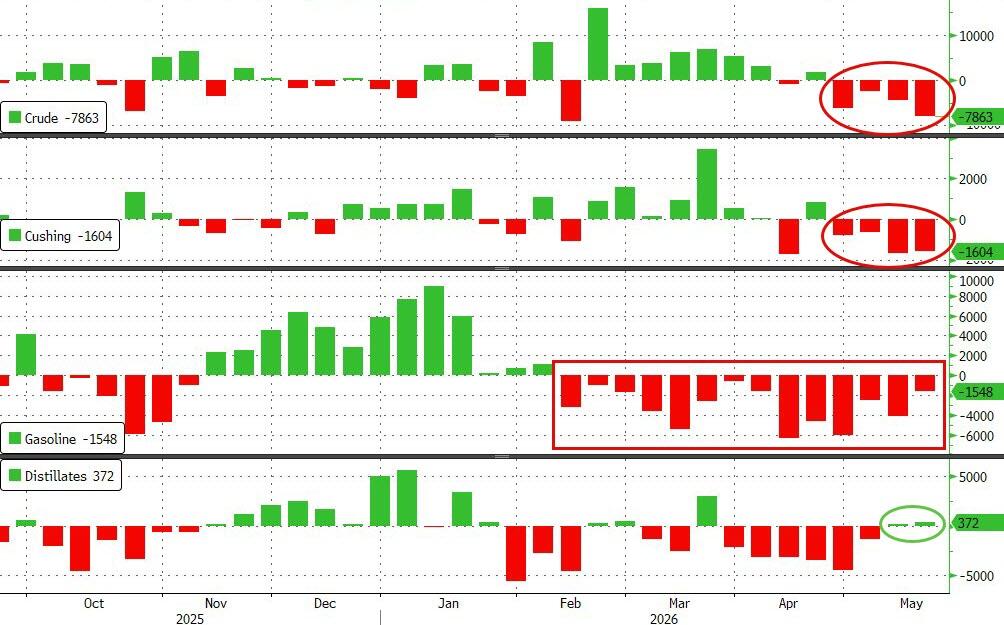
  • Crude -7.863mm (-6.0mm exp)

  • Cushing -1.604mm

  • Gasoline -1.548mm

  • Distillates +372k

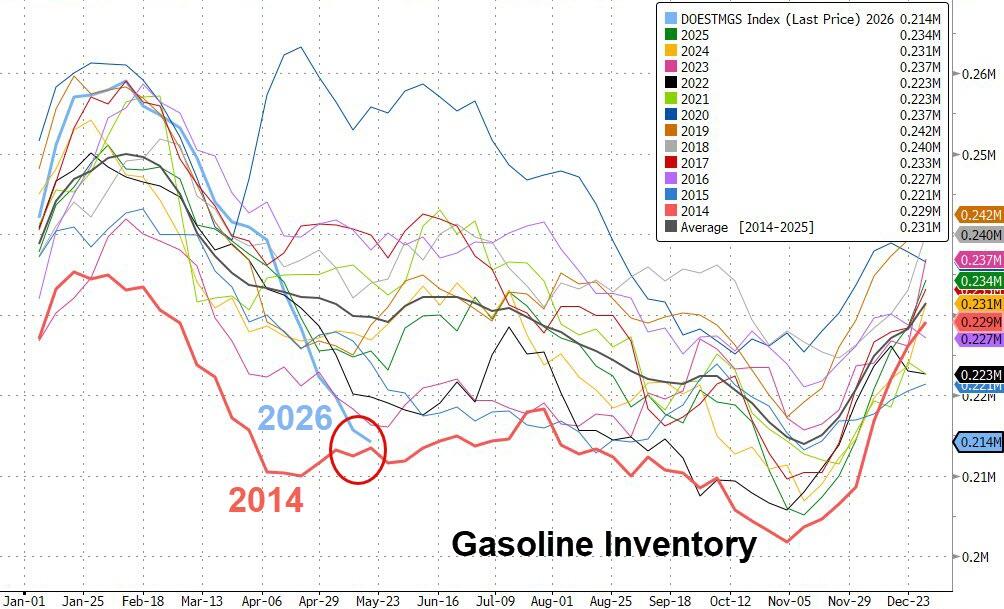
Crude stocks tumbled last week (biggest draw since Feb 13th) for the fourth week in a row. Gsoline inventories saw their 14th weekly drawdown in a row whil distillates saw another small build…

Source: Bloomberg

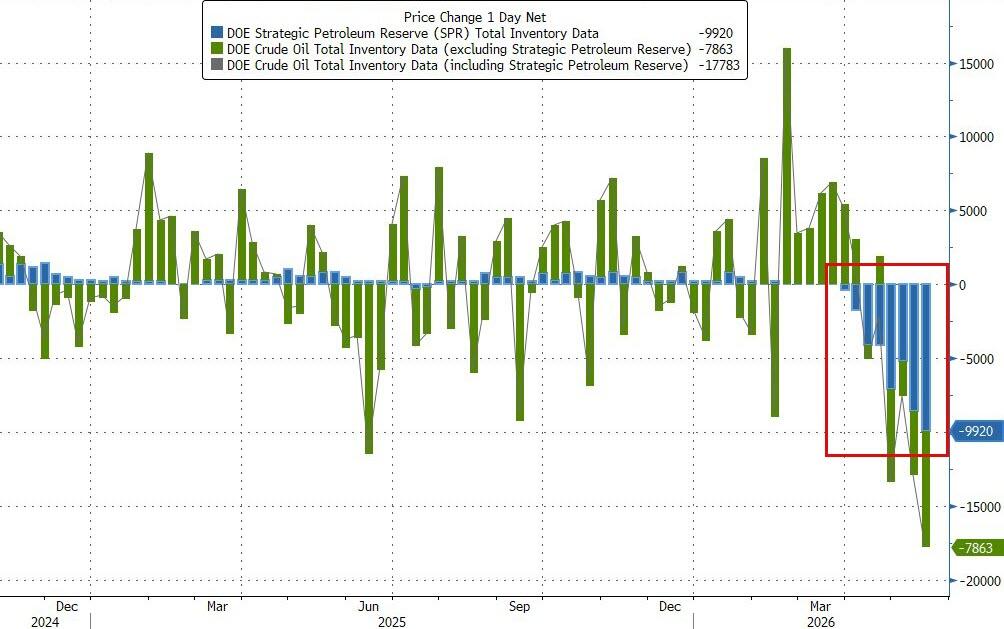
Strategic Petroleum Reserve drawdowns continue to accelerate with 9.92mm barrels/day – a record – drained last week. That means over 10% of the SPR has been drained in the last few weeks

Source: Bloomberg

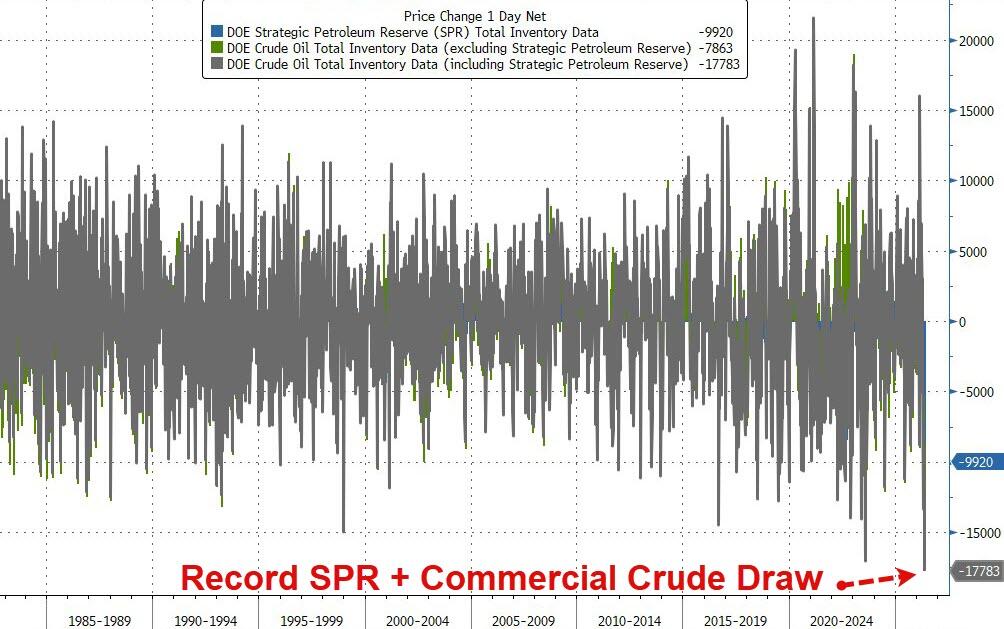
Total US crude stocks including the SPR are at the lowest level since June 2025 with this week seeing the largest SPR + Commercial stock drawdown in history…

Gasoline stockpiles continued their steady decline last week, falling another 1.5 million barrels. Stocks are still at the lowest seasonal levels since 2014.

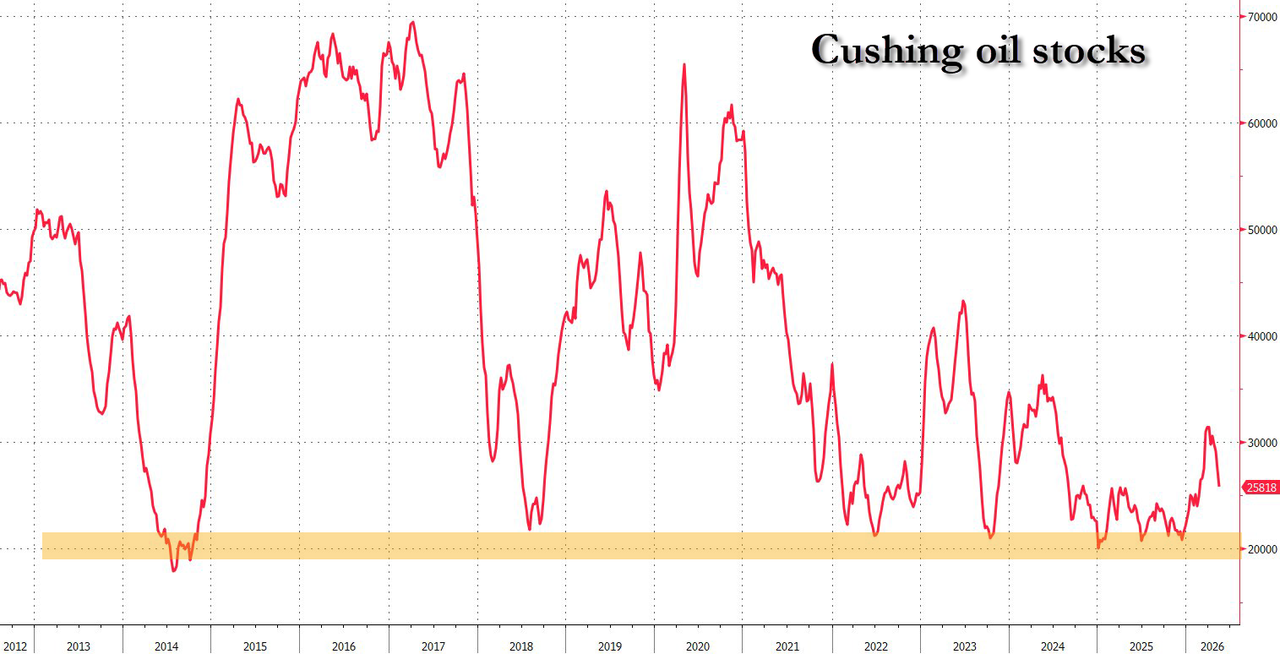
Cushing stocks are rapidly approaching ‘tank bottoms’ once again…

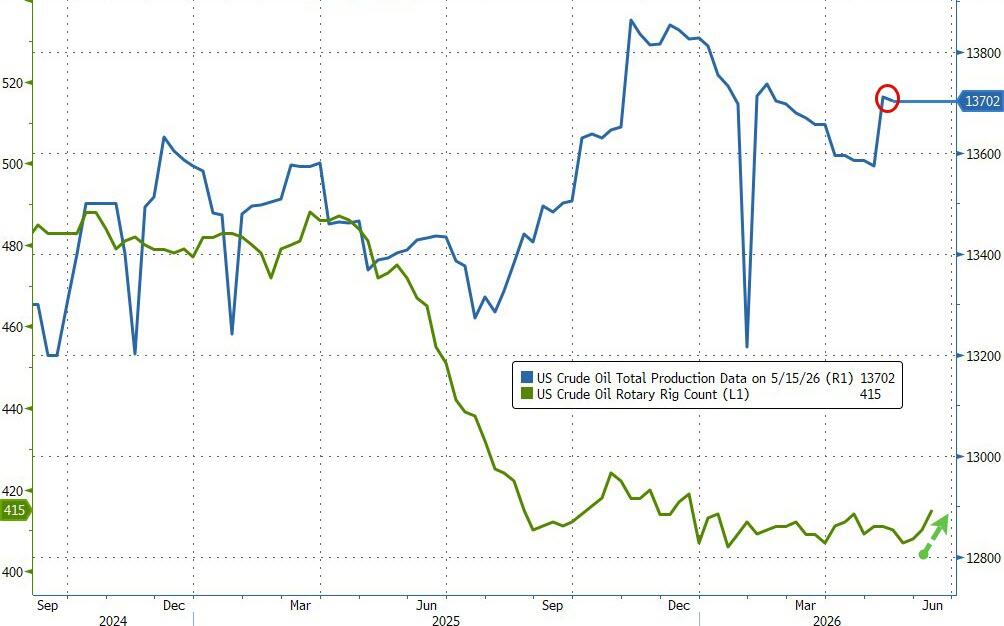
US Crude production dipped very modestly last week…

Source: Bloomberg

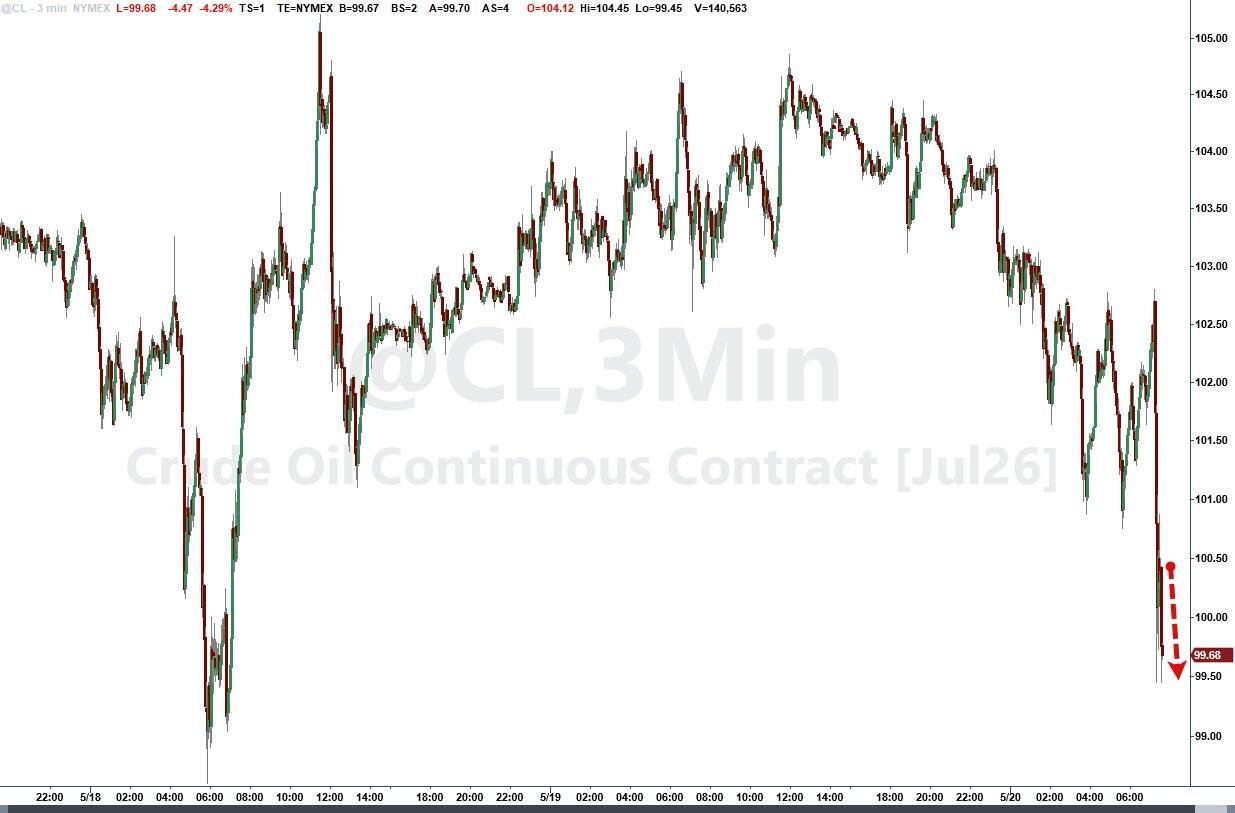
WTI (July 2026) suddenly plunged below $100 just ahead of the official data (on peace deal optimism) and extended the losses after the big draw…

Finally, though the closure of the Strait has already pushed oil prices up by more than half, analytics firm Woods Mackenzie said if the war is extended until the end of the year, oil prices could rise as high as US$200 per barrel, though a quick settlement could lower Brent prices to US$80 by year end.

“The Strait of Hormuz is the most critical chokepoint in global energy markets, and a prolonged closure would become far more than an energy crisis,” said Peter Martin, head of economics at Wood Mackenzie.

“The longer disruption persists, the greater the impact on energy prices, industrial activity, trade flows and global economic growth.”

The market is awaiting the start of the high-demand U.S. summer driving season, which begins with this weekend’s Memorial Day holiday.

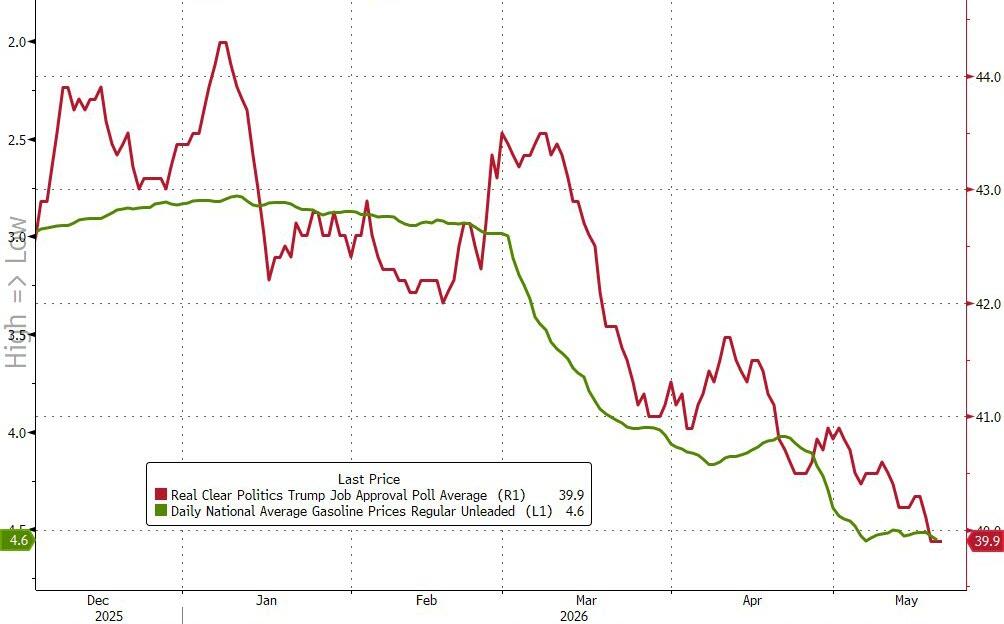
It appears that American drivers will face the highest gas prices ever for Memorial Day…

…not great for Midterms/Approval ratings.

Tyler Durden
Wed, 05/20/2026 – 10:38

via ZeroHedge News https://ift.tt/QlDKYRe Tyler Durden

Xi Warns US Against New Iran Strikes, Denounces ‘Law Of The Jungle’, As Putin Talks Energy Leverage In Beijing Summit

Xi Warns US Against New Iran Strikes, Denounces ‘Law Of The Jungle’, As Putin Talks Energy Leverage In Beijing Summit

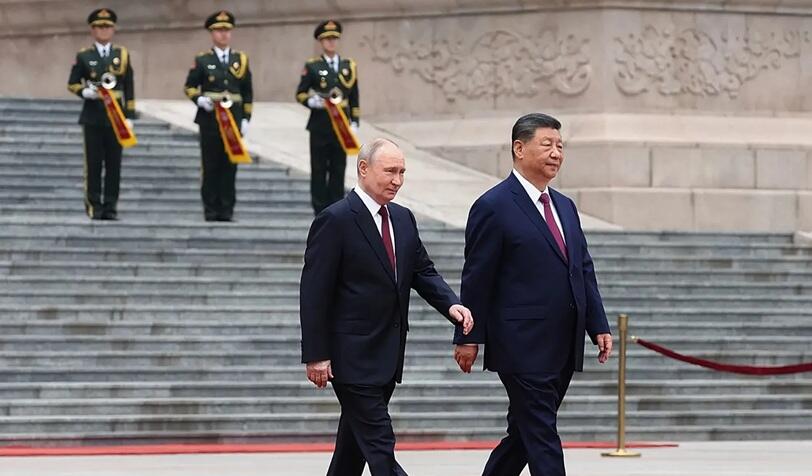
Chinese President Xi Jinping hosted Russian President Vladimir Putin for a high-stakes summit on Wednesday, just days after wrapping up closely watched talks with Trump, which by all accounts failed to produce any Washington-Beijing breakthroughs.

The optics were carefully engineered, and many international outlets observed Putin’s state welcome was no less lavish and opulent than Trump’s own, with the Russian leader entering Great Hall of the People with full military pomp, children waving flags, and the standard marching band – again, strikingly similar to the red-carpet treatment rolled out for Trump last week.

For example, Al Jazeera writes that “We were expecting a more low-key ceremony, but he actually received an identical welcome treatment as Trump last week.” And more:

He had the red carpet rolled out for him; he received a 21-gun salute, as well as children waving Russian and Chinese flags, saying, ‘We warmly welcome you.’

The only difference is who greeted Putin at the airport. With Trump, it was Han Zheng, the vice president, and for Putin, it was Wang Yi, the foreign minister.

via Sputnik

President Xi in his opening remarks delivered a sharp critique of the current geopolitical landscape, warning that the world is at risk of regressing into the “law of the jungle” –  but hailed the Beijing-Moscow alliance as a crucial stabilizing force against what he later termed “all unilateral bullying” in the international arena, which appeared a passing jab at the United States. The very timing of the Putin summit has widely been viewed as a display of leverage.

Among key moments is that Xi called for “a comprehensive ceasefire” in the Middle East and the immediate reopening of the Strait of Hormuz. He characterized the standoff situation in the Persian Gulf as a “critical juncture between war and peace.Xi called for the “unimpeded flow” of crude transit through the strait, as it is in “the common interest of the international community.”

“My four-point proposal for maintaining and promoting peace and stability in the Middle East aims to further build international consensus and contribute to easing tensions, deescalating conflict, and promoting peace,” Xi said on the Iran crisis according to state news outlet Xinhua. Noticeably absent, however, was mention of finding peace in Ukraine. They agreed that it was “necessary to address the root causes of the Ukrainian crisis.”

As for Iran, Xi also explicitly noted that further hostilities in the Middle East were “inadvisable” and that a “comprehensive ceasefire is of utmost urgency.” Putin during the summit sought to assure Beijing that Moscow remains a “reliable energy supplier” amid global oil supply shocks, noting their bilateral relationship sits at an”unprecedentedly high level.”

He even at one point invoked a classical Chinese proverb to describe his relationship with Xi: “Even if we haven’t seen each other for a day, it feels like three autumns have passed.”

Below are some quick highlights based on some emerging reporting Wednesday:

Treaty Extension: The signing of a wave of bilateral agreements across technology, trade, and intellectual property, anchored by the extension of the 25-year-old “China-Russia treaty of good neighborliness and friendly cooperation.”

The Energy Lifeline: Putin countered by assuring Beijing that Moscow remains a “reliable energy supplier” amid global oil supply shocks, noting their bilateral relationship sits at an “unprecedentedly high level.”

The Crude Lifeline: China remains critical in terms of an outside Russian economic lifeline, purchasing nearly 50% of Moscow’s total oil exports as Western sanctions continue to squeeze Russia’s domestic capital.

On potentially reviving a major stalled Russian gas pipeline project, CNBC wrote:

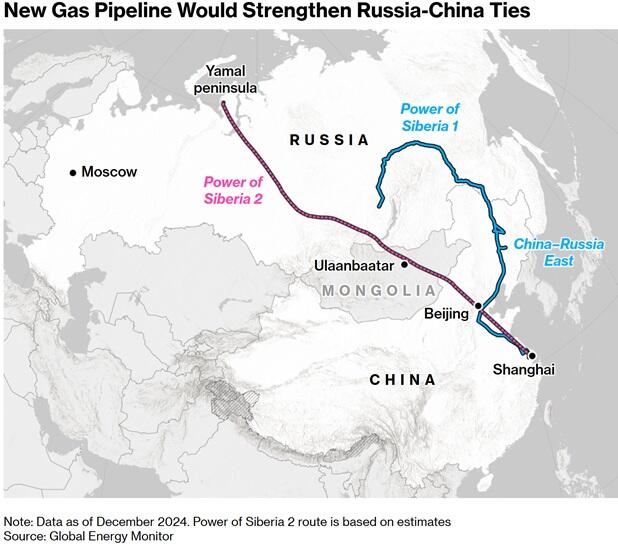
Russian President Vladimir Putin met with Chinese leader Xi Jinping in Beijing on Wednesday, with the long-stalled Power of Siberia 2 natural gas pipeline on the agenda, as the Iran war disrupts energy supplies.

Kremlin foreign policy aide Yuri Ushakov said Tuesday that the project “will be discussed in great detail between the leaders.”

The planned 2,600-kilometer pipeline would carry 50 billion cubic meters of gas annually from Russia’s Yamal fields to China via Mongolia. Moscow and Beijing signed a legally binding memorandum to advance construction in September 2025, but pricing, financing terms, and a delivery timeline remain unresolved.

Later this year, in November, both Presidents Trump and Putin could attend the APEC summit (Asia-Pacific Economic Cooperation) on Chinese soil. 

via Bloomberg

The White House website hints at APEC summit attendance: “President Trump and President Xi agreed that the United States and China should build a constructive relationship of strategic stability on the basis of fairness and reciprocity. President Trump will welcome President Xi for a visit to Washington this fall. The two countries will support each other as the respective hosts of the G20 and APEC Summits later this year.”

In the context of the Iran conflict Trump has lifted some oil sanctions on Russia, making its oil trade a key beneficiary of the US-Israel initiated war. “Russia has emerged as a primary beneficiary of the Middle East conflict due to the massive supply vacuum created by the closure of the Strait of Hormuz,” George Voloshin, an independent energy analyst based in Paris, has commented. “Global refiners are desperate for alternative medium-sour crudes, a need that Russia’s Urals grade specifically meets.”

Tyler Durden
Wed, 05/20/2026 – 10:05

via ZeroHedge News https://ift.tt/gEt0uNP Tyler Durden

The Building Blocks Of A Global Stagflationary Shock Are Falling Into Place

The Building Blocks Of A Global Stagflationary Shock Are Falling Into Place

By Peter de Groot, Head of Macro Strategy at Rabobank

The Inflation Regime That Doesn’t Fade

As we noted at the outset of the Gulf conflict, history rarely repeats – but it often rhymes. The closure of the Strait of Hormuz is increasingly revealing a familiar pattern: the building blocks of a global stagflationary shock are falling into place.

A closer look across inflation indicators in advanced economies shows a clear and consistent structure. The upstream impact has been immediate and forceful – exactly as expected in an energy-driven shock. The surge in oil and gas prices has translated into sharp increases in petroleum products such as diesel, and into key industrial inputs like sulphur and fertilisers. Producer price expectations – particularly in energy-intensive sectors such as chemicals, base metals, and wood – have risen rapidly, in many cases outpacing the (initial) post-Covid surge. European industrial surveys point to strong repricing at the start of the production chain.

But further downstream, the picture is more nuanced, for now. While higher input costs are being passed through, the degree of transmission appears more muted than during the inflation surge of 2021–2022. Initial producer price data suggest that firms are adjusting prices, but not with the same breadth or intensity yet. Part of this may be timing – pass-through is always gradual – and whilst the gap between sharply rising price expectations and more modest realized price increases is notable, this could also point to more significant price hikes in the months ahead.

At the consumer level, the divergence is clearer. Inflation has responded, but the impulse remains concentrated in energy and energy-related components. Headline CPI prints have broadly matched expectations, and in some cases even surprised to the downside. Core inflation has remained contained. However, the same sort of slow transmission was seen during the initial phase of the 2021-2022 inflation surge, which, arguably, led policy makers to respond too slowly. So it’s too early to draw any firm conclusions and ‘transitory’ cannot be one of them, for now.

However, there is one crucial difference: the starting point for this shock is materially weaker demand. Labor markets have cooled in many places, albeit not to the same degree. US payrolls growth and job openings have slowed. In the Eurozone, labor market tightness indicators have eased (even as unemployment has stayed at cyclical lows). In the UK, unemployment has moved back to around 5%, vacancies have dropped to a five-year low, and wage growth continues to slow. As Stefan Koopman, our UK analyst, notes, these are not the conditions of an overheated economy requiring aggressive monetary tightening. Instead, they suggest increasing slack – an environment in which firms may struggle to fully pass on higher costs without sacrificing demand.

As a result, while energy prices are likely to push inflation higher in the coming months, the broader macro backdrop does not appear conducive to a sustained second-round inflation spiral. That said, central banks may still feel compelled to respond – more as a signal than out of necessity. In the UK, for instance, a symbolic rate hike cannot be ruled out, as policymakers seek to underscore their commitment to the inflation target, even if the case for a full tightening cycle remains weak.

Policy choices will be critical in shaping the trajectory from here. One of the defining lessons from the 2021–22 inflation episode is that policy responses can amplify shocks. The combination of large-scale fiscal support and ultra-loose monetary policy played a key role in transforming an initial supply shock into a broad-based and persistent inflation surge. Today, the policy environment is different – rates are higher, fiscal space is more constrained – but the uncertainty surrounding the duration of the Hormuz disruption complicates the outlook.

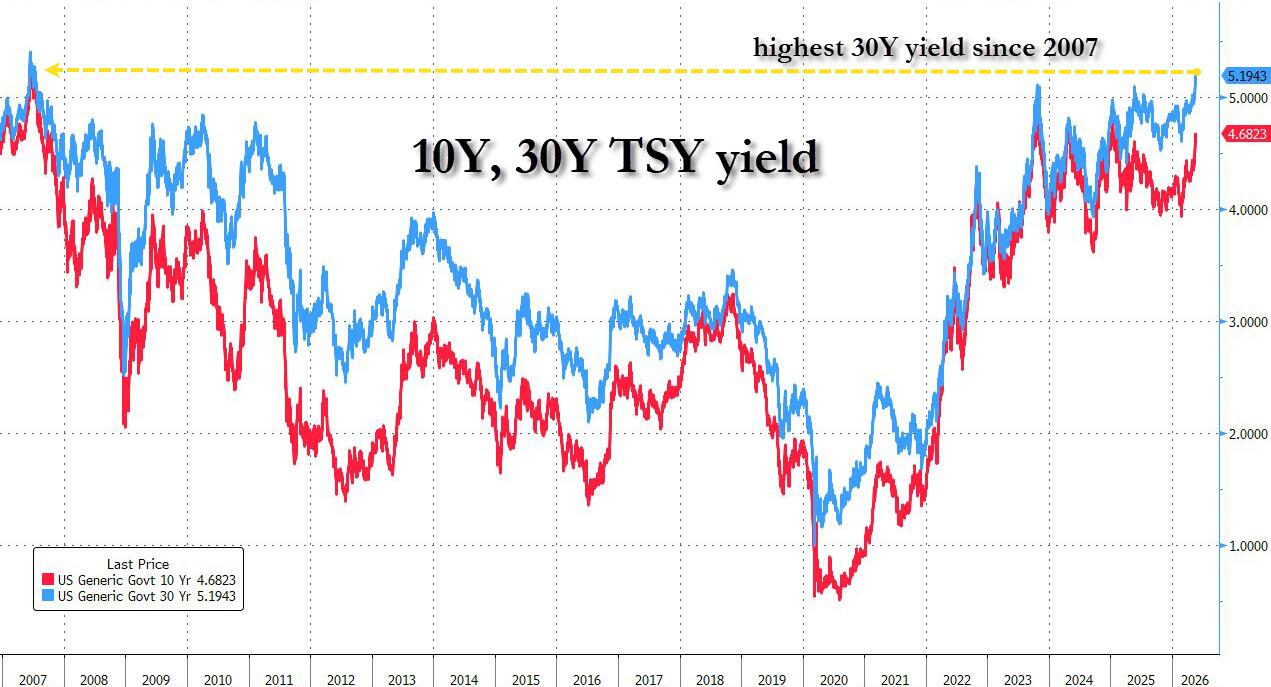
In that context, policymakers may be inclined to assume persistence rather than transience, if only as a precaution. Markets, for their part, have already moved in that direction. Bond yields have repriced sharply higher, particularly at the long end, tightening financial conditions globally. The US 10-year yield rose above 4.67% yesterday, the highest level since mid-January 2025. And although European yields were dragged higher as well, the spread of 10y Treasuries over German bunds has widened from 120bp on 13 April to nearly 150bp yesterday. The rise in US Treasury yields – alongside a widening spread over German Bunds – signals that investors are increasingly focused on both inflation persistence and fiscal sustainability.

This shift in market discipline is not going unnoticed. The IMF has urged Britain to “stay the [fiscal] course” in its ‘Article IV’ consultation. At this week’s G7 meeting, finance ministers and central bankers struck a notably cautious tone, emphasising that any policy support should remain temporary, targeted, and fiscally responsible. Compared to the sweeping interventions seen in recent crises, the response so far has been measured – arguably deliberately so.

Yet this restraint also exposes a tension. While targeted domestic support is relatively straightforward, meaningful international coordination is far more challenging. Countries face competing objectives: protecting domestic growth, ensuring economic security, and enhancing resilience. Measures such as export restrictions may serve national interests but risk undermining collective outcomes. In that sense, the G7’s commitment to cooperation may prove difficult to translate into concrete action.

This suggests a risk of fragile stagflation, with slowing growth alongside persistent inflation. The main danger is not runaway prices but policy errors and poor coordination amid ongoing geopolitical pressures. Much depends on the duration of the Hormuz disruption, as supply shocks may last longer than expected and blur the line between temporary and persistent inflation.

This may also be the reason why we see tentative signs that policymakers are beginning to look beyond purely economic tools. The economic consequences of the Hormuz closure are, after all, rooted in a geopolitical disruption. Discussions within NATO about potentially facilitating maritime passage through the strait underscore a growing recognition that resolving the supply shock itself may be the most effective form of policy response. Although there is no unanimous support yet, according to sources, as per Bloomberg reporting, the fact that NATO is reconsidering an (active) role was seen by investors as a positive development.

Meanwhile, after months of wrangling, the EU finalized the text on the US-EU trade deal, to be signed off by European Parliament and member states before Trump’s 4 July deadline. Reaching a compromise was driven by the overriding objective of “maintaining a stable, predictable and balanced transatlantic partnership”, as put by Cyprus’ minister of commerce. However, the text now includes a 2029 expiration date (unless both sides agree extension). It also includes a clause that would allow the Commission to suspend the deal if tariffs on products using steel and aluminium surpass 15% after 2026 and a ‘pause button’ should the US not keep with its commitments. So let’s see if the US wants to cooperate.

Tyler Durden
Wed, 05/20/2026 – 09:50

via ZeroHedge News https://ift.tt/PstR5yC Tyler Durden

Why Populism Leads to Decline

Today’s guest is Johan Norberg, a senior fellow at the Cato Institute and the author of Peak Human: What We Can Learn From the Rise and Fall of Golden Ages.

He talks with Nick Gillespie about the historical patterns behind flourishing civilizations, from the Roman Republic to modern America. Norberg argues that societies thrive when they remain open to trade, immigration, experimentation, and new ideas, but begin to decay when fear and nostalgia push them toward protectionism, centralization, and tribal politics.

They also discuss the resurgence of populism in the United States and Europe, why tariffs and anti-globalization politics keep returning throughout history, and whether America is becoming more risk-averse and nativist. Norberg explains why he believes optimism and innovation can still win, explores the promise of artificial intelligence, and reflects on whether China is entering a new golden age or repeating the mistakes that led past civilizations into decline.


0:00—Why open societies thrive

3:07—The Roman Republic

10:05—America as a creedal nation

11:57—The rise of nativism

16:15—The dangers of nostalgia

20:31—What sparks renaissance?

26:40—Are older societies more risk averse?

28:33—Populism and Viktor Orbán’s defeat

32:04—Left-wing populism

34:10—Javier Milei

35:42—Tariffs and free trade

40:28—Is China in a golden age?

The post Why Populism Leads to Decline appeared first on Reason.com.

from Latest – Reason.com https://ift.tt/ePUvaD4
via IFTTT

Data Centers Use Less Water Than Almond Farms—and Do More Good


Data centers with almonds above them | Adani Samat/Envato

Opposition to data centers is all the rage among populists of all stripes. On the left, Sen. Bernie Sanders (I–Vt.) has proposed a national moratorium on new data center construction; on the right, Tucker Carlson describes them as “dystopian” and “devouring American energy and jobs.” In recent days, X has become flooded with images of pristine American forests, plains, beaches, and lakes alongside captions warning that no data center is worth losing this. (The images are often AI-generated, and many of the accounts sharing them are foreign.)

Data center panic is fueled by concerns about electricity and water usage. Many Americans wrongly believe that data centers are driving up their electric bill, even though evidence suggests the exact opposite: Data centers may actually decrease electricity costs for their neighbors. Water use fears are even more unreasonable. Data centers don’t actually use all that much water.

For example, a chart comparing data centers’ water requirements to almond farms helps put things in perspective.

California’s almond farms consume 4.2 billion gallons of waters per day, according to Reason’s Christian Britschgi. Data centers consume just 46 million gallons per day. Those numbers will certainly rise over time, but compared to all the other things that use water—golf courses account for 1.4 billion gallons per day—it’s just a drop in the bucket.

Unfortunately, many foes of data centers do not find this comparison very compelling. Speaking for the opposition, The Federalist‘s Sean Davis points out that almonds are, you know, food. People eat almonds. They can’t eat data. Thus, almond farms are a good use of water and data centers are not.

Carlson made a similar argument during his debate with Kevin O’Leary, in which he took it as a knock against data centers that they wouldn’t provide as many jobs as the city of Manhattan despite taking up more space and using about as much power.

It’s a problem for data center advocates, I suppose, that the good being produced is not as obvious as a job or an almond. But you have to be pretty dense not to realize that the data centers make possible a huge amount of economically beneficial activity. Storing massive amounts of data is a necessary precondition for the modern economy. It will be used to power and train AI models that will improve everyone’s lives. AI is already making medical diagnoses more accurate and reducing car crash fatalities via driverless vehicles. AI can swiftly navigate legal, regulatory, and licensing issues, making it easier to start a business or buy a home. As a research tool, it can cut down on time spent learning about a complicated issue.

Reducing the time it takes to complete an annoying (or dangerous) task is a huge benefit that allows people to spend their time—the ultimate finite resource—more effectively, if only for leisure. If this doesn’t seem obviously beneficial, then consider where we would be without search engines at all. Not so long ago, people had to trek to the library and consult an encyclopedia when they wanted information. They had to obtain physical copies of relevant documents: books, newspapers, etc. Being able to summon these things instantly—electronically—has inarguably led to huge gains: There are countless jobs that simply would not exist without it (including internet commentator).

The United States’ economic future is inexorably tied to the tech sector. Gains from AI are vital to the country’s stability. In that sense, it’s not very surprising to discover that some of the arguments against AI are being made in coordination with the Chinese government. According to the Bitcoin Policy Institute, the Chinese Communist Party has indirectly encouraged a pause or slowing of AI developments in the U.S.—but not in China. That’s one reason Sen. John Fetterman (D–Pa.), a self-described “pro-capitalist Democrat,” called Sanders’ data center moratorium proposal “China first.”

In any case, you can’t eat an oil rig, a suspension bridge, or a satellite. Yet it should be obvious that these are no less useful—even factoring in land, energy, and water use—than almonds, even if the benefits are slightly less straightforward. This is plainly true for data centers as well, and anyone arguing otherwise deserves suspicious looks.

The post Data Centers Use Less Water Than Almond Farms—and Do More Good appeared first on Reason.com.

from Latest – Reason.com https://ift.tt/s5Yfymn
via IFTTT

AI Purge Accelerates: Intuit Reportedly Slashing 17% Of Workforce

AI Purge Accelerates: Intuit Reportedly Slashing 17% Of Workforce

Intuit, the company that owns TurboTax, QuickBooks, Credit Karma, and Mailchimp, is reportedly preparing to lay off a staggering 17% of its workforce according to Reuters, which cites an internal memo.

Details are scant at the moment regarding the reason for the layoffs, but CEO Sasan Goodarzi sent an email to staff earlier in the day, saying that reducing complexity and simplifying the structure would help it deliver better ​products, to streamline operations and sharpen focus ​on its key bets including its AI efforts.

The company has signed multi-year deals with AI startups Anthropic and ​OpenAI to integrate their AI models into its software and add Intuit’s personalized tax, finance, ‌accounting and ⁠marketing capabilities into Claude and ChatGPT.

Bloomberg data shows Intuit’s total workforce was around 18,200 in mid-2025. If those figures are still accurate, the layoffs could affect upwards of 3,000 employees.

As of Tuesday’s close, Intuit shares were down nearly 40% on the year amid AI fears disrupting the software stocks.

Shares are down 2% in premarket trading.

Analysts are mostly bullish…

Related:

The last day for impacted staff at Intuit in the United States will be July 31 and they will receive 16 weeks of base pay and two extra weeks for every year at Intuit as part of ​the severance package, the ​memo on Wednesday ⁠showed.

Tyler Durden
Wed, 05/20/2026 – 09:35

via ZeroHedge News https://ift.tt/A3pXVbQ Tyler Durden

Trump Retains Dominant Influence: 4 Takeaways From Tuesday’s Primary Elections

Trump Retains Dominant Influence: 4 Takeaways From Tuesday's Primary Elections

Authored by Joseph Lord, Jeff Louderback, Troy Myers, and Nathan Worcester via The Epoch Times,

Voters on Tuesday headed to the polls in states across the country for some of the most-anticipated battles of the 2026 midterm election season.

May 19 marks the largest day of primary elections yet, seeing ballots cast across six states: Alabama, Georgia, Idaho, Kentucky, Oregon, and Pennsylvania.

The night continued past trends showing that President Donald Trump retains a dominant influence over the Republican Party, as his chosen candidates sailed to victory in race after race—with one Republican incumbent in a major race being defeated.

Democrats, meanwhile, locked in their picks for several key congressional races, as the party works to reclaim the House and possibly the Senate.

Here are the biggest takeaways from the night.

Massie Unseated

Rep. Thomas Massie (R-Ky.) lost his Republican primary to former Navy SEAL Ed Gallrein, concluding one of the most-watched (and most expensive) primary battles of the 2026 election cycle.

President Donald Trump had endorsed Gallrein as part of his effort to get Massie removed from Congress.

Trump was openly critical of Massie and urged people in Kentucky’s Fourth Congressional District to elect Gallrein.

Gallrein had tallied 54 percent of the votes compared to 45 percent for Massie when The Associated Press called the race at 7:54 p.m. ET.

Massie’s ousting is seen as underscoring Republican voters’ support for Trump.

The Kentucky lawmaker, who’s been at odds with Trump over several issues, joins Sen. Bill Cassidy (R-La.) and several Indiana state senators who were defeated by primary challengers backed by Trump in recent weeks.

Gallrein, in his victory speech, vowed to work closely with the president in Congress.

“We have a saying on the family farm that it’s a contact sport,” Gallrein said at an election night event in Covington, Kentucky. “I can tell you that campaigning is one as well, folks.”

Kentucky, Alabama Open Senate Primaries

In Kentucky and Alabama, voters went to the polls to cast ballots in open Senate primaries for seats being vacated by their incumbents.

Rep. Andy Barr (R-Ky.) will face former Democratic state Rep. Charles Booker in the race to replace outgoing Sen. Mitch McConnell (R-Ky.) in the U.S. Senate.

The Associated Press called the Republican primary race for Barr at 7 p.m. ET, an hour after polls closed. Barr won with 60.5 percent of the vote to 30.8 percent for the next closest rival, former Kentucky Attorney General Daniel Cameron.

On the Democratic side, Booker—who previously served as Democrat’s nominee for the post in 2022—won with 46.8 percent of the vote. His closest rival, 2020 Democratic nominee Amy McGrath, trails with 35.8 percent of the vote. The race was called at 9:41 p.m. ET.

The primary marks the first time in 16 years that the state has seen a fully open race for a Kentucky Senate seat. The last such primary took place in 2010, when Sen. Rand Paul (R-Ky.) won his first election to Congress.

McConnell, 84, was first elected to his seat in 1984. He had served as the leader of the Republican Senate conference since January 2007 before agreeing to step down at the start of the current Congress.

Meanwhile, Rep. Barry Moore (R-Ala.), Trump’s pick to replace outgoing Sen. Tommy Tuberville (R-Ala.), will advance to a runoff, as he fell short of the 50 percent needed to forgo the second election.

The Republican he’ll face is still being determined as votes are counted.

Trump has called Moore “a true America First Patriot who’s been with me from the very beginning.”

Georgia Republican Races Go to Runoff

Voters in the Peach State sent Republican candidates in Georgia’s gubernatorial and Senate elections to a runoff.

Trump-endorsed Georgia Lt. Gov. Burt Jones and billionaire businessman Rick Jackson will go to a runoff in Georgia’s gubernatorial primary contest.

Jones and Jackson received 37 percent and 34 percent of the vote, respectively, when the Associated Press called the runoff at 8:50 p.m. ET, as neither managed to garner more than 50 percent of the vote in what became a costly contest for the GOP field.

Georgia’s Secretary of State Brad Raffensperger came in third with 14 percent of the vote.

Another competitive Georgia Republican contest is also on its way to a second round.

As of 9:50 p.m. ET on May 19, none of the major candidates in the state’s Senate GOP primary—Rep. Mike Collins (R-Ga.), Rep. Earl “Buddy” Carter (R-Ga.), and former football coach Derek Dooley—had claimed more than 50 percent of the vote in the Senate primary.

At 9:44 p.m. ET, the Associated Press declared that Collins will advance to the runoff. It later declared that Dooley will face him in that race.

As of 11:52 p.m., Collins had received 40.5 percent of the vote. Dooley followed with 30.1 percent, while Carter trailed in third with 25.2 percent.

The runoff was expected ahead of Election Day, as polling generally did not show any candidate with a majority.

Bernadette Breslin, the national press secretary for the National Republican Senatorial Committee (NRSC), told The Epoch Times in an exclusive statement that “Republicans are united behind defeating Ossoff and retiring his record of failure for Georgia.”

Trump has not given an endorsement in the Senate race.

The runoff elections are set for June 16.

Pennsylvania Democrats Make Picks in Key Swing Districts

While observers’ focus was largely centered on Republican races during this round of voting, Democratic candidates were also locked in for several key swing districts during the May 19 elections.

It’s unclear whether Democrats can overcome Republicans’ steep 53-seat majority in the U.S. Senate, and the party is instead focusing its major efforts this cycle on the House, where Democrats are widely expected to reclaim the majority by observers.

In Pennsylvania, three Democratic candidates endorsed by Gov. Josh Shapiro won their elections, including Janelle Stelson, Bob Harvie, and Bob Brooks.

The three candidates will take on Republican opponents in the November general election, in seats that include some of the party’s top targets.

Stelson will go up against Rep. Scott Perry (R-Pa.), Harvie against Rep. Brian Fitzpatrick (R-Pa.), and Brooks against Rep. Ryan Mackenzie (R-Pa.).

Shapiro himself is seeking reelection this year, running for the gubernatorial nomination unopposed. Shapiro’s approach to politics has been viewed as moderate by voters in the state, propelling him to a sweeping double-digit victory in his 2022 election, giving his endorsement some weight in state politics.

Tyler Durden
Wed, 05/20/2026 – 09:05

via ZeroHedge News https://ift.tt/Rt2gM3Q Tyler Durden