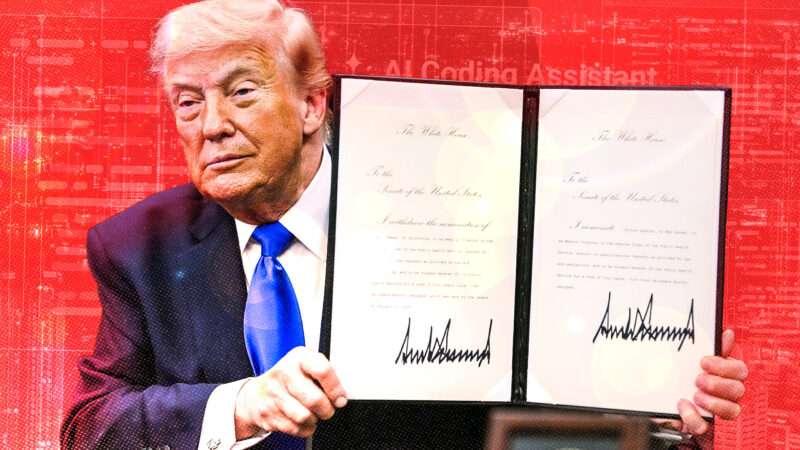
This week brings starkly different artificial intelligence visions from President Donald Trump and Sen. Bernie Sanders (I–Vt.). Thankfully, only the former has the force of law.
Couched in the language of giving power to “the American people,” Sanders’ plan actually presents a frighteningly authoritarian vision in which the federal government gains significant control over private AI companies and the future of output.
In contrast, the White House’s AI vision is—at least this week—admirably restrained.
Trump Rejects Pre-Approval Scheme for New AI Models
Trump’s executive order on “Promoting Advanced Artificial Intelligence Innovation and Security,” issued yesterday, mainly focuses on shoring up the “cyber defense” of federal systems and establishing processes to detect and patch vulnerabilities. It also instructs the National Security Agency and officials from the Cybersecurity and Infrastructure Security Agency to “develop and maintain a classified benchmarking process to assess the advanced cyber capabilities of AI models and determine the threshold at which an AI model” is deemed a “frontier model.”And it would institute a voluntary program through which AI developers could share new models with the federal government for both assessment and cybersecurity purposes.
But—this is important—it explicitly states that nothing in it “shall be construed to authorize the creation of a mandatory governmental licensing, preclearance, or permitting requirement for the development, publication, release, or distribution of new AI models, including frontier models.”
Is it perfect? No. It “wisely stops short of calling for mandatory government licensing, but leaves plenty of room for future regulatory overreach,” said Jessica Melugin, director of the Competitive Enterprise Institute’s (CEI) Center for Technology and Innovation.
“The explicit commitment from the White House that this review process will remain entirely voluntary and should not be expanded into a quasi-licensing regime is the correct call by the Administration and should be applauded,” said Cato Institute policy analyst Juan Londoño. “However, the lack of clear specifications on which criteria should be used to determine what constitutes a ‘covered frontier model,’ and the government’s involvement in decisions about which ‘trusted partners’ can access these advanced models, gives the executive a great deal of discretion” and “could open the door to potential weaponization against companies that have any sort of conflict with the administration.”
The order “hints at a growing government role in identifying ‘frontier’ models, selecting certain ‘trusted partners,’ and coordinating deployment and information sharing,” notes CEI’s Wayne Crews, suggesting that “AI’s greatest danger is not technological misalignment but political misalignment – or what we dub ‘misalignment by design,’ the growing fusion of government priorities and private-sector innovation.”
Sanders Wants Government in Control
Fusing government priorities with private sector priorities is the whole point of Sanders’ new proposal, which would “give the public a 50% ownership stake in the largest AI companies in America,” Sanders explained in a video posted to X on Monday.
“The foundation of AI is our collective human intelligence,” said Sanders (twice) in the video. Because of this, the collective is owed a cut of AI company stock, he suggests.
(It’s unclear how the stock thing would work with AI companies that have no publicly traded shares, such as Anthropic and OpenAI.)
Sanders said he’ll soon introduce the American AI Sovereign Wealth Fund Act, which would “give the public a direct ownership stake in the largest AI companies in America.” Through “a one-time 50 percent tax not on profits, but on stock,” the measure “would give the American people a direct role in determining the future of this technology.”
That may sound nice enough—but neither you nor I nor any other member of the general public will have any control here, and the direct benefits part is iffy. By “the public,” Sanders of course means the federal government—people like Sanders, and Trump, and others who tend to think that they know what’s best for everyone, what innovation is permissible, and what civil liberties like privacy and free speech should sometimes be sacrificed in the name of security.
“The American people” would not have a direct role in determining the future of this technology; bureaucrats and politicians would.
We would have government appointees—unelected representatives—sitting on AI company boards and voting on AI company decisions.
Some might say that’s better than a bunch of tech bros deciding it entirely on their own. In neither scenario does your average person get control, sure. But unlike the government, private companies cannot mandate that these technologies across the board be developed in ways that let the government spy on everyone or control the range of permissible speech. Unlike the government, private companies cannot say, sorry, no one is allowed to experiment with potentially lifesaving or otherwise beneficial new uses, or, conversely, everyone must let their models be used for mass government surveillance and military robot weapons, and so on.
I will soon be introducing a bill to give the public a 50% ownership stake in the largest AI companies in America.
This would guarantee that the trillions created by AI are used to improve the lives of all of us — and block oligarch decisions that harm the American people. pic.twitter.com/y3ERWOsRfs
— Bernie Sanders (@BernieSanders) June 2, 2026
Sanders said his AI Sovereign Wealth Fund would result in “direct payments to the American people.” But he also says it would “help guarantee healthcare, education, and housing as human rights.”
Even if you can get over the government just seizing a significant portion of private companies—I can’t, but certainly some will (alas) be unbothered by this—this calls into question how much your average person would directly financially benefit.
The money will be handed out to the American people—but also used for whatever programs that politicians feel like funding?
Maybe that means massive new government spending programs. Maybe it means more bombing of Iran and more drug wars. Who knows? It’s certainly not unheard of for authorities to use wealth fund money for whatever whims those in charge have.
“Sanders frames ‘tech oligarchs’ as modern-day robber barons,” notes Reason‘s Tosin Akintola. But “he proposes an idea commonly used by real oligarchs and authoritarians across the world to prop up illiberal regimes, illegally funnel money, and wield unchecked power over their citizens.”
OpenAI and Anthropic have themselves floated sovereign wealth fund ideas. But “Sanders’s plan differs in scale and compulsion,” as Blockspace points out. “OpenAI’s proposal involved taxes on AI profits and voluntary participation. Sanders is proposing a mandatory transfer of half of each company’s outstanding equity to federal control, paired with governance rights that go well beyond a passive investment.”
In The News
Florida’s attorney general is at it again. If there’s a tech panic, James Uthmeier is ready to capitalize on it. Social media, online games, forum boards—all have come under fire from Uthmeier. Now it’s his turn to go after artificial intelligence. On Monday, he took a page out of the “social media addiction” playbook and sued OpenAI for allegedly cultivating psychological and emotional dependence on ChatGPT. The complaint also faults OpenAI for not employing stringent age-verification measures. If politicians like Uthmeier get their way, we’re soon going to be carded at every juncture of phone and computer use.
Read This Thread
This phrasing is certainly just inconceivably bad judgment in every way, but:
Isn't this really the fundamental (if worded differently) goal of every product/service? Make people want to keep using it and feel they just couldn't live without it (and thus keep paying for it)? https://t.co/GKrCnRAxXN
— Ari Cohn (@AriCohn) June 2, 2026
More Sex & Tech News
• “Hackers say that they used Meta’s AI support chatbot to break into a host of high-profile Instagram profiles by asking the support bot to change the email address associated with the target account,” reports 404 Media.
• Police cannot legally harass and “rescue” women who are voluntarily engaging in prostitution, India’s Supreme Court said.
The post Do You Trust the Government to Control AI? appeared first on Reason.com.
from Latest – Reason.com https://ift.tt/NiqbTsJ
via IFTTT