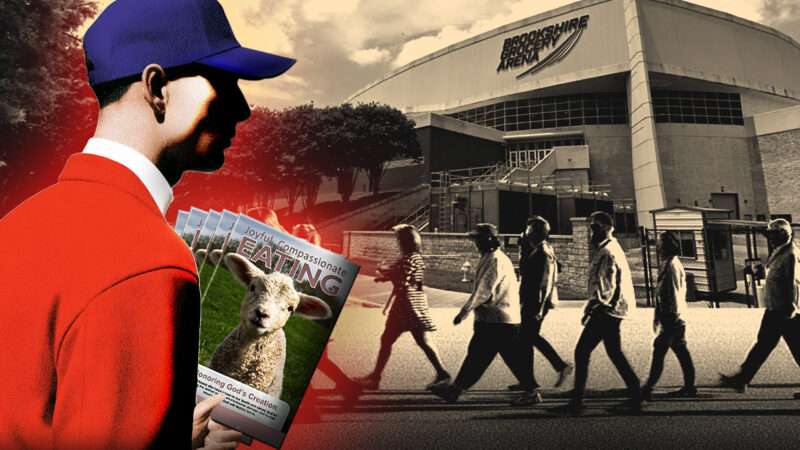
Six years ago, Richard Hershey was distributing religious leaflets on a public sidewalk in a public park surrounding a public arena in Bossier City, Louisiana, when he was accosted by police officers who insisted that he stop. Hershey, who was promoting the views of the Christian Vegetarian Association outside a Christian rock concert at the Bossier City Arena, pointed out that he was exercising his constitutionally guaranteed freedom of speech and freedom of religion. He also noted that the officers had not interfered with another leafleteer, who was advertising a local radio station.
The cops were unmoved. If Hershey did not leave immediately, they said, he would be arrested, and he likewise would be carted off to jail if he ever dared return to the park.
It would be hard to imagine a more blatant violation of First Amendment rights. But last October, the U.S. Court of Appeals for the 5th Circuit held that Hershey could not sue the officers responsible for it because they were protected by qualified immunity, a doctrine that bars federal civil rights claims unless they allege violations of “clearly established” law. Now Hershey is asking the Supreme Court to overrule that jaw-dropping conclusion, which illustrates how broad interpretations of qualified immunity prevent victims of outrageous police misconduct from vindicating their rights.
“The right to evangelize in public, free of viewpoint-based government suppression, is as clearly established as any right in the firmament,” Hershey’s lawyers, who include former Solicitor General Paul Clement and litigators at the First Liberty Institute, note in a Supreme Court petition filed last Friday. “It is squarely protected by two separate but overlapping clauses of the First Amendment—the Free Speech and Free Exercise Clauses—and by decisions of this Court underscoring that viewpoint discrimination is verboten and that discrimination against religious speech is viewpoint discrimination (im)pure and simple. No government official should need an on-point circuit precedent to illustrate what the Constitution itself and this Court’s cases make clear beyond cavil.”
Hershey filed his lawsuit under 42 USC 1983, which authorizes people to sue state or local officials for violating statutory or constitutional rights under color of law. That provision, which dates back to the Civil Rights Act of 1871, says nothing about qualified immunity. The Supreme Court invented that doctrine in the 1982 case Harlow v. Fitzgerald on the theory that officials should be liable under Section 1983 only when they had fair notice that their conduct was illegal or unconstitutional.
As interpreted by lower courts, qualified immunity evolved into a requirement that plaintiffs cite precedents involving nearly identical facts, which can be especially challenging when plaintiffs allege abuses so egregious that they are rarely committed, documented, or litigated. But beginning with Hope v. Pelzer in 2002, the Supreme Court made it clear that victims of “obvious” constitutional violations do not have to cite closely similar cases. The Court reiterated that point in the 2020 case Taylor v. Rojas.
Although Hope and Taylor involved Eighth Amendment claims of “cruel and unusual” punishment, most federal appeals courts have understood the “obviousness” exception to qualified immunity as a general principle that also applies to alleged violations of other constitutional rights. But the 5th Circuit has declined to recognize that exception outside of the Eighth Amendment context. In particular, it has prevented plaintiffs from seeking damages for obvious First Amendment violations, such as arresting a reporter for asking questions, unless they can locate a 5th Circuit precedent that is directly on point.
Fifth Circuit Judge James Ho has repeatedly expressed his dismay at that situation. He nevertheless concurred when a 5th Circuit panel blocked Hershey’s lawsuit in October, saying he was bound by the appeals court’s precedents.
Hershey’s claims “should have been amply sufficient to defeat qualified immunity at this preliminary stage of the proceedings” and “allow Hershey to proceed to trial,” Ho wrote in his concurring opinion. “After all, the Supreme Court has repeatedly denied qualified immunity where it found the constitutional violation so ‘obvious’ that it didn’t require the plaintiff to identify factually indistinguishable case law.”
Under Hope and Taylor, “it should be enough to defeat qualified immunity that the alleged constitutional violation is obvious,” Ho wrote. “And this ‘obviousness’ principle should be intuitive to all who treasure our constitutional rights.” Ho quoted an observation that Supreme Court Justice Neil Gorsuch made as a 10th Circuit judge in 2015: “Some things are so obviously unlawful that they don’t require detailed explanation.”
Gorsuch added that “sometimes the most obviously unlawful things happen so rarely that a case on point is itself an unusual thing.” He thought “it would be remarkable if the most obviously unconstitutional conduct should be the most immune from liability only because it is so flagrantly unlawful that few dare its attempt.”
Ho said he “most certainly” agreed with Gorsuch. But in the 5th Circuit, he noted, “Hope and Taylor apply only to the Eighth Amendment claims of incarcerated criminals.” Ho thought the court made that clear in 2024, when it rejected the First Amendment lawsuit that Laredo, Texas, journalist Priscilla Villarreal filed after she was charged with two felonies because she had asked a police officer to confirm information about a fatal car crash and a public suicide.
In Villarreal v. City of Laredo, the majority noted that Hope and Taylor were “Eighth Amendment cases,” which it said established only a “narrow” exception that Villarreal could not invoke. Ho joined six other judges in vigorously dissenting from that decision. But although the Supreme Court vacated the ruling against Villarreal later that year, Ho noted, “our court has now reinstated it.” On remand in April 2025, the 5th Circuit again blocked Villarreal’s lawsuit, saying its previous decision was “superseded” only to the extent that it addressed the requirements for proving a retaliatory arrest.
Given Ho’s objections to the 5th Circuit’s take on the “obviousness” exception, it is a bit puzzling that he concurred when the court rejected Hershey’s petition for an en banc rehearing of his case last December. “It should go without saying,” Ho wrote, that “the freedom of speech secured by the First Amendment includes religious speech,” and “the obviousness of that right should have been enough to defeat qualified immunity in this case, without the need for a factually identical case saying so.” Ho nevertheless joined the majority in passing up a chance to reconsider the 5th Circuit’s narrow understanding of the principle recognized in Hope and Taylor.
Seven judges voted to rehear Hershey’s case. In an opinion joined by the six other dissenters, Judge Andrew Oldham chided Ho for opposing a rehearing. “According to Judge Ho, our court’s approach to qualified immunity in First Amendment cases is deeply flawed,” Oldham wrote. “If our precedent is that bad, however, we should obviously go en banc to overturn it. It’s surpassing strange to say, ‘our precedent requires persecution of Christians,’ and then say, ‘we should not go en banc to fix it!'”
It is now the Supreme Court’s responsibility to “fix it,” Hershey’s lawyers argue. “The decision below got an exceptionally important issue exceptionally wrong,” they write. “Compelled by erroneous precedent, a Fifth Circuit panel granted qualified immunity to police and security officers who violated First Amendment rights that have been clearly
established for decades.”
Defenders of qualified immunity often argue that it is necessary to protect officers from liability for good-faith decisions made in challenging circumstances. But the cops who threatened Hershey “had no split-second, life-or-death decision to make,” the petition notes. “All the officers had to do to avoid liability was to do nothing.”
Instead, the cops “needlessly committed an obvious constitutional violation, threatening to arrest petitioner, compelling him to leave, and banishing him indefinitely from a public park on pain of arrest, all while leaving the commercial leafleteer alone,” Hershey’s lawyers write. “Constitutional violations do not come any plainer than that, and [Section 1983] unambiguously promises a remedy.”
Americans “have a clear right to engage in peaceful leafletting, and the prohibition on viewpoint discrimination, especially disfavoring religious viewpoints, is pellucidly clear,” the petition says. “Government officials do not need an on-point circuit precedent to tell them as much. Indeed, one would hope that there is no on-point circuit precedent precisely because the constitutional line is so clearly established that no one has previously crossed it. There is no reason to grant officers immunity simply because they have gone where no prior officer ever dared to tread.”
The post Louisiana Cops Threatened To Arrest a Man for Handing Out Religious Leaflets. They Got Qualified Immunity. appeared first on Reason.com.
from Latest – Reason.com https://ift.tt/jiMNSPA
via IFTTT