The Slow Disappearance Of Cash In Europe

The Slow Disappearance Of Cash In Europe

Authored by Cláudia Ascensão Nunes via the Foundation for Economic Education (FEE),

Under the guise of fighting money laundering, the EU is making anonymous economic activity progressively harder…

Starting in July 2027, Europeans will no longer be allowed to pay businesses or professionals more than €10,000 in cash (roughly $11,500). Any transaction above €3,000 (just under $3,500) will require mandatory customer identification. This is another step toward political uniformity across Europe, stripping countries of autonomy and subtly pushing citizens toward the digital euro.

This measure, part of the new Anti-Money Laundering Regulation (AMLR), applies directly to all Member States. Under the pretext of fighting money laundering, Brussels is imposing yet another form of forced harmonization that ignores the principle of subsidiarity: the idea that decisions should be made at the level closest to citizens and national governments.

What was once a matter regulated by individual countries is now becoming a uniform mandate from Brussels.

This is a thinly disguised restriction not only on political freedom, but above all on economic freedom. Cash remains one of the last truly private means of exchange still available; unlike digital transactions, cash does not automatically create a centralized record accessible to banks or public authorities.

The use of cash is often associated with the intention to hide illicit activity. Yet the ability to conduct private and discreet transactions is a natural extension of property rights and freedom of contract. Many law-abiding citizens prefer cash for entirely legitimate reasons, including protection against financial instability or potential capital controls.

From that date onward, professionals will be forced to turn every transaction above €3,000 into a bureaucratic process involving identity verification, data collection, and the risk of penalties. This is yet another regulatory imposition that raises the cost of doing business, similar to the introduction of VAT in Europe decades ago, which pushed many small businesses to close their doors or move into the informal economy because of increased bureaucracy and compliance costs. Small entrepreneurs, already pressured by high taxes and excessive red tape, will once again bear the heaviest burden.

What were once simple voluntary exchanges will become sources of additional costs, delays, and state intrusion.

Once again, centralized authorities are creating regulatory complexity under the difficult-to-challenge justification of fighting crime, even though each country already has its own rules in this area.

More liberal countries such as Germany will lose flexibility, since they previously had no general limit on cash payments. The uniformity imposed by Brussels ignores cultural differences, particularly differing levels of trust in institutions. In some countries, cash culture remains deeply rooted, and confidence in digital systems is significantly lower.

This measure represents a gradual erosion of individual autonomy. If using cash becomes increasingly inconvenient for merchants and consumers, people will naturally migrate toward digital payments. Over time, this initially convenient shift will make the introduction of the digital euro far easier.

It is difficult to believe that it is mere coincidence that these restrictions are scheduled to take effect in July 2027 at roughly the same time the European Central Bank (ECB) plans to launch the first pilots of the digital euro. Cash becomes inconvenient and potentially risky at the same time digital money is presented as the practical alternative.

Once the principle is established that the state can limit private cash transactions, there is a strong tendency for those limits to become progressively stricter. European countries themselves demonstrated this pattern when they still controlled these rules nationally. Belgium, for example, steadily lowered its cash payment ceiling over the years to the current €3,000.

The most likely outcome is that the new European-wide limit of €10,000, which may seem relatively high today, will gradually be reduced further until using cash for most significant transactions becomes impractical. In reality, the vast majority of cash transactions are already well below this threshold. According to studies by the ECB, around 81 percent of all point-of-sale payments are below €25, and cash is predominantly used for small everyday purchases. This means that the €10,000 limit will mainly affect legitimate higher-value transactions, such as the payment of certain professional services that many citizens and small businesses still prefer to carry out in cash.

The digital euro, presented as a complement to cash, will arrive at a moment when cash has already been substantially weakened. Unlike cash, this system is traceable, programmable, and potentially subject to holding limits, expiration mechanisms, or usage restrictions.

China has already offered real-world examples. In several pilots of its digital yuan, authorities tested expiration dates on funds, meaning the money would lose its value if not spent by a certain date. This turns money from a reliable store of value into a tool that encourages spending according to government timelines. Such features demonstrate how programmable digital currencies can be used to control economic behavior, punish saving, and steer consumption in line with state priorities.

These are conditions fundamentally incompatible with the freedom that cash provides.

This accelerated yet discreet path toward a fully digital monetary system opens the door to an unprecedented level of financial surveillance and control in European history. By overriding the principle of subsidiarity, it will affect almost the entire continent.

The road to total societal control passes through the restriction of economic freedom.

Tyler Durden
Mon, 06/01/2026 – 02:00

via ZeroHedge News https://ift.tt/mwHIxa4 Tyler Durden

Shutting Down Federal Bee Labs Threatens The US Food System

Shutting Down Federal Bee Labs Threatens The US Food System

Authored by Jennie Durant via TheConversation.com,

America’s bees and beekeepers are losing a valuable ally just when they need its help most.

The U.S. Department of Agriculture plans to soon close the Beltsville Agricultural Research Center, a 6,500-acre agricultural research station in Maryland that is home to the nation’s premier bee research and disease diagnosis hub, the Beltsville Bee Research Lab.

The closure comes at a critical moment for bees. In winter 2025, many beekeepers lost over half their operations as pesticide-resistant varroa mites spread, bringing deadly viruses. The losses have led to low honey production, and soaring fuel costs have made shipping bees cross-country for agricultural pollination increasingly expensive, further stressing the industry.

Beekeeping involves keeping colonies as healthy as possible. Often, beekeepers need help. Allagash Brewing/FlickrCC BY

During my 14 years researching bees and beekeepers, and in writing my new book, “Bitter Honey: Big Ag’s Threat to Bees and the Fight to Save Them,” I’ve seen beekeepers frequently turn to the USDA bee labs for support during crises like this. Because honey bees contribute roughly US$15 billion to U.S. crop production – native and managed bees pollinate more than 130 crops – these labs help stabilize the nation’s food system.

Today, that scientific support system is at risk, just as beekeepers face their greatest challenges and native bee populations continue to decline.

Why the Beltsville Bee Lab matters

USDA’s bee researchers have served beekeepers for over 130 years, including nearly 90 years at the Beltsville station. One of the Beltsville Bee Lab’s standout services is its bee disease diagnostic service, where beekeepers can send samples for analysis free of charge.

Since the early 2000s, Beltsville researchers have helped beekeepers respond to varroa mites – a primary driver of high colony losses each year. Now, the lab is helping them prepare for a deadlier mite that is infesting honey bees in Asia, Tropilaelaps mercedesae, or “tropi” mites – by developing detection and response protocols that beekeepers can use to protect their colonies.

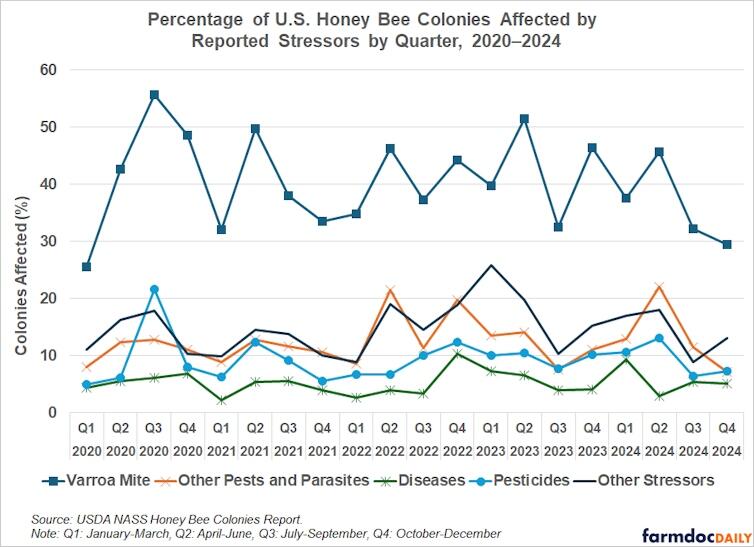
Varroa mites are the leading source of stress on honey bees, affecting half of all colonies at times. Other major stressors affect large numbers of colonies as well. Farm Doc Daily/University of Illinois

While the Beltsville Bee Lab supports beekeepers nationwide, it’s located in a prime farming and beekeeping region. Its closure would leave a critical research gap in the Northeast, where beekeepers help pollinate cranberries, squash, blueberries and other crops.

Its location has also allowed researchers to conduct extensive studies on winter colony losses, research that would be difficult to replicate at the remaining USDA bee labs, which are primarily located in more temperate climates.

Hidden costs of bee lab closures

The USDA states that it will decommission the entire Beltsville Agricultural Research Center because building maintenance and renovations would cost an estimated $500 million. But closing the lab could cost beekeepers, farmers and consumers far more.

For example, in winter 2025, beekeepers experienced their highest losses in U.S. history. Many opened their colonies in January that year and found that more than 60% of their colonies had died – nearly 1.7 million colonies nationwide. Beekeepers contacted Beltsville, and researchers quickly flew out to test affected colonies for pesticide residues, diseases and varroa mites, data that could help guide beekeepers’ treatment response.

Entomologist Jay Evans explains what the Beltsville Bee Lab does and the diseases bees face.

A few weeks later, as the lab’s scientists were working on the crisis, the Trump administration fired probationary researchers and staff at the bee labs, along with thousands of other employees across the USDA. The Beltsville team was hobbled, and the remaining staff restricted from communicating with beekeepers.

Because of the communication lockdown, it took nearly six months for researchers to deliver their findings. By then, the season was over and beekeepers had been forced to navigate the crisis on their own.

The loss of bee colonies ultimately cost beekeepers an estimated $600 million in lost honey production, pollination income and colony replacement costs – far more than the one-time projected costs to modernize the entire Beltsville Agricultural Research Center.

These losses can hit consumer pocketbooks too.

When beekeepers lose nearly half their operations, they often need to charge farmers more for pollination services to stay afloat. Those added costs can ripple through the food system and affect what everyone pays for the fruits, vegetables and nuts that depend on pollinators.

Beekeepers often transport their bees across the country to meet pollination needs and produce honey at different times of year. The map shows the movement of bees out of California to other states in summer and fall. Jennifer K. Bond, et al., USDA Economic Research Service, 2021

More cuts planned to US pollinator research

The Beltsville Bee Lab closure is not an isolated case. The administration has proposed eliminating the U.S. Geological Survey’s Ecosystems Mission Area, a move that could defund the USGS Bee Lab, an essential resource for research on native bees.

It also plans to decommission 16 USGS research centers nationwide, including the Northern Prairie Wildlife Research Center in North Dakota, the highest honey-producing state in the nation. For decades, beekeepers have brought colonies to forage on grasslands in the region. Researchers have been tracking how the shift from grasslands to crops has affected honey bee health and beekeeper revenue.

The U.S. Forest Service also faces widespread cuts, including the planned closure of 57 of its 77 research stations throughout the United States. Since the Forest Service manages over 193 million acres of federal lands that support native plants and pollinators, those closures could affect crucial pollinator habitat as well.

All kinds of bees are valuable for pollinating crops and flowers, not just managed honey bees. Jean Hort/Flickr Creative Commons

These closures risk a severe brain drain.

When the first Trump administration moved the USDA Economic Research Service from Washington to Kansas City, Missouri, in 2019, the agency lost over 75% of its experienced research staff. A recent survey suggests that history may repeat itself. If the reorganization goes through, farmers and beekeepers will lose experts with decades of institutional and technical knowledge.

The Beltsville Bee Lab is a key part of the often-unappreciated federal research infrastructure that supports the health of pollinators and the nation’s food supply.

If the USDA and the USGS move forward with their plans to close bee labs and research sites, the result could be slower responses to bee threats, weaker tracking of native bee populations and diminished pollinator habitat for bees – all of which raise costs and risks for beekeepers, farmers and everyone who depends on the food system.

Tyler Durden
Sun, 05/31/2026 – 23:20

via ZeroHedge News https://ift.tt/1buApFU Tyler Durden

US Officials Suspect Iran Used Chinese Missile To Bring Down F-15E Warplane: Report

US Officials Suspect Iran Used Chinese Missile To Bring Down F-15E Warplane: Report

Via The Cradle

US officials believe that a Chinese-made shoulder-fired missile was likely used by Iranian forces to shoot down a US F-15E Strike Eagle over southwestern Iran last month, NBC News reported Saturday. 

The incident marks the first time in decades that the US has had to acknowledge that one of its jets was shot down by enemy fire, although three F-15Es were also shot down in Kuwait in March. 

Illustrative, via Reuters/stringer

Washington insists the Kuwait incident was due to ‘friendly fire,’ even as Iran claims responsibility.

Following the downing of the F-15E in southwestern Iran, the Pentagon allegedly launched a two-day rescue operation to recover the aircraft’s two-man crew, whose names and photos have not yet been made public.

While US officials continue to investigate the specifics of the shootdown, intelligence sources suggest that Beijing may also have provided Tehran with an advanced, long-range early-warning radar, the YLC-8B, designed to track stealth aircraft. 

US President Donald Trump previously said that Chinese President Xi Jinping had personally “promised” him that Beijing would not supply military hardware to Iran, adding, “That’s a beautiful promise. I take him at his word. I appreciated it.”

However, reports of Chinese-manufactured man-portable air defense systems, or Manpads, being found on the battlefield have raised questions about those assurances. 

In response to the allegations, the Chinese Embassy in Washington issued a statement rejecting the claims as “groundless smear and ill-intentioned association,” saying that “China always acts prudently and responsibly on the export of military products,” in accordance with international regulations.

Recent US intelligence indicates that Beijing might be planning to supply more air defense weapons to Iran soon. 

While China has historically provided an economic lifeline and dual-use technology to Iran, US officials noted that previous assistance has not had a “decisive operational impact” on the current conflict.

Tyler Durden
Sun, 05/31/2026 – 22:10

via ZeroHedge News https://ift.tt/IfEimtK Tyler Durden

AI’s Coming Reality Check: When The Physics Finally Hits The Hype

AI’s Coming Reality Check: When The Physics Finally Hits The Hype

Authored by Chris MacIntosh vis InternationalMan.com,

In five years, we’ll all likely be chuckling and shaking our heads over AI. Because today, the tech feels free and limitless, doesn’t it?

People are generating endless content: images, videos, memes, code snippets, social posts. Companies are bolting AI onto products by default, the way every Fortune 500 company suddenly discovered they were “sustainable” five years ago.

There’s much deliberation on AI right now, and it splits into two main camps of thesis:

  • The majority — those who will die on its hill of promise, convinced we’re months away from effective altruism, UBI, and sentient toasters.

  • And the minority — usually older, more experienced types — who don’t fully understand it, but look at numbers, remember the dot-com bust, and think this rhymes. We’ll leave that debate to the dinner parties.

What interests us is something more boring. Physics. Because here’s the thing: AI isn’t free.

Every token represents electricity. Something your average developer, product manager, user, or investor gives precisely zero thought to.

Electricity means power plants, transmission lines, grid infrastructure — yes. It also means hot sheds; capital-intensive data centres and all the equipment, cooling systems, and real estate that go with them. Real things. Physical things.

We are surrounded by hype without consideration for the physics.

Right now, there’s a disconnect between the physical cost of this technology and the price users pay for it.

That gap is being covered by Wall Street, venture capital, pension funds, hyperscaler balance sheets, and strategic spending on “growth” (a word which here means “losses we’ve chosen to rebrand”).

The question is: what happens when that gap closes?

Scenario 1: The Industry Matures

No outright collapse, but financial discipline arrives. A novel concept in Silicon Valley. Low-value usage disappears first. “AI slop” dies because the people generating junk stop when it costs them actual money. Turns out nobody’s willing to pay real dollars to have a chatbot write their LinkedIn thought leadership posts. Tragic.

Serious users — those deriving profit or genuine productivity gains — remain. Growth slows but doesn’t stop. GPU upgrade cycles stretch from two years to three or five or seven. Valuations compress. The froth comes off but the infrastructure remains important.

The boardroom shifts from “infinite logarithmic growth” to “focus only on what’s profitable.” Less bubble burst, more long, slow leak of disappointment. A bit like ESG.

Scenario 2: Energy as the Arbiter

Now overlay structurally higher energy prices. You know, the thing everyone was told wouldn’t matter because we’d all be running on solar and unicorn farts by now. If power becomes materially more expensive while capital markets tighten simultaneously, the economics get a lot harder.

Inference costs rise. Training LLMs gets hella more expensive. Shareholders start feeling like they’re holding the next NFT apes. Spending slows sharply. Many AI firms disappear. Hyperscalers pull back, maybe with taxpayer assistance (they are, after all, strategically important to those in power — funny how that works).

GPU cycles extend further. Seven-plus years between major upgrades becomes normal outside the top tier. Markets correct hard. Confidence takes a long time to rebuild.

This is not the end of AI, but a reset. Users will fondly remember the “good old days” when it was free. When one could generate a movie scene and post on X about how they just ended a billion-dollar production company’s business model. Peak delusion makes for great content.

Scenario 3: AI Actually Delivers

There is also the upside case, though we admit it’s included here much like a “minority” conspicuously placed on a corporate board — a box-ticking exercise.

In this scenario, AI meaningfully increases productivity across enterprises. It reduces costs durably. It embeds itself in everything from coding to logistics to research. The sentient toaster.

Higher energy prices don’t kill demand because efficiency gains outweigh them. Hardware cycles remain short. Today’s valuations look justified in hindsight and Jensen Huang’s leather jacket gets its own wing at the Smithsonian.

For anyone familiar with us, you’ll know we think this is the most unlikely scenario. And yet it’s by far the consensus view. Which, if you’ve been paying attention to consensus views over the past decade (“inflation is transitory,” “ESG is the future,” “commercial real estate is fine”) should tell you something.

The gap between expectations and likely reality remains wide open. For Insider members, you’re familiar with the portfolio positioning and Nasdaq hedge.

What Really Matters

The key variable isn’t whether AI is impressive or useful (it is). The key variable is whether AI becomes a true profit engine or remains a subsidised cost centre dressed up in a hoodie and a TED talk.

If profitable and productivity-enhancing, current valuations are justified and the gravy train keeps chugging. If it remains mostly hype layered over weak economics, spending contracts, hardware cycles extend, and we could have an absolute humdinger of an economic “event.”

A ten-year stagnation would require something extreme: demand dropping significantly, hyperscalers becoming hyposcalers, capital markets wanting nothing to do with AI, and energy remaining expensive — all at once. Stranger things have happened. Just ask anyone who bought Peloton at $170.

Almost 50 years of history show this eventually reverts to the mean… and the pendulum swings the other way.

*  *  *

The AI boom is just one example of a much larger shift already underway—where economics, politics, energy, and culture are colliding in ways most investors are not prepared for. That’s why we’ve prepared a special report, Clash of the Systems: Thoughts on Investing at a Unique Point in Time. In it, you’ll discover the key trends unfolding right now, the risks they pose to your money and personal freedom, and what a contrarian money manager believes you could do to stay one step ahead. Get your free copy of Clash of the Systems now.

Tyler Durden
Sun, 05/31/2026 – 21:00

via ZeroHedge News https://ift.tt/O90jSRE Tyler Durden

Monolithic 3D Silicon Chips Achieve Near-Perfect Yields At Low Temperatures

Monolithic 3D Silicon Chips Achieve Near-Perfect Yields At Low Temperatures

Authored by Neetika Walter via Interesting Engineering,

Researchers at the University of Illinois Urbana-Champaign have developed a way to stack high-performance silicon circuits directly on top of one another, a breakthrough that could help the semiconductor industry keep increasing computing power without shrinking transistors further.

The 200-mm wafer contains multiple silicon layers stacked for monolithic 3D chip integration.University of Illinois Urbana-Champaign

The approach tackles one of the biggest challenges facing chipmakers as Moore’s law begins to slow. For decades, the industry boosted performance by making transistors smaller and packing more of them onto a chip. But as devices approach fundamental physical limits, further miniaturization is becoming increasingly difficult.

Instead of shrinking components, the Illinois team is building upward. By stacking multiple layers of silicon circuits, engineers can increase transistor density, reduce communication distances inside chips, and improve energy efficiency.

The researchers say their process could accelerate the development of monolithic three-dimensional chips, a long-sought technology that many experts see as the next step in semiconductor scaling.

Building Chips Upward

“Take something as simple as static random-access memory, which is universal in CPUs and GPUs. Today it takes six microelectronic devices called transistors on a single plane to store one bit of information. With vertical integration, you can distribute them across multiple layers. It’s like replacing a sprawling suburb with high-rises: you get the same functionality, but the spatial footprint is reduced while making communication between layers faster and more efficient,” said Qing Cao, associate professor of materials science and engineering.

While three-dimensional chip technologies already exist commercially, most rely on bonding together separately manufactured wafers. That approach creates relatively large connections between layers and limits how densely components can be integrated.

Monolithic three-dimensional integration takes a different route by building each circuit layer directly on top of the previous one. The method allows much denser vertical connections and more precise alignment between layers, potentially leading to faster and more efficient chips.

The challenge has been temperature. Manufacturing high-performance silicon devices typically requires temperatures approaching 1,000 degrees Celsius. However, once the first layer of circuits and metal wiring is completed, additional layers must remain below about 400 degrees Celsius to avoid damaging existing structures.

To overcome this barrier, the researchers developed a process that transfers ultrathin single-crystalline silicon nanomembranes onto completed circuit layers. The bonding process requires temperatures no higher than 200 degrees Celsius, staying well within the industry’s thermal budget.

Beyond Moore’s Limits

“Vertical integration is already starting to make its way into commercial devices, particularly in specialized AI hardware, but monolithic integration is what unlocks the full promise of 3D chips. For the first time, we have met the thermal budget of monolithic 3D integration using standard single-crystalline silicon and delivered unprecedented performance,” Cao said.

The team also redesigned transistor fabrication to avoid high-temperature processing steps. Instead of conventional transistor structures, they used junctionless transistors that can be prepared before the stacking process begins.

Using the technique, the researchers built three stacked silicon layers containing 625 transistors each. The devices achieved yields between 98% and 100% while delivering performance comparable to standard silicon transistors fabricated at much higher temperatures.

The researchers also demonstrated three-dimensional logic circuits and static random-access memory cells by connecting the layers with vertical metal links.

“But most importantly, we’ve shown that this process is scalable,” Cao said. “You can keep stacking layers beyond the three we demonstrated.”

The researchers are now working to transfer the technology into an industrial semiconductor foundry with support from industry partners including IBM, Intel, and TSMC.

The study was published in the journal Nature.

Tyler Durden
Sun, 05/31/2026 – 19:50

via ZeroHedge News https://ift.tt/MYFsnoU Tyler Durden

Alexis Wilkins, FBI Director’s Kash Patel’s Girlfriend, Sues MS Now for Defamation

From the Complaint in Wilkins v. Versant Media Group. Inc. (M.D. Tenn.), filed Friday:

This defamation lawsuit is about MS Now (formerly, MSNBC) using sham “anonymous” sources to push knowingly or recklessly false allegations that Alexis Wilkins, through her relationship with FBI Director Kash Patel, abused FBI resources. Defendants are, of course, free to comment on the leadership of the FBI and its allocation of resources, whether positively or negatively. They are not, however, entitled to lie about it.

Defendants falsely asserted that Ms. Wilkins demanded, and Director Patel ordered, that federal agents assigned to her security detail—which did not even exist at the time—escort an intoxicated friend home after a “night of partying.” They falsely portrayed Ms. Wilkins as being intoxicated even knowing that she does not drink. Defendants presumed they could get away with this fiction by citing to “anonymous sources,” disingenuously claiming “nonpublic” and “inside” knowledge. This was hogwash and they knew it. Journalists cannot avoid accountability by hiding behind fabricated “anonymous” sources. This lawsuit seeks to bring accountability for Defendants’ egregious lies….

On December 5, 2025, Defendant, MS Now, published an article, written by its employees, Defendants Carol Leonnig and Ken Dilanian, titled, “Kash Patel ordered FBI detail to give girlfriend’s pal a lift home: sources” …. In the Article, Defendants wrote:

FBI Director Kash Patel has—on more than one occasion—ordered that the security detail protecting his girlfriend escort one of her allegedly inebriated friends home after a night of partying in Nashville, according to three people with knowledge of the incidents.

Patel’s girlfriend, Alexis Wilkins, asked FBI agents on her security team at least two times, including once this spring, to drive her friend home, and agents objected to diverting from their assignment, said the sources, who were granted anonymity to discuss nonpublic matters. But Patel insisted they do as Wilkins requested and in one case called the leader of Wilkins’ security detail and yelled at him to do so.

This is entirely false. Director Patel has never ordered any FBI agent or member of Ms. Wilkins’ security detail to escort any of Ms. Wilkins’ friends home—inebriated or otherwise—nor did Ms. Wilkins ask any of them to do so. Not only did these supposed demands/orders never take place, but the entire scenario is fabricated. No FBI agents have ever escorted any of Ms. Wilkins’ friends home.

Defendants claimed in the Article that the substance of their defamatory allegations supposedly occurred in Spring 2025. Notably, Ms. Wilkins did not have a security detail at that time. Defendants were aware of this. Defendants had previously published, on November 17, 2025, an entire article about Ms. Wilkins’ security detail. Defendants were the first to break that story as Ms. Wilkins had only then been recently assigned a detail, necessary due to credible death threats made against her….

On December 2, 2025—three days prior to publication of the Article at issue in this case—Defendant Dilanian reached out to FBI spokesman, Ben Williamson, to obtain comment on the accusation that Ms. Wilkins’ detail had been diverted to escort her friends home. Defendants grossly misrepresented and diminished the FBI’s response in the Article, writing:

FBI spokesperson Ben Williamson did not answer questions about multiple inside accounts of Wilkins’ detail being diverted, but broadly denied such events took place.

“This is made up and did not happen,” Williamson said.

{Since its original publication, Defendants have stealth-edited the Article, without any acknowledgement of the change. In the current online version, the sentence reads: “FBI spokesperson Ben Williamson broadly disputed that such events took place.”}

This was dishonest in two respects. First, Mr. Williamson did answer Mr. Dilanian’s questions about these unfounded accusations. He did not just “broadly” deny them. He specifically, and pointedly, refuted them on the record after having researched the matter by speaking to all potential witnesses, explaining that there is no record or corroboration. Second, it was Dilanian who refused to answer questions. Williamson, who was flabbergasted at Dilanian’s complete lack of details or corroboration, asked him for anything that would support the accusations. Their text exchange was as follows:

WILLIAMSON: This detail thing you emailed about looks like it’s made up. I just checked. No record of it anywhere and Alexis, who doesn’t even drink, said it’s not true. As did Director. Do you have any more details? General date? Who is the friend? Anything.

DILANIAN:  Stand by

WILLIAMSON:  Do you not have this info already?

DILANIAN: Just to be clear no one is saying Alexis was drunk. We don’t have the details you are looking for but we are comfortable with our sourcing. So just looking for your official comment.

WILLIAMSON:  So you have no name, no date range, no nothing – just comfortable with your sourcing. Are you serious?

Respectfully

Defendants were, therefore, specifically aware prior to publication that the FBI had investigated the allegations and refuted them. Not only did Defendant Dilanian recklessly disregard this fact, claiming “we are comfortable with our sourcing,” but Defendants omitted this information from the Article, falsely implying that the FBI made only a reflexive and broad denial, and falsely claiming that the FBI had refused to answer questions.

Additionally, Defendant Dilanian lied to the FBI in the text exchange, falsely claiming that he had no information on the general date of the alleged incident. Had Dilanian provided the Spring timeframe for the allegation, the FBI could, and would have even more conclusively refuted the story by pointing out that Ms. Wilkins had no security detail at that time.

Defendants, in calculated fashion, avoided that truth. They knew about the recent assignment of Ms. Wilkins’ detail by virtue of their own November 17 article. They knew that if they were to give the FBI the Spring timeframe, it would result in more than just the “official comment” they were looking to get and would derail their desired narrative.

Because the alleged events did not take place, all potential witnesses, including every member of Ms. Wilkins’ security detail flatly, and rightly, deny the allegations from the Article. And as the FBI has no corroborating records, Defendants’ “anonymous” sources could not possibly have had first-hand knowledge. If their sources existed at all, Defendants knowingly or recklessly disregarded their complete lack of knowledge and credibility. Defendants knew this and recklessly chose to publish these anonymously sourced lies in the face of on-the-record refutation.

In fact, by saying in the Article that their sources were “granted anonymity to discuss nonpublic matters,” and that they were “inside accounts,” Defendants falsely suggest to their readers, as intended, that the sources are official, or even members of Ms. Wilkins’ security detail. This alone is evidence of Defendants’ maliciously deliberate obfuscation and knowledge of falsity….

As implicitly acknowledged by Defendant Dilanian, the Article also implies that Ms. Wilkins was inebriated. By claiming that on multiple occasions she was out late after a “night of partying” with a group of inebriated friends in Nashville, Tennessee—a city known for late-night partying and drinking—the Article suggests to the average reader that Ms. Wilkins is a heavy drinker. This is entirely false, as Ms. Wilkins very rarely drinks, if ever. Importantly, Defendants were on actual notice that this implication was false from Mr. Williamson’s text message….

The complaint also (1) alleges that the statements were said with “actual malice” (i.e., were knowingly or recklessly false, (2) argues that “Ms. Wilkins is not a public figure,” so that the actual malice standard doesn’t apply, and instead “she need only show that Defendants acted negligently,” and (3) criticizes New York Times v. Sullivan, which set forth the actual malice requirement. That last point is of course not particularly relevant in a Complaint, but presumably Wilkins is planning to raise and preserve such a challenge in the event that the Supreme Court can be persuaded to cut back on that precedent, or cut back its extension from public officials (the precise issue in Sullivan) to public figures. The complaint also includes a “false light” claim, which is closely related to a defamation claim: It also rests on the statements being allegedly false, but seeks to recover for their being “highly offensive” to the plaintiff and to a reasonable person, rather than for their damaging reputation.

The post Alexis Wilkins, FBI Director's Kash Patel's Girlfriend, Sues MS Now for Defamation appeared first on Reason.com.

from Latest – Reason.com https://ift.tt/ZbO2LeQ
via IFTTT

Thomas and Alito Take a Regrettable Position in a Qualified Immunity Case


Law enforcement officer standing in front of court house | Illustration: Midjourney

Qualified immunity is a judge-made doctrine that routinely shields bad cops from facing civil lawsuits over their abusive and unconstitutional behavior. All too often, a federal judge will hear a case in which a clear constitutional violation occurred, only to then shield the offending officer anyway from facing civil liability over the blatant misconduct. It’s a legal doctrine that deserves to be abolished.

Occasionally, however, the officer will lose one of these cases, and qualified immunity will be denied. That’s what happened last year in Hart v. Grand Rapids, in which the U.S. Court of Appeals for the 6th Circuit actually let a federal civil rights lawsuit proceed against a Michigan police officer whose use of deadly force against a protester was officially reprimanded by his own superiors because of how the officer’s actions violated the department’s training and procedures.

That officer subsequently appealed his loss to the U.S. Supreme Court, which finally turned him down earlier this week, thereby leaving the 6th Circuit’s denial of qualified immunity undisturbed. The civil rights suit against the officer will now move forward in federal court, a welcome result. To be clear, the officer may still prevail in the end, but at least his alleged victim will now get the chance to seek redress for a credible constitutional rights violation.

What makes this case especially notable, in addition to the all-too-rare denial of qualified immunity, is the fact that two members of the Supreme Court went out of their way to let us know just how eager they were to rule in the offending officer’s favor.

In the view of Justices Clarence Thomas and Samuel Alito, the officer in this case was fully entitled to receive qualified immunity and to be shielded from facing civil suit. If it were up to Thomas and Alito, the 6th Circuit’s judgment against the officer would have been summarily reversed.

I am sometimes asked which members of the Supreme Court are the most reliably libertarian on various legal matters, such as criminal justice. After clarifying that nobody on the current Supreme Court is a truly consistent legal libertarian on anything, I typically say something to the effect that Justices Sonia Sotomayor and Neil Gorsuch usually tend to give libertarians the most reasons to cheer on matters of criminal justice.

This case presents us with the flip side of that coin. When viewed from a libertarian legal perspective, Thomas and Alito tend to stand out as the worst on criminal justice issues. In far too many cases, Thomas and Alito have exhibited a kind of overriding deference to law enforcement that undermines the Bill of Rights and thwarts government accountability. Their actions this week continue that unfortunate trend.

The post Thomas and Alito Take a Regrettable Position in a Qualified Immunity Case appeared first on Reason.com.

from Latest – Reason.com https://ift.tt/3X90alE
via IFTTT