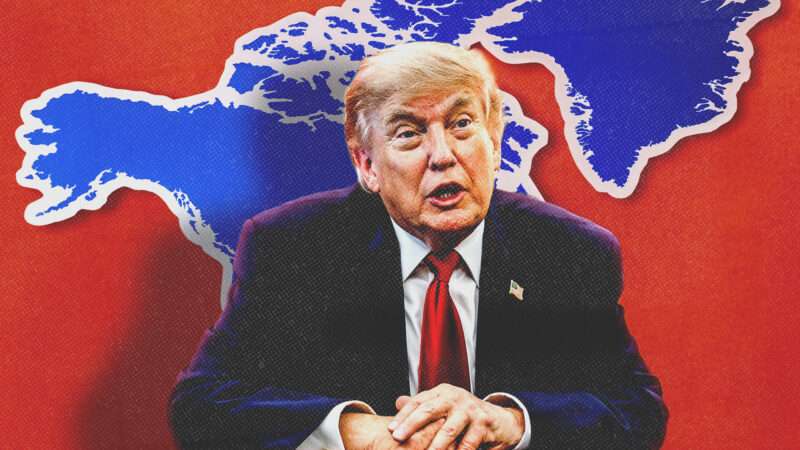
When President Donald Trump signed a new North American trade deal during his first term, he celebrated it as “the fairest, most balanced, and beneficial trade agreement we have ever signed into law. It’s the best agreement we’ve ever made.”
Six years later, he wants out.
The Trump administration announced Wednesday that it would not renew the United States-Mexico-Canada Agreement (USMCA). That decision seems to have been driven by an ongoing worry about trade deficits between the U.S. and the other two members of the deal.
“The United States will continue to engage with Mexico and Canada to address the Agreement’s shortcomings and our trade deficits with these countries,” said U.S. Trade Representative Jamieson Greer in a statement.
Wednesday’s announcement is significantly less dramatic than it might at first seem. The USMCA will remain in place while further negotiations take place. Compared to some of Trump’s more haphazard and destabilizing trade policy maneuvers, this seems relatively tame. It merely means a more fraught process will be required to keep the North American free trade zone together, while a smooth renewal would have meant the USMCA would remain in force for 16 more years.
But that doesn’t mean this was a wise or necessary move. Indeed, Trump’s decision to throw the USMCA’s future into doubt carries economic risk and further erodes the trust that is required to reach any trade deal.
“Given the Trump administration’s decision today, where do things stand right now on the future of the USMCA? ‘Totally up in the air’ is probably a good characterization,” writes Simon Lester in the International Economic Law and Policy Blog.
That uncertainty will have consequences for industries across the continent. Much of American manufacturing involves sprawling supply chains that have been built in the decades since NAFTA came into force. A single piston in a car engine might move through factories in all three countries before being installed, as The Wall Street Journal recently highlighted.
The move to renegotiate the USMCA also opens the door to more economic protectionism. Avocado farmers in California quickly responded to Wednesday’s news by demanding new barriers to imported avocados from Mexico, for example.
The Trump administration believes that greater uncertainty will give it leverage in new rounds of negotiations with Canada and Mexico, said Ryan Young, a senior economist at the Competitive Enterprise Institute. But the opposite might happen.
“In the meantime, Mexico and Canada both have an incentive to strengthen their ties with China and Europe as their alliance with America weakens,” Young said in a statement.
The USMCA was, in many ways, a step backward from the North American Free Trade Agreement (NAFTA), which it replaced. The newer deal had stricter requirements for the duty-free imports of cars and car parts, for example. But the best thing about the USMCA was the sense that, as Reason‘s Nick Gillespie wrote optimistically in 2018, “it ends the drama created by Trump in the first place.”
Clearly, that hasn’t panned out. The gap between that promise and the reality of American trade policy in 2026 is perhaps the most significant part of Wednesday’s announcement. The USMCA was a proper trade agreement, and one that was ratified by Congress. Trump’s second-term approach to trade policy has instead been notably more improvisational, more corrupt, and less successful in terms of actually securing freer trade for American citizens and businesses.
“The [USMCA] was passed through Congress with bipartisan support and created a stable economic partnership in North America, unlike the reckless, illegal tariffs the administration has pursued since retaking office,” said Rep. Suzan DelBene (D–Wash.) in a statement responding to Wednesday’s news.
But it is telling that congressional Republicans aren’t upset about Trump’s decision to cancel the USMCA’s renewal.
Rep. Adrian Smith (R–Neb.), chairman of the House Ways and Means Committee’s trade panel, told Semafor on Tuesday that “there’s a path” where Congress “wouldn’t even have to vote on” a replacement agreement that supplants the USMCA.
That sums it up pretty well. During Trump’s first term, we traded a long-standing, successful trade deal for a replacement that allowed the president to claim a meaningless victory. Now, we’re trading that deal for a new reality in which Congress is fully cut out of the process. The only certain result of Wednesday’s USMCA nonrenewal is that there will be more economic uncertainty across North America.
The post Trump Called the USMCA His 'Best Deal.' Now, He Wants Out of It. appeared first on Reason.com.
from Latest – Reason.com https://ift.tt/5QPuz7G
via IFTTT