These Are The World’s Top Destinations For Wealth Migration
Countries are increasingly competing to attract wealthy individuals alongside businesses and skilled workers. For many governments, internationally mobile wealth represents a source of investment, entrepreneurship, and long-term economic growth.
This graphic, via Visual Cspitalist’s Dorothy Neufeld, ranks the world’s most competitive destinations for wealth migration using data from The Henley Private Wealth Migration Report 2026, which evaluates countries across 12 factors including tax policy, investor pathways, regulatory quality, and overall business environment.
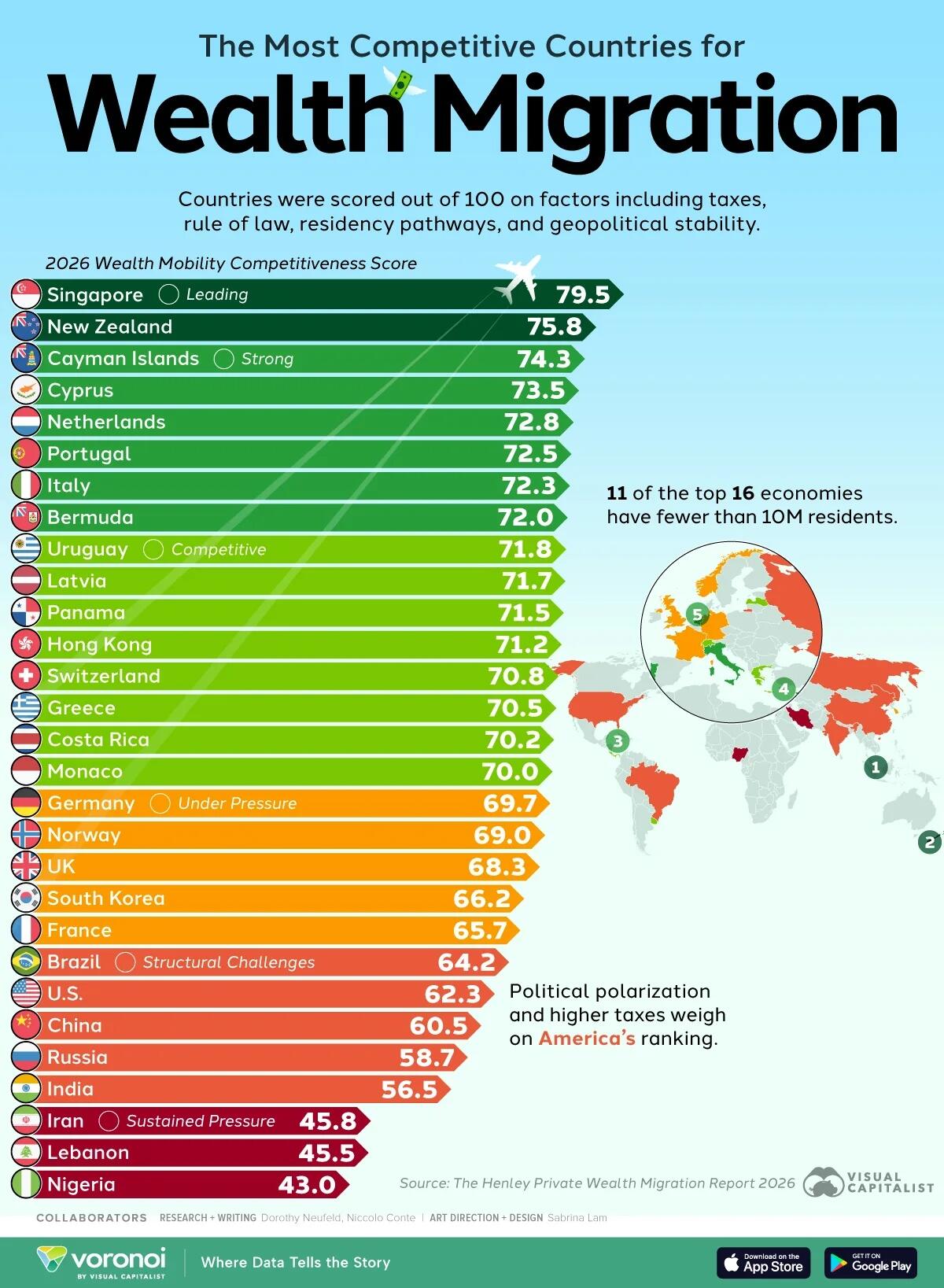
The Most Competitive Countries for Wealth Migration
Below, countries are measured by their competitiveness for attracting internationally mobile wealth.
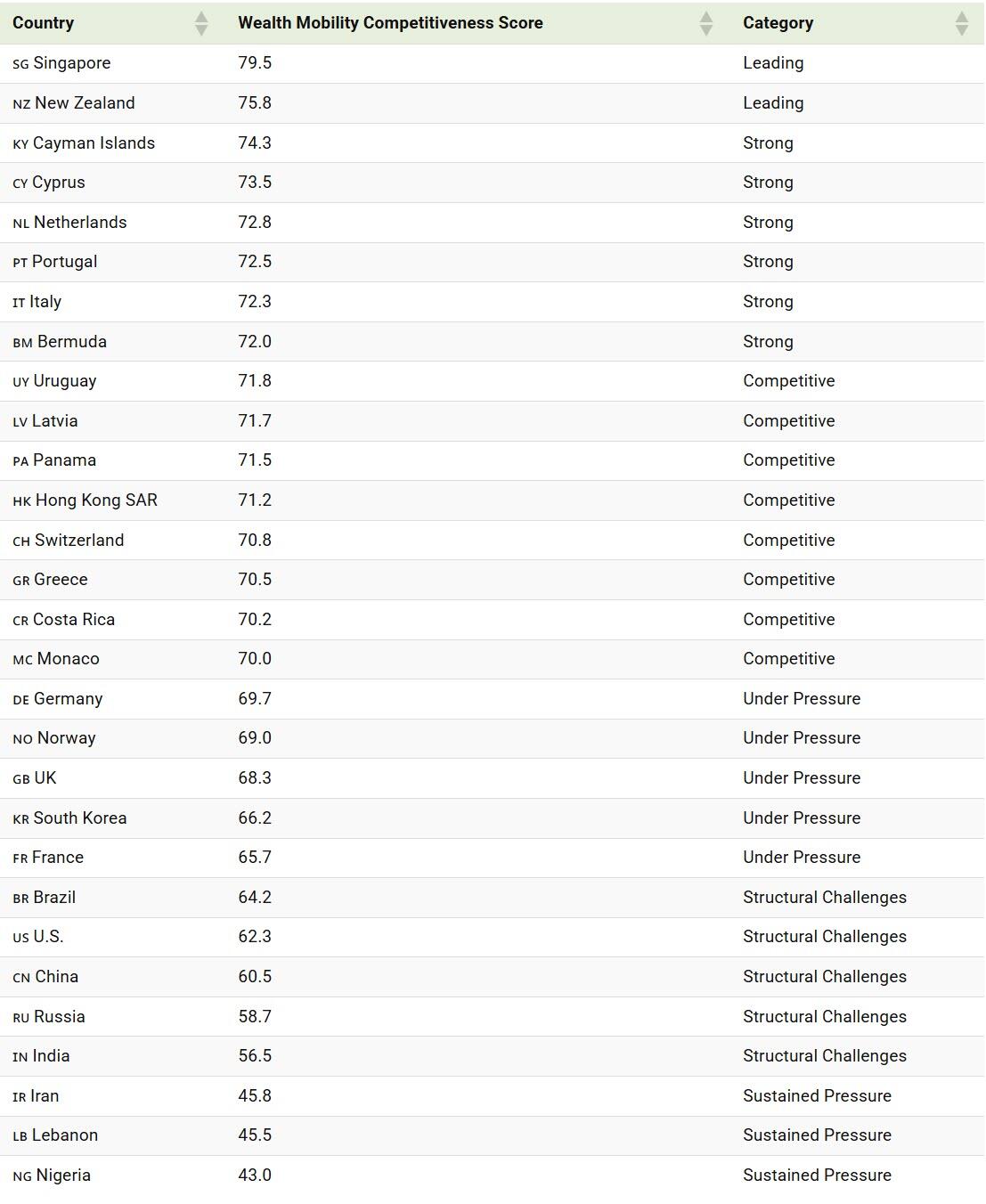
Singapore leads globally, ahead of New Zealand and the Cayman Islands. Europe also performs strongly, with the Netherlands, Cyprus, Portugal, Italy, Switzerland, and Greece all appearing in the top 15.
Singapore’s position reflects its combination of low taxes, political stability, and business-friendly policies. Together, these strengths have made it one of the safest countries for investors, and a magnet for wealth across Asia.
Small Countries Stand Out
One of the clearest patterns is the strength of smaller economies. Overall, 11 of the 16 most competitive countries have populations under 10 million.
Many of these countries have spent decades building investor-friendly ecosystems. Singapore offers a globally connected financial hub, Cyprus provides attractive residency pathways, and Switzerland combines political stability with an established private banking industry.
Rather than relying on domestic market size, many of these countries compete by offering predictable regulation, efficient tax systems, strong legal institutions, and straightforward pathways for investors to establish residency or relocate wealth.
The U.S. Falls Behind
Despite having the world’s largest economy, the U.S. faces several structural challenges in attracting wealth.
Citizenship-based taxation, fiscal complexity, longer investor processing times, and political polarization are among the factors weighing on its score. By contrast, many higher-ranked countries offer simpler tax regimes, making them more attractive to internationally mobile wealth.
Unlike most countries, the U.S. taxes its citizens on worldwide income regardless of where they live, a feature that can increase tax burdens for internationally mobile individuals.
Why Countries Are Competing for Wealth
Countries are increasingly competing for more than businesses and skilled workers. They are also competing for private capital.
In 2025 alone, nearly 1 million people globally became millionaires, highlighting the growing pool of internationally mobile wealth.
High-net-worth individuals often relocate with businesses, investment capital, and philanthropic spending. As global wealth continues to grow, attracting even a relatively small number of affluent residents can have an outsized economic impact, particularly for smaller countries.
To learn more about this topic, check out this graphic on the world’s most powerful passports.
Tyler Durden
Sat, 07/04/2026 – 16:55
via ZeroHedge News https://ift.tt/tXaZdgV Tyler Durden