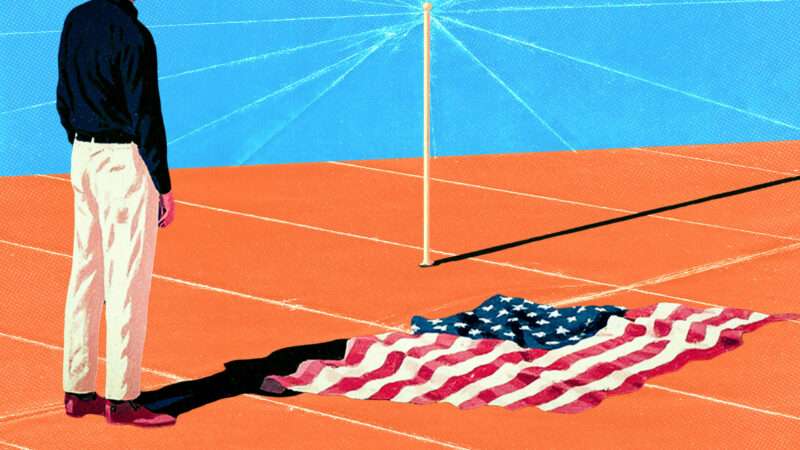
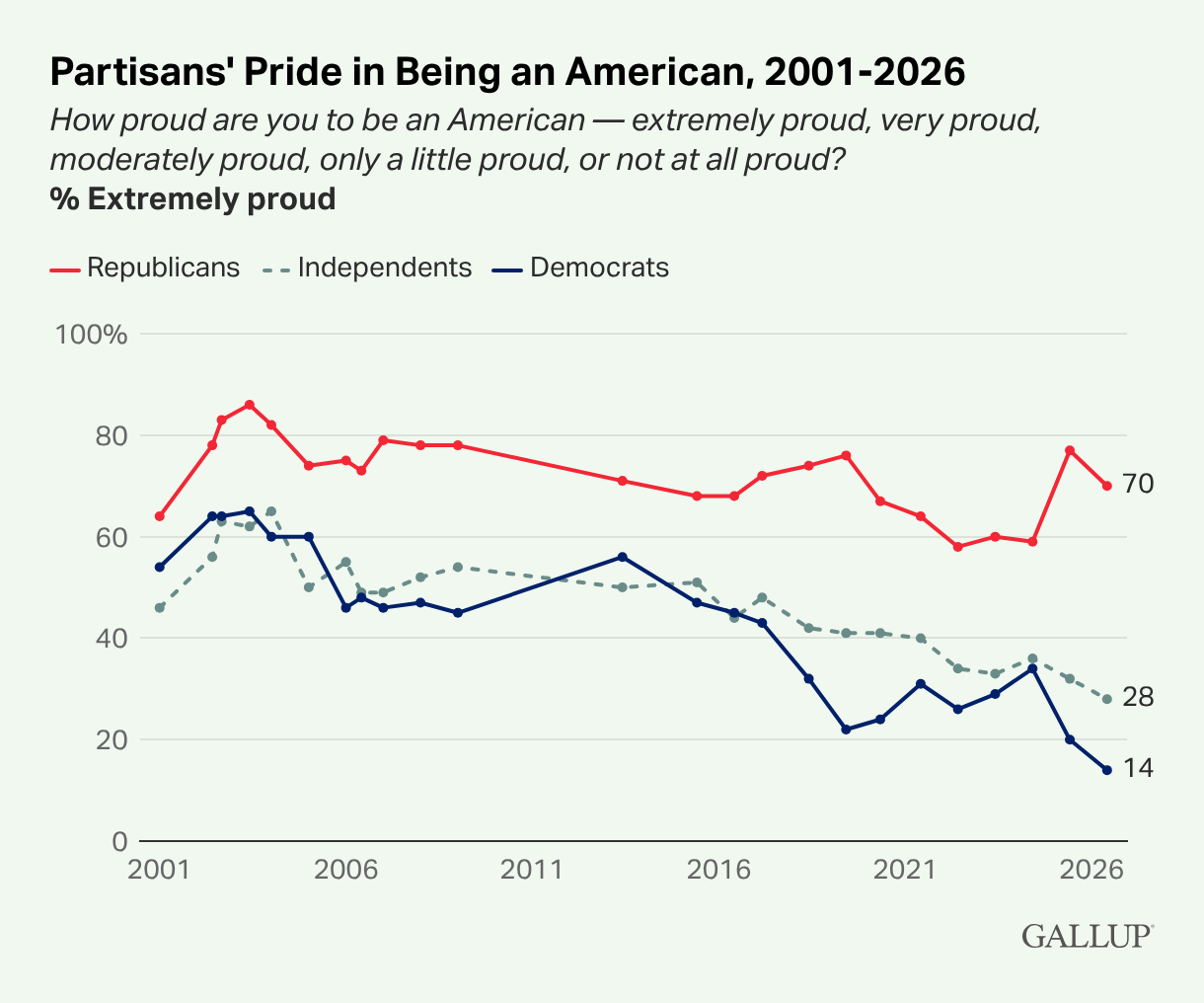
In the days before the much-ballyhooed celebrations of America’s 250th anniversary, Gallup dropped what passes for a bombshell from its polling operation. “American Pride Falls to 25-Year Record Low,” reads the headline on Megan Brenan‘s summary of recent polling, which asked a representative group of Americans the following question: “How proud are you to be an American—extremely proud, very proud, moderately proud, only a little proud, or not at all proud?”
In a column I wrote last week about the apparent decline of American patriotism, I noted that much of the press coverage focused on the low rates of pride evinced by Gen Z and millennials while ignoring that “all age groups are less likely to love America than in the past.” I also focused on how volatile the patriotism of partisan Democrats and Republicans tends to be. Going back to 2001, when Gallup started asking this question, Republicans have always been much more likely to say they are extremely proud to be American. But their positive feelings routinely dip sharply when Democrats take the White House or control of Congress. The same pattern holds for Democrats, whose pride surged during President Barack Obama’s first term, when the Democrats also controlled the House and Senate for a spell, before cratering from 34 percent in 2024 to an all-time low of just 14 percent this year. Does anyone think those numbers wouldn’t look significantly different if Kamala Harris had won the 2024 election?

But mere partisanship can’t explain a more surprising, and potentially troubling, finding: Independents, whom Gallup says now comprise “a record-high 45% of U.S. adults,” have been seriously falling out of love with America for most of this century. In 2004, about two-thirds of independents said they were extremely proud to be an American, a figure that now stands at just 28 percent. That drop persisted under Democratic and Republican presidents and majorities.
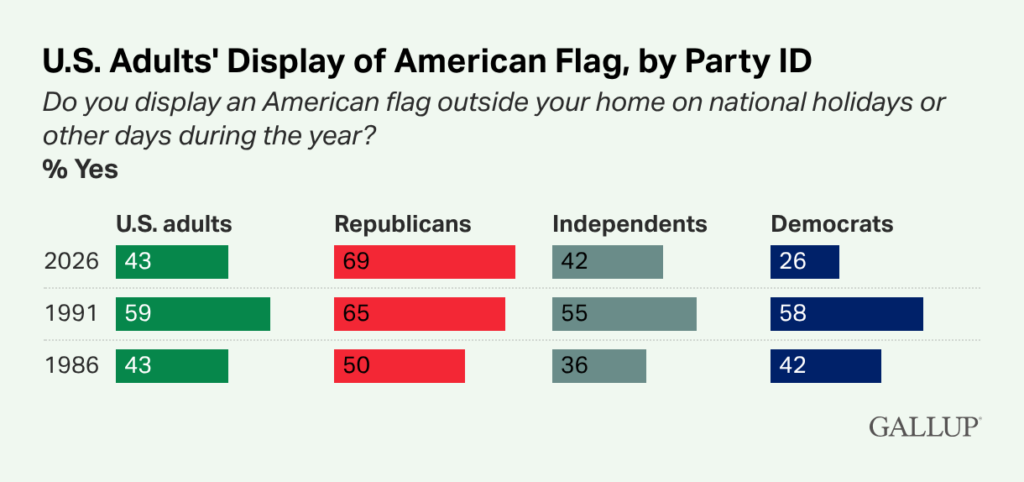
So what gives? Two other questions asked by Gallup suggest strongly that pride in being an American is actually a proxy for attitudes toward the government, especially the federal government. In the recently released survey, Gallup also asked people whether they display an American flag, which seems to be a stand-in for something other than mere political or partisan identity. Interestingly, what they found was that overall, flag displays are back to where they were 40 years ago, with 43 percent of U.S. adults saying they fly a flag sometimes. Republicans are at all-time highs (69 percent) and Democrats at all-time lows (26 percent), while independents are up six points from where they were in 1986.
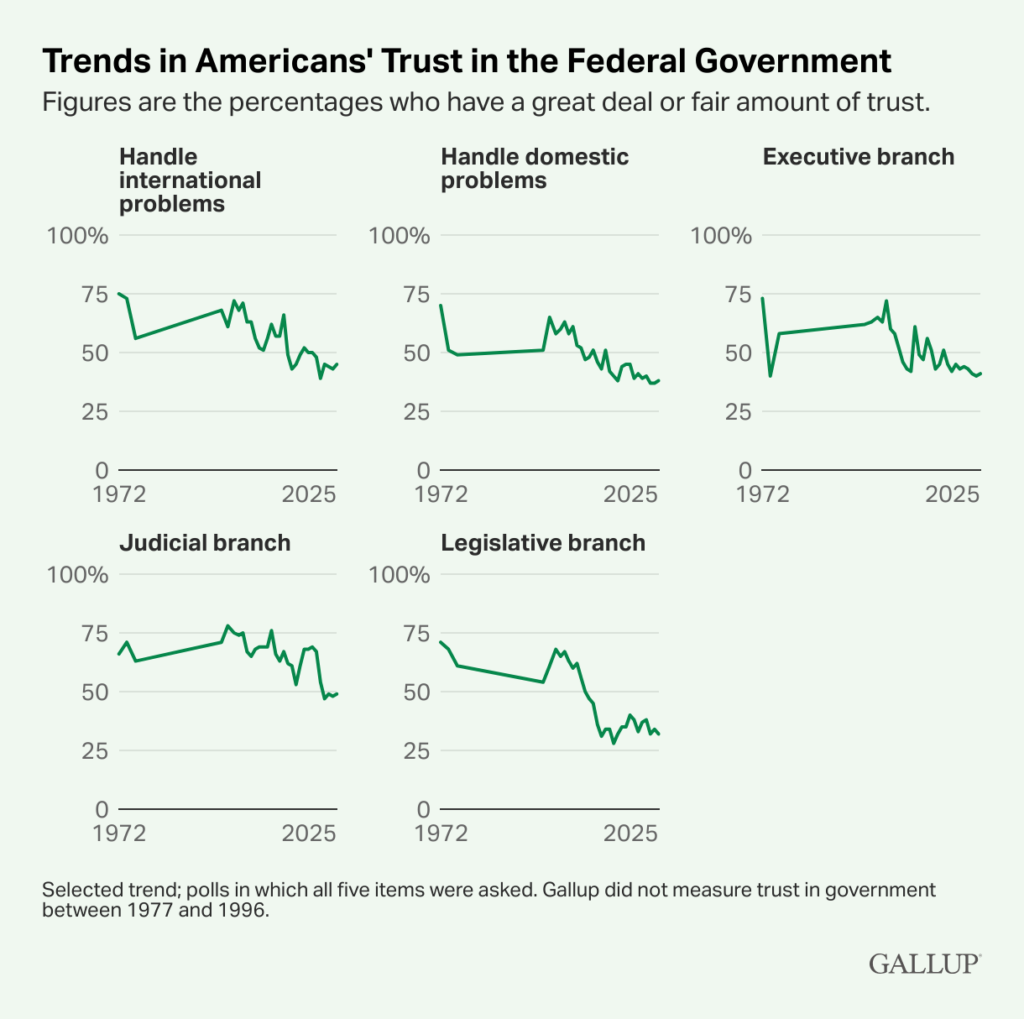
A Gallup report published last November suggests that independents—again, a plurality of voters—are firmly in the camp of loving their country but fearing their government (a sentiment popular enough that Walmart, Amazon, and Etsy all sell t-shirts featuring variations on the theme). When updating its series on whether Americans have confidence in the executive branch, legislative branch, and the judicial branch, and whether the federal government can be trusted to handle domestic problems and international problems, Gallup found massive long-term declines that have accelerated over the past 15 years or so. “Two decades ago, all five measures showed trust above the majority level, and as recently as 2012, majorities trusted all but the legislative branch,” wrote Jeffrey M. Jones last year.
From a libertarian perspective, eroding trust in the ability of government to get things done or be on the up-and-up is not good. Counterintuitively, it leads to calls for greater state involvement in all sorts of economic and cultural activities and produces more spending and regulation as we shift from a high-trust society to a low-trust one.
It’s not surprising that political partisans vacillate wildly in their opinion of the government depending on whether their team is in or out of power. But attention must be paid when there is a substantial long-term decline not only among Democrats or Republicans who happen to be on the outside looking in, but Americans generally, especially the swelling ranks of independents.
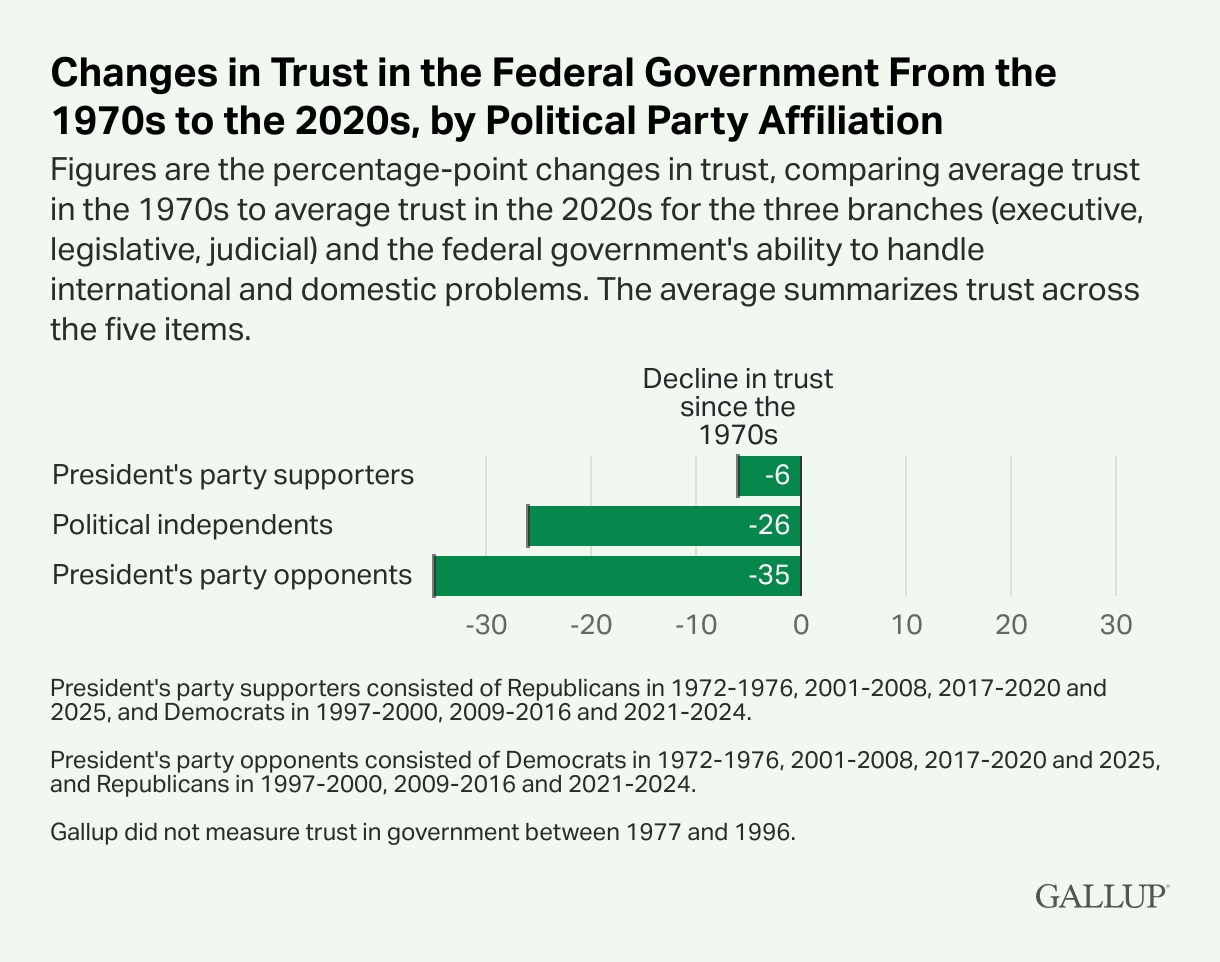
“Average trust in the five federal government branches or policy areas has declined by 35 points since the 1970s among out-party identifiers,” wrote Jones last year. “At the same time, average trust among political independents is down 26 points.” Rubbing salt in the wound, Gallup even found a six-decline in trust among the president’s party supporters. Think about it: Even the in-group trusts the government less than it did in the 1970s, the decade of Watergate, government-mandated gas lines, and endless revelations about the government abusing its power to illegally surveil citizens.
The good news is that widely reported declines in patriotism and pride in being an American are in reality growing dissatisfaction with the federal government. When you follow debacles like the recent controversy over Graham Platner, the would-be progressive hero of Democrats hoping to win back the Senate in the midterms, or dig into President Donald Trump’s hyper-scaled and unprecedented grifting, it’s not a mystery why people trust the government less and no longer want to identify as a Democrat or Republican.
Per Gallup, at the start of this year, just 27 percent of Americans identified as Republicans and another 27 percent identified as Democrats, levels that are at or near historic lows for each party. Yet we are turning out for elections, especially in the presidential years of 2020 and 2024, at levels that we haven’t seen in a century. It may be too much to ask, but whichever party insists on running decent, honest candidates who broadly appeal to beliefs in individual freedom and limited government will not only do well in the midterms and beyond but also help restore confidence in the government.
The post Why Are Political Independents Less Patriotic Than Ever? appeared first on Reason.com.
from Latest – Reason.com https://ift.tt/pn9xwoi
via IFTTT