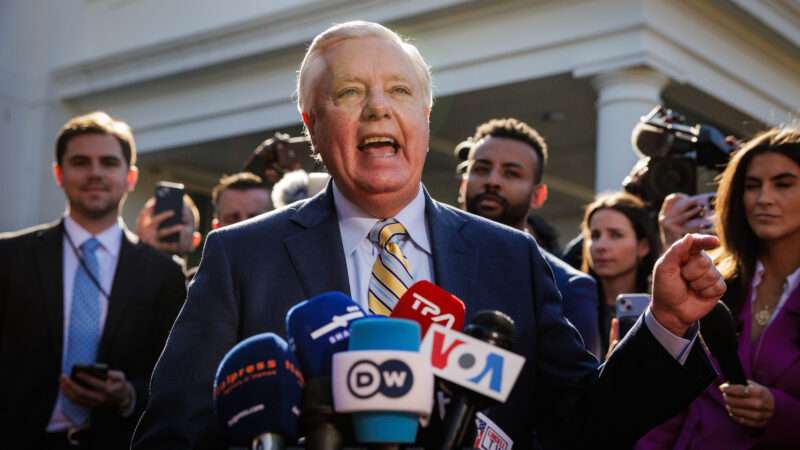
With the passing of Sen. Lindsey Graham (R–S.C.), U.S. foreign policy may be poised for a big shift from the hawkish stance the longtime D.C. insider preferred to a more restrained one better aligned with President Donald Trump’s nationalist MAGA base. Once a Trump critic, Graham became a friend and confidant to the president during both his administrations and nudged him in an internationalist direction that (mostly) avoided the hard break that many world leaders feared. But his position was out of step with an American public increasingly skeptical of military adventures.
Graham ‘Believed Strongly in the NATO Alliance’
In the hours before Graham died of an aortic tear, as he began to feel unwell, the senator reportedly joked, “I can’t die now. I still need to do the Russia sanctions, get Iran sorted out and do Israeli-Saudi normalization.”
Graham had just returned from meeting with Ukraine’s President Volodymyr Zelenskyy as part of his support for that country’s fight against invading Russian forces, about which he briefed Trump. He’d been a strong supporter of sanctions against Russia, aid to Ukraine, support for Israel, and engagement with allies including the members of NATO.
“Deeply saddened by the news of the passing of United States Senator Lindsey Graham. Lindsey was a true defender of freedom and the values that make our world safer,” commented Zelenskyy as news spread of the senator’s death.
Deeply saddened by the news of the passing of United States Senator Lindsey Graham. Lindsey was a true defender of freedom and the values that make our world safer.
He visited Ukraine ten times during the years of Russia’s full-scale invasion and was here with our people when it… pic.twitter.com/7oE2F5ZDAy
— Volodymyr Zelenskyy / Володимир Зеленський (@ZelenskyyUa) July 12, 2026
“So sad to learn of the sudden passing of my friend @LindseyGrahamSC,” mourned NATO Secretary General Mark Rutte. “He was a powerful advocate for America who believed strongly in the NATO Alliance and was actively working to bring an end to Russia’s war against Ukraine.”
“Lindsey understood that the security of Israel and America are inseparable,” agreed Israel’s Prime Minister Benjamin Netanyahu. “He devoted his life to defending America, strengthening our alliance and standing up for the free world.”
As those eulogies suggest, Graham served as an advocate for an active and often war-like foreign policy on behalf of U.S. interests and those of the country’s allies. Importantly, he also had the ear of Trump, a chief executive who frequently voiced skepticism of foreign involvement but noted Graham’s passing by calling him “a dear friend of mine, and a truly great man, who achieved so much for our Country.”
From Trump Critic to Trusted Confidant
The connection between Graham and Trump would have been inconceivable a decade ago. In 2016, with Trump closing in on the GOP nomination, Graham accused the front-runner of waging “a campaign on xenophobia, race-baiting, religious bigotry” and warned that if Trump was nominated, “the Republican Party will get killed, we’ll get creamed, we’ll lose, we’ll deserve it.”
Aside from his personal criticism of the eventual nominee and two-term president, Graham championed an aggressive and often violent foreign policy of the sort that Trump had criticized for decades. Of the 2003 U.S. invasion of Iraq—a war that Trump opposed—Graham said at the time that it was “the only reasonable option available.” Graham favored America’s participation in NATO while Trump, as long ago as 1987, paid for newspaper ads arguing that U.S. allies don’t cover their fair share of the cost of defense.
It would have been reasonable to expect the lawmaker from South Carolina to be on the outs with an administration that leaned toward a more go-it-alone position. Instead, a president who once predicted that then-President Barack Obama “will attack Iran in order to get re-elected” ended up waging a war against Iran of the sort favored by Graham and resuming military support for Ukraine despite very public spats with that country’s leadership. Trump has also, however grudgingly, continued working with traditional U.S. allies, despite repeated flirtations with the idea of pulling the U.S. out of NATO.
The president’s ongoing backing of Israel is less surprising given his long-established support for the world’s only majority-Jewish country.
Graham may have modified his opinion of Donald Trump, but it was the president who bent when it came to engagement with other countries. Graham never budged from his hawkish advocacy under Trump and through the interregnum Biden administration when he worked to normalize relations between Israel and Saudi Arabia. Last September, in a bid to overcome congressional opposition, Politico credited Graham for a strategy of attaching Trump-supported sanctions against Russia to a spending bill intended to keep the government open.
Out of Step With the American Public
But, as the Associated Press noted after Graham’s death, the senator was a believer in “the traditional Washington consensus prioritizing alliances with Europe and Israel, one falling out of favor with many in both political parties.” His passing leaves that school of thought with a dwindling pool of champions at a time when the public is having second thoughts about international entanglements fueled by long, expensive, and bloody experiences in Afghanistan and Iraq.
The latest YouGov/Economist poll, released this week, finds “a majority (57%) of Americans say going to war in Iran was the wrong decision, while only 27% say it was the right decision.” That’s a shift from 51 percent opposition and 30 percent support in April.
Internal NATO polling reported by Politico shows that “just 43 percent of U.S. adults responded positively when asked whether NATO would follow through with its pledge to assist their home country if attacked” – a sharp drop from previous numbers.
Likewise, support for military aid to both Israel and Ukraine has declined as those wars drag on.
Waiting in the wings as the heir apparent to the nationalist MAGA movement is Vice President J.D. Vance who may be the anti-Graham. Vance wants to end military support for Ukraine, says “NATO has failed to carry its fair share of the burden for literally decades,” and has become extremely critical of Israel. Vance may or may not be a true “isolationist”—foreign policy experts quibble over his beliefs, and in that poll, MAGA Republicans are the only strong supporters of the Iran war—but he’s closer to the go-it-alone positions that Trump has voiced than Graham ever was, and he’s now more likely to get traction for his views.
Sen. Lindsey Graham’s death may mark the end not just of his life, but of a foreign policy era in which the U.S. was eager to engage with the world and, all too often, wade into global conflicts.
The post Lindsey Graham's Death Marks the End of an Era of Interventionist Foreign Policy appeared first on Reason.com.
from Latest – Reason.com https://ift.tt/eUqmYJx
via IFTTT