Live Cattle Futures Tumble To Seven-Month Low, But Bernstein Says Beef Prices Will Stay Elevated
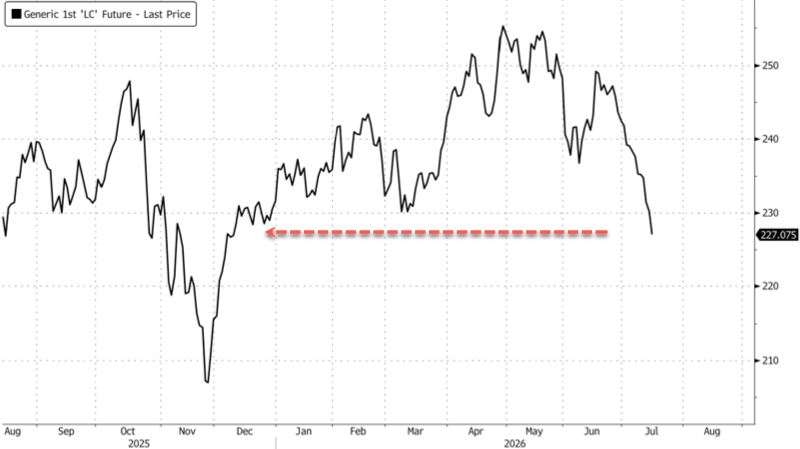
Despite our view that beef prices will remain elevated this year amid the smallest US cattle herd size in more than 60 years and mounting concerns over New World screwworm detections in Texas, live cattle futures in Chicago have tumbled this month as speculative traders unwind bullish bets.
Chicago live cattle futures have dropped to their lowest point since December 2025, as speculative traders liquidate positions amid weakening cash trade and falling wholesale beef prices.
The commodities firm CIH Cattle Team pointed out on X that both speculative and commercial traders are reducing their long exposure: “Live Cattle OI in a major downtrend! Down 11k over the past month and 83k contracts year-over-year; OI lowest since 2022 for July.”
Live Cattle OI in a major downtrend!
Down 11k over the past month and 83k contracts YoY
OI lowest since 2022 for July#cattle #beef #ag pic.twitter.com/bGT12q5L8h— CIH Cattle Team (@CIHCattleTeam) July 15, 2026
Feeder Cattle Index -$3.55
CIH Est: $365.52; Previous: $369.07
2,963 head dropping off (15% of index); 1,979 head traded (11%) #ag #cattle #feedercattle pic.twitter.com/8uQtyXI9da— CIH Cattle Team (@CIHCattleTeam) July 16, 2026
Analysts from Hightower Report noted that the “market is vulnerable to further losses” as the physical trade slows and funds continue to liquidate positions, adding that a strong cash trade had been driving the long bull market, but cash is now a liability.
Chris Lehner, a senior livestock analyst at ADM Investor Services, was quoted by Bloomberg as saying that the decline in cattle prices was mostly driven by spreads, with traders selling cattle positions and buying lean hog futures.
“Consumer beef demand has been strong, but indications of growing consumer headwinds could weigh on the sector going forward,” University of Georgia Assistant Professor Will Secor wrote in a note for the Livestock Marketing Information Center.
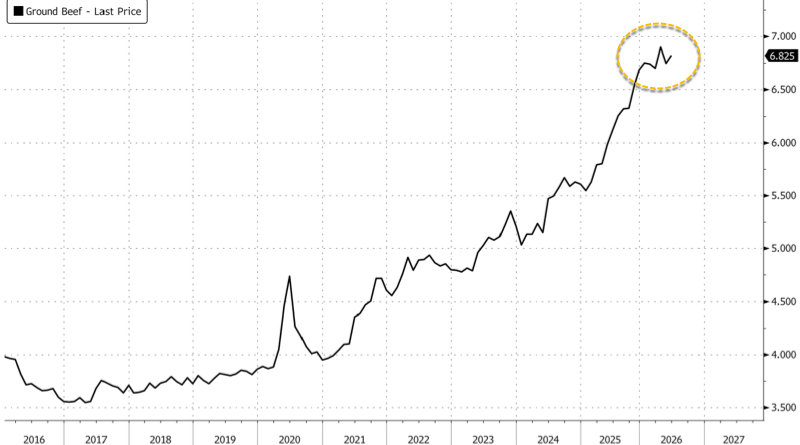
Recent USDA data show that wholesale beef values have fallen to their lowest levels since late February. The national average retail price for ground beef remains sticky around $7 per pound.
Analysts at Bernstein spoke with industry experts this week and concluded that beef prices are likely to remain high for several reasons:
We left the conversation with greater conviction that beef prices will remain elevated for a while.
The experts emphasized how the current state of herd size, which has reached a 60-year low, is unlikely to expand given that (1) land has become more expensive and is being used by developers (due to population migration into Texas), making it hard for farmers to raise more cattle, (2) farmers are opting to sell heifers (given the current high spot prices) rather than raising them, as they fear that prices will eventually fall, making it economically sub-optimal to wait 2 years to increase the herd size through the eventual calves of that heifer. (3) recreational use of land has also become more profitable, with a buck sold at “30k a kill” vs “$500 per cattle”.
Important to understand: When Will The Cattle Cycle Turn? BofA Has Answers For Beef Lovers
Tyler Durden
Fri, 07/17/2026 – 07:45
via ZeroHedge News https://ift.tt/1zjCyXd Tyler Durden