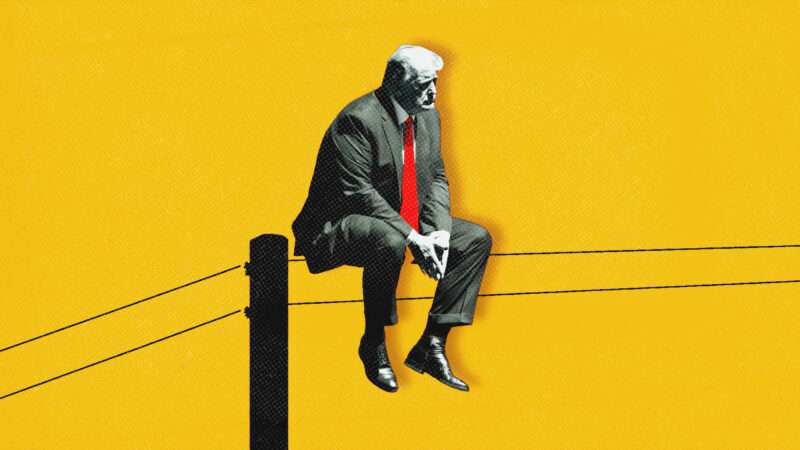
Donald Trump pledged on the campaign trail that he would slash electricity prices in half within 18 months of returning to the White House. That self-imposed deadline is today, and—as with many of the president’s promises—he appears to have fallen short of his goal.
From Trump’s inauguration in January 2025 to April 2026, the most recent month for which government data are available, residential electricity rates have risen by an eye-watering 18 percent. From April 2025 to April 2026, rates jumped by 7.3 percent, or about twice the rate of inflation, according to the Energy Information Administration.
Unfortunately, for many consumers, there is not much relief in sight.
Last week, PJM Interconnection, the nation’s largest grid operator, announced the results of its annual capacity auction, which determined the cost to procure power in the region for the 2028–2029 delivery year. The cost of the latest auction hit $16.4 billion, tying the previous auction’s record-high price and all but locking customers into historically high rates.
Nationally, utilities in the second quarter of 2026 “asked state regulators to approve $9.2 billion in rate hikes, up 26% from the $7.3 billion in rate increase proposals filed in the same period last year,” reports Utility Dive.
While it may be easy to place most of the blame on Trump, given the brashness of his promise, the president inherited a slow-moving train crash of unprecedented load growth from the data center boom, which coincided with the closure of coal and natural gas power plants. Together, this has led to rate hikes and warnings about grid reliability.
“It was an impossible promise to deliver on because there really isn’t that much federal government involvement in retail rates,” says Travis Fisher, director of energy and environmental policy studies at the Cato Institute. “It was always going to be a steep uphill climb.”
Indeed, while the federal government—primarily through the Federal Energy Regulatory Commission—sets the rules governing interstate transmission lines and wholesale markets, what consumers pay each month for electricity is determined by a myriad of other factors, including fuel prices and the cost of building local distribution infrastructure, such as poles and wires. And though the price of wholesale electricity depends on where you live, states retain significant authority over many of the costs that make it to utility bills.
Trump does bear at least some of the responsibility, though.
His trade war, for instance, has made critical components more expensive. Like many other goods, most transformers in the United States are imported, primarily from Mexico and China. (At one point in the past 18 months, goods from the latter faced a 147 percent import tax.) Electrical steel, meanwhile, comes in from South Korea, India, and Japan, all of which were subject to “reciprocal” tariffs until the Supreme Court struck them down earlier this year.
When these duties were still in place, the investment firm Morningstar warned that they “directly threaten the ambitious agenda to upgrade and expand the U.S. power grid.” With them struck down, consumers are still paying for these duties, as well as the 15 percent tariff rate the administration maintains on “some electrical grid equipment,” according to Utility Dive.
As the administration has increased input costs, it has also made it harder for certain energy sources to connect to the grid. Beginning on Day 1, Trump blocked leasing for offshore wind in federal waters, which a federal judge later struck down. In March, the administration unveiled a new strategy to stop offshore wind: paying developers to abandon these projects. That month, the federal government agreed to give TotalEnergies nearly $1 billion—a reimbursement for what it paid for its leases—to terminate planned offshore wind plants in New York and North Carolina and instead invest that money in fossil-fuel projects. The federal government has since reached similar deals to terminate four other offshore wind projects, reports The New York Times.
Fisher, who is “not a fan of offshore wind” because “it pretty much only gets built with subsidies and mandates,” is also not a fan of these agreements. He says these plants could have added “substantial downward pressure” and reduced PJM’s auction price. Notably, even when the administration has done the opposite and forced power plants to stay open, consumers have been left to foot the bill.
Meanwhile, data centers’ electricity use added $6 billion to PJM’s auction.
With more Americans becoming increasingly anti–data center, states have implemented stringent regulations on these facilities. Last week, New York Democratic Gov. Kathy Hochul issued the nation’s first moratorium on data centers. New York’s ban follows Maine’s efforts to implement a similar measure that passed the Legislature but was vetoed by Democratic Gov. Janet Mills in April.
There are better solutions than a moratorium. In March, Trump unveiled a Ratepayer Protection Pledge that would require signatories to front the cost of grid upgrades, water infrastructure, and power generation for data centers. The pledge has not really made an impact, but that could change as more governors and utilities get on board.
Some experts, including Fisher, advocate a Consumer Regulated Electricity (CRE) model that allows large-load customers (such as data centers) to connect directly to unregulated power plants independent of the grid. Fisher says this approach is more “nimble and innovative.” He also calls it a “hedge against the political risk” associated with data centers.
New Hampshire adopted CRE-adjacent rules last year. And in January, Sen. Tom Cotton (R–Ark.) introduced a bill that would make it easier for data centers to plug directly into a power plant.
Solutions like that could provide a fix to the affordability crisis. But even they are unlikely to provide the kind of relief that Trump promised and failed to deliver.
The post Trump's 18-Month Deadline To Cut Electricity Prices in Half Has Arrived. Rates Are Up 18%. appeared first on Reason.com.
from Latest – Reason.com https://ift.tt/C5vfyLI
via IFTTT