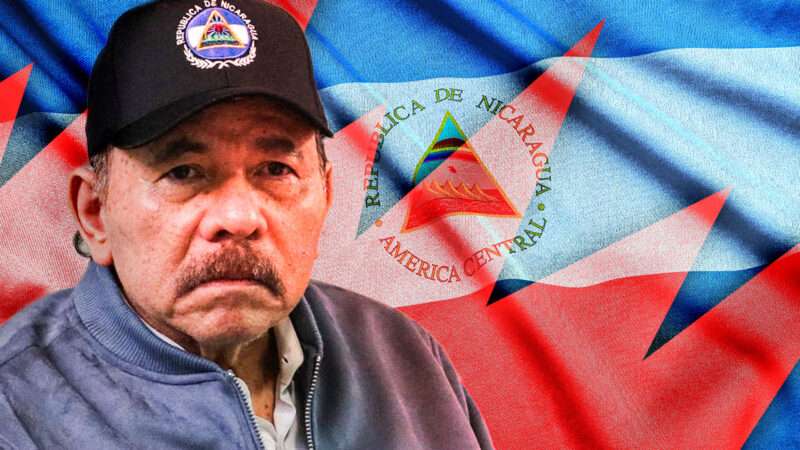
Nicaraguan President Daniel Ortega announced on Sunday that the country will no longer hold elections, preventing the opposition from competing for power and further cementing his authoritarian grip on the country.
“There will never be elections here again so that [the opposition] can try to seize the government, to seize power,” Ortega said in front of thousands of state employees during an official ceremony marking the 47th anniversary of the 1979 Sandinista Revolution, which first brought him into power.
“We will work with the National Assembly and the relevant institutions on laws, because we need laws that build a wall, a barrier, against the coup plotters and the traitors who sell out their country,” he added.
General elections had been scheduled for November 2027. Ortega provided few details about the election ban, making it unclear whether the elections will be completely canceled or whether only the opposition will be prevented from taking part. Either way, the move eliminates the possibility of an electoral challenge to his rule.
Ortega, now 80 years old, is a former guerrilla fighter who first came to power after the Sandinista Revolution and served as president from 1985 to 1990. After suffering a defeat in 1990, he returned to power in 2007 and has remained there ever since.
His regime, which he now formally leads alongside his wife and “co-president,” Rosario Murillo, had long since extinguished what remained of democracy in the country. Over the years, it has cracked down on political dissent, free speech, independent media, and civil society. Ortega’s most recent announcement is just an escalation of that trend.
“This is simply a statement that unequivocally shows how the mask of a certain legality he had been trying to wear has fallen off,” Félix Maradiaga, a former presidential candidate who is now exiled, told The New York Times.
Ortega’s regime has repeatedly been accused of rigging elections. In 2016, he was reelected in a landslide after barring the country’s main opposition coalition from participating. In 2021, he similarly claimed around 75 percent of the vote after imprisoning opposition candidates and outlawing genuine opposition parties.
The United States, the European Union, and international human rights groups, including Amnesty International and Human Rights Watch, condemned the 2021 election as a sham intended to keep Ortega in power. “The Ortega-Murillo government has deprived Nicaraguans of any real choice,” and thereby “stripped the…vote of any real significance,” the U.S. State Department said at the time.
The regime’s repression intensified after widespread protests challenged Ortega’s government in 2018. The government responded with a violent crackdown that left hundreds dead and thousands injured. Since then, authorities have revamped efforts to imprison political opponents, journalists, religious figures, and other critics.
At least 46 people currently remain imprisoned for political reasons, according to the Mechanism for the Recognition of Political Prisoners, a group that documents politically motivated detentions in Nicaragua. The government denies that it holds political prisoners.
The regime has also been accused of torture, extrajudicial executions, arbitrary detention, and weaponizing the justice system against its opponents. A 2023 investigation by a United Nations–appointed group of experts found evidence of widespread human rights violations amounting to crimes against humanity.
“What we uncovered is a tightly coordinated system of repression, extending from the presidency down to local officials,” U.N. expert Ariela Peralta said of a subsequent 2025 investigation. “These are not random or isolated incidents—they are part of a deliberate and well-orchestrated State policy carried out by identifiable actors through defined chains of command.”
The system of repression has extended beyond the imprisonment of individual opponents to the dismantling of nearly every independent institution in the country.
Since 2018, the government has shut down more than 5,000 organizations, most of them religious or civil society groups, but also universities, charities, and local civic organizations, because of the apparent threat they pose to the regime.
Freedom of the press has likewise been eroded, with independent media outlets shuttered and journalists harassed, imprisoned, or forced into exile. Reporters Without Borders described the situation as “a nightmare of censorship, intimidation and threats,” in which “journalists are constantly stigmatised and face harassment campaigns, arbitrary arrest and death threats.”
Earlier this month, the government stripped masses of lawyers of their licenses to practice without notice or explanation. Reed Brody, a member of the U.N. panel investigating Nicaragua, described the move as a “purge of the legal profession” aimed at eliminating the country’s remaining democratic checks and balances.
The Ortega-Murillo regime has also stripped hundreds of opponents of Nicaraguan nationality, rendering many of them stateless, confiscating their property, and expelling them from the country.
Last year, Ortega introduced a series of constitutional reforms that extended the presidential term from five to six years, concentrated control over virtually every branch of government in the presidency, and made Murillo the country’s co-president.
Sunday’s announcement strips away whatever pretense of democratic legitimacy remains in the country. Whatever form the new measures ultimately take, they will formalize what has long been true: Nicaraguans have no meaningful say in who governs them.
The post Nicaragua's Regime Drops the Pretense of Democracy appeared first on Reason.com.
from Latest – Reason.com https://ift.tt/ID9Lufz
via IFTTT