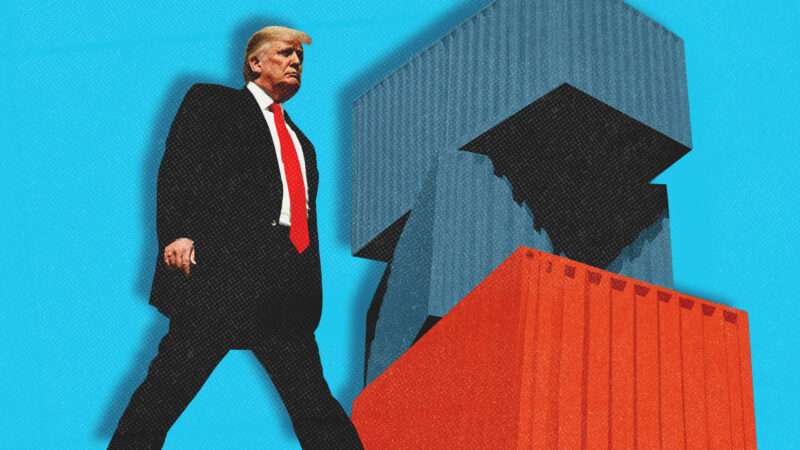
When you start with a predetermined policy and then go looking for a legal pretext to justify it, you are building on shaky ground. President Donald Trump illustrated that point once again last week, when he announced a third round of broad tariffs after his first two attempts were rejected by federal courts.
Shortly after taking office last year, Trump claimed to have discovered a previously unnoticed delegation of tariff authority in the International Emergency Economic Powers Act (IEEPA), a 1977 law that does not mention import taxes and had never been used to impose them. Under IEEPA, Trump argued, he could tax imports of any goods he decided to target from any country he chose at any rate he deemed appropriate for any length of time he thought was necessary.
Trump’s claim was rejected by every court that considered it, including the Supreme Court, which last February ruled that IEEPA does not authorize tariffs at all. But Trump had a backup plan: Immediately after that decision, he announced another sweeping set of tariffs, this time relying on Section 122 of the Trade Act of 1974.
That provision allows tariffs in response to “fundamental international payments problems” caused by “serious United States balance-of-payments deficits.” In May, the U.S. Court of International Trade ruled that the new tariffs were illegal because Trump had failed to “identify balance-of-payments deficits within the meaning of Section 122.”
Although that decision was stayed pending appeal, Trump’s Section 122 tariffs, which were subject to a 150-day statutory limit, expired last Friday. Trump then switched to Plan C, invoking Section 301 of the Trade Act, which authorizes tariffs in response to a foreign “act, policy, or practice” that is “unreasonable or discriminatory” and “burdens or restricts United States commerce.”
The latest tariffs supposedly target countries that have failed to “impose and effectively enforce a prohibition on the importation of goods produced with forced labor.” Because of that failure, U.S. Trade Representative Jamieson Greer says, U.S. businesses face unfair and unethical competition from foreigners who use forced labor to keep their costs and prices low.
The list of alleged offenders is long. Greer counts “60 economies,” but that includes the European Union, which encompasses 27 countries, so the actual number is 86, accounting for nearly all U.S. imports, which will be taxed at either 10 percent or 12.5 percent.
According to a lawsuit that the Liberty Justice Center (LJC) filed last Friday on behalf of the U.S. businesses that will have to pay the Section 301 tariffs, the findings underlying Greer’s list are woefully inadequate. By and large, they fail to specify exactly how each of these countries has fallen short, how their supposed failures burden U.S. commerce, or why the new tariffs, which make no distinction between forced-labor products and other imports, can be expected to ameliorate the problem that the administration claims to be addressing.
The LJC complaint argues that the forced-labor issue is “simply a pretext” for reinstating Trump’s “invalidated global tariff regime.” That impression is confirmed by Treasury Secretary Scott Bessent’s assurance of “virtually unchanged tariff revenue,” his statement that Greer’s “Section 301 studies” would result in “tariffs at the previous level,” and Greer’s promise that the new taxes would “address many of the issues at the heart of the President’s reciprocal tariff program.”
This strategy, the LJC says, is inconsistent with Section 301, which was designed as a remedy for specific practices by specific trading partners, as opposed to an excuse for broad tariffs aimed at reducing the gap between imported and exported goods. Interpreting Section 301 to justify the latter, the LJC warns, would violate the “major questions” doctrine, which requires clear congressional authorization for policies of “vast economic and political significance,” and allow an unconstitutional delegation of legislative powers.
That lawsuit may not be a slam dunk. But since the LJC spearheaded the successful challenge to Trump’s IEEPA tariffs, the president should be worried.
© Copyright 2026 by Creators Syndicate Inc.
The post Trump Keeps Pushing Legally Dubious Tariffs appeared first on Reason.com.
from Latest – Reason.com https://ift.tt/5Bb174r
via IFTTT