Logistical Nightmare Unfolds As Rhine Plunges Toward Record Low
The Rhine, one of Europe’s most vital arteries for transporting industrial goods, has fallen to one of its owest level since the drought-stricken summer of 2018. The resulting loss of shipping capacity is driving up freight costs and raising the risk of supply disruptions for iron ore, coal, chemicals, petroleum products and other commodities moving through Europe’s industrial heartland.
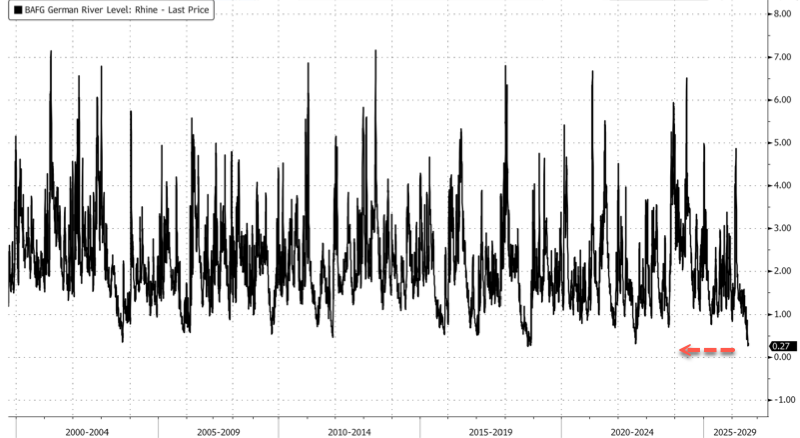
The Rhine water level gauge at Kaub, a key chokepoint on the Rhine for shipments heading to southern Germany and Switzerland, has fallen to just 25 centimeters, the lowest reading since the drought-stricken summer of 2018.
Zwei eindrucksvolle Bilder bei Rüdesheim bzw. Bingen (Nahemündung) mit dem Rekordniedrigwasser am Rhein und auffällig großen Sandbänken. Danke an Christian. /LD pic.twitter.com/9GC4c3zv6y
— Kachelmannwetter (@Kachelmannwettr) August 2, 2026
At levels of 40 to 50 centimeters, vessels can carry only about 20% of their normal cargo, according to Germany’s Federal Waterways and Shipping Administration. The resulting loss of transport capacity is driving up freight costs and increasing the risk of supply disruptions of critical commodities.
Some Rhine Freight Rates Rose 400% in Two Months as Water Levels Fell
The benchmark freight rate per tonne for oil and liquid-bulk barges from Rotterdam to German cities south of the Kaub chokepoint rose about 400% in two months, reaching a record on the chart. Cargo demand did… pic.twitter.com/Yht6yiSWXQ
— LearnInvest (@LearnInvest2026) August 2, 2026
German federal data compiled by ETH Zurich shows that a drop below 24 centimeters, which is in the forecast for this week, would mark the lowest level since records began in 1880.
JPMorgan analyst Chetan Udeshi told clients that with Rhine water levels dropping to 2018 levels, this may spark a drag across Germany’s chemicals industry:
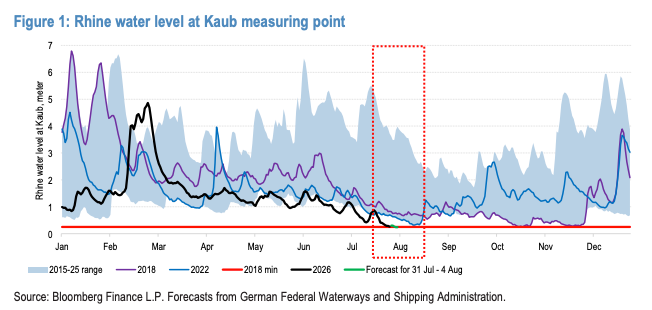
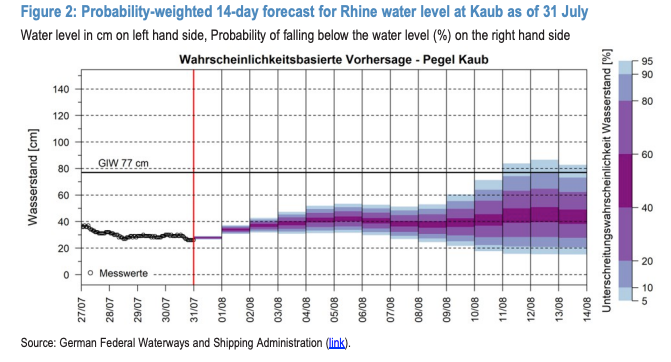
BASF/K+S/Sector read: Rhine water levels dropped to multi-year lows in August and are now comparable to 2H18 levels, when Germany-exposed chemicals saw material operational/logistics headwinds (see our previous report here). It remains to be seen whether low water levels will persist for as long as they did in 2H18; if they do, this would represent an additional downside risk to 2H26 expectations, albeit likely smaller given post-2018 mitigation. As illustrated in Figure 1Rhine watrlve Kaubmsring potand Figure 2Probailty-weghd 14-ayforecst forRhine watrlve Kaubsof 31July, at the Kaub gauge, Rhine levels have fallen to multi-year lows and are now similar to Oct–Nov 2018, when disruptions to barge logistics and wider supply chains hit German/European chemicals; the two most impacted names then were BASF and K+S. Evonik and to a lesser extent Brenntag had also flagged earnings headwinds in 2H18.
BASF saw the most adverse impact of ~€250m in 3Q-4Q18 (~2.5% of 2018 adj EBITDA) due to its reliance on the Rhine for transportation infrastructure and plant cooling. Since then, BASF has implemented a number of mitigation measures, including diversifying its logistics network to be able to switch to alternative transport modes (e.g. rail), if needed, as well as expanding its fleet to include vessels that can still operate in the Rhine at low water levels. On the last week’s 2Q26 conference call, BASF’s CEO commented that thanks to the mitigation measures, this time the company does not expect to see a negative impact of the magnitude seen in 2H26.
K+S relied on the Rhine for saline water disposal, which became impossible due to reduced water levels; as a result, K+S had to halt production at parts of its largest site in Germany, Werra, for almost two months. This translated into a ~€95m adverse impact (~15% of 2018 EBITDA). Since 2018, K+S has invested in improving the resiliency and sustainability of its wastewater disposal at the Werra site, including as part of the ongoing Werra 2060 project capex, which should help to more than halve the amount of process water for the Werra site. In its 2025 annual report, K+S commented that through the system of wastewater storage basins at the company’s disposal, as well as other measures, it had “significantly increased the flexibility of wastewater management at the Werra plant in recent years, to fully maintain production at the Werra plant even in a hydrologically dry year”. The company also noted, however, that in the case of an extreme drought comparable to that seen in the summer of 2022 and lasting over a long period of time, resulting in low levels in the Werra river, there could still be a risk of a temporary production interruption. Hence, subject to the duration of dry conditions, the impact on production at K+S cannot be ruled out, although we would expect it to be much reduced compared to the 2018 situation reflecting the improved wastewater management infrastructure.
Rhine Level At Kaub
Kaub Level Forecast
Barclays analyst Katie Richards recently told clients to have Rhine water levels “on their radars.”
Here’s more from Richards:
Our view: Investors should have the Rhine on their radar. Rhine-exposed chemical stocks historically underperformed during the 2018 and 2022 low-water episodes. What makes 2026 noteworthy is that the Rhine is entering the summer from an unusually weak position, with water levels already near multi-year lows for this point in the year and further risk from El Niño. However, unlike 2018, producers have invested heavily in mitigation measures, and these appeared to have proven effective during the 2022 drought when disruption was limited despite challenging conditions. As a result, we see the risk today as more skewed towards higher logistics costs and supply-chain inefficiencies than a repeat of the severe operational disruption experienced in 2018.Our concern would increase if Kaub water levels were to spend a prolonged period around 40cm or below, a level broadly consistent with or more severe than the 2022 drought, when financial impacts across the sector were largely negligible (versus ~100cm today).
The fallout of summer heat across the continent has spread beyond freight markets. Heat waves have forced France to curb output from its nuclear fleet because rising river temperatures could fuel wildfires.
In Hungary, the government has urged households and businesses to conserve electricity and water after demand overwhelmed supplies in Szentendre, leaving thousands without drinking water. Meanwhile, Italy’s Po River has fallen below historic lows.
Tyler Durden
Mon, 08/03/2026 – 02:45
via ZeroHedge News https://ift.tt/UXl1Oa7 Tyler Durden