Digging Deeper Inside Physical AI’s Hardware Stack Powering Humanoids
Building on our “Physical AI Faces One Critical Chokepoint, and Here’s How to Profit“ report earlier this week, Barclays analysts are closing out the week with a comprehensive map of the humanoid value chain.
As readers look beyond flashy Chinese Unitree robot demonstrations, attention is shifting toward the critical hardware stack, including motors, actuators, sensors, and batteries, and the deep supply-chain players positioned to reap the rewards before global humanoid deliveries begin to ramp up.
Anatomy of a humanoid robot
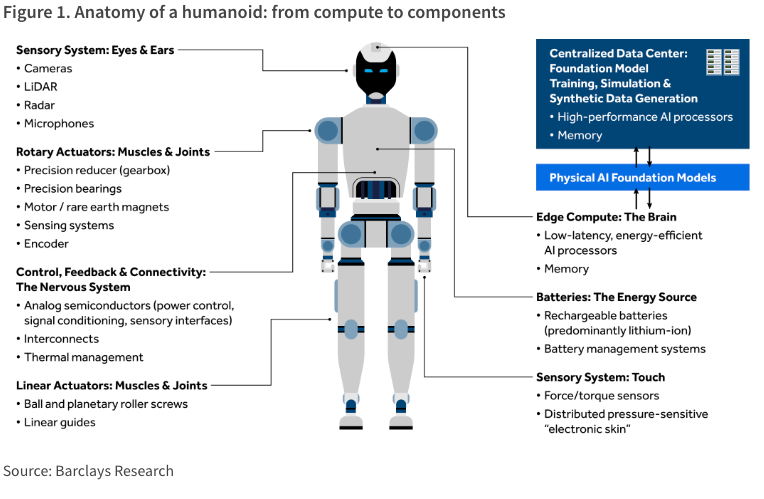
“While the humanoid market remains small today, at roughly $2-3bn, forecasts range from $10-25bn by 2030, with more optimistic scenarios reaching ~$200bn by 2035, as detailed in (open in new tab)Global Macro – AI gets physical: Ten things to know about humanoids(open in new tab),” Barclays analyst William Thompson wrote in a note on Thursday.
Within the hardware stack, reducers – high-precision gearing systems embedded in actuators – have been high barriers to entry and are led by Japanese players such as Harmonic Drive Systems and Nabtesco, while rare earth materials – particularly magnets used in high-performance motors – create strategic dependencies, with supply chains heavily concentrated in China.
Actuators are the biggest hardware prize. A humanoid may require 40 to 70 actuators, representing roughly 30% to 50% of the material bill. This makes motors, reducers, bearings, and motion-control systems critically important.
The current supply chain for humanoids is mostly dominated by China.
The supply chain will likely be shaped by geopolitics as much as technology. China currently leads in humanoid deployment volumes and holds strong positions across several parts of the value chain, including rare earth processing, motors, batteries, and robot manufacturing.
However, growing U.S. and European scrutiny of Chinese technology and industrial supply chains could influence market access, procurement decisions, localization requirements, and ultimately the geographic distribution of production and deployment. As a result, humanoid supply chains may become increasingly regionalized over time, with parallel hardware, software, and manufacturing ecosystems emerging across China and Western markets.
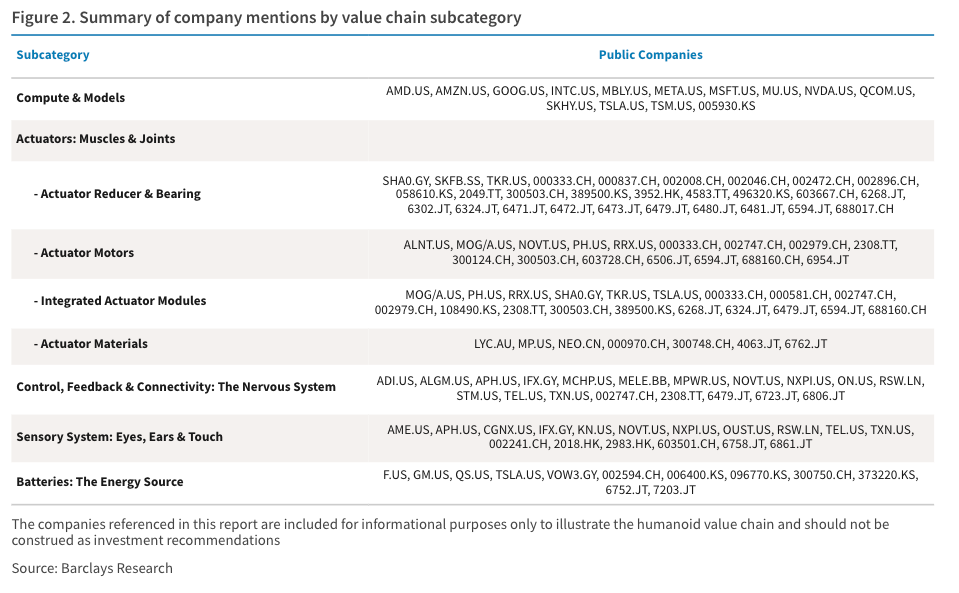
Thompson provided a deep understanding of how to profit from the humanoid robotic value chain by subcategory.
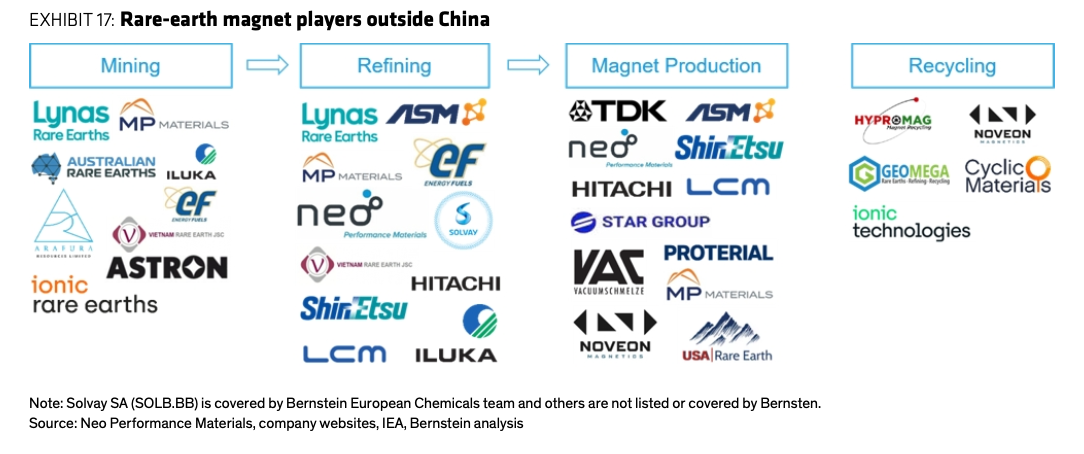
Earlier this week, Bernstein analyst Dien Wang warned about “critical chokepoints” in the humanoid robotic supply chain, outlining high-performance motors, robotic actuators, and rare-earth minerals that are mostly dominated by China.
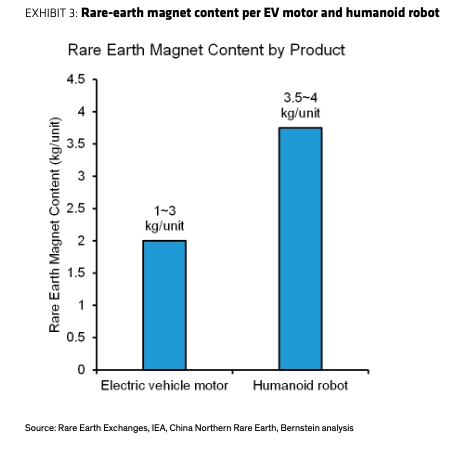
“A humanoid robot can consume more than twice as much magnetic material as an EV motor (Exhibit 3), highlighting the growing strategic importance of rare-earth magnets,” Wang said.
He outlined that China’s dominance in rare earth magnets is troubling in an “increasingly multipolar world.”
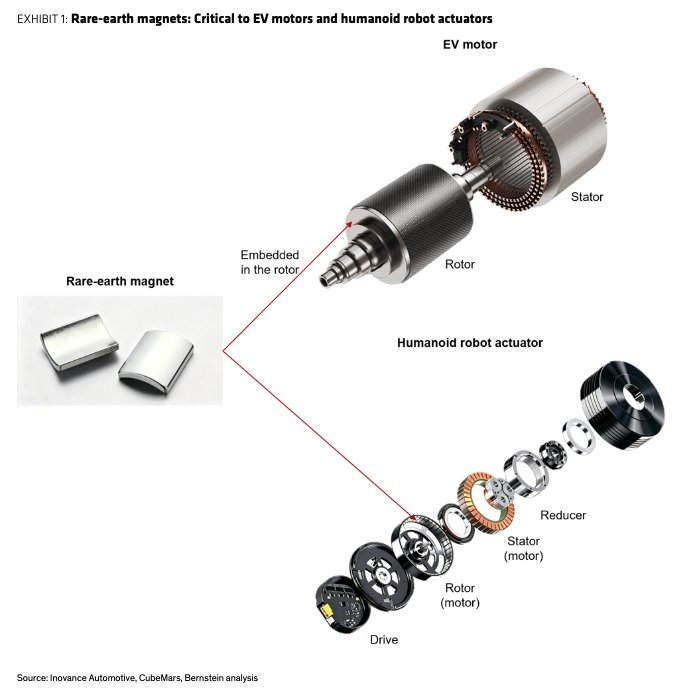
Taken together, both Barclays and Bernstein notes suggest the humanoid robotics value chain remains dangerously exposed to China and concentrated Asian supply chains. The Trump admin must accelerate the development of domestic production for motors, rare earth magnets, precision reducers, semiconductors, and other critical actuator components.
If Beijing moves on Taiwan, U.S. robot manufacturers could lose access not only to advanced chips but also to the motion-control systems needed to build humanoids at scale. In that scenario, America’s physical-AI ambitions could grind to an instant halt
Professional subscribers can read a whole lot more on humanoids here at our new Marketdesk.ai portal.
Tyler Durden
Fri, 08/07/2026 – 23:00
via ZeroHedge News https://ift.tt/eQnWLzJ Tyler Durden