The Least-Psychedelic President in History Supports Psychedelic Research More Than Any of His Predecessors


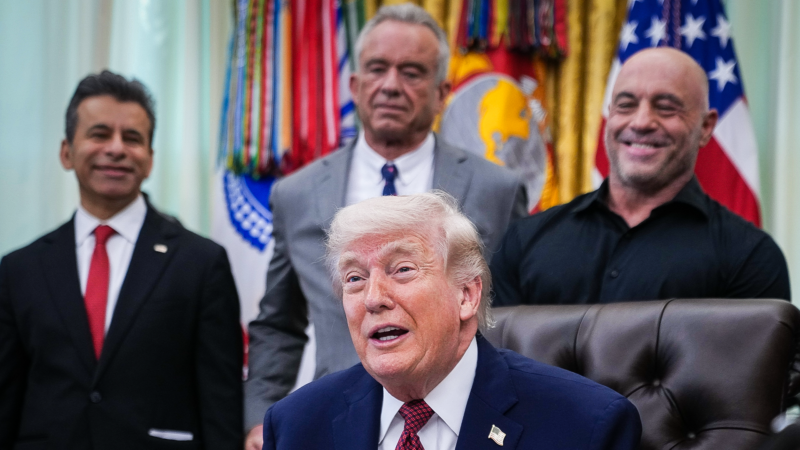
Trump sits in the Oval Office as he announces his executive order on psychedelics, flanked by people like Joe Rogan and RFK Jr. | Sipa USA/Newscom

This is the way the drug war starts to end, not with a bang or a whimper, but with an executive order signed by a president who must surely be the least-psychedelic occupant ever of the Oval Office, even when you think about characters as glum and dour as Millard Fillmore and Calvin Coolidge. In recent weeks, Donald Trump has picked figurative and literal fights with everyone from the Pope to Iran’s ayatollah. Last year, he released an animated video of himself in a fighter plane dropping feces on “No Kings” protestors. If there is an American alive over the age of 30 who has never listened to Sgt. Pepper’s Lonely Hearts Club Band all the way through, it’s Trump.

But there he was this past Saturday, flanked by, among others, a pumped-up podcast host known for smoking weed on the air (Joe Rogan), an ibogaine evangelist (Bryan Hubbard), and a Cabinet member who has bragged about snorting cocaine off toilet seats (Robert F. Kennedy Jr.). The president was eagerly putting his John Hancock on “Accelerating Medical Treatments for Serious Mental Illness,” an executive order that fast-tracks “innovative research models and…drug approvals to increase access to psychedelic drugs that could save lives and reverse the crisis of serious mental illness in America.” The order calls for expedited approval of “psychedelic drugs, including ibogaine compounds,” that “show potential in clinical studies to address serious mental illnesses for patients whose conditions persist after completing standard therapy.” A president who famously ingests nothing more psychoactive than Diet Coke is now pushing ibogaine—dubbed the “Mount Everest of psychedelics” because of the intensity of the trips it induces and its immense potential to reverse brain damage—into respectability. What’s next? Ayahuasca in juice boxes for K-12 cafeterias?

The people present at the signing show how drug policy reform springs from a mix of popular-culture discussion and hardcore, in-the-trenches policy work. Trump himself thanked Rogan for calling his attention to psychedelics and ibogaine, and RFK Jr. wrote on Instagram, “Thank you, [Joe Rogan] for helping bring national attention to these potentially life-saving treatments for veterans and others living with mental illness, and for pushing this conversation into the mainstream.” Rogan has used his immensely popular podcast for years to tout psychedelics and a wide array of conventional and unconventional therapies, supplements, and protocols (some more credible than others). Without him and his show, Saturday’s signing just doesn’t happen. Whatever else one might think of him, Rogan embodies better living through chemistry and self-directed experimentation with all sorts of drugs, exercise programs, and ways of creating a personalized life plan.

When Reason Senior Producer Zach Weissmueller and I interviewed RFK Jr. in 2023 as he was running for president, he told us that he “would definitely decriminalize psychedelics” if he got elected, partly as a wind-down to the drug war in general and because psychedelics are particularly promising as treatments for various sorts of addictions and mental health issues. Kennedy, a former heroin addict who hails from a family as synonymous with substance abuse as politics, has long reflected the majority of Americans who think addicts aren’t criminals.

The hulking redhead at the signing ceremony is Hubbard, a lawyer who speaks with a booming, folksy Southern accent and who first became acquainted with ibogaine as a treatment for addiction in 2022. Back then, he told Reason a couple of years ago, he was the head of Kentucky’s Opioid Abatement Advisory Commission. His job was to invest hundreds of millions of dollars that the commonwealth got from a national settlement with opioid makers. When he found out about ibogaine, which is derived from an African shrub, from a journalist named Julia Blum, a light switched on. The research was so promising, he knew he had found his life’s mission. As he told journalist Rachel Nuwer for Reason during a 2024 trip to New York:

If someone had told me as a 25-year-old man—a staunchly straight-laced, square, institutionalist Republican—that I would have undergone a transformation which would result in me being in New York City for the advancement of God’s medicine to heal God’s people, I would have told you that I had gone insane and something catastrophic must have happened in my life.

When his Kentucky gig ended due to internal state politics, he was unleashed to pursue activism far beyond the confines of the Bluegrass State.

Others at the signing ceremony included Food and Drug Administration Commissioner Marty Makary, a medical doctor who spent much of his career at Johns Hopkins, who was happy to announce the coming of the “first-ever human trials in the United States” involving ibogaine (patients currently must go out of the country, often to Mexico, for treatment). And then there was Matt Zorn, a Houston-based attorney who only a couple of years ago was busting the Drug Enforcement Administration (DEA)’s balls over phony arguments regarding marijuana rescheduling and more. Just last year, Zorn joined the Department of Health and Human Services as RFK Jr.’s “psychedelics czar,” working within the administration now to help produce orders like Saturday’s or last December’s calling for the “expeditious” rescheduling of marijuana from Schedule I (the most restrictive category) to something that would allow research and medical designation at the federal level.

It was this mix of activists, politicians, medical researchers, and weirdos that led to a significant act of drug policy reform. But it is also the public, which, ever since Richard Nixon declared war on drugs, has been groping toward a full embrace of legalization of weed at least, if not all currently illegal drugs. Over the decades, more and more of us have tried different sorts of drugs for different sorts of reasons. Apart from illegal/illicit substances, we take pills to give us energy or to calm us down, to grow hair back or perform better sexually, to stimulate appetite or suppress it (one in eight Americans is already taking GLP-1s). Overdoses from opioids are falling sharply, and more of us feel like drugs are not such a problem anymore. We are learning a basic libertarian lesson: that we want to be free and will need to be responsible for what we do with that freedom.

Reason‘s Jacob Sullum writes, “Trump’s initiative…falls far short of acknowledging that adults have a right to use psychedelics for whatever reasons they deem compelling.” That is absolutely true, but Saturday’s executive order is still no small thing. This is how the drug war ends, a little bit at a time, and then almost all at once (cannabis arrests have declined from more than 870,000 in 2007 to about 211,000 in 2025). And under the orders of a president who just last year was bragging that every suspected Venezuelan drug boat his administration blew up without constitutional authorization “saved 25,000 lives,” a plainly fantastical number as imaginary as the idea the targeted boats mostly ferried fentanyl to America (Venezuela is not a fentanyl producer; neither is it a big exporter of drugs to the United States).

As it happens, on Sunday, April 19, an unseasonably cold and rainy day in Manhattan, I found myself at a “March for Cognitive Liberty,” sponsored by the Psychedelic Assembly, a nonprofit that cultivates “connection, education, and culture at the edge of expanded consciousness.” About 100 people huddled in the rain at Grand Army Plaza, where a statue of William Tecumseh Sherman eerily stood guard as the featured speakers abbreviated their comments due both to the weather and to Trump’s executive order.

“I had written this huge, long screed for today, which was all about what our government should be doing,” joked Julie Holland, a psychiatrist, author, advocate for drug legalization, and Reason Interview guest. “And I didn’t have to say what the government should be doing. Somehow, they are doing some of the things I think they should be doing. I want us to just be happy for a minute and not be cynical.”

“Suddenly, we’re getting a little excited about the changes that are coming,” said William Leonard Pickard, an LSD chemist whom the DEA claimed was responsible for 90 percent of the world’s acid supply when he was arrested in 2000. Sentenced to two life sentences, he was released in 2020 under a compassionate release program. “Suddenly, it gets very quiet, like something magical is about to emerge.”

When America finally declares victory in the drug war, there will be no big, public signing of surrender papers on the USS Missouri with Gen. Douglas MacArthur or anything so grand and definitive as one might see at the end of a literal war. No, the drug war will fade away, just like MacArthur himself did. And we’ll all wonder what took so long.

The post The Least-Psychedelic President in History Supports Psychedelic Research More Than Any of His Predecessors appeared first on Reason.com.

from Latest – Reason.com https://ift.tt/8qOR3H2
via IFTTT

The Least-Psychedelic President in History Supports Psychedelic Research More Than Any of His Predecessors


Trump sits in the Oval Office as he announces his executive order on psychedelics, flanked by people like Joe Rogan and RFK Jr. | Sipa USA/Newscom

This is the way the drug war starts to end, not with a bang or a whimper, but with an executive order signed by a president who must surely be the least-psychedelic occupant ever of the Oval Office, even when you think about characters as glum and dour as Millard Fillmore and Calvin Coolidge. In recent weeks, Donald Trump has picked figurative and literal fights with everyone from the Pope to Iran’s ayatollah. Last year, he released an animated video of himself in a fighter plane dropping feces on “No Kings” protestors. If there is an American alive over the age of 30 who has never listened to Sgt. Pepper’s Lonely Hearts Club Band all the way through, it’s Trump.

But there he was this past Saturday, flanked by, among others, a pumped-up podcast host known for smoking weed on the air (Joe Rogan), an ibogaine evangelist (Bryan Hubbard), and a Cabinet member who has bragged about snorting cocaine off toilet seats (Robert F. Kennedy Jr.). The president was eagerly putting his John Hancock on “Accelerating Medical Treatments for Serious Mental Illness,” an executive order that fast-tracks “innovative research models and…drug approvals to increase access to psychedelic drugs that could save lives and reverse the crisis of serious mental illness in America.” The order calls for expedited approval of “psychedelic drugs, including ibogaine compounds,” that “show potential in clinical studies to address serious mental illnesses for patients whose conditions persist after completing standard therapy.” A president who famously ingests nothing more psychoactive than Diet Coke is now pushing ibogaine—dubbed the “Mount Everest of psychedelics” because of the intensity of the trips it induces and its immense potential to reverse brain damage—into respectability. What’s next? Ayahuasca in juice boxes for K-12 cafeterias?

The people present at the signing show how drug policy reform springs from a mix of popular-culture discussion and hardcore, in-the-trenches policy work. Trump himself thanked Rogan for calling his attention to psychedelics and ibogaine, and RFK Jr. wrote on Instagram, “Thank you, [Joe Rogan] for helping bring national attention to these potentially life-saving treatments for veterans and others living with mental illness, and for pushing this conversation into the mainstream.” Rogan has used his immensely popular podcast for years to tout psychedelics and a wide array of conventional and unconventional therapies, supplements, and protocols (some more credible than others). Without him and his show, Saturday’s signing just doesn’t happen. Whatever else one might think of him, Rogan embodies better living through chemistry and self-directed experimentation with all sorts of drugs, exercise programs, and ways of creating a personalized life plan.

When Reason Senior Producer Zach Weissmueller and I interviewed RFK Jr. in 2023 as he was running for president, he told us that he “would definitely decriminalize psychedelics” if he got elected, partly as a wind-down to the drug war in general and because psychedelics are particularly promising as treatments for various sorts of addictions and mental health issues. Kennedy, a former heroin addict who hails from a family as synonymous with substance abuse as politics, has long reflected the majority of Americans who think addicts aren’t criminals.

The hulking redhead at the signing ceremony is Hubbard, a lawyer who speaks with a booming, folksy Southern accent and who first became acquainted with ibogaine as a treatment for addiction in 2022. Back then, he told Reason a couple of years ago, he was the head of Kentucky’s Opioid Abatement Advisory Commission. His job was to invest hundreds of millions of dollars that the commonwealth got from a national settlement with opioid makers. When he found out about ibogaine, which is derived from an African shrub, from a journalist named Julia Blum, a light switched on. The research was so promising, he knew he had found his life’s mission. As he told journalist Rachel Nuwer for Reason during a 2024 trip to New York:

If someone had told me as a 25-year-old man—a staunchly straight-laced, square, institutionalist Republican—that I would have undergone a transformation which would result in me being in New York City for the advancement of God’s medicine to heal God’s people, I would have told you that I had gone insane and something catastrophic must have happened in my life.

When his Kentucky gig ended due to internal state politics, he was unleashed to pursue activism far beyond the confines of the Bluegrass State.

Others at the signing ceremony included Food and Drug Administration Commissioner Marty Makary, a medical doctor who spent much of his career at Johns Hopkins, who was happy to announce the coming of the “first-ever human trials in the United States” involving ibogaine (patients currently must go out of the country, often to Mexico, for treatment). And then there was Matt Zorn, a Houston-based attorney who only a couple of years ago was busting the Drug Enforcement Administration (DEA)’s balls over phony arguments regarding marijuana rescheduling and more. Just last year, Zorn joined the Department of Health and Human Services as RFK Jr.’s “psychedelics czar,” working within the administration now to help produce orders like Saturday’s or last December’s calling for the “expeditious” rescheduling of marijuana from Schedule I (the most restrictive category) to something that would allow research and medical designation at the federal level.

It was this mix of activists, politicians, medical researchers, and weirdos that led to a significant act of drug policy reform. But it is also the public, which, ever since Richard Nixon declared war on drugs, has been groping toward a full embrace of legalization of weed at least, if not all currently illegal drugs. Over the decades, more and more of us have tried different sorts of drugs for different sorts of reasons. Apart from illegal/illicit substances, we take pills to give us energy or to calm us down, to grow hair back or perform better sexually, to stimulate appetite or suppress it (one in eight Americans is already taking GLP-1s). Overdoses from opioids are falling sharply, and more of us feel like drugs are not such a problem anymore. We are learning a basic libertarian lesson: that we want to be free and will need to be responsible for what we do with that freedom.

Reason‘s Jacob Sullum writes, “Trump’s initiative…falls far short of acknowledging that adults have a right to use psychedelics for whatever reasons they deem compelling.” That is absolutely true, but Saturday’s executive order is still no small thing. This is how the drug war ends, a little bit at a time, and then almost all at once (cannabis arrests have declined from more than 870,000 in 2007 to about 211,000 in 2025). And under the orders of a president who just last year was bragging that every suspected Venezuelan drug boat his administration blew up without constitutional authorization “saved 25,000 lives,” a plainly fantastical number as imaginary as the idea the targeted boats mostly ferried fentanyl to America (Venezuela is not a fentanyl producer; neither is it a big exporter of drugs to the United States).

As it happens, on Sunday, April 19, an unseasonably cold and rainy day in Manhattan, I found myself at a “March for Cognitive Liberty,” sponsored by the Psychedelic Assembly, a nonprofit that cultivates “connection, education, and culture at the edge of expanded consciousness.” About 100 people huddled in the rain at Grand Army Plaza, where a statue of William Tecumseh Sherman eerily stood guard as the featured speakers abbreviated their comments due both to the weather and to Trump’s executive order.

“I had written this huge, long screed for today, which was all about what our government should be doing,” joked Julie Holland, a psychiatrist, author, advocate for drug legalization, and Reason Interview guest. “And I didn’t have to say what the government should be doing. Somehow, they are doing some of the things I think they should be doing. I want us to just be happy for a minute and not be cynical.”

“Suddenly, we’re getting a little excited about the changes that are coming,” said William Leonard Pickard, an LSD chemist whom the DEA claimed was responsible for 90 percent of the world’s acid supply when he was arrested in 2000. Sentenced to two life sentences, he was released in 2020 under a compassionate release program. “Suddenly, it gets very quiet, like something magical is about to emerge.”

When America finally declares victory in the drug war, there will be no big, public signing of surrender papers on the USS Missouri with Gen. Douglas MacArthur or anything so grand and definitive as one might see at the end of a literal war. No, the drug war will fade away, just like MacArthur himself did. And we’ll all wonder what took so long.

The post The Least-Psychedelic President in History Supports Psychedelic Research More Than Any of His Predecessors appeared first on Reason.com.

from Latest – Reason.com https://ift.tt/8qOR3H2
via IFTTT

A Reckoning Is Underway At The FDA

A Reckoning Is Underway At The FDA

Authored by Maryanne Demasi via The Brownstone Institute,

For months, a quiet battle has been unfolding inside the US Food and Drug Administration (FDA).

It began with an analysis of child deaths after Covid vaccination, followed by strategic leaks to major media outlets, and has now erupted into the open with a memo from the regulator’s own vaccine chief.

In September, it was reported that FDA officials had privately investigated 25 paediatric deaths following Covid vaccination — the first systematic review of such cases since the rollout began.

The findings were meant to be presented to the CDC’s Advisory Committee on Immunization Practices (ACIP). But the presentation never came. The meeting passed without a word. Something had happened behind closed doors.

Now we know what.

On 13 November 2025, STAT published an extraordinary insider account describing a tense internal meeting in which FDA scientist Dr Tracy Beth Høeg presented evidence of young people who had died after Covid vaccination.

According to STAT, her findings triggered pushback from career FDA regulators who feared the implications of acknowledging fatal cases.

Now, comes the explosive memo from FDA vaccine chief Dr Vinay Prasad, confirming — for the first time — that US regulators have formally attributed at least 10 of these children’s deaths to Covid vaccination.

Prasad called it “a profound revelation” with far-reaching implications for American vaccine policy, adding that the true number is “certainly an underestimate.”

Here, I’ll take you through the memo, the leaks, the internal rebellion at FDA, and what this means — not just for Covid vaccines, but for all vaccine approvals going forward.

This story marks a turning point in US vaccine regulation.

The Story That Divided the Regulator

In early September, insiders at the FDA and CDC quietly told the New York Times and the Washington Post that the agency had begun investigating child deaths reported to VAERS.

My reporting confirmed that Dr Tracy Beth Høeg, a senior adviser within the FDA’s vaccine division, had led the review — contacting families, gathering medical records, and obtaining autopsy findings.

click image for story

It was the first case-by-case evaluation of paediatric deaths conducted since the vaccines were authorised.

The review identified twenty-five children whose deaths occurred following vaccination. Those findings were expected to be presented to ACIP on 18–19 September. Instead, without explanation, the discussion disappeared from the agenda.

Even FDA Commissioner Dr Marty Makary had hinted at the findings on CNN, saying, “We’ve been looking into the VAERS database self-reports, [and] there have been children that have died from the Covid vaccine.”

He described an “intense” investigation involving doctors, autopsies, and family interviews. Yet ACIP heard nothing.

Had the FDA reversed course — or had internal forces blocked disclosure?

STAT’s reporting offered the first real clues.

Inside the FDA: The Meeting That Changed Everything

STAT described a confidential gathering of FDA vaccine scientists in which Høeg presented slides listing roughly two dozen deaths of young people following vaccination.

One slide reportedly read: “Timing fits. Diagnosis fits. No better explanation found. Sufficient information provided.”

According to STAT, some career regulators reacted with “quiet horror” — not at the deaths themselves, but at the policy implications of acknowledging them.

The article portrayed Høeg as pushing to bring the findings to ACIP and to amend vaccine labels for younger males, while longtime staff resisted, describing the evidence as “thin” and worrying about restricting vaccine access.

STAT reported that “no career regulator would stand by the decision,” and Høeg backed away from presenting the cases to ACIP.

It was a rare glimpse of a regulator divided against itself: career staff trying to contain the findings, and FDA leadership apparently trying to surface them.

Nothing more was said publicly — until Prasad’s memo detonated inside the agency.

Prasad’s Explosive Memo

The memo from Dr Vinay Prasad, Director of the FDA’s Centre for Biologics Evaluation and Research (CBER), is unlike anything ever issued by a senior US vaccine regulator.

Addressed to all CBER staff, it confirmed what STAT only implied: FDA scientists had determined that “at least 10 children have died after and because of receiving Covid-19 vaccination.”

Prasad wrote that the true number is “certainly an underestimate” and that “the real number is higher.”

He wrote that “deaths were reported between 2021 and 2024, and ignored for years,” calling it a systemic failure that “requires humility and introspection.”

“It is horrifying to consider that the US vaccine regulation, including our actions, may have harmed more children than we saved,” he wrote.

Prasad defended Høeg’s analysis, saying “Dr Hoeg was correct in her assessment,” and that disagreements reflected subjective coding — not differing facts.

He also noted that healthy children at extremely low risk from Covid had been “coerced” into vaccination under Biden-era mandates, some of which he said “were harmful.”

He added that it was “difficult to read cases where kids aged 7 to 16 may be dead as a result of covid vaccines.”

Prasad also challenged one of the most repeated claims in pandemic messaging — that Covid infection causes more myocarditis than vaccination.

He argued that these comparisons rely on faulty denominators, because they count only people sick enough to seek hospital care while ignoring the far larger number of infections that never present to clinics.

He underscored that vaccination does not prevent eventual infection, so the comparison cannot be framed as “virus versus vaccine.”

A vaccinated child still encounters the virus over their lifetime — but now carries the additional myocarditis risk from the vaccine itself.

The Leaks

Prasad’s memo contained another revelation — confirmation of internal sabotage inside the FDA.

He wrote that “slides she presented, emails she sent, and distorted firsthand reports” from Høeg’s meeting had been leaked to media outlets by staff who believed they were acting appropriately.

He condemned the behaviour as “unethical, illegal, and…factually incorrect,” a blunt repudiation of how the STAT narrative had framed events.

In Prasad’s telling, Høeg had not exaggerated the evidence at all. She had uncovered what the FDA had failed to recognise for nearly three years — that Covid vaccines had killed children.

Far from being the rogue figure depicted in selective leaks, she was doing precisely what the public assumes a regulator does: investigating deaths, contacting families, gathering records, and treating each case as a potential signal that demands scrutiny.

For Prasad, the leaks weren’t merely improper — they betrayed the core obligation of a scientific agency.

He said internal debates must remain inside the FDA until ready for public release, and that he would not “endorse selective reporting of our meetings and documents.” Anyone unwilling to follow that principle, he said, should resign.

It was an extraordinary directive — and a clear sign that the internal battle over whether to acknowledge children’s deaths had reached a breaking point.

A Reaction from Inside ACIP

When the memo surfaced, ACIP vice-chair Dr Robert Malone issued his own statement.

He wrote that he had been aware of the review through ACIP’s internal working group, and that the child deaths “have been known since this summer but not released to the public due to the need to validate the initial findings independently.”

Bound by confidentiality, he could only say, “I have seen the data and findings, and they are even more stunning than this strongly worded letter indicates.”

He said he was “stunned, gobsmacked,” adding: “The significance and importance of this letter in the context of US and global vaccine policy cannot be overestimated. This is a revolution, the likes of which I never expected to see in my lifetime.”

Malone then took aim at the Covid-19 mRNA products: “These products do not work. They do not prevent disease and death. And as Secretary Kennedy testified in the Senate, objective analysis cannot even demonstrate that, on balance, they saved lives.”

MIT professor Retsef Levi — who leads ACIP’s Covid-19 Vaccines Workgroup — issued a similarly forceful response.

He wrote, “the acknowledgement that at least 10 children died from COVID vaccination must be followed with disclosure to the parents,” and said regulators and media “have gaslighted the vaccine injured, including the parents who lost their precious child.”

He described disclosure as “a moral imperative” and essential for any hope of trustworthy vaccine programs.

Inside ACIP, the memo is being understood not only as a scientific shift — but an ethical reckoning.

Critics Rise Up

Predictably, the memo triggered pushback from establishment figures who have spent years defending the Covid vaccines from scrutiny.

Dr Paul Offit — a long-time industry-aligned vaccine promoter and a familiar voice deployed whenever safety concerns arise — dismissed the memo as “science by press-release.”

He argued that the memo lacked context and should not be treated as evidence, calling the memo “irresponsible” and “dangerous.”

But Prasad’s communication was never presented as a scientific publication. It was an internal memo to staff. Offit’s attempt to judge it by academic-paper standards is a tactic to avoid addressing what the memo actually says — that children died and regulators overlooked it.

Former CBER director Dr Peter Marks — whose tenure is explicitly criticised in the memo for failing to identify child deaths for years — said he was “taken aback by the clearly political tone of the communication.”

But Prasad’s memo details precisely why Marks’s era is under scrutiny, including his 2021 decision to push out senior FDA officials Marion Gruber and Philip Krause after they objected to the Biden administration’s rush toward booster approval.

If anything was political, it was that episode.

For years, figures like Offit and Marks insisted that VAERS was a robust early-warning system — and that anyone citing it without follow-up investigation “didn’t understand pharmacovigilance.”

Now that FDA investigators have actually done the follow-up — contacting families, obtaining medical records, and reviewing autopsies — these same voices suddenly claim VAERS can’t establish causality at all.

This is the core hypocrisy. You cannot praise VAERS as the backbone of vaccine safety, then declare its signals meaningless once they are properly investigated.

Critics also warned that stricter evidence requirements — such as randomised trials and rejection of surrogate endpoints — would “slow innovation” or “harm vaccine confidence.”

But vaccine confidence is already shattered. Fewer than 10% of American healthcare workers took last season’s Covid booster.

Trust collapsed not because regulators asked too many questions — but because they asked too few, dismissed safety concerns that later proved real, and insisted on messaging long after the data had shifted.

The problem for these critics is not that children have died after vaccination. The problem is that the regulators have finally acknowledged it.

The Future of Vaccine Regulation in the United States

Prasad’s memo goes far beyond confirming child deaths. It announces a structural overhaul of vaccine oversight.

He wrote that future vaccine approvals would require randomised trials for most new products; that immunogenicity studies would no longer be accepted as proof of effectiveness in new populations; and that vaccines for pregnant women would not be authorised on unproven surrogate markers.

He committed to rewriting the US influenza vaccine framework and overhauling assessments of concomitant vaccination.

Most strikingly, he declared that vaccines would be treated as “no better or worse” than any other medical product — ending decades of special regulatory leniency.

“Never again,” he wrote, “will the US FDA commissioner have to himself find deaths in children for staff to identify it.”

A Global Shift Begins

The ACIP meeting on 4–5 December will be the first held under these new realities — with the knowledge that the FDA has attributed paediatric deaths to Covid vaccination, that senior leadership has repudiated the previous regulatory approach, and that a revolution in evidentiary standards is underway.

Because many international regulators track the FDA, the acknowledgment that children died from the Covid-19 vaccine — and that the agency failed to detect it — marks a seismic moment in global vaccine policy.

For bereaved families, the acknowledgment is devastating but necessary. For the public, it signals that the institutional silence of the pandemic era is beginning to fracture.

The reckoning has begun.

Republished from the author’s Substack

Tyler Durden
Tue, 04/21/2026 – 17:40

via ZeroHedge News https://ift.tt/RHakJyL Tyler Durden

Whistleblower Says CIA Hid 2020 Election Threats To Help Biden

Whistleblower Says CIA Hid 2020 Election Threats To Help Biden

For years, Democrats and the mainstream media treated 2020 as settled history: the system worked, the election was secure, and accusations of fraud were conspiracy theories.

However, a newly declassified intelligence memo, paired with fresh whistleblower allegations, points in a less convenient direction. 

Behind the scenes, U.S. intelligence warned well before the 2020 election that core election systems were more exposed than the public was told, especially the vast digital repositories that hold voter registration data. Making matters worse, according to former senior cyber official Christopher Porter, intelligence leaders then kept those warnings from public view because airing them could have benefited President Donald Trump and complicated the push to portray Joe Biden’s eventual victory as unquestionable.

On January 15, 2020, the National Intelligence Council (NIC) produced an assessment warning that foreign adversaries could compromise U.S. election infrastructure in the coming presidential election, which has just been declassified. The memo specifically called out Russia, China, Iran, North Korea, and other non-state actors. Analysts did not claim they had evidence of a specific plot to alter votes nationwide, but they did say the threat was real, technically plausible, and serious enough that senior intelligence officials personally briefed President Trump at the White House in February 2020. 

What worried analysts most was not some Hollywood-style rewrite of every ballot cast in America. “We assess that centralized election-related data repositories, such as voter registration databases, pollbooks, and official election websites, are most vulnerable to exploitation, and adversaries could use access to these systems to disrupt election processes,” the NIC assessment warned. 

Intelligence analysts believed vote tabulators and reporting systems had weaknesses, especially machines without paper backups. Despite this, they judged it would be hard for foreign adversaries to change the certified national outcome through direct machine compromise alone. That was never the same as saying the systems were secure in any ordinary sense. It meant large-scale outcome manipulation looked difficult, while localized disruption and perception management looked much easier. 

Despite the warnings of threats, after the election, senior officials pushed the opposite narrative, assuring Americans that 2020 had been a model of resilience.

In mid-November 2020, the Election Infrastructure Government Coordinating Council’s executive committee issued the now-famous statement declaring that “the November 3rd election was the most secure in American history.” Chris Krebs, then running the Cybersecurity and Infrastructure Security Agency (CISA), later testified that he approved the statement and regarded it as the consensus view of the election-security community. That tidy line proved politically useful. It also sat awkwardly beside an internal intelligence record showing that multiple foreign actors had the capacity to exploit the very systems officials were publicly celebrating.

Porter, who prepared the January 2020 memo in his role overseeing cyber intelligence, says the contradiction was not an accident. “What is shocking is how uncontroversial some of these findings are to professionals—it is no secret that China and Iran compromise election equipment for a variety of intelligence purposes, nor was it controversial at the time that these systems had technical vulnerabilities,” he said. He goes further, alleging that bureaucratic and political considerations shaped what the public was allowed to know. “Every agency concurred on these findings, but because it was seen as potentially aiding the President’s reelection campaign, there was an active effort to damage him politically by refusing to share the declassified report with the public.”

Another way to put it was that the truth would have undermined faith in Joe Biden’s eventual victory. That is the heart of the whistleblower claim. 

According to Porter, Trump personally ordered the information declassified because he believed election integrity demanded it. But Porter said that CIA leadership refused to release it.

“The President of the United States personally ordered this information declassified and shared with the public because he thought election integrity was so important to our country. Despite this, CIA leaders at the time refused to release the declassified report,” he said. He also alleges the resistance did not end there. “Years later, when he was reelected, CIA went so far as to claim that the report had never been declassified. Even the record of its declassification had been removed from the system,” he said. Porter describes that as an extraordinary breach of normal intelligence practice, adding, “It is important for people to recognize that this is not normal behavior by the Intelligence Community—most officers would never do something like this.”

 Intelligence reports later concluded that China gained access to voter registration databases in multiple states before the election. A confidential FBI counterintelligence source also reported in summer 2020 that Beijing was attempting to interfere to aid Biden, including through a scheme involving fake U.S. driver’s licenses shipped into the country. Those reports did not become part of the public understanding in real time. Iranian hackers were not indicted until November 2021. Chinese penetration of voter data emerged publicly only after documents surfaced in March 2026. By then, the “most secure in history” line had already hardened into civic catechism.

The intelligence community’s inspector general, Christopher Fox, has opened a full investigation into whether Porter’s warnings were buried and whether he faced retaliation for pressing agencies to follow Trump’s declassification order. That review arrives alongside earlier findings from the intelligence community’s analytic ombudsman, who concluded in January 2021 that some analysts downplayed China’s role because of their disdain for Trump and reluctance to bolster his China policy.

None of this proves that foreign actors changed the 2020 outcome through hacked machines. But it tells us that senior officials knew election systems had meaningful vulnerabilities, but went out of their way to sell to the public a more politically convenient story.

Tyler Durden
Tue, 04/21/2026 – 17:20

via ZeroHedge News https://ift.tt/Mz2lk1U Tyler Durden

The Gem State Shines on Zoning Reform


Idaho capital | imageBROKER/David Ryan/Newscom

Happy Tuesday, and welcome to another edition of Rent Free. This week’s newsletter covers the flood of housing reforms that passed the Idaho Legislature this session, and what they say about where the policy and politics of zoning reform is at.


The Gem State Shines on Zoning Reform

While it doesn’t lend itself to easy alliteration like the “Montana Miracle,” Gem State lawmakers have now, like their eastern neighbors, passed a long series of bills right out of the YIMBY (“yes in my backyard”) playbook during a single session of the state Legislature.

Here’s what Idaho’s slew of zoning reforms says about YIMBY politics and policymaking in the states.

Top of the list is Idaho’s now-enacted “starter home” law, S.B. 1352, which would require cities of 10,000 people or more to update their land use laws to allow single-family homes on lots as small as 1,500 square feet within new subdivisions of at least four acres.

Minimum lot size laws can require new homes to sit on as much as an acre, or more, of land. Critics argue that these laws raise the price of housing by requiring each home to consume land in excess of what builders and homebuyers might want.

Over a dozen states have considered similar “starter home” reforms allowing small homes on small lots this year.

Idaho’s appears to be the most robust such policy to pass at the state level, given the small size of the lots and subdivisions it allows. Texas’ new starter home law, by comparison, caps minimum lot sizes at 3,000 square feet within new subdivisions of at least five acres.

Idaho additionally enacted another law, H.B. 800, that allows manufactured homes to be placed anywhere traditional site-built housing is allowed. This is another increasingly common reform that states are adopting to reduce the cost of housing.

Manufactured housing made up nearly a quarter of new homes built each year as late as the early 1970s. A mix of tightening federal regulatory standards, changing market conditions, and zoning regulations that prevented these homes from being placed in residential areas saw manufactured homes’ share of the market fall into single digits.

The pending housing legislation in Congress would loosen federal building code regulations on manufactured housing as well. Combined with local land use reforms like Idaho’s, that could see factory-built homes regain some of the former prominence they had as a source of affordable housing.

The state also enacted a law that overrides local zoning laws and homeowner association restrictions on accessory dwelling units (ADUs) in residential areas. By comparison, Montana’s ADU reforms overrode local zoning restrictions while explicitly preserving private covenant restrictions on accessory units.

Last on the list of the state’s reforms is its new law changing the state building code to allow apartment buildings of up to six stories to be built with a single staircase. Advocates argue this wonky reform will enable smaller apartment buildings to be built at lower cost and on smaller parcels of land, while not impeding fire safety (the initial reason for requiring two staircases in apartment buildings). The state building code change allows Idaho localities to pass their own ordinances allowing single-stair apartments.

A bill that would have allowed duplexes in single-family neighborhoods did not make it out of the Legislature after failing a committee hearing vote.


Standard Policy Playbook

These reforms came out of the Legislature’s Interim Land Use and Housing Study Committee, which was convened last year to study the state’s land use regulations and make recommendations to increase housing supply.

This is similar to the process that led to the slew of zoning reforms now called the “Montana Miracle” that passed in 2023. The year prior, Republican Gov. Greg Gianforte convened a housing task force to make recommendations to increase housing supply for the Legislature to act on.

Indeed, there’s a lot about Idaho’s reform bills that is standardized. As mentioned, many states have passed, or are considering, liberalizing regulations around starter homes, single-stair apartments, manufactured housing, ADUs, etc.

Most localities’ zoning codes look similar and contribute to similar problems of high costs and less housing choice. Zoning reform advocates now have a pretty standardized set of legislative fixes they can roll out to address this standardized national problem.

The growth of off-the-shelf YIMBY reforms is likely one factor behind so many more housing bills being introduced, and passed, in state legislatures with each subsequent session.


Strange Politics 

“The vote count on all these bills was absolutely fascinating to me. There was no rhyme or reason,” says Hollie Conde, an Idaho-based fellow with the Sightline Institute who advocated for the housing reforms.

Conde notes that some lawmakers voted for ADUs but not for starter homes or duplexes. In the supermajority GOP-controlled Legislature, whether one was a more conservative Republican or a moderate Republican did not determine how they voted on the housing bills. The Legislature’s minority Democrats were also divided in how they voted on the bills, Conde says.

The one big determinant for how a lawmaker voted, says Conde, was whether they had been on the land use task force that studied the issue and recommended reforms. If they were task force members, then they voted for reform.

This scrambled partisan dynamic is not unique to Idaho. From Arizona to Texas to California, the intrapartisan splits on zoning reform are common, with Republicans and Democrats on either side of the issue. In almost every state, questions of whether to liberalize zoning restrictions do not have that strong of a partisan valence.

In the absence of partisanship, lawmakers on the left and the right can tell their own story for and against zoning reform. Conservatives can argue they’re supporting the free market by endorsing state zoning reforms. They can also claim to be sticking up for local control by voting against them.

Some Democrats argue that zoning reform is a progressive means of lowering housing costs, while others say it favors the interests of for-profit developers over community voices.

The lack of polarization on housing reform is, all things considered, probably a good thing for proponents of looser land use regulations. Even in very different state political contexts, similar sets of reform bills are getting passed into law.

The downside, of course, is that reformers can’t take any votes for granted. Any individual lawmaker could wind up anywhere on the issue.


Quick Links

  • Won’t someone think of the children? In California, parents complain that fast-tracked environmental review of an apartment building will endanger students at a neighboring school.
  • Denver, Colorado, is moving ahead with “middle housing” reforms.
  • Evictions fell in 2025.
  • A new White House report claims the country is missing 10 million homes.
  • Yet another local zoning backlash against data centers.

The post The Gem State Shines on Zoning Reform appeared first on Reason.com.

from Latest – Reason.com https://ift.tt/6dHq4Tf
via IFTTT

This AI Warning Is A Myth; The Danger Is Not…

This AI Warning Is A Myth; The Danger Is Not…

Authored by Kay Rubacek via The Epoch Times,

You know this story.

Drop a frog into boiling water, and it will scramble out immediately. But place that same frog in cool water, heat it slowly, and degree by degree, it will never notice the danger until it is too late.

Most of us accept this without question.

The problem is that the story is not true.

It traces back to a German physiologist named Friedrich Goltz, who in 1869 conducted a series of experiments with a rather unusual purpose: to determine whether the soul resided in the brain or the spinal cord. He removed portions of a frog’s brain and observed what the animal could no longer do without it.

He found that a frog without its brain would sit placidly in slowly heating water and not attempt to escape. However, a normal frog, with its brain intact, would feel the rising temperature and get out.

That finding was passed around over the decades that followed, stripped of its context, and reshaped into the cautionary tale we now all repeat. 

later biologists confirmed the original finding: A frog in cold water will jump out before it gets too hot.

The frog that stays in hot water is the one that can no longer think for itself.

We have been repeating that story for more than 150 years as settled truth, because it felt right, without ever stopping to ask whether it was actually true.

We accepted a false warning about the danger of not noticing gradual change, without noticing that the warning itself was false.

That should give us pause on its own.

But this month, it became more than an interesting historical footnote when a team of researchers from Carnegie Mellon University, the University of Oxford, MIT, and UCLA published a landmark study on how artificial intelligence (AI) is affecting human cognition.

The findings are fascinating, but the metaphor they chose caught many people’s attention.

They wrote of the boiling frog.

Scientists studying the effects of AI on the human mind described how the human cost of using AI could be “analogous to the ‘boiling frog’ effect, where each incremental act feels costless, until the cumulative effect becomes overwhelming to address.”

They were describing something that doesn’t arrive in a single dramatic moment, but degree by degree, use by use, in the ordinary decisions of ordinary days.

Whether knowingly or not, they used a story about an animal that only stops trying to escape once you remove its ability to think.

In their study, the researchers gave participants a series of mathematical reasoning and reading comprehension problems to solve. One group had access to an AI assistant throughout. The other worked alone. Then, without warning, the AI was removed, and everyone was tested independently on the same problems.

The AI group performed significantly worse.

That result, perhaps, is not surprising.

What is surprising is this: Every participant in the experiment had a skip button.

There was no penalty for using it, no reward for pushing through. The choice to try or to give up was entirely their own.

The AI group chose to skip at nearly double the rate.

This was not an inability to solve the problems.

It was an unwillingness to try. After just 10 minutes of having an AI system handle every moment of difficulty, something had changed in the participants’ choices. The researchers give a name to what was lost: “desirable difficulties.” It is a term from cognitive science that describes the productive struggle that, in the moment, creates a challenge and, over time, is the process by which human beings learn, grow, and develop capabilities.

The discomfort of not knowing, the resistance of a hard problem, the effort required to work through something without being handed the answer—these are not obstacles to learning. They are learning. And AI, which is designed to be maximally helpful in the immediate moment, removes them every single time.

The concerning part is not that AI makes people less capable in any permanent or measurable sense; it is that it makes people less willing to try. It erodes the willingness to push through a challenge—the very foundation on which intelligence is built and maintained. A person who never lifts anything heavy does not lose the biological capacity for strength overnight.

This is what the researchers meant when they invoked the boiling frog metaphor. They were not predicting any single catastrophic failure. They were observing an accumulation of small human surrenders.

There is a generation growing up right now who is living this on a daily basis. A recent Gallup poll found that 42 percent of Gen Z respondents believe that AI is harming their ability to think carefully and will make it harder for them to learn in the future.

These are children and young adults, still with developing human brains, forming their cognitive habits, their tolerance for difficulty, and their relationship with struggle, inside an environment that has been optimized to remove all of those things for them as efficiently as possible. The researchers warned explicitly of the risk of creating a generation that has lost the disposition to struggle productively without technological support. That is not a distant possibility. It is a trajectory in motion.

The irony at the center of all of this is that we have spent 150 years repeating a false story about how humans fail to notice gradual danger. We have repeated it uncritically, without checking, because it felt familiar and instinctively correct. Now the scientists documenting the most significant gradual cognitive shift of our time have reached for that same false story to name what they are seeing.

It’s time to rewrite the boiling frog story.

The frog with a functioning brain gets out of the water before it gets too hot.

That capacity to feel the rising temperature, to recognize what is happening, and to choose to respond is not a small thing. It is, in the context of this moment, very nearly everything.

The question worth asking is not whether we are using AI. Most people already are, and that will not change. The question is how we respond to the rising temperature.

Tyler Durden
Tue, 04/21/2026 – 17:00

via ZeroHedge News https://ift.tt/GjmCvUw Tyler Durden

Israeli Soldiers In Lebanon Who Sledgehammered Statue Of Jesus Arrested As Bibi Does Damage Control

Israeli Soldiers In Lebanon Who Sledgehammered Statue Of Jesus Arrested As Bibi Does Damage Control

Earlier this week we featured commentary on a disturbing viral photograph: IDF Under Fire After Troops Caught Destroying Statue Of Jesus With Sledgehammer.

The destruction of the statue took place in the Maronite Christian village of Debel, which is roughly 54 miles to the southeast of Beirut and situated just north of the border between Lebanon and Israel.

Photo taken by IDF soldiers

Since the onset of the war Israel began waging against Iran in March, Debel has come under heavy fire after a second front was created against Lebanon when the IDF resumed attacks against Hezbollah – and as Hezbollah began once again lobbing missiles into northern Israel.

The demographics of the village are almost entirely Christian, with 99.5% of registered voters adhering to the Christian faith, over 92% of whom are Maronite Catholics. In the 20th century, Christianity – made up chiefly of Lebanese Catholic and Eastern Orthodox believers – was actually the majority demographic of the small Mediterranean country.

At this point, Islam is a slight majority, but Christianity is still the most sizeable minority, also with the Lebanese President being a Christian along with top officials. But most of the American public remains ignorant of just how large and visible the ancient Christian communities of the Middle East remain, with many Westerners in general falsely assuming the whole of the Levant is somehow just “the Muslim world.”

Increasingly, outlets like Fox News have begun to little by little acknowledge the suffering of Lebanese and Palestinian Christians as Israel’s multi-front wars grind on. And this is why it is now such a sensitive issue for the Netanyahu government, which has already long ago lost the support of Tucker Carlson and some other big conservative names, even including some Christian leaders.

As of Tuesday, the Israel Defense Forces (IDF) said the soldier who struck the statue of Jesus with a sledgehammer, along with the soldier who photographed the incident, will receive 30 days of military detention. They will also be “removed from combat duty” following an inquiry – though there’s no indication they will be fully discharged from the army.

Prime Minister Benjamin Netanyahu in the aftermath of the photo circulating said he was “stunned and saddened” by what happened. The IDF in turn expressed “deep regret over the incident” – with the military also saying troops had replaced the damaged statue “in full co-ordination with the local community” shortly afterward.

But despite all of this public relations ‘clean-up’ – the tragic reality that remains is that Lebanese, Palestinian, and Syrian Christians will continue to die.

Tyler Durden
Tue, 04/21/2026 – 16:40

via ZeroHedge News https://ift.tt/6VpBAXL Tyler Durden

All The Dream-Houses Of The Left

All The Dream-Houses Of The Left

Authored by Victor Davis Hanson via American Greatness,

The Left’s political imagination builds heroes, villains, and entire histories untethered from reality, substituting narrative for fact until it collapses under scrutiny.

Pseudo-Heroes

It is difficult to determine whether the bizarro worldview of the current Democrat-media nexus can simply be attributed to either its generic Trump Derangement Syndrome or the attendant Wile E. Coyote/Roadrunner obsessive/compulsive disorder. But the crazy world of the Left increasingly bears scant resemblance to reality.

In this alternate universe, Eric Swalwell was a liberal icon and invaluable asset for years, though admittedly a bit randy and occasionally a serial sexual predator—a fact that the man himself made little effort to hide.

Maine Senate candidate Graham Platner was, at last, the Left’s “real thing,” the white working-class liberal stiff who could win back the hoi polloi—although he couldn’t get his story straight on whether his Nazi tattoo was an accident or supposed proof that he was brainwashed into Nazism by the toxic US military.

Tim Walz was also hailed as the Left’s Mr. Everyman, a truck-driving street fighter, although he is now in anti-American socialist Spain, at a time of war, libeling his own country and American soldiers as being in the service of a fascist cause.

Jeffrey Epstein was allegedly a mere eccentric autodidact, wannabe insider, and generous party host, though a bit too eager to use his girls to buy his way into liberal academic and intellectual circles.

Sam Bankman-Fried was a lovable genius gadfly, a billionaire slob, but with a big and timely checkbook for radical causes.

Jussie Smollett was to be the next George Floyd rallying cry, if only his ridiculous lies were not so ridiculous.

And George Floyd—multi-felon, ex-convict, past home invader who once stuck a pistol in a woman’s stomach, arrested while passing counterfeit bills, high on drugs, and resisting arrest—became the innocent martyr who died at the hands of diabolical, murderous police and set America afire.

Erasing Joe Biden

Along with such a pantheon, somehow the Democrat borg also fantasizes that the historic legacy of the Biden years has been squandered by Trump—as if the country suffers from collective amnesia.

But any sane person knows that Biden served as a waxen effigy, puppeteered by the radical Left to serve as a moderate veneer over the most radical agenda in modern memory.

In just four years, Biden’s handlers obliterated the southern border, admitting 10–12 million unvetted aliens, including an estimated 500,000 criminals, apparently as a demographic booster shot for their otherwise unpopular agendas.

Almost daily, we read of Americans assaulted, raped, and murdered by illegal aliens—stories almost always smothered in the left-wing media.

Rampant multibillion-dollar theft of US entitlement money by foreign nationals or recently naturalized citizens from Minneapolis to Los Angeles is also daily fare. The nihilistic Biden years of open borders have cost the nation untold amounts in blood and treasure. Yet the Left’s answer is to attack ICE officers attempting to enforce federal immigration law.

Stranger still is the contrast between protesters who seem to be mostly affluent, suburban white women. The latter, for some reason, seem to be free between 9 and 5 on workdays, to spit on, scream at, and obstruct ICE officers—whose ranks are working-class and 45 percent non-white.

All this is called progressivism: impeding the deportation of violent criminals who prey on poor neighborhoods, lacking the security that the protesters take for granted in their own protected enclaves.

The Biden puppeteers enriched and empowered theocratic Iran by lifting sanctions. They did little to nothing when Iranian proxies in Syria, Iraq, and Yemen serially attacked US installations and ships.

The Biden years saw near-record gas prices, 9 percent hyperinflation, all-time high crime spikes, and a president who even Democrats now admit was non compos mentis. He was toppled as a candidate for reelection by a coup of Democrat backroom politicos, but only after a disastrous debate. In his place, they and donors appointed a mostly inert Kamala Harris as nominee, who, as a 2020 presidential candidate, had failed to win a single delegate.

Iran Fantasies

The Left has created another fantasy world out of the current six-week Iran war.

When Trump warned on a Monday that the Iranian regime might face terrible punishment for its continued drone and missile attacks, he was libeled as a modern Nazi exterminator, hellbent on mass death. When on Tuesday Iran relented and asked for negotiations, Trump suddenly became smeared as a TACO naif, apparently too eager for peace. Each day, the Left tries to think up a new argument for American defeat, even as Iran suffers more one-sided damage. Their idea is to embolden Iran to hold out, in hopes that Trump—under constant left-wing assault, international pressure to lower gas prices, and his own restive Congressional allies—will fold and then be trashed by the Left as a TACO again.

More preposterously, the Left has peddled the fantasy that Trump’s demands for Iran to surrender its nuclear material (mostly hyper-enriched during the Biden administration) copied the Obama Joint Comprehensive Plan of Action, the so-called Iran deal.

But who could deny that, under Obama, the deal empowered Iran to rearm even more rapidly with lifted sanctions, nocturnal cash transfers, and the unfreezing of its assets?

The frenzied armament and empowerment of Iran either terrified or impressed the Obama administration enough to hatch the wacky idea of envisioning a Shiite crescent of Tehran, Damascus, Beirut, and Gaza. Such terrorist regimes would “balance” the moderate Arab states and democratic Israel in “creative tension.”

And the message to Iran was not nuclear disarmament, but slow, graduated nuclear armament, albeit of the sort to be completed during an administration to come.

In contrast, Trump’s deal was with an obliterated, prostrate Iranian military. The US fleet was in charge of the Strait of Hormuz and the blockade of Iran. More than 300 US combat aircraft could render Iran a medieval mess with impunity, should it persist in its terrorist agendas.

Begging a fully armed and defiant Iran merely to postpone its acquisition of a bomb is not the equivalent of dictating to a flattened Iran a series of demands that, if unmet, will lead to its veritable destruction—after it had already suffered the loss of a half-century investment in a half-trillion-dollar arsenal and military infrastructure.

In the surreal left-wing narrative, the more Iran lost its air force, navy, most of its missiles and drones, its command and control, its subterranean arsenals, its nuclear production facilities, and its factories that turn out weapons of war, the more the Democrat-media nexus declared the war lost and the Americans—after six weeks and 13 lost lives—to be trapped in a quagmire analogous to the war in Vietnam (eight years of war with 58,000 dead, 150,000 wounded).

Impeaching Pete Hegseth?

Examine another fantasy: the charade of a Democrat effort to impeach Secretary of War Pete Hegseth on silly charges of supposedly aiding an unauthorized war against Iran, war crimes, reckless handling of classified information, obstruction of Congressional oversight, abuse of power, politicization of the military, and conduct bringing disrepute to the US and its armed forces.

Each of these writs is either false or more aptly applies to the Biden and prior Democrat administrations.

Note that Hegseth, in a single year, fixed the years-long crisis of falling enlistment that he inherited. He has now even exceeded recruitment targets by emphasizing that soldiers should concentrate on combat effectiveness and not fixate on race, sex, or sexual orientation.

His Pentagon oversaw the summer 2025 destruction of Iranian nuclear facilities (with no fatalities), the military extradition of Nicolás Maduro and the recalibration of a once-rogue Venezuela (with no casualties), and the current six-week war that had destroyed the military capability of a once-feared, 93 million-person theocratic Iran (with 13 fatalities so far).

Hegseth has rebooted procurement with emphasis on far more excellent weapons rather than too few superb ones. Compare that to the prior secretary, Lloyd Austin, who went medically AWOL without informing the White House that he was incapacitated for 3–4 days in the ICU. He oversaw the Pentagon’s historic misadventure in Afghanistan and the constant attacks on US soldiers in the Middle East that went unanswered and emboldened Iran’s terrorist proxies. No Republican called for his impeachment.

The war in Iran is not “unauthorized”; it has not exceeded the 90-day limit under the War Powers Act. However, Barack Obama’s seven-month unauthorized bombing of Libya, under the Democrats’ current logic, really was a “war crime,” as was his “unauthorized,” months-long predator assassination campaign on the Afghan border that killed 500, including four US citizens.

The Congress that wants to impeach Hegseth should extend its gaze to Joe Biden’s 30-year unlawful possession of unsecured and classified documents and his use of them with an unauthorized ghostwriter who subsequently destroyed subpoenaed tapes with impunity.

The military has been depoliticized. That is, it no longer serves as a fast-track laboratory for the Left to try out its radical theories—transgenderism, racial tribalism, and unconstitutional racial prejudiced preferences.

Resuscitating Lawfare?

Finally, for over a decade, the Left has waged a coordinated, often extralegal effort to destroy the campaigns and presidency of Donald Trump. What lawfare did the Left not sanction?

The first impeachment hinging on the hearsay evidence on an unnamed pseudo-whistleblower who connived with the prevaricator Adam Schiff—with the acquiescence of a partisan inspector general?

The Russian collusion hoax orchestrated by the past and present Obama FBI and CIA?

The laptop disinformation campaign, to use the government to censor the news and promulgate the lie of a Russian-concocted Hunter Biden laptop on the eve of an election?

The unconstitutional effort to de-ballot Trump in 25 blue states?

The SWAT-like, staged raid on the then-ex-president’s home at Mar-a-Lago to find some 100 classified documents from more than 11,000 confiscated?

The pervasion of the legal system to wage four years of lawfare in five civil and criminal courtrooms?

Despite all that, we are now warned by Democrats like Susan Rice that when the Left regains power, they are going to restart their vendettas to punish their enemies.

An unbalanced politico, James Carville, advises the Democrats to keep quiet about their real plans upon returning to power: to pack the court to destroy the 157-year, nine-justice Supreme Court; to end the 66-year, 50-state Union with two new blue “states,” Puerto Rico and Washington, DC—all to obtain in an instant four new left-wing senators; and to kill off the 220-year-old Senate filibuster.

Carville is upset that the decade-long lawfare against Trump failed. So now he advocates expanding the warping of the justice system to charge Trump’s family and friends.

What is the one constant theme in this alternate left-wing universe?

No Democrat outlines an immigration agenda, a way to round up Biden’s criminal illegal alien entrants, an energy plan, a way to balance the budget, an anti-corruption agenda to stop the multibillion-dollar looting of the federal and state welfare systems, or a new strategic plan abroad. Instead, the party creates alternate realities that demand changing the system itself rather than working within it to appeal to the American voter.

Living with daily delusions and shrieking at Trump demons raging in their collective heads is no way to run a country.

Tyler Durden
Tue, 04/21/2026 – 16:20

via ZeroHedge News https://ift.tt/vtSAIkr Tyler Durden

The Gem State Shines on Zoning Reform


Idaho capital | imageBROKER/David Ryan/Newscom

Happy Tuesday, and welcome to another edition of Rent Free. This week’s newsletter covers the flood of housing reforms that passed the Idaho Legislature this session, and what they say about where the policy and politics of zoning reform is at.


The Gem State Shines on Zoning Reform

While it doesn’t lend itself to easy alliteration like the “Montana Miracle,” Gem State lawmakers have now, like their eastern neighbors, passed a long series of bills right out of the YIMBY (“yes in my backyard”) playbook during a single session of the state Legislature.

Here’s what Idaho’s slew of zoning reforms says about YIMBY politics and policymaking in the states.

Top of the list is Idaho’s now-enacted “starter home” law, S.B. 1352, which would require cities of 10,000 people or more to update their land use laws to allow single-family homes on lots as small as 1,500 square feet within new subdivisions of at least four acres.

Minimum lot size laws can require new homes to sit on as much as an acre, or more, of land. Critics argue that these laws raise the price of housing by requiring each home to consume land in excess of what builders and homebuyers might want.

Over a dozen states have considered similar “starter home” reforms allowing small homes on small lots this year.

Idaho’s appears to be the most robust such policy to pass at the state level, given the small size of the lots and subdivisions it allows. Texas’ new starter home law, by comparison, caps minimum lot sizes at 3,000 square feet within new subdivisions of at least five acres.

Idaho additionally enacted another law, H.B. 800, that allows manufactured homes to be placed anywhere traditional site-built housing is allowed. This is another increasingly common reform that states are adopting to reduce the cost of housing.

Manufactured housing made up nearly a quarter of new homes built each year as late as the early 1970s. A mix of tightening federal regulatory standards, changing market conditions, and zoning regulations that prevented these homes from being placed in residential areas saw manufactured homes’ share of the market fall into single digits.

The pending housing legislation in Congress would loosen federal building code regulations on manufactured housing as well. Combined with local land use reforms like Idaho’s, that could see factory-built homes regain some of the former prominence they had as a source of affordable housing.

The state also enacted a law that overrides local zoning laws and homeowner association restrictions on accessory dwelling units (ADUs) in residential areas. By comparison, Montana’s ADU reforms overrode local zoning restrictions while explicitly preserving private covenant restrictions on accessory units.

Last on the list of the state’s reforms is its new law changing the state building code to allow apartment buildings of up to six stories to be built with a single staircase. Advocates argue this wonky reform will enable smaller apartment buildings to be built at lower cost and on smaller parcels of land, while not impeding fire safety (the initial reason for requiring two staircases in apartment buildings). The state building code change allows Idaho localities to pass their own ordinances allowing single-stair apartments.

A bill that would have allowed duplexes in single-family neighborhoods did not make it out of the Legislature after failing a committee hearing vote.


Standard Policy Playbook

These reforms came out of the Legislature’s Interim Land Use and Housing Study Committee, which was convened last year to study the state’s land use regulations and make recommendations to increase housing supply.

This is similar to the process that led to the slew of zoning reforms now called the “Montana Miracle” that passed in 2023. The year prior, Republican Gov. Greg Gianforte convened a housing task force to make recommendations to increase housing supply for the Legislature to act on.

Indeed, there’s a lot about Idaho’s reform bills that is standardized. As mentioned, many states have passed, or are considering, liberalizing regulations around starter homes, single-stair apartments, manufactured housing, ADUs, etc.

Most localities’ zoning codes look similar and contribute to similar problems of high costs and less housing choice. Zoning reform advocates now have a pretty standardized set of legislative fixes they can roll out to address this standardized national problem.

The growth of off-the-shelf YIMBY reforms is likely one factor behind so many more housing bills being introduced, and passed, in state legislatures with each subsequent session.


Strange Politics 

“The vote count on all these bills was absolutely fascinating to me. There was no rhyme or reason,” says Hollie Conde, an Idaho-based fellow with the Sightline Institute who advocated for the housing reforms.

Conde notes that some lawmakers voted for ADUs but not for starter homes or duplexes. In the supermajority GOP-controlled Legislature, whether one was a more conservative Republican or a moderate Republican did not determine how they voted on the housing bills. The Legislature’s minority Democrats were also divided in how they voted on the bills, Conde says.

The one big determinant for how a lawmaker voted, says Conde, was whether they had been on the land use task force that studied the issue and recommended reforms. If they were task force members, then they voted for reform.

This scrambled partisan dynamic is not unique to Idaho. From Arizona to Texas to California, the intrapartisan splits on zoning reform are common, with Republicans and Democrats on either side of the issue. In almost every state, questions of whether to liberalize zoning restrictions do not have that strong of a partisan valence.

In the absence of partisanship, lawmakers on the left and the right can tell their own story for and against zoning reform. Conservatives can argue they’re supporting the free market by endorsing state zoning reforms. They can also claim to be sticking up for local control by voting against them.

Some Democrats argue that zoning reform is a progressive means of lowering housing costs, while others say it favors the interests of for-profit developers over community voices.

The lack of polarization on housing reform is, all things considered, probably a good thing for proponents of looser land use regulations. Even in very different state political contexts, similar sets of reform bills are getting passed into law.

The downside, of course, is that reformers can’t take any votes for granted. Any individual lawmaker could wind up anywhere on the issue.


Quick Links

  • Won’t someone think of the children? In California, parents complain that fast-tracked environmental review of an apartment building will endanger students at a neighboring school.
  • Denver, Colorado, is moving ahead with “middle housing” reforms.
  • Evictions fell in 2025.
  • A new White House report claims the country is missing 10 million homes.
  • Yet another local zoning backlash against data centers.

The post The Gem State Shines on Zoning Reform appeared first on Reason.com.

from Latest – Reason.com https://ift.tt/6dHq4Tf
via IFTTT

A Grim Diagnosis, but New Science Is Rewriting the Story of Pancreatic Cancer


A model pancreas sits on a table next to some papers and someone's clasped hands. The lower half of a standing person is seen behind the table. | Panuwat Dangsungnoen/Dreamstime

Former Sen. Ben Sasse (R–Neb.), who previously served as president of the University of Florida, revealed in late December that he had been diagnosed with Stage 4 pancreatic cancer. “Advanced pancreatic is nasty stuff; it’s a death sentence,” he observed. He’s right. Patients diagnosed at that late stage currently have a five-year survival rate of about 3 percent and often less than a year to live.

Researchers, however, have recently reported some good news about advanced treatments that significantly increase the life expectancy of patients and, in some cases, even appear to cure the illness.

In fact, Sasse is enrolled in a clinical trial for one of the medications. He is taking the anti-cancer drug daraxonrasib, developed by Revolution Medicines. The drug aims at a previously hard-to-target RAS mutation that drives tumor growth and survival in around 90 percent of pancreatic cancer cases. The company reported earlier this month that patients taking their new anti-cancer drug basically doubled their overall survival time from 6.7 to 13.2 months. The company now plans to seek Food and Drug Administration approval for the treatment.

Last week, researchers associated with the Memorial Sloan Kettering Cancer Center in New York reported their success with a new therapeutic mRNA anti-cancer vaccine. mRNA vaccines work by delivering messenger RNA to cells, instructing them to produce tumor proteins that trigger the immune system to kill cancer cells. The researchers worked with mRNA vaccine company BioNTech, along with Genentech, to develop the vaccine that targets a version of the RAS cancer-causing mutation. (BioNTech previously worked with Pfizer to develop a highly effective mRNA COVID-19 vaccine.)

The researchers surgically removed pancreatic cancer tumors from 16 early-stage patients. Patients diagnosed with Stage 1 and Stage 2 average five-year survival rates of about 43.6 percent and 16.7 percent, respectively.

The tumors were sent to BioNTech, which used them to develop personalized mRNA vaccines targeting the specific cancer-causing mutations in each patient. In eight of the 16 patients, the vaccine activated cancer-killing immune cells. Of those eight, seven patients were alive four to six years following the surgery. Patients who have had pancreatic cancer surgery live, on average, about two and a half years after diagnosis. In the Memorial Sloan Kettering clinical trial, only two of the eight patients whose immune systems didn’t respond to the vaccine are still alive. The researchers are launching a larger Phase 2 clinical trial to further test their vaccine.

Preliminary research last October reported that being vaccinated with mRNA COVID-19 vaccines actually primes the immune system to respond more fully to anti-cancer immunotherapies. Receipt of mRNA COVID-19 vaccines within 100 days of initiating cancer immunotherapy treatments significantly improved the median and three-year overall survival of cancer patients in various trials.

These heartening results stand in stark contrast to the bogus claims that mRNA vaccines are causing an epidemic of “turbo cancers.”

The post A Grim Diagnosis, but New Science Is Rewriting the Story of Pancreatic Cancer appeared first on Reason.com.

from Latest – Reason.com https://ift.tt/j6oQyxw
via IFTTT