What City Banned Doorknobs? And Why Wasn't That Enough to be Reason's November Nanny of the Month?


We’ve been announcing a “Nanny of the Month” for years now as a
way of calling attention to the “busybodies who make it their
business to know your business.” Each month, we name a couple of
runners-up and then a champion (or, in the case of repeat offenders
such as New York Mayor Mike Bloomberg, we offer a lifetime
achievement award).

How awful was the selection in November? Get this: A city that
has banned doorknobs didn’t get the top prize. Click above to watch
the 80-second vid now or
go here for the whole story.

from Hit & Run http://reason.com/blog/2013/12/01/what-city-banned-doorknobs-and-why-wasnt
via IFTTT

Black Friday Sales Tumble 13% On Thanksgiving Thursday Opening Scramble

If somehow the scramble to open stores earlier and earlier on Thanksgiving day, until such time as the very Thanksgiving dinner had to be interrupted early for the annual rush out to the (un)friendly neighborhood Thug-Mart (Toys’R’Us opened at a ridiculous 5pm on Thanksgiving day) and punching people in the face just to get that 42 inch, 2010-model Plasma TV for $99, was supposed to boost overall sales instead of merely pulling them forward (see cash for clunkers), it didn’t work. According to ShopperTrak, total Black Friday traffic plunged 11% and total sales fell 13.2%, the second consecutive year of declines following last year’s 1.8%. The reason, as largely expected, is that a substantial portion of Friday shopping was pulled back to Thursday: as ShopperTrak founder Bill Martin said, “if retailers continue to promote Thanksgiving as the start of the holiday buying season, he thinks the holiday will eventually surpass Black Friday in sales. “We’re just taking Black Friday sales and spreading them across a larger number of days,” Martin said.”

Combining Thursday and Friday retail sales represented a 2.8% increase in traffic and a 2.3% increase in actual sales compared to the same period last year, which however took place against the backdrop of the most aggressively promotional environment ever, leading to even greater drops in retailer margins.

The bigger problem for retailers, and the economy, is that the National Retail Foundation expects sales to be up 3.9% to $602 billion for the season, which encompasses the last two months of the year. That’s higher than last year’s 3.5% growth, but below the % pace seen before the recession. Unfortunately, starting off the holiday shopping season at a selling pace that is 40% below the run-rated growth projection is hardly encouraging for the hoped for increase in sales, as well as  US GDP, not to mention the disposable income state of the US consumer.

Sure enough, since reality once again intruded on economist “models” it was time to blame the weather. From the WSJ:

The ShopperTrak report showed strong traffic in the Western and Southern U.S. while visits in the Northeast slipped as a cold snap may have deterred some customers. Apparel and accessories stores saw more visits on both days, while gadget sellers suffered weaker traffic throughout the period, the firm said.


About 140 million people are expected to shop over this holiday weekend, a decline from the 147 million who planned to do so last year, according to the National Retail Federation. The trade group said that nearly a quarter of the people it surveyed planned to shop on Thanksgiving Day.

There is hope the weak start to the retail season will be salvaged by online sales, which have been progressively climbing as a percentage of total, accounting for 40% of the $59 billion in sales racked up over the four-day Black Friday weekend last year, up from 23% in 2006, according to the National Retail Federation. Store traffic this year has been sluggish amid slow growth in consumer spending. That transition is expected to persist according to the WSJ:

During the first 17 days of November this year, store traffic declined 4.8% from the same period the year before, according to Retail Next, which analyzes more than nine million shopping trips nationwide within 450 stores.


Meanwhile, online shopping is set to rise, with 51% of shoppers surveyed by Nielsen planning to buy something over the Internet on Friday, up from 38% last year. That compared with 48% of consumers who said they planned to visit a big-box store like Target or Wal-Mart.

Curiously, some shoppers were turned off by the Goliath in the online selling space, Amazon.

Andrea Bailey is one of those online shoppers, but she wasn’t on Amazon. Around 2 a.m. Thursday morning, she was sitting at a laptop in her living room in Lexington, Ky., refreshing Best Buy’s website. When she finally got through, she bought a $99 Kindle Fire, made by Amazon, for her 8-year-old son.


After a couple of hours of sleep, Ms. Bailey continued her shopping spree, buying sweaters and Christmas pajamas for her 5-year-old daughter and dress shirts for her husband from Macys.com, some Disney Infinity characters for her son from Toysrus.com and a new printer from the Sam’s Club website.


Altogether, Ms. Bailey spent nearly $400 before noon. She finds it easier to browse websites run by brick-and-mortar stores than to deal with Amazon’s overwhelming number of options, she said: “If I go on Amazon and look at videogames, holy moly, my brain hurts.”


Such big retailers as Wal-Mart and Target continue to struggle to keep up with Amazon on the Web. Despite years of effort, online sales still typically account for only around 2% of sales for the two chains.

And while online sales are a far easier way of getting shopper “feet in the door”, the margin erosion to vendors once the competition is unleashed, is far greater than even from brick and mortar venues which have at least some discipline in preserving margins.

To be sure, the full impact of the early start to selling season will not be known for a few more days, as Cyber Monday’s impact is becoming increasingly greater and will have to be taken into consideration to determine just how strong, or weak, the US consumer is.

Finally, speaking of US consumers, recall that “strong” Thanksgiving sales were trumpeted every year between 2009 and 2012 only for the final holiday sales tally to disappoint without fail every single year. It remains to be seen if this time will finally be the opposite, as Bernanke’s “wealth effect” finally trickles down to the 99%. Or not.


   &
nbsp;


via Zero Hedge http://feedproxy.google.com/~r/zerohedge/feed/~3/aEZPV7i67Gk/story01.htm Tyler Durden

Shiller Worried About “Boom In US Stocks… Bubbles Look Like This”

On the heels of his recent appearance pouring cold water on Jim Cramer's housing recovery exuberance, recent Nobel Prize winner Bob Shiller unloads another round of uncomfortable truthiness (presumably on the basis of his future-proofing tenure guaranteed by the Nobel). "Bubbles look like this," Shiller tells Der Spiegel, adding that he is, "most worried about the boom in US stock prices." As Reuters reports, Shiller is concerned since "the world is still very vulnerable to a bubble," and with stock exchanges around the world at record highs despite an economy that is "still weak," the Nobel winner proclaimed, "this could end badly."


Via Reuters,

[Bob Shiller] believes sharp rises in equity and property prices could lead to a dangerous financial bubble and may end badly, he told a German magazine.


"I am not yet sounding the alarm. But in many countries stock exchanges are at a high level and prices have risen sharply in some property markets," Shiller told Sunday's Der Spiegel magazine. "That could end badly," he said.


"I am most worried about the boom in the U.S. stock market. Also because our economy is still weak and vulnerable," he said, describing the financial and technology sectors as overvalued.


"Bubbles look like this. And the world is still very vulnerable to a bubble," he said.


Bubbles are created when investors do not recognize when rising asset prices get detached from underlying fundamentals.

We tend to agree – bubbles do look like this…

…we observe a variety of other features typically associated with dangerous extremes:

  • unusually rich valuations on a wide variety of metrics that actually have a reliable correlation with subsequent market returns; margin debt at the highest level in history and representing 2.2% of GDP (eclipsed only briefly at the 2000 and 2007 market extremes);
  • a blistering pace of initial public offerings – back to volumes last seen at the 2000 peak – featuring “shooters” that double on the first day of issue;
  • confidence in the narrative that “this time is different” (in this case, the presumption of a fail-safe speculative backstop or “put option” from the Federal Reserve); lopsided bullish sentiment as the number of bearish advisors has plunged to just 15% and bulls rush to one side of the boat;
  • record issuance of covenant-lite debt in the leveraged loan market (which is now spreading to Europe);
  • and a well-defined syndrome of “overvalued, overbought, overbullish, rising-yield” conditions that has appeared exclusively at speculative market peaks – including (exhaustively) 1929, 1972, 1987, 2000, 2007, 2011 (before a market loss of nearly 20% that was truncated by investor faith in a new round of monetary easing), and at three points in 2013: February, May, and today (see A Textbook Pre-Crash Bubble).

Many of us in the financial world know these to be classic features of speculative peaks, but there is career risk in responding to them, so even those who view the situation with revulsion can't seem to tear themselves away.


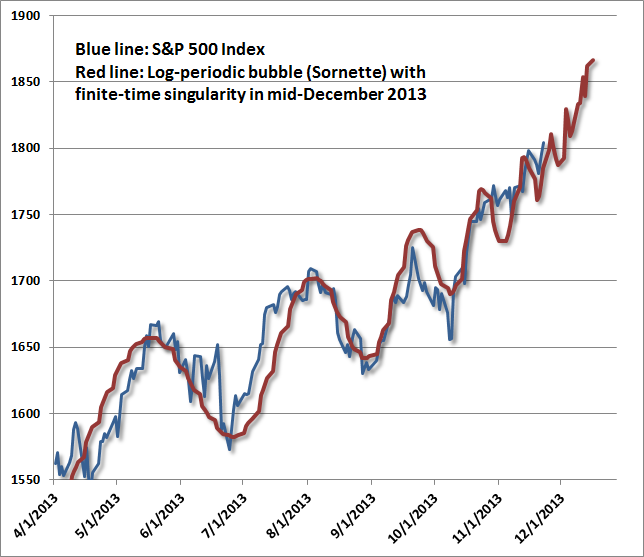
While I have no belief that markets follow any mathematical trajectory, the log-periodic pattern is interesting because it coincides with a kind of “signature” of increasing speculative urgency, seen in other market bubbles across history. The chart above spans the period from 2010 to the present. What’s equally unsettling is that this speculative behavior is beginning to appear “fractal” – that is, self-similar at diminishing time-scales. The chart below spans from April 2013 to the present. On this shorter time-scale, Sornette’s “finite time singularity” pulls a bit closer – to December 2013 rather than January 2014, but the fidelity to this pattern is almost creepy. The point of this exercise is emphatically not to lay out an explicit time path for prices, but rather to demonstrate the pattern of increasingly urgent speculation – the willingness to aggressively buy every dip in prices – that the Federal Reserve has provoked.


via Zero Hedge http://feedproxy.google.com/~r/zerohedge/feed/~3/_DAzCwweo2I/story01.htm Tyler Durden

Shiller Worried About "Boom In US Stocks… Bubbles Look Like This"

On the heels of his recent appearance pouring cold water on Jim Cramer's housing recovery exuberance, recent Nobel Prize winner Bob Shiller unloads another round of uncomfortable truthiness (presumably on the basis of his future-proofing tenure guaranteed by the Nobel). "Bubbles look like this," Shiller tells Der Spiegel, adding that he is, "most worried about the boom in US stock prices." As Reuters reports, Shiller is concerned since "the world is still very vulnerable to a bubble," and with stock exchanges around the world at record highs despite an economy that is "still weak," the Nobel winner proclaimed, "this could end badly."


Via Reuters,

[Bob Shiller] believes sharp rises in equity and property prices could lead to a dangerous financial bubble and may end badly, he told a German magazine.


"I am not yet sounding the alarm. But in many countries stock exchanges are at a high level and prices have risen sharply in some property markets," Shiller told Sunday's Der Spiegel magazine. "That could end badly," he said.


"I am most worried about the boom in the U.S. stock market. Also because our economy is still weak and vulnerable," he said, describing the financial and technology sectors as overvalued.


"Bubbles look like this. And the world is still very vulnerable to a bubble," he said.


Bubbles are created when investors do not recognize when rising asset prices get detached from underlying fundamentals.

We tend to agree – bubbles do look like this…

…we observe a variety of other features typically associated with dangerous extremes:

  • unusually rich valuations on a wide variety of metrics that actually have a reliable correlation with subsequent market returns; margin debt at the highest level in history and representing 2.2% of GDP (eclipsed only briefly at the 2000 and 2007 market extremes);
  • a blistering pace of initial public offerings – back to volumes last seen at the 2000 peak – featuring “shooters” that double on the first day of issue;
  • confidence in the narrative that “this time is different” (in this case, the presumption of a fail-safe speculative backstop or “put option” from the Federal Reserve); lopsided bullish sentiment as the number of bearish advisors has plunged to just 15% and bulls rush to one side of the boat;
  • record issuance of covenant-lite debt in the leveraged loan market (which is now spreading to Europe);
  • and a well-defined syndrome of “overvalued, overbought, overbullish, rising-yield” conditions that has appeared exclusively at speculative market peaks – including (exhaustively) 1929, 1972, 1987, 2000, 2007, 2011 (before a market loss of nearly 20% that was truncated by investor faith in a new round of monetary easing), and at three points in 2013: February, May, and today (see A Textbook Pre-Crash Bubble).

Many of us in the financial world know these to be classic features of speculative peaks, but there is career risk in responding to them, so even those who view the situation with revulsion can't seem to tear themselves away.


While I have no belief that markets follow any mathematical trajectory, the log-periodic pattern is interesting because it coincides with a kind of “signature” of increasing speculative urgency, seen in other market bubbles across history. The chart above spans the period from 2010 to the present. What’s equally unsettling is that this speculative behavior is beginning to appear “fractal” – that is, self-similar at diminishing time-scales. The chart below spans from April 2013 to the present. On this shorter time-scale, Sornette’s “finite time singularity” pulls a bit closer – to December 2013 rather than January 2014, but the fidelity to this pattern is almost creepy. The point of this exercise is emphatically not to lay out an explicit time path for prices, but rather to demonstrate the pattern of increasingly urgent speculation – the willingness to aggressively buy every dip in prices – that the Federal Reserve has provoked.


via Zero Hedge http://feedproxy.google.com/~r/zerohedge/feed/~3/_DAzCwweo2I/story01.htm Tyler Durden

Has Obamacare Been Rescued by the Administration’s ‘Tech Surge’? Don’t Bet On It

Is Obamacare back in action? For the last two
months, Healthcare.gov, the federally run insurance portal at the
heart of the law, has experienced numerous technical troubles. The
administration vowed to fix those problems by the end of November,
and today, the Department of Health and Human Services (HHS)
announced that it had met the goal of making sure that the site
“worked smoothly” for the “vast majority of users.”

In a conference call this morning, a spokesperson for HHS

said
, “we believe we have met that goal.” A
six-page progress report
released by the administration this
morning touts technical progress as well as managerial
improvements, declaring that the team making the improvements is
now “operating with private sector velocity and efficiency.”

Anyone else catch the irony there? Set up a vast,
government-managed tech operation, watch it fail—and then, as it
attempts to reboot itself, boast of private-sector quality
work?  (Also, let’s not forget that the original failed work
was in fact done by private contractors working under the
managerial bumbling
of the federal health bureaucracy.)

So it’s all fixed, and Obamacare’s going to be great, right? Not
so fast. The White House’s
stated goal
of improving the website so that 80 percent of
users can get all the way through the system still means that one
in five users won’t make it through the digital gauntlet. It also
claims that the site is stable and accessible 90 percent of the
time, a figure it only gets by excluding the hours of scheduled
maintenance it undergoes each day.

And that’s if the website even works as well as the
administration says it’s supposed to. Which is, at best, a very big
if.
According
to The Washington Post, some progress has
been made, but the techies and bureaucrats attempting to patch
together the site have not fully met their own internal goals for
performance yet. That would certainly fit the pattern. All
throughout the development of the online insurance exchange system,
the administration has claimed that Obamacare’s tech is working, or
just about to work—but its promises have repeatedly been proven
wrong.

Given its history, the administration’s claims have to be taken
with a cargo ship full of salt—especially since there’s no good way
to independently confirm that the website is working as well as the
administration claims. You just have to
take their word for it
.

Even if the website appears to be working on the user end,
there’s no guarantee that less visible functions are performing
adequately. Insurers have been reporting dropped or incorrectly
transmitted enrollment data since the exchanges launched. And

according
to The New York Times, the repair team
prioritized front-end fixes for consumers over accurate
insurance-company connections. So the site might appear to be
working just fine, until you try to actually use the insurance that
you thought you purchased. 

These are just the known problems. There are plenty more
opportunities for technical troubles down the line, particularly
because when administration officials say the website is working
better, they mean the portion of the website that’s actually been
built. Yet by the reckoning of a senior Obamacare tech official,

some 30 to 40 percent of the exchange functionality
has yet to
been constructed, including some of the crucial insurer payment
systems. (“It’s not built, let alone tested,” one insurance
industry official
told
The Washington Post.”) So the best possible
scenario here is that the 70 percent of the site that’s been built
works for about 80 percent of the people who want to use
it. 

from Hit & Run http://reason.com/blog/2013/12/01/has-obamacare-been-rescued-by-the-admini
via IFTTT

Has Obamacare Been Rescued by the Administration's 'Tech Surge'? Don't Bet On It

Is Obamacare back in action? For the last two
months, Healthcare.gov, the federally run insurance portal at the
heart of the law, has experienced numerous technical troubles. The
administration vowed to fix those problems by the end of November,
and today, the Department of Health and Human Services (HHS)
announced that it had met the goal of making sure that the site
“worked smoothly” for the “vast majority of users.”

In a conference call this morning, a spokesperson for HHS

said
, “we believe we have met that goal.” A
six-page progress report
released by the administration this
morning touts technical progress as well as managerial
improvements, declaring that the team making the improvements is
now “operating with private sector velocity and efficiency.”

Anyone else catch the irony there? Set up a vast,
government-managed tech operation, watch it fail—and then, as it
attempts to reboot itself, boast of private-sector quality
work?  (Also, let’s not forget that the original failed work
was in fact done by private contractors working under the
managerial bumbling
of the federal health bureaucracy.)

So it’s all fixed, and Obamacare’s going to be great, right? Not
so fast. The White House’s
stated goal
of improving the website so that 80 percent of
users can get all the way through the system still means that one
in five users won’t make it through the digital gauntlet. It also
claims that the site is stable and accessible 90 percent of the
time, a figure it only gets by excluding the hours of scheduled
maintenance it undergoes each day.

And that’s if the website even works as well as the
administration says it’s supposed to. Which is, at best, a very big
if.
According
to The Washington Post, some progress has
been made, but the techies and bureaucrats attempting to patch
together the site have not fully met their own internal goals for
performance yet. That would certainly fit the pattern. All
throughout the development of the online insurance exchange system,
the administration has claimed that Obamacare’s tech is working, or
just about to work—but its promises have repeatedly been proven
wrong.

Given its history, the administration’s claims have to be taken
with a cargo ship full of salt—especially since there’s no good way
to independently confirm that the website is working as well as the
administration claims. You just have to
take their word for it
.

Even if the website appears to be working on the user end,
there’s no guarantee that less visible functions are performing
adequately. Insurers have been reporting dropped or incorrectly
transmitted enrollment data since the exchanges launched. And

according
to The New York Times, the repair team
prioritized front-end fixes for consumers over accurate
insurance-company connections. So the site might appear to be
working just fine, until you try to actually use the insurance that
you thought you purchased. 

These are just the known problems. There are plenty more
opportunities for technical troubles down the line, particularly
because when administration officials say the website is working
better, they mean the portion of the website that’s actually been
built. Yet by the reckoning of a senior Obamacare tech official,

some 30 to 40 percent of the exchange functionality
has yet to
been constructed, including some of the crucial insurer payment
systems. (“It’s not built, let alone tested,” one insurance
industry official
told
The Washington Post.”) So the best possible
scenario here is that the 70 percent of the site that’s been built
works for about 80 percent of the people who want to use
it. 

from Hit & Run http://reason.com/blog/2013/12/01/has-obamacare-been-rescued-by-the-admini
via IFTTT

Zenon Evans on Why Feminists Make Great Free Market Capitalists

If you put a bunch of people who identify
as feminists into a room with a bunch of people who identify as
free market capitalists, they would likely have some strained
conversations. At best. They just don’t roll with the same crowds.
This is a shame, argues Zenon Evans, because feminists are actually
quite savvy at operating within the voluntary mechanisms of the
free market system.

View this article.

from Hit & Run http://reason.com/blog/2013/12/01/zenon-evans-on-why-feminists-make-great
via IFTTT

Obama Administration Admits “There Is More Work To Be Done” As Healthcare.gov Relaunches

While even the most naive private sector cyber-experts knew well in advance that an effective rewrite of Obamacare’s 500 million lines of code would take a “little longer” than the month promised by the government in advance of the November 30 fix deadline, the Obama administration went ahead with its much touted healthcare.gov relaunch anyway. The results have been mixed.

The WSJ quotes Obama administration officials who said Sunday there has been “dramatic progress” in fixing HealthCare.gov but acknowledged “there is more work to be done” in improving the site and its underlying technology and that technicians for the site said they will not be able to fix all the glitches by the deadline.

Centers for Medicare and Medicaid Services officials released an eight-page report Sunday morning offering a few details of progress in fixing the site, which crashed shortly after its launch Oct. 1.

The site now allows 50,000 people to use it at the same time, according to the report, and wait times for Internet pages to load have dropped from 8 seconds to less than a second. More than 400 fixes have been made to the site.


“The bottom line, HealthCare.gov on Dec. 1 is night and day from where it was on Oct. 1,” said Jeffrey Zients, the Obama aide tasked with fixing the technical mess, in a call with reporters.

Ironically, if Obamacare ends up being the success Obama has portrayed it as since day one, and traffic to the website surges (as is needed for Obamacare to become financially viable as opposed to just stop showing 404 screens), it is likely that it will crash once again. CMS representative Julie Bataille cautioned, “If there are extraordinary high spikes in traffic, which exceed the site’s capacity, consumers will be put in a new advance queuing system that will give them an expected wait time, or allow them to be notified via email when they can return to the site.” Aka: F5.

That said, assuming the website is indeed finally fixed, it is clear who should be thanked: Google and Oracle. “Contractors and outside engineers from Google Inc. and Oracle Corp. brought in by Obama administration officials have been working overtime over the past five weeks to try to fix the site and its underlying technology, including systems that send information and payments to insurers. Administration officials say they installed fixes this weekend to address erroneous customer data that have been sent to insurers. They won’t know if that issue has been fixed until more consumers get through the enrollment process and more customer data is sent to insurers, said Julie Bataille, a CMS spokeswoman.”

In other words, you have to sign up for Obamacare, to find out not only what’s in it and what your premiums will be, but if it has even been fixed.

Finally, those still confused about the enrollment process, will get some much needed clarity from the flowchart below.


via Zero Hedge http://feedproxy.google.com/~r/zerohedge/feed/~3/FvB3dFzSaUk/story01.htm Tyler Durden

Obama Administration Admits "There Is More Work To Be Done" As Healthcare.gov Relaunches

While even the most naive private sector cyber-experts knew well in advance that an effective rewrite of Obamacare’s 500 million lines of code would take a “little longer” than the month promised by the government in advance of the November 30 fix deadline, the Obama administration went ahead with its much touted healthcare.gov relaunch anyway. The results have been mixed.

The WSJ quotes Obama administration officials who said Sunday there has been “dramatic progress” in fixing HealthCare.gov but acknowledged “there is more work to be done” in improving the site and its underlying technology and that technicians for the site said they will not be able to fix all the glitches by the deadline.

Centers for Medicare and Medicaid Services officials released an eight-page report Sunday morning offering a few details of progress in fixing the site, which crashed shortly after its launch Oct. 1.

The site now allows 50,000 people to use it at the same time, according to the report, and wait times for Internet pages to load have dropped from 8 seconds to less than a second. More than 400 fixes have been made to the site.


“The bottom line, HealthCare.gov on Dec. 1 is night and day from where it was on Oct. 1,” said Jeffrey Zients, the Obama aide tasked with fixing the technical mess, in a call with reporters.

Ironically, if Obamacare ends up being the success Obama has portrayed it as since day one, and traffic to the website surges (as is needed for Obamacare to become financially viable as opposed to just stop showing 404 screens), it is likely that it will crash once again. CMS representative Julie Bataille cautioned, “If there are extraordinary high spikes in traffic, which exceed the site’s capacity, consumers will be put in a new advance queuing system that will give them an expected wait time, or allow them to be notified via email when they can return to the site.” Aka: F5.

That said, assuming the website is indeed finally fixed, it is clear who should be thanked: Google and Oracle. “Contractors and outside engineers from Google Inc. and Oracle Corp. brought in by Obama administration officials have been working overtime over the past five weeks to try to fix the site and its underlying technology, including systems that send information and payments to insurers. Administration officials say they installed fixes this weekend to address erroneous customer data that have been sent to insurers. They won’t know if that issue has been fixed until more consumers get through the enrollment process and more customer data is sent to insurers, said Julie Bataille, a CMS spokeswoman.”

In other words, you have to sign up for Obamacare, to find out not only what’s in it and what your premiums will be, but if it has even been fixed.

Finally, those still confused about the enrollment process, will get some much needed clarity from the flowchart below.


via Zero Hedge http://feedproxy.google.com/~r/zerohedge/feed/~3/FvB3dFzSaUk/story01.htm Tyler Durden