Chart Of The Day: How China's Stunning $15 Trillion In New Liquidity Blew Bernanke's QE Out Of The Water

Much has been said about the Fed’s attempt to stimulate inflation (instead of just the stock market) by injecting a record $2.5 trillion in reserves into the US banking system since the collapse of Lehman (the same goes for the ECB, BOE, BOJ, etc). Even more has been said about why this money has not been able to make its way into the broader economy, and instead of forcing inflation – at least as calculated by the BLS’ CPI calculation – to rise above 2% has, by monetizing a record amount of US debt issuance, merely succeeded in pushing capital markets to unseen risk levels as every single dollar of reserves has instead ended up as assets (and excess deposits as a matched liability) on bank balance sheets.

Much less has been said that of the roughly $2 trillion increase in US bank assets, $2.5 trillion of this has come from the Fed’s reserve injections as absent the Fed, US banks have delevered by just under half a trillion dollars in the past 5 years. Because after all, all QE really is, is an attempt to inject money into a deleveraging system and to offset the resulting deflationary effects. Naturally, the Fed would be delighted if instead of banks being addicted to its zero-cost liquidity, they would instead obtain the capital in the old-fashioned way: through private loans. However, since there is essentially no risk when chasing yield and return and allocating reserves to various markets (see JPM CIO and our prior explanation on this topic), whereas there is substantial risk of loss in issuing loans to consumers in an economy that is in a depressionary state when one peels away the propaganda and the curtain of the stock market, banks will always pick the former option when deciding how to allocated the Fed’s reserves, even if merely as initial margin on marginable securities.

However, what virtually nothing has been said about, is how China stacks up to the US banking system when one looks at the growth of total Chinese bank assets since the collapse of Lehman.

The answer, shown on the chart below, is nothing short of stunning.


Here is just the change in the past five years:

You read that right: in the past five years the total assets on US bank books have risen by a paltry $2.1 trillion while over the same period, Chinese bank assets have exploded by an unprecedented $15.4 trillion hitting a gargantuan CNY147 trillion or an epic $24 trillion – some two and a half times the GDP of China! Putting the rate of change in perspective, while the Fed was actively pumping $85 billion per month into US banks for a total of $1 trillion each year, in just the trailing 12 months ended September 30, Chinese bank assets grew by a mind-blowing $3.6 trillion!

Here is how Diapason’s Sean Corrigan observed this epic imbalance in liquidity creation:

Total Chinese banking assets currently stand at some CNY147 trillion, around 2 ½ times GDP. As such, they have doubled in the past four years of increasingly misplaced investment and frantic real estate speculation, adding the equivalent of 140% of average GDP – or, in dollars, $12.5 trillion – to the books. For comparison, over the same period, US banks have added just less than $700 billion, 4.4% of average GDP, 18 times less than their Chinese counterparts – and this in a period when the predominant trend has been for the latter to do whatever it takes to keep commitments off their balance sheets and lurking in the ‘shadows’!


Indeed, the increase in Chinese bank assets during that breakneck quadrennium is equal to no less than seven-eighths of the total outstanding assets of all FDIC-insured institutions! It also compares to 30% of Eurozone bank assets.

Truly epic flow numbers, and just as unsustainable in the longer-run.

But what does this mean for the bigger picture? Well, a few things.

For a start, prepare for many more headlines like these: “Chinese buying up California housing“, “Hot Money’s Hurried Exit from China“, “Following the herd of foreign money into US real estate markets” and many more like it. Because while the world focuses and frets about the Fed’s great reflation experiment (which is set to become bigger not smaller), China has been quietly injecting nearly three times in liquidity into its own economy as the Fed and the Bank of Japan combined!

To be sure, due to China’s still firm control over the exchange of renminbi into USD, the capital flight out of China has not been as dramatic as it would be in a freely CNY-convertible world, although in recent months many stories have emerged showing that enterprising locals from the mainland have found effective ways to circumvent the PBOC’s capital controls. And all it would take is for less than 10% of China’s new credit creation to “escape” aboard from the Chinese banking system, the bulk of which is quasi nationalized and thus any distinction between prive and public loan creation is immaterial, for the liquidity effect to be as large as one entire year of QE. Needless to say, the more effectively China becomes at depositing all this newly created liquidity, the faster prices of US real estate, the US stock market, and US goods and services in general will rise (something the Fed would be delighted with).

However, while the Fed certainly welcome this breakneck credit creation in China, the reality is that the bulk of these “assets” are of increasingly lower quality and generate ever lass cash flows, something we covered recently in “Big Trouble In Massive China: “The Nation Might Face Credit Losses Of As Much As $3 Trillion.” It is also the reason why China attempted one, aborted, tapering in the summer of 2013, and why the entire third plenum was geared toward economic reform particularly focusing on the country’s unsustainable credit (and liquidity) creation machine.

The implications of the above are staggering. If the US stock, and especially bond, market nearly blew a gasket in the summer over tapering fears when just a $10-20 billion reduction in the amount of flow was being thrown about, and the Chinese interbank system almost froze when overnight repo rates exploded to 25% on even more vague speculation of a CNY1 trillion in PBOC tightening, then the world is now fully addicted to about $5 trillion in annual liquidity creation between just the US, Japan and China alone!

Throw in the ECB and BOE as many speculate will happen eventually, and it gets downright surreal.

But more importan
tly, as with all communicating vessels, global liquidity is now in a constant state of laminar flow – out of central banks: either unadulterated as in the US, Japan, Europe and the UK, or implicit, when Chinese government-backstopped banks create nearly $4 trillion in loans every year. If one issuer of liquidity “tapers”, others have to step in. Indeed, as we suggested a few weeks ago, any possibility of a Fed taper would likely involve incremental QE by the Bank of Japan, and vice versa.

However, the biggest workhorse behind the scenes, is neither: it is China. And if something happens to the great Chinese credit-creation dynamo, then we see no way that the rest of the world’s central banks will be able to step in with low-powered money creation, to offset the loss of China’s liquidity momentum.

Finally, when you lose out on that purchase of a home to a Chinese buyer who bid 50% over asking sight unseen, with no intentions to ever move in, you will finally know why this is happening.


via Zero Hedge http://feedproxy.google.com/~r/zerohedge/feed/~3/ZACrd_nbepc/story01.htm Tyler Durden

Fresh From “Success” In Iran, President Obama Addresses Immigration Reform – Live Webcast

A renewed confidence in the administration must be carried forward. We can’t wait to hear how immigration reform will single-handedly fix the economy, joblessness, education, and healthcare… and if it’s not passed, the failure of all those things is due to the Republican’s unwillingness to negotiate… perhaps it is time for the Republicans to don their best Rouhani costumes?


via Zero Hedge http://feedproxy.google.com/~r/zerohedge/feed/~3/YjvokcVZrWo/story01.htm Tyler Durden

Fresh From "Success" In Iran, President Obama Addresses Immigration Reform – Live Webcast

A renewed confidence in the administration must be carried forward. We can’t wait to hear how immigration reform will single-handedly fix the economy, joblessness, education, and healthcare… and if it’s not passed, the failure of all those things is due to the Republican’s unwillingness to negotiate… perhaps it is time for the Republicans to don their best Rouhani costumes?


via Zero Hedge http://feedproxy.google.com/~r/zerohedge/feed/~3/YjvokcVZrWo/story01.htm Tyler Durden

Is the 'Knockout Game' a Hate Crime? Is It Even a Game?

Amrit
Marajh, the 28-year-old accused of sucker-punching Shmuel Perl, a
24-year-old Orthodox Jew, in the side of the head on Friday in the
Borough Park neigborhood of Brooklyn, has been
charged
with assault, which makes sense, and aggravated
harassment as a hate crime, which is harder to figure out. Leave
aside the question of whether a criminal should be punished extra
severely when he is motivated by bigotry. (He shouldn’t.)
According to
ABC News
, Perl said he “heard his alleged attackers daring each
other to punch him out minutes before one actually assaulted him.”
Hence the assault has been described as the latest example of “the
knockout game,” a pastime supposedly sweeping the nation in which
young assailants dare each other to knock out randomly selected
targets with a single punch. But if the victims are picked at
random, as the knockout game supposedly requires, can they also be
selected based on their ethnicity or religion? ABC does not
mention any anti-Semitic slurs or other evidence that Marajh
was looking for a Jew to attack, and neither do the accounts in

The New York Times
, the New York
Daily News
, or
The Jewish Press
. So why the hate crime charge? The
Daily News story suggests that Perl just happened to
be walking down the street at the wrong moment:

Amrit Marajh, 28, had just left a bar on McDonald Ave. on Friday
with four friends and was talking about boxing when the knockout
game came up, police sources said. 

“You can’t do that,” one member of the group said as they came
upon Shmuel Perl, 24, according to a source.

Marajh allegedly said, “Yes I can, I’ll do it to this guy right
now!” before punching Perl in the face, leaving him bruised.

Marajh’s lawyer, by contrast, told the Daily News “this
had nothing to do with the knockout game.” Also in dispute: whether
the knockout game is actually a thing. “Police officials in several
cities where such attacks have been reported said that the ‘game’
amounted to little more than an urban myth,” the
Times reports,
“and that the attacks in question might be nothing more than the
sort of random assaults that have always occurred.” For
example:

Much news coverage of reported knockout
attacks includes 2012 footage from a surveillance camera in
Pittsburgh of James Addlespurger, a high school teacher who
was 50, being swiftly struck to the ground by a young man
walking down an alleyway with some friends. Yet the Pittsburgh
police said the attacker insisted the assault was not part of any
organized “game.”

“This was just a random act of violence,” Police Commander Eric
Holmes said in a televised interview last year. “He stated that he
was just having a bad day that day.” The assailant saw Mr.
Addlespurger, the commander said, “and decided this was a course of
action he was going to take.”

Once such crimes are relabeled, of course, young thugs who are
inclined to attack people for no particular reason may start using
the new terminology, thereby retroactively validating it. If Marajh
and his friends really were talking about “the knockout game,” they
were probably discussing what they’d heard from news outlets hyping
this supposedly new trend.

from Hit & Run http://reason.com/blog/2013/11/25/is-the-knockout-game-a-hate-crime-is-it
via IFTTT

Is the ‘Knockout Game’ a Hate Crime? Is It Even a Game?

Amrit
Marajh, the 28-year-old accused of sucker-punching Shmuel Perl, a
24-year-old Orthodox Jew, in the side of the head on Friday in the
Borough Park neigborhood of Brooklyn, has been
charged
with assault, which makes sense, and aggravated
harassment as a hate crime, which is harder to figure out. Leave
aside the question of whether a criminal should be punished extra
severely when he is motivated by bigotry. (He shouldn’t.)
According to
ABC News
, Perl said he “heard his alleged attackers daring each
other to punch him out minutes before one actually assaulted him.”
Hence the assault has been described as the latest example of “the
knockout game,” a pastime supposedly sweeping the nation in which
young assailants dare each other to knock out randomly selected
targets with a single punch. But if the victims are picked at
random, as the knockout game supposedly requires, can they also be
selected based on their ethnicity or religion? ABC does not
mention any anti-Semitic slurs or other evidence that Marajh
was looking for a Jew to attack, and neither do the accounts in

The New York Times
, the New York
Daily News
, or
The Jewish Press
. So why the hate crime charge? The
Daily News story suggests that Perl just happened to
be walking down the street at the wrong moment:

Amrit Marajh, 28, had just left a bar on McDonald Ave. on Friday
with four friends and was talking about boxing when the knockout
game came up, police sources said. 

“You can’t do that,” one member of the group said as they came
upon Shmuel Perl, 24, according to a source.

Marajh allegedly said, “Yes I can, I’ll do it to this guy right
now!” before punching Perl in the face, leaving him bruised.

Marajh’s lawyer, by contrast, told the Daily News “this
had nothing to do with the knockout game.” Also in dispute: whether
the knockout game is actually a thing. “Police officials in several
cities where such attacks have been reported said that the ‘game’
amounted to little more than an urban myth,” the
Times reports,
“and that the attacks in question might be nothing more than the
sort of random assaults that have always occurred.” For
example:

Much news coverage of reported knockout
attacks includes 2012 footage from a surveillance camera in
Pittsburgh of James Addlespurger, a high school teacher who
was 50, being swiftly struck to the ground by a young man
walking down an alleyway with some friends. Yet the Pittsburgh
police said the attacker insisted the assault was not part of any
organized “game.”

“This was just a random act of violence,” Police Commander Eric
Holmes said in a televised interview last year. “He stated that he
was just having a bad day that day.” The assailant saw Mr.
Addlespurger, the commander said, “and decided this was a course of
action he was going to take.”

Once such crimes are relabeled, of course, young thugs who are
inclined to attack people for no particular reason may start using
the new terminology, thereby retroactively validating it. If Marajh
and his friends really were talking about “the knockout game,” they
were probably discussing what they’d heard from news outlets hyping
this supposedly new trend.

from Hit & Run http://reason.com/blog/2013/11/25/is-the-knockout-game-a-hate-crime-is-it
via IFTTT

Iron Chef Talks Food, Freedom, and the Future of American Cuisine

“What we’ve witnessed in the past 25 or 30 years is just
incredible,” says Iron Chef Geoffrey
Zakarian
 about the culinary revolution in America. “We’ve
birthed 30,000 or 40,000 restaurants. I used to go to Europe every
year to get experience [and ideas]. I don’t go to Europe anymore. I
go to Oregon, I go to Washington. I go to Louisiana, I go to Little
Rock. I go to Austin. I travel New York City. I don’t go to Europe
anymore.”

In a wide-ranging interview with Reason’s Nick Gillespie held at
The Lambs Club on November 5, the night before the
annual Reason Media
Awards
, Zakarian talks about why America’s cuisine has become a
hotbed of innovation and experimentation, how tough it is to make
it in the restaurant business under the best of circumstances, and
how food nannies are preventing even-better cuisine. “I can’t use
[raw milk] cheese without running afoul of the health inspectors,”
he says.

View this article.

from Hit & Run http://reason.com/blog/2013/11/25/iron-chef-talks-food-freedom-and-the-fut
via IFTTT

Bill Ackman's "Seven Hallmarks Of A Pyramid Scheme" Herbalife Takedown

We are used to hedge fund managers blindly making up “facts” to hide the reality that nothing else matters (most definitely not fundamentals) except the Fed’s balance sheet (in order to defend his 2-and-20 sapping performance). So it is ironic that Pershing Square’s Bill Ackman has added to his previous 342-slide PowerPoint presentation with the following 61 pages of his reality in the hope that market technicals (i.e. the weight of activist longs and shrinking float) and momentum will give way to his view that ‘these’ Herbalife’s fundamentals will eventually win. Good luck with that…


Here are his 7 Hallmarks of a Pyramid Scheme and the full Herbalife’s “Robin Hood In Reverse” presentation is found here:


via Zero Hedge http://feedproxy.google.com/~r/zerohedge/feed/~3/5AEN-oaluaU/story01.htm Tyler Durden

Bill Ackman’s “Seven Hallmarks Of A Pyramid Scheme” Herbalife Takedown

We are used to hedge fund managers blindly making up “facts” to hide the reality that nothing else matters (most definitely not fundamentals) except the Fed’s balance sheet (in order to defend his 2-and-20 sapping performance). So it is ironic that Pershing Square’s Bill Ackman has added to his previous 342-slide PowerPoint presentation with the following 61 pages of his reality in the hope that market technicals (i.e. the weight of activist longs and shrinking float) and momentum will give way to his view that ‘these’ Herbalife’s fundamentals will eventually win. Good luck with that…


Here are his 7 Hallmarks of a Pyramid Scheme and the full Herbalife’s “Robin Hood In Reverse” presentation is found here:


via Zero Hedge http://feedproxy.google.com/~r/zerohedge/feed/~3/5AEN-oaluaU/story01.htm Tyler Durden

Glutathione: Boost Your Health and Help Protect Yourself From Radiation

Glutathione is your body’s “master antioxidant”.

Every cell of your body contains glutathione. And glutathione makes any other antioxidant which you ingest more effective.

Low glutathione levels are associated with serious diseases such as cancer, Aids and diabetes.

As we age, our glutathione levels decline. Indeed, low glutathione levels may be associated with aging quickly:

Glutathione is also central to many other basic mechanisms in our body, such as immune response, blood transport and protein synthesis:

Numerous studies have shown that glutathione can help protect cells against radiation damage, including studies published in the following journals:

This is not entirely surprising, given that it’s well-documented that all antioxidants help to protect against damage from radiation.   Specifically, one of the main ways in which low-level ionizing radiation damages our bodies is by the creation of free radicals. (This 2-minute BBC video shows how damaging free radicals can be to your health.)

Columbia University explains the damaging effects of low-level radiation through free radical creation:

Some radiation experts argue that the creation of a lot of free radical creation is the most dangerous mechanism of low level ionizing radiation:

During exposure to low-level doses (LLD) of ionizing radiation (IR), the most of harmful effects are produced indirectly, through radiolysis of water and formation of reactive oxygen species (ROS). The antioxidant enzymes – superoxide dismutase (SOD): manganese SOD (MnSOD) and copper-zinc SOD (CuZnSOD), as well as glutathione (GSH), are the most important intracellular antioxidants in the metabolism of ROS. Overproduction of ROS challenges antioxidant enzymes.

We’ve previously told you how to get past the hype to find the foods that are highest in antioxidants.

But glutathione – as the “master antioxidant”, which is in every cell of your body – is probably the most important one to focus on.

Dr. Jimmy Gutman – a practicing physician, former Undergraduate Director and Residency Training Director of Emergency Medicine at McGill University in Montreal, Quebec, who has served on the Board of Directors of the Canadian Association of Emergency Physicians – claims:

Raising glutathione levels protects cells from damage from the most dangerous of free radicals, the hydroxyl-radical, is released when ionizing radiation hits us.

Note also that exposure to radiation depletes glutathione in your body.   You basically use up glutathione neutralizing the free radicals created by radiation. So it is important to keep your glutathione levels up when you are exposed to radiation.

How Can We Boost Glutathione Levels?

Despite the hype from the supplement industry, glutathione supplements don’t do anything.  Specifically, our stomach acid destroys glutathione … so you’ll be throwing money away if you buy supplemenets.

But you can eat foods that are high in the precursors to glutathione … and your body will use them to make more glutathione.

Specifically, 3 amino acides – cysteine, glycine and glutamate – are the precursors to glutathione production.

Protein-rich foods tends to be high in all 3. But heating or pasteurizing them destroys many of the glutathione-producing pro
perties.

For example, raw eggs and raw meat are high in cysteine, but cooking destroys the cysteine.   Most industrially-raised meat is of poor quality, and large-scale egg producers have been riddled with salmonella and other problems in recent years.

If you raise your own animals for meat or egg-laying hens, then you’ll know they’re safe.  Otherwise, it may be a little risky eating raw eggs or meat.

Raw milk is apparently very high in glutathione precursors.   But the USDA says that raw milk can be dangerous … and the police may go to some length to shut down raw milk producers.

Raw cruciferous vegetables (brocolli, cauliflower, brussel sprouts, cabbage, cress, and bok choy) are also a good source of cysteine.  But you would have to eat a lot of them … which would cause stomach distress in many people.

So what’s the answer?

Exercise boosts glutatione (and see this).  Lack of sleep can deplete glutathione.  So exercise and get enough rest.

Numerous scientific studies show that “undenatured whey protein” raises glutathione levels.  See this, this, this, this, this, and this.  (Whey protein is derived from milk or cheese, and “undenatured” just means that it is heated enough to kill bacteria … but not high enough to destroy the glutathione precursors.) You can buy it at most health food stores.

If you are a vegan – eating neither meat or dairy products – then you may want to make sure you get enough brown rice protein (because it’s high in the glutathione precursor cysteine).

Supplements available in health food stores – such as Alpha lipoic acid (and here), N-acetylcysteine, S-adenosyl-L-methionine, and the herb milk thistle (and see this) – have also been shown to boost glutathione levels.

For more information on glutathione from physicians – including additional tips for boosting glutathione levels – see this, this and this.

Postscript: Many companies are trying to sell various glutathione boosters. Some work, some don’t … and some do more harm than good. We don’t endorse any specific product.

Read this for more information on how to protect yourself from radiation.


via Zero Hedge http://feedproxy.google.com/~r/zerohedge/feed/~3/sBntFNffqHA/story01.htm George Washington

Guest Post: Madness… And Sanity

Submitted by Tim Price via Sovereign Man blog,

“In investing, what is comfortable is rarely profitable.” — Robert Arnott

Valuations still matter.

Assuming that one is ‘investing’ as opposed to ‘speculating’, initial valuation (i.e. the price you pay for the investment) remains the single most important characteristic of whatever one elects to buy.

And at the risk of sounding like a broken record, “initial valuation” in the US stock market is at a level consistent with very disappointing subsequent returns, if the history of the last 130 years is any guide.

Without fail, every time the US market has traded on a cyclically-adjusted P/E (CAPE) ratio of 24 or higher over the past 130 years, it has been followed by a roughly 20 year bear market.

The evidence for the prosecution is clear, especially for the peak years 1901, 1929, 1966 and 2000. And 2013? The CAPE ratio is more than 25 today.

But there is the stock market, and then there are individual stocks. We have no interest in the former, but plenty of interest in the opportunity set of the latter.

We’re just not that interested in the US market, given general valuation concerns, and the malign role of Fed policy in distorting the prices of everything. As purists and unashamed value investors, we have plenty of other fish to fry.

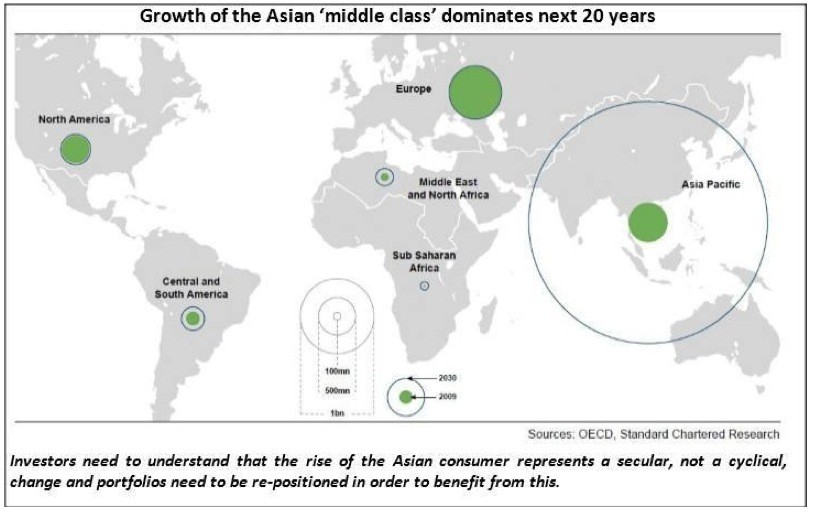
Probably the biggest of those fish is that giant part of the world economy known as Asia. The chart below shows the anticipated growth in numbers of the middle class throughout the world over the next two decades.

AsiaGrowth Madness, and sanity

The solid green circle is the current middle class population (or as at 2009 to be precise); the wider blue-fringed circle represents the forecast size of this population in 20 years’ time.

The OECD definition of middle class is those households with daily per capita expenditures of between $10 and $100 in purchasing power parity terms.

Note that in the US and Europe, the size of the middle class is barely expected to change over the next two decades. The stand-out area is obvious: the emerging middle class in Asia is forecast to explode, from roughly 500 million to some 3 billion people.

In equity investing, the combination of a compelling secular growth story and compellingly attractive valuations is a very rare thing, the sort of investment opportunity that one might only see once or twice in a generation, if that.

But it exists, here in Asia, today. Once again, however, we have to abandon conventional financial thinking in order to exploit it.

Asian personal consumption between 2007 and 2012 – while the West was suffering from a little localised financial crisis – grew by 5% to 10% per annum. Industries likely to benefit from sustained growth in domestic consumption include food and beverages, clothes, cars, and insurance.

But the index composition of Asian equity index benchmarks leaves much to be desired.

Of the 10 largest companies in the MSCI Asia ex-Japan index, three are low margin exporters in Korea and Taiwan, one is a low margin Chinese telecoms business, three are state-run Chinese banks, one is an inefficient Chinese oil and gas producer, and one is an expensive Chinese internet business.

That doesn’t leave much for value investors to go on.

Asian equity funds more generally, tending to be index-trackers, are heavy in Chinese stocks of indeterminate value and clunky ‘old Asia’ exporters with far too much research coverage.

Or one can ignore index composition (‘yesterday’s winners’) entirely and focus instead on ‘best in breed’ businesses throughout the region on an unconstrained basis– especially those with favorable returns on equity, strong balance sheets, and low valuations.

As Greg Fisher of Adepa Asset Management wrote, amid a world of worries, “keeping the discipline of holding lowly valued, under-owned and unleveraged companies is likely to continue to protect our capital and earn us both income and capital appreciation over the longer term.”

Or to put it more plainly, and in the words of Warren Buffett, “price is what you pay; value is what you get.”

US stocks may be expensive, but you can get better economic fundamentals and cheaper valuations selectively throughout Asia.

And as insurance against the sort of disorderly currency moves that seem to be almost inevitable courtesy of so many central banks behaving badly, we still maintain you can’t do better over the medium term than gold.


via Zero Hedge http://feedproxy.google.com/~r/zerohedge/feed/~3/gJqCaZfs9j8/story01.htm Tyler Durden