Mass Surveillance Has a “Chilling Effect” on Online Expression

Turns out people who believe they have Chilling effect.“nothing to hide” hold back more than anyone else when it comes to expressing “minority” opinions on social media. 

A study published in Journalism & Mass Communication Quarterly, titled “Under Surveillance: Examining Facebook’s Spiral of Silence Effects in the Wake of NSA Monitoring” theorizes, “knowing one is subject to surveillance and accepting such surveillance as necessary act as moderating agents in the relationship between one’s perceived climate of opinion and willingness to voice opinions online.”

Put more succinctly, even though most Americans have some working knowledge of the revelations laid bare in 2013 by former NSA contractor Edward Snowden of the agency’s mass surveillance of the population, and even though a majority of Americans deem such generalized snooping “unacceptable,” the mere knowledge that online communications are “subject to government interception” influences “conformist behavior.”

Motherboard summarized the study’s methodology:

The paper is based on responses to an online questionnaire from a random sample of 255 people, selected to mimic basic demographic distributions across the US population.

Participants were asked to answer questions relating to media use, political attitudes, and personality traits. Different subsets of the sample were exposed to different messaging on US government surveillance to test their responses to the same fictional Facebook post about the US decision to continue airstrikes against the Islamic State of Iraq and Syria (ISIS).

They were then asked about their willingness to express their opinions about this publicly—including how they would respond on Facebook to the post; how strongly they personally supported or opposed continued airstrikes; their perceptions of the views of other Americans; and whether they supported or opposed online surveillance.

The results indicated that people who perceived their own opinions to be in the minority were less likely to comment, but so were people who felt their opinions were in the majority yet believed that government surveillance of their online activity was necessary.

The study’s author, Elizabeth Stoycheff of Wayne State University told the Washington Post:

“The fact that the ‘nothing to hide’ individuals experience a significant chilling effect speaks to how online privacy is much bigger than the mere lawfulness of one’s actions. It’s about a fundamental human right to have control over one’s self-presentation and image, in private, and now, in search histories and metadata,” she said.

Stoycheff is also concerned about the quietly oppressive behavior of self-censorship.

“It concerns me that surveillance seems to be enabling a culture of self-censorship because it further disenfranchises minority groups. And it is difficult to protect and extend the rights of these vulnerable populations when their voices aren’t part of the discussion. Democracy thrives on a diversity of ideas, and self-censorship starves it,” she said. “Shifting this discussion so Americans understand that civil liberties are just as fundamental to the country’s long-term well-being as thwarting very rare terrorist attacks is a necessary move.”

Writing at The Atlantic, Kaveh Waddel notes that “a simple reminder of everyday surveillance” can also affect people’s behavior in non-digital life:

Studies have shown that being watched can make people less likely to commit some crimes, or to act in ways that don’t conform to widely held morals.

One 2013 study, for example, found that when restaurants installed monitoring software to alert managers about stealing employees, weekly revenue went up, suggesting that employees were changing their behavior in response to the knowledge that they were being watched.

But commenting on controversial topics isn’t the same as skimming off your employer’s bottom line. The “self-censorship” caused by the spectre of Big Brother watching our 0s and 1s isn’t likely to do much besides make people’s personally-curated echo chambers even more homogeneous. As Stoycheff said, government surveillance “changes the assumption that we’ve been working on this whole time, that the Internet is a safe space for deliberation.”

If the people who feel they have “nothing to hide” decide to pre-emptively hide their ideas and opinions, then the robust exchange of ideas through which we all have something to potentially learn from one another is threatened.

Watch Reason TV’s interview with Edward Snowden below.

from Hit & Run http://ift.tt/22uqEyj
via IFTTT

Bono: Send in the Clowns To Beat ISIS

Irish singer Bono addressed a Senate subcommittee inquiring into the “causes and consequences of violent extremism and the role of foreign assistance.”

When the conversation turned to how best to combat rising Islamic terrorism, Bono called sending in the shock-comedy troops. Cereally:

I think comedy should be deployed…The first people that Adolf Hitler threw out of Germany were the dadaists and surrealists. It’s like, you speak violence, you speak their language. But you laugh at them when they are goose-stepping down the street and it takes away their power. So I am suggesting that the Senate send in Amy Schumer and Chris Rock and Sacha Baron Cohen, thank you.

You ask a general how to beat ISIS, he’s gonna tell you to send in bombs and troops. You ask a diplomat the same question, she’ll you to use diplomacy. You ask a carpenter how to beat ISIS, he’s gonna tell you to use a hammer. So it shouldn’t be surprising that a showbiz guy like Bono tells you to send in the clowns. Which, to be fair, is better than sending in high-art types or classical musicians. As I’ve noted elsewhere, people have named revolutions after rock bands but no one ever named one after Van Cliburn.

Let’s give Bono some artistic license here when he suggests that artists (not comedians, by the way) were the first victims of the Nazi government (sadly, many groups can claim that sickening prize). Still, the idea that “going pffft in Der Fuhrer’s face” was a major front in the war against Nazi aggression is a bridge too far. Anyone who seriously thinks that The Little Dictator or Bugs Bunny cartoons—as opposed to massive amounts of bombs, troops, tanks, bullets, and the like—turned the tide should have his head examined.

Which isn’t to say that Bono didn’t say some things worth considering. In the past, he’s noted (with sadness!) that increasing global trade has done more to alleviate extreme poverty than aid and in his comments yesterday, he said:

‘When aid is structured properly, with a focus on fighting poverty and improving governance, it could just be the best bulwark we have against the extremism of our age,’ the rock star and anti-poverty campaigner testified.

But should U.S. leaders heed his call for a “Marshall Plan” for the Middle East? No, for the same reasons that held a few years ago. As even the World Bank acknowledges, increased aid erodes “the quality of governance.” 

(Incidentally, the whole Marshall Plan invocation is stupendously wrong as a matter of economic history. As Tyler Cowen wrote more than 30 years ago, the aid package’s role in post-war recovery is a myth: “The countries which got the most help, like Greece and Austria, didn’t begin to recover until the aid was nearing its end. Others, like France, Germany and Italy, were recovering even before the help arrived.”)

So if not sending in massive amounts of comedians and foreign aid, what is to be done? For starters, it’s probably a good idea not to spend 15 years bombing and occupying the Middle East as a prelude to fixing things up. Seriously, the lack of serious discussion about the role of war and foreign policy in conversations about “the rise of extremism” is nothing short of baffling to me. Second, the United States and other Western nations might think less about getting more involved in the day-to-day running of the Middle East and more about doing business with those countries and allowing as many people who want to leave the area find safe passage and a future in our own nations. That may be less dramatic and spectacular than letting a million ribbon-cutting ceremonies bloom at new buildings and rec centers built with foreign aid, but it would have the advantage of possibly actually helping people.

Here’s another thing to consider: Islamic terrorism in Europe is being conducted primarily by Muslims born and raised in Europe itself. One of the main places that such actors are radicalized are prisons, where many of them end up because of petty crime and drug offenses. As The Influence reported recently:

An estimated 12 percent of the population of France is Muslim, while a staggering 50-70 percent of France’s prison population is estimated to be Muslim. In Belgium, about 5 percent of the population is Muslim; prison figures are unreliable, but unconfirmed claims that Muslims are disproportionately represented in Belgian prisons would be in line with other European countries. (By way of comparison, in the UK, where the overall Muslim population is about 3-4 percent, the prison population is closer to 11 percent Muslim.)

There is no panacea to terorrism which, like crime, will always be with us. What “we” (meaning pluralistic, Western nations) might do is create societies that actually find meaningful ways for outsiders to assimilate (America does this well, Europe doesn’t) and to not constantly intervene in places were our power to destroy is always going to be far, far greater than our ability to—what’s that old term?—”nation build.”

This seems like a good time to trot out “Everybody Loves Me, Baby,” Don McLean’s allegorical critique of U.S. foreign policy that appeared on his epic and damn-near-flawless American Pie LP. Take a spin:

from Hit & Run http://ift.tt/1SzX2Kq
via IFTTT

FacePlant – Social Network Stock Slumps On Ad-Spend Plunge Chatter

Facebook is making headlines this morning for CEO Zuckerberg’s anti-Trump stance. However, shareholders are focused on chatter from a conference call, confirming Deutsche comments last week, that Ad Spend is plunging worse than expected – CLSA and AdParlor saying that Facebook advertising spend is down a shocking 18% in Q1

The stock is not reacting well…


Still keep talking about Trump – that will fix it…

via http://ift.tt/1TRoSHw Tyler Durden

America’s New Impossible Trinity: You Can’t Have Higher Wages, Steady Inflation And High Profits At The Same Time

At the start of the month we focused on what is set to soon be the new buzzword in economic circles: staglation. Specifically, we referred to the the explicit and inverse correlation between corporate profits and employee wages. As we showed, in the chart recreated below, if indeed labor income, i.e., wages, are rising, then profit margins have no choice but to fall even more; this means that if the stock market wishes to continue rising even higher in a time when wages are supposedly increasing, it will only achieve this with margin expansion, which however can only be achieved by even more Fed intervention and more stimulative inflation, which then pushes wages even higher generating a self-defeating feedback loop.


Yesterday Deutsche Bank picked up on this theme and in a note titled “A New Impossible Trinity”, not to be confused with China’s impossible trinity according to which, policymakers cannot simultaneously achieve fixed exchange rates, cross-border capital mobility, and independent monetary policy, it says that “America’s ongoing labour productivity slump has created a new impossible trinity – policymakers can only choose two of the following three desirable outcomes: higher nominal wage growth, steady inflation and high corporate profits.

At its core the thesis has to do with the secular decline in US productivity and sliding nominal wage growth. As DB explains “the theory behind this new ‘impossible trinity’ is intuitively simple. If workers’ wages rise faster than their productivity, the companies paying those higher wages face two choices. They can either pass on the extra costs to customers, thereby leading to higher overall prices and rising inflation, or they can absorb the extra costs resulting in lower profit margins. Or in economist speak, increases in nominal wages must equal the sum of productivity improvements, price rises and changes to labour’s share of output (which is the flip-side of profit margins).”

This interaction is shown in the chart below:


DB further notes that for the entire second half of the last century, growth in nominal wages tracked the sum of productivity growth and inflation while leaving labour’s share of output largely unchanged. However, the first decade of this millennium saw nominal wages failing to rise sufficiently to compensate workers for rising prices and their productivity gains. The result was a substantial decline in labour’s share of output through the decade of the 2000s.

This is also the primary complaint about the Fed’s policies, namely that in seeking to boost the stock market, policymakers have ignored the lack of wage growth.

DB then recreates the chart we first show above, noting that labour’s share of output is just the flipside of corporate profit margins. And for a quarter century or so after 1970 profit margins of companies remained range-bound, mean-reverting around their average of 7.5 per cent. However, the sustained decline in labour’s share of output which started in the mid-1990s lead to a corresponding increase in profit margins, taking them to a record 12.5 per cent in 2012.


The summary:

The impossible trinity framework also helps explain the reversal of this trend in the last couple of years. Even as companies have enjoyed a Goldilocks scenario of low commodity prices, modest wage pressures and rock-bottom interest costs, corporate America is still somehow mired in what is sometimes called a ‘profit recession’. That is because even though nominal wage growth has been weak by historical standards, it is still outpacing the combination of even lower inflation and historically low productivity growth. Therefore, the labour share of output has actually been rising since 2014, resulting in corporate profit margins declining by two percentage points from their 2012 peak.

What does this mean for the US economy? The optimistic scenario is that productivity rebounds and all returns back to normal. However, DB is skeptical:

The sheer scale of the current slump raises the awkward possibility that a productivity recovery might not come about as expected. A case in point is the data pertaining to the recently concluded first quarter of 2016. While employment growth continued to be strong, monthly payroll additions averaging over 200,000 jobs, forecasts of output growth during the quarter remain subdued. In particular, the Atlanta Fed’s real-time estimate is now for merely 0.1 per cent annualised output growth. The combination of strong employment and weak output growth looks likely to register yet another quarter of very weak productivity growth. Also note that Congressional Budget office recently downgraded its projections of potential productivity over the next decade.

The conclusion:

The point though remains, the cost of lower productivity growth has to be picked up by someone in the economy – by workers in the form of lower growth in real wages and living standards, bond holders in the form of higher inflation or stock investors in the form of lower profit margins. Hence, when forming their assessment of possible future outcomes, investors should bear the impossible trinity framework in mind. An economy stuck in a low productivity growth rut cannot enjoy high nominal wage growth, reasonable inflation and steady corporate profits all at once. Some things are just impossible.

So which will it be: a rebound in corporate profits, a critical precondition to new market highs (unless central banks want to expand PE multiples even more), or rising wages, while keeping inflation constant. Because the Fed can’t have all three.

via http://ift.tt/1TRoTLo Tyler Durden

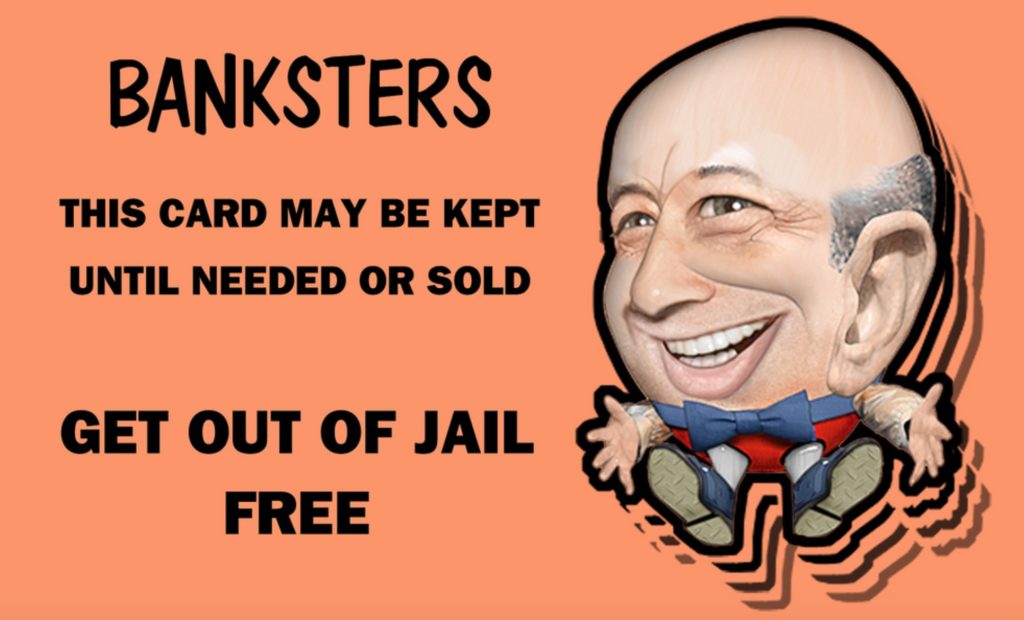
The Goldman Sachs Settlement Is an Abomination and Insult to All American Citizens

Screen Shot 2016-04-13 at 9.56.03 AM

The increased use of eminent domain to transfer property to powerful political interests, the ramifications of the wars on terrorism and drugs, and the violation of the property rights of bondholders in the auto-bailout case have weakened the tradition of strong adherence to the rule of law in United States. We believe these factors have contributed to the sharp decline in the rating for the legal-system area.

To a large degree, the United States has experienced a significant move away from rule of law and toward a highly regulated, politicized, and heavily policed state.

– From the 2014 post: New Report – The United States’ Sharp Drop in Economic Freedom Since 2000 Driven by “Decline in Rule of Law”

The American public should be out in the streets by the hundreds of thousands demanding the resignation of President Barack Obama in response to the total sham settlement just announced by the U.S. government with Goldman Sachs. This farce should be seen for what it really is; a gigantic establishment middle finger waving contemptuously in the face of the reliably neutered and long-suffering American public.

continue reading

from Liberty Blitzkrieg http://ift.tt/1S6USm7
via IFTTT

Virginia’s System of Injustice: New at Reason

Keith Allen Harward spent more than 30 years behind bars for a crime he didn’t commit in part because prosecutors withheld DNA evidence that could’ve been used in his defense.

A. Barton Hinkle writes:

Swabs from the rape kit in Harward’s case included blood-type evidence that, his appeal says, “excluded Mr. Harward as the perpetrator.” But that evidence was “never provided Mr. Harward or his counsel. This information was not only suppressed but also falsely characterized as ‘inconclusive’ by the Commonwealth’s forensic expert at trial.”

As the Richmond Times-Dispatch‘s Frank Green has reported, the work of that expert—David Pomposini—also has been involved in another wrongful conviction case, concerning a man named Troy Webb. Webb spent eight years in prison for rape before DNA cleared him.

Harward and Webb are preceded by other well-known innocents set free long after conviction. Thomas Haynesworth spent 27 years in prison for rapes committed by another man. Earl Washington spent 17 years in prison for crimes that DNA proved he did not commit—including several years on death row and six more years even after his exoneration.

Still, that Harward’s lawyers never got to see evidence that could have kept another innocent man out of prison—while the guilty one went free—ought to chasten the members of the Virginia Supreme Court.

View this article.

from Hit & Run http://ift.tt/23ES0UW
via IFTTT

“Feeding The Monster” – The Complete Bear Case, In Charts

Via NorthmanTrader.com,

In Greek mythology there was a monster called Cerberus, the hound of Hades, a monstrous multi-headed dog who guarded the gates of the underworld, preventing the dead from leaving. Today central banks have taken on the role of feeding our own modern version of Cerberus to keep all the troubles away. Ever since the 2008/2009 financial crisis Cerberus has been chained to a wall, but he’s pulling and he’s growling and he’s demanding ever more attention. But in the process of feeding Cerberus with ever lower rates and stimulus central banks keep making him stronger and fiercer and ever more aggressive. But worse, central bankers are running out of food to feed the monster.

This hound of Hades has 3 heads that are named debt, deflation and demographics. Together they make a deadly combination that will result in a massive reset of asset prices. And today I will aim to outline why this will eventually happen.

Most of the town folk have pretended for a long time that Cerberus is contained or denied his existence even as he has grown and is getting stronger. In fact a curious process of denial has begun.

Consider this dramatic shift in narrative:

In 2015 Wall Street analysts had projected the S&P 500 to end the year in the 2,200-2,300 range. Some of the key arguments centered around a narrative that earnings would expand further, that lower oil prices would be good for the consumer (which will spur spending) and that the FOMC would hike rates which would be a positive development as it would show confidence in the recovery and help bank earnings. In short everything was bullish.

None of these narratives came to fruition. GAAP earnings actually started to decline, the fall in oil prices became a disaster as energy stocks started walking on the bring of default and lower oil prices did not translate into increased consumer spending. Finally, after much handwringing and dozens and dozens of Fed speeches, the FOMC finally implemented its first rate hike in 9 years in December of 2015. The immediate result: Bank stocks fell 24%, global markets were in disarray as energy stocks crashed prompting the only response possible: Feed the monster again. China offered stimulus, the BOJ went rate negative, the ECB added QE and cut rates further into negative and the US FOMC took back its offered roadmap of 4 rate hikes for 2016 back to 2 and then, with a highly dovish speech by Janet Yellen, to possibly zero.

In short central banks have simply following the feeding pattern they have followed for years whenever Ceberus get hungry:

DJIA

Yet suddenly in 2016 the narrative has shifted and the irony has not been lost on people as evidenced by the response to this tweet:


This is called playing tennis without the net especially considering we wouldn’t even have this conversation were it not for constant central bank intervention and jaw boning.

Look, humans are great at rationalizing anything. But there are fundamental truths that are very hard to escape from.
One truth is that GAAP earnings have been declining while pro-forma reporting has been able to mask this decline:

gaap

And the recent rally has made the market the most expensive in years in light of this substantial decrease in GAAP earnings:

SPX GAAP

Which brings us back to Cerberus and his 3 heads of debt, deflation and demographics.

A little history first. Ever since the 1980s we have been in a trend of lower highs in GDP growth:

GDP growth

On any sign of trouble central banks have done their part to help: Cut rates. But in doing so their efforts to reflate rates after each downturn has resulted in lower highs and culminated in, well, rock bottom:

Funds

The conclusion: Feeding the monster has diminishing returns and this in spite of feeding the monster ever more.

Consider that these rate declines enabled the ever increasing cycle of debt:

Debt

Not only in absolute terms, but also as part of the economy at large:

debt to GDP

And of course it’s a global issue and has only increased since the publication of this study last year:

debt

The immediate conclusion: Not only is GDP growth shrinking, it is also vastly overstated as it is augmented by deficit spending:

deficits

What central banks have been able to do is permit for all this debt growth to be virtually consequence free. Due to zero rates all debt can be financed at very low rates and so despite massive increases in debt the amount of money needed to pay interest on debt has actually been relatively stable at around $400-450B per year:

interest payments ST

The problem should be obvious: If the FOMC were to normalize rates to say, 3-4%, the incremental increase in interest payments would render the US discretionary budget insolvent as each 1% increase would ultimately cause a $200B increase in payments required. So the notion of rate normalization appears to be entirely unrealistic. Additionally there is zero evidence to suggest that the US government can run deficit free. So it’s a perpetual cycle of ever more debt that requires ever more resources to service it.

Even with the most tax receipts ever the US government is running a massive deficit as shown here for the first 6 months of fiscal 2016:

2016

Government debt is not the only issue. Consumers have been loading up on debt for years:

student loans auto loans

mortgage debt consumer credit

All of this also sustainable only due to low rates. In other words: Rate hikes would eventually severely disturb this seemingly serene picture.

household debt payments

Corporations have been joining the party and taking on ever more debt:

debt to equity

debt ebitda

Net Debt EBITDA

and the combination of it all shows a massive disconnect from the underlying productive asset base:

debt loans

The conclusion: Low rates have enabled an unprecedented increase in debt for governments, consumers and businesses.

What has it all produced? What are the results? And how do they pertain to sustainability?

If one takes on debt to expand, to produce more, to become more productive, to earn higher rates of return, then debt makes sense as it ultimately gets paid off. But none of these goals are being achieved:

Real household incomes have been decreasing:

real income

Retail sales are not increasing:

retail sales

And how could they? While debt service payments have remained stable, due to low rates, many key budget items for families have gone nowhere but up:

Rents:

rent

Medical:

medical

And we already mentioned student loans:

student loans

Combine some of these things and you get:

College-versus-Medical-Care-or-New-Car

But remember the Fed says there is no inflation. Worse for consumer: The dollars they do earn have ultimately less and less value as purchasing power keeps dwindling:

PP

None of this is sustainable or will result in growth without large increases in wage growth and productivity.

The evidence? Severely lacking.

On the student loan front already over 40% are no longer making payments:

loans

It’s a symptom of larger issues. Folks are stretched and don’t have the income or wage growth to sustain their financial obligations.

The structural reality shows lower highs for wage growth:

hourly wage

Productivity is not increasing:

labor productivity

In fact in this latest recovery, despite the unprecedented increases in debt, productivity is lagging severely:

productivity growth cycle

And it’s a global issue:

UK productivity

Has debt produced investment? The answer is no:

Investment

But it’s producing low rates enabled buybacks of stocks:

Buybacks

So the picture that presents itself is this:

Despite the taking on of record debt with ever more stimulus the returns on investment are decreasing.

The culprit: Structural deflationary forces, the biggest one of which is technology itself. One symptom is the massive value Wall Street places on the very companies that benefit the most from technology: The FANGs of the world. Facebook, Amazon, Netflix, Google and many others that are able to build global monopolies on scalable platforms that require relatively few people. None of these companies produce any real products, but they can reach literally billions of eyeballs with a limited number of employees. Highly effective, highly concentrated, but highly limited for employment expansion. One could even go as far as to say that some of these companies are in essence sapping productivity from the rest of society. All consumer activities associated with them could be counted as nonproductive.

After all who is productive browsing Facebook, YouTube, Google, etc?

social

The answer preciously few.

Speaking of few: The ones actually employed. The Fed tells us we are close to full employment. Yet the number of people not in the labor force has shown one long standing trend:

Not in labor force

As of late there has been a little dip and it is called a major improvement and change in trend.

Perhaps, but it is again the prospect of enhanced technology that suggests further deflationary trends to come, especially for many job categories that may face complete extinction. The driver? AI and robotics. We see incredible developments in driverless cars, chat bots, actual robots capable of taking on basic human tasks. While none of these technologies are ready for mass implementation, one can firmly sense that they are around the corner in the years ahead. The potential victims? The trucking industries, customer care services, warehouse operations, etc. In short: Millions of jobs may disappear and be replaced by what exactly?

Speaking of human replacement: Demographics.

The coming shift in demographics is dramatic:

children-vs-elderly-cotd

And the Fed knows is. The Atlanta Fed after all has this header image on their twitter feed:

demo

They know. And it’s a huge problem as the size of unfunded liabilities is exploding further with each day:

debt clock

Look we can all pretend Cerberus is not there and he won’t come to bite us or let the evils out of Hades. But the math simply doesn’t work.

Central banks can’t change the business cycle. Their game is one of pretend confidence and feeding the monster as best as they can. But they don’t produce jobs, they don’t produce growth, heck they can’t even predict anything:

Here’s the Atlanta Fed in February:


And here they are in April:


Alan Greenspan summarized it best:

greenspan

And so the warning signs are mounting:

deals

guidance

interbank

ipos

And I’m not alone in seeing massive risk building as a result of all these central bank actions.

Here’s Laurence Fink of Blackrock:

“These actions are severely punishing the world’s savers and creating incentives to reach for yield, pushing investors into less liquid asset classes and increased levels of risk, with potentially dangerous financial and economic consequences,” Fink said. That and other forces, including geopolitical instability, are creating “a level of fragility in the global economy that we have not seen since the lead-up to the financial crisis.”

But it’s not only financial risk that is of concern, there is the political risk that appears not priced into markets at all. In June the UK faces a Brexit vote largely driven by discontent over imposing European policies.

Even Germany is feeling the heat and a stretching of its political spectrum.

Germany’s Finance Minister:

Politicians from Chancellor Angela Merkel conservative camp, to which the finance minister belongs, have complained the ECB’s ultra-low rates are creating a “gaping hole” in savers’ finances and pensioners’ retirement plans as returns have dropped.


Schaeuble suggested they risked fuelling the rise of euroscepticism in Germany, where voters flocked to the right-wing Alternative for Germany in state elections last month.


“It is undisputable that the policy of low interest rates is causing extraordinary problems for the banks and the whole financial sector in Germany,” said the 73-year-old. “That also applies for retirement provisions.”

“That is why I always point out that this does not necessarily strengthen citizens’ readiness to trust in European integration,” he added in an interview. 

Markets are currently ignoring all of it.

What does this all mean for stocks for the here and now?

On a GAAP basis earnings are back to where they were at the peak of the 2007 earnings cycle:

SPX GAAP

Structurally the S&P 500 has been following a familiar pattern: It rises on increased earnings, it breaks trend once earnings stall, has a correction and bounces back to reconnect with major moving averages before falling further. Markets have just bounced back and strongly so primarily driven by short covering and massive central bank intervention and jaw boning. But now we find ourselves at a key juncture: Repeat the pattern or diverge from it. My supposition has been that without a sudden positive turn in earnings this rally will be hard to sustain:

WLSH

XVG

So the question that presents itself is not one of destination. The destination is clear. It’s a massive re-alignment of asset prices down the road. It’s widely acknowledged that most asset prices are vastly overvalued. Here’s VC Peter Thiel:

“Startup tech stocks may be overvalued, but so are public equities, so are houses, so are government bonds”

While Janet Yellen denies the existence of bubbles she is amongst the chief architects of fueling overvaluation of asset prices globally.

The math shows clearly that the FOMC can’t really raise rates in any substantial manner at all. So it’s an elaborate PR dance that is on display on a monthly basis with dozens of Fed speeches full of sound and fury signifying nothing.

The real question then is one of the exact path to perdition. The charts above indicate that markets are at a key juncture. Either they will break lower this summer or, if central banks succeed one more time, can create the one element this bull market has been lacking: A proper blow-off top.

Just know a blow-off top will make markets not cheaper, but much more expensive:

SPX GAAP

In either case: Cerberus will continue to demand to be fed. And the math says he is getting hungrier every day. And looking around the world it appears he wants a change in diet as more and more stimulus is not only producing diminishing return, but is breeding more political discontent.

BOJ

DAXM

What this means for me from a trading perspective is simply this: I want to observe this earnings season for clarity. Without a sudden positive shift in earnings prospects this market remains at very high risk of following the previous historic structures, hence I remain defensive/tactical here.  Should earnings improve subtantially then basic fib retraces of this rally may be buyable. If not, then Cerberus will break his leash sooner rather than later.

via http://ift.tt/1qp3qO1 Tyler Durden
Atlanta Fed Stuns Everyone, Revises GDP Higher Despite Retail Sales, Inventory Miss

Following today’s triple whammy of economic misses, in which first retail sales both declined and missed expectations, and then both business inventories and sales declined and missed from downward revised numbers, AtlantaFed watchers were certain that the keeper of the GDP Nowcast would cut its GDP estimate from 0.1% to zero or even negative.

However, this did not happen. Perhaps due to another tap on the shoulder as a negative GDP print would be just too much to justify the relentless market rally, or as a result of the NY Fed’s own competing service now trying to steal the limelight with its own 1.1% GDP forecast, moments ago the Atlanta Fed stunned everyone when it announced that instead of revising its concurrent GDP tracker lower, it actually pushed it up from 0.1% to 0.3%.

This is what it said:

The GDPNow model forecast for real GDP growth (seasonally adjusted annual rate) in the first quarter of 2016 is 0.3 percent on April 13, up from 0.1 percent on April 8. After this morning’s retail sales report from the U.S. Bureau of the Census, the forecast for first-quarter real consumer spending growth increased from 1.6 percent to 1.8 percent.


What makes this particularly curious is that even Goldman Sachs, which keeps a concurrent tally of GDP components and revises it after every major data point, revised its GDP estimate down from 0.9% to 0.8%: “Details of the retail sales report were slightly negative for our tracking estimate of Q1 GDP growth: we revised down by one tenth to +0.8% (qoq ar).”

Stocks, enthused by this curious interpretation of today’s economic data, just took out intraday highs.

via http://ift.tt/1VpcwrL Tyler Durden

Happy Birthday, Thomas Jefferson

Thomas Jefferson, the Virginia statesman, principal author of the Declaration of Independence, and third president of the United States, was born on this day in 1743. Jefferson was a brilliant theorist and politician who, to say the very least, had an outsized impact on the course of American history. Yet Jefferson was also a deeply flawed individual, a man who could champion the idea that “all men are created equal” while at the same time owning numerous slaves. To mark Jefferson’s birthday today, and to reflect on his complicated legacy, here’s an excerpt from my take on “The Trouble With Thomas Jefferson,” an essay which first appeared in Reason‘s January 2009 issue:

Does the fact that Thomas Jefferson owned slaves—probably including his own children—negate the wonderful things he wrote about inalienable rights in the Declaration of Independence? To put it another way, why should anyone listen to what Master Jefferson (or other slaveholding Founders) had to say about liberty and equality?

It’s important to remember that the idea of inalienable rights didn’t start or stop in the year 1776. The historian Gordon S. Wood, in his superb 1991 book The Radicalism of the American Revolution, argues that “to focus, as we are apt to do, on what the Revolution did not accomplish—highlighting and lamenting its failure to abolish slavery and change fundamentally the lot of women—is to miss the great significance of what it did accomplish.” In Wood’s view, by destroying monarchical rule and replacing it with republicanism, the American revolutionaries “made possible the anti-slavery and women’s rights movements of the nineteenth century and in fact all our current egalitarian thinking.” They upended “their societies as well as their governments…only they did not know—they could scarcely have imagined—how much of their society they would change.”

As evidence, consider two very different figures whose lives intersected with slavery in the 19th century: the abolitionist Frederick Douglass and the pro-slavery politician John C. Calhoun. An escaped slave and self-taught author and orator, Douglass understood better than most just how potent the Declaration’s promise of inalienable rights could be. “Would you have me argue that man is entitled to liberty? That he is the rightful owner of his own body?” Douglass would demand of his mostly white audiences. “There is not a man beneath the canopy of heaven that does not know that slavery is wrong for him.”

Calhoun, by contrast, believed the Declaration’s assertion that “all men are created equal” was “the most dangerous of all political error.” As he put it in an 1848 speech, “For a long time it lay dormant; but in the process of time it began to germinate, and produce its poisonous fruits.” This false notion of equality, Calhoun continued, “had strong hold on the mind of Mr. Jefferson…which caused him to take an utterly false view of the subordinate relation of the black to the white race in the South; and to hold, in consequence, that the former, though utterly unqualified to possess liberty, were as fully entitled to both liberty and equality as the latter.”

Think about what Calhoun is saying here. The idea that “all men are created equal” has slowly developed in the American consciousness, producing the “poisonous fruits” of the anti-slavery movement. Jefferson may or may not have intended such an outcome; he certainly did little actively to bring it about, though he did denounce slavery and its brutalizing impact on white society. But the libertarian ideas that inspired Jefferson, the ones coursing through the Declaration of Independence and later through the Constitution, nonetheless did bring it about. Douglass welcomed that result; Calhoun despised it.

Read the whole thing here.

from Hit & Run http://ift.tt/1oXOg1i
via IFTTT

40,000 Verizon Workers Go On Strike: How Will It Affect You

Starting early today, over 36,000 Verizon workers will go on strike after the firm failed – after 8 months of 'negotiations' – to meet two union's demands (which merely includes controlling health care costs, protecting well-paying jobs and expanding the ranks of the workers who have them). The strike – one of the largest in years, according to NYTimes – will affect some consumers but Verizon has said that customers will be less impacted because it has trained thousands of non-union employees since last year to fill in for those who walk the picket line.

As The Wall Street Journal reports,

 The employees, who work mostly on the company’s landline phone and Internet operations along the East Coast, have been working without a contract since August.


The workers are represented by the Communications Workers of America and the International Brotherhood of Electrical Workers. In 2011, a strike lasted two weeks before a new contract was reached.


The unions say they are trying to improve pension benefits and prevent Verizon from outsourcing jobs to contractors. The company, which has about 178,000 total employees, is looking to reduce retirement benefits and health-care costs.


“We’ve worked hard in negotiations to find common ground, but working people at Verizon and across the country have had enough of the corporate greed that is destroying our families and our economy,” said CWA union official Dennis Trainor.

Here’s a guide from NYTimes to which consumers may be affected, who won’t and how any disruption might manifest itself.

Which services will be affected?


The unions generally represent workers for Verizon’s wireline operations, which include the company’s landline, high-speed Internet and television services. These services are mostly available only in the Northeast, including Massachusetts, Rhode Island and the region from southern New York to Virginia. The unionized workers perform a range of tasks, like fixing a phone line that’s out of service, installing new phone and broadband Internet lines, or fielding customer support calls.


Union workers say they plan to picket some Verizon Wireless stores, but only a small number of those employees are part of the unions.


In other words, subscribers to Verizon’s cellular phone and data services should not notice any changes. There should be no major difference when you call Verizon Wireless or go into a retail store with questions about your cellphone bill, data usage or upgrading to a new smartphone, for example.


How might wireline services be affected by the strike?


Verizon says consumers need not worry about the potential strike. “We went through very extensive, good training and we’re very confident that we’re more than ready to meet the needs of our customers,” said Mr. McConville of Verizon.


But judging from numbers alone, Verizon’s wireline customers can reasonably expect a deterioration in customer service quality. Even with preparation, the company said it has trained only upward of 10,000 employees to fill in for the nearly 36,000 workers who went on strike. In addition, many unionized workers who are striking have been doing this type of work for far longer than the one year that Verizon has trained nonunion workers to fill in.


“There will almost certainly be some functions which may be slower or unavailable during the strike, because they require specialized skills or there just aren’t sufficient alternative resources available to fill all functions,” said Jan Dawson, an independent technology analyst for Jackdaw Research.


How long could services be disrupted?


Indefinitely. Verizon’s unionized workers have not specified how long they might go on strike, so it could last hours, days, weeks or even months.


Will this affect my utility bill?


Mr. McConville said the strike would have no effect on consumers’ bills.

Don't Americans have a right to wireline and wireless phone services? This strike seems very unpatriotic.

via http://ift.tt/1S6NYNX Tyler Durden