Jim Rogers Warns: Albert Edwards Is Right “Sell Everything & Run For Your Lives”

From Bitcoin to the Swiss gold referendum, and from Chinese trade and North Korean leadership, Jim Rogers covers a lot of ground in this excellent interview with Boom-Bust’s Erin Ade. Rogers reflects on the end of the US bull market. citing a number of factors from breadth to the end of QE, adding that he agrees with Albert Edwards’ perspective that now is the time to “sell everything and run for your lives,” as the “consequences of [The Fed] are now being felt.” Most notably though, Rogers believes the de-dollarization is here to stay as Western sanctions force many nations to find alternatives. Simply put, Rogers concludes, “we are all going to pay a terrible price for all this money-printing and debt.”


Excerpts:

On US stocks:

This is the end of the bull market. Stocks will fall 20%


Market breadth is waning as evidenced by the lower number of stocks hitting new highs and trading above their 200-day moving averages. Small cap stocks have already corrected over 10 percent and almost half of the Nasdaq is down 20 percent – a bear market already.


Where is this headed? Consolidation is the bare minimum. But, depending on the real economy, it could be worse.


“Any pension plans, endowments, etc., are suffering because they invest for the futures and are finding that their situation has gotten worse,” he says.

On The Fed:

“We are all going to pay a terrible price for all this money-printing…


They are doing this at the expense of people who save and invest.


They are doing it to bail out the people who borrowed huge amounts of money. The consequences are already being felt.

On de-dollarization:

The move away from the U.S. dollar is yet another reaction to Western sanctions placed on Russia since it annexed Crimea from Ukraine in March.


Russia and Iran have agreed to use their own national currencies in bilateral trade transactions rather than the U.S. dollar.


An original agreement to trade in rials and rubles was made earlier this month in a meeting between Russian Energy Minister Alexander Novak and Iranian Oil Minister Bijan Namdar Zanganeh.


Similarly, Russia and China also agreed to trade with each other using the ruble and yuan in early September, following a Russian deal with North Korea in June to trade in rubles


via Zero Hedge http://ift.tt/11yvTVB Tyler Durden

Apart From Ebola (And Inflation), These Are The Greatest Dangers To The World

With 80% of Americans concerned about Ebola, and Europe's most worrisome 'factor' is rising prices (yes, rising, despite central banks' deflation ogre fears), we thought it might be useful to remember just what other concerns the world has. From 'inequality' to 'religious hatred' and from 'nuclear weapons' to 'pollution', there is a lot of diverse fears around the world.


Americans are focused on Ebola (for now)

…nearly 80 percent were concerned about the Ebola outbreak, with 41 percent saying they were "very concerned" and 36 percent "somewhat concerned."

*  *  *

Europe's biggest fears – rising prices!

So, paradoxically to "fix" Europe, Mario Draghi is desperately trying to make Europe's biggest problem even worse.


*  *  *

Let's see what the rest of the world is worried about… (via The Washington Post)

As panic over the spread of Ebola persists, a new report from the Pew Global Attitudes Project offers a bit of perspective. It explores the larger threats people in different regions of the world fear. Unsurprisingly, concerns vary across continents.


Respondents to the poll were asked to cite what they believed was the top global threat out of five categories. The 48,643 respondents came from 44 countries.


Source: The Washington Post


via Zero Hedge http://ift.tt/ZwNbRa Tyler Durden

What A Correction Feels Like

Authored by Jared Dillian,

Back in the summer of 2007, when I was working for Lehman Brothers, I had a vacation to the Bahamas planned. This was unusual for me. Up until that point, in six years of working for Lehman, I had taken about five vacation days—total. But my wife and I were going to a semi-primitive resort on Cat Island, the most desolate island in the Bahamas. Interesting place for a vacation. Suffice to say that it’s plenty hot in the Bahamas in August.

The market had been acting funny for a while, and I had a hunch that there was going to be trouble while I was gone, so I bought the 30 strike calls in the CBOE Market Volatility Index (VIX). I was betting that volatility was going to go up a lot in a short period of time. In fact, these options—which I spent a little over $100,000 on—would be worthless unless there was outright panic. I gave instructions to my colleagues to sell the call options if the VIX went over 35. (Note: my memory on the details of the trade, like the strike of the options and the level of the VIX, is a little hazy. The specifics might have been different, but you get the general idea.)

So there I was, sunning myself at this primitive resort on Cat Island and the world was melting down, and I was completely oblivious to what was going on back on Wall Street. Coincidentally, the local Bahamas newspaper had a picture of black swans on the cover one day. I staged a photo of me in a hammock reading the newspaper with the black swans on it. I still have that photo.

I got back to civilization and checked the markets. I saw the chart of the VIX. I could hardly contain myself. If my colleagues had executed the trades properly, I would have had a profit of over $800,000. But when I got back to work and opened my spreadsheet, I found that I’d made less than $100,000. What I had failed to consider was that if the world actually was blowing up, the guys would have been too busy to execute my trade.

So there is this whole idea of state dependence that we have to consider when we’re talking about the market. Like, you might have a plan to buy stocks when the index gets below a certain level, but when the market gets to that point, you:

a) may not have the capital; and


b) might be panicking into your shorts. It’s nice to have a plan, but, paraphrasing Mike Tyson, everyone has a plan until they get punched in the face.

I remember reading Russell Napier’s book about bear markets, called Anatomy of the Bear. It talked about all the big bear markets in the US, including the granddaddy of them all, the stock market crash of 1929 and the Great Depression. One of the things that I learned from this book was that if you can time the bottom exactly right, you can make a hell of a lot of money in very short order. For example, if you had bought the lows in 1932, you could have doubled your money in a matter of months.

I wanted to do that. I prayed for a bear market, so I would get my chance.

Little did I know that I would get my chance just two years later—and blow it.

When the market is down 60%, it’s scary as hell to buy stocks. Hindsight being 20/20, you can say, “What, did you think it was going to zero?” Actually, yes—in March of 2009, people thought it was going to zero.

But for those people who:

a) had capital; and


b) weren’t terrified,

it was a once-in-a-lifetime opportunity.

A Thousand Days with No Correction

So let’s talk about a). Does everybody have capital?

Remember, the hard part of this is not picking bottoms. Many people can do this quite capably. Panic/liquidation is very easy to spot. But few people have the ability to take advantage of it, because they’re fully invested.

As for b), you tend not to be terrified if you have capital.

Everyone knows by now that the stock market is correcting. The price action is pretty terrible. Will it get worse? I think so. We’re seeing excesses (corporate credit, growth stocks, IPOs) that we haven’t seen in many, many years. It’s been over 1,000 days since we’ve had a correction of any magnitude. With the market down about 5%, nobody is particularly worried, because every other time the market was down 5%, it ended up going higher.

Back to state dependence.

What is it going to feel like if the market goes down further? How will people behave if the S&P 500 gets to, say, 1,700?


I can tell you what it will be like if the S&P gets to 1,700. It’s going to be like it was in August of 2007 when my coworkers forgot to sell my VIX calls because they were buried under an avalanche of panicked sell orders from institutional money managers. Pre-algorithmic trading, the trading floor used to get pretty noisy. I used to be able to tell you what the market was doing just from listening to the floor. At SPX 1,700, trading floors will be very noisy.


It’s been so long since we’ve had a correction, I’m guessing that most people have forgotten what a correction feels like. When you go that long in between corrections, people are sitting on a mountain of capital gains. And unless the capital gains really start to disappear, there is little pressure to sell. But if you’re the owner of, say, airline stocks, and you’ve watched them evaporate to the tune of 30%, that tends to focus the mind a little bit.


As with any steep correction, there will be fantastic opportunities, but they will only be available to those who have capital. Remember, bear markets don’t just destroy the bulls’ capital, they destroy the bears’ capital, too.

Bear markets destroy everyone’s capital.


via Zero Hedge http://ift.tt/102uu9b Tyler Durden

Airbnb Scandal! New York Attorney General Concerned Citizens May Be Satisfying Needs with Their Apartments

New York’s Attorney General’s office has just issued a
report on “Airbnb in the City,”
studying the impact of the
service that allows humans to easily find other humans who might
want to pay to stay in their domiciles for short periods.

Since this sort of lodging service has largely heretofore been
dominated by businesses calling themselves “hotels,” regulated and
taxed in specific ways by localities and states, entrenched
interests in both business and government feel bedeviled by this
innovation of the tech-enabled “sharing economy” that makes finding
paying use for idle resources easier and cheaper for everyone.

Some of the AG’s findings, examining Airbnb from 2010-June 2014,
include a tenfold increase in Airbnb bookings, $282 million in
revenue (including both the service and the hosts), and, hmm, 72
percent of Airbnb units violating some local law or another (again,
while, overwhelmingly, making both renters and temporary tenants
happy).

Also, the AG report finds a small number of people controllling
lots of units dominate the NYC market:

Ninety-four percent of Airbnb hosts offered at
most two unique units during the Review Period. But the
remaining six percent of hosts dominated the platform during
that period, offering up to hundreds of unique units, accepting 36
percent of private short-term bookings, and receiving $168
million, 37 percent of all host revenue. ….
Each of
the top 12 New York City operations on Airbnb during that period
earnedrevenue exceeding $1 million

This, naturally, makes fewer units available for long-term
lodging. This seems like an obvious bad thing, to people who have
decided more long-term lodging is better for them, or the city, or
just their sense of how things should go.

Why that value judgement should mean anything when lively demand
for that many short term rentals clearly exists is unclear, but the
AG’s office seems to think that to merely state this fact is
tantamount to some sort of call to action.

The reports details some of the specific regulations likely
being broken by Airbnb operators, and notes, again as if this
should matter to you, that:

Bookings in just three Community Districts in
Manhattan—the Lower East Side/Chinatown, Chelsea/Hell’s
Kitchen, and Greenwich Village/SoHo—accounted for
approximately $187 million in revenue to hosts, or more than
40 percent of private stay revenue to hosts during the Review
Period. By contrast, all the reservations in three boroughs
(Queens, Staten Island, and the Bronx) brought hosts revenue
of $12 million—less than three percent of the New York City
total.)

I mean, the AG’s office doesn’t need to rub it in to Queens,
Staten Island, and the Bronx that way fewer people want overnight
visits there, but his office is cruel and judgmental.

The AG’s office notes it finds the growth in the use of Airbnb
“staggering.” Some might just call it useful, nice, good for them,
or who cares? (Or, sure, I’m pissed seeing a new couple stagger in
to the apartment next door every night.) But the AG is
staggered.

Mostly, I suspect, staggered by the $33 million in taxes his
office believes the city of New York should be owed on all this
making-people-happy, the vast majority of which it isn’t getting
because it’s a pretty easy tax to evade with Airbnb’s
technology.

The report goes on to groan a lot about the alleged shifting of
property use from long term rental to short term in the city, which
again may annoy someone personally or upset their sense of the “way
things ought to be.”

But Airbnb allows for people to express their true desires, as
both property controllers and property users, and needn’t be
condemned just for that reason. Unless you are the sort of civic
busybody type who just knows exactly how everyone else’s
property should be used and what choices everyone else should make.
Alas, America’s government and media are all too full of those
sorts of civic busybodies.

Gothamist joins in an attempt to make really great
things seem really bad by throwing
in arbitrary negatively valued
 phrases such as that
the concentration of Airbnb rentals in lower Manhattan means that
“Lower Manhattanites are taking a beating” and that it’s
“startling” that some people controlling lots of units use Airbnb
to fill them with willing guests.

A ReasonTV video from last August on Airbnb—and its enemies:

from Hit & Run http://ift.tt/1DgI3jx
via IFTTT

Mapping The Battle Of The Bulge: Russia’s War Against McDonalds

Since Russia first began rattling its retaliatory anti-Western-fast-food sabre at McDonalds in April, things have escalated. It started in Crimea, spread to Moscow, and now as Yopolis notes, has spread across much of Russia as more and more McDonalds stores are shuttered by Russia’s Food Safety Commission (Rospotrebnadzorom)…


The Map of Hostilities – all the closed McDonalds in Russia…


July 28th. There is information about the checks Rosselkhoznadzor. Experts interested in the quality of the cheese, which is still possible to deliver from the Czech Republic and France.

August 6th. Vladimir Putin signed a decree banning the import of products and raw materials from Europe, the United States and other countries that have imposed sanctions against Russia.

On 20 August. “McDonald’s” unexpectedly closes three Moscow restaurant – on Manezh Square, on Prospekt Mira and Malaya Bronnaya street. Company forced to suspend their activities because of the claims Rospotrebnadzora that found numerous violations in the work of institutions. A few days later a restaurant on Manezh Square will be closed for 90 days, the decision of the court of Tver.

Court suspends the very first McDonald’s in Russia – Pushkin Square.

On 27 August. 85 days closes McDonalds in Yekaterinburg. The next day, suspend work two places in Sochi and one – in Serpukhov.

On 29 August. banned 12 restaurants across Russia, among them – three in Moscow and two in the suburbs.

September 1st. “McDonald’s” makes a statement that eliminate irregularities in three popular restaurants in Moscow. Despite this, the court does not allow them to open ahead of schedule. Around the same time, it appears that the company has filed eight lawsuits in the Pension Fund. The fact that officials refuse to accept the quarterly reports of the “McDonald’s”, and because of this, the staff could not shape their future retirement.

It turns out that the CPS checks quarter of 440 restaurants, “McDonald’s” in Russia. According to the service, their actions are planned and not related to politics.

September 4th. Closes second restaurant network in Yekaterinburg.

September 9 receives information about the penalties for suburban McDonald’s – in total they have to pay 500 thousand rubles.

“McDonald’s” refuses to salads “Vegetable” and “Caesar” because of the ban on the importation of products from the EU. Company “Belaya Dacha”, collaborating with restaurants since 1994, promised to find new channels of supply of raw materials, but in Moscow, salads and have not appeared.

On the website of the Russian “McDonalds” appears statement “planned modernization” restaurants.

September 12th. McDonalds on “Tretyakov” cordoned off by police.

September 16th. CPS finds a breach in the restaurant Novosibirsk.

On 17 September. “McDonald’s” increasingly resists. She sued the Government of St. Petersburg with a request to annul the decision of the arbitral tribunal. However, according to local Rospotrebnadzora, the service has not conducted inspections in St. Petersburg.

On 29 September. Temporarily closes the only McDonald’s in the Komi Republic. Guide denies Rospotrebnadzora explains closing “technical Rearrangement.”

On 8 October. PROSECUTOR starts checking the charity fund “Ronald McDonald House”, which helps sick children. In all honesty, organizations questioned the deputy from the “Just Russia” Andrei cool.

October 10th. third McDonalds in Volgograd closed for two months. Total in the region, there are five restaurants of the chain. The first closed in September, the second stopped working after a month. The reason is the same: the violation of sanitary norms and E. coli. After complaining of the court permits the work to one of the restaurants, but without the right to sell food and drinks. Places fined 100 and 150 thousand rubles.

On the same day the company’s representatives say they won the case in Veliky Novgorod. The court did not prohibit the restaurant to sell their products, as requested in Roskomnadzor.

In one of the McDonald’s Voronezh find E. coli. Allowable rate of bacteria in cucumbers exceeded 1.6 times. Restaurant fined 50 thousand rubles. Another McDonald’s closes at center of Nizhny Novgorod.

October 13th. Court in Moscow satisfies the claim Rospotrebnadzora to “McDonald’s” in 100 thousand rubles. In the production and reverse actions are – the company wants to make a claim for it to be unfounded.

October 14th. One of the restaurants of the Krasnodar Territory is sentenced to a fine of 300 thousand rubles. “McDonald’s” again disagrees with the decision of the court and provides a counter-suit.

With each passing day the story gets more and more strange. On Monday, the Moscow Arbitration Court fined the restaurant at ENEA 100 thousand rubles for the illegal sale of toys in the “Happy Meal.”

Source: Yopolis

*  *  *

We are sure this is not helping MCD sales as they suffer the longest streak of losing quarters on record


via Zero Hedge http://ift.tt/1F7faIl Tyler Durden

How is Crowdfunding Changing Finance

By: Mark Wallace at http://ift.tt/146186R

On Tuesday we posted podcast session #1 with Jason Best and Sherwood Neiss from Crowdfund Capital Advisors, two of the Crowdfunding movement’s most influential thought leaders. Today we bring you parts 2 and 3.

As we mentioned previously, Jason was kind enough to join us in Aspen this past August to speak to Members of our private global investment syndicate, Seraph. That talk was one of the most highly-anticipated of the event, and Jason didn’t disappoint.

Jason and his partner Sherwood have led the charge in the US for crowdfunding, which led to the passage of the JOBS Act, the first significant change to the securities laws in the last 80 years!

Crowdfunding has ushered in a new, highly disruptive movement. Players are clamoring to get into the space, everyone from Angel List to Our Crowd on the top end of equity crowdfunding, to the less well-known players like AgFunder and EmergingFrontiers, which is set to launch its own platform in the next couple of weeks! They’ll be bringing emerging and frontier markets equity crowdfunding to Main Street, with minimum investments as low as $1,000, and the ability to create your own syndicates and funds… Stay tuned!

Listen to Podcast #2 here. Alternatively, you can download podcast #2 here. For the audio transcription for podcast #2, click here to download.

Listen to Podcast #3 here. Alternatively, you can download podcast #3 here. For the audio transcription for podcast #3, click here to download.

We’ll be interviewing Luan Cox from CrowdNetic in an upcoming podcast where will be discussing the data analytics side of the industry. Then we’ll speak to Kevin Virgil from EmergingFrontiers.com to tell us about the launch of their platform and how it’s set to revolutionize investing in emerging and frontier markets!

As always, thank you for reading (and now listening!). If you have questions you can reach out to Jason and Woodie via their website at: http://ift.tt/19O6TKz

You can also meet Jason in person at the Crowdfinance 2014 conference happening TODAY in New York at the Thomson Reuters Event Center. For more information check out the website here: http://ift.tt/1mKnGjA


– Mark


“Think left and think right and think low and think high. Oh, the thinks you can think up if only you try!” – Dr. Seuss


via Zero Hedge http://ift.tt/1F7dPkB Capitalist Exploits

Now Comes The “Specter Of Deflation”: The Money Printers’ Latest Scam

Submitted by David Stockman via Contra Corner blog,

The Fed’s public relations firm of Hilsenrath & Blackstone was out this morning with the official line on the market’s tremors of recent days. It seems that $10 trillion in freshly minted digital money at the world’s major central banks over the last eight years—-that is, a tripling of their balance sheets to $16 trillion—- is not enough. Not only is 2% inflation still MIA, but it now threatening to enter the dark side:

Behind the spate of market turmoil lurks a worry that top policy makers thought they had beaten back a few years ago: the specter of deflation.

Never mind that there is nothing close to a sustained run of negative consumer price indices anywhere in the world. The recent modest abatement of what has been 45 years of relentless consumer price inflation throughout the DM economies can be readily explained by short-term oil and commodity price movements and exchange rate fluctuations. Indeed, the money printers are always gumming about inflation-ex food and energy— so here it is.

During the most recent twelve months, the CPI-ex food and energy is up 1.7%, and that compares to 1.8% in the prior year and 1.9% in each of the two years before that. Indeed, since the turn of the century the CPI less food and energy has risen by an average of 1.9% annually. So now that it has tumbled all the way down to 1.7%——a fractional emission of pure statistical noise from the government data machine—-we are suddenly drifting into a deflationary crisis?

And, no, the data is no different for Europe. There is no sudden lurch into a sustained downward price spiral. Instead, European consumers are enjoying a period of only marginal erosion of their purchasing power. Thus ,during the most recent twelve months, core inflation in the euro area has risen by 0.7% and that is virtually the same rate as the prior year. Going back to the pre-crisis peak in September 2007, the average core inflation rate has been 1.1% for seven years running. Again, there is no step-wide plunge in the consumer inflation trend—-just a reasonable approximation of price stability.
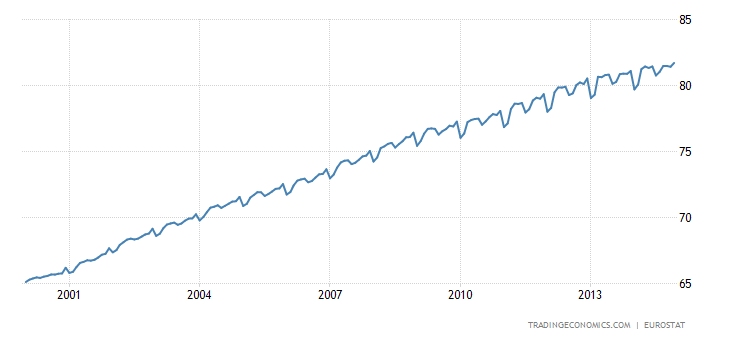
Historical Data Chart

Self-evidently, the current brief interval of inflation slowdown has happened before. So what has occurred during recent months cannot be described as some deeply embedded structural condition that changes the whole course of economic life.

In fact, what possible explanation do the Keynesian money printers have for what they imply to be an economic disease that could be called SODS (sudden onset deflation syndrome). That notion is empirically false as shown above, but by their lights where did it come from all of a sudden? The overwhelming driving force in financial markets and worldwide economies during the past few years has been the ultra-stimulative, “unconventional” monetary policies.  No one disputes that—especially the fast money traders who rightly insist that its always and everywhere about the Fed.

Certainly, the monetary politburo in the Eccles Building would never agree that ZIRP and QE are responsible for deflation. So, it must be some kind of horror show dead hand from the grave—-a relapse of the financial crisis contagion. But of course they never explained where that came from, either.

Well, they did say that central bank policy had nothing to do with it. Not even Greenspan’s desperate slashing of money market rates to an unprecedented 1% in the spring of 2003 had anything to do with the explosion of variable rate mortgages and the “refi” stampede. The latter resulted in gross mortgage originations at a $5 trillion annual rate compared to historic originations in the $1 trillion range, and provided the catalyst for the housing price explosion and mortgage equity withdrawal (MEW) based consumption boom which followed.

Nope, it was all greed and animal spirits getting too frisky. Why that keeps happening after periods of extreme central bank stimulus and Wall Street coddling, they don’t say.  Likewise, now we have “deflation” suddenly welling up among the masses on main street. The latter are held to be reluctant to spend, thereby causing inflation to weaken and the spending impulse to consequently falter even more.

This outbreak also remains unexplained, but the cure is the same: More monetary accommodation which means that ZIRP and N-ZIRP (“near ZIRP” or trivial increases in the target rate after ZIRP is officially lapsed) must be extended as far as the eye can see.

All of this is empirical nonsense, of course. In fact, its a blatant con game. The only reason that there is an appearance of a troublesome “inflation shortfall” is that recent rates have been below the arbitrary 2% “policy” target that has been set by Keynesian central bankers all around the world.

Moreover, when this 2% target is taken with such literalistic rigor as to rival creationist doctrine regarding the scriptures, it can make trivial differences appear profound; and to cry out for new forms of policy action—which is what the monetary central planners are actually all about.

In fact, there is no proof anywhere that 2% inflation on the CPI enables extra GDP growth. It’s just a flat-out invention of the monetary scholastics who have seized control of the world’s financial system.

The truth is, the 50% gap between 2% and 1% inflation is a distinction without a meaningful difference. Indeed, there is no difference at all when it comes to the fundamentals of true economic growth and wealth creation—-except that higher inflation is always slightly worse. Yet due to the unquestioned status of the 2% inflation target, the central banks are getting a free pass in the public debate.

In fact, it is worse than that.  They are being postured by their public relations firms in the financial press as fireman at the ready to remedy the very problems they have previously created. Thus, Hilsenrath & Blackstone note,

….fresh signs of slow global economic growth, falling commodities prices, sagging stock markets and declining bond yields…… suggest the deflation risk hasn’t gone away…

Com’on. The welcome decline in oil prices and other commodities that is currently helping to ease the inflation indices is not anything bad that needs to be combatted. It represents an overdue cooling of the 14-year global commodity boom that the combined central banks of the world have stimulated through their massive support for artificial economic growth fueled by cheap credit; and by the free money induced transformation of commodities into still another speculative asset class.

Here is the major commodity index. Since 2000 it has risen at a 8% annual rate—-a trend that could never be sustained under a regime of sound money and disciplined credit management.  And now that the world economy has reached the maximum extent of the central bank enabled boom and has begun to falter, the Fed’s PR men are out flogging a new mission. That is, for the central banks to arrest the dangerous collapse of global commodity prices.

It puts you in mind of the boy who killed his parents and then threw himself on the mercy of the court because he was an orphan.


So here’s the real reason the nonsense of 2% inflation targeting and the specter of deflation is being fed to the compliant financial press by the policy apparatchiks running the central banks, IMF and the major nation treasury departments. In a word, governments have buried themselves in debt, and are desperate for an excuse to inflate away the real burden.

Euro Area Government Debt to GDP

So they have invented the Big Lie of the present era. Namely, that the cause of low growth is “low-flation”. And the simplistic arithmetic behind this false proposition is a wonder to behold.  In the case of the Euro-zone, for instance, real growth has been registering at less than 1% per year and with inflation in the same zone, nominal GDP is hardly growing at all.

Yet public debt continues to soar and there is no political will to stop it outside of Germany. Already the EC fiscal compact agreed to two years ago is being cast aside because it is inconvenient for the socialist politicians and opportunists who run France and Italy, in particular, but most of the balance of the EC as well.

So the financial policy elite has invented a “twofer”. Get inflation above 2% and, presto, growth will rebound to the 2-3% zone of Keynesian “potential GDP” growth. Soon enough, the public debt/GDP ratios will stop rising and all will be well.

Indeed, the data for Italy shows the real scam behind the deflation scare in spades.  Its nominal GDP has been essentially flat for seven year running, yet is public debt has continued to rise inexorably. In a word, it is buried in a debt trap.

Moreover, Italy is only an advanced case of the universal condition in the DM economies. Stated differently, the specter of deflation is not about economic analysis or honest monetary policy options. Its just a cover story for an intended fraudulent default on public debt of monumental proportions.

Historical Data Chart

Historical Data Chart

The fly in the ointment, however, is that this inflationary default scheme can never work.  Central banks have buried the world in massive malinvestment and unsustainable credit fueled growth that will eventually collapse. So a classic hyper-inflation will never break-out because there is too much capacity in the world economy to permit labor, commodity and industrial prices to explode.

At the end of the day, the central banks can’t levitate inflation, and they surely cannot cause production, enterprise and labor productivity on the supply side of the economy to accelerate by sloshing N-ZIRP liquidity through the money markets. The latter impossibility is already proven by the anemic recovery in the US and the triple dip now enveloping Europe.

In fact, bringing the monetary firemen in to douse with more kerosene the massive financial fires they have already started would only defer the day or reckoning–if even that. It would just mean that the financial casinos of the world would be given one more round of speculative juice, thereby inflating asset values to an even more dangerous extreme.

Some evidence for that proposition seems to be extant in the modest financial turbulence incepting even now.


via Zero Hedge http://ift.tt/1F7dMp2 Tyler Durden

Cop in Milwaukee Fired After Shooting Unarmed Mentally Ill Man 14 Times; Could Get Job Back

Christopher ManneySix
months after Officer Christopher Manney shot and killed an unarmed
Dontre Hamilton, the officer’s been fired by the Milwaukee Police
Department for, the police chief Edward Flynn says, instigating the
fight that ended with Hamilton being shot at 14 times.

“There’s got to be a way for us to hold ourselves accountable
absent putting cops in jail for making mistakes,” Flynn said,
saying Manney shouldn’t have tried to frisk Hamilton just because
he seemed mentally ill but that he didn’t think there was any
“malice” involved in the shooting.

Flynn’s decision was based on an internal affairs review but
other investigations are continuing. The Associated Press
reports
:

Hamilton’s family has said he was diagnosed with schizophrenia
but was not violent, and they doubt he struck Manney. They called
Wednesday for police to release photographs documenting the
officer’s injuries. They also said that while the firing was “a
victory,” they would continue to lead and participate in marches in
an effort to persuade the district attorney to bring criminal
charges.

“Yes, he was fired, but he took a man’s life,” Hamilton’s
mother, Maria, said during a separate news conference.

While the A.P. reports about the independent investigation
required under a new state law in the past tense, the results of
that investigation have not yet been released. The father of a
previous Wisconsin police shooting victim
used
a portion of his settlement to lobby for the law.

Unfortunately, Milwaukee TV station WISN
reports
that a number of the “outside” investigators working
for the state are retired Milwaukee Police Department
employees.

The Milwaukee police union protested Manney’s firing. Cops fired
in Milwaukee have gotten their jobs back
before
thanks to the police bill of rights.

from Hit & Run http://ift.tt/1vjVwoi
via IFTTT

Washington D.C. Is Now The Most Expensive Place To Live In The US

Submitted by Mike Krieger of Liberty Blitzkrieg blog,

There is no greater signpost of the decay in America’s cultural, economic and spiritual life than Washington D.C.’s ascendancy into the most expensive spot to live in within these United States.

Yes, according to a recent government study, the nation’s capital is even more expensive than New York City, ground zero for America’s most unscrupulous banking criminals, as well as San Francisco, the epicenter of the latest tech venture capital binge. This is extraordinarily disturbing, considering the primary products created in the D.C. area consist of death, destruction, criminality, propaganda and lies. In a nation in which the primary driver of GDP growth has become fraud, I suppose this shouldn’t be that surprising.

The Washington Post noted the following:

The Washington region ranks as the most expensive place to live in the country, ahead of the pricey markets of New York and San Francisco, according to a government study.


The surprising statistic comes from a Bureau of Labor Statistics report that shows that — on average — Washingtonians spend more on housing and related expenses (utilities, furnishings and equipment) than New Yorkers and San Franciscans.


Screen Shot 2014-10-14 at 10.48.32 AM

Naturally, this trend has been in the works for a long time. Last year, I posted an article titled, How Washington D.C. is Sucking the Life Out of America. Here are a few excerpts:

At the same time, big companies realized that a few million spent shaping legislation could produce windfall profits. They nearly doubled the cash they poured into the capital.


During the past decade, the region added 21,000 households in the nation’s top 1 percent. No other metro area came close.


At the peak in 2010, companies based in Rep. James Moran’s congressional district in Northern Virginia reaped $43 billion in federal contracts — roughly as much as the state of Texas.


The number of lawyers in the D.C. metro area increased by a third from 2000 to 2012, nearly twice as fast as the growth rate nationwide.

We have become a nation that rewards and celebrates thieving parasites. It needs to end, or we will destroy ourselves completely.

You may also be interested in this post from 2012: 70% of the Wealthiest Counties in America are in the Washington D.C. Area.


via Zero Hedge http://ift.tt/1F6SLuD Tyler Durden