Europe On Triple-Dip Alert After German Manufacturing Posts First Contraction In 15 Months

If the European triple-dip alert was barely glowing a muted red until this morning, then following the latest German PMI data, which tumbled to 49.9 from 50.3, below the 50.3 consensus, and is the first contractionary print in 15 months, then they are now screaming a bright burgundy. And while the European recession has now clearly made its way to the core, it wasn’t just Germany: French PMI continued to be solidly in a contracting phase, at 48.8, unchanged from the previous month, the overall European Manufacturing PMI also missed and declined, dropping from a flash reading 50.5 to only 50.3, which was a 14 month low, with the average PMI reading for Q3 the lowest since a year ago, and as MarkIt summarized, Eurozone manufacturing edges closer to stagnation.” Have no fear, though, Mario Draghi and his monetization of Greek Junk Bonds will fix everything!

Finally, not helping matters was the UK PMI which too tumbled from 52.5 (revised lower to 52.2) to 51.6, far below the 52.7 expected increase, and the lowest print since April 2013.

In other words, the world’s central bankers, except the Fed for now of course, have been given the MarkIt green stamp of approval to do what has so far failed to do anything to boost the global economy on a sustained basis: CTRL-P.

The full breakdown of today’s European manufacturing data:


Here is what a German triple dip looks like:


And a European triple-dip:


Not even PMI could spin the data in a favorable light. Here is what Oliver Kolodseike said:

“September’s manufacturing PMI results paint a worrying picture of the health of Germany’s goods-producing sector. The headline PMI fell to its lowest level in 15 months, heavily weighed down by the sharpest drop in new orders since the end of 2012. Surveyed companies reported that a weakening economic environment, Russian sanctions and subdued growth in key export destinations were reasons behind the disappointing reading.


“Moreover, deflationary pressures persisted into September, with both input and output prices falling since the previous month. This was the first time since March that both price indices registered below the neutral 50.0 mark.


“On a positive note, September marked an end to a three-month period of job cuts, and despite declining order intakes, companies reported further  (albeit weaker) production growth and a marginal rise in buying activity.”

And Europe in general, from MarkIt’s Chris Williamson. Sorry, recovery fanatics. Not this time (again).

“September’s eurozone PMI makes for gloomy reading. The euro area’s manufacturing economy has lost the growth momentum seen earlier in the year, lurching closer to stagnation. The near-term outlook also looks worrying. Order books are now deteriorating for the first time since June of last year, suggesting output could start to fall as we move into the final quarter of the year.


“Not surprisingly, firms are focusing on cost-cutting, resulting in an ongoing lack of job creation and sending a depressing signal of little hope for any reduction in the region’s near-record unemployment rate.


“Companies are also cutting prices at the expense of profit margins as they strive to boost sales. In a sign of spreading deflationary pressures, prices fell in all countries surveyed for the first time in over a year.


“In a sign of spreading economic malaise, Germany, Austria and Greece all joined France in reporting manufacturing downturns in September. What’s especially perturbing is that Germany’s PMI fell into contraction for the first time since June of last year, suggesting the region’s northern industrial heartland has succumbed to the various headwinds of weak demand within the euro area, falling business and consumer confidence, waning exports due  to the Ukraine crisis and Russian sanctions.


“The weakening manufacturing sector will intensify pressure on the ECB to do more to revive the economy and no doubt strengthen calls for full-scale quantitative easing. Many will hope that this week’s policy meeting will at least show a determination to address the slowdown with details of an aggressive ABS and covered bond purchase programme.”

So, one would think this is bad news for Europe right? Well, moments ago Germany just priced it first ever 10 year Bund Auction at a yield of below 1.0%, or 0.93% on average. This happened even as the Bit To Cover was 1.1, well below 1.4, and meaning the auction was once again technically uncovered, meaning that the Bundesbank had to step in and make sure there is enough demand. Which at a record low yield and an economy entering a triple-dip, almost makes sense.


via Zero Hedge http://ift.tt/1xAHIri Tyler Durden

Brickbat: Uh Oh, SpaghettiOs

The Hall County,
Georgia, district attorney’s office has dropped a possession
of meth
 charge against Ashley Gabrielle Huff. A
Gainesville police officer had stopped an SUV that Huff was a
passenger in for  a tag light violation. The officer obtained
permission to search the vehicle and found a spoon that had some
sort of residue on it. A field test indicated it was meth, but the
lab results later showed no controlled substances on the spoon.
Huff says the residue was from SpaghettiOs.

from Hit & Run http://ift.tt/1v4alIQ
via IFTTT

The “Sexy” Facts about Debt Markets

By: Chris Tell at http://ift.tt/146186R

Like a bad case of hemorrhoids, debt is a topic too often left out of polite conversation. It’s a good thing then that you don’t come here for polite conversation. It is a topic previously written about in these pages and one which has the power to keep me awake at nights when I really ought to be doing other things.

In our quest to clearly understand debt around this ball of dirt we call home, how it impacts us, if it impacts us and what it all means we’ve had our team put together a comprehensive report on the topic. The report itself is completed and currently with a gentleman who takes our analytical work, adds some witchcraft and makes it look readable after I’ve finished with it. As soon as we receive this ergonomically designed masterpiece, readers will find it magically appear in their inbox. If you’re not a subscriber then, for goodness sakes, sign up here NOW.

Littering my desktop like paper bags on a Nairobi highway are dozens of graphs, the remnants of this debt report. I thought therefore I’d take some of the scraps and provide readers with a short sampling of what is really a visual ice bath.

Earlier this year the Bank of International Settlements said in its annual report that debt ratios in the developed economies have grown by 20 percentage points to 275 percent of GDP since the beginning of the global financial crisis. Albeit not as severe, the trend is similar in the emerging economies where debt ratios have grown with the same pace to 175 percent of GDP, thanks to the spillover effect of central bankers in the developed world testing their limits with low interest rate policies.

Debt Levels Continue to Rise

The Bank warned that global debt levels could trigger another Lehman-style crisis, calling continued debt accumulation over successive business and financial cycles as the root (rather than the solution) of the problem.

The symptom, however, goes way back than just 2007. As you can see in the charts below (taken from the Wall Street Journal), both public and private debt levels have been expanding since the early 90s.

Debt Levels in 1990

Debt Levels in 2012

With interest rates trending downwards for the past 30 years and eventually hitting rock bottom in late 2008, it is no wonder that the global debt levels have swollen to 200 year highs. Yep, 200 year highs!

US Interest Rate Chart

Although the chart above only shows the US rates, the situation is similar all across the globe.

It looks like the central bankers of the world have painted themselves into corner. Growing mountain of debt makes it harder for economies to grow at higher interest rates, hence forcing central banks into a downward spiral of record low rates and monetary stimulus that simply encourages more borrowing and worsening the underlying problem – what the BIS calls “a debt trap” where low rates essentially validate themselves.

Just a few weeks ago Spain, one of the Europe’s ailing economies, issued a 50-year bond at a mere 4 percent rate. This is Spain for God’s sake. They’re broke!

There are some truly crushing debt burdens lurking in full view right here and now. Debts which cannot be repaid and will not be repaid!

Personally I tend to keep on top of this sort of information but I’ll be honest with you when I say that what our analysts have put together scared even me, and here I was under the illusion that I was adequately informed. We believe it is vital for every investor to keep an eye on those markets.

Subscribers will have the report within the next few days. Sign up here if you’re not subscribed already.

– Chris


“Blessed are the young for they shall inherit the national debt.” – Herbert Hoover


via Zero Hedge http://ift.tt/1uAxmXp Capitalist Exploits

The "Sexy" Facts about Debt Markets

By: Chris Tell at http://ift.tt/146186R

Like a bad case of hemorrhoids, debt is a topic too often left out of polite conversation. It’s a good thing then that you don’t come here for polite conversation. It is a topic previously written about in these pages and one which has the power to keep me awake at nights when I really ought to be doing other things.

In our quest to clearly understand debt around this ball of dirt we call home, how it impacts us, if it impacts us and what it all means we’ve had our team put together a comprehensive report on the topic. The report itself is completed and currently with a gentleman who takes our analytical work, adds some witchcraft and makes it look readable after I’ve finished with it. As soon as we receive this ergonomically designed masterpiece, readers will find it magically appear in their inbox. If you’re not a subscriber then, for goodness sakes, sign up here NOW.

Littering my desktop like paper bags on a Nairobi highway are dozens of graphs, the remnants of this debt report. I thought therefore I’d take some of the scraps and provide readers with a short sampling of what is really a visual ice bath.

Earlier this year the Bank of International Settlements said in its annual report that debt ratios in the developed economies have grown by 20 percentage points to 275 percent of GDP since the beginning of the global financial crisis. Albeit not as severe, the trend is similar in the emerging economies where debt ratios have grown with the same pace to 175 percent of GDP, thanks to the spillover effect of central bankers in the developed world testing their limits with low interest rate policies.

Debt Levels Continue to Rise

The Bank warned that global debt levels could trigger another Lehman-style crisis, calling continued debt accumulation over successive business and financial cycles as the root (rather than the solution) of the problem.

The symptom, however, goes way back than just 2007. As you can see in the charts below (taken from the Wall Street Journal), both public and private debt levels have been expanding since the early 90s.

Debt Levels in 1990

Debt Levels in 2012

With interest rates trending downwards for the past 30 years and eventually hitting rock bottom in late 2008, it is no wonder that the global debt levels have swollen to 200 year highs. Yep, 200 year highs!

US Interest Rate Chart

Although the chart above only shows the US rates, the situation is similar all across the globe.

It looks like the central bankers of the world have painted themselves into corner. Growing mountain of debt makes it harder for economies to grow at higher interest rates, hence forcing central banks into a downward spiral of record low rates and monetary stimulus that simply encourages more borrowing and worsening the underlying problem – what the BIS calls “a debt trap” where low rates essentially validate themselves.

Just a few weeks ago Spain, one of the Europe’s ailing economies, issued a 50-year bond at a mere 4 percent rate. This is Spain for God’s sake. They’re broke!

There are some truly crushing debt burdens lurking in full view right here and now. Debts which cannot be repaid and will not be repaid!

Personally I tend to keep on top of this sort of information but I’ll be honest with you when I say that what our analysts have put together scared even me, and here I was under the illusion that I was adequately informed. We believe it is vital for every investor to keep an eye on those markets.

Subscribers will have the report within the next few days. Sign up here if you’re not subscribed already.

– Chris


“Blessed are the young for they shall inherit the national debt.” – Herbert Hoover


via Zero Hedge http://ift.tt/1uAxmXp Capitalist Exploits

Is the U.S. Secretly Egging On Hong Kong Protesters?

The mass demonstrations in Hong Kong are dramatic, indeed. And given that Hong Kong has long enjoyed a more liberal existence under British rule, protests against a more authoritarian Chinese government (at least it used to be more authoritarian) are not entirely surprising.

But Chinese officials accuse the U.S. of egging on the protests.  As the Wall Street Journal’s China Real Time blog reports:

On Thursday, Wen Wei Po published an “expose” into what it described as the U.S. connections of Joshua Wong, the 17 year-old leader of student group Scholarism.


The story asserts that “U.S. forces” identified Mr. Wong’s potential three years ago, and have worked since then to cultivate him as a “political superstar.”


Evidence for Mr. Wong’s close ties to the U.S. that the paper cited included what the report described as frequent meetings with U.S. consulate personnel in Hong Kong and covert donations from Americans to Mr. Wong. As evidence, the paper cited photographs leaked by “netizens.” The story also said Mr. Wong’s family visited Macau in 2011 at the invitation of the American Chamber of Commerce, where they stayed at the “U.S.-owned” Venetian Macao, which is owned by Las Vegas Sands Corp.


***


This isn’t the first time that Beijing-friendly media have accused foreign countries of covert meddling in the former British colony. China’s government has long been concerned that Western intelligence agencies might try to exploit the city’s relatively more open political environment to push democracy in the rest of the country. The various “color revolutions” that ushered in democratic governments across the former Soviet Union in the early 2000s, and which were partly organized by foreign-funded NGOs, heightened those concerns.


Allegations of foreign intervention in Hong Kong have become particularly intense in the run-up to 2017, the earliest that Beijing has said Hong Kong residents can begin to directly elect their leaders. Wen Wei Po and another Beijing-leaning Hong Kong newspaper Ta Kung Pao, for example, have accused the U.K. of stationing British spies across Hong Kong institutions. Pro-Beijing publications have also accused Hong Kong media mogul and staunch Beijing critic Jimmy Lai of having connections with the CIA. Mr. Lai is the founder of Next Media Ltd., which owns the Apple Daily newspapers in Taiwan and Hong Kong, and is a major donor to pro-democracy groups in Hong Kong.


In its report on Mr. Wang, Wen Wei Po said that the U.S. Central Intelligence Agency is making a pointed effort to infiltrate Hong Kong schools, for example through the Hong Kong-America Center, a group headed by former U.S. diplomat Morton Holbrook that promotes H.K.-U.S. ties. It also alleged that the CIA is actively training a new generation of protest leaders in Hong Kong through sponsoring students to study in the U.S., with an aim of stoking future “color revolutions” in the city.

Tony Cartalucci writes:

Behind the so-called “Occupy Central” protests … is a deep and insidious network of foreign financial, political, and media support. Prominent among them is the US State Department and its National Endowment for Democracy (NED) as well as NED’s subsidiary, the National Democratic Institute (NDI).


Now, the US has taken a much more overt stance in supporting the chaos their own manipulative networks have prepared and are now orchestrating. The White House has now officially backed “Occupy Central.” Reuters in its article, “White House Shows Support For Aspirations Of Hong Kong People,” would claim:

The White House is watching democracy protests in Hong Kong closely and supports the “aspirations of the Hong Kong people,” White House spokesman Josh Earnest said on Monday. “

The United States supports universal suffrage in Hong Kong in accordance with the Basic Law and we support the aspirations of the Hong Kong people,” said Earnest, who also urged restraint on both sides.

US State Department Has Built Up and Directs “Occupy Central”

Image: The US through NED and its subsidiaries have a long history of
promoting subversion and division within China. 


Earnest’s comments are verbatim the demands of “Occupy Central” protest leaders, but more importantly, verbatim the long-laid designs the US State Department’s NDI articulates on its own webpage dedicated to its ongoing meddling in Hong Kong. The term “universal suffrage”and reference to “Basic Law” and its “interpretation” to mean “genuine democracy” is stated clearly on NDI’s website which claims:

The Basic Law put in place a framework of governance, whereby special interest groups, or “functional constituencies,” maintain half of the seats in the Legislative Council (LegCo). At present, Hong Kong’s chief executive is also chosen by an undemocratically selected committee. According to the language of the Basic Law, however, “universal suffrage” is the “ultimate aim.” While “universal suffrage” remains undefined in the law, Hong Kong citizens have interpreted it to mean genuine democracy.

To push this agenda – which essentially is to prevent Beijing from vetting candidates running for office in Hong Kong, thus opening the door to politicians openly backed, funded, and directed by the US State Department – NDI lists an array of ongoing meddling it is carrying out on the island. It states:

Since 1997, NDI has conducted a series of missions to Hong Kong to consider the development of Hong Kong’s “post-reversion” election framework, the status of autonomy, rule of law and civil liberties under Chinese sovereignty, and the prospects for, and challenges to democratization.

It also claims:

In 2005, NDI initiated a six-month young political leaders program focused on training a group of rising party and political group members in political communications skills.

And:

NDI has also worked to bring political parties, government leaders and civil society actors together in public forums to discuss political party development, the role of parties in Hong Kong and political reform. In 2012, for example, a conference by Hong Kong think tank SynergyNet supported by NDI featured panelists from parties across the ideological spectrum and explored how adopting a system of coalition government might lead to a more responsive legislative process.

NDI also admits it has created, funded, and backed other organizations operating in Hong Kong toward achieving the US State Department’s goals of subverting Beijing’s control over the island:

In 2007, the Institute launched a women’s political participation program that worked with the Women’s Political Participation Network (WPPN) and the Hong Kong Federation of Women’s Centres (HKFWC) to enhance women’s participation in policy-making, encourage increased participation in politics and ensure that women’s issues are taken into account in the policy-making process.

And on a separate page, NDI describes programs it is conducting with the University of Hong Kong to achieve its agenda:

The Centre for Comparative and Public Law (CCPL) at the University of Hong Kong, with support from NDI, is working to amplify citizens’ voices in that consultation process by creating Design Democracy Hong Kong (http://ift.tt/1wWIVpZ), a unique and neutral website that gives citizens a place to discuss the future of Hong Kong’s electoral system.

It should be no surprise to readers then, to find out each and every “Occupy Central” leader is either directly linked to the US State Department, NED, and NDI, or involved in one of NDI’s many schemes.

Image: Benny Tai, “Occupy Central’s” leader, has spent years associated with
and benefiting from US State Department cash and support.

“Occupy Central’s” self-proclaimed leader, Benny Tai, is a law professor at the aforementioned University of Hong Kong and a regular collaborator with the NDI-funded CCPL. In 2006-2007 (annual report, .pdf) he was named as a board member – a position he has held until at least as recently as last year. In CCPL’s 2011-2013 annual report (.pdf), NDI is listed as having provided funding to the organization to “design and implement an online Models of Universal Suffrage portal where the general public can discuss and provide feedback and ideas on which method of universal suffrage is most suitable for Hong Kong.”


Curiously, in CCPL’s most recent annual report for 2013-2014 (.pdf), Tai is not listed as a board member. However, he is listed as participating in at least 3 conferences organized by CCPL, and as heading at least one of CCPL’s projects. At least one conference has him speaking side-by-side another prominent “Occupy Central” figure, Audrey Eu. The 2013-2014 annual report also lists NDI as funding CCPL’s “Design Democracy Hong Kong” website.


Civic Party chairwoman Audrey Eu Yuet-mee, in addition to speaking at CCPL-NDI functions side-by-side with Benny Tai, is entwined with the US State Department and its NDI elsewhere. She regularly attends forums sponsored by NED and its subsidiary NDI. In 2009 she was a featured speaker at an NDI sponsored public policy forum hosted by “SynergyNet,” also funded by NDI. In 2012 she was a guest speaker at the NDI-funded Women’s Centre “International Women’s Day” event, hosted by the Hong Kong Council of Women (HKCW) which is also annually funded by the NDI.

Image: Martin Lee and Anson Chan belly up to the table with US Vice President Joseph Biden in Washington DC earlier this year. During their trip, both Lee and Chan would attend a NED-hosted talk about the future of “democracy” in Hong Kong. Undoubtedly, “Occupy Central” and Washington’s support of it was a topic reserved for behind closed doors.


There is also Martin Lee, founding chairman of Hong Kong’s Democrat Party and another prominent figure who has come out in support of “Occupy Central.” Just this year, Lee was in Washington meeting directly with US Vice President Joseph Biden, US Congresswoman Nancy Pelosi, and even took part in an NED talk hosted specifically for him and his agenda of “democracy” in Hong Kong. Lee even has a NED page dedicated to him after he was awarded in 1997 NED’s “Democracy Award.” With him in Washington was Anson Chan, another prominent figure currently supporting the ongoing unrest in Hong Kong’s streets.

The U.S. has certainly promoted regime change worldwide, often by using non-governmental organizations as front groups to funnel money to dissidents who will overthrow the government.

For example, USAID has been called the “new CIA”, and FBI whistleblower Sibel Edmonds told Washington’s Blog that the U.S. State Department is involved in many “hard power” operations, often coordinating through well-known “Non-Governmental Organizations” (NGOs).    Specifically, Edmonds explained that numerous well-known NGOs – which claim to focus on development, birth control, women’s rights, fighting oppression and other “magnif
icent sounding” purposes or seemingly benign issues – act as covers for State Department operations. She said that the State Department directly places operatives inside the NGOs.

Edmonds also told us that – during the late 90s and early 2000s – perhaps 30-40% of the people working for NGOs operated by George Soros were actually working for the U.S. State Department.

If this all sounds too nutty, remember that historians say that declining empires tend to attack their rising rivals … so the risk of world war is rising because the U.S. feels threatened by the rising empire of China.

The U.S. government considers economic rivalry to be a basis for war. And the U.S. is systematically using the military to contain China’s growing economic influence.

And U.S. sanctions against Russia are not having the desired effect … largely because China is picking up the slack by trading with Russia and even loaning it money.

Indeed, China, Russia, India and Brazil have formed what some top economists say is an alternative to the Western financial institutions, the World Bank and IMF. And China is challenging the petrodollar.

So it’s not beyond the realm of possibility that the U.S. (and the former owner of Hong Kong, Britain) egged on democracy protesters in Hong Kong in order to try to shake up the Chinese regime.


via Zero Hedge http://ift.tt/1mODOHC George Washington

RX For Revisionist Bunkum: A Lehman Bailout Wouldn’t Have Saved The Economy

Submitted by David Stockman via Contra Corner blog,

Here come the revisionists with new malarkey about the 2008 financial crisis. No less august a forum than the New York Times today carries a front page piece by journeyman financial reporter James Stewart suggesting that Lehman Brothers was solvent; could and should have been bailed out; and that the entire trauma of the financial crisis and Great Recession might have been avoided or substantially mitigated:

What happened that September was the culmination of circumstances reaching back years – of ordinary people too eager to borrow, of banks too eager to lend and of Wall Street financial engineers reaping multimillion-dollar bonuses. Even so, saving Lehman from complete collapse might have shielded the economy from what turned out to be a crippling blow.

That is not just meretricious nonsense; its a measure of how thoroughly corrupted public discourse about the fundamental financial and economic realities of the present era has become owing to the cult of central banking. For crying out loud, yes, there would have been a Great Recession – even had Lehman been pawned off to Barclays with a taxpayer guarantee or if it had been bailed-out in some other manner.

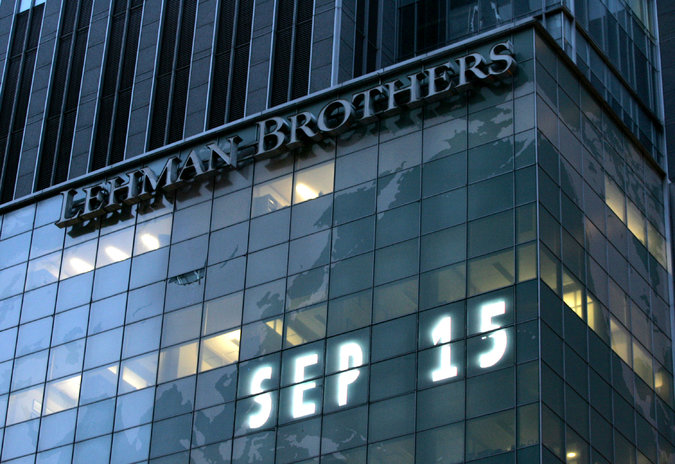
In fact, the Barclay’s logo did end up on Lehman’s 7th Avenue glass tower shortly after the September 15th screen shot below. Yet the decision to allow Lehman’s stock and bondholders to take a severe haircut first did not cause the thundering collapse of the housing and credit markets, nor the loss of the artificially bloated level of consumption spending, jobs and income that had accompanied the giant financial bubble that finally burst in September 2008.
The villain is the Greenspan Fed and the rampage of debt and speculation its cheap money and “wealth effects” coddling of Wall Street had engendered over the previous two decades. When Greenspan took office in 1987, total credit market debt outstanding was $10.5 trillion, but by the time of the Lehman event it was nearly $53 trillion. This means that the debt burden on the US economy had soared by 5X during a period when nominal GDP grew by only 2.9X. That’s called leveraging up big time—–and it fueled a party of consumption and speculation like the nation had not experienced since the 1920s, or even then.


Moreover, within the household sector the explosion of debt was even more stunning owing to the Greenspan policies of cheap mortgage rates and the overt encouragement of American families to raid their home ATM machines. As shown below, household debt ballooned from just $2.7 trillion when Greenspan took charge of the Eccles Building in August 1987 to nearly $14 trillion on the eve of the crisis.


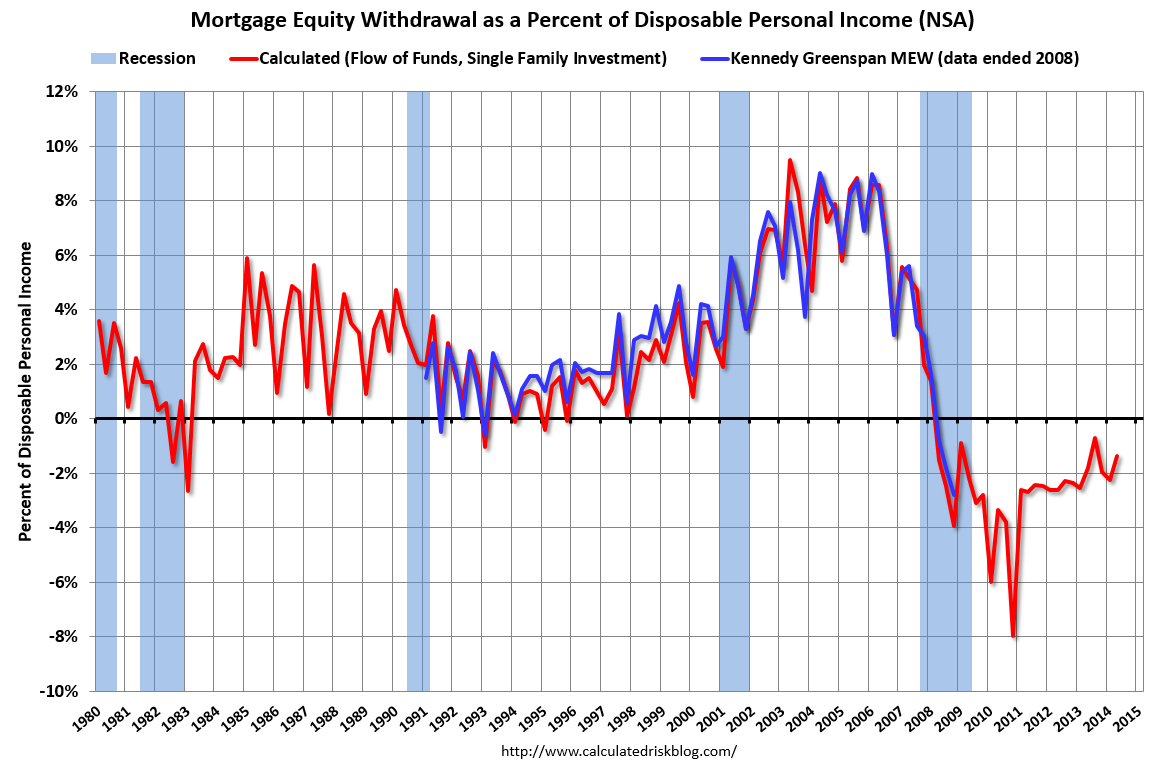
And there can be little doubt as to what explains the above mountain of household debt. American households were raiding their home ATM machines – that is, cashing out the equity in their homes – in order to indulge in a massive orgy of consumption spending that they had not earned. In fact, at the peak in 2005-2007, households were extracting cash from their ATMs at nearly a $1 trillion annual rate, ballooning their disposable incomes by upwards of 8%. That is, they were buying flat screen TVs, granite top kitchen counters, restaurant dinners and trips to the mall with money they hadn’t earned, and based on rapidly rising leverage ratios that couldn’t be sustained.

What caused the Great Recession, therefore, was the day of reckoning when the household borrowing mania reached its limit. As shown below, the swing in household spending funded by withdrawals from home ATM machines was massive and violent. At its peak extent between 2006 and 2010 – it amounted to a reversal of nearly $1.4 trillion. Yes, when a gigantic, artificial spending bubble of this magnitude is pricked, the repercussions do cascade through the main street economy taking down sales, jobs and incomes as they go.

Accordingly, the chart below explains the Great Recession, not some revisionist gumming from the bowels of the New York Fed as to how the economy could have been “saved” if only Tiny Tim Geithner had gotten the word on Sunday evening September 14th that Lehman was “solvent” after all. In fact, the name on the glass tower above had nothing to do with the crash of household borrowing at upwards of 30 million home ATMs depicted in the graph below.
Moreover, what caused the recession to be so painful and deep is that the phony prosperity of the Greenspan era could no longer be fueled by pushing households deeper into debt. By the fall of 2008, “peak debt” had been reached in the household sector, and a modest deleveraging was begun owning to upwards of $1 trillion in mortgage defaults. But this wasn’t a recoverable loss of “aggregate demand”  per the Keynesian mantra at the Bernanke Fed. The US economy was drastically squeezed by the Great Recession because artificial mortgage fueled spending was being liquidated all across America, not because punters in Lehman stock and bonds lost their shirts, and deservedly so.
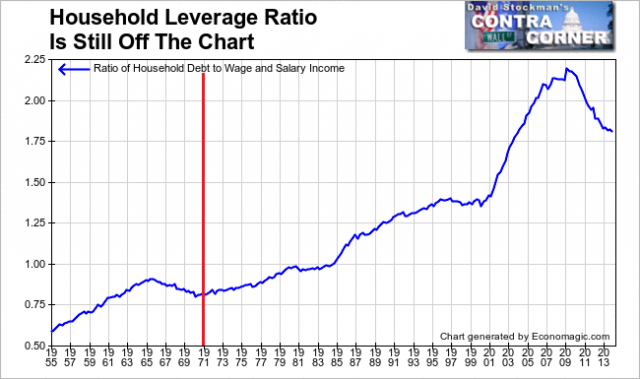
 

Household Leverage Ratio - Click to enlarge


In short, the Great Recession was about the abrupt end of the great financial party conducted by the Maestro. During his 19 year reign, the nation underwent a collective LBO, raising it leverage ratio from a historically sound and sustainable 1.5X national income to 3.5X on the eve of the Lehman collapse. Those two extra turns of debt amounted to $30 trillion at the time the US economy buckled in 2008; they were a measure of both the folly of the Greenspan/Bernanke spending party that had been financed by the Fed’s cheap money policies, and the enormity of the adjustment that was brought to bear on the US economy when the bubble finally collapsed.


Not surprisingly, upwards of $12 trillion in household wealth was destroyed by the financial crisis and the deep recession which followed. But given the enormous inflation of housing prices and risk asset values which had been driven by the debt bubble, it is ludicrous to suggest that save for not saving Lehman, the housing crash pictured below would not have happened. In fact, between late 1994 and early 2006 home prices in America rose each and every month for about 125 straight months, rising by nearly 140% over the period.
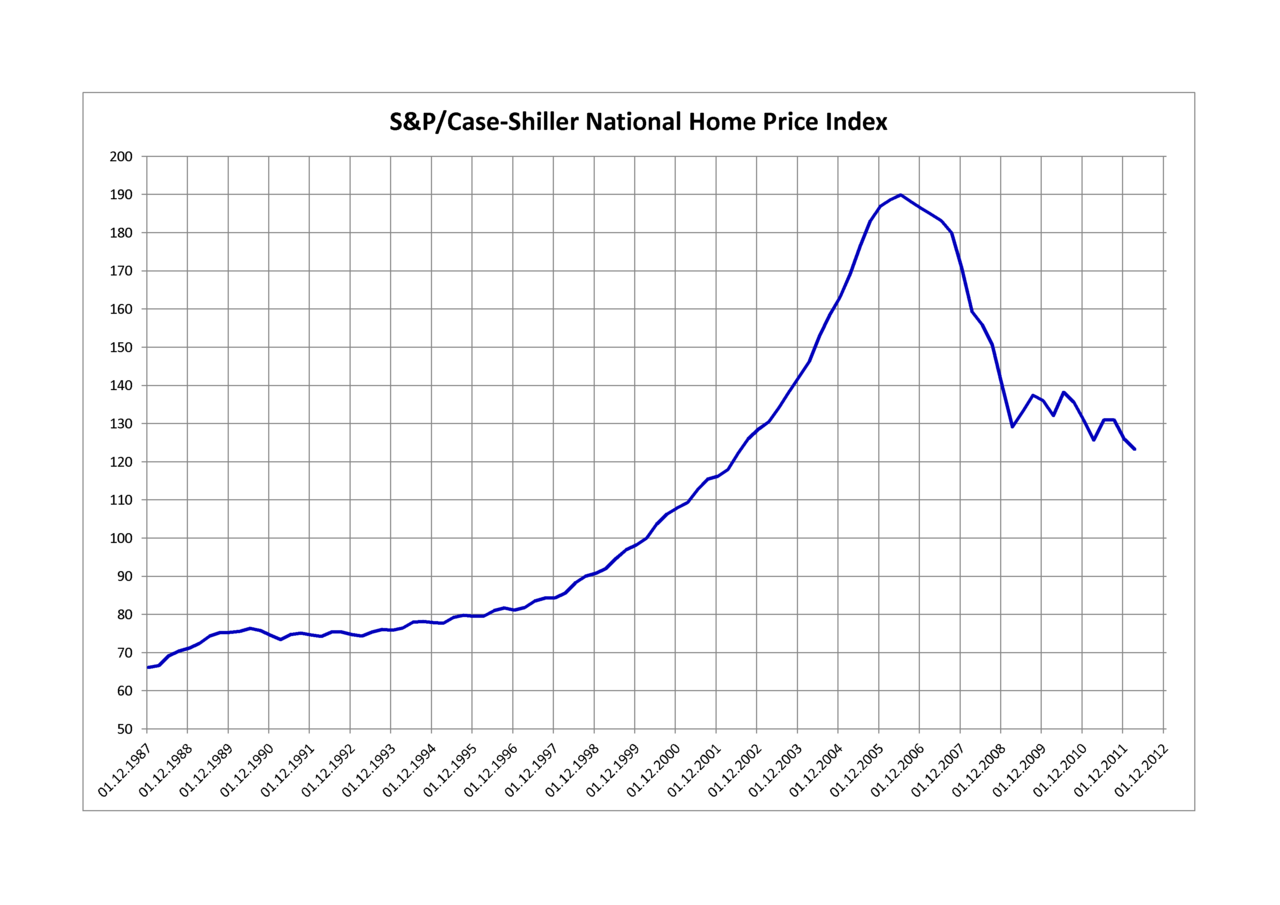
 

Needless to say, the above wasn’t sustainable and didn’t reflect either the free market at work or greed running rampant in the towns and cities of America. It was the cheap money and Wall Street coddling policies of the Fed which generated the housing binge, and the gambling hall known as Lehman Brothers that had gone along for the ride.

It is therefore especially misfortunate that mainstream journalists like Stewart take up the revisionist line that Lehman was “solvent”, and that a great mistake was made in not throwing it a life line. Well, it just doesn’t fricking matter whether it was “solvent”.  It was self-evidently illiquid because it – like the rest of Wall Street – had funded tens of billions of illiquid, opaque and drastically over-valued long-term assets in the short-term money markets. It was a classic, massive funding mismatch and there is no doubt whatsoever about what caused it, and why it happened.

What caused it, of course, is the fundamental tool of Fed policy – that is, pegging the money market rate (federal funds) and holding it rigidly in place until a well telegraphed decision to change it is announced from the Eccles Building.  Stated differently, Fed policy inherently offers a big fat yield curve arbitrage to Wall Street and a guarantee that it can be taken to the bank day after day.

By contrast, in the pre-Fed era money market rates could move by hundreds of basis points per day, and that most definitely did deter large banks from loading up on illiquid assets and funding their books with hot money. To be sure, there were plenty of punters prior to 1913, but the game was played in the call money market and their were no illusions among the participants.

Broker loans were instantly callable, and were called without hesitation by the street’s bankers when frothy markets took a dive. Needless to say, speculation was held in check by the discipline of the call money market and no one proposed to make a living by generating giant balance sheets with recklessly mismatched funding.

The latter is a disease of the Greenspan/Bernanke/Yellen era of Keynesian central banking and massive manipulation of financial market prices and rates. Its why the balance sheet of Goldman and Morgan had reached $2 trillion with hundreds of billions of hot money funding, and why Lehman’s $800 billion balance sheet was not even remotely liquid. Indeed, the idea that the Wall Street gambling houses were “solvent” but only needed a liquidity injection goes to the very heart of the matter, explains why financial crises have become endemic in the current era and why bailouts have become standard operating procedure.

Central bank apparatchiks like Tim Geithner and journalist fellow travelers like Stewart would have viewed the call market panics of the pre-Fed era as “bank runs” that needed to be stopped at all hazards. By contrast, they were, in fact, a healthy financial therapeutic that kept speculation reasonably in check.

But money market pegging by the central bank, to use Friedman’s phrase, always and everywhere causes bank runs and liquidity crises in the canyons of Wall Street. Tempt the titans of finance with the opportunity to scalp prodigious profits by ballooning their balance sheets with sticky assets that yield more than the pegged cost of hot money, and they will do it every time.

And when a black swan comes calling, the value of all those sticky assets will not be what’s on the books, but what can be salvaged in a plunging market when hot money lenders want their money back….and now.  So of course Lehman was insolvent and massively so. It had funded itself so that its assets were only worth their fire sale price.

The great error of September 2008, therefore, was not in failing to bailout Lehman. It was in providing a $100 billion liquidity hose to Morgan Stanley and an even larger one to Goldman.  They too were insolvent. That was the essence of their business model.

Not surprisingly, Greenspan co-architect in creating this madness was Alan Blinder. As he told Stewart in today’s article,  there was no doubt that the Fed could have saved Lehman and should have:

"Of course the Fed can stop a run,” said Mr. Blinder, the economist. “That’s what it’s all about.”

That’s right. Its policies inherently generate runs, and then it stands ready with limitless free money to rescue the gamblers.  You can call that pragmatism, if you like. But don’t call it capitalism.


via Zero Hedge http://ift.tt/1uA7HOy Tyler Durden

Recovery? 60% Of Greeks Live At Or Below Poverty Levels

While Greek government yields (and political leaders) proclaim the troubled peripheral European nation is ‘recovering’, the risk of major political upheaval in Greece has not gone away ahead of next year’s presidential vote next year. As Reuters notes, under growing pressure from anti-bailout leftists, Greek Prime Minister Antonis Samaras desperately needs a new narrative to get the backing of lawmakers and rally Greeks fed up with four years of austerity. We wish him luck as Keep Talking Greece notes, it is high time that the real data of the economic situation of the Greek society come to the surface and so it did this week. A report from Greece’s State Budget Office found that three in every five Greeks, or some 6.3 million people, were living in poverty or under the threat of poverty in 2013 due to material deprivation and unemployment.

As we noted previously, poverty rates are disturbing in Greece


As Reuters reports,

Four years after a messy descent into emergency funding to stave off bankruptcy, Greece’s government is trying to pull the plug on a deeply unpopular bailout program to secure its own survival.

Under growing pressure from anti-bailout leftists, Greek Prime Minister Antonis Samaras desperately needs a new narrative to get the backing of lawmakers in a crucial presidential vote next year and rally Greeks fed up with four years of austerity.

It is a gamble with high stakes for the Greek economy and Athens’ relations with its euro zone peers. Failure by Samaras to get his presidential nominee elected would trigger new polls that his anti-austerity rivals would almost certainly win.

He better try hard as the situation is dismal… (as ekathimerini reports,)

Three in every five Greeks, or some 6.3 million people, were living in poverty or under the threat of poverty in 2013 due to material deprivation and unemployment, a report by Parliament’s State Budget Office showed on Thursday.


Using data on household incomes and living conditions, the report – titled “Minimum Income Policies in the European Union and Greece: A Comparative Analysis” – found that “some 2.5 million people are below the threshold of relative poverty, which is set at 60 percent of the average household income.” It added that “3.8 million people are facing the threat of poverty due to material deprivation and unemployment,” resulting in a total of 6.3 million people.


The State Budget Office’s economists who drafted the report argued that in contrast with other European countries “which implement programs to handle social inequalities, Greece, which faces huge phenomena of extreme poverty and social exclusion, is acting slowly.” They added that there is high demand for social assistance, while its supply by the state is “fragmented and full of administrative malfunctions.”


In that context “the social safety net is inefficient, while there is no prospect for the recovery of income losses resulting from the economic recession in the near future,” the report noted, reminding readers that the measure of the minimum guaranteed income “arrived in Greece belatedly.”


According to Eurostat Greece ranks top among the 28 European Union countries in terms of poverty risk and also has the highest poverty share in the population (23.1 percent). Greece also ranks fourth among EU states in poverty disparity, after Spain, Romania and Bulgaria.

h/t Keep Talking Greece

*  *  *

But, of course, none of that matters – bond yields are low and the ECB-collateralized cash is flowing.


As for Greece: don’t cry for it – it still has the euro – that symbol of successful European integration – so all is well.


via Zero Hedge http://ift.tt/1v2P7Ll Tyler Durden

Will Hong Kong’s Umbrella Movement Move China?

What started as a
pro-democracy student strike
has turned into a occupation of
the central business district in Hong Kong. Originally
organized as a rebuke to the Chinese government for their shifty
denial of the right of Hongkongers to directly elect their chief
executive, the protest has grown demographically, as have the
stakes.

Hong Kong in the street

Led by by the student group Scholarism and the rare
local Occupy outfit with an actual agenda, Occupy
Central
, tens of thousands of citizens have spent the past
several days blocking an eight-lane thoroughfare in the heart of
the economic hub of 7 million people. They have been tear-gassed,
pepper-sprayed, and the 17-year-old leader of the student group
that started the uprising was arrested
and held for two days
 before being released with a
standing threat by Hong Kong authorities that more serious charges
could be imminent.

As thuggish responses from government agents on unarmed
civilians sometimes draw more attention ot protests rather than
shut them down, the previously unnamed protest is now being
referred to as the “Umbrella Movement,” umbrellas being the defense
of choice among the crowds to protect themselves from the
paralyzing toxins being sprayed at them. 

As noted by J.D. Tuccille
earlier today
, the protesters are very conscious of the optics
of their movement and are taking pains to be peaceful,
eschewing—and even apologzing
for
—vandalism. The students remian dutiful,
doing their homework
while maintaining their
watch

For the most part, they are not anarchists, but hard-working and
ambitious young people merely demanding the “one country, two
systems” they were promised as babies when Great Britain’s lease on
the city ended and Hong Kong returned to mainland Chinese rule in
1997.

A great many in the Umbrella Movement were not yet alive in May
1989, when thousands of pro-democracy students were slaughtered by
police and military in Beijing’s Tiananmen Square, but

the fear of a bloody reprise
is on many minds.

It is also important to note that Beijing has never known
anything close to the freedom that Hong Kong residents accept as
their birthright. One student made that point to the

Huffington Post
, saying, 
Tell the world what
happened to Hong Kong and tell the world China and Hong Kong are
different. We are not Chinese, we are Hong Kongese.

You could make the argument that because 2014 Hong Kong’s
ecomonic importance dwarfs 1989 Beijing’s, any sustained clash
between citizens and authorities would have far greater global
impact. Perhaps that’s why the international response has been so
muted.

White House spokesman Josh Earnest
expressed support
for Hong Kong’s self-determination but added
that he hoped both sides show “restraint,” which is an odd response
to a violent government’s attack on disciplined civil disobedience,
and hardly a robust defense of democracy.

Hong Kong’s
former colonial masters in Britain
have done little more than
call the Chinese ambassador in for a tête-à-tête and release
statements with dispassionate throwaway lines like “Britain
and China have solemn obligations to the people of Hong Kong to
preserve their rights and freedoms.

The international business community wants no part of a
sustained shutdown of Hong Kong’s major business artery, and the
world’s four biggest accounting firms said as much in a
joint statement last June
:

“If Occupy Central happens, commercial institutions such as
banks, exchanges and the stock market will inevitably be affected,”
the accounting companies said. “We are worried that multinational
corporations and investors will consider relocating their
headquarters from Hong Kong or even withdrawing their
businesses.”

Hong Kong Chief Executive Leung Chun-ying has
rejected negotiating
or even meeting with leaders of the
protests, and the Chinese Commuinst Party’s official line is that
they trust their man in Hong Kong to deal with the unrest.

For their part, Hongkongers have a
history of bold protest
 and affecting change, as
they did in the early in 2003 when they held massive protests
against Article 23,
an 
anti-subversion law which
contained severe curtailments of civil liberties.

Come at me, bros!

The Chinese government is anxious to stamp out trouble spots all
over its fraying empire. In Tibet, they are mandating a
“happiness” festival
; in the restive Xinjiang region,
foreign journalists are barred from interviewing
ethnic Uighurs
; and
Taiwan’s president rejected
a Chinese reunification proposal
based on the “one country, two systems” proposal proving so elusive
in Hong Kong. 

China doesn’t need another domestic headache, but they’ve
got one in Hong Kong.

With the Umbrella movement growing in boldness and
international stature by the day, who blinks first? And if
Tiananmen 2.0 unfolds live on Youtube, what will—or should—any of
us do about it?

from Hit & Run http://ift.tt/YJNgRu
via IFTTT

Will Hong Kong's Umbrella Movement Move China?

What started as a
pro-democracy student strike
has turned into a occupation of
the central business district in Hong Kong. Originally
organized as a rebuke to the Chinese government for their shifty
denial of the right of Hongkongers to directly elect their chief
executive, the protest has grown demographically, as have the
stakes.

Hong Kong in the street

Led by by the student group Scholarism and the rare
local Occupy outfit with an actual agenda, Occupy
Central
, tens of thousands of citizens have spent the past
several days blocking an eight-lane thoroughfare in the heart of
the economic hub of 7 million people. They have been tear-gassed,
pepper-sprayed, and the 17-year-old leader of the student group
that started the uprising was arrested
and held for two days
 before being released with a
standing threat by Hong Kong authorities that more serious charges
could be imminent.

As thuggish responses from government agents on unarmed
civilians sometimes draw more attention ot protests rather than
shut them down, the previously unnamed protest is now being
referred to as the “Umbrella Movement,” umbrellas being the defense
of choice among the crowds to protect themselves from the
paralyzing toxins being sprayed at them. 

As noted by J.D. Tuccille
earlier today
, the protesters are very conscious of the optics
of their movement and are taking pains to be peaceful,
eschewing—and even apologzing
for
—vandalism. The students remian dutiful,
doing their homework
while maintaining their
watch

For the most part, they are not anarchists, but hard-working and
ambitious young people merely demanding the “one country, two
systems” they were promised as babies when Great Britain’s lease on
the city ended and Hong Kong returned to mainland Chinese rule in
1997.

A great many in the Umbrella Movement were not yet alive in May
1989, when thousands of pro-democracy students were slaughtered by
police and military in Beijing’s Tiananmen Square, but

the fear of a bloody reprise
is on many minds.

It is also important to note that Beijing has never known
anything close to the freedom that Hong Kong residents accept as
their birthright. One student made that point to the

Huffington Post
, saying, 
Tell the world what
happened to Hong Kong and tell the world China and Hong Kong are
different. We are not Chinese, we are Hong Kongese.

You could make the argument that because 2014 Hong Kong’s
ecomonic importance dwarfs 1989 Beijing’s, any sustained clash
between citizens and authorities would have far greater global
impact. Perhaps that’s why the international response has been so
muted.

White House spokesman Josh Earnest
expressed support
for Hong Kong’s self-determination but added
that he hoped both sides show “restraint,” which is an odd response
to a violent government’s attack on disciplined civil disobedience,
and hardly a robust defense of democracy.

Hong Kong’s
former colonial masters in Britain
have done little more than
call the Chinese ambassador in for a tête-à-tête and release
statements with dispassionate throwaway lines like “Britain
and China have solemn obligations to the people of Hong Kong to
preserve their rights and freedoms.

The international business community wants no part of a
sustained shutdown of Hong Kong’s major business artery, and the
world’s four biggest accounting firms said as much in a
joint statement last June
:

“If Occupy Central happens, commercial institutions such as
banks, exchanges and the stock market will inevitably be affected,”
the accounting companies said. “We are worried that multinational
corporations and investors will consider relocating their
headquarters from Hong Kong or even withdrawing their
businesses.”

Hong Kong Chief Executive Leung Chun-ying has
rejected negotiating
or even meeting with leaders of the
protests, and the Chinese Commuinst Party’s official line is that
they trust their man in Hong Kong to deal with the unrest.

For their part, Hongkongers have a
history of bold protest
 and affecting change, as
they did in the early in 2003 when they held massive protests
against Article 23,
an 
anti-subversion law which
contained severe curtailments of civil liberties.

Come at me, bros!

The Chinese government is anxious to stamp out trouble spots all
over its fraying empire. In Tibet, they are mandating a
“happiness” festival
; in the restive Xinjiang region,
foreign journalists are barred from interviewing
ethnic Uighurs
; and
Taiwan’s president rejected
a Chinese reunification proposal
based on the “one country, two systems” proposal proving so elusive
in Hong Kong. 

China doesn’t need another domestic headache, but they’ve
got one in Hong Kong.

With the Umbrella movement growing in boldness and
international stature by the day, who blinks first? And if
Tiananmen 2.0 unfolds live on Youtube, what will—or should—any of
us do about it?

from Hit & Run http://ift.tt/YJNgRu
via IFTTT