Jacob Sullum on Life Sentences for Nonviolent Offenders

Nine years ago,
Ronald Washington swiped two Michael Jordan jerseys from a Foot
Locker in Shreveport, Louisiana. Although the shirts were on sale
for $45 each, they were officially priced at $60, putting their
combined value above $100. The difference between the discounted
price and the list price was the difference between a misdemeanor
punishable by no more than six months in jail and a felony that
triggered a life sentence.

Washington is one of the prisoners profiled in a new
report from the American Civil Liberties Union (ACLU) on
nonviolent offenders serving sentences of life without parole.
There were at least 3,278 such prisoners in the U.S. at the end of
2012. Senior Editor Jacob Sullum says that astonishing number
reflects decades of tough-on-crime policies unconstrained by
justice, wisdom, or compassion.

View this article.

from Hit & Run http://reason.com/blog/2013/11/20/jacob-sullum-on-life-sentences-for-nonvi
via IFTTT

Brickbat: He Might Bring a Toy Knife, Too

New Haven,
Connecticut, police have charged Angelo Appi, Jr. with breach of
the peace for criticizing
security
 at his daughter’s school. Appi apparently doesn’t
believe that officials are taking his concerns seriously and posted
on Facebook “Maybe I have to walk in with a toy gun just to prove a
point.” Police say the remark alarmed many parents.

from Hit & Run http://reason.com/blog/2013/11/20/brickbat-he-might-bring-a-toy-knife-too
via IFTTT

Interest Rates Swaps Hit Record High As China Warns “Big Chance Of Bank Failures”

Overnight repo rates are spiking once again in early trading as the typically smaller banks that are more desperate bid aggressively for whetever liquidity they can find. 5Y Chinese swap rates have also reached a record high as the Yuan reaches its highest since Feb 2005. Chinese authorities are clearly stepping up the rhetoric:

  • *CHINA SHADOW-FINANCE RISKS WILL SPREAD TO BANKS, FANG SAYS
  • *VERY BIG CHANCE ONE OR TWO SMALL CHINA BANKS WILL FAIL: FANG
  • *SOME CHINA TRUST INVESTMENT FIRMS MAY FAIL, SELL ASSETS: FANG
  • *CHINA MUST PLAN FOR BANK-FAIL SCENARIOS TO MANAGE RISKS: FANG
  • *CHINA NEEDS TO PAY MORE ATTENTION TO CORPORATE LEVERAGE: HU

The gambit between the PBOC’s liqudity provision and the growing dependence on their “spice” is clear – the question is, of course, will banks send a message (via the markets) to the PBOC or will they self-select (on first-mover’s advantage) eradicating the weakest.


5Y Chinese Interest Rate Swaps have reached a record high (implying expectations priced into the market of rising interest rates)…


and short-term liquidity is problematic again as overnight repo jumps to 5.00% in early trading..


What everyone is wondering is – with the failure of 1 or 2 banks seemingly guaranteed – how will the contagion be contained? How will the interbank market respond when no one knows who is it? We know what happened in the US in 2008…


Charts: Bloomberg


via Zero Hedge http://feedproxy.google.com/~r/zerohedge/feed/~3/_27dTDfxJAc/story01.htm Tyler Durden

Interest Rates Swaps Hit Record High As China Warns "Big Chance Of Bank Failures"

Overnight repo rates are spiking once again in early trading as the typically smaller banks that are more desperate bid aggressively for whetever liquidity they can find. 5Y Chinese swap rates have also reached a record high as the Yuan reaches its highest since Feb 2005. Chinese authorities are clearly stepping up the rhetoric:

  • *CHINA SHADOW-FINANCE RISKS WILL SPREAD TO BANKS, FANG SAYS
  • *VERY BIG CHANCE ONE OR TWO SMALL CHINA BANKS WILL FAIL: FANG
  • *SOME CHINA TRUST INVESTMENT FIRMS MAY FAIL, SELL ASSETS: FANG
  • *CHINA MUST PLAN FOR BANK-FAIL SCENARIOS TO MANAGE RISKS: FANG
  • *CHINA NEEDS TO PAY MORE ATTENTION TO CORPORATE LEVERAGE: HU

The gambit between the PBOC’s liqudity provision and the growing dependence on their “spice” is clear – the question is, of course, will banks send a message (via the markets) to the PBOC or will they self-select (on first-mover’s advantage) eradicating the weakest.


5Y Chinese Interest Rate Swaps have reached a record high (implying expectations priced into the market of rising interest rates)…


and short-term liquidity is problematic again as overnight repo jumps to 5.00% in early trading..


What everyone is wondering is – with the failure of 1 or 2 banks seemingly guaranteed – how will the contagion be contained? How will the interbank market respond when no one knows who is it? We know what happened in the US in 2008…


Charts: Bloomberg


via Zero Hedge http://feedproxy.google.com/~r/zerohedge/feed/~3/_27dTDfxJAc/story01.htm Tyler Durden

How Washington D.C. Is Sucking The Life Out Of America

Submitted by Michael Krieger of Liberty Blitzkrieg blog,

The more corrupt the state, the more numerous the laws.
– Tacitus

Ever since I started writing about what is happening in the world around me, my primary theme has been that the root cancer at the core of the U.S., and indeed global economy, is cronyism and an absence of the rule of law when it comes to oligarchs. In the U.S., this cronyism is best described as an insidious relationship between large multi-national corporations and big government to funnel all of the wealth and resources of the nation to themselves at the expense of everyone else. In a genuine free market defined by heightened competition and governed by an equal application of the rule of law to all, the 0.1% does not aggregate all of a nation’s wealth. This sort of thing only happens in crony capitalism, which is basically nothing more than complete and total insider deals to aggregate newly created money into the hands of the few.

The following profile of Washington D.C.’s so-called “boom” from the St. Louis Post-Dispatch pretty much tells you all you need to know. While I think the tone of the article is absurd considering this is no “economic boom,” but merely parasitic wealth extraction on a unprecedented scale, it is still quite telling. It is no coincidence that as D.C. has grown wealthier, the nation has become much, much poorer. Key excerpts below:

The avalanche of cash that made Washington rich in the last decade has transformed the culture of a once staid capital and created a new wave of well-heeled insiders.


The winners in the new Washington are not just the former senators, party consiglieri and four-star generals who have always profited from their connections. Now they are also the former bureaucrats, accountants and staff officers for whom unimagined riches are suddenly possible. They are the entrepreneurs attracted to the capital by its aura of prosperity and its super-educated workforce. They are the lawyers, lobbyists and executives who work for companies that barely had a presence in Washington before the boom.


At the same time, big companies realized that a few million spent shaping legislation could produce windfall profits. They nearly doubled the cash they poured into the capital.

Sorry these aren’t “entrepreneurs,” they are parasitic opportunists.

At Cafe Joe, a greasy spoon near the National Security Agency in suburban Maryland, software engineers with top-secret clearances merely have to look at the place mats under their fried eggs to find federal contractors trying to entice them away from their government jobs with six-figure salaries and stock options. The place-mat ads cost $250 a week. They are sold out through 2014.


During the past decade, the region added 21,000 households in the nation’s top 1 percent. No other metro area came close.

Two forces triggered the boom.

The share of money the government spent on weapons and other hardware shrank as service contracts nearly tripled in value. At the peak in 2010, companies based in Rep. James Moran’s congressional district in Northern Virginia reaped $43 billion in federal contracts — roughly as much as the state of Texas.


Back in 2000, the company spent a mere $260,000 lobbying Congress, federal records show. Its lobbyists mostly talked to lawmakers about health care: medical manufacturing issues, Medicare reimbursement rates, privacy of health records, and congressional oversight of the Food and Drug Administration.


By the end of the decade, the company had broadened its horizons dramatically. “Government relations” now accounted for $2.6 million — a tenfold increase. On one quarterly disclosure report from 2010, Boston Scientific listed 35 different pieces of legislation on which it was lobbying. They included proposals on patent reform, tax penalties for moving American jobs abroad, tax credits for research and development, rules for transporting lithium batteries, limits on workers’ ability to form labor unions and federal regulation of certain types of financial derivatives.


Government relations has become so important to the bottom line of a modern company, Becker said, that it should be a required course at business school. The numbers suggest she’s right. Companies spent about $3.5 billion annually on lobbying at the end of the last decade, a nearly 90 percent increase from 1999 after adjusting for inflation, political scientist Lee Drutman notes in a forthcoming book, “The Business of America Is Lobbying.”

And you wonder why the economy sucks?

Legal services also boomed, fueled by the growing complexities of federal business regulations. The number of lawyers in the D.C. metro area increased by a third from 2000 to 2012, nearly twice as fast as the growth rate nationwide. And those lawyers have the highest mean salaries in the country, according to George Mason University’s Center for Regional Analysis.


The more companies spend on influence, the lower their effective tax rates and the higher their stock returns compared with competitors’, according to recent research. A company called Strategas has built an index to track the stock performance of the 50 companies that lobby the most; last year, that index outperformed the rest of the market by 30 percent.

If you still are confused why the U.S. economy is completely stuck in the mud, look no further than the parasites of Washington D.C.

Full article here.


 &nbsp
;  


via Zero Hedge http://feedproxy.google.com/~r/zerohedge/feed/~3/5bYBlnFYBls/story01.htm Tyler Durden

Jeremy Grantham On Timing Bear Markets: 25% Upside Left And Then The Bust “We All Deserve”

From Jeremy Grantham of GMO

Timing Bear Markets

My personal view is that the Greenspan-Bernanke regime of excessive stimulus, now administered by Yellen, will proceed as usual, and that the path of least resistance, for the market will be up. I believe that it would take a severe economic shock to outweigh the effect of the Fed’s relentless pushing of the market. Look at the market’s continued advance despite almost universal disappointment in economic growth. Exhibit 3 shows the economic forecasts for major economic countries made a year ago by the IMF compared to what actually happened. Only Japan was a modest pleasant surprise at 0.7% ahead of forecast and the U.K. and Switzerland scraped home by the skin of their teeth. Everyone else fell short. There have been few such occasions when such broad disappointment with economic growth still allowed the U.S. and most other major economies to make material upward moves in their stock markets. It is yet another testimonial to the global reach of the Fed’s stimulus of equities (as was the very substantial decline in emerging market equities on just talk of tapering!)

In equities there are few signs yet of a traditional bubble. In the U.S. individuals are not yet consistent buyers of mutual funds. Over lunch I am still looking at Patriots’ highlights and not the CNBC talking heads recommending Pumatech or whatever they were in 1999. There are no wonderful and infl uential theories as to why the P/E structure should be much higher today as there were in Japan in 1989 or in the U.S. in 2000, with Greenspan’s theory of the internet driving away the dark clouds of ignorance and ushering in an era of permanently higher P/Es. (There is only Jeremy Siegel doing his usual, apparently inexhaustible thing of explaining why the market is actually cheap: in 2000 we tangled over the market’s P/E of 30 to 35, which, with arcane and ingenious adjustments, for him did not portend disaster. This time it is unprecedented margins, usually the most dependably mean reverting of all fi nancial series, which are apparently now normal.) By June this year, markets felt relatively quiet and under the surface there was still a considerable undertow of risk aversion in the institutions. The Russell 2000 and the GMO High Quality universe were both just level with the S&P, all up 16%. Normally we would have expected the Russell to outperform handsomely. However, since then speculation has perked up so that today, the broad U.S. market is up 20% and the Russell 2000 is a more typical six points ahead while stocks in the GMO High Quality universe are several points behind. We have also had a sharp and unexpected uptick in parts of the IPO market in the U.S., so I would think that we are probably in the slow build-up to something interesting – a badly overpriced market and bubble conditions.

My personal guess is that the U.S. market, especially the non-blue chips, will work its way higher, perhaps by 20% to 30% in the next year or, more likely, two years, with the rest of the world including emerging market equities covering even more ground in at least a partial catch-up. And then we will have the third in the series of serious market busts since 1999 and presumably Greenspan, Bernanke, Yellen, et al. will rest happy, for surely they must expect something like this outcome given their experience. And we the people, of course, will get what we deserve. We acclaimed the original perpetrator of this ill-fated plan – Greenspan – to be the great Maestro, in a general orgy of boot licking. His faithful acolyte, Bernanke, was reappointed by a democratic president and generally lauded for doing (I admit) a perfectly serviceable job of rallying the troops in a crash that absolutely would not have occurred without the dangerous experiments in deregulation and no regulation (of the subprime instruments, for example) of his and his predecessor’s policy. At this rate, one day we will praise Yellen (or a similar successor) for helping out adequately in the wreckage of the next utterly unnecessary financial and asset class failure. Deregulation was eventually a disappointment even to Greenspan, shocked at the bad behavior of fi nancial leaders who, incomprehensibly to him, were not even attempting to maximize long-term risk-adjusted profits. Indeed, instead of the “price discovery” so central to modern economic theory we had “greed discovery.”

(Memo: “price discovery” is the process that happens in an open and competitive and unregulated market, where the interplay of supply, demand, and cost structures determines the effi cient price. “Greed discovery” is the process by which a vastly and unnecessarily complicated fi nancial system is exploited by expert insiders. These insiders have far more knowledge than the lambs – formerly known as clients – and without adequate regulations the lambs are defleeced in a surge of “rent seeking.”)

In the meantime investors should be aware that the U.S. market is already badly overpriced – indeed, we believe it is priced to deliver negative real returns over seven years – and that most foreign markets having moved up rapidly this summer are also overpriced but less so. In our view, prudent investors should already be reducing their equity bets and their risk level in general. One of the more painful lessons in investing is that the prudent investor (or “value investor” if you prefer) almost invariably must forego plenty of fun at the top end of markets. This market is already no exception, but speculation can hurt prudence much more and probably will. Ah, that’s life. And with a Fed like ours it’s probably what we deserve.

Inconvenient Conclusion

Be prudent and you’ll probably forego gains. Be risky and you’ll probably make some more money, but you may be bushwhacked and, if you are, your excuses will look thin. Your call. We of course are making our call.

Postscript 1

What can go wrong for the market? There is a slow and for me rather sinister slowing down of economic growth, most obviously in Europe but also globally, that could at worst overwhelm even the Fed. The general lack of fiscal stimulus globally and the almost precipitous decline in the U.S. Federal deficit in particular do not help. What are the odds in the next two years? Perhaps one in four.


via Zero Hedge http://feedproxy.google.com/~r/zerohedge/feed/~3/0pBQ_weTHcU/story01.htm Tyler Durden

Jeremy Grantham On Timing Bear Markets: 25% Upside Left And Then The Bust "We All Deserve"

From Jeremy Grantham of GMO

Timing Bear Markets

My personal view is that the Greenspan-Bernanke regime of excessive stimulus, now administered by Yellen, will proceed as usual, and that the path of least resistance, for the market will be up. I believe that it would take a severe economic shock to outweigh the effect of the Fed’s relentless pushing of the market. Look at the market’s continued advance despite almost universal disappointment in economic growth. Exhibit 3 shows the economic forecasts for major economic countries made a year ago by the IMF compared to what actually happened. Only Japan was a modest pleasant surprise at 0.7% ahead of forecast and the U.K. and Switzerland scraped home by the skin of their teeth. Everyone else fell short. There have been few such occasions when such broad disappointment with economic growth still allowed the U.S. and most other major economies to make material upward moves in their stock markets. It is yet another testimonial to the global reach of the Fed’s stimulus of equities (as was the very substantial decline in emerging market equities on just talk of tapering!)

In equities there are few signs yet of a traditional bubble. In the U.S. individuals are not yet consistent buyers of mutual funds. Over lunch I am still looking at Patriots’ highlights and not the CNBC talking heads recommending Pumatech or whatever they were in 1999. There are no wonderful and infl uential theories as to why the P/E structure should be much higher today as there were in Japan in 1989 or in the U.S. in 2000, with Greenspan’s theory of the internet driving away the dark clouds of ignorance and ushering in an era of permanently higher P/Es. (There is only Jeremy Siegel doing his usual, apparently inexhaustible thing of explaining why the market is actually cheap: in 2000 we tangled over the market’s P/E of 30 to 35, which, with arcane and ingenious adjustments, for him did not portend disaster. This time it is unprecedented margins, usually the most dependably mean reverting of all fi nancial series, which are apparently now normal.) By June this year, markets felt relatively quiet and under the surface there was still a considerable undertow of risk aversion in the institutions. The Russell 2000 and the GMO High Quality universe were both just level with the S&P, all up 16%. Normally we would have expected the Russell to outperform handsomely. However, since then speculation has perked up so that today, the broad U.S. market is up 20% and the Russell 2000 is a more typical six points ahead while stocks in the GMO High Quality universe are several points behind. We have also had a sharp and unexpected uptick in parts of the IPO market in the U.S., so I would think that we are probably in the slow build-up to something interesting – a badly overpriced market and bubble conditions.

My personal guess is that the U.S. market, especially the non-blue chips, will work its way higher, perhaps by 20% to 30% in the next year or, more likely, two years, with the rest of the world including emerging market equities covering even more ground in at least a partial catch-up. And then we will have the third in the series of serious market busts since 1999 and presumably Greenspan, Bernanke, Yellen, et al. will rest happy, for surely they must expect something like this outcome given their experience. And we the people, of course, will get what we deserve. We acclaimed the original perpetrator of this ill-fated plan – Greenspan – to be the great Maestro, in a general orgy of boot licking. His faithful acolyte, Bernanke, was reappointed by a democratic president and generally lauded for doing (I admit) a perfectly serviceable job of rallying the troops in a crash that absolutely would not have occurred without the dangerous experiments in deregulation and no regulation (of the subprime instruments, for example) of his and his predecessor’s policy. At this rate, one day we will praise Yellen (or a similar successor) for helping out adequately in the wreckage of the next utterly unnecessary financial and asset class failure. Deregulation was eventually a disappointment even to Greenspan, shocked at the bad behavior of fi nancial leaders who, incomprehensibly to him, were not even attempting to maximize long-term risk-adjusted profits. Indeed, instead of the “price discovery” so central to modern economic theory we had “greed discovery.”

(Memo: “price discovery” is the process that happens in an open and competitive and unregulated market, where the interplay of supply, demand, and cost structures determines the effi cient price. “Greed discovery” is the process by which a vastly and unnecessarily complicated fi nancial system is exploited by expert insiders. These insiders have far more knowledge than the lambs – formerly known as clients – and without adequate regulations the lambs are defleeced in a surge of “rent seeking.”)

In the meantime investors should be aware that the U.S. market is already badly overpriced – indeed, we believe it is priced to deliver negative real returns over seven years – and that most foreign markets having moved up rapidly this summer are also overpriced but less so. In our view, prudent investors should already be reducing their equity bets and their risk level in general. One of the more painful lessons in investing is that the prudent investor (or “value investor” if you prefer) almost invariably must forego plenty of fun at the top end of markets. This market is already no exception, but speculation can hurt prudence much more and probably will. Ah, that’s life. And with a Fed like ours it’s probably what we deserve.

Inconvenient Conclusion

Be prudent and you’ll probably forego gains. Be risky and you’ll probably make some more money, but you may be bushwhacked and, if you are, your excuses will look thin. Your call. We of course are making our call.

Postscript 1

What can go wrong for the market? There is a slow and for me rather sinister slowing down of economic growth, most obviously in Europe but also globally, that could at worst overwhelm even the Fed. The general lack of fiscal stimulus globally and the almost precipitous decline in the U.S. Federal deficit in particular do not help. What are the odds in the next two years? Perhaps one in four.


via Zero Hedge http://feedproxy.google.com/~r/zerohedge/feed/~3/0pBQ_weTHcU/story01.htm Tyler Durden

Guest Post: The American Model Of “Growth”: Overbuilding And Poaching

Submitted by Charles Hugh-Smith of OfTwoMinds blog,

Why has this doomed model of overbuilding and poaching sales become so dominant? Look no farther than the cheap-money policies of the Federal Reserve.

The rising Gross Domestic Product (GDP) and other simulacra of "growth" are masking the real model of growth in America: overbuilding and poaching, as in poaching customers and sales from competitors.

No matter how many outlets a company has, there's always room for a few hundred more somewhere. Now that there's a Starbucks on every corner, you might think the opportunities for expansion are limited. No way–now there are Starbucks in bookstores, Safeway supermarkets, subway stations (BART), etc.

Not only is there a coffee outlet of some sort everywhere you look (hey, how about a Starbucks in every Home Depot?), Starbucks is getting into everybody else's business as well–even occasionally hawking music CDs, for example, at least until CD sales plummeted to the point it wasn't worth poaching the declining sales.

Dollar stores are proliferating at a phenomenal rate, as are drug stores in various sizes and iterations–all aimed at poaching customers from WalMart and Target. There is a certain irony in this, as WalMart and Target expanded rapidly by poaching customers from the entire spectrum of retail competitors–supermarkets, department stores, drug stores, sporting goods, and so on.

Everybody's getting into everybody else's business. If there is a profit to be made, suddenly every gas station mini-mart is stocking the line of goods, as are dollar stores and drug stores coast-to-coast.

In the department store/luxury outlet space, the scrimmage for the top 10% and "aspirational" consumers is fierce. Macys, Nordstrom, et al. successfully poached the upper-middle class and "aspirational" consumers with credit (if they could buy luxury brands with discretionary cash, they wouldn't be aspiring to look wealthy, they would bewealthy) from mid-range retailers such as Sears and J.C. Penny.

Countless catalog retailers have opened discount outlets while still poaching customers from other bricks-and-mortar retailers with blizzards of catalogs pitching "crazy low prices" to the marginalized middle class who cannot afford luxury outlets but seek brands above the WalMart level.

Look no further than the enormous success of surf-watersports brands as evidence that an "active youth" brand can sell millions of units to paunchy shark-bait couch potatoes, effectively poaching customers from other sectors on the middle-class retail spectrum.

Specialty retailers are busy poaching customers from competitors, and if that fails then they merge. Witness the absurdly overcapacity office supply space. The fleeting success of BBQ World quickly spawns BBQ Galaxy and BBQ Universe, a manic cycle of overbuilding/poaching that ends in ruination of all three retailers, which then merge and close hundreds of (mostly empty) stores.
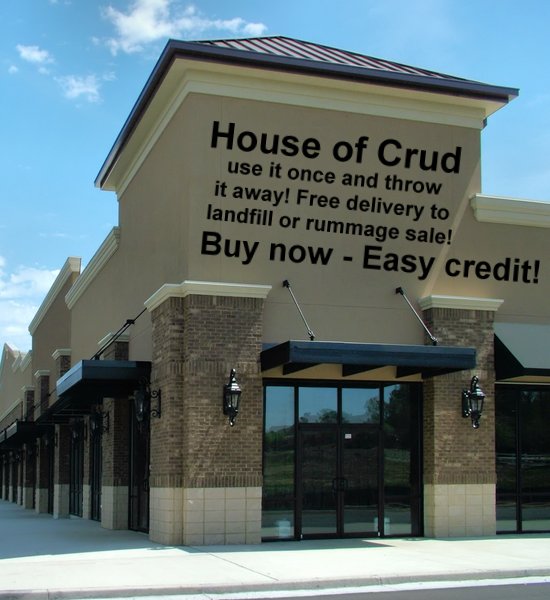
That is the operative model of "growth" in America: rapid expansion/overbuilding in pursuit of poaching customers from existing competitors, a strategy that leads to massive overcapacity/redundancy and declining profits that then leads to mergers and shuttering hundreds of redundant outlets.

This overbuilding is especially nonsensical given that the "Brown Truck Store" delivers virtually anything you want to your doorstep: The Inevitable Decline of Retail(September 19, 2012).

Why has this doomed model of overbuilding and poaching become so dominant?Look no farther than the cheap-money policies of the Federal Reserve: Take It To The Bank (The Burning Platform):

This is another classic case of mal-investment spurred by the Federal Reserve easy money policies, zero interest rates, and QEternity. Cheap money leads to bad investments. I’m all for competition between drug store chains and banks. I have my pick of multiple stores close to my house. There are clearly too many stores competing for a dwindling number of customers, with a dwindling supply of disposable income.

If this is the engine of "growth" in America, a period of degrowth will be needed to clear the system of unprofitable deadwood and Fed-incentivized malinvestment.


via Zero Hedge http://feedproxy.google.com/~r/zerohedge/feed/~3/ZoBSHJXRaAk/story01.htm Tyler Durden

Guest Post: The American Model Of "Growth": Overbuilding And Poaching

Submitted by Charles Hugh-Smith of OfTwoMinds blog,

Why has this doomed model of overbuilding and poaching sales become so dominant? Look no farther than the cheap-money policies of the Federal Reserve.

The rising Gross Domestic Product (GDP) and other simulacra of "growth" are masking the real model of growth in America: overbuilding and poaching, as in poaching customers and sales from competitors.

No matter how many outlets a company has, there's always room for a few hundred more somewhere. Now that there's a Starbucks on every corner, you might think the opportunities for expansion are limited. No way–now there are Starbucks in bookstores, Safeway supermarkets, subway stations (BART), etc.

Not only is there a coffee outlet of some sort everywhere you look (hey, how about a Starbucks in every Home Depot?), Starbucks is getting into everybody else's business as well–even occasionally hawking music CDs, for example, at least until CD sales plummeted to the point it wasn't worth poaching the declining sales.

Dollar stores are proliferating at a phenomenal rate, as are drug stores in various sizes and iterations–all aimed at poaching customers from WalMart and Target. There is a certain irony in this, as WalMart and Target expanded rapidly by poaching customers from the entire spectrum of retail competitors–supermarkets, department stores, drug stores, sporting goods, and so on.

Everybody's getting into everybody else's business. If there is a profit to be made, suddenly every gas station mini-mart is stocking the line of goods, as are dollar stores and drug stores coast-to-coast.

In the department store/luxury outlet space, the scrimmage for the top 10% and "aspirational" consumers is fierce. Macys, Nordstrom, et al. successfully poached the upper-middle class and "aspirational" consumers with credit (if they could buy luxury brands with discretionary cash, they wouldn't be aspiring to look wealthy, they would bewealthy) from mid-range retailers such as Sears and J.C. Penny.

Countless catalog retailers have opened discount outlets while still poaching customers from other bricks-and-mortar retailers with blizzards of catalogs pitching "crazy low prices" to the marginalized middle class who cannot afford luxury outlets but seek brands above the WalMart level.

Look no further than the enormous success of surf-watersports brands as evidence that an "active youth" brand can sell millions of units to paunchy shark-bait couch potatoes, effectively poaching customers from other sectors on the middle-class retail spectrum.

Specialty retailers are busy poaching customers from competitors, and if that fails then they merge. Witness the absurdly overcapacity office supply space. The fleeting success of BBQ World quickly spawns BBQ Galaxy and BBQ Universe, a manic cycle of overbuilding/poaching that ends in ruination of all three retailers, which then merge and close hundreds of (mostly empty) stores.

That is the operative model of "growth" in America: rapid expansion/overbuilding in pursuit of poaching customers from existing competitors, a strategy that leads to massive overcapacity/redundancy and declining profits that then leads to mergers and shuttering hundreds of redundant outlets.

This overbuilding is especially nonsensical given that the "Brown Truck Store" delivers virtually anything you want to your doorstep: The Inevitable Decline of Retail(September 19, 2012).

Why has this doomed model of overbuilding and poaching become so dominant?Look no farther than the cheap-money policies of the Federal Reserve: Take It To The Bank (The Burning Platform):

This is another classic case of mal-investment spurred by the Federal Reserve easy money policies, zero interest rates, and QEternity. Cheap money leads to bad investments. I’m all for competition between drug store chains and banks. I have my pick of multiple stores close to my house. There are clearly too many stores competing for a dwindling number of customers, with a dwindling supply of disposable income.

If this is the engine of "growth" in America, a period of degrowth will be needed to clear the system of unprofitable deadwood and Fed-incentivized malinvestment.


via Zero Hedge http://feedproxy.google.com/~r/zerohedge/feed/~3/ZoBSHJXRaAk/story01.htm Tyler Durden

High school sports roundup

Boys basketball

McIntosh defeated Our Lady of Mercy 78-44 in a season-opening scrimmage last week. Sophomore Dishon Lowery led all scorers with 19 and chipped in 11 rebounds. Junior Phillip Venson scored 16, sophomore Jordan Lyons scored 9, sophomore Will Washington scored 8, and senior Connor Nash scored 7. “We shared the ball very well,” said McIntosh head coach Jason Eisele. “All eleven Chiefs who played scored in the contest.”

read more

via The Citizen http://www.thecitizen.com/articles/11-19-2013/high-school-sports-roundup