TEPCO Doubles Hazard Pay For Fukushima Workers

The operator of Japan's wrecked Fukushima nuclear plant will double the pay of contract workers as part of a revamp of operations at the station, after coming under criticism for its handling of clean-up efforts. Reuters reports, hazard pay for the thousands of workers on short-term contracts will be increased from 10,000 yen ($100) to 20,000 yen a day, Tokyo Electric Power Co said in a statement on Friday. The plan released on Friday also lays out improvements to the management of hundreds of thousands of tonnes of contaminated water building up, which comes from groundwater mixing with coolant poured over melted uranium rods. All of this as the riskiest phase of the decommissioning of Fukushima begins soon


Via Pater Tenebrarum of Acting-Man blog,

Fuel Rod Removal 'No Problem'?

TEPCO spokesmen express confidence that the soon to begin removal of spent (and a number of not yet spent) fuel rods from the storage pool 30 meters above ground in reactor building number 4 of the Fukushima Daiichi nuclear plant will proceed without a hitch. Indeed, as the photograph below shows, a fairly sturdy looking gantry crane has been installed to accomplish the task, but it is no longer the fully computer-controlled machinery that was previously used to move the rods to and fro with great precision in what is a fairly cramped environment. The problem is two-fold: for one thing, the damaged building is listing and the crane will have to be operated manually. The second problem is that the number 4 reactor was undergoing a maintenance shutdown when the tsunami hit. This saved it from suffering a meltdown, but it means that the unspent fuel from the reactor is whiling away its time in the pool as well. Removing this 'hot fuel' is the most dangerous part of the operation, as it is far more likely to go critical than the spent rods ('spent' doesn't mean 'can no longer go critical').


Fuku fuel rod crane

Hitachi gantry crane hovering above the fuel rod pool in reactor building 4.

(Photo via fukuleaks.org / Author unknown)


Here is what TEPCO says according to a report at Bloomberg:

An uncontrolled nuclear reaction due to structural failures or mishandled fuel is highly unlikely because of safeguards and workers’ experience with the procedure, Akira Ono, the Dai-Ichi plant’s chief supervisor, said at a news conference at the power station yesterday.


Ono’s remarks coincide with preparations to remove fuel rods from the No. 4 reactor’s cooling pool at the plant operated by Tepco, as the utility is known. The task is an early milestone in decommissioning that experts say could threaten another crisis if mishandled. Were the rods to break or overheat, it could prompt a self-sustained nuclear chain reaction similar to the meltdowns at three Fukushima reactors following the March 2011 earthquake and tsunami.


“I personally believe this kind of thing is very close to being impossible,” Ono said. “It’s not the first time for us to do this operation. At any ordinary nuclear power plant, workers remove spent fuel.”


Still, working amid high radiation emitted by other reactors with melted cores and dealing with possible debris remaining in the pool could present problems, Ono said.

(emphasis added)

It is of course true that there are workers who are familiar with removing spent fuel from the pool. However, the conditions for doing so have changed all around. The things that Ono admits could become a problem actually pose a fairly big problem: due to the radiation, no crew can work beyond a strict and presumably fairly small time limit. Any debris in the pool will make a mishap inherently more likely.


glimpse-of-hell

A glimpse of what's in the fuel rod pool. The rods are tightly packed, so this is going to require a sure touch.

(Photo via fukuleaks.org / Author unknown)


Critics are adamant that TEPCO is downplaying the risks, and they are probably right to be a bit worried:

“The 1,533 fuel assemblies earmarked for removal are stored in a building heavily damaged by the March 2011 explosion. Removal is expected to begin this month, with practice drills scheduled for as early as next week, Ono said.


Some experts, such as former nuclear engineer Michael Friedlander, say Tepco could be playing down the dangers of the process. “The thing that keeps me up late at night is that they’re getting ready to unload the spent fuel in unit 4,” said Friedlander, who spent 13 years operating U.S. nuclear plants.


Tepco’s record of accidents at the plant, including power failures and contaminated water leaks, tests faith in its competence to perform such a delicate task, Friedlander said this week from Hong Kong during a phone interview. “It has the potential if it doesn’t go well to create a very, very serious accident,” he said.”

(emphasis added)

It is one thing when laymen are worried, it is another when former nuclear engineers are 'kept up late at night' when contemplating the fuel rod removal operation. It is probably true that the chances for an accident are fairly low, just as TEPCO says. Even with its tarnished reputation, its managers are surely aware of the delicacy of the task, so one can presumably expect them to take every precaution. The problem is that if an accident does happen, the effects will be phenomenally catastrophic in this case.


Beset by Murphy's Law

If one thinks about the Fukushima nuclear plant, it has been an uncanny attractor of the 'Murphy's law' effect from the beginning. Murphy's law states that “anything that can go wrong, will go wrong”.

Consider the accident's progression so far. Fukushima was protected by extra-high barriers against tsunami waves. It turned out though that some tsunami waves are so high and powerful that these barriers, against all previous experience and expectation, failed anyway (a 2008 study that warned of tsunami waves higher than 10 meters was ignored because it was held to be too unlikely an event). Because no-one thought the barriers would ever fail, the back-up power generators were housed on the ground level – where the seawater could get at them and destroy them. The long list of mishaps that have occurred since then, from tanks leaking radioactive water, to contaminated groundwater flowing into the ocean, to sudden steam eruptions spewing highly radioactive steam from cracks opening up around the plant, are all testament to Murphy practically squatting atop the plant.


Fuke-crane-2

What one has to wear near the spent fuel pool – full radiation riot gear.

(Photo via fukuleaks.org / Author unknown)


Looking at the photograph above, the first thought that struck us was how uncomfortable and difficult it must be to work clad in these protective radiation outfits, especially considering the work is delicate and stressful. Let us assume though that everything goes as planned, and no-one actually makes a mistake.

Could Murphy's law still strike anyway? The answer is definitely yes. Again, there are a number of risks that simply have to be taken, as it is not possible to leave the fuel rods where they are. Consider for instance the following scenario: just as an assembly of rods is being lifted out of the pool, another strong earthquake strikes and the fuel rod assembly falls where it isn't supposed to fall. Game over. The evacuation of Tokyo would presumably be on the menu next.

It is impossible to predict such events, and it is probably also impossible to guard against them. Here is an interesting documentary on the Chernobyl accident that looks at what happened in the minutes leading up to the disaster. In essence it was a combination of design problems and human error that caused the accident. A failure of various operators that were assigned different tasks to communicate with each other during the critical moments was all it ultimately took (they may have realized the implications of the design problem in time had they been in contact with each other).


rod transporter

The cylinder is one of the transport containers that will be used to remove the fuel rods from the site.

(Photo via fukuleaks.org / Author unknown)


Conclusion:

Nothing can be done about the remaining 'Murphy' risk that is going to attend the fuel rod removal. One can only hope that it all goes as planned.


And it gets worse… As Reuters reports,

Fukushima evacuees are anxious to go back home, but would settle for acknowledgement from the government that some may never return. Japanese lawmakers on Monday said the government should scale back cleanup goals.


The government may offer compensation to residents whose homes were in the most contaminated regions and will not be able to return. So far, 1,539 displaced Fukushima residents have died due to illness associated with prolonged evacuation. Japan is dealing with fallout from the faulty nuclear plant, which was wrecked by earthquake and tsunami in 2011 and is currently leaking nuclear radiation.


via Zero Hedge http://feedproxy.google.com/~r/zerohedge/feed/~3/MxAF2MUSXlA/story01.htm Tyler Durden

A. Barton Hinkle Says: Cheer Up – Things Are Getting Better

“Pessimism,” according to John
Kenneth Galbraith, “is the mark of a superior intellect.” Many
pessimists would no doubt agree. And yet, if another mark of a
serious intellect is attention to facts, then Galbraith is wrong,
and so are the pessimists. A. Barton Hinkle goes through a slew of
facts that give us great reason for optimism.

View this article.

from Hit & Run http://reason.com/blog/2013/11/11/a-barton-hinkle-says-cheer-up-things-are
via IFTTT

James Carville Suggests President Obama Smoke Crack to Get His Poll Numbers Up, Worked for Toronto Mayor

he's a democratPresident
Obama’s approval rating
hit a one-year low
in Gallup polling, at 39 percent, and is
approaching his record low. Obama is beset by scandals ranging from
revelations about the NSA’s massive surveillance operations to the
massive failure that’s been the Obamacare roll out so far. It’s
left Obama boosters
scrambling
to give advice. What about James Carvile?


From Politico:

Democratic strategist James Carville said Monday in
light of President Barack Obama’s declining poll numbers, maybe he
should take a page from an infamous Canadian mayor.

“I think the best thing he can do is take a toke on the mayor of
Toronto’s crack pipe, because his numbers are about 48,” Carville
joked on MSNBC’s “Morning Joe,” referring to Rob Ford, who has
admitted smoking crack.

Ford’s approval rating went up after he confirmed allegations he
had smoked crack. He is seeking re-election next year. Some Obama
supporters, meanwhile, suggest making next year’s midterm elections
a national referendum of sorts on the president. Presumably,
they’ve seen the same poor polling numbers Carville has. Have they
taken his advice too?

Follow these stories and more at Reason 24/7 and don’t forget you
can e-mail stories to us at 24_7@reason.com and tweet us
at @reason247

from Hit & Run http://reason.com/blog/2013/11/11/james-carville-suggests-president-obama
via IFTTT

Guest Post: Obamacare – Blinding You With Science

Submitted by Jeffrey Tucker via the Laissez Faire Club blog,

It is such a kick to read the transcripts from the White House’s health care “war room” in the first days of release. What a meltdown, and you get to watch it all in real-time.

I’m not trying to be cruel to the kindly despots who have wrecked so much of what worked in the existing system, only to replace it with an unworkable central plan that’s robbing people all over the country.

But still, there is justice in this humiliation.

Somehow, the Republicans forced the Obama administration to cough up the details, and it is from these transcripts that we discovered the truth about HealthCare.gov’s mysterious first day. Only six people enrolled. That’s six of 7 million people eligible for the great new dawn for “affordable” health care.

It’s no wonder the Obama administration tried to hide the numbers from you. But in a digital age, even the White House can’t keep this stuff secret anymore. Every aspect of reality is logged in real-time.

It’s a double-edged sword. True enough, they are still logging our lives, which is tremendously annoying. But at the same time, they are also logging their own failures. In real-time, nonetheless. And this provides unprecedented insight into many great disasters of our time.

Here is a screenshot I pulled from one such transcript:

If you’re critical of the government, this is a beautiful failure.

Supporters of the president and the health care law in his name see this as a small hiccup. To be sure, people say that all of these problems will be fixed. That the problems with creating an account are mere technical issues. Top technicians from the best companies have all been hired by the government to make it right.

In other words, it’s only a matter of time. Maybe.

But there is a more substantive issue here. The real question is how an epic failure on this scale could have happened in the first place. The Affordable Care Act is the fulfillment of decades of planning on the part of policy professionals. They had a half billion dollars to work with. The so-called “smartest guys in the room” had every incentive to make this rollout work.

So why was it such a mess? This is where things become interesting. Government doesn’t have customers that it serves. It has only subjects that obey. It has no profit and loss statements. It is not limited in its operations by the demand that it behave rationally like other businesses. It can spend what it wants based on political priorities. It has neither the incentive nor the means to anticipate changes in the system or to deal with the uncertainties of the future.

For all these reasons, it really doesn’t matter whether the website is fixed or not. The website is a metaphor for a program that cannot work. If it is fixed, it will be frozen in time, unable to adapt to change, much less improve as technology improves.

The harshest critics are exactly right. The government-backed American health care system will become ever more like the automobiles in Cuba, a living monument to what once was.

Just this weekend, I heard a fascinating lecture by professor Alexei Marcoux of Loyola University in Chicago. He provided some real insight into the mindset that led to the creation of this program. Architects of the ACA expected that a government-made system would work better than the market could work.

It all began about 100 years ago. The government’s first intervention in the medical industry created a regulatory agency for medical schools. And after that, all bets were off. Government was in charge, using “science” to improve the world you live in. The actual effect — and probably the real intent — was to limit the number of people who could call themselves physicians. This, in turn, drove up the price for their services.

How is it that society went hundreds of years without any government intervention in the medical marketplace and then it suddenly came upon us with very little public objection or even awareness?

Professor Marcoux explained in his lecture how the late 19th century saw a tremendous explosion in scientific knowledge in every area. It came with rising prosperity, increased funding for research, and new creativity inspired by commercial ambitions.

It was a natural and normal assumption that every other field of study could benefit from the application of scientific methods and insights. So, therefore, why not the management of human affairs through government? Notice that at the same time we got the beginnings of medical intervention, we also got the income tax (manage wealth!), the Fed (manage money!), antitrust policy (only government knows how big or small business must be), the origins of the welfare state, spreading intervention in education and labor, and so much else.

The pushers of Obamacare had years to plan. Everything looked right on paper. No expense was spared. There were thousands of meetings, a foolproof plan, mountains of numbers to back it all up. Then finally you press the button. The whole thing explodes — and not just the website. The risk pools will not lower premiums. The mandates will not cause people to experience health-insurance bliss. The price controls will not control costs. The new tools for access will not lead to greater access.

Science is glorious. But government is not science, and society cannot be managed scientifically from the center. Ludwig von Mises had a phrase he used to describe every attempt: “planned chaos.” There is a plan, and the experts are in charge with all resources and conviction. But the results are crazy, random, irrational, confusing, and chaotic.

It would be the greatest legacy of the Affordable Care Act if the government finally understands this message. Then we could get back to the old liberal conviction that individuals always and everywhere do a better job in managing their lives. Better than the government, anyway.


via Zero Hedge http://feedproxy.google.com/~r/zerohedge/feed/~3/18riMBQRy7I/story01.htm Tyler Durden

Twitter To Be Added To Wilshire 5000 On Friday

Just when Twitter briefly dipped in bear market territory from its post IPO highs, and threatened to wipe out the retail mania of 2013 (very much as FaceBook did in 2012), here comes the hail mary to provide the most anticipated IPO of the year its second wind. Of course, how inclusion in the Wilshire 5000 will boost TWTR profitability, remains a mystery.

Twitter to be Added to the Wilshire 5000 After Market Close on Friday, November 15


Rules-Based Index Provides for Inclusion Seven Trading Days After IPO


Only seven trading days after completing its initial public offering (IPO), Twitter Inc. (NYSE:TWTR) will be added to the Wilshire 5000 Total Market Index(SM)effective after the markets close on Friday, November 15, 2013, according to Wilshire Associates Incorporated (Wilshire(R)), a diversified global financial services firm. The inclusion will be in conjunction with the regular monthly additions and deletions of the Wilshire 5000(R).


“From its inception in 1974, the intent always has been for the Wilshire 5000 Total Market Index to be the most complete and investable measure of the total U.S. equity market,” noted Robert J. Waid, managing director. “As a rules-based index, the Wilshire 5000 does not need to make special accommodations for early entry of large IPOs, like Twitter, as stock additions always have been made monthly for U.S. companies with readily available price data. The Twitter IPO is no exception,” he concluded.


Other securities to be added next week include The Container Store Group Inc. and Burlington Stores, Inc.


The Wilshire 5000, the original pure and complete(SM) measure of the U.S. stock market, was developed in 1974 by Dennis A. Tito, chairman and chief executive officer of Wilshire. The Wilshire 5000 is widely considered the best way to track the U.S. equities market and estimate market value changes. The Wilshire 5000 Total Market exchange-traded fund (NYSE Arca:WFVK) is the only ETF based upon the Wilshire 5000.


via Zero Hedge http://feedproxy.google.com/~r/zerohedge/feed/~3/8OwhViJRMpU/story01.htm Tyler Durden

Ron Paul Exposes The Fed-Driven Erosion Of US Living Standards

Submitted by Ron Paul via The Free Foundation,

One of the least discussed, but potentially most significant, provisions in President Obama’s budget is the use of the “chained consumer price index” (chained CPI), to measure the effect of inflation on people’s standard of living. Chained CPI is an effort to alter the perceived impact of inflation via the gimmick of “full substitution.” This is the assumption that when the price of one consumer product increases, consumers will simply substitute a similar, lower-cost product with no adverse effect. Thus, the government decides your standard of living is not affected if you can no longer afford to eat steak, as long as you can afford to eat hamburger.

The problem with “full substitution” should be obvious to anyone not on the government payroll. Since consumers did not choose to buy lower-priced beef before inflation raised the price of steak, they obviously preferred steak. So if the Federal Reserve’s policies create inflation that forces you to purchase hamburger instead of steak, your standard of living is lowered. CPI already uses this sort of substitution to mask the costs of inflation, but chained CPI uses those substitutions more frequently, thereby lowering the reported rate of inflation.

Supporters of chained CPI also argue that the government should take into account technology and other advances that enhance the quality of the products we buy. By this theory, increasing prices signal an increase in our standard of living! While it is certainly true that advances in technology improve our standard of living, it is also true that, left undisturbed, market processes tend to lower the prices of goods. Remember the mobile phones from the 1980s? They had limited service, constantly needed charging, and were extremely expensive. Today, almost all Americans can easily afford a mobile device to make and receive calls, texts, and e-mails, as well as use the Internet, watch movies, read books, and more.

The same process occurred with personal computers, cars, and numerous other products. If left alone, the operations of the market place will deliver higher quality and lower prices. It is only when the government interferes with the operation of the market, especially via fiat money, that consumers must contend with constant price increases.

The goal of chained CPI is to decrease the government’s obligation to meet its promise to keep up with the cost of living in programs like Social Security. But it does not prevent individuals who have a nominal increase in income from being pushed into a higher income bracket. Both are achieved without a vote of Congress.

Noted financial analyst Peter Schiff correctly calls chained CPI a measurement of the cost of survival. Instead of using inflation statistics as a political ploy to raise taxes and artificially cut spending, the President and Congress should use a measurement that actually captures the eroding standard of living caused by the Federal Reserve’s inflationary policies. Changing government statistics to exploit the decline in the American way of life and benefit big spending politicians and their cronies in the big banks does nothing but harm the American people.


And here is Ron Paul addressing – among other things – the counter-factual supporting the “but what would we do without them” argument for the Fed


via Zero Hedge http://feedproxy.google.com/~r/zerohedge/feed/~3/0eSaa_vc8sY/story01.htm Tyler Durden

What You Should Be Doing NOW to Protect Yourself from Radiation

It is well-known that potassium iodide works to protect against damage from radioactive iodine by saturating our body (the thyroid gland, specifically) with harmless iodine, so that our bodies are unable to absorb radioactive iodine from nuclear accidents.

For example, the World Health Organization notes:

The thyroid gland is at particular risk from irradiation from radioactive iodine because the thyroid uses iodine to produce hormones that regulate the body’s metabolism.  The thyroid gland does not differentiate between non-radioactive and radioactive iodine.


***


When taken at the appropriate dosage and within the correct time interval around exposure to radioactive iodine, KI [i.e. potassium iodide] saturates the thyroid gland with stable (non-radioactive) iodine. As a result, radioactive iodine will not be taken up and stored by the thyroid gland.

However, KI only protects against one particular radioactive element, radioactive iodine, which has a half life of only 8.02 days.* That means that the iodine loses half of its radioactivity within 8 days.  For example, after the initial Fukushima melt-down, radioactive iodine was found in California kelp.

But the longer-term threat lies elsewhere.  As the New York Times noted – in addition to iodine-131 – the big danger is cesium:

Over the long term, the big threat to human health is cesium-137, which has a half-life of 30 years.


At that rate of disintegration, John Emsley wrote in “Nature’s Building Blocks” (Oxford, 2001), “it takes over 200 years to reduce it to 1 percent of its former level.”


It is cesium-137 that still contaminates much of the land in Ukraine around the Chernobyl reactor.


***


Cesium-137 mixes easily with water and is chemically similar to potassium. It thus mimics how potassium gets metabolized in the body and can enter through many foods, including milk.


***


The Environmental Protection Agency says that … once dispersed in the environment … cesium-137 “is impossible to avoid.”

Cesium-137 is light enough to be carried by the wind a substantial distance. And it is being carried by ocean currents towards the West Coast of North America.

Fortunately – while little-known in the medical community – other harmless minerals can help “saturate” our bodies so as to minimize the uptake of other harmful types of radiation.

The U.S. Department of Defense’s Army Medical Department Center and School explained in its book Medical Consequences of Radiological and Nuclear Weapons (Chapter 4):

One of the keys to a successful treatment outcome is to reduce or eliminate the uptake of internalized radionuclides before they can reach the critical organ.


***


The terms “blocking” or “diluting” agent can, in most cases, be used interchangeably. These compounds reduce the uptake of a radionuclide by saturating binding sites with a stable, nonradioactive element, thereby diluting the deleterious effect of the radioisotope. For example, potassium iodide is the FDA-recommended treatment to prevent radioactive iodine from being sequestered in the thyroid…. Nonradioactive strontium compounds may also be used to block the uptake of radioactive strontium. In addition, elements with chemical properties similar to the internalized radio-nuclide are often used as blocking agents. For example, calcium, and to a lesser extent phosphorus, can be used to block uptake of radioactive strontium.

The American Association of Physicists In Medicine agrees:

As does the book published in 2006 by the American Academy of Orthopaedic Surgeons, called Weapons of Mass Casualties and Terrorism Response:

After the U.S. military conducted above-ground nuclear tests on Bikini Island, scientists found that adding potassium to the soil reduced the uptake of radioactive cesium by the plants:

The first of a series of long-term field experiments was established on Bikini Island during the late 1980s to evaluate potential remediation techniques to reduce the uptake of cesium-137 into plants (Robison and Stone, 1998). Based on these experiments, the most effective and practical method for reducing the uptake of cesium-137 into food crop products was to treat agricultural areas with potassium fertilizer (KCl).

John Harte – Professor at the University of California at Berkeley in Energy and Resources and Ecosystem Sciences, a PhD physicist who previously taught physics at Yale, a recipient of the Pew Scholars Prize, Guggenheim Fellowship,  the Leo Szilard prize from the American Physical Society, and who has served on six National Academy of Sciences Committees and has authored over 170 scientific publications, including six books notes:

Marine fish are usually about 100 times lower in cesium-137 than are freshwater fish because potassium, which is more abundant in seawater, blocks uptake of cesium by marine organisms.

The same is true in mammals.  The U.S. Department of Health and Human Services’ Agency for Toxic Substances and Disease Registry notes:

Cesium is a close chemical analogue of potassium. Cesium has been shown to compete with potassium for transport through potassium channels and can also substitute for potassium in activation of the sodium pump and subsequent transport into the cell.


***


Elimination rates of cesium may be altered by potassium intake.  Following the intraperitoneal injection of 137 Cs in rats, a basal diet supplemented with 8–11% potassium resulted in cesium clearance of 60 days compared to about 120 days for rats receiving the unsupplemented basal diet that contained 1% potassium
(Richmond and Furchner 1961). After 20 days on the diets, rats receiving supplemental potassium had body burdens of 137 Cs that were one-half those of the rats not receiving supplemental potassium. This finding shows that  supplemental potassium reduces the uptake and increases the elimination of ingested 137 Cs.

Dr. Ingrid Kohlstadt – a medical doctor with a master’s of public health, on the Faculty at the Johns Hopkins Bloomberg School of Public Health, editor of the best-seller Food and Nutrients in Disease Management – says that the same is true for humans:

Plutonium is treated like iron by our bodies. So getting enough iron will help reduce absorption of plutonium. And see this. (Plutonium is a very heavy element, and so normally cannot travel too far. Therefore, adequate iron intake is primarily important for those living in Japan.)

Here are the recommended daily allowances (RDA) for various minerals (data from the U.S. Department of Agriculture):

You can buy calcium, potassium, iron supplements. You can also buy non-radioactive strontium supplements.  Or incorporate foods high in calcium, potassium, and iron.

(Selenium also helps protect our bodies from radiation. See  this, this and this.)

In addition to these minerals, getting enough of certain vitamins is helpful.

A number of scientific articles conclude that Vitamin A helps to protect us from radiation. See this, this and this.

Numerous studies show that Vitamin C helps to protect the body against radiation.

Vitamin D can help repair damage to DNA, and may help protect against low-level radiation.   As Science Daily reports:

Radiological health expert Daniel Hayes, Ph.D., of the New York City Department of Health and Mental Hygiene suggests that a form of vitamin D could be one of our body’s main protections against damage from low levels of radiation. Writing in the International Journal of Low Radiation, Hayes explains that calcitriol, the active form of vitamin D, may protect us from background radiation and could be used as a safe protective agent before or after a low-level nuclear incident.


***


“Vitamin D
by its preventive/ameliorating actions should be given serious consideration as a protective agent against sublethal radiation injury, and in particular that induced by low-level radiation,” concludes Hayes.

It takes a couple of weeks or months to build up our body’s levels of Vitamin D.  You cannot just pop a bunch of pills and raise your Vitamin D level.   You should never take more than the recommended dose, and  – even if you did – it wouldn’t raise your vitamin D level all at once.  As such, we should start now …

Vitamin E has also shown promise in protecting from low-level radiation, at least in animal studies. Here and here.

Here are the RDAs for vitamins (data from the U.S. Department of Agriculture):

You can buy vitamin supplements, or eat foods rich in vitamins A, C, D and E.

Antioxidant-rich foods also help protect you against low-level radiation.  See this for the science behind antioxidant protection from radiation, tips on inexpensive, anti-oxidant rich foods – and other tips on how to protect yourself from radiation.

The bottom line: starting to saturate your body now with the right types of healthy vitamins, minerals and antioxidants can help protect you against radiation if it hits in the future.

Postscript: We only advocate taking the RDA for various nutrients, which is healthy for you anyway. We are not talking about mega-doses.

We have spent hours looking through medical journal articles for other foods which help protect against radiation.  Here are the results.

For a more complete discussion of commonly-accepted scientific consensus on different prevention and treatment options, please review the Army’s Medical Consequences of Radiological and Nuclear Weapons and the The American Association of Physicists In Medicine’s Medical Management of Radionuclide Internal Contamination.

* Potassium iodide is found in most common table salt.  However, if exposed to air, the iodine content can largely evaporate within a month or so.  So store your salt in as air-tight a condition as possible.  Also, it is important not to ingest too much potassium iodide, and most of us already get a lot of salt in our diets from processed foods.  (The RDA for “sodium” – i.e. salt – is listed in the table above on the RDAs for various minerals)

Here is RDA for iodine:

And here are some iodine-rich foods.

Disclaimer: We are not doctors or health professionals, and this should not be taken as medical advice. Nothing contained herein is intended to diagnose or treat any condition.


via Zero Hedge http://feedproxy.google.com/~r/zerohedge/feed/~3/95fwt45reA0/story01.htm George Washington

How to Invest Gold In Your Pension Plan

Today’s AM fix was USD 1,283.75, EUR 957.81 and GBP 801.54 per ounce.             
Friday’s AM fix was USD 1,309.00, EUR 975.12 and GBP 814.16 per ounce.

Gold dropped $19.30 or 1.48% Friday, closing at $1,287.40/oz. Silver slipped $0.15 or 0.69% closing at $21.45. Platinum dipped $9.26 or 0.6% to $1,439.49/oz, while palladium fell $3.25 or 0.4% to $755.47/oz. Gold and silver fell 2.08% and 1.79% for the week respectively.

Gold dropped for its third day in a row after the U.S. non farm payrolls data on Friday showed that more jobs were added than expected, which increased speculation that the U.S. Fed will begin to taper its stimulus program. Friday’s rallying of U.S. equities and an elevated  U.S. dollar sent gold to a three week low. The next U.S. Fed meeting is December 17 & 18th.

How to Invest Gold In Your Pension Plan – Part 1
When the time arrives for you to retire, how will your pension fund reward you?  For many people, the entire process is entrusted to a pension broker or pensions company to manage on their behalf, with yearly statements to appraise of your pensions’ performance. Most of these funds are heavily weighted towards equities and property funds and as such, are not adequately diversified.

Gold is one such diversification opportunity to consider and despite the recent price retrenchment, has outperformed the both Irish bank deposit rates and the ISEQ (Irish stock exchange) over the past 10 years (see figure 1 below.) The analysis below examines the performance of constant monthly investment over ten years, net of fees and adjusted for inflation.


Figure1: How a constant monthly investment compares in value from November 2003 to October 2013. ©GoldCore

Irish citizens can invest in gold bullion in their pension funds since 2007 when the Irish Revenue Commissioners approved investments in gold in Self-Administered Pension Schemes via the Perth Mint Certificate Programme.

The approval came after an extensive review which included consultation with the Association of Pensioneer Trustees in Ireland (APTI), senior executives of the Perth Mint of Western Australia and GoldCore Limited.

Many investors are increasingly looking for an effective way to manage the macroeconomic, monetary and geopolitical risks in their retirement portfolios. By diversifying into gold in your pension, you can mitigate some of these risks.

Gold has outperformed most asset classes over the past ten years due to uncertainty regarding the global economy and in the mainstream asset classes such as equities, bonds and property.

Click here for our guide to Putting Gold In Your Pension Plan in Ireland.

Tomorrow, we will cover Putting Gold In your Pension Plan in the UK, and on Wednesday, the USA.

Click Gold News For This Week’s Breaking Gold And Silver News
Click Gold and Silver Commentary For This Week’s Leading Gold And Silver Comment And Opinion
Like Our Facebook Page For Breaking News, Interesting Insights, Blogs, Prizes and Special Offers


via Zero Hedge http://feedproxy.google.com/~r/zerohedge/feed/~3/RhQMoh8Xj5Y/story01.htm GoldCore

Sarvis Non-Role in McAuliffe’s Victory Over Cuccinelli Prompts Strange Misreadings of Libertarianism, Reason

SPOILer! I never even met her! |||Tightly contested major-party political races are
not exactly factories for lucid, dispassionate political analysis.
Particularly when, as in Virginia’s gubernatorial race last week, a
third party candidate draws more votes than the margin of victory
between the two leading candidates.

Over at Forbes.com, Carrie Sheffield asks “Who
Will Be the Next Libertarian Spoiler?
” Her piece starts as
follows: 

Don’t get me wrong, I enjoy Cato Unbound as
much as the next supply-sider. But I don’t understand why
it’s not uncommon that libertarian candidates play spoiler to
Republican candidates. Too often this throws the race to a Democrat
who’s much farther removed from the libertarian’s ideology than the
GOP candidate.

Over at Reason, Matt Welch identified
seven congressional cases
 last year where the libertarian
candidate garnered more support than the margin between a
victorious Democrat and vanquished Republican. The most recent
glaring case in point is the Virginia gubernatorial race, where
governor-elect Terry McAuliffe (47.6 percent of the vote) could
have lost to Republican Ken Cuccinelli (45.4 percent of the vote)
were it not for Libertarian candidate Robert Sarvis, who won 6.6
percent of the vote.

Here’s an important point for those trying to blame Sarvis
voters for throwing the election to Terry McAuliffe:
Sarvis voters didn’t throw the election to Terry
McAuliffe
. No really, they didn’t. According to
CNN’s exit polling unit
, “if Sarvis had not been in the race,
exit polls indicate McAuliffe would have beaten Cuccinelli by 7
points (50%-43%).” According to
ABC News’ analysis
, “Libertarian Robert Sarvis, may have made
it closer for McAuliffe than it would have been otherwise. Had he
not been on the ballot, a third of his voters said they’d have
supported McAuliffe – slightly more than twice as many as said
they’d have gone for Cuccinelli.” In other words, the whole hook
for the column is bogus.

Sheffield deploys as supporting evidence for her thesis that
“too often” the Libertarian “throws the race to a Democrat” this

Nov. 12, 2012 blog post
of mine pointing out seven federal
races where the margin of victory was lower than what the LP
candidate received. As telegraphed by the use of the scare-quote
“‘Spoiler'” in my headline, having third-party candidates beat the
margin of victory does NOT mean that they threw the election to the
winner. To arrive at that conclusion you need to not only assume
that votes by definition belong to one of two major parties (an
assumption that I will go along with for the moment), but also to
have some idea of who they would have voted for (if anyone) had the
third-party candidate not been on the ballot.

Goddamned hippies! |||To that effect, this follow-up
Nov. 16, 2012 post
of mine applied a formula derived from a

Reason-Rupe pre-election poll
of Gary Johnson supporters (who
leaned 53% Republican, 38% Democrat, 10% independent) onto eight
congressional races that had been flagged as possible LP spoilers
in a
Daily Kos chart
. My conclusion?

[A]s best as I can calculate–there are no
spoilers in the chart above. Obviously, there are reasons to
believe that the 53-38-10 formula is flawed, but (unlike the
implied 100-0-0 number people sometimes use to divvy up third-party
votes), at least it’s based on real polling data.

With a year’s hindsight, I would amend that to say you can begin
to make a convincing LP-spoiler claim in exactly one 2012
congressional race: Democrat John Tierney’s 48.2%-47.2% win over
Republican Rich Tisei in a Massachusetts 6th district race where
Libertarian Daniel Fishman received 4.6% of the vote. So there you
have it: 435 members of Congress, 33 senators, 13 governors, and
one president were elected in November 2012; of those 482 electoral
outcomes only one (to the best of my knowledge) can be plausibly
argued to have been affected by an LP candidate. And yet, in the
face of a Virginia race that does not add to that tally, we’re
worried about the next Libertarian spoiler?

Well, at least Sheffield didn’t use the Sarvis case as occasion
for a strange I-break-with-thee rant about libertarians
and the allegedly solutions-averse, possibly hooker-banging rabble
at Reason magazine. Derek Hunter, come on down!

See??? |||Two days
after the Virginia election, in a Townhall column illustrated by a
victorious Terry McAuliffe, Derek Hunter laid out “The
Problem With Libertarians
.” Starts like this:

There was a time I called myself a Libertarian. And there was a
time I was a Libertarian. I just wanted to get government to leave
me alone, to leave people alone and to go all crazy and limit
itself to doing only that which is spelled out clearly in the
Constitution. That was what a Libertarian was. But it’s not
anymore.

So how did libertarianism leave Derek Hunter?

They went from the movement for individual responsibility, small
government and free markets to a gaggle of misfits who want pot and
prostitution legalized and a total non-interventionist foreign
policy.

That pretty much sums it up.

Honestly, what does being a Libertarian mean beyond legalizing
drugs, banging hookers and sitting by while the rest of the world
blows itself up?

This about captures the quality of Hunter’s analysis. At a time
when libertarians (who Hunter is using the capital-L descriptor to
discuss here) represent a newly
identified
and
growing bloc
of American voters, are affecting modern life in
all kinds of beneficial ways outside the scrum of electoral
politics, and are making
recently unprecedented inroads
in the Republican Party in a way
that has had tangible effects on
federal spending
,
civil-liberties politics
, and
reckless foreign intervention
, now we’re talking about
“a gaggle of misfits” who just want to bang hookers?

Hunter then manages to mis-portray Reason even while
praising (thanks!) our work:

The great Reason magazine is a wonderful
publication filled with great articles, solid journalism you won’t
find elsewhere…and a voice that does little more than complain.

Reason is great at highlighting abuses by every
level of government, stories ignored by other media outlets. But
you won’t find much in the way of philosophy or solutions. (There’s
some, it just doesn’t seem to be a focus.) They preach to the
choir, and it ends there.

True story: In the same week Hunter was writing this complaint,
I was busy proofreading for our next print issue a feature about
using crowdsourcing to fix…potholes.

See??? |||As many of
our libertarian-movement critics will be first to tell you,
Reason is forever “compromising” pure philosophical
principles by attempting to apply libertarian insights onto the
very non-libertarian real policy world we inhabit. So we publish a
19
Percent Solution
” about affixing federal spending to a
percentage of GDP rather than merely complain that most federal
government activity is morally and constitutionally illegitimate
(the upshot is that our solutions end up sounding like
those
being offered by a new generation of libertarian-leaning
Republicans). The same impulse is behind our calls to replace
entitlements with a real safety net
(rather than ripping up
both),
slowly unwind Fannie and Freddie
(rather than ending them
overnight), redirect
federal transportation spending
(rather than just getting rid
of it), and on and on.

This approach is baked right into Reason’s DNA. Robert
Poole wrote the first real journalistic case for deregulating
airlines in the September 1969 issue
of Reason, and is as responsible for the real-world
solutions of
airline deregulation
and privatization
as anyone alive. Poole, who is still Director of
Transportation Policy
for the Reason Foundation (the public-policy work of which embodies
the very definition of pragmatically applying libertarian insights
onto the fallen world of governance), described in our
2008 oral history of Reason
how the magazine made the
deliberate choice early on to not preach to the choir, but
rather engage in the world outside our comfort zone:

We said, “Let’s leave movement stuff to movement zines and go
back to our original vision and make reason a competitor
to National Review and The
Nation
 and engage in the battle of ideas with the whole
spectrum of thinking people.” We’ve tried to stick with that ever
since, with different ways to carry that idea out.

See??? |||Hunter never
mentions what kind of “solutions” he has in mind, but since he
spends five paragraphs complaining about the anti-John McCain
sentiment he witnessed at a 2008 D.C. election night happy hour
co-sponsored by Reason and America’s Future Foundation (I wasn’t
there, FWIW), it’s probably safe to infer that cheering for the
electoral success of Republicans, no matter
how big-government they might be
, is a solution in and of
itself:

Libertarians have devolved from the pro-liberty wing of the
right side of the ledger to the annoying kid who, when he doesn’t
get 100 percent of what he wants, takes his ball and goes home. The
team he agrees with more than half the time loses to the team he
barely agrees with at all, and he cheers while marinating in his
smugness.

This revealing paragraph makes broader assumptions that don’t
reflect the lived-in reality of voter behavior. For example,
according to
this 2010 analysis
from David Boaz and David Kirby, libertarian
voters in 2008 backed McCain over Obama by 71% to 27%, a sharp
increase over their 21-point preference for George W. Bush in 2004.
A Reason-Rupe
poll
just prior to the 2012 election showed even bigger
libertarian support for Mitt Romney, 77% to 20%.

And yet Hunter is exercised about libertarians’ alleged “‘my way
or the highway’ approach to electoral politics,” and “100
percent-or-nothing purity tests” (an odd complaint in a piece—and
paragraph!—that spends time fretting that people like Bill Maher
are diluting the libertarian brand, and so need to be more loudly
repudiated by libertarian organizations).

See??? |||The real
category error here is assuming that the fortunes of libertarianism
rise and fall on the narrow issue of the GOP winning elections.
Republicans pretty much ran Washington, D.C. from 2001-2006, and
accomplished roughly nothing of a libertarian nature (not
surprising, since they campaigned and conceived of themselves on

explicitly anti-libertarian grounds
).

As Nick Gillespie and I argue in
The Declaration of Independents
, there is ample reason to
believe that Republicans became more interested in such
long-neglected issues as fiscal restraint precisely when they
realized that they could no longer count on automatic votes from
people who actually believed in limiting government. The more the
“Liberty Movement” gains traction within the GOP, the more
interesting the GOP becomes. And the more any politician
embraces any libertarian solution, the more that
libertarian-minded folk will put aside differences on other issues
and try to get positive stuff done, piece by piece. And yes, that
damn well includes attempting to wipe away each and every vestige
of the Drug War, one of the single worst government policies in the
history of the United States.

Meanwhile, most libertarian victories—like most other things
that are worth celebrating in life—happen far, far away from
Capitol Hill. For copious examples of such, I recommend picking up
Reason’s latest issue, which has a package of stories
under the rubric of “Technology vs. The
State
.”

Mediate’s Andrew Kirell responded to Hunter’s piece
here
; Hunter fired back
here
.

from Hit & Run http://reason.com/blog/2013/11/11/sarvis-non-role-in-mcauliffes-victory-ov
via IFTTT

Busted! HFT Algo Goes Wild in Nasdaq Futures Moments Before Job Number Hits

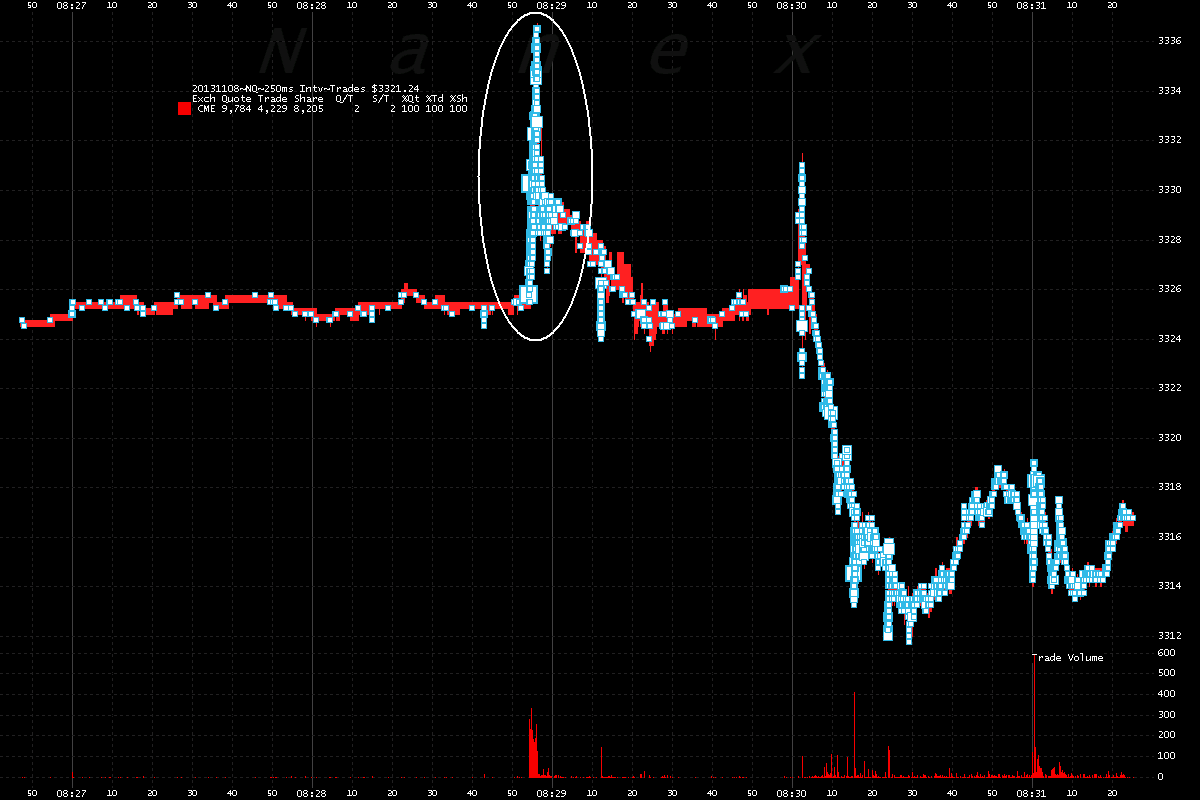
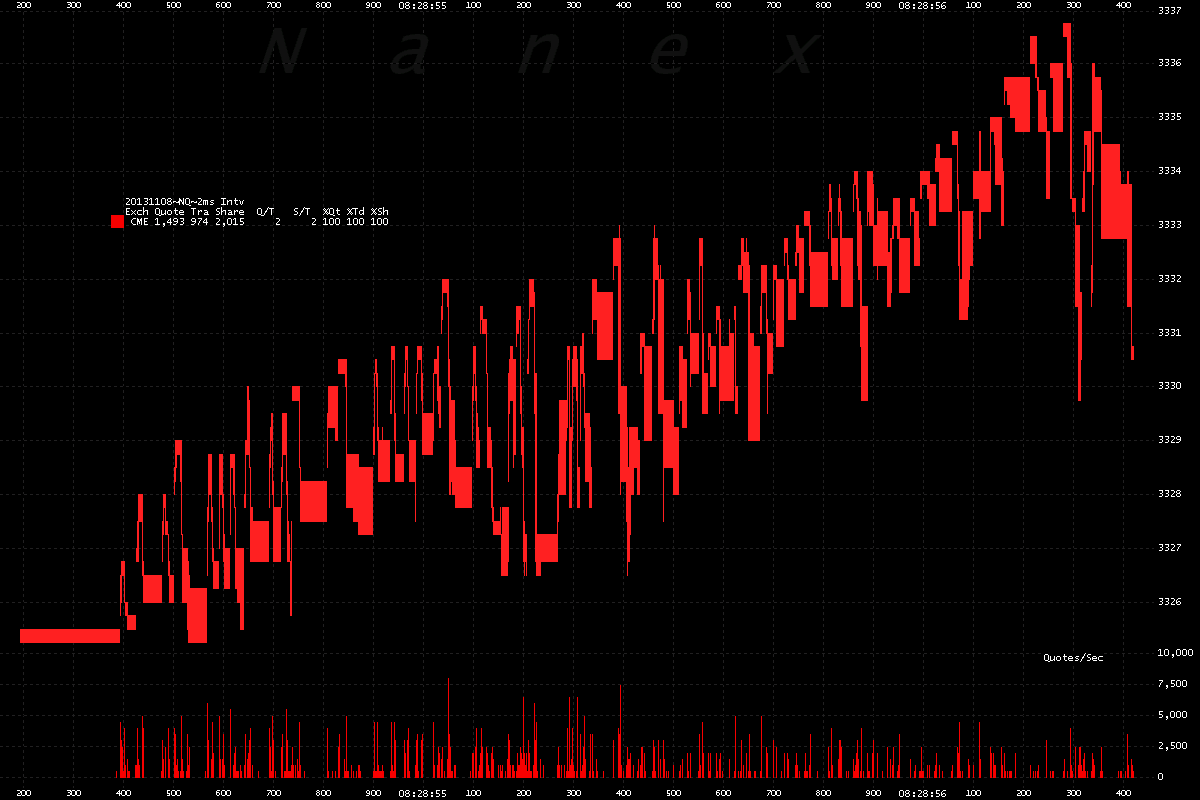
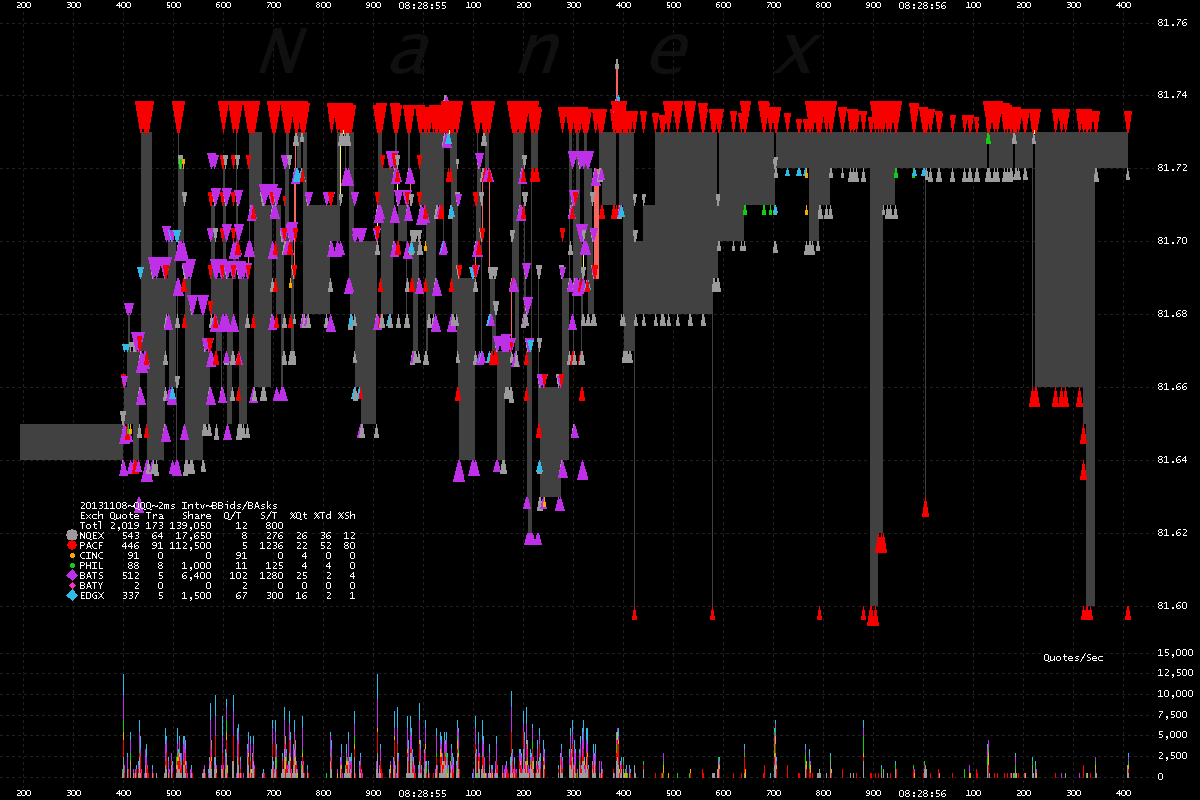
In the minute preceding last week's highly anticipated payrolls report, Nanex exposes the appearance of a High Frequency Trading (HFT) algo in both the December 2013 Nasdaq (NQ) Futures and the QQQs (an ETF). When it was active, it caused prices to gyrate wildly over a few seconds of time. This is the brief period that also saw Treasury Futures halted (and gold prices jumping) and looking closer at the charts, it appears this HFT algo caused wild price oscillations in the futures in a way that enable it to establish a short position in QQQs. We are sure the regulatory world is already on this blatant manipulation (or simple front-running on information received)…


1. December 2013 Nasdaq 100 (NQ) Futures trades (blue squares) and quote spread (red shading).
The circled area is when the algo ran.


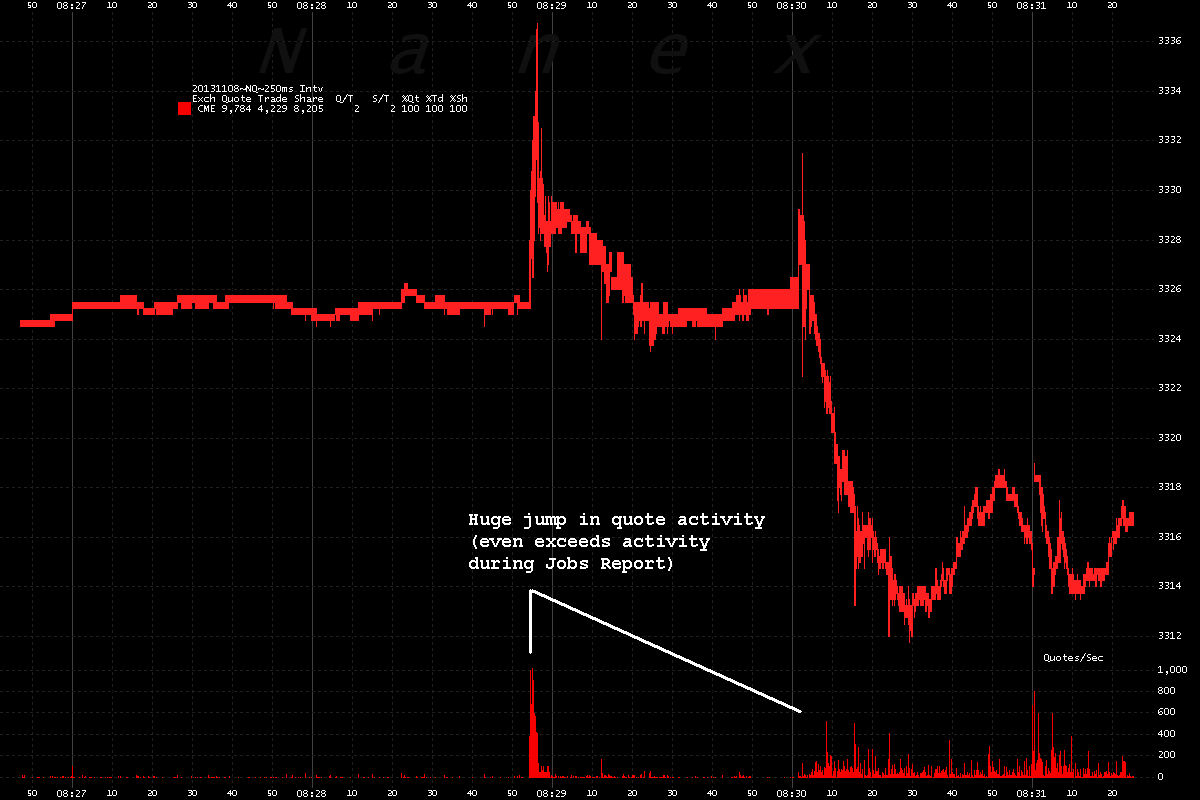
2. Same as Chart 1 above, but showing quote spread and quote rate.
Note the explosion of trade (chart above) and quote activity (this chart). There were more quotes during this period of quiet time than during the release of the Employment report! No other futures contracts or stocks showed any significant activity during this time, which means this was not news driven. The activity appears to have been caused solely by the HFT algo.


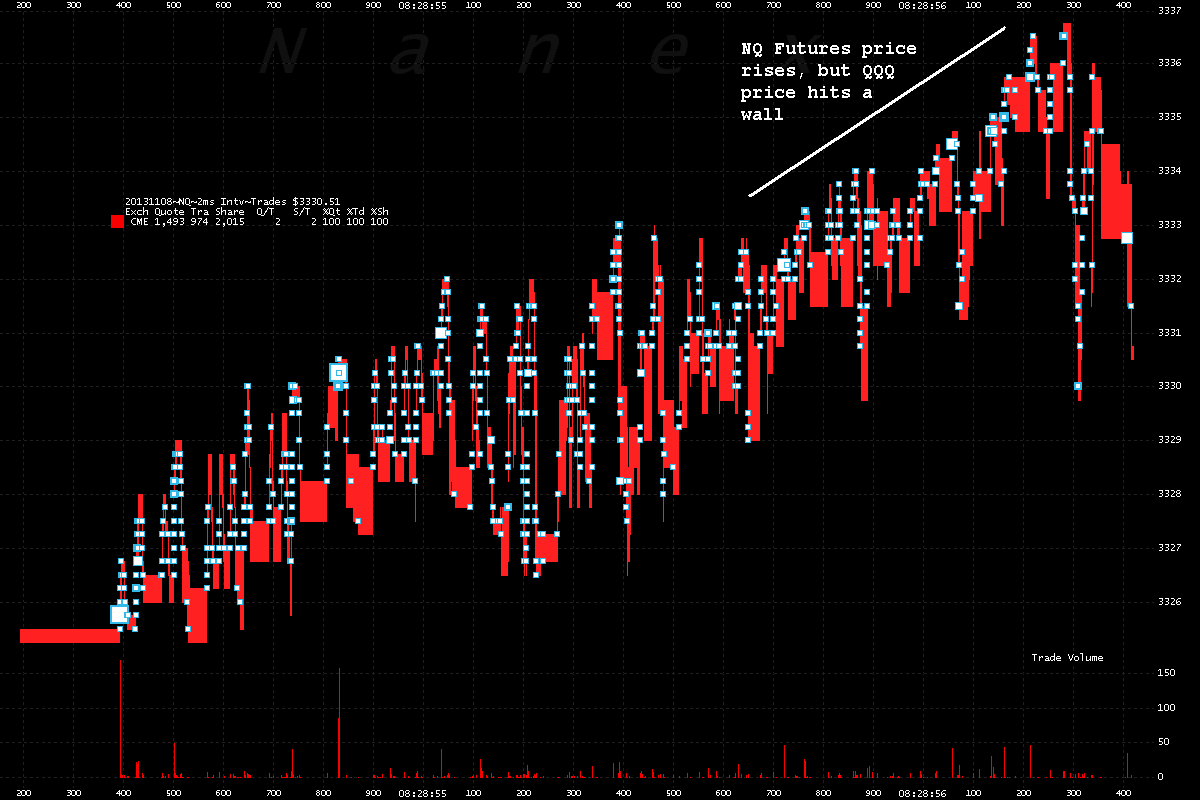
3. NQ Futures, Zooming to the area circled in Chart 1.
Compare this chart to the one below it: while price rises in NQ futures (this chart), they hit a wall in QQQ (chart 4 below).


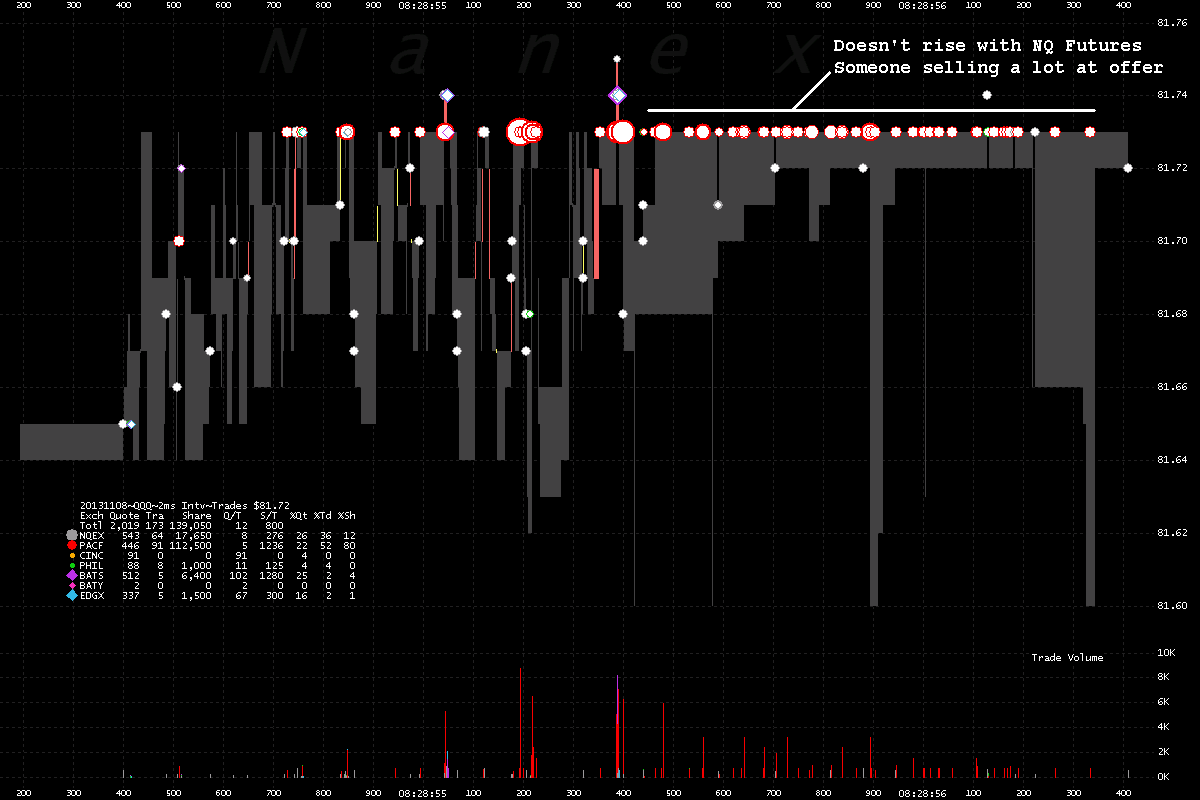
4. QQQ Trades color coded by reporting exchange and NBBO.
Compare to chart above – notice how prices fail to rise in QQQ (this chart) when they do in futures (chart 3 above). Someone is selling QQQ's regardless of the futures. Is the algo causing the price oscillations in futures also selling QQQ's at the peak?


5. NQ Futures – showing just the quote spread over 2 seconds so you can appreciate the magnitude and speed of price oscillations.
This is pretty crazy.


6. QQQ best bids/asks color coded by exchange and NBBO over the same 2 second period as chart above.


via Zero Hedge http://feedproxy.google.com/~r/zerohedge/feed/~3/xGgboy3rVNU/story01.htm Tyler Durden