“No Warning Can Save People Determined To Grow Suddenly Rich”

Submitted by Tim Price of The Price of Everything blog,

“No warning can save people determined to grow suddenly rich.” – Lord Overstone.

We have seen a confluence of events that suggests we may be reaching the terminal point of the financial markets merry-go-round – that point just before the ride stops suddenly and unexpectedly and the passengers are thrown from their seats. Having waited with increasing concern to see what might transpire from the gridlocked US political system, the market was rewarded with a few more months’ grace before the next agonising debate about raising the US debt ceiling. There was widespread relief, if not outright jubilation. Stock markets rose, in some cases to all-time highs. But let there be no misunderstanding on this point: the US administration is hopelessly bankrupt. (As are those of the UK, most of western Europe, and Japan.)

The market preferred to sit tight on the ride, for the time being. Three professors were awarded what was widely misreported as ‘the Nobel prize in economics’ for mutually contradictory research. What they actually received was the ‘Sveriges Riksbank Prize in Economic Sciences in Memory of Alfred Nobel’, which is not quite the same thing. But then economics is not a science, and Eugene Fama’s ‘efficient market hypothesis’ is not just empirically wrong, but dangerously so. History, it would seem, is clearing the decks. Perhaps the most intriguing development of the week was the news that Neil Woodford would soon be retiring from his role managing £33 billion of other people’s money at Invesco Perpetual to start up his own business. It was widely reported that Mr. Woodford nursed growing frustration at the short-termism of the financial services industry. We will return to this theme.

One of the sadder stories in the history of investment management is that of Mr. Tony Dye. The following extract is taken from his obituary in The Independent:

Tony Dye was one of Britain’s best known fund managers, becoming a household name in the late 1990s due to his controversial opinions about the outlook for global stock markets. At a time when markets were soaring, Dye insisted they were overvalued and on the verge of a crash – a view which put him at odds with most other investors at the time and earned him the nickname “Dr Doom”.


As early as 1995, as the FTSE 100 was approaching 4,000 points, Dye began to make the case that markets were too expensive. At the time, he was the chief investment officer for Phillips & Drew, one of Britain’s biggest asset management firms, and by 1996 he had begun to move large sums of clients’ money out of equities and into cash.


In the years that followed, however, stock markets continued to soar, driven by the technology boom. But Dye stuck to his guns, avoiding the high-growth, high-risk internet stocks, maintaining large positions in cash, and consequently ensuring that Phillips & Drew’s funds significantly underperformed their rivals. By 1999, the firm was ranked 66th out of 67 for performance amongst Britain’s institutional fund managers, and was haemorrhaging clients – and in February the following year, just weeks after the FTSE had broken through 7,000 points for the first time, Dye was sacked.


Days later, his prophesy finally came true. Markets collapsed, and settled into a three year slump, which saw more than 50 per cent wiped off the value of global stock markets.

Neil Woodford’s apparent concerns are well placed. There is a grotesque mismatch between the set-up of institutional asset managers and what is in the best interests of their end clients, the individual members of the public who pay their fees. The investment fund marketplace is grotesquely oversupplied. There is far too much, to use the dismal phrase, product. The problem is exacerbated by perhaps inevitable weaknesses in psychology – both on the part of the manager, and on the part of the investor. Stress points abound throughout the chain. The investment fund world is hopelessly balkanised, and brimming over with a degree of product specialisation utterly unwarranted by investors’ real needs. The fund management industry is a perpetual production line of novelty, or rather an endless rehash of the same old ideas. The point of absurdity was reached and surpassed when there were more mutual funds listed on the New York Stock Exchange than there were common stocks with which to populate them. The industry is a monstrous hydra, busily consuming its own, and its investors’, capital. New funds are launched daily. Failing older funds are quietly tidied away, merged, or destroyed. They are ‘uninvented’.

Alison Smith and Stephen Foley covered the news of Neil Woodford’s resignation for the Financial Times. They cited the FT’s own John Kay, who carried out a review of UK equity markets last year, and who said,

The short-term horizon is basically introduced by the intermediary sector.. Pension trustees [for example] are told they should keep reviewing managers, while retail investors get constant invitations to trade from independent financial advisers [for example] and the platforms set up to enable them to do so.

As they suggest, Neil Woodford’s past success means that raising money for his new business is unlikely to be much of a struggle. “But imagine the hurdles in the way of a manager who would like to purse long-term strategies but is just starting out.” In the words of Professor Kay,

How easy would Warren Buffett find it to set up now?

We have not been immune to the demands of clients frustrated at the performance of diversified portfolios lagging the broader equity markets (although this explicit benchmarking against stocks was never a mandate to which we subscribed). We struggle, in some cases, to make sufficiently clear our concerns about broader market valuation, or just as importantly the gravity of the global financial situation (including a potential QE-driven currency crisis), which makes a wholehearted commitment to the stock market in late 2013 seem to us a risky strategy. So where, if anywhere, does the fault lie? Sometimes it is not just asset managers who should be accused of being short-termist, or of missing the big picture.

Our thesis has been consistent for five years now. We believe we are at the tail end of a 40-years’ and counting experiment in money and the constant expansion of credit. This experiment is not ending well. Because government money, unbacked and unchecked as it now is by anything of tangible value, can be created at will, it has been. What is extraordinary is that despite trillions of dollars / pounds / yen of stimulus, there are few visible signs of what we would call inflation, in anything other than the prices of financial assets themselves.

We are living through a historic period of global currency debasement. The neo-Keynesian money-printers who dominate the world’s central banks have ‘won’ the debate, but are now scratching their heads, looking in vain for the economic recovery that they were expecting all those trillions to have bought. They will continue to look in vain, because money creation and true wealth creation are polar opposites. As portfolio manager Tony Deden has asked,

If cheaper currency is the source of wealth, where has Bangladesh gone wrong? If cheaper money means economic prosperity, why not just print as much as we can and give it out to everyone? We have become fools. The customers know nothing and the advisers know even less. And then we have the idiot economists – the neo-classical Keynesian variety with solutions to problems they did not even anticipate; solutions that have, in fact, been long discredited. And so we lurch from crisis to crisis, eating our meagre capital in the hopes of becoming rich in money. It is a pity.

Those words were written four years ago. The printing presses have been run to exhaustion ever since. So far they have bought us an inflationary rally in the prices of financial assets, and not much else. It has been a lousy time for anyone focused on the disciplined and genuinely diversified pursuit of capital preservation in real terms (more recently, for anyone seeking to escape the inflationary insanity via the honest money that is gold). We have not, to any significant extent, participated in the ‘phony rally’. But then we are playing a longer game than most of our peers. Round and round and round she goes; where she stops, nobody knows. Fund manager Sebastian Lyon recently quoted another celebrated fund manager, Jean-Marie Eveillard:

I would rather lose half of my shareholders than half of my shareholders’ money.


via Zero Hedge http://feedproxy.google.com/~r/zerohedge/feed/~3/obCgZTZOllU/story01.htm Tyler Durden

5 Big Questions About President Obama’s Health Law Tweak

Earlier today, President Obama
announced a plan to tweak Obamacare by allowing state insurance
commissioners to let health insurers continue to offer plans that
do not pass muster under Obamacare’s health insurance regulations.
The announcement came following mounting public outrage about the
millions of individual market health plans being terminated as a
result of the health law’s regulations—in direct contradiction to
the president’s repeated promise that people who liked their health
plans could keep them. Congressional Democrats had been circling
around plans to address plan cancellations all week; the
announcement was in large part a response to growing pressure from
within the president’s own party to respond.

But the president’s plan doesn’t resolve the mess. Indeed, it
may have just compounded the law’s existing political and policy
troubles. Big questions remain about how it will work, and how
other parties will respond.

1. Will congressional Democrats be satisfied?
The president’s tweak was designed to help congressional Democrats
under fire for supporting a law that caused people to lose their
health plans despite many absolute promises to the contrary. But
while some Democrats appear to be
happy with the change
, which allows them to blame insurers for
cancelling plans, it’s not clear that this will placate all of
them. Sen. Mary Landrieu (D-La.), who sponsored a bill to require
insurers to continue existing plans,
said
in a press conference this afternoon that the president’s
proposal was a “step in the right direction,” but also suggested
that a further legislative fix might be needed.

2. How will the insurance industry react? This
is potentially a big deal. Right now, the insurance industry is
working closely with the administration, and despite frustrations
with the rocky rollout of the exchanges, has largely avoided direct
confrontation with the administration. Not so here. The head of
America’s Health Insurance Plans (AHIP), issued a statement warning
that the president’s plan could upend the insurance market.
“Changing the rules after health plans have already met the
requirements of the law,”
said AHIP CEO Karen Iganagni
, “could destabilize the market and
result in higher premiums for consumers.” That, in turn, could have
political consequences, as next year’s insurance rates will be
revealed in the months leading up to the 2014 election.

3. How will the new policy be implemented? A
letter sent to state insurance commissioners says that the Obama
administration will allow health insurers to “choose to continue
coverage that would otherwise be terminated or cancelled” next year
under a “transitional” policy. But that still depends on the say-so
of state insurance regulators, who are merely “encouraged to adopt
the same transitional policy” regarding specific types of
terminated coverage. Yet insurance regulators aren’t sure how to do
that. “It is unclear how, as a practical matter, the changes
proposed today… can be put into effect,” said the head of an
insurance commissioner’s group, according
to a Wall Street Journal health reporter. So there’s a
significant operational question about how—and whether—this would
work.

4. Will state insurance commissioners actually pursue
the Obama administration’s encouraged change?
Maybe not.

At least one
has already said no thanks: Washington state
Insurance Commissioner Mike Kreidler, one of
the most liberal insurance regulators in the nation
, has
already indicated that his state won’t participate, citing “serious
concerns” about implementation and insurance market stability.
Washington state, notably, has had direct experience with insurance
market meltdowns in the past: In the 1990s, it passed a slew of
health insurance market reforms that eventually
resulted
in the large majority of individual market insurance
carriers exiting the market.

5. Is it legal? Right now the administration is
citing “transitional” authority to implement the change. But it’s
all pretty vague. The idea, as with the delay of the employer
mandate, is that transitional authority gives the administration
the power to do what is necessary in order to put the law in place.
But the power to take the steps necessary to implement a law
doesn’t apply here. What the administration is doing is using its
authority to not implement a part of the law.

from Hit & Run http://reason.com/blog/2013/11/14/5-big-questions-about-president-obamas-h
via IFTTT

Obama Attempting to Reverse Insurance Cancellations, Student Debt Passes $1 Trillion, Another City Considers Bankruptcy: P.M. Links

  • Today's P.M. links brought to you by Benjamin FranklinPresident Barack Obama’s
    solution to the disaster of the rollout of his signature Affordable
    Care Act is to allow insurers to
    uncancel customers’ policies
    for a year. Insurance industry
    representatives worry this will make the problem
    even worse
    .
  • As of the third fiscal quarter, total student debt has
    surpassed $1 trillion
    . Good luck getting them to pay for your
    health care!
  • Desert Hot Springs in California may be the next city to

    declare bankruptcy
    , though they’re trying hard to resist
    it.

  • School security spending
    is predicted to double to $5 billion
    by 2017 in response to the Sandy Hook Elementary shootings.
  • Toronto Mayor Rob Ford is
    threatening legal action
    against aides who told police about
    his drug use and drunken-driving. Snitches get stiches, guys!
  • Murderous Boston ganster
    Whitey Bulger
    has officially been sentenced to two life terms
    (plus five years).

Get Reason.com and Reason 24/7
content 
widgets for your
websites.

Follow us on Facebook
and Twitter,
and don’t forget to
sign
up
 for Reason’s daily updates for more
content.

from Hit & Run http://reason.com/blog/2013/11/14/obama-attempting-to-reverse-insurance-ca
via IFTTT

J.D. Tuccille on Health Care Reform Without Obamacare

SyringeIf we’d all spent the last few generations eating
swill slapped in front of us at state-run cafeterias, who would
feel comfortable describing a world of gourmet restaurants,
fast-food drive-ins, greasy spoons, and ethnic food carts evolving
all by itself if we just swept away the federal Department
of Heartburn? Yet describe the alternatives, we must, when goggling
at the current if-you-like-it-there-it-goes fiasco that doesn’t
even rate a description as the army-issue shit on a shingle of
health care systems. We can’t reliably describe what a free society
would come up with for treating people’s aches and pains given time
to evolve and react to human needs, writes J.D. Tuccille, but
Obamacare can be improved upon. A lot.

View this article.

from Hit & Run http://reason.com/blog/2013/11/14/jd-tuccille-on-health-reform-without-oba
via IFTTT

The QEeen Sends Stocks Soaring To Moar New Highs; Bonds & Bullion Bid

Despite a 10% collapse in CSCO (which apparently is not a bellwhether anymore at all) – notching a mere 18 points off the Dow, Yellen's confirmation of everything we thought we knew (and bad macro data) was enough to send the S&P and Dow to new all-time highs. Treasuries rallied 2bps (5-8bps on the week) and gold lifted back to unchanged on the week. VIX limped lower. On the day, the USD closed higher (thanks to JPY weakness supporting stocks) but was lower from early highs. Credit markets rallied very modestly but remain hugely divergent in this supposed QEeen-fueled surge. And on it goes…


Stocks are unstoppable… credit not so much…


The Dow, Nasdaq totally ignored CSCO – so old school – and roared again…


Some context off the debt-ceiling lows…


and across the sectors…


Gold lurched begrudgingly today – back to unchanged on the week…


as Treasuries rallied (10Y back to 2.69%)


Before everyone gets too excited – we have seen this rampacious levitation 4 times this year now and each time it reached this pace – we turned lower…


You think this is funny… does it amuse you?


Charts: Bloomberg


Bonus Chart: It all makes sense somewhere…


via Zero Hedge http://feedproxy.google.com/~r/zerohedge/feed/~3/cw33tsj9-Mw/story01.htm Tyler Durden

The QEeen Sends Stocks Soaring To Moar New Highs; Bonds & Bullion Bid

Despite a 10% collapse in CSCO (which apparently is not a bellwhether anymore at all) – notching a mere 18 points off the Dow, Yellen's confirmation of everything we thought we knew (and bad macro data) was enough to send the S&P and Dow to new all-time highs. Treasuries rallied 2bps (5-8bps on the week) and gold lifted back to unchanged on the week. VIX limped lower. On the day, the USD closed higher (thanks to JPY weakness supporting stocks) but was lower from early highs. Credit markets rallied very modestly but remain hugely divergent in this supposed QEeen-fueled surge. And on it goes…


Stocks are unstoppable… credit not so much…


The Dow, Nasdaq totally ignored CSCO – so old school – and roared again…


Some context off the debt-ceiling lows…


and across the sectors…


Gold lurched begrudgingly today – back to unchanged on the week…


as Treasuries rallied (10Y back to 2.69%)


Before everyone gets too excited – we have seen this rampacious levitation 4 times this year now and each time it reached this pace – we turned lower…


You think this is funny… does it amuse you?


Charts: Bloomberg


Bonus Chart: It all makes sense somewhere…


via Zero Hedge http://feedproxy.google.com/~r/zerohedge/feed/~3/cw33tsj9-Mw/story01.htm Tyler Durden

4 Terrible Things About the Intellectual Property Section of the Leaked Trans-Pacific Partnership Agreement

Yesterday, Wikileaks published a draft of the
intellectual property chapter of the secretive and controversial
Trans-Pacific Partnership Agreement (TPP).

This document is the first full chapter to be leaked. The TPP is
billed as a free-trade
agreement that will prepare the US and 11 other Pacific-rim
nations. This leak gives clearer insight
about how far-reaching and potentially damaging this agreement,
which the Obama Administration hopes to hammer out by the of the
year, could be. Here are some of the worst features discovered
in the Intellectual Property chapter.

1. Loose Language Means Worse
Laws: 
Earlier this week, Reason contacted
Simon Lester, a trade policy analyst with Cato, regarding the TPP.
Having read prior leaks, he cautioned that “the problem is, a lot
of [TPP] rules are very vague.”

The newly released document shows the same trend. Addressing how
this group of nations will deal with everything from copyrights, to
domain names, to Internet service provider liability, and even
border enforcement,
the language throughout this 95-page chapter is dangerously broad.
Governments have enough trouble reconciling technology and the law
in a productive way, and allowing a centralized body of authority
to make sweeping, international decisions is a poor foundation to
remedy that issue.

2. You Don’t Really Own Your Phone…Or Any Electronic
Device: 
Although
unlocking your phone
has been illegal for nearly two decades in
the US, legislators have been working this year to do away with the
outdated, innovation-stifling
Digital Millenium Copyright Act
. The TPP would
crush these efforts and extend the same bad legislation abroad.

The draft states
that the 12 nations would “provide adequate legal protection and
effective legal remedies against the circumvention of effective
technological measures.” This means that despite having paid for an
iPhone or Xbox One, you would not legally be allowed to tinker with
the device, because the TPP would make it illegal to tamper with
manufacturers’ digital locks that prevent you from from changing
carriers or share copies of your video games.

3. Copyrights and Cronyist Collusion: It’s
no secret that CEOs from the Recording Industry Association of
America (RIAA), Pharmaceutical Research and Manufacturers of
America (PhRMA), International Trademark Association (INTA), and
many others
voiced their support
for the TPP in an open letter to Obama.
Luckily for these large copyright holders, the agreement would
extend copyright terms up to 100 years after an author’s death and
as much as 120 years for unpublished corporate works.

The Electronic Frontier Foundation (EFF)
explains
that “such bloated term lengths benefit only a
vanishingly small portion of available works, and impoverish
the public domain
 of our collective history,” and points
out that “the U.S. will see no new published works enter the public
domain until 2019.”

Compounding this problem, the TPP intends to make service providers liable for
copyright-infringing material that they host. This would
essentially force Comcast, Time Warner Cable, others to become
private Internet police not just for the U.S. government, but for
all 12 countries in the agreement.

4. The U.S. Government is the Leading the
Charge: 
The draft lets readers see where nations
disagreed about terms of the agreement. Thus, we know that the US
pushed for 120-year copyrights, Chile opposed the idea, and
Australia and others proposed 70-year terms. This is consistent
throughout. More than any other, it is the US government that
pushed in favor of stricter rules and regulations. Peter Peter
Maybarduk, a director at the advocacy group Public Citizen,

said
it’s “the Obama administration’s shameful bullying” that
dominates the TPP negotiations. The EFF lauds the “numerous heroic
proposals for fixes, most notably from Canada and Chile” to strike
down the US’s “dangerous provisions.”

from Hit & Run http://reason.com/blog/2013/11/14/tpp-five-worst-things-found-in-the-wikil
via IFTTT

"The Terminator" Explains Janet Yellen's Confirmation To The Middle Class

Submitted by Simon Black of Sovereign Man blog,

“It’s a big club…. and you ain’t in it.”


– George Carlin

Irony: The woman who is set to become one of the most powerful people in the world begins her confirmation hearing today. And few people have ever even heard of her.

It must be a byproduct of the government-controlled education system; people still think they live in a free country with a representative democracy. It’s anything but.

Voting, elections, etc. are all just illusions to make people think that they have some influence in society.

A tiny elite orchestrates the whole system. And one of the most influential conductors is the Chairman of the Federal Reserve, a post about to be taken over by Janet Yellen.

Since most people have no idea how central banking really works, her confirmation hearing today is just a footnote.

Even people who are otherwise financially sophisticated simply trust that the men behind the curtain know what they’re doing.

This is quite strange when you consider that central bankers have nearly total control over the economy.

In their sole discretion, they are able to set interest rates, conjure money out of thin air, finance trillion-dollar government deficits, bail out commercial banks, etc.

And through these tools, they have the power to manipulate the prices of just about anything, from the Google stock to real estate in Thailand to turnips in Sri Lanka.

For the last several years, the US central bank has set the example for the rest of the world in aggressively using their policy tools.

Most significantly, they have unabashedly printed money in unprecedented quantities. And this has not been without consequence.

For some, the effects have been beneficial.

Rapid expansion of the money supply has pushed asset prices up all over the world. Stocks. Bonds. Many commodities. US Farmland. Artwork. Fine wines. Just about every asset class imaginable is near its all-time high.

People who are already wealthy have the available funds to invest in these markets. So their wealth has grown even more– exponentially.

The middle class, on the other hand, is experiencing an entirely different effect of money printing– retail price inflation.

And anyone who has been to a gas station, airport, university, doctor’s office, grocery store, etc. over the last few years understands this phenomenon very well.

A typical middle class family has little excess cash to invest after paying for rapidly increasing living expenses. Food. Fuel. Mortgage. Insurance. Etc.

And whatever wages or savings they have are being eaten away by inflation. So while the wealthy are getting wealthier exponentially, the middle class is actually getting poorer.

This explains why the wealth gap in the Land of the Free is the largest since 1929 at the start of the Great Depression.

Central bankers are responsible for much of this. In conjuring money out of thin air, they are benefitting one segment of society at the expense of another.

And with Janet Yellen at the head of the Fed, you can be sure that nothing is going to change.

Yellen has made it clear that she will continue to print unlimited quantities of money despite overwhelming data that such actions are ineffective and destructive for the the majority of the population.

Kyle Reese from the first Terminator movie sums this up rather succinctly here:


via Zero Hedge http://feedproxy.google.com/~r/zerohedge/feed/~3/IbfuKyaELzc/story01.htm Tyler Durden

“The Terminator” Explains Janet Yellen’s Confirmation To The Middle Class

Submitted by Simon Black of Sovereign Man blog,

“It’s a big club…. and you ain’t in it.”


– George Carlin

Irony: The woman who is set to become one of the most powerful people in the world begins her confirmation hearing today. And few people have ever even heard of her.

It must be a byproduct of the government-controlled education system; people still think they live in a free country with a representative democracy. It’s anything but.

Voting, elections, etc. are all just illusions to make people think that they have some influence in society.

A tiny elite orchestrates the whole system. And one of the most influential conductors is the Chairman of the Federal Reserve, a post about to be taken over by Janet Yellen.

Since most people have no idea how central banking really works, her confirmation hearing today is just a footnote.

Even people who are otherwise financially sophisticated simply trust that the men behind the curtain know what they’re doing.

This is quite strange when you consider that central bankers have nearly total control over the economy.

In their sole discretion, they are able to set interest rates, conjure money out of thin air, finance trillion-dollar government deficits, bail out commercial banks, etc.

And through these tools, they have the power to manipulate the prices of just about anything, from the Google stock to real estate in Thailand to turnips in Sri Lanka.

For the last several years, the US central bank has set the example for the rest of the world in aggressively using their policy tools.

Most significantly, they have unabashedly printed money in unprecedented quantities. And this has not been without consequence.

For some, the effects have been beneficial.

Rapid expansion of the money supply has pushed asset prices up all over the world. Stocks. Bonds. Many commodities. US Farmland. Artwork. Fine wines. Just about every asset class imaginable is near its all-time high.

People who are already wealthy have the available funds to invest in these markets. So their wealth has grown even more– exponentially.

The middle class, on the other hand, is experiencing an entirely different effect of money printing– retail price inflation.

And anyone who has been to a gas station, airport, university, doctor’s office, grocery store, etc. over the last few years understands this phenomenon very well.

A typical middle class family has little excess cash to invest after paying for rapidly increasing living expenses. Food. Fuel. Mortgage. Insurance. Etc.

And whatever wages or savings they have are being eaten away by inflation. So while the wealthy are getting wealthier exponentially, the middle class is actually getting poorer.

This explains why the wealth gap in the Land of the Free is the largest since 1929 at the start of the Great Depression.

Central bankers are responsible for much of this. In conjuring money out of thin air, they are benefitting one segment of society at the expense of another.

And with Janet Yellen at the head of the Fed, you can be sure that nothing is going to change.

Yellen has made it clear that she will continue to print unlimited quantities of money despite overwhelming data that such actions are ineffective and destructive for the the majority of the population.

Kyle Reese from the first Terminator movie sums this up rather succinctly here:


via Zero Hedge http://feedproxy.google.com/~r/zerohedge/feed/~3/IbfuKyaELzc/story01.htm Tyler Durden

US Treasury 30yr Auction Post-Mortem

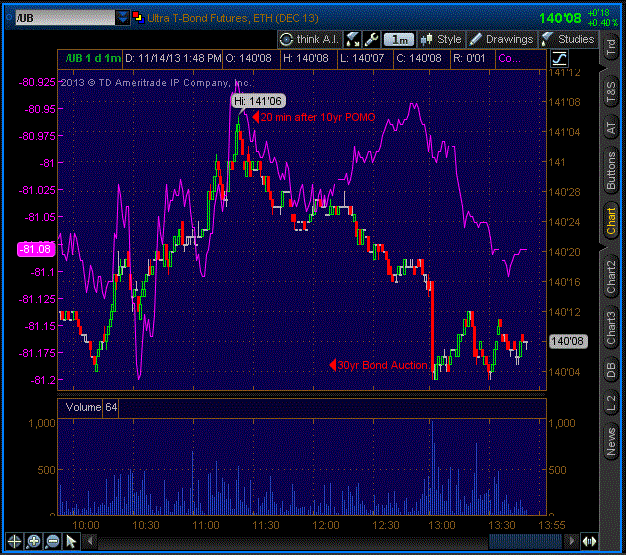
Today the treasury auctioned off 16bln 30yr bonds at 1pm (ET).  This occurred during a fairly volatile backdrop.  Janet Yellen was answering questions from the Senate for much of the “setup” period.  Her testimony was fairly QE – supportive, and so the bond market rallied during her entire testimony.  Then we had a 3.5bln 10yr POMO @ 11am (ET) 2 hours before the auction.  This was the pre-auction crescendo that many day traders are familiar with.

Bonds rallied right into the 20minute period after the 10yr POMO in a crescendo of volume….and then fell back down to the overnight VWAP after the 1pm 30yr auction tailed 1.5 basis points.

(pictured are 30yr UB futures vs inverse DX futures)

I suggested selling bonds at 11:20am this morning into the crescendo of volume, and covering after the auction.  As a trader, i couldn’t really think of anything else to do.

Up until the 10yr POMO, the 10/30 curve was stable at 108 basis points.   This indicated that a concentrated short setup had not taken place.  However, after 11:20am, 30yr bonds started to underperform (both outright price and on the curve), indicating that the setup (selling bonds pre-auction) had begun.  I thought the timing of this setup selling very coincidental.

While the treasury market is still generally strong post-auction (the belly inparticular), the fact that the 30yr auction tailed indicates that the large short base pre-Yellen speech release has mostly covered and the market should be fairly stable in the current price range.

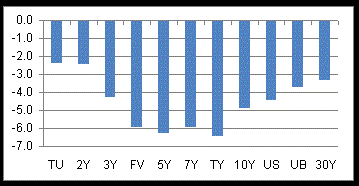
 (UST yield change on day)

Typically, the treasury market builds a concession pre-auction, and actual investors of US Treasury paper buy these auctions to get long.  Today that is a scary trade (getting long) because the market has repriced higher after Yellen’s early-release speech last night.

As a day trader, i won’t participate in that trade…but as a portfolio manager, i’m sure that many are.
 With Janet Yellen at the helm, its clear that the economy will need to clearly demonstrate deep economic strength before she will consider reducing QE…and that may be a long time away.

If you are interested in this type of bond market commentary intraday, in addition to following along with the trades that i am doing in the market, then i suggest trying out my paypal subscription twitter feed.

-GovtTrader


http://govttrader.blogspot.com/

https://twitter.com/GovtTrader


via Zero Hedge http://feedproxy.google.com/~r/zerohedge/feed/~3/hGIJyK_2q8o/story01.htm govttrader