South Sudan Rebel Leader Returning to Capital, May Signal End of Civil War

Riek Machar, the South Sudanese vice president who was dismissed in 2013 over coup charges and started his own rebel army, has returned to Juba, the country’s capital, today, after a week of delays largely over how many rebel soldiers Machar could bring into the capital with him and what kind of weapons they could take with them.

A peace deal between Machar’s forces and the government will apparently return Machar to his role as vice president, and offer his party a number of cabinet appointments to make as well as control of two oil-rich provinces, according to the Sudan Tribune.

Machar will also command his own army and police force for at least a year before it is integrated into the Sudanese People’s Liberation Army, the southern Sudanese rebel group that became the official army of the country when its residents voted for independence in 2011.

A 2014 New York Times article called South Sudan “in many ways an American creation, the result of a “referendum largely orchestrated by the United States” with “fragile institutions nurtured with billions of dollars in American aid.” This was at the height of the civil war in South Sudan, once a hopeful to be one of America’s “success stories” on the African continent.

“None of us is naïve; this is a real and profound crisis,” Gayle Smith of the White House National Security Council told The Times at the time. “But we’ve got a long history, and we’ve got some leverage.” That leverage, however, was disappearing as South Sudan became the recipient of oil revenue after independence that used to go to the Sudanese government in Khartoum. Independence also meant it was no longer subject to the U.S. embargo on Sudan.

South Sudan has topped the Fragile States Index for the last two years, surpassing even Somalia. South Sudan’s president, Salva Kiir, has been linked to a construction company awarded at least $160 million in government road contracts since South Sudan’s independence.

The country spends a greater percentage of its gross domestic product on its military than any other country on the planet. The U.S. has spent at least $1 billion on aid to South Sudan’s government, including for its military. Human Rights Watch estimates about 15,000 child soldiers have been conscripted during the civil war, by government and rebel forces.

from Hit & Run http://ift.tt/1SNqjHK
via IFTTT

Sow Rape Culture Hyperbole, Reap Transgender Bathroom Paranoia

KidnappingWhy not let transgender people use the bathroom of their choice? The problem, many conservatives insist, is that rapists and sexual deviants will take advantage of looser bathroom laws in order to assault little girls and boys. 

That argument strikes me as absurd. But I’m surprised it’s not more persuasive among liberals—particularly a certain kind of liberal, the feminist anti-rape activist—who believe we live in an actual rape culture where sexual assault is an everyday occurrence for as many as a quarter of all women. 

On college campuses, the left has defined “rape culture” down to indict not just forcible assault, but nonconsensual touching, harassment, and in some cases, offensive but clearly constitutionally-protected expression. Activists have done this with the explicit goal of convincing people, particularly women, that they live in uniquely perilous times: sexual assault has reached epidemic levels, they say. Consider this ad campaign from the co-creators of The Hunting Ground documentary, which warns incoming female students—in no uncertain terms—that their college memories will include “being raped by someone you thought you could trust.” 

These efforts have been underway for years, despite solid evidence that sexual assault is decreasing nationwide, less prevalent on campuses than other places, and not overwhelmingly the work of serial sexual predators. [Related: Junk Science and Campus Rape.] 

Scaring people has consequences. College administrators, with the federal government’s backing, have accepted rape panic and used it as a pretext to regulate students’ sex and social lives to an extent unprecedented since before the 1960s. 

Which is not to say that stoking unnecessary fears is the exclusive domain of the left. A great many safety panics are caused by the left. Others are more difficult to pin down ideologically, though equally destructive. 

Here are some other things people are afraid of. 

At Reason, Lenore Skenazy documents the incomprehensible public panic over kids playing in parks by themselveswalking to and from school, and waiting in cars. Paranoid moralizers, busybodies, authority figures, and local news reporters have all played a role in drumming up bizarre support for the idea that an unsupervised child is an endangered child. The American public—and in many cases, local law enforcement—have bought into the notion that sociopaths are lurking around every corner, ready to abduct any child left alone for more than a second. 

To say these fears are overblown gives them more credence than they deserve. Streets, parks, and schools have never been safer. Violent crime has plummeted. Most child abductions are caused by someone the child knows—usually a family member, often as the result of a custody dispute—rather than by a stranger. The same authority figures who demand incessant supervision of children grew up with far greater autonomy in far more dangerous times. 

Nor are hundreds of thousands of underage girls being kidnapped by sex traffickers and forced into underground prostitution rings. My colleague Elizabeth Nolan Brown has repeatedly debunked this particular public panic. 

In summary, the American people are constantly bombarded with misleading statistics, gross exaggerations, and outright lies about sexual assault, child safety, child abductions, sex trafficking, sexual predators, and related subjects. Is it really so surprising, then, that a lot of people are suddenly worried about children being sexually assaulted in public restrooms? 

Popehat’s Ken White, a Reason contributing editor, states the matter perfectly

I don’t find transgender people scary, and I’m not concerned they are out to molest my kids. … 

But here’s the thing: in viewing the situation that way, I’m fighting against what our culture is screaming at me to think. 

Our kids are much safer than they’ve been in generations, but our culture relentlessly demands that we be terrified for their safety — specifically including their safety from “stranger danger.” The very media outlets that will spend today suggesting that you’re bigoted and ignorant if you worry about “a man in my daughter’s bathroom” will tomorrow go back to making money by scaring the living shit out of you about how your daughter is in constant peril from kidnappers and rapists and child molesters and crime, crime, crime. The culture that tells you today that your fear is irrational will tomorrow return to telling you to embrace fear you can’t rationalize. This message isn’t all law-and-order, either. The leftward-leaning side of the culture telling you today that you’re a bigot for fearing rape in a Target bathroom will return tomorrow to telling you you’re living in a rape culture and that you ought to be accepting of the stories, insights, and fears of the people who face that culture. In short, having long refused to hold you accountable for your fears, and having stoked them and encouraged you to indulge them, the culture is now abruptly demanding that you justify them logically. That strikes me as unfair. 

Full thing here

It’s a terrible shame that transgender people have to suffer discrimination as a result of the public’s irrational fear. Supporters of the transgender community ought to urge people to be less bigoted. But they should also persuade people not to be so irrationally fearful about a great many other things. When we sow fear, we reap demagoguery.  

from Hit & Run http://ift.tt/26s8zWD
via IFTTT

The “Fracklog Trigger”: Why 500,000 Barrels Of Shale Crude Could Hit The Market At Any Moment

Yesterday, when reading through Pioneer’s results we stumbled on something unexpected: not only was the company pumping more than its had previously guided, but announced it was waiting for $50/barrel to reactivate five to ten horizontal drilling rigs. To wit:

  • producing 222 thousand barrels oil equivalent per day (MBOEPD), of which 55% was oil; production grew by 7 MBOEPD, or 3%, compared to the fourth quarter of 2015, and was significantly above Pioneer’s first quarter production guidance range of 211 MBOEPD to 216 MBOEPD; oil production grew 10 thousand barrels oil per day during the quarter, or 9%, compared to the fourth quarter;
  • expecting to deliver production growth of 12%+ in 2016 compared to the Company’s previous production growth target of 10%; the higher forecasted growth rate reflects improving Spraberry/Wolfcamp well productivity;
  • expecting to add five to ten horizontal drilling rigs when the price of oil recovers to approximately $50 per barrel and the outlook for oil supply/demand fundamentals is positive

Whether this is due to aggressive hedging (as also explained previously) or simply because Pioneer and its peer companies have dramatically reduced their all-in costs of production is unclear, but what is clear is that with every dollar that the price of oil rises, the risk of US shale coming back to market in an aggressive fahion become ever greater.

Today, we turn our attention to another potentially disruptive source of oil supply, one also covered previously, namely Drilled, Uncompleted Wells, or DUCs.

As Bloomberg writes, drilled, uncompleted wells could return 500,000 barrels a day back to the market, according to Richard Westerdale, a director at the U.S. State Department’s Bureau of Energy Resources. The inventory of wells is known as the fracklog.

Once we start approaching $45 and above, the risk of a much sharper pullback starts to increase as a lot of shale becomes profitable again,” Angus Nicholson, an analyst at IG in Melbourne, said by phone. “It’ll bring more supply back into the market. This happened last year when a swathe of output hit the market after a price gain and subsequently led to oil dropping to record lows.”

As Bloomberg reminds us, oil has rebounded amid speculation a global glut will ease after a decline in U.S. production this year trimmed more than 280,000 barrels a day of daily supply. However, that may not last long, especially if oil prices continue rising: as noted above, Pioneer Natural Resources Co. has expanded its 2016 production growth target as wells pump more than expected. Others such as EOG Resources, the largest landholder in the Eagle Ford shale formation in Texas, said it will wait for the market to rebalance before boosting output. It may not wait much longer.

Meanwhile, the above brings up a point we just presented with a previous post in which Morgan Stanley asked if algos will succeed in pushing oil back to $60.

Last year, US oil output surged to a weekly record in June as drillers returned rigs to service after West Texas Intermediate climbed above $60 a barrel. The rebound was short-lived, with prices slipping almost 40 percent to end the year at $37.04 as the nation’s stockpiles swelled.

The question is when will history repeat itself: since then output fell below 9 million barrels a day this month to the lowest since October 2014. Drillers have cut more than 190 rigs from service this year to the least amount of active machines since 2009, according to data from Baker Hughes Inc.

The question: how long until oil prices are high enough for production to once again triumphantly return? Because everyone knows what oil did last summer, and more importantly, last fall and winter.

via http://ift.tt/1T2Q6Wg Tyler Durden

Greener Earth Thanks to Extra Carbon Dioxide from Fossil Fuels, Says New Study

GreenerEarthEarth is getting much greener because humanity is adding more carbon dioxide to the atmosphere by burning coal, oil, and natural gas. The amount of carbon dioxide in the atmosphere has increased from 280 parts per million (ppm) in 1800 to nearly 400 ppm today. Plants breathe in carbon dioxide and use it to make the sugars, starches, carbohydrates, and proteins that are used to their construct roots, stems, and leaves. Carbon dioxide is essentially a kind of fertilizer.

A new study in Nature Climate Change, “Greening of earth and its drivers,” analyzes satellite data from 1982 to 2009 and finds that between 25 and 50 percent of the earth’s terrestrial surface is becoming greener whereas only 4 percent is browner. They attribute 70 percent of the observed greening trend to the carbon dioxide fertilization effect, 9 percent to extra nitrogen added by human activities like farming, 8 percent to a warmer wetter climate, and 4 percent to land cover changes, e.g., abandonment of farms and reforestation.

CO2 PlantsAn intriguing 2010 study in the journal New Phytologist looked at how low levels of carbon dioxide affect plant growth. Toward the end of the last ice age, atmospheric levels of carbon dioxide were around 180 to 200 ppm. The researchers estimate in such a carbon dioxide impoverished atmosphere that plant growth was about 50 percent lower than at present. Increasing levels of carbon dioxide not only raised global average temperatures but perhaps made a switch to agriculture worthwhile for our ancestors by raising plant productivity. 

Despite the good news that extra carbon dioxide is greening the planet, the researchers believe that future increases will have less and less effect on plants; chiefly because growth will be limited by the lack of other nutrients. The BBC also reports, “The lead author, Prof Ranga Myneni from Boston University, told BBC News the extra tree growth would not compensate for global warming, rising sea levels, melting glaciers, ocean acidification, the loss of Arctic sea ice, and the prediction of more severe tropical storms.”

No silver lining is evidently without its dark cloud.

from Hit & Run http://ift.tt/1pCAmlk
via IFTTT

Obama Reveals Plans To Build A “Missile Defense Shield” Around North Korea

While it has amounted to nothing more than mere populist posturing and jawboning, with the occasional entertaining (fabricated) clip of a submarine missile launch thrown in for good measure, North Korea’s launches of ballistic missiles have succeeded in provoking anger among the international community, which has so far been unable (or unwilling) to provide an adequate response to Kim Jong Il’s periodic “shows of strength”, mostly for domestic consumption.

However, Obama now appears ready to respond. In an interview with CBS’ Charlie Rose, Obama described the regime as “a massive challenge.”

“Our first priority is to protect the American people and our allies, the Republic of Korea, Japan, that are vulnerable to the provocative actions that North Korea is engaging in,” Mr. Obama said.

He said North Korea is “erratic enough” and the country’s leader, Kim Jong Un, is “irresponsible enough that we don’t want them getting close.”

“But it’s not something that lends itself to an easy solution,” Mr. Obama said. “We could, obviously, destroy North Korea with our arsenals. But aside from the humanitarian costs of that, they are right next door to our vital ally, Republic of Korea.”

So how is Obama preparing to fend off threats from North Korea? It appears that the US will set up a missile defense system to surround North Korea and shoot down any future flying nuisances. 

“One of the things that we have been doing is spending a lot more time positioning our missile defense systems, so that even as we try to resolve the underlying problem of nuclear development inside of North Korea, we’re also setting up a shield that can at least block the relatively low-level threats that they’re posing right now,” Obama said.

Which is surprising considering North Korea has no chance of ever launching a fully functioning ICBM, let alone one which can reach the US.

So what is the unsaid impetus for this move? Perhaps it is simply to deploy even more ships and military equipment in the region where recent diplomatic posturing between the US and China over various contested islands in the South China Sea has been the biggest geopolitical threat in recent years.

“How aggressive do you see the action in the South China Sea? And do you worry that they will cross some line, in which you’ll have to respond more aggressively?” Rose asked the president.

“I’ve been consistent, since I’ve been president, in believing that a productive, candid relationship between the United States and China is vital, not just to our two countries, but to world peace and security,” Mr. Obama said.

It’s not a zero-sum game, Mr. Obama added.

“What is true, though, is that they have a tendency to view some of the immediate regional issues or disputes as a zero-sum game,” he said. “So with respect to the South China Sea, rather than operate under international norms and rules, their attitude is, ‘We’re the biggest kids around here. And we’re gonna push aside the Philippines or the Vietnamese.’ … But it doesn’t mean that we’re trying to act against China. We just want them to be partners with us. And where they break out of international rules and norms, we’re going to hold them to account.”

This latest development comes just days after Reuters reported that in an apparent attempt to cement its stronghold on the South China Seas, China is getting closer to building maritime nuclear power platforms that could one day be used to support projects in the disputed islands. 

The Global Times, an influential tabloid published by the ruling Communist Party’s official People’s Daily, said the nuclear power platforms could “sail” to remote areas and provide a stable power supply.

The northwest side of Mischief Reef showing a 1,900 foot seawall and
newly-constructed infrastructure including housing, an artificial turf
parade grounds, cement plants, and docking facilities are shown

China Shipbuilding Industry Corp, the company in charge of designing and building the platforms, is “pushing forward the work”, said Liu Zhengguo, the head of its general office.

“The development of nuclear power platforms is a burgeoning trend,” Liu told the paper. “The exact number of plants to be built by the company depends on the market demand.”

Demand is “pretty strong”, he added, without elaborating.

Which means that soon China may have nuclear facilities sailing in close proximity to US ship as they continue to contest Chinese territorial disputes. And now the US will be dispatching even more ships to the region under the pretext of creating a missile shield around North Korea. Hopefully nothing will go wrong.

Obama’s full Charlie Rose interview is below.

via http://ift.tt/1Syoj0M Tyler Durden

Surviving Mission Creep – The Inglorious History Of Economic Central Planning

Submitted by Tim Price via SovereignMan.com,

“So there is another reason why Europe isn’t growing and it’s one the central bank can do nothing about. Namely, the 19 governments of the Eurozone and the super-state in Brussels have essentially outlawed it. If you want to know why growth is so tepid just examine the Eurozone’s massive barriers to enterprise and work in the form of taxes, regulation, welfare state extravagance, crony capitalist subsidies and privileges and labour law protectionism.


In a word, the problem is not that private sector credit is too niggardly; it’s that the leviathan state has crushed the ingredients of supply side enterprise and growth. When the state budget consumes 50% of GDP, and its tentacles of regulation and intrusion penetrate most of the rest, the central bank’s printing press is impotent.”


– David Stockman.

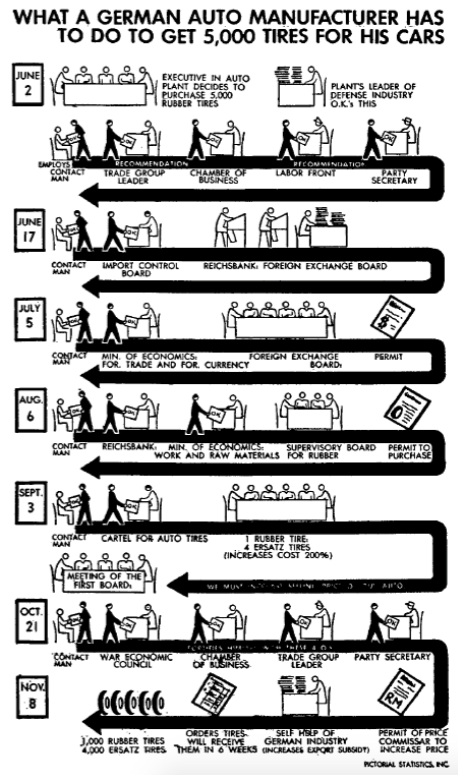
The history of economic central planning is not exactly glorious. The Soviet Union’s economy finally collapsed in the late 1980s, but not before over 20 million of its citizens had been murdered. The People’s Republic of China started implementing meaningful economic reforms in 1978, after having terminated the existence of over 45 million of its own people. Central planning in Nazi Germany was admittedly successful in bringing down the domestic unemployment rate, but the success of its wider economic legacy is debatable. Gu?nter Reiman in ‘The Vampire Economy: doing business under Fascism’ highlights the process involved in, for example, a German carmaker of the regime purchasing 5,000 rubber tyres:

German Rubber Tyres

The process culminates in the delivery of 1,000 rubber tyres and 4,000 ersatz tyres, albeit after five months.

Ludwig von Mises, in his magnum opus ‘Human Action’, wrote on ‘The impossibility of economic calculation under socialism’:

The paradox of “planning” is that it cannot plan, because of the absence of economic calculation. What is called a planned economy is no economy at all. It is just a system of groping about in the dark. There is no question of a rational choice of means for the best possible attainment of the ultimate ends sought. What is called conscious planning is precisely the elimination of conscious purposive action…


The mathematical economists are almost exclusively intent upon the study of what they call economic equilibrium and the static state. Recourse to the imaginary construction of an evenly rotating economy is, as has been pointed out, an indispensable mental tool of economic reasoning. But it is a grave mistake to consider this auxiliary tool as anything else than an imaginary construction, and to overlook the fact that it has not only no counterpart in reality, but cannot even be thought through consistently to its ultimate logical consequences. The mathematical economist, blinded by the prepossession that economics must be constructed according to the pattern of Newtonian mechanics and is open to treatment by mathematical methods, misconstrues entirely the subject matter of his investigations. He no longer deals with human action but with a soulless mechanism mysteriously actuated by forces not open to further analysis. In the imaginary construction of the evenly rotating economy there is, of course, no room for the entrepreneurial function. Thus the mathematical economist eliminates the entrepreneur from his thought. He has no need for this mover and shaker whose never ceasing intervention prevents the imaginary system from reaching the state of perfect equilibrium and static conditions. He hates the entrepreneur as a disturbing element. The prices of the factors of production, as the mathematical economist sees it, are determined by the intersection of two curves, not by human action.

But Marxist economic theory has other strings to its bow. It has not just murdered tens of millions of people, bankrupted entire nations, and provoked international warfare. It has also provided employment for literally dozens of economists at British universities and newspapers.

Mario Draghi, the unelected Goldman Sachs alumnus now attempting to macro-manage the Eurozone economy via the European Central Bank, was engaged in a bitter-sounding spat with German politicians last week. Germany’s finance minister, Wolfgang Scha?uble, had made the not unreasonable assertion that

“It is indisputable that the policy of low interest rates is causing extraordinary problems for the banks and the whole financial sector in Germany. That also applies for retirement provisions.”

Draghi’s response was robust, albeit progressively disingenuous:

“We have a mandate to pursue price stability for the whole of the Eurozone, not only for Germany. We obey the law, not the politicians, because we are independent, as stated by the law…”

It also became progressively political:

“With rare exceptions, monetary policy has been the only policy in the last four years to support growth.”

But neither Mario Draghi nor the European Central Bank has a mandate to support growth. That is not his job.

David Stockman again:

But here’s the thing. The world’s greatest monetary charlatan is nearly out of tricks. He pointedly backed off from helicopter money today because the Germans have obviously drawn a line in the sand. And he can’t push NIRP much farther without breaking what remains of Europe’s sclerotic socialist banking system. And if he tries even more negative carry money under TLTRO it will assuage the margin pressure on European banks but not make the Eurozone’s debt besotted households and businesses a wit more credit-worthy or inclined to borrow.

Mario Draghi is not acting in isolation. The world’s major central banks are now acting entirely outside whatever spurious authority they believe they have amassed for themselves – undemocratically – since the Global Financial Crisis first ignited.

The mandate of the US Federal Reserve System, for example, is “to provide the nation with a safer, more flexible, and more stable monetary and financial system”. After over a century of Fed overseen credit cycles and banking crises, it is legitimate to ask: safer and more stable compared to what?

As the American economist Thomas Sowell points out,

Socialism in general has a record of failure so blatant that only an intellectual could ignore or evade it.

Someone should tell Mario Draghi, perhaps.

But in the business of fiduciary investing, we are tasked with operating in the financial world as is, not the financial world as we would like it to be. The financial world as is, is a world of negative interest rates, typically overvalued financial assets and increasingly arbitrary monetary policy. Not an easy world in which Mises’ hero, the entrepreneur, can comfortably operate. But try, he must. The entrepreneur might justifiably counter that the future is never certain.

The asset allocator is tasked with a similar problem. How can one sensibly invest when all prices have been distorted and no prices can be taken at face value (assuming they ever could)? The answer, surely, is to focus solely on those areas of the global marketplace which have the characteristics of high quality, matched by the attributes associated with the possession of a ‘margin of safety’. Along with an association with high quality, ‘margin of safety’ in the financial markets of 2016 implies very specifically the absence of conspicuous overvaluation. Bonds no longer qualify in any real sense, but value equities still do. Happily, investible pockets of them still exist, despite the best efforts of the arch-exponents of mission creep to demolish the working economy.

via http://ift.tt/240m2WO Tyler Durden

Why All Eyes Will Be On Apple’s Earnings Report After The Close

Shortly after the close today, Apple will report its much watched earnings which will be closely watched for several reasons. The biggest one is that since Q1 2014 AAPL has contributed 25% of the S&P’s 4.2% growth rate (excluding the EPS benefit of the company’s massive buyback program). Furthermore, roughly 40% of the nearly 9% jump in Tech margins since 2009 is attributable to Apple alone.

However, that was all in the past: this quarter Apple is actually forecast to subtract 0.7% from the S&P’s bottom line.

The reason: the iconic company is expected to report its first ever year-over-year decline in iPhone unit sales: at 50.7 million iPhone sold, this will represent a steep 17% drop from a year ago.


The slowdown in Apple’s iPhone sales has been documented here previously, both through channel checks, and most recently from media reports suggesting the company itself is dramatically slowing down production. This has been a bitter pill to swallow for the throngs of raving sellside analysts: most recently Raymond James analyst Tavis McCourt lowered his full-year outlook on iPhone sales to 212 million units earlier this week on “meaningfully lower” average selling prices

The consensus estimate is calling for iPhone unit sales of 217 million for fiscal 2016, compared to a record 231 million last year.


Worse, compounding these issues are signs people are upgrading their phones less frequently than they used to, a slowdown in demand in China, and expectations that the new iPhone 5SE and Apple Watch are selling below expectations.

Some other key observations: The current mean EPS estimate for the company for Q1 2016 is $2.00, compared to year-ago actual EPS of $2.33. If Apple reports a year-over-year decline in EPS for Q1 2016, it will mark the first time the company has reported a year-over-year decline in EPS since the calendar third quarter of 2013 (fiscal fourth quarter of 2013 for Apple). However, while AAPL has posted declining EPS before, this will be the first time in which the company will also reported an annual drop in iPhone sales.

As Factset adds, as a result of the decline, Apple is expected to be the largest contributor to the blended earnings decline for the Information Technology sector for Q1 2016. The blended (combines actual results for companies that have reported and estimated results for companies yet to report) earnings decline for the Information Technology sector is -7.4%.

Excluding Apple, the blended earnings decline for the sector would be -4.1%.

If Apple reports actual EPS equal to or below the mean EPS estimate for the quarter, it will mark the first time Apple has been the largest detractor to earnings growth for the Information Technology sector since the calendar third quarter of 2013.

And just like iPhones were a key driving force behind the profit growth of the S&P, now comes the payback: over the past three years on average, the iPhone product segment has accounted for nearly 60% of the total revenues generated by Apple. In four of the past five quarters, the iPhone product segment has reported year-over-year revenue growth in excess of 35%. However, last quarter (Q4 2015), the segment reported year-over-year revenue growth of only 7%. For Q1 2016, the segment is projected to report a year-over-year revenue decline of -18%. If the iPhone product segment does report a year-over-year decline in sales for the calendar first quarter, it will mark the first year-over-year decline in iPhone sales since FactSet began tracking sales for this product segment in the calendar fourth quarter of 2010.

Suddenly betting it all on ravenous iPhone demand does not seem like a brilliant idea.

Some other consensus expectations.

Revenue: sell-side analysts expect Apple to report revenue of $52.0 billion, according to FactSet, down from $58.0 billion in the same period last year. Contributors on Estimize according to Marketwatch, are forecasting revenue of $51.5 billion. In January, Apple forecast revenue between $50.0 billion and $53.0 billion for the quarter. The company fell slightly short of the FactSet consensus estimate last quarter, but beat expectations in the five straight quarters before that.

Stock reaction: Shares of Apple have increased 5% from three months ago, underperforming the Dow Jones Industrial Average, which is up nearly 12%. The stock is down 17.5% from 12 months ago, while the index has stayed relatively flat. It recently entered and exited a bear market. Earlier this week, Deutsche Bank analyst Sherri Scribner forecast that Apple shares would “trade at a discount,” as her analysts found that S&P 500 companies with more than a 3% index weight tend to trade at a roughly 20% discount to the market’s forward P/E multiple.

What to watch for: According to MarketWatch, China has been a bright spot for Apple for several quarters (recall the infamous Tim Cook email to Jim Cramer on August 24, 2015), but the world’s largest consumer market is starting to become saturated with smartphones, which is slowing the pace of growth there. Adding fuel to the fire are reports that Chinese regulators this week shut down Apple’s online book and movie services in the country as it tightens guidelines on media. Macroeconomic issues continue to weigh on sales growth not only in China, but in other regions across the world.

Since Apple’s first-quarter earnings report in January, analysts have grown more skeptical on whether the company can maintain the pace of growth it experienced during the heyday of the iPhone. Deutsche Bank’s Scriber, who has a neutral rating and $105 12-month price target on the stock, said that long-term fundamentals suggest “top-line growth will be more challenging going forward.” Last month, BTIG analyst Walter Piecyk said there appears to be a “structural change underway in the pace of upgrades,” which could weigh on sales growth long term.

Despite all the criticism, other analysts are more optimistic that Apple will be able to get through the near-term trauma by building out its software and services platforms. Earlier this month, Credit Suisse analyst Kulbinder Garcha said analysts were underestimating and underappreciating the potential growth of services such as Apple Pay, Apple Care, Apple Music and iCloud.

Will the optimists win out? Find out in two hours.

via http://ift.tt/1MWS4eF Tyler Durden

Spain “Doomed” To New Elections After King Felipe Unable To Bring Parties Together

Back In December, Spain held what turned out to be inconclusive elections as voters clearly rejected the status quo with the country's lowest turnout in three decades. While incumbent Rajoy gained themost seats he was unable to get a majority and now four months later, King Felipe appears to have thrown in the towel on trying to bring the sides together in a working coalition. A new election for Spain is now inevitable in the summer after the king said no candidate counts with enough support to form a government – after a third round of talks between party leaders, the king won’t nominate a candidate, the Royal Palace said in a statement.

To be sure, voters were clearly sick of the status quo. The country’s three decade old political duopoly was broken when PP and PSOE garnered their lowest combined share of the vote since the eighties.


And now as AP reports,

A new election in June for Spain seemed all but inevitable Tuesday after the leader of the country's Socialist party said he was open to a last-minute deal for a coalition government proposed by a small leftist group but predicted he wouldn't get enough support to pull it off.


Pedro Sanchez said Spain is "doomed to a call for new elections" after meeting with King Felipe VI, who has spent the last two days with political leaders to determine whether he should pick one to try to form a government or set a fresh national election for June 26 in a bid to break four months of political paralysis.


The poll would happen six months after the last election on Dec. 20 that saw the downfall of the country's traditional two-party system as voters enraged by high unemployment, corruption and austerity cuts strongly supported two new upstart parties.


Felipe was expected to decide Tuesday night whether or not Spain will hold another election after meeting with acting Prime Minister Mariano Rajoy, who told the king on Tuesday for the second time since January that he doesn't have enough support among other parties to cobble together a government led by his conservative Popular Party.


Sanchez' declaration came after the small Compromis party floated a list of 30 proposals Tuesday to form a new government to rule in the 350-seat lower house of Parliament, and the Socialists said they could accept most of them.


The challenge in Spain for forming a government has come down to mathematical calculations on which party could win enough support in an election that saw the Popular Party come in first with 123 seats, the Socialists second with 90, the far-left Podemos party with 60, the business friendly Ciudadanos with 40 and a handful of smaller parties with the remaining 37 seats.


Sanchez had already struck a deal with Ciudadanos but in two votes last month was unable to convince Podemos and Compromis, which together have sway over 69 seats, to join them.


Podemos leader Pablo Iglesias said his group backed the last minute Compromis plan but that the Socialists' refusal to enter into a coalition of leftist forces excluding Ciudadanos meant the deal had little chance of success.


Ciudadanos leader Albert Rivera rejected the proposal outright and also predicted the country was headed for another election.


Polls suggest a repeat election — which would be a first for Spain since democracy was restored in 1978 — is unlikely to break the stalemate and could mean a political impasse stretching into the summer, possibly ending with another impasse and yet another election.


Spain has never had a coalition government at the national level. The Socialists rejected Rajoy's proposal for a grand coalition as has happened in many other European countries.

Additionally, The King asked parties on Monday to keep the costs of a new political campaign down, a sign he had little hope a viable pact could be found, and some leaders have already acknowledged they lack the support of rivals to secure a parliamentary majority.

In December's election, which produced the most fragmented result in decades, the center-right People's Party (PP) of caretaker Prime Minister Mariano Rajoy won 123 seats in the 350-seat lower house of parliament, while the Socialists took 90, Podemos 69 and Ciudadanos 40.


Although opinion polls suggest a new election would do little to resolve the deadlock, leaders have entered pre-campaign mode, blaming each other for the impasse which may start taking its toll on the economy more noticeably if Spain remains without a government for many more months.

So more political turmoil ahead in the periphery, turmoil which has the potential to rattle markets. But perhaps the most important thing to note about everything said above is this: a leftist-led government is now considerably more certain. It's only a matter of what form it will take. That means the religious adherence to Berlin-style fiscal rectitude is going to come to a rather unceremonious end sooner or later. That, in turn, means the relative calm shown in the following chart may well give way to carnage by the end of the year…

via http://ift.tt/24i7bng Tyler Durden

Is Breadth Signaling More Than Meets The Eye In This Market?

Via Dana Lyons' Tumblr,

Does an unprecedented show of positive breadth foretell a quick end to stocks’ recent struggles?

One year ago, the emerging theme in the stock market was the failure of the stock market’s internals to keep pace with the advance in the major averages. This negative divergence would persist into the summer before reaching a head in late July. For us, it was easy to reach the conclusion that the internal deterioration had substantial negative implications for the broad market. This was based not only on intuition, but historical evidence as well. Now whether or not the long-term negative implications suggested by that internal deterioration come to pass is still to be determined. However, I think it is reasonable to assume that this dynamic played a role in the weakness that unfolded over the subsequent 6 months.

Fast forward one year and we have the opposite situation…sort of. The breadth off of the mid-February low has been extraordinarily positive, even out-shining the advance in the large-cap averages. While this is a positive and bodes well for an eventual extension of the 2-month rally, we would not place its implications on par with last year’s situation. Last year saw a persistent negative divergence wherein many pieces of evidence accumulated into a great big storm cloud. Present circumstances are likely a positive factor on a smaller scale. Even so, the positive breadth again augurs for favorable market action, at least in the intermediate-term.

Then there are “one-offs” like we saw on Friday (April 22), i.e., unusual breadth occurrences that may or may not have implications for the near-term or longer. What happened on Friday? The Nasdaq 100 dropped almost 1.5% and the broader Nasdaq Composite fell 0.8%. Despite that, advancing stocks on the Nasdaq accounted for over 62% of all issues.

  • That marked the most positively skewed breadth on any day in history (back to 1988) that the Nasdaq Composite lost at least 0.8%.
  • Or, conversely, it marked the worst day ever for the Nasdaq Composite when advancing issues accounted for at least 60% of all stocks.

So is this just a bit of interesting trivia, devoid of larger meaning? Maybe, but let’s check out some similar historical precedents that may shed some light on what, if anything, we can expect going forward.

Obviously we have to relax our parameters a little given that Friday’s divergence was unprecedented. So first off, let’s look at all days the Nasdaq dropped at least 0.8% with more advancing issues than declining issues. Since 1988, there were 22 such days, before Friday.

image


Interestingly, Friday marked the first such occurrence since January 2008. Obviously, that date dispels the notion that our present case has to lead to positive longer-term performance. At the same time, however, there have been an equal number of dates occurring during cyclical bull and bear markets. So, perhaps any longer-term message can be dismissed.

As to the question of positive implications in the short or intermediate-term, those can essentially be dismissed as well – at least based on these historical precedents. Here is the performance of the Nasdaq in the aftermath of these dates.

image

To the extent that there is any conclusion to be gleaned from these prior events, it is not a bullish one. The most consistent trend was for weakness the following day as 20 of the 22 days saw the Nasdaq lose ground – and at a staggering -1.1% median return. Today’s trading makes it 21 for 23 day-after losses.

Things even out from there but still maintain a negative bias up to 3 months out. By 6 months, returns are almost back to normal. Now let’s take a look at the Russell 2000 as an (albeit imperfect) proxy for the broader, less top-heavy Nasdaq exchange. Returns following these days are a little bit brighter, but certainly nothing to get excited about.

image

What if we go from the other direction? That is, let’s look at all days when Nasdaq advancing issues accounted for at least 60% of all issues yet the Nasdaq Composite closed lower. Based on this criteria, we find 11 previous occurrences going back to 1988. The results? Outside of a tendency for gains 1 week later (the Nasdaq and Russell 2000 were up 9 of 11 times), the returns were so nondescript as to not even warrant presenting them.

So what’s the takeaway here? Studies of breadth thrusts similar to what we’ve witnessed off of the mid-February low tend to argue for a further extension of the rally. That said, positive daily breadth divergences like we saw on Friday would not. At best, the evidence is too scarce to lend one to conclude anything. At worst, the evidence that does exist has actually leaned to the bearish side. However, even that has been mostly a toss-up after 1 day, which we’ve already had.

Therefore, if you are bearish, this data point won’t change your mind. On the other hand, if you are bullish, it is almost a certainty that the rationale for your position is more sound than any that can be concocted from this data.

*  *  *

More from Dana Lyons, JLFMI and My401kPro.

via http://ift.tt/240aV0a Tyler Durden

10 Key Things To Watch In Tonight’s Presidential Primary Bonanza

Today we see five states hold the presidential primaries, the so-called “Acela Primary” as most of the states up for grabs fall along Amtrak’s Acela train line between Washington, D.C., and Connecticut, and with Hillary comfortable, and Trump looking for a sweep as he surges on the back of yet another failed “stop-trump” attempt, there should be no real surprises when polls close this evening.

One thing to keep an eye on is how Trump performs in Pennsylvania, which as we noted earlier, will be an indication of how well his campaign’s ground game is. He will need to be able to sway delegates his way if necessary during the convention, and this could be an early indicator for how well he’ll be able to do that. Also on the topic of Trump, the question is not if he will win tonight’s 5 states but whether he will be able to get above 50% of the vote in them (recent polls suggest it may be a stretch).

Here is a quick update on where the candidates stand heading into this evening.

Republicans

Democrats


* * *

Politico gives us ten key places to watch as results start to come in this evening.

Connecticut

Greenwich: If Kasich or Cruz can steal one of the state’s five congressional districts, it will likely be the affluent 4th District — where the Republican vote is anchored by wealthy and educated residents of Greenwich, Stamford and Bridgeport. In 2012, Mitt Romney ran about 10 points better in the 4th District than he did statewide.

New Haven: More votes came from New Haven than any other town in the 2008 Democratic primary, and it’s critical to Clinton’s effort to hold off Sanders — despite the fact she lost it badly four years ago.

In 2008, Barack Obama defeated Clinton by a more than two-to-one margin in New Haven, 66 percent to 32 percent — far greater than Obama’s 4-point margin of victory statewide.

New Haven is both a college town — it’s home to prestigious Yale University — and easily the state’s most-diverse city. Sanders, who has won more than 70 percent of the under-30 vote thus far, will likely clean up with college students. He attracted an estimated crowd of 10,000 to a Sunday night rally there.

But if Clinton can turn out minority voters — fewer than one-in-three New Haven residents was non-Hispanic white, according to the 2010 Census — she can build a coalition of older whites and minority voters to put her over the top.

Delaware

New Castle County: By far the largest of Delaware’s three counties, New Castle accounted for 64 percent of the vote in the 2008 Democratic primary, and 47 percent in the 2012 Republican primary.

But New Castle is also split between overwhelmingly Democratic Wilmington, the state’s largest city, and the rest of the county. How Democratic is Wilmington? The city was 13 percent of the overall statewide electorate in the 2008 Democratic primary, but only 2 percent of the 2012 Republican primary.

Wilmington is majority-black: Obama beat Clinton there in 2008, 75 percent to 22 percent. But the race was much closer in the rest of New Castle County, with Obama only ahead by 8 points, 52 percent to 44 percent.

The state is winner-take-all on the Republican side — and while nearly half the vote will come from New Castle County, it functions differently from the rest of the state.

Mitt Romney won Delaware with 56 percent of the vote in 2012 — capturing 60 percent of the New Castle vote, but only 50 percent in Kent County and 55 percent in Sussex County.

Maryland

Baltimore city: Majority-black Baltimore city should be a boon for Clinton. Obama beat Clinton by a three-to-one margin in Baltimore City in 2008, but Clinton’s advantage among African-Americans against Sanders project well for her here.

Clinton could also benefit from a competitive mayoral primary also on the ballot on Tuesday, which could goose turnout in Baltimore city compared to some more suburban precincts.

Baltimore County: In the Republican primary — where delegates are allocated winner-take-all to the victor in each congressional district — Maryland’s tortuous congressional map makes it difficult to isolate specific regions. The district lines, which were drawn by Democrats to ensure a 7-to-1 party advantage in the congressional delegation, snake through communities in an effort to separate Republicans and keep them from having too much influence in a number of districts.

But Baltimore County is crucial for the GOP candidates. It touches two of the three districts anti-Trump forces think are the best chances to defeat the real-estate tycoon: the 3rd and 7th districts.

The majority-black 7th District is overwhelmingly Democratic and will be a key district for Clinton in her primary. But a small number of Republicans will also vote there, and both Cruz and Kasich are hopeful they can sneak ahead of Trump there.

The 3rd District snakes from the Baltimore Inner Harbor all the way down to Annapolis, but also includes a good chunk of Baltimore County. Anti-Trump groups are seeking to boost the more moderate Kasich there.

Montgomery County: The populous, liberal suburbs north and west of D.C. represent Sanders’ best chance to cut into Clinton’s big lead in the state. Obama carried Montgomery in 2008 by 12 points, a much smaller margin than his 25-point statewide edge.

Like in Baltimore with the mayoral race, a number of local contests could also boost turnout, including an expensive, closely fought primary for Congress in the 8th District, which includes most of Montgomery County’s immediate D.C. suburbs.

Pennsylvania

Allegheny County: Allegheny County, which includes Pittsburgh and the immediate suburbs, holds more GOP voters than any other county in the state.

Pennsylvania’s “loophole primary” makes the focus on specific districts for Republicans trickier, but Allegheny is still a key battleground. Kasich was born and raised in the county, in McKees Rocks. Trump visited Pittsburgh earlier this month.

The county includes all or part of three different congressional districts: the 12th, 14th and 18th.

On the Democratic side, Allegheny is battleground territory: Clinton won it by almost nine points in 2008. A similar performance there on Tuesday could close the door on Sanders’ underdog bid at a statewide victory.

Lackawanna County: This is Clinton territory: She won Lackawanna by a yawning margin in 2008, 74 percent to 26 percent.

Clinton claims Scranton roots that served her well eight years ago. And it’s no surprise one of her closing events in the state was in Dunmore, just outside Scranton, last Friday. (Her husband held an event earlier this month at Scranton High School.)

These are mostly white voters who stuck with Clinton eight years ago. The question is whether they will still serve as a firewall for her on Tuesday, or jump to Sanders, as a number of white Democrats have in other states.

Philadelphia: Clinton managed to win statewide eight years ago despite losing Philadelphia by nearly a two-to-one margin, 65 percent to 35 percent.

This time around, the African-American base in Philadelphia should be strong for Clinton. But the city is also a big college town, and enhanced youth turnout could help Sanders.

Clinton has the backing of former Mayor Michael Nutter — who backed her over Obama in 2008 — and also from longtime supporter Ed Rendell, another former Philadelphia mayor and former two-term governor, who will be under pressure to reinstate his turnout machine to help the former secretary of state.

Rhode Island

Warwick: Providence, the state capital, should function much like Philadelphia but scaled down. Obama narrowly won in Providence in 2008; Sanders will need to turn out enough young voters — including students at Brown University and Providence College — to overcome Clinton’s advantages with non-white voters.

But Warwick, the state’s second-largest city, also looms large. Clinton won comfortably here eight years ago, beating Obama, 61 percent to 38 percent.

The city is mostly white, but the population leans older, which could benefit Clinton.

* * *

And just to confirm how serious tonight’s primary race is, even Goldman has opined, as per the following note.

After a brief period of uncertainty following the Wisconsin primary earlier this month, the Republican nomination once again looks like it is Mr. Trump’s to lose, while Sec. Clinton appears to have a tight grip on her party’s nomination and could clinch it outright (including “superdelegates” in the total) before the last of the contests in June.

Trump looks very likely to win all five states; the main uncertainty at this point is whether he will win sufficient delegates to put him on track to clinch a majority of delegates prior to the Republican convention that starts July 18. Connecticut, Delaware, Maryland, Pennsylvania, and Rhode Island go to the polls, with 118 Republican delegates at stake. Our expectation, based on polling in the states and each state’s primary rules, is that Mr. Trump is likely to win slightly less than 100 of the delegates in play.

Coordination between Gov. Kasich and Sen. Cruz might make a difference in Indiana, though Mr. Trump still looks like the narrow favorite there. Sen. Cruz and Gov. Kasich appear to be coordinating their campaign strategies, with Gov. Kasich shifting resources out of Indiana, and Sen. Cruz suggesting he will not focus on New Mexico or Oregon. The contest in Indiana does indeed look close — Mr. Trump leads Sen. Cruz by an average of 39% to 33% in an average of the only three polls in the state, conducted last week; Gov. Kasich is farther behind at around 19%. If enough support shifts to Sen. Cruz, it is possible that he could take the 30 delegates that Indiana will award to the statewide winner, plus a fraction of the additional 27 delegates split among the winners of the 9 congressional districts. However, “strategic voting” seems unreliable. When Sen. Rubio attempted something similar in urging his Ohio supporters to vote for Gov. Kasich, his actual vote share came in 4pp below his prior level of support, or a decline of slightly more than half. But the political and ideological differences between Sen. Cruz and Gov. Kasich are much greater than between Sen. Rubio and Gov. Kasich. Moreover, while the intent of the strategy seems clear enough, Gov. Kasich stopped short of actually instructing supporters to vote for Sen. Cruz.

Whatever the outcome in Indiana next week (May 3), Oregon and New Mexico will probably be less consequential. Although Sen. Cruz has suggested he will shift resources out of Oregon (May 17) and New Mexico (June 7), it might not make that much of a difference. These are among the few states left that allocate their delegates in proportion to the statewide result, so even if Gov. Kasich were to deny Mr. Trump a win in either state, it probably would make only a small dent in the delegate count.

There isn’t that much left on the table between today’s contests and June 7. A few other states vote in May, but these contests look unlikely to change the outlook significantly. Nebraska (May 10), Montana, and South Dakota (both June 7) look likely to award Sen. Cruz all of their combined 92 delegates. New Jersey (June 7) awards all of its 51 delegates to the statewide winner, and Mr. Trump seems to have a sizeable advantage there. West Virginia (May 10) has an unusual system that looks likely to award a substantial share of delegates to Trump while possibly also producing some unbound delegates. Washington State (May 27) is a bit of a mystery at this stage due to a lack of polls; it awards its statewide delegates proportionally so it might make slightly less of a difference in the delegate math in any case. Overall, we expect that Trump will win around half of the 199 delegates up for grabs in May, suggesting that the risks are fairly evenly balanced in next month’s contests.

The outlook in California (June 7) will quickly become a focus. Polling since the start of the month in California shows Mr. Trump averaging 46% support, well above Sen. Cruz’s 25% and Gov. Kasich’s 19%. However, while California awards 3 delegates to the winner of each congressional district (159 in total) like several other states, it awards a disproportionately small number to the statewide winner (13 delegates, which is the same number Rhode Island awards to the statewide winner, for example). This is important because even if Trump wins the majority in the state as a whole, he is apt to lose delegates to Gov. Kasich and Sen. Cruz in some congressional districts. We assume that he will win around 100 of the 172 California delegates in our illustrative delegate count (Exhibit 1) but there is obviously a good deal of uncertainty in these later races.

The outcome of the Republican nomination looks unlikely to become clear until the convention. If Trump fails to win 1237 delegates in the contests through June 7, his remaining option to secure the nomination would be to win the support of unbound delegates before or even during the convention, which starts July 18. Under the hypothetical delegate scenario illustrated in Exhibit 1 where Trump wins around 1200 of the delegates but falls short of a majority, he would need to work to gain the support of another 37 or more unbound delegates, out of around 150 total. However, a number of these delegates have already announced their support for other candidates (e.g., Sen. Cruz), leaving a smaller pool for Trump to draw from. The primary results in Pennsylvania could shed some light on this question; Pennsylvania will send 54 unbound delegates to the convention—the largest amount from any single state—and some Pennsylvania delegates have suggested they might feel obliged to support their state’s winner (though others have already announced support for a candidate regardless of the results). We would expect to see additional scrutiny of these delegates’ intentions in coming days.

via http://ift.tt/23413N0 Tyler Durden