Roubini: The End Of The Market’s ‘Trump Honeymoon’

Authored by Nouriel Roubini via MarketWatch.com,

Nouriel Roubini says fiscal recklessness, and bluster about trade, could sap growth…

When Donald Trump was elected president of the United States, stock markets rallied impressively. Investors were initially giddy about Trump’s promises of fiscal stimulus, deregulation of energy, health care, and financial services, and steep cuts in corporate, personal, estate, and capital-gains taxes. But will the reality of Trumponomics sustain a continued rise in equity prices?

It is little wonder that corporations and investors have been happy. This traditional Republican embrace of trickle-down supply-side economics will mostly favor corporations and wealthy individuals, while doing almost nothing to create jobs or raise blue-collar workers’ incomes. According to the nonpartisan Tax Policy Center, almost half of the benefits from Trump’s proposed tax cuts would go to the top 1% of income earners.

Expectations of stimulus, lower taxes, and deregulation might boost the U.S. economy and the stock market’s performance in the short term. But President Donald Trump’s inconsistent, erratic, and destructive policies will take a heavy toll on domestic and global economic growth in the long run.

Yet the corporate sector’s animal spirits may soon give way to primal fear: the market rally is already running out of steam, and Trump’s honeymoon with investors might be coming to an end.

There are several reasons for this.

For starters, the anticipation of fiscal stimulus may have pushed stock prices up, but it also led to higher long-term interest rates, which hurts capital spending and interest-sensitive sectors such as real estate. Meanwhile, a strengthening dollar BUXX, -0.09%  would destroy more of the jobs typically held by Trump’s blue-collar base. The president may have “saved” 1,000 jobs in Indiana by bullying and cajoling the air-conditioner manufacturer Carrier; but the U.S. dollar’s appreciation could destroy almost 400,000 manufacturing jobs over time.

Moreover, Trump’s fiscal-stimulus package might end up being much larger than the market’s current pricing suggests. As Presidents Ronald Reagan and George W. Bush showed, Republicans can rarely resist the temptation to cut corporate, income, and other taxes, even when they have no way to make up for the lost revenue and no desire to cut spending. If this happens again under Trump, fiscal deficits will push up interest rates and the dollar even further, and hurt the economy in the long term.

A second reason for investors to curb their enthusiasm is the specter of inflation. With the U.S. economy already close to full employment, Trump’s fiscal stimulus will fuel inflation more than it does growth. Inflation will then force the Federal Reserve to hike up interest rates sooner and faster than it otherwise would have done, which will drive up long-term interest rates and the value of the dollar still more.

Third, this undesirable policy mix of excessively loose fiscal policy and tight monetary policy will tighten financial conditions, hurting blue-collar workers’ incomes and employment prospects. An already protectionist Trump administration will then have to pursue additional protectionist measures to maintain these workers’ support, thereby further hampering economic growth and diminishing corporate profits.

If Trump takes his protectionism too far, he will undoubtedly spark trade wars. America’s trading partners will have little choice but to respond to U.S. import restrictions by imposing their own tariffs on U.S. exports. The ensuing tit-for-tat will hinder global economic growth, and damage economies and markets everywhere.

It is worth remembering how America’s 1930 Smoot-Hawley Tariff Act triggered global trade wars that exacerbated the Great Depression.

Fourth, Trump’s actions suggest that his administration’s economic interventionism will go beyond traditional protectionism. Trump has already shown his willingness to target firms’ foreign operations with the threat of import levies, public accusations of price gouging, and immigration restrictions (which make it harder to attract talent).

The Nobel laureate economist Edmund S. Phelps has described Trump’s direct interference in the corporate sector as reminiscent of corporatist Nazi Germany and Fascist Italy. Indeed, if former President Barack Obama had treated the corporate sector in the way that Trump has, he would have been smeared as a communist; but for some reason when Trump does it, corporate America puts its tail between its legs.

Fifth, Trump is questioning U.S. alliances, cozying up to American rivals such as Russia, and antagonizing important global powers such as China. His erratic foreign policies are spooking world leaders, multinational corporations, and global markets generally.

Finally, Trump may pursue damage-control methods that only make matters worse. For example, he and his advisers have already made verbal pronouncements intended to weaken the dollar. But talk is cheap, and open-mouth operations have only a temporary effect on the currency.

This means that Trump might take a more radical and heterodox approach. During the campaign, he bashed the Fed for being too dovish, and creating a “false economy.” And yet he may now be tempted to appoint new members to the Fed Board who are even more dovish, and less independent, in order to boost credit to the private sector.

If that fails, Trump could unilaterally intervene to weaken the dollar, or impose capital controls to limit dollar-strengthening capital inflows. Markets are already becoming wary; full-blown panic is likely if protectionism and reckless, politicized monetary policy precipitate trade, currency, and capital-control wars.

To be sure, expectations of stimulus, lower taxes, and deregulation could still boost the economy and the market’s performance in the short term.

But, as the vacillation in financial markets indicates, the president’s inconsistent, erratic, and destructive policies will take their toll on domestic and global economic growth in the long run.

via RSS http://ift.tt/2E6B2Ii Tyler Durden

Europe Looks to Solve Loneliness With New Government Ministries, Senate Considers Two-Year Budget Deal, and Trump Endorses a Possible Shutdown: P.M. Links

  • TrumpEurope looks to solve rising loneliness with more government ministries.
  • Senate considers two-year budget deal to prevent yet another shutdown.
  • Meanwhile President Trump says he would “love” to see a shutdown if funding for enhanced border security is not included in budget.
  • SpaceX has launched the world’s most powerful rocket today.
  • The stock market sees wild swings this week.

from Hit & Run http://ift.tt/2sjZ3u3
via IFTTT

WTI/RBOB Rise After Surprise Crude Inventory Draw

Both WTI/RBOB slid notably lower on the day amid equity market chaos, OPEC comments, and chatter about US production reaching 11m b/d sooner than expected. API printed an unexpected 1.05mm crude draw and WTI managed a small pop.

“The mood of the market will get a lot more positive as the stock market mood gets more positive,” Phil Flynn, senior market analyst at Price Futures Group Inc. in Chicago, said by telephone. Meanwhile, there’s concern about being “too long ahead of tonight’s API report.”

API

  • Crude -1.05mm (+3.15mm exp)
  • Cushing -633k
  • Gasoline-227k
  • Distillates +4.552m

Last week’s surprise crude build – breaking the streak of draws – has prompted expectations of a build again this week from analysts, but API shows a draw. The big build in distillates was also very notable…


The move in oil prices is “linked to what’s going on in the broader markets,”Tamar Essner, an analyst at Nasdaq Inc. in New York, said by telephone. “Markets tend to move in lockstep. In panic situations, markets tend to move together in a coordinated way.”

But we do note that as stocks ramped into the close, WTI/RBOB did not but very modestly popped higher on the API data


via RSS http://ift.tt/2Eq9bGa Tyler Durden

“1987”

Authored by Michael Lebowitz via RealInvestmentAdvice.com,

The 1987 stock market crash, better known as Black Monday, is frequently deemed a historical anomaly. Unlike the crashes of 1929, 2000, 2008 and other smaller ones, many investors are under the false premise that the stock market in 1987 provided no warning of the impending crash. On Black Monday, October 19, 1987, the Dow Jones Industrial Average (DJIA) fell 22.6% in the greatest one-day loss ever recorded on Wall Street. Despite varying perceptions, there were clear fundamental and technical warnings preceding the crash that were detected by a few investors. For the rest, the market euphoria raging at the time blinded them to what in hindsight seemed obvious.

As of just last week, the market was in a state of euphoric complacency, donning a ‘what could go wrong’ brashness and extrapolating good times as far as the eye can see. While we respected the bullish price action, we also appreciated that investors were not properly assessing fundamental factors that overwhelmingly argue the market is grossly overvalued. Whether prices revert to more normal levels via a long period of market malaise or a single large drawdown as we are seeing, we do not know. Historically situations with the largest fundamental imbalances ended with powerful failures that quickly erased years of gains.

Frankly, it is easy to demonstrate the fundamental factors that could cause a meltdown, but it is difficult to predict when it might occur. In this series of articles, we explore the market peaks of 1929, 1987, 1999 and 2007 and the fundamental and technical conditions that prevailed during those periods. Since each episode has different attributes, we cannot provide a comprehensive checklist of the fundamental and technical conditions that must occur before the market peaks this time. However, history provides us with the gift of insight, and though history will not repeat itself, it may rhyme.

Fundamental Causes

Below is a summary of some of the fundamental dynamics that played a role in the market rally and the ultimate crash of 1987.

Takeover Tax Bill- During the market rally preceding the crash, corporate takeover fever was running hot. Leveraged Buyouts (LBOs), in which high yield debt was used to purchase companies, were stoking the large majority of stocks higher. Investors were betting on rumors of companies being taken over and were participating in strategies such as takeover risk arbitrage. A big determinant driving LBOs was the acquirer’s ability to raise the necessary capital through debt issuance. The enthusiasm for more LBO’s, similar to buybacks today, fueled speculation and enthusiasm across the stock market. On October 13, 1987, Congress introduced a bill that sought to rescind the tax deduction for interest on debt used in corporate takeovers. This bill raised concerns that the LBO machine would grind to a halt. From the date the bill was announced until the Friday before Black Monday, the market dropped over 10%.

Inflation/Interest Rates- In April 1980, annual inflation peaked at nearly 15%. By December of 1986, it had sharply reversed to a mere 1.18%.  This would be the lowest level of inflation from that point until the financial crisis of 2008. Throughout 1987, inflation bucked the trend of the prior six years and hit 4.23% in September of 1987. Interest rates demonstrated a similar pattern as inflation during that period. In 1982, the yield on the ten-year U.S. Treasury note peaked at 15%, but it would close out 1986 at 7%. Like inflation, interest rates reversed the trend in 1987, and by October, the ten-year U.S. Treasury note yield was 3% higher at 10.23%. Higher interest rates made LBOs more costly and takeovers less likely, put pressure on economic growth and, most importantly, presented a rewarding alternative to owning stocks.

Deficit/Dollar- A frequently cited contributor to the market crash was the mounting trade deficit. From 1982 to 1987, the annual trade deficit was four times the average of the preceding five years. As a result, on October 14th Treasury Secretary James Baker suggested the need for a weaker dollar. Undoubtedly, concerns for dollar weakness led foreigners to exit dollar-denominated assets, adding momentum to rising interest rates. Not surprisingly, the S&P 500 fell 3% that day, in part due to Baker’s comments.

Valuations- From the trough in August 1982 to the peak in August 1987, the S&P 500 produced a total return (dividends included) of over 300%, or nearly 32% annualized. However, earnings over the same period rose a mere 8.1%. The valuation ratio, price to trailing twelve months earnings, expanded from 7.50 to 18.25. On the eve of the crash, this metric stood at a 33% premium to its average since 1924.

Technical Factors

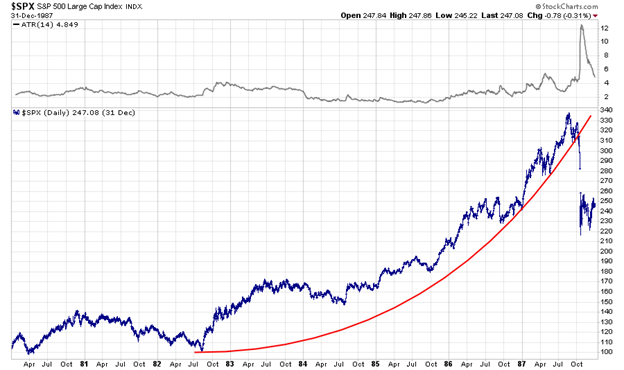
This section examines technical warning signs in the days, weeks and months prior to Black Monday. Before proceeding, the chart below shows the longer term rally from the early 1980’s through the crash.

Portfolio Insurance- As mentioned, from the 1982 trough to the 1987 peak, the S&P 500 produced outsized gains for investors. Further, the pace of gains accelerated sharply in the last two years of the rally.

As the 1980’s progressed, some investors were increasingly concerned that the massive gains were outpacing the fundamental drivers of stock prices. Such anxiety led to the creation and popularity of portfolio insurance. This new hedging technique, used primarily by institutional investors, involved conditional contracts that sold short the S&P 500 futures contract if the market fell by a certain amount. This simple strategy was essentially a stop loss on a portfolio that avoided selling the actual portfolio assets. Importantly, the contracts ensured that more short sales would occur as the market sell-off continued. When the market began selling off, these insurance hedges began to kick in, swamping bidders and making a bad situation much worse. Because the strategy required incremental short sales as the market fell, selling begat selling, and a correction turned into an avalanche of panic.

Chris Cole of Artemis Capital estimates that, in 1987, portfolio insurance strategies comprised about two percent of the market. Currently, he estimates that short volatility trades, which if unwound would have a similar effect as portfolio insurance, is between six and ten percent of the market.

Price Activity- The rally from 1982 peaked on August 25, 1987, nearly two months before Black Monday. Over the next month, the S&P 500 fell about 8% before rebounding to 2.65% below the August highs. This condition, a “lower high,” was a warning that went unnoticed. From that point forward, the market headed decidedly lower. Following the rebound high, eight of the nine subsequent days just before Black Monday saw stocks in the red. For those that say the market did not give clues, it is quite likely that the 15% decline before Black Monday was the result of the so-called smart money heeding the clues and selling, hedging or buying portfolio insurance.

Annotated Technical Indicators

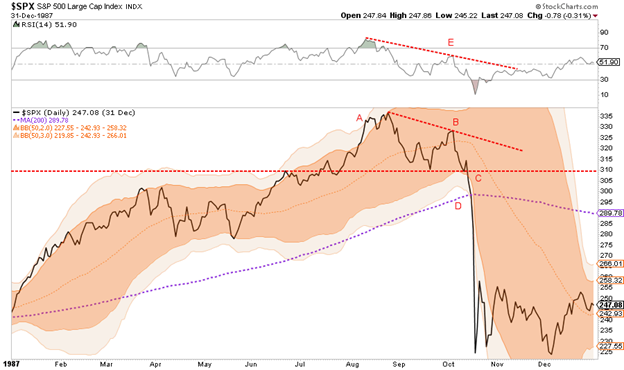
The following chart presents key technical warnings signs labeled and described below.

  • A: 7/30/1987- Just before peaking in early August, the S&P 500 extended itself to three standard deviations from its 50-day moving average (3-standard deviation Bollinger band). This signaled the market was greatly overbought. (description of Bollinger Bands)
  • B: 10/5/1987- After peaking and then declining to a more balanced market condition, the S&P 500 recovered but failed to reach the prior high.
  • C: 10/14/1987- The S&P 500 price of 310 was a point of both support and resistance for the market over the prior two months. When the index price broke that line to the downside, it proved to be a critical breach from a technical perspective.
  • D: 10/16/1987- On the eve of Black Monday, the S&P 500 fell below the 200-day moving average. Since 1985, that technical level provided dependable support to the market on five different occasions.
  • E: August 1987- The relative strength indicator (RSI – above the S&P price graph) reached extremely overbought conditions in late July and early August (labeled green). When the market rebounded in early October to within 2.6% of the prior record high, the RSI was still well below its peak. This was a strong sign that the underlying strength of the market was waning. (description of RSI)

Volatility- From the beginning of the rally until the crash, the average weekly gain or loss on the S&P 500 was 1.54%. In the week leading up to Black Monday, volatility, as measured by five-day price changes, started spiking higher. By the Friday before Black Monday, the five-day price change was 8.63%, a level over six standard deviations from the norm and almost twice that of any other five-day period since the rally began.

Over the course of the rally from 1982, the average daily difference between the high and low (true range) of each trading day was just under 1.50%. In the week leading up to the crash, the average daily range doubled. On the Friday before the crash, it expanded to over 6%, or four standard deviations from the norm. A longer average true range is shown above the longer term S&P 500 at the start of the technical section.

Similarities and Differences

While comparing 1987 to today is helpful, the economic, political and market backdrops are quite different. There are however some similarities worth mentioning.

Currently:

  • Interest rates are rising
  • Federal deficits are increasing
  • Weaker dollar policy was recently affirmed by Treasury Secretary Mnuchin
  • Equity valuations are above almost every instance of the last 100+ years, regardless of how those valuations are measured
  • Sentiment and expectations are at or near record levels.
  • The use of margin is helping investors lever their holdings.
  • Trading strategies such as short volatility positions can have a snowball effect, like portfolio insurance, if they are unwound

There are also vast differences. The economic backdrop of 1987 and today are nearly opposite.

  • In 1987 baby boomers were on the verge of becoming an economic support engine. Today they are retiring and do not have the same economic effect.
  • Debt to GDP has grown enormously since 1987.
  • The amount of monetary stimulus in the system today is extreme, leaving one to question how much more can the Fed do.
  • Productivity growth was robust in 1987, and today it has nearly ground to a halt.

While some of the fundamental drivers of 1987 may appear similar to today, the current economic situation leaves a lot to be desired when compared to 1987. After the 1987 market crash, the market rebounded quickly, hitting new highs by the spring of 1989.

We fear that, given the economic backdrop and challenging circumstances of both monetary and fiscal policy, recovery from an episodic event like that experienced in October 1987 may look vastly different today.

Summary

Market tops are said to be processes. Currently, there are an abundance of fundamental warnings but few if any technical signals that the market is at or near a peak. In fact, most technical indicators are waving the all-clear flag. It is worth noting that longer-term interest rates, a key driver of economic activity, have begun rising while shorter-term rates have been rising since late 2015. Given the role debt has played in economic growth and in supporting stock buybacks, it is likely that equities will not take kindly to further increases in interest rates.

Those looking back at 1987 may blame the tax legislation and warnings of a weaker dollar as the catalysts for the severe declines. In reality, those were just the sparks that started the fire. The market was overly optimistic and had gotten well ahead of itself. When the current market reverses course, investors are also likely to blame a specific catalyst or two. Like 1987, the true fundamental catalysts are already apparent; they are just waiting for a spark.

We leave you with an appropriate tweet from David Rosenberg, Chief Economist, and Strategist at Gluskin Sheff.


via RSS http://ift.tt/2EmvFI5 Tyler Durden

San Francisco to Open Safe Drug Injection Sites by Summer

cocaine and heroinSan Francisco may end up being the first city in the United States to open injection sites where drug addicts can shoot up safely.

Several other major cities are considering proposals. Seattle has been planning injection sites but has had to fight off a ballot initiative to try to stop them. San Francisco is now moving forward with plans to open two sites by July.

Barbara Garcia, director of the city’s Department of Public Health, told the San Francisco Chronicle that facilities’ operators would be selected from the small group of nonprofits that already operate needle exchange programs in San Francisco. The facilities will be funded from private sources, though Garcia declined to say where specifically the money will come from.

The private operations should ease some heartburn among people who don’t like the drug war but aren’t fond of the notion of using public dollars to subsidize drug use.

The reason the sites will be privately funded, Garcia explained, is to avoid any potential liability for the City of San Francisco, since the sites will be operating in defiance of state and federal law. San Francisco is already in the Department of Justice’s crosshairs because of its status as a sanctuary city for illegal immigrants.

San Francisco has an estimated 22,000 intravenous drug users, and they often shoot up in public. City officials think 85 percent of those drug users would use an injection facility if they could. They also think this could potentially save the city $3.5 million in medical costs, given that it will be overseen by professionals and will hopefully reduce the need to call emergency responders.

Some lawmakers and prosecutors complain that allowing for drug injection facilities “normalizes” heroin use. But that ship has long sailed. Studies have shown that in practice, safe injection sites reduce overdoses and help marginalized users find access to health care, and that they do not lead to more drug use, drug trafficking, or crime. Other Western countries have opened such facilities; as overdose deaths climb, it’s time America tried this option too.

from Hit & Run http://ift.tt/2nJ2rcU
via IFTTT

Volmageddon Sparks 6000-Pt Swings In The Dow As Liquidity Evaporates

Full Court Press from the media today to ensure bag-holders stay in…


So, first things first, the total catastrophe that is the Inverse VIX ETF XIV dropped 90% in after-hours trading, triggering its termination event…

And then when it re-opened, it crashed some more before squeezing higher (remember it will be at $4.22 on Feb 20th, no matter what happens in between)…


And in yet another example of the market’s sheer idiocy, this short-squeeze sent The Dow up 600 points…


VIX traded above 50 overnight before going dead, crashing, ramping, and generally being chaotic amid the large vol-of-vol ever…


Notably, S&P ‘VIX’ was the biggest mover across all the indices…


Asian equities were ugly overnight but played more catch-down than extended the moves..


European stocks extended their losses…

European ‘VIX’ smashed higher to the same level as US VIX today…


And US equity futures were a bloodbath overnight, before a panic-bid appeared from nowhere at the US equity market cash open… (NOTE that the market ramped at the open of Japanese markets as Abe and Kuroda spoke reassuringly and at the US open)


Quite a day…


The Dow ended up 568 points but went through some enormous point-swings intraday – from the cash close last night, Dow -1400, +1000, -600, +1100, -500, +400, -300, +600…


Some context, however, from Friday’s close…


Nasdaq, S&P and Dow managed to get back into the green for 2018…


Nanex’s Eric Scott Hunsader showed liquidity has evaporated from US equities – Liquidity rising from “Lord of the Flies” to “Banana Republic”. Still ridiculous (black=today)


Credit markets have started to awaken…


But for now, FX, rates, and Commodity vol remains ‘contained’…


After a massive loss yesterday (the most since the 2013 taper tantrum), aggregate bond and stock gains today were the best since Jan 2016…


Treasury yields were higher from the US equity cash close, after yields crashed notably lower overnight (but remain lower on the week)…


10Y ended back above 2.80% (pre-payrolls)


The yield curve flattened dramatically intraday…


The odds of a 3rd rate-hike in 2018 plunged overnight to just 10%, but rallied back, as stocks bounced, to around 46%…


The Dollar Index ramped back to pre-Mnuchin-Masscare levels, tagged those stops, then dumped back into the red…


Gold and Silver were notably lower on the day after spiking overnight, crude trod water ahead of tonight’s inventory data and copper made modest gains…


Cryptos rallied into the hearing this morning…


But this chart made us think a little…


But then again, Bitcoin soared as VIX plunged…

via RSS http://ift.tt/2BdMPpq Tyler Durden

XIV Trader Loses $4 Million And 3 Years Of Work: Here Is His Story

The devastating 90% overnight collapse in the now “terminated” XIV Exchange Traded Note (ETN) has had many casualties – from one hedge fund down as much as 65%, to Morgan Stanley’s (formerly) $39 million position, to Reddit user /u/Lilkanna who posted “Ive lost 4million USD, 3 years worth of work, and other people’s money” in the “TradeXIV” subreddit. 

“1.5 mill was capital I raised from investors who believed in me,” Lilkanna wrote. “I had a leveraged position I used DTBP to buy and it was down like 1% and I thought I could hold it knowing that I would get a reg-t call deadline in 2 days.”

aa

aa

As confirmation of his woes, Lilkanna posted a screenshot of his depleted account:

aa

Close up:

aa

“The amount of money I was making was ludicrous, could take out my folks and even extended family to nice dinners and stuff,” he wrote. “Was planning to get a nice apartment and car or take my parents on a holiday, but now that’s all gone.”

“Sad thing is I was long VIX until a couple of days ago. I was sure there was gonna be a correction but with each passing day my conviction wavered. Stupid. Really fu**ing stupid. I feel like such a fool.”

While some Redditors were supportive – emoting empathy, “Hey man, I know others have said it but I’m here for you man,” one user wrote. “It may seem like the end of the world but tomorrow is a new day.”

Another Redditor said “Jesus dude, if you were able to turn 36k into 2.5 million (even with raised capital), you can make back all the lost money and then some,” he said. “You just have to learn from the lessons and give it time, you will make it back in no time. It sounds cliche as f**k but you know its true.”

User /u/asianhere commiserated with Lilkanna, writing “I feel you as I’ve lost 1/2 of my net worth today T_T prob 5 years on my life”

For what it’s worth, Lilkanna is able to take responsibility for his epic fail:

I guess you never expect it until it hits you. You always hear stories about how people get cancer and how people get randomly killed in the street or about how they lose all their money, but sometimes you find it hard to believe that it will happen to you.

I started with 50k and traded all the way to 4 mill over 2.5 years, started using more and more margin, started taking it less less seriously, what could go wrong? Arrogance. Stupidity.

Ah well. Thanks for the kind words though. They are more comforting than you realise.

aa

Credit Suisse, XIV’s issuer, announced this morning that February 20 will be the last day of trading before termination. 

via RSS http://ift.tt/2E84e5P Tyler Durden

Play Reason Podcast Bingo, Win Fame and Fabulous Prizes[*]

A bit more than a year old, the Reason Podcast is a free, thrice-weekly offering featuring wide-ranging conversations with Katherine Mangu-Ward, Peter Suderman, Matt Welch, and me; interviews with authors, policymakers, and leading libertarian thinkers; and rebroadcasts of Reason events and panel discussions.

The best way to subscribe is via iTunes. Go here to do that and never miss an episode.

You can also listen via SoundCloud.

Our most-recent review at iTunes, by Bruno Bleaux, raves:

GREAT PROGRAM [5 stars]| “An insightful, informative, wickedly funny & challenging program.”

Here’s a full archive of all our episodes. Among the recent offerings:

‘The State Has Been One of the Largest Perpetrators of Gender Inequality and Violence’: Meet Feminists for Liberty’s Kat Murti, who wants to make libertarianism the default setting for women, people of color, and Millennials.

“Micro-Schools” Might Be the Next Big Education Thing: It’s way past time that we dump factory-model schools for more individualized K-12 programs.

“Sexual Politics Needs More Economics: Probing uncomfortable gender and generational splits.”

Why This Is TV’s Golden Age!: How streaming video has blown apart, and improved, television as we know it.

How the United States Can—And Cannot—Help Iranian Protesters: “Millions of Iranians…don’t want to live under a corrupt clerical fascist state” says Bloomberg’s Eli Lake. Are the Islamic Republic’s days finally numbered?

Click below to listen to yesterday’s regular Monday roundtable. From the description: “On today’s Reason Podcast, which features Nick Gillespie, Katherine Mangu-Ward, Peter Suderman, and Matt Welch discussing news of the week, we start speculating on how to begin the long political road back to a fiscal sanity both major political parties have recklessly abandoned. What, Gillespie asked, will be the symbolic equivalent for debt realists of feminists burning their bras? Other topics include (of course) The Memo, the hysteria, the weird FBI-love, right-to-try, deregulation, and how Howard the Duck is holding up after all these years.”

And as a special bonus, listener Ryan Juliano created a reusable Reason Podcast bingo card. Play along at home, work, or in the car (preferably not while driving).

from Hit & Run http://ift.tt/2nJlLa5
via IFTTT

Play Reason Podcast Bingo, Win Fame and Fabulous Prizes[*]

A bit more than a year old, the Reason Podcast is a free, thrice-weekly offering featuring wide-ranging conversations with Katherine Mangu-Ward, Peter Suderman, Matt Welch, and me; interviews with authors, policymakers, and leading libertarian thinkers; and rebroadcasts of Reason events and panel discussions.

The best way to subscribe is via iTunes. Go here to do that and never miss an episode.

You can also listen via SoundCloud.

Our most-recent review at iTunes, by Bruno Bleaux, raves:

GREAT PROGRAM [5 stars]| “An insightful, informative, wickedly funny & challenging program.”

Here’s a full archive of all our episodes. Among the recent offerings:

‘The State Has Been One of the Largest Perpetrators of Gender Inequality and Violence’: Meet Feminists for Liberty’s Kat Murti, who wants to make libertarianism the default setting for women, people of color, and Millennials.

“Micro-Schools” Might Be the Next Big Education Thing: It’s way past time that we dump factory-model schools for more individualized K-12 programs.

“Sexual Politics Needs More Economics: Probing uncomfortable gender and generational splits.”

Why This Is TV’s Golden Age!: How streaming video has blown apart, and improved, television as we know it.

How the United States Can—And Cannot—Help Iranian Protesters: “Millions of Iranians…don’t want to live under a corrupt clerical fascist state” says Bloomberg’s Eli Lake. Are the Islamic Republic’s days finally numbered?

Click below to listen to yesterday’s regular Monday roundtable. From the description: “On today’s Reason Podcast, which features Nick Gillespie, Katherine Mangu-Ward, Peter Suderman, and Matt Welch discussing news of the week, we start speculating on how to begin the long political road back to a fiscal sanity both major political parties have recklessly abandoned. What, Gillespie asked, will be the symbolic equivalent for debt realists of feminists burning their bras? Other topics include (of course) The Memo, the hysteria, the weird FBI-love, right-to-try, deregulation, and how Howard the Duck is holding up after all these years.”

And as a special bonus, listener Ryan Juliano created a reusable Reason Podcast bingo card. Play along at home, work, or in the car (preferably not while driving).

from Hit & Run http://ift.tt/2nJlLa5
via IFTTT

Steele Goes Dark; Ditches London Court Appearance Following Criminal Referral By US Senate

Former British MI-6 intelligence officer Christopher Steele was a no-show on Monday at a London courthouse, reports Fox News. Steele was expected for a long-requested deposition in a multi-million dollar civil case brought against Buzzfeed, which published a salacious and unverified “Trump-Russia” dossier.

Steele may have skipped out over concerns that he would be asked questions about his contacts with various media outlets in connection with at least two dossiers he had a hand in assembling and disseminating – for which he stands accused by Senators Chuck Grassley (R-IA) and Lindsey Graham (R-SC) of misleading the FBI about his contacts with journalists at various news outlets during the 2016 election. 

There is substantial evidence suggesting that Mr. Steele materially misled the FBI about a key aspect of his dossier efforts, one which bears on his credibility,” reads the unredacted document that refers Steele for criminal prosecution in the US. 


It therefore stands to reason that Steele wanted to avoid any uncomfortable questions which might apply to ongoing investigations in US House and Senate. Separately, records obtained and reviewed by Fox News from related civil litigation in Florida reveal that Steele maintains that even showing up for a deposition would “implicate state secrets in London.”

Evan Fray-Witzer, a Boston-based attorney representing Russian tech tycoon Aleksej Gubarev in multi-million dollar civil litigation, described Monday’s U.K. court actions to Fox News. “My understanding is that Mr. Steele’s lawyers spent a good deal of time arguing why they thought he (Steele) should not be required to sit for a deposition and that ultimately the court took the entire matter under advisement.”

Gubarev is suing Steele’s UK-based Orbis Business Intelligence because the Trump-Russia dossier claimed Gubarev’s companies used “botnets and port traffic to transmit viruses, plant bugs and steal data.” 

Fray-Witzer stressed in that hearing that the British government “has not asserted” Steele’s claims. The attorney has said Steele “is asserting he can’t speak about things.  We have pointed out that he’s spoken to anyone who is willing to listen, every journalist, and the FBI.” –Fox News

Steele was paid $168,000 by opposition research firm Fusion GPS, which was funded in part by Hillary Clinton and the DNC, who used law firm Perkins Coie as an intermediary. 

Meanwhile, the Senate Judiciary Committee’s January 4 criminal referral of Steele also reveals that the former British spy was involved in a second anti-Trump opposition research dossier

As we reported on Monday, this second dossier went from Clinton “hatchet man” Cody Shearer, who gave it to an unnamed official in the Obama State Department, before it was routed to Christopher Steele. It is unknown what happened to the document after that. 

According to the referral, Steele wrote the additional memo based on anti-Trump information that originated with a foreign source. In a convoluted scheme outlined in the referral, the foreign source gave the information to an unnamed associate of Hillary and Bill Clinton, who then gave the information to an unnamed official in the Obama State Department, who then gave the information to Steele. Steele wrote a report based on the information, but the redacted version of the referral does not say what Steele did with the report after that.

Published accounts in the Guardian and the Washington Post have indicated that Clinton associate Cody Shearer was in contact with Steele about anti-Trump research, and Obama State Department official Jonathan Winer was a connection between Steele and the State Department during the 2016 campaign. –Washington Examiner

Of note, Shearer’s brother served as an ambassador during the Clinton administration, and his late sister was married to Strobe Talbott, the chief authority on Russia in President Bill Clinton’s State Department, according to ProPublica.

Recalling that the dossier was published by Buzzfeed after the election, we’re sure that much like the rest of the swamp; Clinton, Obama, Comey, McCabe, Mueller, Rosenstein, Strzok, Page, and the rest of the gang – Christopher Steele thought Hillary would win, and none of this would have ever come to light.

Better watch out Steele!


via RSS http://ift.tt/2GVXd5M Tyler Durden