It’s not often you’ll hear me say positive things about a U.S. government regulator, but I nearly fell out of my seat when I heard what the Chairman of the U.S. Commodity Futures Trading Commission (CFTC), Christopher Giancarlo, said at today’s hearing with the Congressional Committee on Banking, Housing, and Urban Affairs.
In case you missed it, here’s his opening statement:
Speaking live from the White House on Tuesday, President Donald Trump told reporters that “I’d love to see a shutdown” if Democratic leaders refuse to back his immigration proposals – specifically his push to tighten illegal immigration laws to make it more difficult for immigrants to sponsor relatives – a phenomenon Trump has called “chain migration.”
As Reuters reported, Trump said during a meeting with law enforcement officials that focused on gang violence, adding that his ultimate goal is to change immigration laws to stem the flow of dangerous MS-13 gang members into the US.
He also reiterated his demands that funding for the border wall be a part of a hoped-for immigration deal. Last month, the White House submitted a proposal for $18 billion in funding to start construction on the first 700 miles of the wall.
“If they don’t want to take care of our military then shut it down,” Trump said.
“We need much better border mechanisms and much better border security. We need the wall. We’re going to get the wall,” Trump said. “If we don’t have the wall, we’re never going to solve this problem.”
He also said he’d welcome a shutdown if Congress can’t pass a plan – demanding by Freedom Caucus Chairman Mark Meadows – to separate out defense spending from the continuing resolution in order to make an appropriation that would cover the remainder of he year.
See headlines from the meeting below.
*TRUMP: IF WE DON’T GET RID OF LOOPHOLES LET’S HAVE `SHUT DOWN’
*TRUMP SAYS IF CONGRESS CANNOT AGREE TO EXTEND FUNDING FOR U.S. MILITARY, THEN HE WELCOMES A GOVERNMENT SHUTDOWN
*PRESIDENT TRUMP SAYS HE’D “LOVE TO SEE A SHUTDOWN” IF CANNOT GET CHANGES TO IMMIGRATION LAWS
*U.S. PRESIDENT TRUMP SAYS NEED TO HAVE IMMIGRATION LAWS CHANGED IN ORDER TO HAVE SATISFACTORY RESPONSE TO MS 13 GANG
*PRESIDENT TRUMP SAYS HE’D “LOVE TO SEE A SHUTDOWN” IF CANNOT GET CHANGES TO IMMIGRATION LAWS
*U.S. PRESIDENT TRUMP SAYS NEED TO HAVE IMMIGRATION LAWS CHANGED IN ORDER TO HAVE SATISFACTORY RESPONSE TO MS 13 GANG
* * *
Trump’s insistence on border wall funding will probably dismay GOP Senate leaders including Texas Sen. John Thune, who said yesterday that Republicans would prefer to push the immigration debate until after the continuing resolution has passed. That sentiment was echoed by GOP Senator Mitch McConnell Tuesday afternoon, once again setting the president at odds with his Congressional leadership.
Earlier today, Trump tweeted a Daily Caller story claiming that the majority of Americans support a DACA compromise that would fully strengthen the border and include changes to legal immigration laws.
Polling shows nearly 7 in 10 Americans support an immigration reform package that includes DACA, fully secures the border, ends chain migration & cancels the visa lottery. If D’s oppose this deal, they aren’t serious about DACA-they just want open borders. https://t.co/XDMcDOr9vM
House Intelligence Committee Chairman Devin Nunes (R-CA) railed against Democrats and the FBI for the “clear link” between Russia and opponents of Donald Trump, who engaged in a literal conspiracy to smear Trump with the cooperation of Russian government officials.
Appearing on Fox News, Nunes traced the path directly from the Clinton campaign to the Kremlin:
“We have a clear link to Russia — you have a campaign who hired a law firm, who hire Fusion GPS, who hired a foreign agent, who then got information from the Russians on the other campaign,” said Nunes, adding “It seems like the counterintelligence investigation should have been opened up against the Hillary campaign when they got ahold of the dossier. But that didn’t happen, either.”
Nunes also noted that the FBI never informed the Foreign Intelligence Surveillance Act (FISA) court which granted a spy warrant on one-time Trump advisor Carter Page was not informed that the salacious and unverified dossier used as its foundation was funded in part by the Clinton campaign and the DNC.
It has been reported through various outlets, however, that officials did disclose the political origins of the dossier.
.@DevinNunes: “It seems like the counter intelligence investigation should’ve been opened up against the Hillary campaign when they got ahold of the dossier. But that didn’t happen, either.” #Hannitypic.twitter.com/zJuEu7xPwM
Nunes then called out the MSM for extreme hypocrisy over the disproportionate standards applied to the left vs. the right;
“I think the bigger problem, challenge here, is that the mainstream media is totally uninterested in this. Can you imagine if the shoe was on the other foot – and Donald Trump or George Bush or Karl Rove had paid for information and then George W Bush’s FBI had opened an investigation into the Obama campaign because they were talking to Russians – which, by the way, really did happen; the Obama campaign was talking to Russians back in 2008 – and open up a counterintelligence investigation using dirt dug up and paid for by RNC and George W. Bush supporters?
This town would be on fire. Every reporter would be following around Karl Rove and George W. Bush all over town – yet it’s crickets from the media. It’s embarrassing. It’s absolutely embarrassing, I’m almost flabbergasted. Because I thought at least there would be some ounce of credibility left, but there really is none.” –Devin Nunes
.@DevinNunes: “I think the bigger problem, challenge here, is that the mainstream media is totally uninterested in this. Can you imagine if the shoe was on the other foot?” #Hannitypic.twitter.com/geGYgzdS0P
Earlier on Monday, Nunes appeared on Fox & Friends where he told them that the four-page “FISA memo” authored by staffers from his office and released last Friday was “just the beginning.”
While the memo released last Friday summarizes what the House Intelligence Committee GOP says are rampant abuses of surveillance powers by the FBI and DOJ during and after the 2016 election, phase two will focus on “irregularities” within the Obama State Department headed by Hillary Clinton and later John Kerry.
“What we will do in phase two is follow the facts where they lead, and when we get enough facts, we will figure out a way to let the American people know,” Nunes told “Fox & Friends.”
“Phase one of our investigation was getting to the FISA abuse. What we’re looking at now is the State Department and some of the irregularities there,” Nunes said Monday, noting that the committee has “several other areas” to probe.
Nunes first mentioned “phase two” last Friday on Special Report with Bret Baer.
Actual Russian Collusion
While Nunes didn’t elaborate, we suspect it might have something to do with the involvement of John Kerry’s State Department’s in a second Dossier containing claims from Kremlin officials – as detailed in a January 4 letterfrom Senate Judiciary Committee Chairman Chuck Grassley (R-IA).
As we detailed yesterday, the second dossier – like the first, relied on Russian officials for information (actual Russian collusion people). From there, this second dossier went from Clinton “hatchet man” Cody Shearer, who gave it to an unnamed official in the Obama State Department, before it was routed it to former British Spy Christopher Steele. It is unknown what happened to the document after that.
Shearer – who took the Russian sourced Dossier andhanded it to the Obama State Department, before they then handed it to Christopher Steele – is a controversial political activist and former journalist who was close to the Clinton White House in the 1990s. Of note, Shearer’s brother served as an ambassador during the Clinton administration, and his late sister was married to Strobe Talbott, the chief authority on Russia in President Bill Clinton’s State Department, according to ProPublica.
Sounds like exactly the “hatchet man” Hillary Clinton needed to quite literally collude with Russia in order to influence the US election – which, as Devin Nunes pointed out, the FBI should have done something about.
Again;
“It seems like the counterintelligence investigation should have been opened up against the Hillary campaign when they got ahold of the dossier. But that didn’t happen, either.” –Devin Nunes
Campus Reformvisited John Jay College in New York City to solicit students’ opinions about President Donald Trump’s first State of the Union address. But they actually read the kids quotes from Barack Obama’s State of the Union.
As you’d guess, some students jumped at the chance to slam the comments, and Trump, as “warmongering,” “aggressive,” and “immature.” (A caveat: As always with videos in the Jaywalking genre, it’s an open question how many responses ended up on the cutting room floor.)
Responding to a quote about the need to go after ISIS, one student flirted with a bit of America Firstism: “He should, like, you know, mind his own business and, like, just focus on America because he’s the president of the United States, not the whole world.”
It’s an attitude toward interventionism that might have been more popular during the Obama years if Obama weren’t so popular himself. U.S. foreign policy, particularly when it comes to the War on Terror, didn’t change all that much between George W. Bush and Obama. Were Bush’s policies unpopular, or was it just him?
It shouldn’t surprise us that partisanship can make people’s views so malleable. The evidence is all around us—look no further than Republicans’ rapid shift in opinion about the FBI in the wake of the Trump investigation.
Get ready to hear a lot about exchange traded funds tied to the CBOE VIX Index and their role in today’s market decline. Here is why:
After the close last night two US listed inverse VIX ETFs (XIV and SVXY) gapped down 80% from their 4pm closing price on heavy volume. These are products that rise when the VIX falls intraday, and decline when it increases. The returns are supposed to be 1:1 for those moves. If the VIX rises 5% from open to close, these products should decline 5%.
The CBOE VIX Index opened today at 19 and closed at 37, a 95% move. You can see the problem here: a 1:1 relationship between the asset values for XIV and SVXY versus the underlying VIX index doesn’t leave much value for tomorrow.
As of Friday morning, these two funds had combined assets under management of $3.2 billion. They were also among the most heavily traded symbols at Fidelity’s retail website today, with Buys outnumbering Sells by over 2 to 1. In addition, over the last year they were popular with hedge funds as an easy way to short volatility. Their returns in 2017 were +180%. No, that’s not a typo.
The upshot: this development could well be why the VIX doubled today and equities took it on the chin. In a market already up to its eyeballs with fundamental questions of valuation and interest rate uncertainty, seeing $3 billion of value evaporate is no one’s idea of a good thing. Who owns these assets today? How will volatility trade tomorrow on any unwind? What other volatility products are at risk?
This is a market that shoots first and asks questions later.
Now, as satisfying as it might be to find a possible market structure-related explanation to today’s horrible price action, this doesn’t mean we are out of the woods. Assuming volatility-related ETFs really are a market structure “Achilles heel”, this will take days if not weeks to play out, and there could be other problems waiting in the wings.
To put it bluntly, there’s never just one cockroach in the kitchen.
To help you put the next few days into some perspective, here are some issues to consider:
#1. US equity markets remain unsure of valuation, but not fundamentals. No one we talk to thinks the US economy is on the brink of a recession. The question is how hot the economy gets on the back of tax reform and what that does to yields. We’ve gone from a market used to playing checkers (rising earnings, low rates equals higher prices) to being forced to compete in grand master 3-dimension chess (worries over growth versus rates, equity valuations, and the strength of the dollar, plus now market structure concerns).
#2. We closed very near the intraday lows, which means we’re not likely done with this decline, even if the inverse VIX ETF storyline plays out as a primary cause of today’s action. The low point on the day was 2646 on the S&P 500; the close was 2649. This leaves little room for error tomorrow, and traders will want to see markets hold that intraday low.
#3. The CBOE VIX Index says we’re near a bottom, however. Provided we don’t get some further wonky action in the VIX as a result of whatever happens in ETF land, a VIX at 37 feels like a near term bottom. Yes, we realize that is a caveat as big as a barn door… But the VIX doubling in a day without a clear and present danger to the US economy seems overdone.
#4. There was a flash melt up in Treasuries today that exacerbated the afternoon gap down, perhaps caused by the dislocation in XIV and SVXY. That air pocket you saw just after 3pm in US stocks occurred at the same time as a 2% move higher in long dated US Treasuries. Whether this was a flash melt-up (essentially a market structure glitch) or the result of real buying, it shows how closely tied equities are to volatility in other markets. Also worth noting: VIX ETFs typically tell their brokers how much exposure they need for the close around 3pm. While the meltdown in XIV and SVXY came after the close, it is possible that news started to filter out around this time.
#5. There is also a tremendous amount of buzz/concern regarding how different sorts of investors are positioned and what their exposure means to near term stock price movements. A sample of these:
Volatility/Options Traders. Options prices got very skewed in January as the market melted up. Call options became expensive and puts were close to free. Anyone who bought into those prices to get long “on the cheap” is now forced to unwind in a hurry.
Risk Parity Investors. Picture the classic 60/40 stock-bond portfolio, but juiced up with leverage and a computer algorithm to allocate capital. When the historically negative correlation between stocks and bond goes positive (as it has in the last week), the computer models sell both to reduce risk exposure.
Trend followers. US equity markets have traded in largely predictable patterns for years. Traders who simply follow those trends (again, with leverage to boost returns) must now sell as the trends reverse.
#6. Markets are forcing new Federal Reserve Chair Jay Powell’s hand regarding the “Fed Put”. Ever since Alan Greenspan rode to the rescue of US stocks in October 1987, investors have believed the Fed would take stock prices into account when setting interest rate policy. Today was Chair Powell’s first day on the job. Will he say something about the equity markets’ swoon, or will he wait?
#7. Here are some key valuation levels versus today’s close of 2649, which equates to 17.0x consensus 2018 estimates of $156/share in earnings:
If we sell off another 5%, to 2516: 16.1x this year’s estimate (that $156/share)
Sell off 10% from here, to 2384: 15.3x (NB: this is the historical 5 year average)
Sell off 15% from here, to 2252: 14.4x this year’s estimate
Sell off 20% from here, to 2119: 13.6x this year’s estimate
#8. Even if you find the near term trading low, we will have to retest it before equities can move sustainably higher. In all the chatter about comparing 1987 to the current market, that is the one lesson worth remembering. The October 19th lows that year were NOT the lows for the year. Those came in December.
Our bottom line: even if the inverse VIX ETF story proves true and markets see a relief rally, don’t assume the worst is past. We remain positive on US stocks but recognize that viewpoint will likely leave some scar tissue once the current volatility has passed
Despite the company’s checkered record, will attract a sold-out crowd of observers at The Kennedy Space Center’s visitor complex. Tickets to the event, which cost $195, also include a champagne toast and a commemorative glass.
The Falcon Heavy, purportedly the heaviest operational rocket in the world, is expected to launch for the first time on Tuesday.
“I feel quite giddy and happy actually,” Musk said on a call with reporters Monday ahead of the planned flight, adding – in an ill-timed stab at humor – that he’ll consider it a success if it doesn’t blow up on the launch pad. The launch, originally scheduled for 1:30 pm ET from Florida, has been delayed to 2:20 pm ET due to high winds, the company said. If it doesn’t launch by 4 pm, SpaceX has a back-up window to launch the rocket on Wednesday.
Upper atmosphere winds currently 20% above max allowable load. Holding for an hour to allow winds to diminish. #FalconHeavy
If the launch is successful, it will help repair SpaceX’s reputation, allowing it to fully embrace a crucial new line of business: Launching government satellites into space with its reusable rockets.
However, Musk pointed out that the rocket isn’t equipped to carry humans to Mars.
SpaceX’s new, larger rocket is a reusable “super heavy” launch vehicle that will allow the closely held company to bid on heavier payloads, such as larger commercial satellites and national security missions. It’s not the rocket that could eventually take humans to Mars—that’s the “Big F—ing Rocket” Musk announced in September. But the Falcon Heavy’s maiden flight is targeting Earth-Mars elliptical orbit, bringing Musk’s Red Planet dreams into reach.
“This is a test mission, so we don’t want to set expectations of perfection,” Musk said.
The head of a commercial space-flight lobbying group said the launch is a “big deal” that showcases the “tremendous innovation” in the industry, spearheaded by SpaceX.
“Falcon Heavy is a new rocket, and new rockets are a big deal,” said Eric Stallmer, president of the Commercial Spaceflight Federation, an industry group for the private space sector. “It’s a really big deal that showcases the tremendous innovation taking place in the commercial space sector.”
As Bloomberg explains, the Falcon Heavy is “basically three Falcon 9 rockets strapped together” – allowing to offer triple the power of the Falcon 9, which was introduced back in 2010. The Falcon Heavy is the company’s first new rocket since 2010.
In terms of design, Space Exploration Technologies Corp.’s first new rocket since 2010 is basically three Falcon 9 rockets strapped together, tripling the launch power. While one Falcon 9 has nine Merlin engines in its first stage, Falcon Heavy has 27. That’s more than 5 million pounds of thrust at liftoff, which SpaceX says is equivalent to roughly 18 747 airplanes. It’s twice as large from a capacity perspective as its closest competitor, United Launch Alliance’s Delta IV Heavy.
The launch is high stakes: If it’s a success, Musk expects to start ferrying commercial satellites into space in three to six months.
If it’s another failure, it could take more than a year for the company to recover.
In a typical example of Muskian showmanship, the rocket will carry the Tesla CEO’s personal roadster into space.
If the demonstration flight goes well, Musk said SpaceX would plan to fly its first mission for a paying satellite operator in three to six months. If it goes badly and the pad is destroyed, it could take up to a year to restore the site before launches can resume, though rocket production would continue during that time, he said.
“It will be a really huge downer if it blows up,” Musk said. “If something goes wrong, hopefully it goes wrong far into the mission so we at least learn as much as possible along the way.”
Because of the experimental nature of the first flight, and perhaps as a way to burnish the spectacle, Musk decided the payload will be his personal Roadster sports car made by another one of his companies, Tesla Inc., that will be set to play David Bowie’s “Space Oddity” on repeat as it’s hurled into the deep beyond. Musk said that three cameras would be mounted on the Roadster, which should provide “epic views” of the car floating toward Mars, if all goes to plan.
Musk posted an animated video of what the event could look like here, set to the David Bowie song “Life on Mars?”:
Billionaire investor Carl Icahn spoke to CNBC via telephone this morning and had some very ominous warnings after what he has seen in the last few days.
Reflecting on the market’s moves recently, Icahn shocked the anchors by saying:
“This is something we’ve never seen before… I don’t remember ever seeing a market with this kind of volatility over two weeks.“
“The market has become a much more dangerous place [due to index funds and ETFs]… it’s like 2008 where everyone was buying mortgages and CDS.”
Concluding that: “Passive investing is the bubble right now.”
“There is going to be a major, major, major correction.”
“This is a manifestation of a real deep problem we have in our markets.“
“There is a huge bubble of passive money flowing in… a sort of euphoria and a lot of people are going to pay the price just like in 1929.“
Icahn then took his warning to 11…
“I do think the market will bounce back but these are the rumblings before the earthquake.“
“The market is telling you something… it’s telling you it’s very dangerous…it’s way over-leveraged.“
“Eventually, there’s going to be a bigger problem than 2009 and 1929, eventually. A major storm is coming, could be 5 years, could be 5 months.”
Icahn ended by noting that “no one can tell you what the market is going to do – its almost farcical to think you can,” but added that this is what he thought would happen, based in his research.
“I am still concerned that one day you’ll see a break like you had a few weeks ago…but it won’t come back.“
CNBC, of course, was careful to provide some cover for their advertisers, noting that while Icahn said “this casino is on steroids — the market is a casino on steroids,” they add that the veteran market-watcher said, this is not “the explosive time.”
Former White House Chief Strategist Steve Bannon is in for a busy time next week.
While his former boss’s lawyers are urging their client to refuse an interview with Special Counsel Robert Mueller for fear that the president might accidentally perjure himself, Bannon is finally meeting with the special counsel and the House Intel Committee next week, according to PBS and CNN.
According to PBS’s anonymous sources, Bannon is planning to tell investigators “everything he knows.
That’s according to two people familiar with Bannon’s interview. The people spoke on condition of anonymity because they were not authorized to speak on the record about details of the interview.
One of the people says Bannon plans to tell Mueller “everything” he knows.
Bannon is expected to face questions about key events during his time in the White House, including Trump’s firings of former National Security adviser Michael Flynn and former FBI Director James Comey.
The confirmation of Bannon’s meeting with Mueller comes as Bannon’s closed-door interview set for Tuesday with the House intelligence committee was postponed.
Bannon was initially scheduled to meet with the House Intel Committee today, but his legal team asked for a postponement, CNN reported. However, the committee has decided to allow him another week to appear in person and answer their questions – though this isn’t the first time Bannon, who was subpoenaed by the committee, has bailed on a scheduled meeting to the Intel committee, much to members’ chagrin.
The House Intelligence Committee confirmed Tuesday it was giving Bannon another week to comply with its subpoena.
“The House Intelligence Committee’s interview with Stephen Bannon has been postponed at the Committee’s initiative until next week,” Emily Hytha, spokeswoman for Rep. Mike Conaway, the Republican running the committee’s Russia probe, said in a statement. “We look forward to having him before the Committee once we can assure that he will be able to thoroughly answer all our questions without concerns regarding the scope of executive privilege.”
This is not the first time the committee has pushed back its subpoena as it has negotiated with Bannon over answering questions about the transition and his time in the White House, which he did not answer when he was interviewed last month.
Bannon famously refused to answer certain questions about his time in the White House during a previous meeting with the Intel Committee in January, invoking executive privilege to avoid providing details about his interactions with the president. This controversial move angered committee members, including some Republicans.
Mike Conaway, the nominal leader of the Intel Committee’s probe since Devin Nunes recused himself, told reporters Monday evening he expected Bannon to comply with the subpoena demands of the committee and was unaware of any deal to limit the answers he would provide to the panel.
Mueller’s push to interview senior administration officials – including the president – has been widely interpreted as a sign that his investigation is nearing its conclusion.
By now, you know the score: A couple of weeks have passed, so there’s a new deadline looming for a budget agreement to keep the federal government open until the next continuing resolution can be hammered out, maybe after a brief government shutdown, during which members of Congress might even have to bring their own towels to the House gym (the horror, the horror).
The deadline is Thursday, so lots of luck, fellas. You’ve been getting along so well lately, this shouldn’t be a problem at all. Oh wait.
Since the late 1970s, when new budgeting rules were passed, the government has only passed a budget four times before the fiscal year covered by said budget begins. This time around, there’s a debt limit looming, too, with Treasury Secretary Steve Mnuchin saying that the government’s credit line will be exhausted by February 28. That’s sooner than originally expected, due to the not-at-all-surprising result of the tax cuts passed in December. Lower taxes generally result in lower revenue, after all.
Further down the road—all the way to March 5!—is the end of the Obama-era program Deferred Action for Childhood Arrivals (DACA), which allows immigrants who were brought here illegally as children to stay in the country. Last year, President Trump extended DACA, giving Congress time to pass a legislative fix to the issue. DACA was at the heart of the recent government shutdown, as both sides made different versions of immigration reform a condition of the budget process.
And oh yeah, the market is showing jitters, at least partly because of estimates that the budget deficit is going to zoom to $955 billion this year, or nearly double what we borrowed last year.
With all that incompetency and dysfunction as a backdrop, consider this: A new NBC/WSJ poll finds a record level of Americans agree with the statement that “Government should do more to solve problems and help meet the needs of people.” Fully 58 percent of us agree with that notion, versus just 38 percent who believe “Government is doing too many things better left to businesses and individuals.” In December of 1995, the first time this poll asked that question, 32 percent though the government should do more and 62 percent said it was doing too much. As recently as 2014, 50 percent of Americans thought government was doing too much (versus 46 percent who thought it should do more). It’s worth pointing out that Gallup, which asks the same question, yields different results. Last September (the most recent results reported), it found that 50 percent of Americans think government is doing too much and 41 percent think it should do more. But even if the totals are different, Gallup’s results run in the same direction as those from NBC/WSJ, with more and more people saying that government should do more.
What gives? You’d think that as the government reveals itself to be less and less capable of taking care of its most basic tasks—such as passing legislation that allows it to function—we’d be washing our hands of it, right? I think the answer lies in declining trust in public, private, and nonprofit institutions. Americans also trust individuals less than they used to. Across virtually all aspects of our lives, confidence in most institutions is down from where it was a couple of decades ago. None of this is surprising, given the parade of highly misleading statements and scandals coming out of government (remember when the Bush administration fixated on “WMDs” as the cause to invade Iraq? Or when Barack Obama swore up and down that you if you liked your doctor, you could keep your doctor?), businesses (Volkswagen, Enron), and others (United Way, the Catholic Church) over the past few decades.
To the extent that we are shifting from being a high-trust country to a low-trust one, it is predictable that we are turning to government for more, even as we know it will disappoint if not defraud us.
In “low-trust countries,” write Philippe Aghion, Yann Algan, Pierre Cahuc, and Andrei Shleifer
citizens “support government regulation, fully recognizing that such regulation leads to corruption.” As an example, they point to differing attitudes toward government-mandated wages in former socialist countries that transitioned to market economies. “Approximately 92 percent of Russians and 82 percent of East Germans favor wage control,” they write, naming two low-trust populations. In Scandinavia, Great Britain, and North American countries, where there are higher levels of trust in the public and private sectors, less than half the population does.
Hail Mary passes aren’t just for the Super Bowl, it turns out, and thinking the same government that can’t be trusted will save you is the worst kind of Hail Mary.
What can be done? In the current political climate, it seems very unlikely that partisans from the president on down will make any moves toward fiscal and governmental responsibility, but that’s exactly what needs to happen. Ironically, and despite a generalized hostility toward government, libertarian-leaning members of Congress such as Sen. Rand Paul (R-Ky.), Rep. Justin Amash (R-Mich.), and Rep. Tom Massie (R-Ky.) could well set the proper tone. They are among the few officials who routinely break with their party to stay consistent with higher principles than simple partisan advantage. Pulling out of the worst sort of hyper-polarized, hyper-partisan politicking that we take for granted is what we need and it’s going to take credible ambassadors to sell that message.
Related: “The Government Is Going To Shut Down Again (and That’s Bad)”



 Campus Reform


 By now, you know the score: A couple of weeks have passed, so
 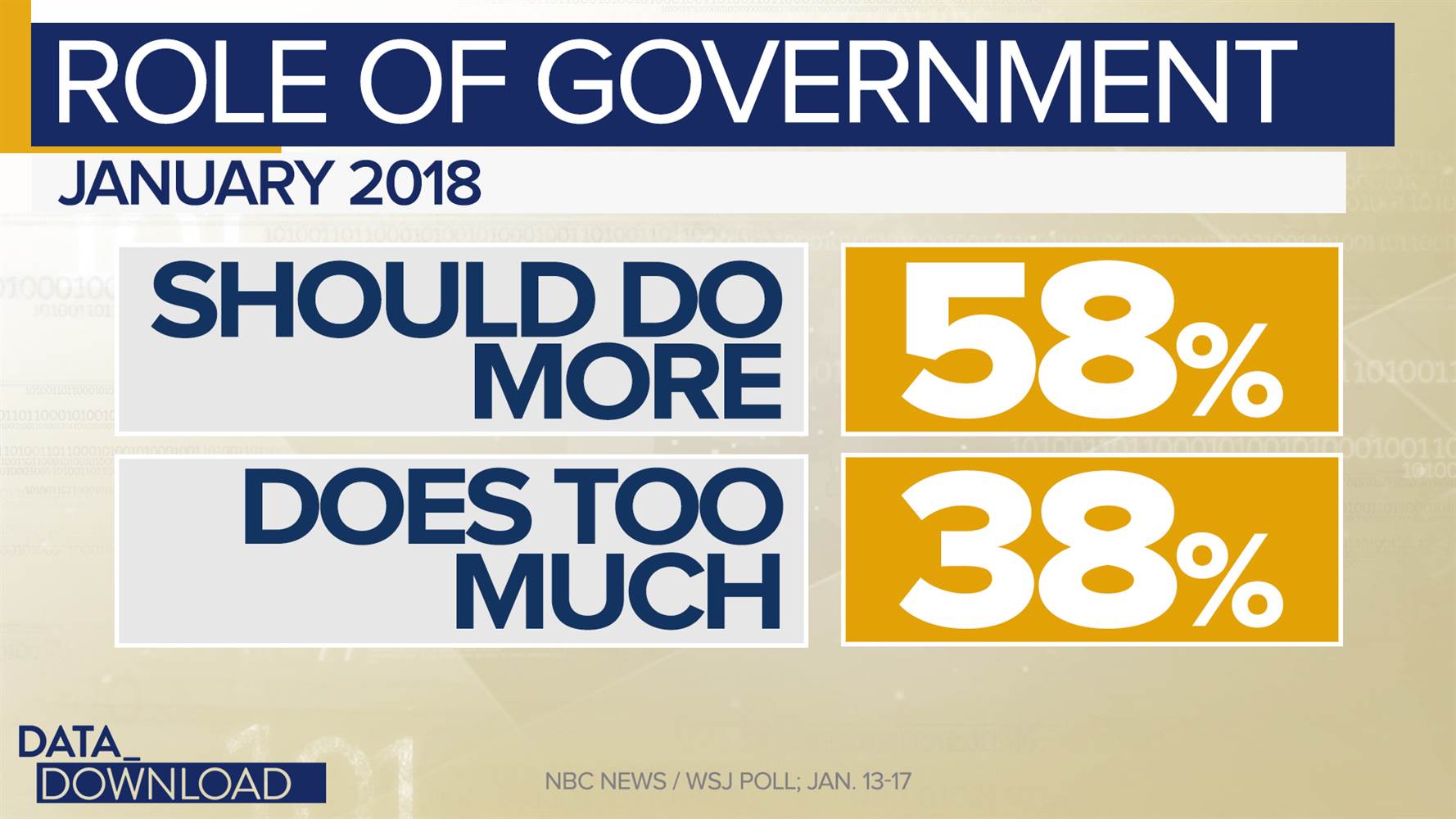 With all that incompetency and dysfunction as a backdrop, consider this: A new NBC/WSJ poll finds a record level of Americans agree with the statement that “
 To the extent that