That Was Just The Start: Risk Parity, CTAs Are In Process Of Selling $200 Billion

Now that inverse VIX ETFs have effectively blown up, suffering “termination events” like XIV earlier today, one of the forming bullish market narratives is that there will be no incremental “squeezed” buying of VIX from this key vol-selling group. Of course, there is a perfectly obvious flipside to that which few have pointed out, namely that holders of the inverse ETPs lost $3.4bn as the products went bankrupt, which removes a steady source of volatility supply over the last year.

But a bigger question is whether the vol selling is indeed over, and according to a just released analysts from Bank of America the answer is a resounding no. In a note from BofA’s Benjamin Bowler, the derivatives expert writes that the ETP driven vol explosion which we described in painful detail previously, is just the beginning.

Here’s why.

While BofA’s model implements position changes in response to a given day’s moves on the close the same day, in reality, both risk parity and CTA strategies operate over varying horizons. In any case, the bank’s derivatives team expects actual rules-based risk parity and CTA strategies to implement significant allocation changes within a few days.

So, with BofA assuming $200bn in rules-based risk parity strategies and $250bn in model-driven CTAs, then its models estimate $140bn of global equity unwinds as a result of Friday’s moves and another $60bn as a result of Monday’s moves.

There are two ways to read that number: over the same two days global equity index futures volumes across the largest markets was approximately $1.6 trillion. So if BofA were to assume the entirety of equity unwinds were completed, then it would equate to approximately 12% of the volume over the last two days.

However, it is certain that the move is nowhere near done and BofA expects that if risk parity and CTAs are still unwinding equities in the coming days, then it will be against a continued rise in volumes due to higher volatility.

As a reminder, earlier in the day we presented calculations from Morgan Stanley‘s quant team, according to whom annuity funds will now need to sell between $30 and $35 bn of equities on Tuesday, and a similar amount Wednesday while Risk Parity could provide an additional $10 to $20bn in equity and bond supply this week.

Further, regarding risk parity BofA’s models estimate that funds are on average around 1.3x leveraged with an about 30% allocation to equities. Assuming about $200bn in unlevered AUM, that gives nearly $75bn remaining exposure to equities. Since risk parity typically does not go short, remaining equity selling pressure – once the current $200BN is offloaded – should be less than what some estimate, the question however is how easily digested that initial sale will be.

There is some good news: According to BofA’s models, CTA equity long positions are in the process of unwinding or are completely sold, with only $75BN left in global equitie4s.

While CTAs have the potential to continue selling via turning short, we believe the risk to that is low as CTAs often use moving average crosses to determine long and short positions. While specific parametrizations can vary tremendously across CTAs, in our opinion an important combination worth monitoring is both the 1M vs. 3M and 1M vs. 10M moving average crosses. Given the strong rally in equities over the last year and longer, the 1M moving average still remains well above the 10M and we do not believe shorts build up until we see that set cross.

However, speaking of CTAs, there is another potential major risk factor: a sudden spike lower in Treasury yields. Recall our article from January 24 “Momentum Traders Wreak Havoc For 2Y Treasurys, Could Unleash Sharp Bond Liquidation” in which we explained that some of the biggest marginal buyers, and sellers, of 2Y notes are CTAs.

Well, according to BofA’s latest analysis, the rally yesterday in bond futures “is causing our model CTA portfolio to cover its short US bond futures position in order to limit losses. Given the recent significant trend lower in bond prices prior to Monday’s reversal, our model’s short position was quite high. Should actual CTAs also start unwinding their short US bond futures positions, then we may see a squeeze in the coming days.

Which brings us to BofA’s final observation: according to the quant strategists, if today’s dip is bought and we reach a local high, “CTAs could accumulate equity longs.”

Given that moving averages still point to positive trending equities, we believe CTAs could actually reinitiate longs should we see a snap back in the next one to two weeks. This incremental buying pressure could help propel any reversal in the markets and is worth monitoring.

In other words, if only central banks provide just enough support to stocks today, we may all simply forget that on “Black Monday 2017” we saw the biggest volatility freakout in history and the algos will be back to buying the dip, as they always have been, in no time as nobody learns any lessons once again.

via RSS http://ift.tt/2BYJnMl Tyler Durden

Do You Have a First Amendment Right to Flip Off the Cops?

middle fingerThe Indiana branch of the American Civil Liberties Union is fighting for your constitutional right to flip off the cops.

Last week the group filed a lawsuit on behalf of Mark May of Vigo County, Indiana. May was ticketed $500 for flipping off Iowa State Trooper Matt Ames while driving down a state highway last year.

According to May, Ames had “aggressively” cut him off in the attempt to pull over another vehicle. Not believing Ames’ actions to be “a wise use of police resources,” May did what any red-blooded patriot would do and gave the trooper the finger.

The gesture so enraged Ames that he broke off the traffic stop he was engaged in and instead pulled over May, issuing him a $500 ticket for “provocation.”

Provocation is a Class C infraction in Indiana, defined as “recklessly, knowingly, or intentionally engages in conduct that is likely to provoke a reasonable person to commit battery.”

May challenged the ticket in Terre Haute City Court. He lost there, but he did have his conviction vacated by Vigo County Superior Court. The ACLU’s suit seeks damages for the violation of his constitutional rights, and for the days of work May lost while having to appear in court.

Giving Ames the middle finger, the lawsuit claims, does not qualify as provocation and did nothing to interfere with the officer’s duties. Thus, while May’s gesture was “perhaps inadvisable,” he was nevertheless “engaged in expressive activity fully protected” by the First Amendment to the U.S. Constitution. The lawsuit also argues that because Ames’ reason for pulling May over was illegitimate, the traffic stop was both unreasonable and done without probable cause, in violation of the Fourth Amendment.

Needless to say, it’s poor form to give someone the middle finger in traffic, or indeed pretty much anywhere. But cops ought to know the difference between a violation of etiquette and a violation of the law.

from Hit & Run http://ift.tt/2sgXih6
via IFTTT

Trump’s Bigly Lie that He’ll Make America’s Immigration System More Merit-Based Like Canada’s

Debunking Trump’s steady stream of bigly lies on immigration is a full time job.

One such lie is that the immigration reforms he is demanding in exchange for handing citizenship to Dreamers will make America’sTrump system more “merit based,” like Canada’s. But I note in my column at The Week, this is like saying that kneecapping someone will make them a better sprinter.

If Trump were serious about this goal, he would:

radically streamline the immigration process for high-skilled immigrants. He could skip the H-1B stage altogether and hand green cards to them directly, just as Canada does. Or at least “staple” greencards to the diplomas of foreign students graduating from American universities (as Mitt Romney once proposed) or to the job offers of foreigners. Or increase the annual quota of H-1Bs. Or scrap the per-country annual limit on green cards. Or at minimum give the unused green card quota of one country to others like India and China that send more talent to America.

Instead, Trump has launched a two-front assault on high-skilled immigrants. He wants to pass laws to cut off the future stream of high-skilled workers and he is using his regulatory powers to make it difficult for those already here to stay.

The administration’s motive here is clear: Make life so uncertain and miserable for foreign tech workers that they’ll think twice before opting to come to America—and the red tape so time-consuming and costly for employers that they would think twice before hiring them.

Go here to read the whole thing.

from Hit & Run http://ift.tt/2BKwv0k
via IFTTT

One Of The Greatest Squeezes Of All Time?

Authored by Kevin Muir via The Macro Tourist blog,

It seems like just yesterday the overly confident bulls were openly taunting any market participant that dared counsel about the increasing risks in the equity market.

“You don’t get it. Trump’s tax policies have ushered in a new era of corporate profitability. Why fight the rise? Nothing can stop this freight train.”

Yadayadayada. It’s always the same. Markets make opinions, not the other way round.

All of sudden, in less than a week, the S&P 500 has given up 200 points.

But what happened? Why the change of heart?

Well, as much as I would like to point to a specific economic release, or some other geopolitical development, the truth of the matter is that there really was no catalyst. Equities were simply up on a stick, with everyone chasing the ever-rising market. It was made worse by the new era of electronic trading that favours VWAP or TWAP type orders that spread the buying out over the course of the day resulting in a relentless drip higher. This had the effect of tricking market participants into believing that volatility had permanently disappeared. And in today’s low alpha world, too many investors leaned on the short equity volatility trade to pick up yield.

I have written about this risk extensively. The Source of the Next Crisis or Vol Sellers Branch Out are just a couple of the articles warning about the risks from selling volatility.

Last night, short equity vol sellers got a lesson in getting squeezed. And as much as everyone wants to enter into these complicated discussions about kurtosis or the volatility of volatility, I am going to spell it out in much simpler terms. The short vol sellers were out over their skis, and the market always punishes the weak hands.

In the space of 20 minutes, VIX futures spiked to a level that was higher than 80% from the previous close, triggering the dreaded liquidation clause in the short XIV ETN. And sure enough, it appears the manager chose to exercise that right, with the market assuming the ETN will be wound down.

Whereas a week ago no one could imagine the equity rally ever stalling, this morning the financial world is filled with all sorts of doomsday contagion scenarios about the short volatility collapse.

And could that happen? For sure. If there is one thing that we should have learned from the recent past is that anything can happen.

Yet here is an alternative thought for you to ponder. What if this was simply a case of weak hands getting shaken out? Market history is replete with examples of short squeezes that were nothing more than the stronger capitalized players taking out the under capitalized ones.

Whether it was Brian Hunter’s massive loss in obscure forward nat gas contracts or Porsche’s epic short squeeze of Volkswagen, this game is as old as the hills.

It’s almost like that the stop loss for the short-volatility ETNs was a target for market participants to shoot for.

But the real question is whether the move from the weak hands to strong ones has already happened. Will VIX short sellers look back at last night’s spike and kick themselves for getting stopped out? Everyone on the financial TV is soooo convinced that the vol trade is about to spiral upwards out of control. A good trader learns to never say never, but I am not as sure that last night’s squeeze won’t prove to be the top in VIX for this move.

via RSS http://ift.tt/2nOidCK Tyler Durden

Damning Audit Says Pentagon Cannot Account for $800 Million

The Pentagon failed to track more than $800 million in construction spending adequately, according to an internal audit of one of the Defense Department’s largest agencies.

That audit, obtained and published by Politico on Monday, shows that the Pentagon’s Defense Logistics Agency (DLA)—described as “the military’s Walmart” because it’s responsible for processing supplies and equipment—lacks a paper trail for millions of dollars of spending, making it impossible for auditors to determine how funds were used. “Across the board, its financial management is so weak that its leaders and oversight bodies have no reliable way to track the huge sums it’s responsible for, the firm warned in its initial audit of the massive Pentagon purchasing agent,” Politico reported.

The audit, conducted by Ernst and Young, was meant to be a test case for whether a full audit of the Pentagon’s $700 billion annual budget should be conducted. Based on the results, it would seem the answer to that question is both “yes” and “hoo boy, you are not going to like the results.”

The audit, completed in December, found misstatements on the DLA’s books totaling $465 million. Another $384 million lacked sufficient documentation and sometimes had no documentation at all. Gaping holes in the Pentagon’s bookkeeping suggest there is even more waste that remains unknown.

“Ernst & Young could not obtain sufficient, competent evidential matter to support the reported amounts within the DLA financial statements,” the Pentagon’s inspector general said in a statement attached to the audit’s release.

At least this audit was allowed to see the light of day. When a 2015 review of the Pentagon’s personnel costs turned up more than $125 billion in bureaucratic waste, Defense Department officials tried to bury the report. Among other things, it found that the average administrative position received over $200,000 in compensation, including benefits.

Such atrocious financial management in the largest department of the federal government should be shocking to—well, to hardly anyone, actually. But the audit’s timing should raise yet more questions about whether the Pentagon really needs more funding, as President Donald Trump and congressional Republicans keep claiming. Maybe what it really needs is a thorough reevaluation of how it’s using the assets it already has. Trump, to his credit, campaigned on a promise to audit the Pentagon’s books. But he’s also called for additional military spending, and Republicans in Congress want to lift spending caps as part of a long-term budget deal.

Here’s a fun thought experiment. Take the first sentence of this article and substitute literally any other hugely expensive government program in place of “Pentagon.” Try “Medicaid,” or “Department of Transportation.” Then ask yourself how Republicans in Congress would respond to news of such an audit. I’m having a hard time picturing Paul Ryan making a case for budget increases, but maybe that’s just me.

from Hit & Run http://ift.tt/2EpwW19
via IFTTT

Job Openings Continue To Decline, Confirming Labor Market Slowdown

After a burst of record high job openings which started in June of last year and declined in the fall, today’s December JOLTS report  – the favorite labor market indicator of now former Fed chair Yellen – showed another modest drop in job openings across most categories as the year wound down, with the total number declining from an upward revised 5.978MM to 5.8113MM, below the 5.950MM consensus estimate, the lowest print since May.

After the recent breakout, which started with the near record 414K monthly spike in job openings in June after years of being rangebound between 5.5 and 6 million, the latest job opening prints suggests that increasingly more vacant jobs are getting filled, although it is unclear if that is due to higher wages or looser employer standards. In any case, the fact that job openings is dropping is likely another modest negative for future wage growth.

The number of job openings was little changed for total private and for government. Job openings increased in information (+33,000) and federal government (+13,000), however job openings decreased in a number of industries with the largest decreases occurring in professional and business services (-119,000), retail trade (-85,000), and construction (-52,000). The number of job openings was little changed in all four regions. Now if only employers could find potential employees that can pass their drug tests…

It wasn’t just job openings that declined: total hires declined as well, although more modestly, dropping from a near record 5.493 million in November to 5.488 million in December. This is roughly the same as the May print of 5.472 million.

The other closely watched category, the level of quits – which indicates workers’ confidence they can leverage their existing skills and find a better paying job – reversed last month’s decrease, and in December increased modestly from 3.161MM to 3.259MM, suggesting workers were feeling more confident about demand for their job skills than the previous month. The number of quits was little changed at 3.3 million in December. The quits rate was 2.2 percent. The number of quits was little changed for total private and for government. Quits decreased in federal government (-4,000). The number of quits increased in the Midwest region.

And with a total 5.2 million separations (a 3.6% rate), this means that there were 1.6 million layoffs and discharges in December, virtually unchanged from November.The number of layoffs and discharges was little changed for total private and for government. Layoffs and discharges increased in state and local government education (+15,000). The number of layoffs and discharges was little changed in all four regions.

Putting all the data in context:

  • Job openings have increased since a low in July 2009. They returned to the prerecession level in March 2014 and surpassed the prerecession peak in August 2014. There were 5.8 million open jobs on the last business day of December 2017.
  • Hires have increased since a low in June 2009 and have surpassed prerecession levels. In December 2017, there were 5.5 million hires.
  • Quits have increased since a low in September 2009 and have surpassed prerecession levels. In December 2017, there were 3.3 million quits.
  • For most of JOLTS history, the number of hires (measured throughout the month) has exceeded the number of job openings (measured only on the last business day of the month). Since January 2015, however, this relationship has reversed with job openings outnumbering hires in most months.
  • At the end of the most recent recession in June 2009, there were 1.2 million more hires throughout the month than there were job openings on the last business day of the month. In December 2017, there were 323,000 fewer hires than job openings.

Finally, and perhaps most notably, the Beveridge Curve (job openings rate vs unemployment rate), appears to be gradually normalizing after a nearly decade-long “drift” from its conventional pattern. From the start of the most recent recession in December 2007 through the end of 2009, the series trended lower and further to the right as the job openings rate declined and the unemployment rate rose. In December 2017, the unemployment rate was 4.1% and the job openings rate was 3.8%.


via RSS http://ift.tt/2nGqVn7 Tyler Durden

“It’s Not Over” – Stocks Slump Back Into Red As VIX Tops 35

Just when you thought is was over…

US equity markets are back in the red after the ubiquitous opening ramp and reassurances that all is well…


And VIX is spiking back above 35…and higher on the day…


And as stocks ink back so Treasury yields also drop from payrolls resistance…

via RSS http://ift.tt/2nDp0zW Tyler Durden

Is The 9-Year-Long Dead-Cat-Bounce Finally Ending?

Authored by Charles Hugh Smith via OfTwoMinds blog,

Ignoring or downplaying these fundamental forces has greatly increased the fragility of the status quo.

The term dead cat bounce is market lingo for a “recovery” after markets decline due to fundamental reversals. Markets tend to bounce back after sharp declines as participants (human and digital) who have been trained to “buy the dips” once again buy the decline, and the financial media rushes to reassure everyone that nothing has actually changed, everything is still peachy-keen wonderfulness.

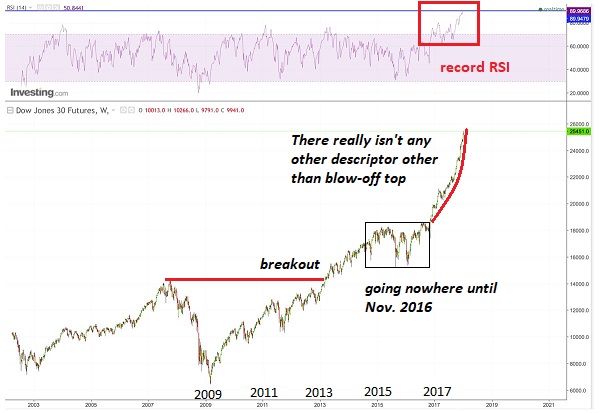
I submit that the past 9 years of market “recovery” is nothing but an oversized dead cat bounce that is finally ending. Here is a chart that depicts the final blow-off top phase of the over-extended dead cat bounce:

Why are the past 9 years nothing but an extended dead cat bounce? Nothing that’s fundamentally broken has been fixed, and none of the dynamics that are undermining the status quo have been addressed.

The past 9 years have been one long dead cat bounce of extend and pretend, i.e. do more of what’s failed because to even admit the status quo is being undermined by fundamental forces would panic those gorging at the trough of the status quo’s lopsided rewards.

This 9-year dead cat bounce was pure speculation driven by cheap central bank credit and liquidity. Demographics, environmental degradation, the decline of middle class security, the erosion of paid work, the bankruptcy of public and private pension plans, the global debt bubble, soaring wealth and income inequality, the corruption of democracy into a pay-to-play bidding war, the destruction of price discovery via market manipulation by those who have turned markets into signaling devices that all is well, the laughable distortion of statistics to mask the real world decline in our purchasing power (inflation is near-zero–really really really), the perverse incentives to leverage up bets in financial instruments that have no connection to the real-world economy–none of these have been addressed in the market melt-up.

Rather, ignoring or downplaying these fundamental forces has greatly increased the fragility of the status quo. Gordon T. Long and I discuss these fundamental forces in our latest half-hour video program, 2018 Themes (29:46 min):

*  *  *

My new book Money and Work Unchained is $9.95 for the Kindle ebook and $20 for the print edition.Read the first section for free in PDF format. If you found value in this content, please join me in seeking solutions by becoming a $1/month patron of my work via patreon.com.

via RSS http://ift.tt/2EL9PMb Tyler Durden

No. It’s not over

Last night I was checking out tickets for some upcoming travel.

I’ll be headed to Colombia soon to check on the progress of a large cannabis investment we’ve made there, then off to Miami for an event with our Total Access members.

After that it’s Puerto Rico to meet with some officials there and check out some exciting investment opportunities on the island.

And then finally back to Asia where we’re setting up a new factory for a business I recently acquired.

So you can imagine my pleasant surprise when I found a ticket for all that travel for just $2800– in business class.

That’s an unbelievable deal; just last month I had a similar itinerary that cost me more than $10,000. So I couldn’t believe my luck.

Hey, who doesn’t like a great bargain?

It’s in our nature as human beings. Whether we’re purchasing a new car, shopping at a ‘Going out of Business’ sale, or planning a vacation, we always feel great when we get a steep discount.

Except, of course, when it comes to investing.

For whatever reason, our ‘value gene’ switches off when it’s time to invest our hard earned savings.

Rather than buy the highest quality assets at the lowest possible prices, people tend to pile into expensive, popular investments that they don’t really understand.

This is clearly not a great strategy to become wealthy… or to stay that way.

I doubt anyone would feel particularly smart if they consistently bought outrageously priced, full-fare plane tickets.

But that’s exactly what people are doing when they buy stocks, bonds, property, and other assets at record highs.

To be clear, it’s not about price. It’s never about price. It’s about value, i.e. what are you receiving in return.

For example, $50,000 might seem like a lot of money to most folks, and the thought of spending that much on anything might cause someone to bristle.

But if you could buy a brand new penthouse apartment in midtown Manhattan for $50,000, you would immediately feel like you were getting tremendous value.

Conversely, $5 is a pretty trivial sum to most people. But if someone tried to sell you used toilet paper for $5, you’d probably turn them down on the spot (unless you were in Venezuela).

Value is never about how much you pay. It’s about how much you get for your money.

And when it comes to investments these days, you don’t get a whole lot.

Here’s a great example:

Mastercard is a company that’s quite popular with investors. As a business, it made around $5 billion last year in ‘Free Cash Flow’.

(Free Cash Flow essentially refers to the amount of company profit that’s available to be paid out to shareholders each year… so it’s a great way to measure return on investment.)

And, at least until a few days ago, Mastercard had an ‘enterprise value’ of about $175 billion.

In other words, if you just happened to have an extra $175 billion lying around the house, you could theoretically buy Mastercard and make it your own private company.

Suppose you actually did that… and spent $175 billion. That’s the price.

The value, i.e. what you receive in return, is $5 billion in annual free cash flow.

As a percentage of your purchase price, that $5 billion works out to be just 2.85%.

That’s a pretty flimsy return. After all, business can be quite risky. And 2.85% hardly seems sufficient to compensate for that risk.

Now consider other options.

Interest rates have surged over the past several months, so the investment returns on bonds have really started to increase.

The United States 10-year note, for example, which is widely considered ‘risk free’ by the market, was yielding as high as 2.86% yesterday afternoon.

In other words, the boring, steady, ‘risk free’ bond had a higher rate of return than a volatile, risky business.

That doesn’t make any sense. And it demonstrates how little VALUE investors are receiving.

By any objective metric, stocks have long been OVERvalued.

Investors are paying more for every $1 in corporate revenue than they ever have before… EVER.

The ratio of Enterprise Value to EBITDA (a good proxy for cash flow) for the average company in the S&P 500 is also at a record high.

The ratio of Stock Market Capitalization to GDP, i.e. the total size of the stock market relative to the size of the economy, is also at a record high.

The list goes on and on.

And of course there are countless individual examples– like Netflix.

That company consistently loses billions of dollars and racks up billions more in debt. Yet it is one of the most expensive and popular investments in the world.

On Friday, it seems the market finally woke up to this absurdity. In the past few days, the Dow Jones Industrial Average has plunged more than 1700 points.

It seems that people are finally starting to become aware that rising interest rates are going to have a serious impact on the stock market.

(Think back to the Mastercard example; why would anyone own stocks if they can get a better return with less risk in the bond market?)

This market rout may continue today.

Or, it’s possible that all the fools come rushing back in and bid stock prices back to record high levels.

The only thing we know for certain is that, as sure as night follows day, there will always be corrections and bear markets.

Nothing goes up or down in a straight line forever.

The market has had years of gains and is at the point where none of it makes sense anymore.

So it’s due for a major correction. Whether or not THIS is the big one, we can be certain that it’s coming. Plan accordingly.

Source

from Sovereign Man http://ift.tt/2BZchMg
via IFTTT

Watch Live: SEC, CFTC Senate Testimony On Cryptocurrencies

In a widely anticipated hearing, the chairmen of the SEC and CFTC, the two federal regulators tasked with overseeing cryptocurrencies, will appear before the Senate Banking Committee today to discuss their regulatory approach to a market that’s rife with fraud and abuse.

In their prepared remarks, the two men appeared to focus on regulating ICOs – which they appear to see as a legitimate form of capital raising – and derivatives like the bitcoin futures launched late last year by the CME and CBOE.

Watch the hearing live below:

Below are the prepared remarks from CFTC Chairman Christopher Giancarlo


Giancarlo Testimony by zerohedge on Scribd


…And the prepared remarks from SEC Chairman Jay Clayton…


Clayton Testimony by zerohedge on Scribd


Cryptocurrencies rallied into the hearing, paring yesterday’s losses. Unfortunately, crypto stocks like Eastman Kodak and Advanced Micro Devices remained lower even as the broader market rebounded.


via RSS http://ift.tt/2BZ9XF2 Tyler Durden