IMF’s Lagarde Laments “Highly Mysterious” Low Inflation, Says “Everybody” Would Like It To Be Higher

Without skipping a beat, IMF Director Christine Lagarde left President Xi’s Belt and Road initiative conference and traveled to sunny southern California to make an appearance at the Milken Institute Conference, where she sat for an interview with former WSJ editor-in-chief (now editor-at-large) Gerry Baker.

Given that Friday’s surprisingly robust (at least on the surface) GDP print has revived speculation among some economists about ‘divergence’ between the US and the global economy, Baker led with a question about whether Q1 GDP had impacted the view on US growth over at the IMF.
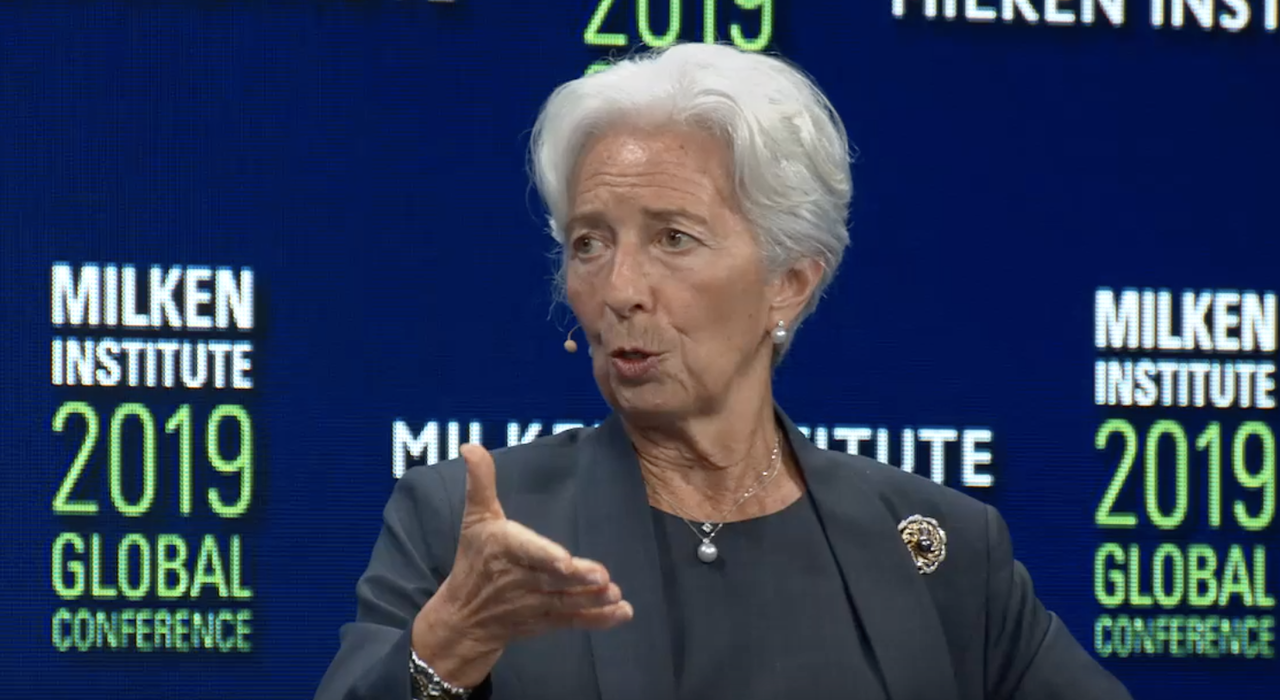
Lagarde

While the surprisingly large number will “certainly lead us to reassess our forecast for growth in the US,” which could in turn boost the global economy, Lagarde cautioned that one strong GDP print doesn’t make a trend, and that the global economy remains mired in what she called a “delicate moment.”

Earlier this month, the IMF again slashed its forecasts for global growth, this time to its weakest level in a decade.

Asked if we’re seeing more divergence now.

“We still think that it’s a delicate moment given the still synchronized slowdown for growth…you have about 70% of the global economy which is slowing – but still growing – and we are not expecting a recession and certainly not in our baseline. Everybody including the highest authorities were certainly surprised by the large number in the United States…that will certainly lead us to reassess our forecast for growth for the United States, and clearly given the size of the US economy it will have an impact overall.”

Looking ahead, the upcoming reading on US productivity will be important.

“First quarter big jump in inventory number we’re not seeing consumption going up and we’re not seeing big investment either…productivity will be important…odds are that it will be good and that’s important because we’ve been waiting for productivity to be good.”

Asked about persistently below target inflation, and whether the Fed may have jumped the gun by hiking rates last year, Lagarde said that inflation (or rather, the lack thereof) was “a mystery” and that if she had the answer she would be “queen of the economy” – to which Baker replied that she already holds that title as head of the IMF?.

“It’s highly mysterious…and if I had the answer I’d be the ‘queen of the economy.’ It’s a big of a mystery because the famous Philips curve should lead inflation up given where we are with unemployment.”

She added that the inflation conundrum wasn’t unique to the US; Germany has experienced a similar phenomenon. But central banks weren’t wrong to raise rates, Lagarde said, citing their ‘mandate’ to maintain stable prices (though of course they also have another implicit and even more important mandate to ensure the continued growth of asset prices).

“I wouldn’t say that they got it wrong. They have a mandate. The mandate is price stability and the number that has been set for decades now has been at or below 2%.”

Indeed, although “everybody” would like a little more inflation (and by ‘everybody’, we assume Lagarde means a handful of economists, because most working people are already struggling to process the inflation in health-care costs, tuition, rent and other necessities that have hammered the standard of living in the developed world), Lagarde pushed back against those who have been pushing to change the central bank’s target rate.

“I’ll tell you what I find quite extraordinary with this theory…if you can’t get it up to 2% why would setting it at 4% get it up? Everybody would like a little more inflation but I don’t think setting a higher bar would necessarily trigger higher inflation. It’s going to be a matter of supply and demand…and the economy responding to those places.”

On the subject of China and, more specifically, Xi’s promise to adopt more sustainable lending standards, Lagarde insisted that she believes the Chinese will follow through.”

Toward the end of the interview, Baker asked Lagarde for her thoughts about the theory that the global economy is entering a period of permanent stagnation, what he called ‘Japanification’. Lagarde said she’s not surprised by this as populations across most of the world are shrinking. And while she couldn’t say whether she believes this is phenomenon will persist for years or decades, she did say that higher productivity growth could help boost growth once again.

“I think relationships are going to be difference…and I don’t know if it will be a  fundamental shift, but it’s one that’s factoring the ageing phenomenon that’s impacting most of the world except Sub-Saharan Africa. What could take us out of that changing landscape is productivity. We might be measuring productivity in a skewed way that’s no longer relevant.”

Finally, Baker asked Lagarde for her thoughts about the rising tide of socialist fervor in the US, and the warnings from Ray Dalio, Jamie Dimon and other prominent capitalists that our unsustainable system must be ‘fixed’ or risk falling apart.

“I don’t think that globalization is going to go away…I don’t think that it can continue with the level of inequality we have around the world and if those issues of inequality aren’t addressed at multiple levels – both in terms of opportunity in terms of focus on the excluded in terms of the desire of people to have their roots and culture preserved…for women to be part of the game at all levels of society…then the system is going to be under threat on a continuous basis.”

While she said she appreciates Jamie Dimon and Ray Dalio speaking out, the world needs to own this problem. And actions speak louder than words.

Being half-way through her second term, Baker closed by asking her if she would consider another term once this one ends in 2021.

“Maybe,” she replied. “I’m keeping my options open – just like the Brits.”

WSJ editor-at-large Gerry Baker’s interview with Christine Lagarde begins around the 15 minute mark.

via ZeroHedge News http://bit.ly/2VtGFfu Tyler Durden

Trump: NRA Under ‘Illegal Investigation’ By Como And New York AG

President Trump on Monday said that the National Rifle Association (NRA) is “under siege by Cuomo and the New York State A.G.,” who he accused of “illegally using the State’s legal apparatus to take down and destroy this very important organization.” 

The NRA must “get its act together quickly, stop the internal fighting, & get back to GREATNESS – FAST!” Trump concluded. 

In a subsequent Monday tweet, Trump said: “People are fleeing New York State because of high taxes and yes, even oppression of sorts. They didn’t even put up a fight against SALT – could have won. So much litigation. The NRA should leave and fight from the outside of this very difficult to deal with (unfair) State!” 

Trump’s tweets come after New York Attorney General Letitia James’ office announced on Saturday that her office had launched an investigation into the NRA and issued subpoenas to the organization, following reports of an internal dispute between the group’s president, Oliver North, and its CEO, Wayne LaPierre – in which North accused LaPierre of financial malfeasance, including misappropriating $200,000 of NRA funds to purchase clothing from an NRA vendor, according to the Wall Street Journal.  

Mr. North, in a letter read to NRA members Saturday morning at the group’s annual meeting in Indianapolis, said he had hoped to be renominated for a second one-year term as president, but “I am now informed that will not happen.”

The departure of Mr. North, a conservative folk hero from his days as an Iran-Contra figure, comes after NRA Chief Executive Wayne LaPierre sent a letter to the NRA board accusing Mr. North of trying to extort him and force him out over allegations of financial improprieties. –Wall Street Journal

According to the Journal, the investigation is focused on “related-party transactions between the NRA and its board members; unauthorized political activity; and potentially false or misleading disclosures in regulatory filings.”

In response to Trump’s tweet, Cuomo (D) tweeted back: “Unlike you, President Trump, New York is not afraid to stand up to the NRA.”

As CNBC noted, AG James’ office has pursued Trump’s nonprofit, the Donald J. Trump Foundation, which agreed to dissolve under judicial supervision last year after the previous Attorney General, Barbara Underwood, accused it of a “shocking pattern of illegality.” 

In a March filing, James wrote that the foundation broke “some of the most basic laws” related to private foundations. Her office is seeking nearly $3 million in restitution from the foundation.

Trump foundation attorneys have denied the allegations and accused officials in the heavily Democratic state of having political motivations. –CNBC

On Friday, Trump spoke at the annual NRA convention in Indiana. 

via ZeroHedge News http://bit.ly/2XV5Rca Tyler Durden

The Satanic Temple Sues After a City Rejects It Pentagram-Covered Veteran Monument

The Satanic Temple is suing the city of Belle Plaine, Minnesota, because it won’t let them erect a Satanic monument in a public park.

The story behind the case begins in 2016, when the Belle Plaine Veterans Club put up a steel monument called “Joe” in the Belle Plaine Veterans Memorial Park—a publicly owned space. The monument depicts a soldier kneeling before a Christian cross, and it was removed after a few months after critics accused the city of violating the First Amendment’s Establishment Clause. (To refresh, that’s the bit prohibiting the government from creating laws “respecting an establishment of religion.”)

In February 2017, the city council voted to let private parties erect temporary displays in the memorial park. “Joe” received a permit to return. The Satanic Temple also applied for, and received, a permit for its own monument. This display was to consist of a black cube covered in pentagrams, with an upturned helmet at the top; a plaque would say, “In honor of Belle Plaine veterans who fought to defend the United States and its Constitution.”

Though “Joe” returned to the park, the Satanic Temple never got an opportunity to erect its effort. That July, the city council unanimously passed a second resolution to rescind the first, explaining that “allowing privately-owned memorials of displays in [Belle Plaine Veterans Memorial Park] no longer meets the intent or purpose of the Park.” The council also encouraged the voluntary removal of “Joe,” to make the resolution easier to pass.

The Satanic Temple is now arguing that the government violated its right to free speech and discriminated against its “controversial but constitutionally protected religious viewpoints.” Had the monument been erected, it would have been the first Satanic Temple display on public property.

This latest lawsuit joins the list of Satanic Temple First Amendment fights. The group made headlines last August after demanding that its statue of Baphomet—a demonic, goat-headed creature—be placed in the Arkansas State Capitol. The statue was unveiled after a Republican state lawmaker sponsored and quietly installed a Ten Commandments display.

Bonus video: A new documentary depicts devil worshippers as unlikely defenders of the First Amendment.

from Latest – Reason.com http://bit.ly/2ZJCGKX
via IFTTT

The Satanic Temple Sues After a City Rejects It Pentagram-Covered Veteran Monument

The Satanic Temple is suing the city of Belle Plaine, Minnesota, because it won’t let them erect a Satanic monument in a public park.

The story behind the case begins in 2016, when the Belle Plaine Veterans Club put up a steel monument called “Joe” in the Belle Plaine Veterans Memorial Park—a publicly owned space. The monument depicts a soldier kneeling before a Christian cross, and it was removed after a few months after critics accused the city of violating the First Amendment’s Establishment Clause. (To refresh, that’s the bit prohibiting the government from creating laws “respecting an establishment of religion.”)

In February 2017, the city council voted to let private parties erect temporary displays in the memorial park. “Joe” received a permit to return. The Satanic Temple also applied for, and received, a permit for its own monument. This display was to consist of a black cube covered in pentagrams, with an upturned helmet at the top; a plaque would say, “In honor of Belle Plaine veterans who fought to defend the United States and its Constitution.”

Though “Joe” returned to the park, the Satanic Temple never got an opportunity to erect its effort. That July, the city council unanimously passed a second resolution to rescind the first, explaining that “allowing privately-owned memorials of displays in [Belle Plaine Veterans Memorial Park] no longer meets the intent or purpose of the Park.” The council also encouraged the voluntary removal of “Joe,” to make the resolution easier to pass.

The Satanic Temple is now arguing that the government violated its right to free speech and discriminated against its “controversial but constitutionally protected religious viewpoints.” Had the monument been erected, it would have been the first Satanic Temple display on public property.

This latest lawsuit joins the list of Satanic Temple First Amendment fights. The group made headlines last August after demanding that its statue of Baphomet—a demonic, goat-headed creature—be placed in the Arkansas State Capitol. The statue was unveiled after a Republican state lawmaker sponsored and quietly installed a Ten Commandments display.

Bonus video: A new documentary depicts devil worshippers as unlikely defenders of the First Amendment.

from Latest – Reason.com http://bit.ly/2ZJCGKX
via IFTTT

Globally Synchronized…

Authored by Jeffrey Snider via Alhambra Investment Partners,

The economic sickness is predictably spreading. While unexpected in most of the world which still, somehow, depends on central banking forecasts, it really has been almost inevitable. From the very start, just the utterance of the word “decoupling” was the kiss of death. What that meant in the context of globally synchronized growth, 2017’s repeatedly dominant narrative, wasn’t the end of synchronized as many tried to say but the end of growth.

This was more than an economic factor. A fixed system leading into full, meaningful recovery was supposed to heal more than economy. Those political extremists who had multiplied and spread while waiting for it would be revealed as illegitimate, their complaints nothing more than some form of evil “ism.” The New York Times in January 2018 succinctly described its wider significance:

A decade after the world descended into a devastating economic crisis, a key marker of revival has finally been achieved. Every major economy on earth is expanding at once, a synchronous wave of growth that is creating jobs, lifting fortunes and tempering fears of popular discontent.

Well, purported significance anyway. If globally synchronized growth was “tempering fears of popular discontent”, the risks are pretty clear should there not be any. I wrote last September what wasn’t any sort of special insight:

From 2003 to 2009, it went: globally synchronized growth, decoupling, globally synchronized downturn. From 2010 to 2012, it went: globally synchronized growth, decoupling, globally synchronized downturn. From 2013 to 2016, it went: strong global growth (not synchronized), decoupling, synchronized downturn.

Last year [2017] to this year [2018], it has gone: globally synchronized growth, decoupling. What comes next?

The answer is here before us. Yesterday, the Bank of Canada throws in the towel on its end of the global economy. Last October, the Canadians were thinking how they had to get serious with their rate hikes. Now, officials admit in all likelihood there won’t be any more.

Something sure changed.

Today, Sweden. Sveriges Riksbank, that country’s central bank, follows the Canadian (or European) example. Rate hikes which were scheduled for later this year, perhaps as soon as July, are now forecast for early next year. Its version of QE has now been extended to likely December 2020. And that’s if this current interruption is “transitory” as each central bank currently figures.

What are the chances of that?

Perhaps we should ask the people of the Republic of Korea.

South Korea’s economy suffered its worst quarterly contraction since the global financial crisis as the export-driven economy felt the pinch from weakening growth in China, global trade tension and a downturn in the technology sector.

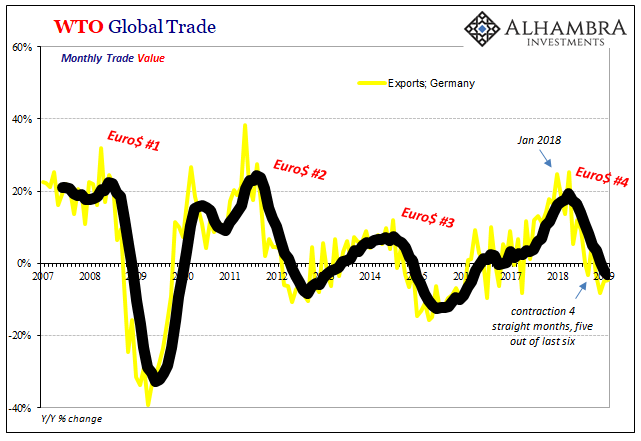
If there are tensions in trade it has little or nothing to do with “trade tensions” as commonly described. About half of ROK’s GDP is derived from global trade. All of the major export bellwethers, South Korea included, are, say it with me, synchronized. Downturn synchronized.

The more immediate issue is what sure looks like a fourth eurodollar downturn being forced on the global economy by a fourth eurodollar squeeze. International data, central bank action, and consistent market data and prices. Curves more than anything. As my offshore friend Emil has said, paraphrasing George Soros, we are not forecasting #4 we are witnessing it.

Thoughts now must turn to severity, including some detective work about variability across nations even regions, as well as duration. We’ll do that some other day.

For now, though, there is also the big picture to consider beyond just eurodollars. The longer the public stays in the dark about shadow money, this is the best we will ever see. And that’s not good. It can only lead to more genuine if understandably misguided dissatisfaction with the way things are. Popular discontent, The New York Times blandly describes it.

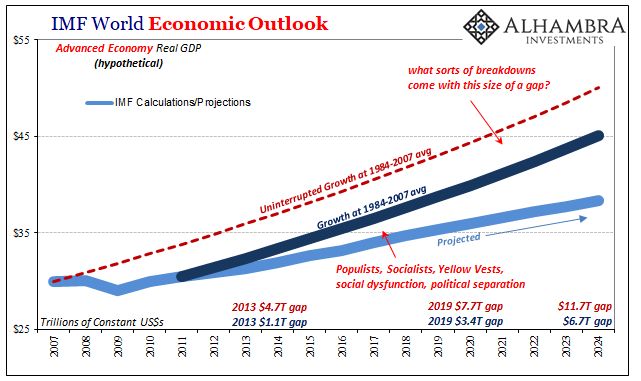
If Euro$ #3 brought out Trump, Bernie, Brexit, populism, AOC, socialism, European dissolution, etc., what does Euro$ #4 do? The Times was right about only the one thing. Had globally synchronized growth been as advertised it would’ve pushed the global trend back toward the center, reversing it away from the extremes.

Synchronized downturn instead, not only does “popular discontent” spread further, the temperature of those already discontented will surely rise. If they distrusted the status quo after 2016…

People around the world have been incredibly patient. For the most part, officials were given ever chance, two, three, and four of them, to get it right. The immediate implication should be easy enough, but it won’t be heeded. Stop listening to central bankers. They really have no idea what they are doing. That’s really all renewed “dovishness” means, and proves.

via ZeroHedge News http://bit.ly/2GRwTvp Tyler Durden

Marriott Preparing To Launch ‘Airbnb Killer’ Home-Rental Business

Just in time to spoil the party ahead of Airbnb’s long-awaited IPO (which may or may not happen this year, according to one of its co-founders), Marriott is reportedly preparing to launch a home-rental business in the US that will focus on courting business travelers (and hopefully involve fewer creepy hidden cameras).

WSJ reports that Marriott is preparing to expand its home-rental pilot program to Paris after finding success in Paris, Rome, Lisbon and London. Marriott could announce plans for the “first phase” of the new business as soon as next month. Assuming it follows through, Marriott, already the world’s largest hotel chain by room count, would be the first hotel operator to push into the home rental market.

Home

Of course, with its purported focus on business travelers, Marriott could steal market share in what is seen as a critical growth market for Airbnb. Though its bookings are popular among leisure travelers, business travelers have preferred to continue booking with traditional hotels, thanks largely to perks like room-cleaning and customer support. To remedy this, Airbnb recently led a $160 million funding round for Lyric, a luxury-rental startup that offers these services to business travelers. It is also developing a unit aimed at corporate travelers that has already attracted signups from some 400,000 companies.

Marriott wouldn’t be the first major hotel chain to dip its toe into the home-rental market, but it would be the first to launch its own business in-house. Hyatt’s purchase of a minority stake in onefinestay, an Airbnb competitor, has turned into a “negative performer,” the company said.

Other global hospitality brands have also dabbled in the home-rental business, but without much to show for it. Hyatt took a minority stake in onefinestay, a company that enables travelers to rent upscale private homes.

Accor, the giant Paris-based hotel company, acquired onefinestay in 2016 but noted in an October 2018 press release that the unit had turned in a “negative performance.” An Accor spokeswoman said the company is “continuing its work to turn onefinestay around, primarily through rationalization programs,” and that it was introducing new home collections.

Hyatt also took a stake in Oasis Collections and incorporated the home-rental firm’s listings into its distribution system and loyalty program. After the rental-management company Vacasa LLC bought Oasis last year, Hyatt said it was ending its affiliation with Oasis.

With Lyft shares still more than 30% below their IPO price one month after the company’s debut, will Marriott’s home-rental play – which could face some of the same legal pushback from cities like NYC nervous about missing out on the tax revenue paid by traditional hotels – give investors one more reason to shy away from Airbnb’s offering?

Might Airbnb, too, be forced to lower its price range, like Uber has now done (twice)? Or even shelve plans for its debut until ‘better market conditions’ arise?

via ZeroHedge News http://bit.ly/2VtDBju Tyler Durden

ISIS’ Baghdadi Appears In Video After 5 Year Absence – Vows “Long Battle” Against West

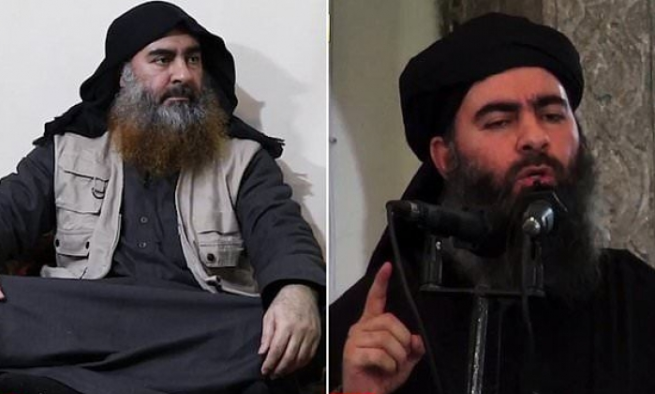
So-called Islamic State Abu Bakr al-Baghdadi has appeared in a video released by the group’s media arm on Monday, for the first time in five years amid widespread speculation about his death.

He appears to have gained some pounds since his first and previously only public video from 2014 in Mosul, and also seems to be channeling Osama bin Laden in his sitting pose while beside an AKS-74U submachine gun, characteristic of the late al-Qaeda leader as well as Ayman al Zawahiri, whose most famous videos feature the same weapon leaned up against a wall. 

The 18-minute video was titled by ISIS as “In the Hospitality of the Emir of the Believers,” and shows Baghdadi sitting next to ISIS members giving a casual talk focused on the general state of affairs in the Islamic world. A rifle and ammunition belt can be seen beside the terrorist leader, something military analysts have said is reminiscent of old al-Qaeda propaganda videos. 

According the Long War Journal’s Thomas Joscelyn, Baghdadi acknowledges ISIS losses in Syria but outlined ways the group has hit back in revenge attacks of late.

Joscelyn translated and summarized the contents of Baghdadi’s words as: “Baghdadi praises attacks launched as revenge for the Islamic State’s loss of territory in Sham (Syria), accepts oaths of allegiance from groups in West Africa (Burkina Faso and Mali), and specifically mentions attacks in Sri Lanka.”

The Middle East analyst noted further that, “This was recorded fairly recently” — though the precise date and location remains unknown. 

It comes following years of widespread media reports and speculation that the ‘caliphate’ head could be dead, and other contradictory reports that he was in hiding somewhere in the desert regions along the Iraq-Syria border. 

He was last seen announcing the establishment of the Islamic caliphate in July 2014, after his fighters took Mosul, Iraq. At that time the younger and thinner ISIS leader was filmed addressing a congregation at the al-Nuri Mosque in the northern Iraqi city. 

In the latest video he also appears to have colored his beard, perhaps to look younger. Though the footage can’t be confirmed as many media reports suggest, analysts say it’s recent given he acknowledged “The battle for Baghouz is over” — in reference to the last ISIS stronghold in Syria, which was only in the past months taken over US-backed SDF Syrian Kurdish forces after an over week long battle with hundreds of ISIS fighters. 

“And as for our brothers in Sri Lanka, I was overjoyed when I heard about the suicide attack, which overthrew the cradles of the Crusaders, and avenged them for our brethren in Baghouz,” he said.

“It was by the grace of god that there were Americans and Europeans in Sri Lanka. They questioned God, who answered in the form of bringing the suicide attackers.” — Middle East Eye translation of video contents

He warned in the video of a “long battle” against the western “crusaders,” and promised ISIS would “take revenge” for western coalition attacks on ISIS forces. “There will be more to come after this battle,” he said, according to a translation by Middle East Eye

via ZeroHedge News http://bit.ly/2LbU9IE Tyler Durden

Democratic Contenders Apologize for Everything Except Their Lousy Economic Policies

Since last the Editors’ Roundtable edition of the Reason Podcast, Sen. Elizabeth Warren (D–Mass.) announced a massive new student-loan forgiveness proposal, Sen. Kamala Harris (D–Calif.) said she’d like to ban right-to-work laws, Beto O’Rourke unveiled a $5 trillion climate change plan, Joe Biden officially began his campaign/apology tour, and Sen. Bernie Sanders (I–Vt.) yet again declined an invitation to disavow his prior support for nationalizing the major means of production. Is anyone else sensing a pattern?

Katherine Mangu-WardNick Gillespie, Peter Suderman, and Matt Welch discuss the leftward bent of Democratic economics, drilling down particularly hard into the bucket of higher education (ed note: the mixed metaphor makes even less sense in the podcast), while also getting into Social Security insolvency, long-term fiscal unsustainability, conversations about conversations, and—yes!—the HBO/Marvel Studios programming y’all were consuming over the weekend.

Subscribe, rate, and review our podcast at iTunes.

Audio production by Ian Keyser.

‘Fluffing a Duck’ by Kevin MacLeod is licensed under CC BY 3.0

Relevant links from the show:

Elizabeth Warren’s Plan To Cancel College Debt Is a Giveaway to the Well-Off and Well-Connected,” by Peter Suderman

The Immorality of Student Loan Forgiveness and Free College,” by Nick Gillespie

Most Democratic Presidential Candidates Think College Should Be Free. Here’s Why They’re Wrong.” By Nick Gillespie

Elizabeth Warren’s Fake Wonkery,” by Peter Suderman

Harris Wants to Ban Right-to-Work Laws, Chooses Union Endorsements Over Worker Well-Being,” by Elizabeth Nolan Brown

Harris Would Hike Teacher Pay Across the Nation by 23 Percent,” by Elizabeth Nolan Brown

Harris Is Rising Above the 2020 Pack With Promises to Be Everything to Everyone,” by Elizabeth Nolan Brown

Here’s What’s in Beto O’Rourke’s $5 Trillion Plan To Fight Climate Change,” by Joe Setyon

Joe Biden Officially Enters the Presidential Race,” by Christian Britschgi

Bernie Sanders Wanted ‘Public Ownership of the Major Means of Production’ in 1976,” by Matt Welch

Social Security Will Be Insolvent in 16 Years,” by Eric Boehm

GAO: Current Federal Fiscal Situation Is ‘Unsustainable,’” by Eric Boehm

The Long Night Is Over on Game of Thrones, but the Real Villain Is Still Coming,” by Robby Soave

Elizabeth Warren Wants You To Know She Totally Loves Game of Thrones. Especially Daenerys. Yay, Women!” By Robby Soave

What Elizabeth Warren Gets Wrong About Daenerys Targaryen,” by Ilya Somin

What Game of Thrones Can Teach Us About Political Power,” by Katherine Mangu-Ward

Movie Review: Avengers: Endgame,” by Kurt Loder

Avengers: Endgame Is Exactly the Movie You Want It to Be,” by Peter Suderman

from Latest – Reason.com http://bit.ly/2XSD8ET
via IFTTT

The Lesson Of Argentina: You Can’t Stabilize A Bankrupt Economy

Authored by John Rubino via DollarCollapse.com,

So the U.S. puts Republicans (the party of small government) in charge, and gets… trillion dollar deficits as far as the eye can see AND a revival of socialism among Democrats.

Scary as this may seem, the real (and even scarier) lesson is that it’s all inevitable: Beyond a certain level of indebtedness, even pro-business, sound money, small government leaders are powerless to stop the march to insolvency and currency crisis.

The latest example is Argentina, which a few years ago elected a free-market president, only to see its debt explode and its currency crash. From Friday’s Wall Street Journal:

Argentine President’s Prospects Dim With Those of His Country’s Economy

Argentina’s assets took a beating Thursday amid President Mauricio Macri’s continuing struggle to tame rising prices and revive a shrinking economy, raising prospects that his left-wing predecessor could make a comeback in this year’s presidential election.

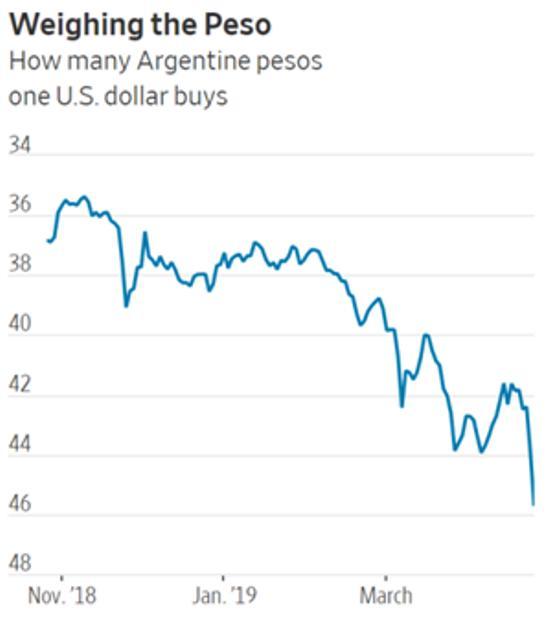
The peso lost more than 5% of its value against the dollar in early trading Thursday, before regaining some ground in the afternoon. Argentina is now the world’s second-riskiest borrower after crisis-hit Venezuela as indicated by credit default swaps, which are derivatives that pay holders when a borrower defaults on a debt payment.

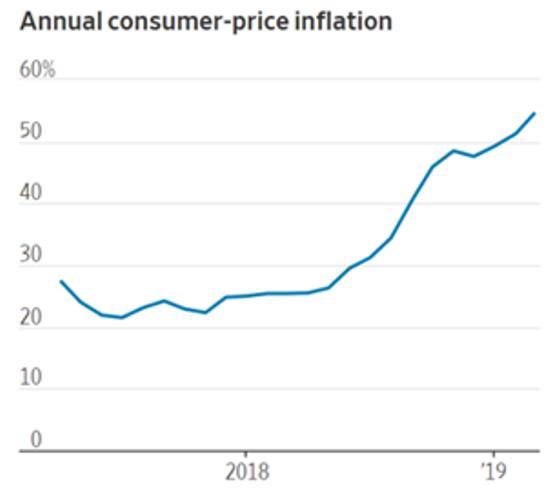
Mr. Macri, who was elected in 2015 on promises to undo the interventionist policies of President Cristina Kirchner, announced new price controls last week to try to get Argentina’s inflation under control. Mr. Macri has failed during his administration to contain inflation, which has risen to a 12-month pace of almost 55% in March from 25% at the start of 2018.

The move sparked criticism that the president was abandoning market-friendly policies for short-term electoral considerations as Argentines grow increasingly impatient with rising prices. It also underscored the possibility that Mr. Macri could lose October’s election, even if he faces the polarizing Mrs. Kirchner in the final runoff between the top two finishers of an initial vote. That scenario was considered unlikely just a few months ago.

“Both the recession and inflation have gotten so bad that not even facing Cristina Kirchner would be enough for [Mr. Macri] to win in the second round,” said Bruno Binetti, a political analyst at the Torcuato Di Tella University in Buenos Aires. “People are so displeased with the state of the economy right now that they would be willing to vote for her given their anger to the current government.”

Mr. Macri has said chronic budget deficits have boosted inflation and caused other economic difficulties. He has defended his government’s actions to balance his administration’s budget.

“We’re going to the source of the problem,” he said in a radio interview Wednesday. “It will take time,“ but inflation has to come down, he added.

The president’s unsuccessful efforts to end a recession that has pushed unemployment up to 9.1% and left about 30% of the country’s population living in poverty have caused a backlash among Argentines. A recent poll by Synopsis Consultores, a local consulting firm, showed Mrs. Kirchner with 45% support versus 44.3% for Mr. Macri in a runoff. Other polls show Mrs. Kirchner winning by a bigger margin.

“If the economy does not improve, the government falls in the polls. If the poll numbers fall for the government, then you have more pressure on the exchange rate, on the financial markets, and then that feeds into the real economy,” said Matías Carugati, head economist at Buenos Aires-based pollster Management & Fit.

“Macri is a disaster,” said Liliana Mejía, a 28-year-old student in Buenos Aires. “They all have to go.” She said she was upset that rising costs left her unable to buy a gift for her son’s second birthday next week.

But many Argentines still back the president, arguing that he inherited the problem after more than a decade of misrule by Mrs. Kirchner and her late husband, Néstor Kirchner.

“Cristina is to blame for all of this,” said Carlos Mayo, a 70-year-old retiree. “You can’t fix in two years the disaster that they did in 12 years.”

Mrs. Kirchner’s administration nationalized businesses and raised taxes on Argentina’s vital grain exports. She financed the deficit by printing money, imposed price controls on hundreds of consumer products and defaulted on the debt. She is facing trial on several corruption allegations, while denying wrongdoing.

Upon taking office almost four years ago, Mr. Macri moved quickly to eliminate most farm export taxes and lift foreign-exchange and capital controls in a bid to restore confidence among businesses, investors and consumers. He cut personal income taxes and invited foreign businesses to invest in Argentina’s energy and transportation sectors.

Mr. Macri, the scion of a wealthy Buenos Aires family, also provided the legal framework to attract foreign investment, said Juan Pereira, an analyst at Inframation, a global infrastructure and energy news and data service.

Mr. Macri borrowed heavily in global markets as he tried to slowly restore the government’s finances. He sought in that way to avoid the deep spending cuts and ensuing social unrest that led to the removal of past presidents during previous economic shocks.

But Mr. Macri found himself mired in a currency crisis after his government eased inflation targets at the end of 2017—an action some market participants saw as threatening the independence of Argentina’s central bank—and interest rates rose in the U.S. early last year. Mr. Macri turned to the International Monetary Fund for a bailout to calm investor concerns about debt payments.

The peso continued to weaken even after the bailout last June, and Mr. Macri had to return to the IMF in September to ask for more money as he promised to balance his budget by slashing government spending and raising taxes on farm exports.

Now, some investors are concerned that the government could eventually default on its debt, said Asha Mehta, a portfolio manager of Boston-based Acadian Asset Management.

“The main risks we see are the potential for a default, the IMF not offering further support, and the currency collapsing,” she said.

Investors are still willing to back Mr. Macri, according to Dominic Bokor-Ingram, a portfolio manager at London-based fund manager Fiera Capital.

“The preference in the international community is for Macri,” he said. “He didn’t have the political power to force through enough reforms, but if he were to get another four-year term there’s a very strong chance he’d be able to carry out the reforms he promised.”

Here’s the key sentence:

 “Mr. Macri borrowed heavily in global markets as he tried to slowly restore the government’s finances. He sought in that way to avoid the deep spending cuts and ensuing social unrest that led to the removal of past presidents during previous economic shocks.”

When a country’s debts reach a certain point, “austerity” — that is, lowering spending to shrink deficits — causes so much pain to a population that has become addicted to easy credit and generous benefits, that the politician implementing it is kicked out and replaced with whoever promises the most free stuff. And the debt binge continues.

Europe found this out after trying to force peripheral EU countries to meet low deficit targets. The result is populists and/or socialists in charge of most of the biggest debtor countries.

Macri seems to have recognized the risk of austerity but discovered that borrowing more money to avoid spending cuts is simply business as usual under a different name.

Meanwhile, here in the US, from a financial standpoint it hardly matters who’s in charge after 2020 because massive spending increases are now the consensus, with the only argument being over which things we buy with all that borrowed money.

Put another way, Argentina is now the future of the developed world.

via ZeroHedge News http://bit.ly/2PATYVW Tyler Durden

Democratic Contenders Apologize for Everything Except Their Lousy Economic Policies

Since last the Editors’ Roundtable edition of the Reason Podcast, Sen. Elizabeth Warren (D–Mass.) announced a massive new student-loan forgiveness proposal, Sen. Kamala Harris (D–Calif.) said she’d like to ban right-to-work laws, Beto O’Rourke unveiled a $5 trillion climate change plan, Joe Biden officially began his campaign/apology tour, and Sen. Bernie Sanders (I–Vt.) yet again declined an invitation to disavow his prior support for nationalizing the major means of production. Is anyone else sensing a pattern?

Katherine Mangu-WardNick Gillespie, Peter Suderman, and Matt Welch discuss the leftward bent of Democratic economics, drilling down particularly hard into the bucket of higher education (ed note: the mixed metaphor makes even less sense in the podcast), while also getting into Social Security insolvency, long-term fiscal unsustainability, conversations about conversations, and—yes!—the HBO/Marvel Studios programming y’all were consuming over the weekend.

Subscribe, rate, and review our podcast at iTunes.

Audio production by Ian Keyser.

‘Fluffing a Duck’ by Kevin MacLeod is licensed under CC BY 3.0

Relevant links from the show:

Elizabeth Warren’s Plan To Cancel College Debt Is a Giveaway to the Well-Off and Well-Connected,” by Peter Suderman

The Immorality of Student Loan Forgiveness and Free College,” by Nick Gillespie

Most Democratic Presidential Candidates Think College Should Be Free. Here’s Why They’re Wrong.” By Nick Gillespie

Elizabeth Warren’s Fake Wonkery,” by Peter Suderman

Harris Wants to Ban Right-to-Work Laws, Chooses Union Endorsements Over Worker Well-Being,” by Elizabeth Nolan Brown

Harris Would Hike Teacher Pay Across the Nation by 23 Percent,” by Elizabeth Nolan Brown

Harris Is Rising Above the 2020 Pack With Promises to Be Everything to Everyone,” by Elizabeth Nolan Brown

Here’s What’s in Beto O’Rourke’s $5 Trillion Plan To Fight Climate Change,” by Joe Setyon

Joe Biden Officially Enters the Presidential Race,” by Christian Britschgi

Bernie Sanders Wanted ‘Public Ownership of the Major Means of Production’ in 1976,” by Matt Welch

Social Security Will Be Insolvent in 16 Years,” by Eric Boehm

GAO: Current Federal Fiscal Situation Is ‘Unsustainable,’” by Eric Boehm

The Long Night Is Over on Game of Thrones, but the Real Villain Is Still Coming,” by Robby Soave

Elizabeth Warren Wants You To Know She Totally Loves Game of Thrones. Especially Daenerys. Yay, Women!” By Robby Soave

What Elizabeth Warren Gets Wrong About Daenerys Targaryen,” by Ilya Somin

What Game of Thrones Can Teach Us About Political Power,” by Katherine Mangu-Ward

Movie Review: Avengers: Endgame,” by Kurt Loder

Avengers: Endgame Is Exactly the Movie You Want It to Be,” by Peter Suderman

from Latest – Reason.com http://bit.ly/2XSD8ET
via IFTTT