Ocasio-Cortez: ‘I Don’t Care If You’re Documented Or Undocumented’

Democratic Socialist Alexandria Ocasio-Cortez has gone full Soros, telling an audience at a Saturday town hall event in New York that America’s immigration system is “completely unjust,” and that a person’s immigration status doesn’t matter to her. 

The New York Rep. also said that President Trump is “creating” populations of illegal immigrants by “grinding all of the agencies to a halt that process the legal forms of immigration,” which she says is “forcing people into the shadows.” 

“First of all I believe in human rights,” AOC continued. “I don’t care if you’re documented or you’re undocumented.”

Ocasio-Cortez has awkwardly thrust herself into the immigration debate, suggesting last month to an astonished House Financial Services Committee that Wells Fargo was involved in the ‘caging of children and financing the caging of children,” because the bank has loaned money to private detention companies CoreCivic and the Geo Group. 

AOC has also repeatedly called for the abolishment of US Immigration and Customs Enforcement (ICE), claiming the agency is racist and has “systematically violated human rights.” 

“The president should not be asking for more money to an agency that has systematically violated human rights. The president should be really defending why we are funding such an agency at all because right now what we are seeing is death,” she told MSNBC‘s Rachel Maddow in January, adding: “The president should be really defending why we are funding such an agency at all. Right now, what we are seeing is death. Right now, what we are seeing is the violation of human rights.

via ZeroHedge News http://bit.ly/2vq8lTO Tyler Durden

Polls Say Biden, Bernie Could Beat Trump. Should You Believe Them?

Recent polls showing Joseph Biden or even Bernie Sanders defeating Donald Trump in a general election are understating Trump’s true strength.

For example, an Emerson College poll released April 15 had Biden beating Trump, 53 percent to 47 percent, and Sanders beating Trump, 51 percent to 48 percent. A Morning Consult Politico poll released April 24 had Biden at 42 percent and Trump at 34 percent. A Hill HarrisX survey released April 26 had Biden at 43 percent and Trump at 37 percent.

These polls are misleading in at least six ways.

First, the presidency is decided on the basis of the electoral vote, not a nationwide popular vote. Trump lost the popular vote in 2016 and won the presidency anyway, because of the way his votes were distributed in the various states. It’d be risky for Trump to count on a repeat of that feat, which is unusual but not unprecedented. But polls of battleground states, or swing states, can be more useful predictors than nationwide surveys.

Second, these head-to-head polls, unlike battleground state ballots, don’t include third party or minor party candidates. Such general-election efforts by candidates such as Jill Stein, Ralph Nader, and Ross Perot all were arguably significant factors in tight presidential elections in recent years. Starbucks coffee entrepreneur Howard Schultz has the money to be a factor this time around, though his campaign so far has been less than impressive.

Third, as “little Marco” Rubio and “Lyin’ Ted” Cruz can attest, Trump has considerable skill at defining an opposing candidate memorably and early. Senator Elizabeth Warren is still trying to recover from Trump’s description of her as Pocahontas, or Fauxcahontas, and Trump has even publicly regretted not saving it for later, maybe after she won the Democratic nomination. This week, after the polls were taken, Trump was tweeting about “Sleepy Joe” Biden. He’s also testing “Crazy Bernie Sanders.” Expect to hear more such nicknames, or insults, between now and Election Day.

Fourth, Trump’s own negative campaigning will be, well before the time the actual election rolls around, supplemented by independent expenditures that that emphasize the worst aspects of his opponent. Remember the way Swift Boat Veterans For Truth took John Kerry’s Vietnam War experience and turned it into a negative in the minds of some voters, or at least raised doubts about his own portrayal of that experience? Look forward to what the Trump campaign’s allies do with Biden’s “handsy” reputation or with Biden’s record as an opponent of federal intervention in integration cases involving school busing.

Fifth, as the cumulative experience of polling Brexit, the 2016 Trump campaign, and Benjamin Netanyahu’s 2019 election victory demonstrate, nationalists or conservatives or populists or whatever you want to call them tend not to be terribly eager to cooperate with pollsters. The pollsters tend to work for either universities or elite media outlets that the nationalists or conservatives or populists or whatever you want to call them view, with at least some justification, as irredeemably biased against them. The pollsters can try to use technical methods such as oversampling or weighting to correct for this sort of thing, but at bottom, if a Trump voter wants to tell a pollster over the telephone that he is actually a die-hard Elizabeth Warren fan, there’s not much the pollster can do to avoid being misled.

Sixth, these races are susceptible to last-minute, event-based swings—the financial crisis in 2008, the James Comey statements about Hillary Clinton in 2016—that are impossible to predict this far in advance. These swings could work in favor of Trump or against him.  It’s hard, though, to imagine Trump getting worse press coverage than he already has, so late surprises could well hurt his Democratic challenger.

Given all of that, why pay any attention at all at this stage? It’s a reasonable question. The colleges and news organizations are investing money in these polls in part on the basis that we readers are curious enough to click through. For better or worse, we all get the journalism, and the politicians, that we deserve.

Ira Stoll is editor of FutureOfCapitalism.com and author of JFK, Conservative.

from Latest – Reason.com http://bit.ly/2UQuhlg
via IFTTT

“The Fed Owns The Next Crash”

Authored by Sven Henrich via NorthmanTrader.com,

Occam’s Razor: The simplest explanation is often the best explanation.

In this case: The Fed panicked in December and by caving to markets reignited the bubble in a major way and now they are losing control as they are trapped and twisted in their own narratives. No rate hikes until 2020 but markets are printing new all time highs less than 4 months following Powell’s famous balance sheet flexibility cave on January 4th, just a couple weeks after President Trump told him “to stop the 50Bs” on twitter.

And markets have done nothing but gone up since then:

But this appears to be only act one of the drama. Now a mere weeks after a constant drum roll by Kudlow and Trump demanding the Fed to cut rates by 50bp the Fed may actually do just that according to Nomura.

Such a move would surely end whatever may be left of the Fed’s “independence” credibility which one can critically question already following the December cave. Loss of credibility being ironically one of the key risk factors Deutsche sees as a threat to the expansion:

Whether they will cut rates at this meeting or not is speculative, but fact is global growth is slowing still and markets are pricing in a rate cut:

The Fed has already made itself the market’s play thing and hence can’t ill afford to disappoint markets this year and consequently the Fed faces a perhaps impossible choice this week:

Cut rates here by 50bp could only exacerbate the bubble and set markets onto their combustion path following a total credibility loss.

But disappointing markets this year could well set the stage for a larger selloff the Fed is so desperate to prevent at every turn, especially now that the Fed has fueled the most vertical rally in this cycle:

So now they’re trapped. Inside the bubble the Fed itself helped create. No, the market is not the bubble. The Fed is the bubble and they’ve blown up markets all around them.

And as a result:

But no worries, The Fed is already tinkering on the next version of QE.

*  *  *

For the latest public analysis please visit NorthmanTrader. To subscribe to our market products please visit Services.

via ZeroHedge News http://bit.ly/2GSLEOL Tyler Durden

Polls Say Biden, Bernie Could Beat Trump. Should You Believe Them?

Recent polls showing Joseph Biden or even Bernie Sanders defeating Donald Trump in a general election are understating Trump’s true strength.

For example, an Emerson College poll released April 15 had Biden beating Trump, 53 percent to 47 percent, and Sanders beating Trump, 51 percent to 48 percent. A Morning Consult Politico poll released April 24 had Biden at 42 percent and Trump at 34 percent. A Hill HarrisX survey released April 26 had Biden at 43 percent and Trump at 37 percent.

These polls are misleading in at least six ways.

First, the presidency is decided on the basis of the electoral vote, not a nationwide popular vote. Trump lost the popular vote in 2016 and won the presidency anyway, because of the way his votes were distributed in the various states. It’d be risky for Trump to count on a repeat of that feat, which is unusual but not unprecedented. But polls of battleground states, or swing states, can be more useful predictors than nationwide surveys.

Second, these head-to-head polls, unlike battleground state ballots, don’t include third party or minor party candidates. Such general-election efforts by candidates such as Jill Stein, Ralph Nader, and Ross Perot all were arguably significant factors in tight presidential elections in recent years. Starbucks coffee entrepreneur Howard Schultz has the money to be a factor this time around, though his campaign so far has been less than impressive.

Third, as “little Marco” Rubio and “Lyin’ Ted” Cruz can attest, Trump has considerable skill at defining an opposing candidate memorably and early. Senator Elizabeth Warren is still trying to recover from Trump’s description of her as Pocahontas, or Fauxcahontas, and Trump has even publicly regretted not saving it for later, maybe after she won the Democratic nomination. This week, after the polls were taken, Trump was tweeting about “Sleepy Joe” Biden. He’s also testing “Crazy Bernie Sanders.” Expect to hear more such nicknames, or insults, between now and Election Day.

Fourth, Trump’s own negative campaigning will be, well before the time the actual election rolls around, supplemented by independent expenditures that that emphasize the worst aspects of his opponent. Remember the way Swift Boat Veterans For Truth took John Kerry’s Vietnam War experience and turned it into a negative in the minds of some voters, or at least raised doubts about his own portrayal of that experience? Look forward to what the Trump campaign’s allies do with Biden’s “handsy” reputation or with Biden’s record as an opponent of federal intervention in integration cases involving school busing.

Fifth, as the cumulative experience of polling Brexit, the 2016 Trump campaign, and Benjamin Netanyahu’s 2019 election victory demonstrate, nationalists or conservatives or populists or whatever you want to call them tend not to be terribly eager to cooperate with pollsters. The pollsters tend to work for either universities or elite media outlets that the nationalists or conservatives or populists or whatever you want to call them view, with at least some justification, as irredeemably biased against them. The pollsters can try to use technical methods such as oversampling or weighting to correct for this sort of thing, but at bottom, if a Trump voter wants to tell a pollster over the telephone that he is actually a die-hard Elizabeth Warren fan, there’s not much the pollster can do to avoid being misled.

Sixth, these races are susceptible to last-minute, event-based swings—the financial crisis in 2008, the James Comey statements about Hillary Clinton in 2016—that are impossible to predict this far in advance. These swings could work in favor of Trump or against him.  It’s hard, though, to imagine Trump getting worse press coverage than he already has, so late surprises could well hurt his Democratic challenger.

Given all of that, why pay any attention at all at this stage? It’s a reasonable question. The colleges and news organizations are investing money in these polls in part on the basis that we readers are curious enough to click through. For better or worse, we all get the journalism, and the politicians, that we deserve.

Ira Stoll is editor of FutureOfCapitalism.com and author of JFK, Conservative.

from Latest – Reason.com http://bit.ly/2UQuhlg
via IFTTT

WeWork Unveils Plans For ‘Community-Adjusted’ Public Offering As Revenues, Losses Double

In an announcement that will no doubt be interpreted as broadly bullish for the unstoppable US equity rally, WeWork (or rather, “the We Company”, as its CEO has promised to rebrand it) said Monday that it is planning a public offering in the near future, and that it had already filed its registration paperwork with the SEC back in December.

It’s the clearest indication yet that Lyft’s post-IPO troubles (the stock is trading more than 30% below its IPO price, and has inspired a flurry of lawsuits) haven’t deterred other companies that boast both growing revenues and growing losses.

In a stunning acknowledgement of just how parlous WeWork’s business model is, a person close to the company reportedly told Axios that it could become the second most-shorted stock, behind Tesla.

WeWork

Critics of the company have pointed out several overarching flaws in its business model: For one, it’s heavily indebted, and Moody’s last year suspended its rating due to a ‘lack of information’, with its bonds frequently trading at a double-digit spread to Treasuries.

With this heavy debt load, the company would be poised to toppled into bankruptcy during an economic downturn due to the fundamental dislocation between its long-term debt obligations and its short-term leases (though the company insists that it’s working to sign up more long-term clients like IBM). And let’s not forget the allegations of self-dealing by the company’s CEO that have been raised in the business press.

Even Soft Bank, the global marginal buyer when it comes to investing in overhyped Silicon Valley startups, cut back on plans for an investment in WeWork, eventually committing just $2 billion to the company, well short of the $16 billion it had initially been eyeing.

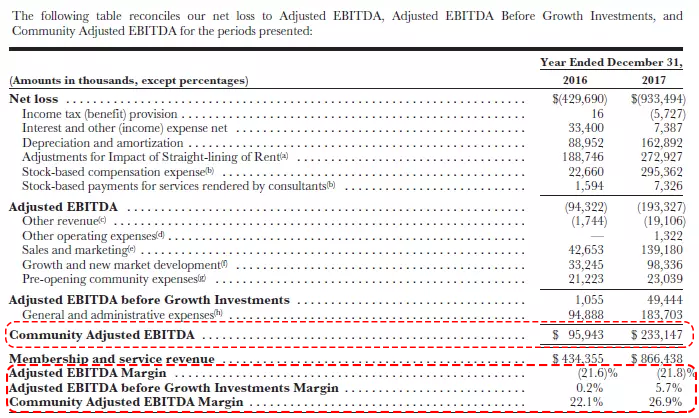
As we’ve pointed out time and time again, WeWork has relied on accounting gimmicks to try and win over bond investors. As we have reportedly pointed out, thanks to its reliance on “community-adjusted EBITDA”, WeWork’s EBITDA is, basically, whatever you want it to be.

Community EBITDA

Here, for the first time we saw not just one adjustment to adjusted EBITDA, but an adjustment to the adjustment to the adjustment, and it was called “Community Adjusted EBITDA”, which by the miracles of non-GAAP “accounting”, pushed the company’s EBITDA from negative $193 million in 2017 to positive $233 million.

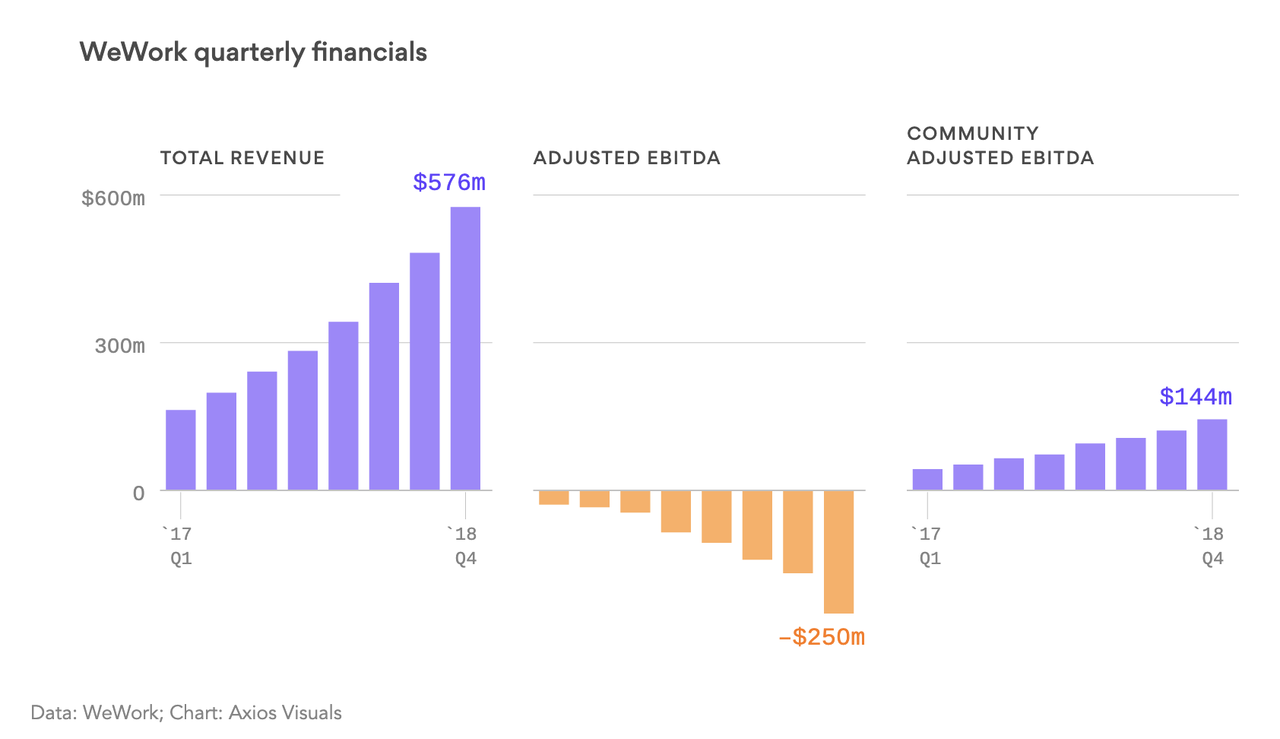
According to an investor presentation from last year, the company revealed that it doubled both revenues and losses last year (well, unless you go by the ‘Community Adjusted EBITDA’ figure).

WeWork

Looks like a sound business model to us.

via ZeroHedge News http://bit.ly/2XWXaxZ Tyler Durden

Guantanamo Bay Prison Commander Fired Weeks Before Scheduled Departure

The commander of the prison at Guantanamo Bay has been terminated just 7 weeks before he was set to formally depart his post.

Navy Rear Admiral John Ring was fired over a “loss of confidence in his ability” to lead, according to a statement from the United States Southern Command. U.S. Army Brigadier General John Hussey has assumed the role of acting commander of the prison, which houses accused terrorists and enemy combatants at a U.S. military base in Cuba.

“This change in leadership will not interrupt the safe, human, legal care and custody provided to the detainee population,” the statement says.

Admiral Ring, a former commander of the aircraft carrier Nimitz, took the reins at Guantanamo in April 2018. There he oversaw approximately 1,800 employees and 40 prisoners. His legacy will likely be dominated by his loud calls to build a new prison to replace Camp 7, the segregated unit that has held Guantanamo’s most notorious inmates, including Khalid Shaikh Mohammed, the alleged 9/11 mastermind. Ring argued that the building lacks the resources and infrastructure to serve its aging population.

“Unless America’s policy changes, at some point we’ll be doing some sort of end of life care here,” Ring told The New York Times before his dismissal was announced. “A lot of my guys are prediabetic. Am I going to need dialysis down here? I don’t know. Someone’s got to tell me that. Are we going to do complex cancer care down here? I don’t know. Someone’s got to tell me that.”

The project came with an estimated $88.5 million price tag, which might sound like quite the renovation. That pales in comparison, though, to the $454 million it costs to operate the prison each year. Taxpayers have spent nearly $5 billion on the detention center since its inception in 2002, all to maintain a fortress that holds prisoners indefinitely without charges, and thus without trials.

A spokeswoman for the Southern Command has told The New York Times that Ring’s advocacy had nothing to do with his termination, declaring that he was fired after a monthlong investigation that began in March. “The vast majority of commanders complete their assigned tours with distinction,” Colonel Amanda Azubuike said to the Times. “When they fall short, we hold our leaders accountable, which reflects the importance we place on the public’s trust and confidence in our military leaders.”

from Latest – Reason.com http://bit.ly/2XSfEzL
via IFTTT

Will Americans Ever Recover From This Excursion Into Unreality?

Authored by James Howard Kunstler via Kunstler.com,

How to account for Americans being the most anxious, fearful, and stressed-out people among the supposedly advanced nations? Do we not live in the world’s greatest democratic utopia where dreams come true?

What if the dreaming part is actually driving us insane? What if we have engineered a society in which fantasy has so grotesquely over-run reality that coping with daily life is nearly impossible. What if an existence mediated by pixel screens large and small presents a virtual world more compelling than the real world and turns out to be a kind of contagious avoidance behavior — until reality is so fugitive that we can barely discern its colors and outlines beyond the screens?

You end up in a virtual world of advertising and agit-prop where manipulation is the primary driver of human activity. That is, a world where the idea of personal liberty (including any act of free thought) becomes a philosophical sick joke, whether you believe in the possibility of free will or not. You get a land full of college kids trained to think that coercion of others is the highest-and-best use of their time on earth — and that it represents “inclusion.” You get a news industry that makes its own reality, churning out narratives (i.e. constructed psychodramas) to excite numbed minds. You get politics that play out like a Deputy Dawg cartoon. You get a corporate tyranny of racketeering that herds spellbound citizens like so many sheep into chutes for shearing, not only of their money, but their autonomy, dignity, and finally their will to live.

Can a people recover from such an excursion into unreality? The USA’s sojourn into an alternative universe of the mind accelerated sharply after Wall Street nearly detonated the global financial system in 2008. That debacle was only one manifestation of an array of accumulating threats to the postmodern order, including the burdens of empire, onerous global debt, population overshoot, fracturing globalism, worries about energy, disruptive technologies, ecological havoc, and the specter of climate change — things that hurt to think about.

The sense of gathering crisis persists. It is systemic and existential. It calls into question our ability to carry on “normal” life much farther into this century, and all the anxiety that attends it is so hard for the public to process that a dismaying number of citizens opt for suicide. There is no coherent consensus about what is happening and no coherent proposals to do anything about it. Bad ideas flourish in this nutrient medium of unresolved crisis. Lately, they dominate the scene on every side.

A species of wishful thinking that resembles a primitive cargo cult grips the technocratic class, awaiting magical rescue remedies to extend the regime of Happy Motoring, consumerism, and suburbia that make up the crumbling armature of “normal” life in the USA. The political Right seeks to Make America Great Again, as though we might return to a 1962 heyday of industrial mass production by wishing hard enough. The Left seeks the equivalent of an extended childhood for all, lived out in a universal safe space, where all goods and services come magically free from a kindly parent-like government, and the sunny days are spent training unicorns to find rainbows.

The decade-long “recovery” from the Great Financial Crisis of 2008 amounted to ten years of fake-it-til-you-make-it — with the prospect nil of actually making it to something like economic and cultural soundness. Are we too far gone now? Some kind of shock therapy is surely in the offing, and probably in the form of a violent financial readjustment that will alter the terms of getting and spending so drastically as to topple the matrix of rackets that masquerades as the nation’s business.

That financial shock has been coiling and coiling in the fantasyland that banking has become in the new zero interest rate regime where notions that pretend to be money get levered into new ways of destroying life on earth and the human project with it. At some cognitive level the people of this land sense what is coming and the wait for it is driving them crazy. Tom Petty was right: the waiting is the hardest part, and a hard way to learn that a virtual life is not an adequate substitute for an authentic one.

via ZeroHedge News http://bit.ly/2GRE2Mf Tyler Durden

Google Tumbles After Missing Across The Board

With Google parent Alphabet closing at all time highs ahead of it earnings, expectations were clearly both high, and priced to perfection. Too much perfection in fact, because unlike many of its peers, the company reported Q1 results which missed across the board.

Here are the highlights:

  • Q1 revenue ex-TAC $29.48 billion, missing the estimate of $30.04 billion
  • Q1 EPS $9.50, Exp. $10.17
  • Q1 paid clicks on Google properties +39% vs. +66% q/q
  • Q1 cost-per-click on Google properties -19% vs. -29.0% q/q
  • Q1 operating margin 18%, vs 21% Q/Q

The immediate comparison made by analysts is one with Facebook which beat revenue across the board, prompting some to wonder if the broader ad business is slowing down, or if the company has conceded even more advertising market share to Facebook (and Amazon).

The topline was disappointing across the board, with 1Q Google advertising revenue $30.72 billion sliding from $32.64 billion q/q; total Google properties revenues of $25.68 billion dropped in Q1 vs. $27.02 billion q/q; Google other revenue also dropped in the quarter to $5.45 billion vs. $6.49 billion.

Just as concerning has been Google’s rising expenses, and in Q1 the company’s traffic acquisition costs (TAC), the amount Google pays out to websites and mobile partners, rose to $6.87 billion for the quarter.

The flipside is that after CapEx soared toward the end of 2018, Alphabet did manage to rein it in during the quarter. As a result, overall CapEx fell to $4.6 billion, from $7.3 billion last year.

Even that however, was not enough, and since the stock was – as noted above – priced beyond perfection, it is tumbling after hours, and was down as much as 5%.


via ZeroHedge News http://bit.ly/2LdxYSx Tyler Durden

Guantanamo Bay Prison Commander Fired Weeks Before Scheduled Departure

The commander of the prison at Guantanamo Bay has been terminated just 7 weeks before he was set to formally depart his post.

Navy Rear Admiral John Ring was fired over a “loss of confidence in his ability” to lead, according to a statement from the United States Southern Command. U.S. Army Brigadier General John Hussey has assumed the role of acting commander of the prison, which houses accused terrorists and enemy combatants at a U.S. military base in Cuba.

“This change in leadership will not interrupt the safe, human, legal care and custody provided to the detainee population,” the statement says.

Admiral Ring, a former commander of the aircraft carrier Nimitz, took the reins at Guantanamo in April 2018. There he oversaw approximately 1,800 employees and 40 prisoners. His legacy will likely be dominated by his loud calls to build a new prison to replace Camp 7, the segregated unit that has held Guantanamo’s most notorious inmates, including Khalid Shaikh Mohammed, the alleged 9/11 mastermind. Ring argued that the building lacks the resources and infrastructure to serve its aging population.

“Unless America’s policy changes, at some point we’ll be doing some sort of end of life care here,” Ring told The New York Times before his dismissal was announced. “A lot of my guys are prediabetic. Am I going to need dialysis down here? I don’t know. Someone’s got to tell me that. Are we going to do complex cancer care down here? I don’t know. Someone’s got to tell me that.”

The project came with an estimated $88.5 million price tag, which might sound like quite the renovation. That pales in comparison, though, to the $454 million it costs to operate the prison each year. Taxpayers have spent nearly $5 billion on the detention center since its inception in 2002, all to maintain a fortress that holds prisoners indefinitely without charges, and thus without trials.

A spokeswoman for the Southern Command has told The New York Times that Ring’s advocacy had nothing to do with his termination, declaring that he was fired after a monthlong investigation that began in March. “The vast majority of commanders complete their assigned tours with distinction,” Colonel Amanda Azubuike said to the Times. “When they fall short, we hold our leaders accountable, which reflects the importance we place on the public’s trust and confidence in our military leaders.”

from Latest – Reason.com http://bit.ly/2XSfEzL
via IFTTT

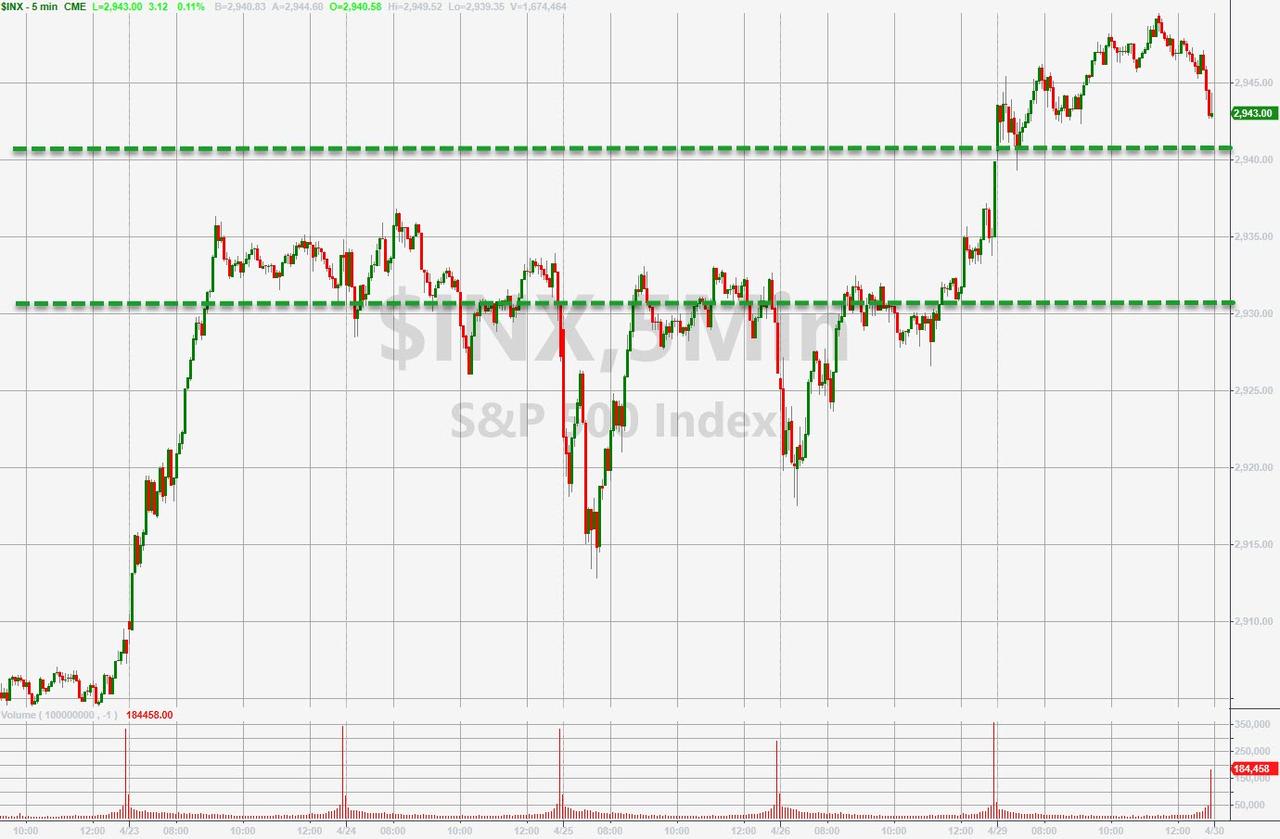
S&P Hits Record High, Most Overbought Since VIXmageddon

The last time the S&P 500 was at a record high and this overbought was January 2018 – right before the world fell out of the bottom of VIX shorts…

And remember, VIX traders have never been shorter vol than they are now…

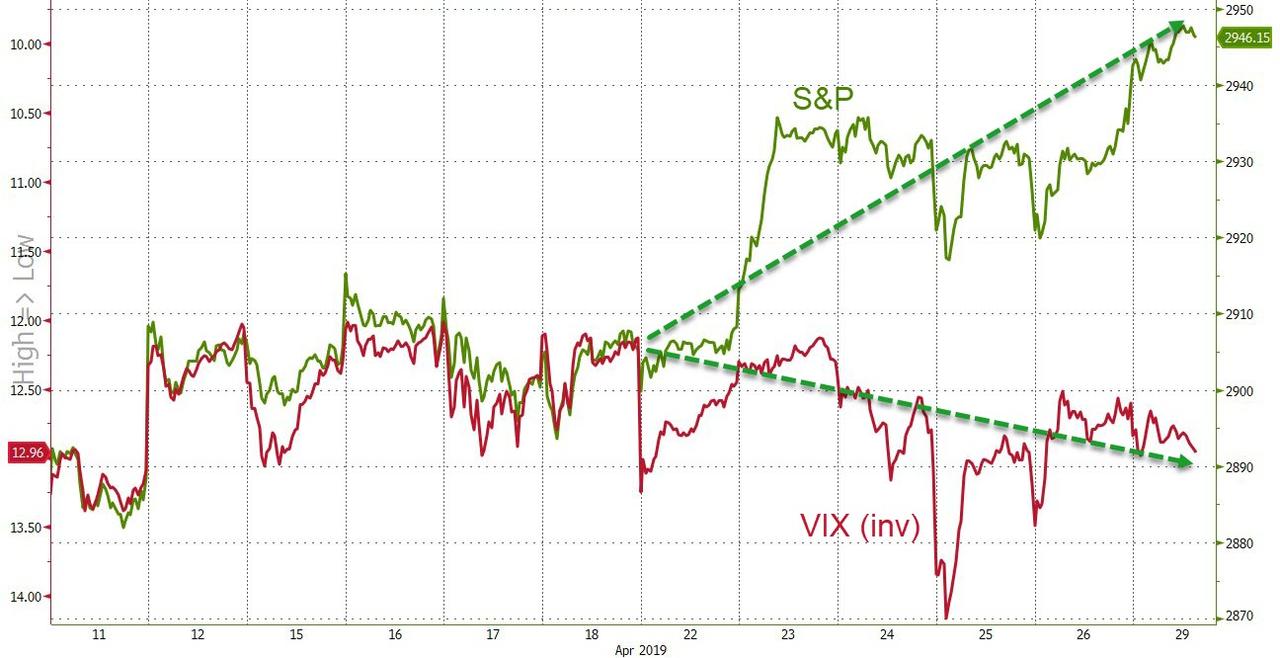
Notably, extending last week’s decoupling, VIX was higher as stocks rose today… The last time we saw this was January 2018’s melt-up as buyers bid up vol on the back of call options

Ignore this…

“Probably nothing”

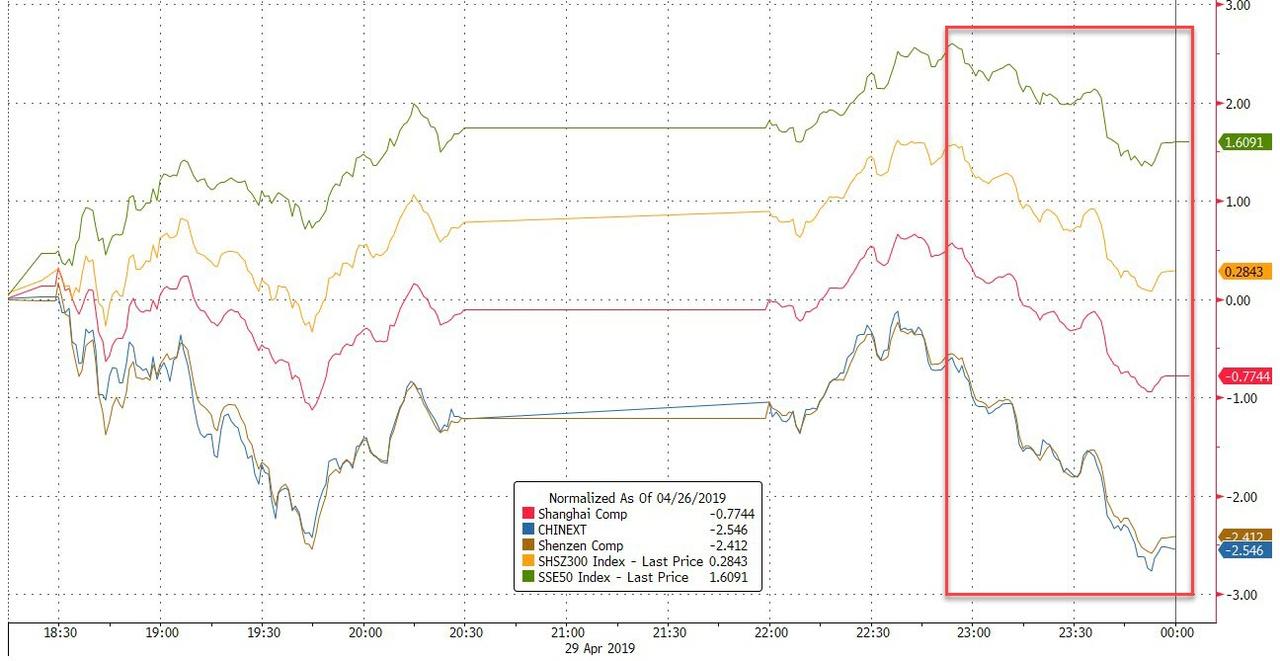
After the worst week in six months last week,  Chinese stocks were very mixed overnight with ChiNext dumping and the big cap SSE50 rallying…

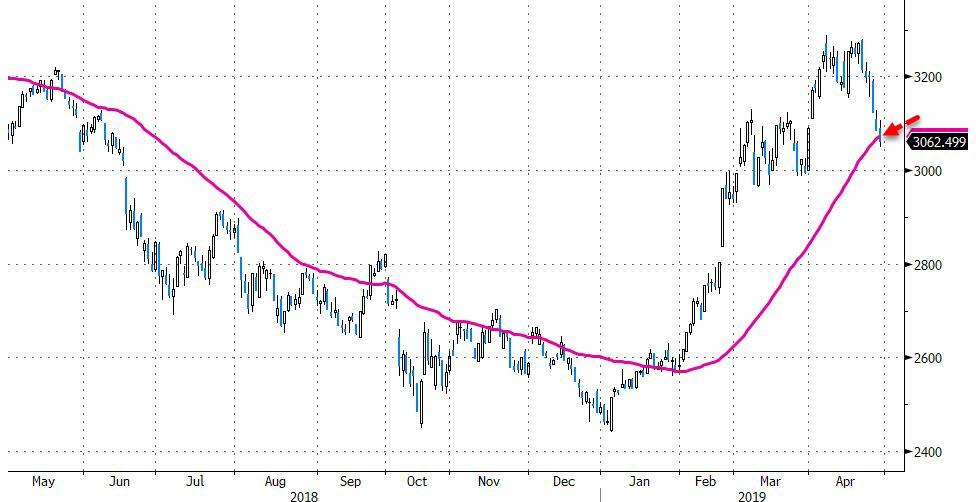
Notably, SHCOMP broke below the 3100 level and its 50DMA…


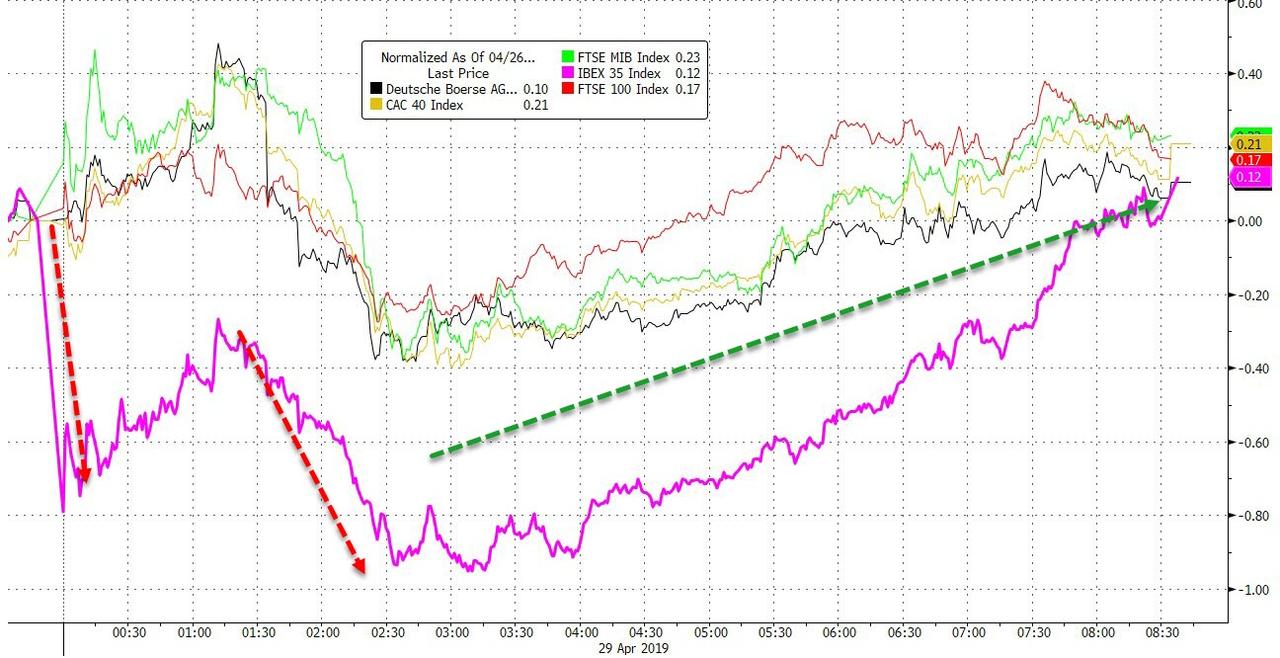
The day started ugly for Spain after their elections but a magic bid arrived across Europe and lifted everything back to breakeven by the close…


After Friday’s late-day melt-up, was there ever any doubt that the S&P 500 would break to record intraday highs…


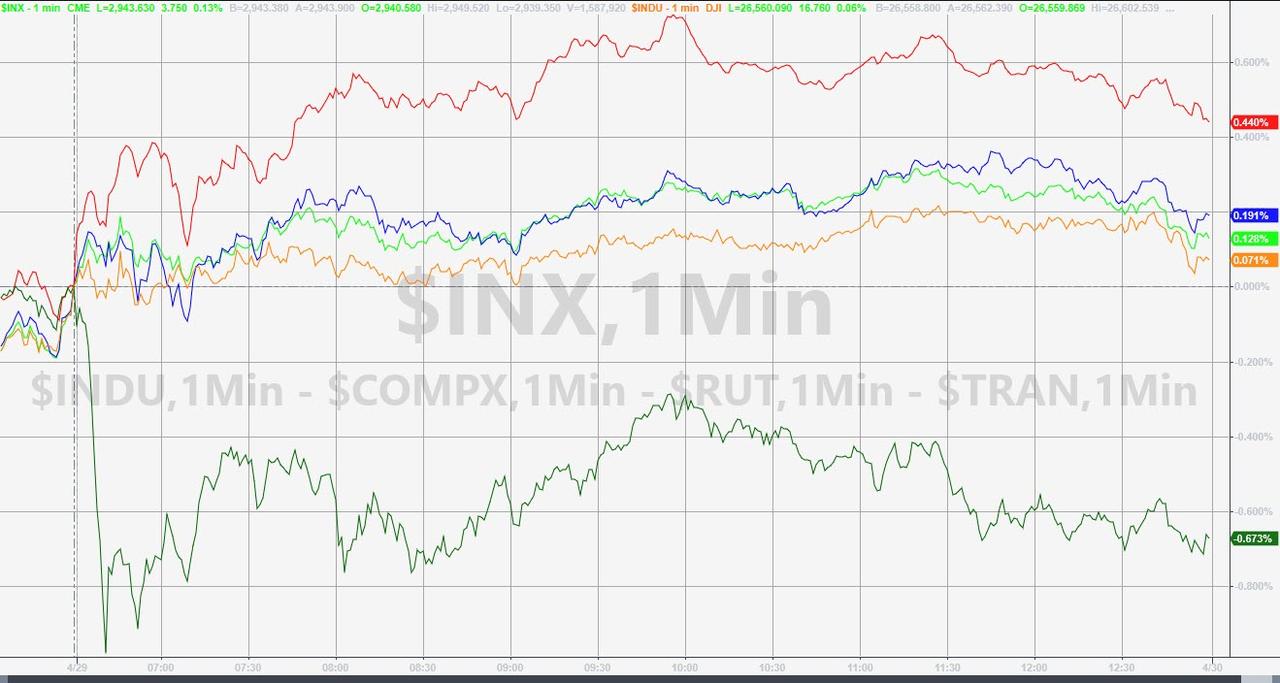
Small Caps led on the day, Trannies lagged…with the Dow managed to just hold green


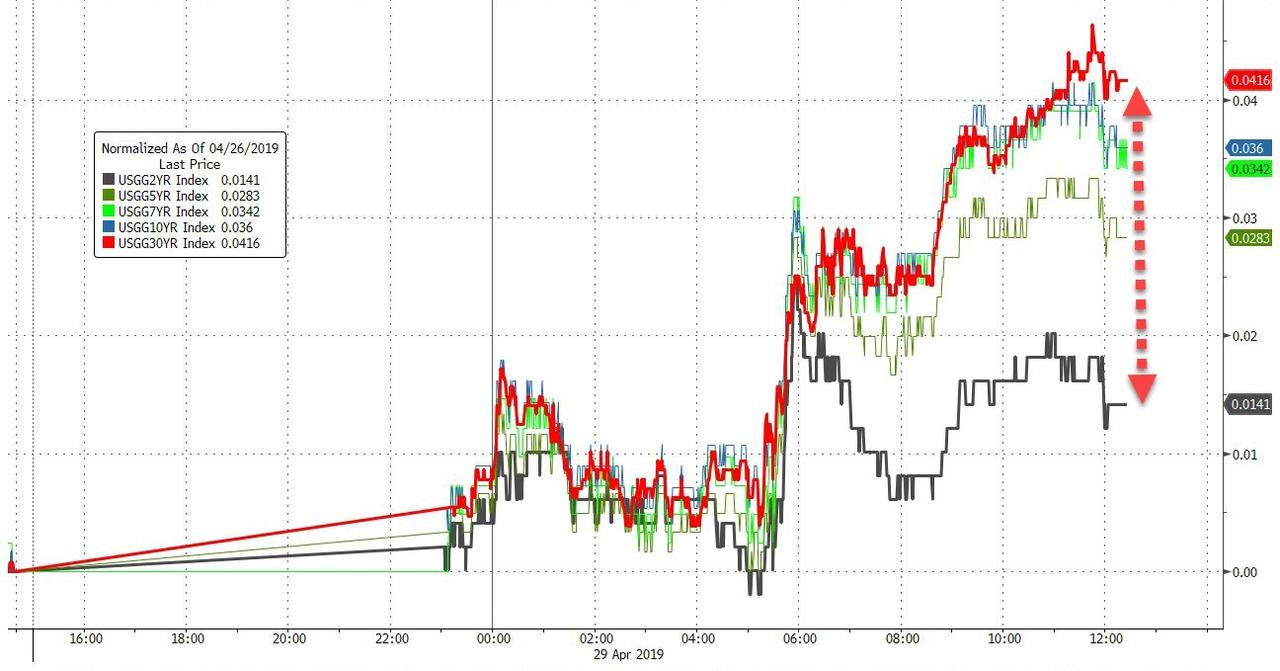
Treasury yields rose on the day with the long-end the biggest price laggard, steepening 3bps against the short-end (NOTE – Japan on golden week)…

30Y remains well below 3.00% though.


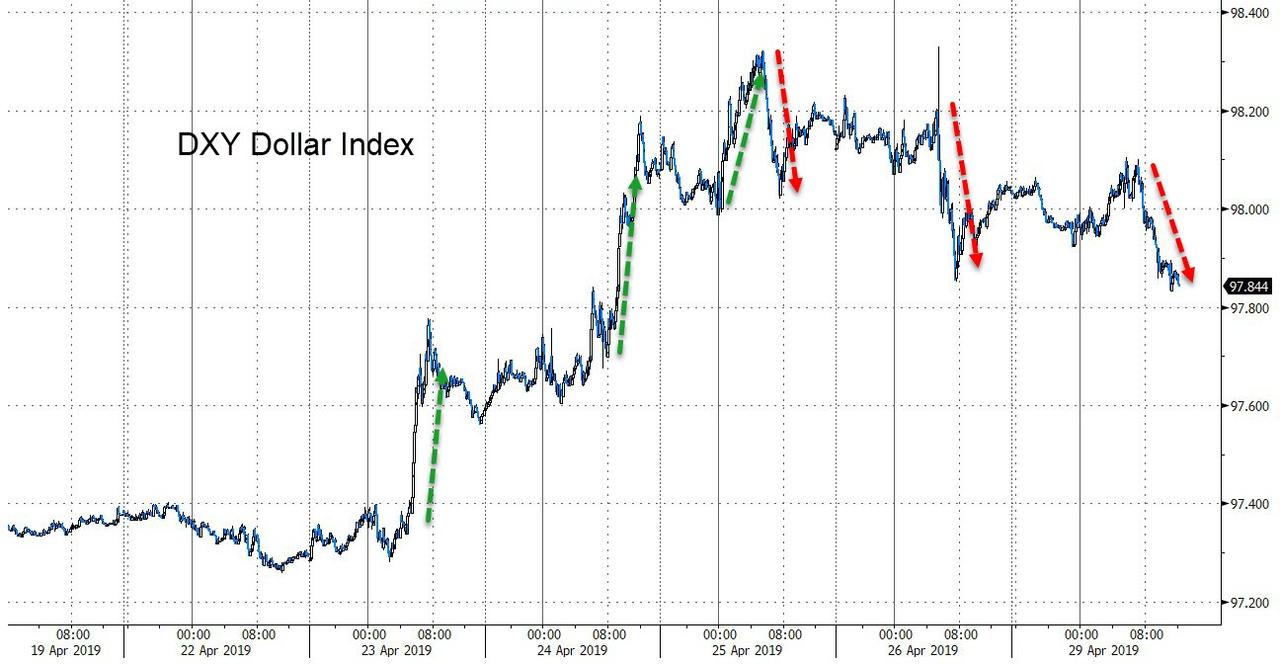
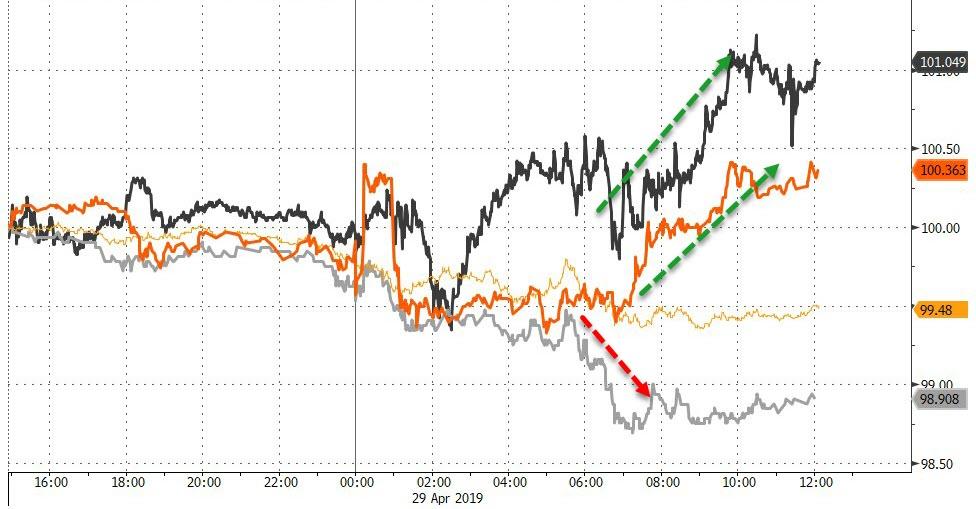
The slide in the dollar continues (albeit modestly)…


Cryptos were mixed with Bitcoin and Ether higher, Bitcoin Cash and Litecoin lower…


Copper and Crude managed gains as gold (and worse silver) slipped lower (despite a flat dollar)…


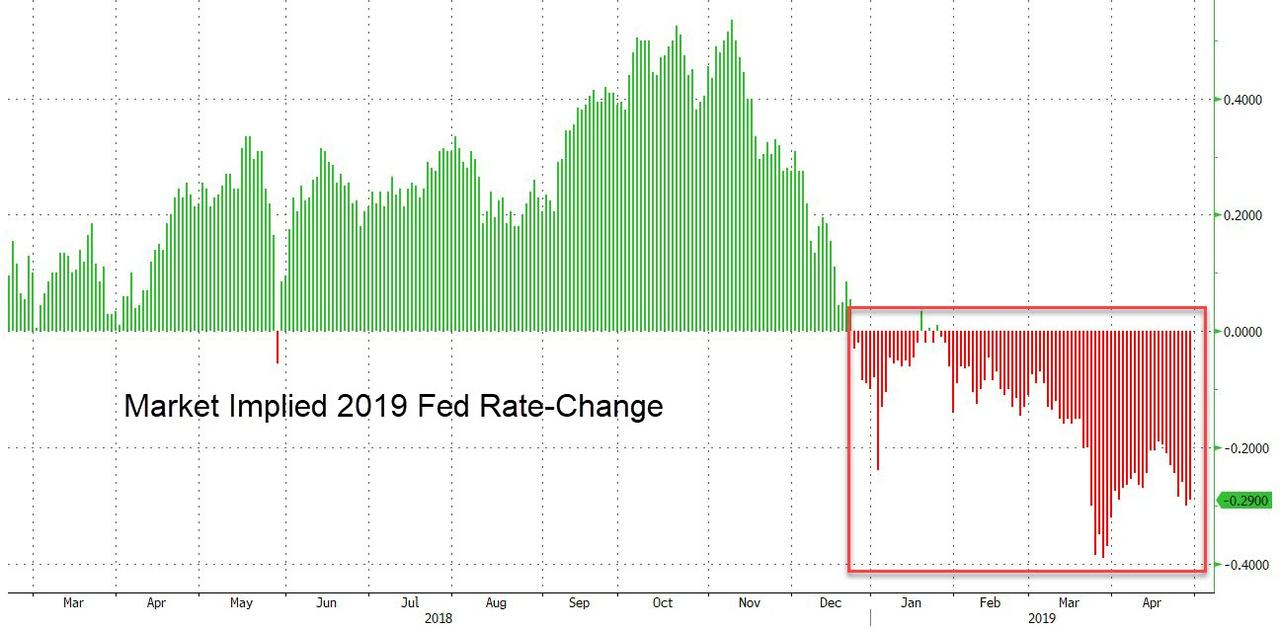
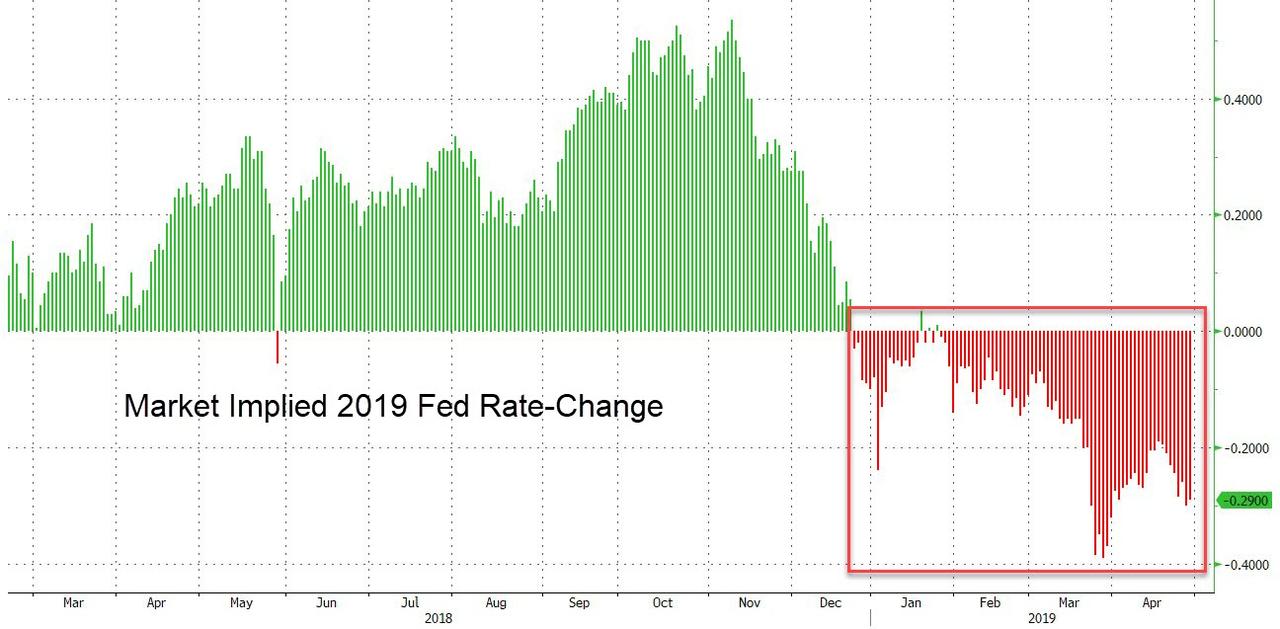
Finally, we ask a simple question – if everything is so awesome (which it ‘clearly’ is, just ask stocks), why are markets pricing in 29bps of rate cuts in the rest of 2019?


via ZeroHedge News http://bit.ly/2GQtz3z Tyler Durden