Here’s What’s in Beto O’Rourke’s $5 Trillion Plan To Fight Climate Change

Beto O’Rourke, the former Texas congressman who’s running for the 2020 Democratic presidential nomination, today released a four-part, $5 trillion plan to fight climate change.

The framework for O’Rourke’s plan, which is posted on his campaign website, promises he will make quick use of his executive authority, though it also pledges the candidate will work with Congress. O’Rourke is not proposing that the federal government fully fund his plan, which sets it apart from Rep. Alexandria Ocasio-Cortez’s (D–N.Y.) much-criticized Green New Deal. Rather, O’Rourke believes a “$1.5 trillion investment” from the federal government will “mobilize” trillions more in additional investments from the private sector to combat climate change.

Part one of the plan would use of executive authority “not only to reverse the problematic decisions made by the current administration, but also to go beyond the climate actions under previous presidents.” O’Rourke says he’ll reverse President Donald Trump’s decision to back out of the Paris climate agreement, and he promises to strengthen emissions standards, reduce various sources of pollution, and require that federal lands plan for net-zero emissions by 2030.

Part two is where Congress comes in. “In the very first bill he sends to Congress,” the plan says, “Beto will launch a 10-year mobilization of $5 trillion directly leveraged by a fully paid-for $1.5 trillion investment—the world’s largest-ever climate change investment in infrastructure, innovation, and in our people and communities.” How are we supposed to pay for that initial investment? The plan doesn’t go into specifics, though it does say “structural changes to the tax code” will “ensure corporations and the wealthiest among us pay their fair share and that we finally end the tens of billions of dollars of tax breaks currently given to fossil fuel companies.”

The proposal does give some specifics on where that $1.5 trillion will go. A total of $600 billion will be invested in “infrastructure necessary to cut pollution across all sectors,” including “$300 billion in direct resources through tax credits and another $300 billion in direct resources through additional investments.” Another “$250 billion in direct resources” will go to various scientific endeavors meant to determine how to achieve net-zero emissions by 2050, as well as “the climate science needed to understand the changes to our oceans and our atmosphere; avoid preventable losses and catastrophic outcomes; and protect public safety and national security.”

Finally, $650 billion will be spent on the people whose lives are affected by climate change. O’Rourke hopes this investment will “mobilize” additional spending in such areas as housing and transportation as Americans adapt to the effects of climate change.

The third part of the plan focuses on that guarantee of net-zero emissions by the middle of the century. “To have any chance at limiting global temperature rise to 1.5 °C and preventing the worst effects of climate change, the latest science demands net-zero emissions by 2050,” the plan says. “By investing in infrastructure, innovation, and in our people and communities, we can achieve this ambition, which is in line with the 2050 emissions goal of the Green New Deal, in a way that grows our economy and shrinks our inequality.” The plan promises O’Rourke will “work with Congress to enact a legally enforceable standard—within his first 100 days.”

“We will harness the power of the market, but also recognize that the market needs rules in order to function equitably and efficiently—not just incentives, but accountability too,” the plan adds.

The “latest science” to which O’Rourke’s plan refers is a 2018 U.N. report that says the world must cut its dependence on fossil fuels by 2050. Climate activists have seized on this report, claiming we’re racing against the clock to save the world. But as Reason science correspondent Ron Bailey explained last month, the doom-and-gloom predictions are exaggerated:

The IPCC asked a group of climate scientists to evaluate how it might be possible to keep the global mean surface temperature from rising 1.5°C above the average temperature of the late 19th century….The report’s authors calculated that in order to have a significant chance of remaining below the 1.5°C threshold, the world would have to cut its carbon dioxide emissions by 40 to 50 percent by 2030 and entirely eliminate such emissions by 2050. So yes, the report says there’s an expiration date if humanity decides to aim for that temperature target. But is it an expiration date for doom? Not so much.

According the report: “Under the no-policy baseline scenario, temperature rises by 3.66°C by 2100, resulting in a global gross domestic product (GDP) loss of 2.6%,” as opposed to 0.3 percent under the 1.5°C scenario and 0.5 percent under the 2°C scenario. In the baseline 3.66°C projection, the estimate of future GDP losses ranged from a low of 0.5 percent to a high of 8.2 percent. In other words, if humanity does nothing whatsoever to abate greenhouse gas emissions, the worst-case scenario is that global GDP in 2100 would be 8.2 percent lower than it would otherwise be.

Let’s make those GDP percentages concrete. Assuming no climate change and an global real growth rate of 3 percent per year for the next 81 years, today’s $80 trillion economy would grow to just under $880 trillion by 2100. World population is likely to peak at around 9 billion, so divvying up that GDP suggests that global average income would come to about $98,000 per person. Under the worst-case scenario, global GDP would only be $810 trillion and average income would only be $90,000 per person. Doom?

Part four of O’Rourke’s plan cites the parts of the country that have been fighting (or at least prepping for) extreme weather. O’Rourke calls for raising spending by a factor of ten “on pre-disaster mitigation grants that save $6 for every $1 invested”; he supports legislation “to make sure that we build back stronger after every disaster”; he wants to invest “in the climate readiness and resilience of our first responders”; and he says we should support U.S. troops “with technologies that reduce the need to rely on high-risk energy and water supply.”

O’Rourke’s climate plan is his first major policy proposal. It could set him apart from many of the other 2020 Democratic candidates—though stopping climate change is already the main platform of one other presidential hopeful, Washington Gov. Jay Inslee.

from Latest – Reason.com http://bit.ly/2ZKErr9
via IFTTT

Here’s What’s in Beto O’Rourke’s $5 Trillion Plan To Fight Climate Change

Beto O’Rourke, the former Texas congressman who’s running for the 2020 Democratic presidential nomination, today released a four-part, $5 trillion plan to fight climate change.

The framework for O’Rourke’s plan, which is posted on his campaign website, promises he will make quick use of his executive authority, though it also pledges the candidate will work with Congress. O’Rourke is not proposing that the federal government fully fund his plan, which sets it apart from Rep. Alexandria Ocasio-Cortez’s (D–N.Y.) much-criticized Green New Deal. Rather, O’Rourke believes a “$1.5 trillion investment” from the federal government will “mobilize” trillions more in additional investments from the private sector to combat climate change.

Part one of the plan would use of executive authority “not only to reverse the problematic decisions made by the current administration, but also to go beyond the climate actions under previous presidents.” O’Rourke says he’ll reverse President Donald Trump’s decision to back out of the Paris climate agreement, and he promises to strengthen emissions standards, reduce various sources of pollution, and require that federal lands plan for net-zero emissions by 2030.

Part two is where Congress comes in. “In the very first bill he sends to Congress,” the plan says, “Beto will launch a 10-year mobilization of $5 trillion directly leveraged by a fully paid-for $1.5 trillion investment—the world’s largest-ever climate change investment in infrastructure, innovation, and in our people and communities.” How are we supposed to pay for that initial investment? The plan doesn’t go into specifics, though it does say “structural changes to the tax code” will “ensure corporations and the wealthiest among us pay their fair share and that we finally end the tens of billions of dollars of tax breaks currently given to fossil fuel companies.”

The proposal does give some specifics on where that $1.5 trillion will go. A total of $600 billion will be invested in “infrastructure necessary to cut pollution across all sectors,” including “$300 billion in direct resources through tax credits and another $300 billion in direct resources through additional investments.” Another “$250 billion in direct resources” will go to various scientific endeavors meant to determine how to achieve net-zero emissions by 2050, as well as “the climate science needed to understand the changes to our oceans and our atmosphere; avoid preventable losses and catastrophic outcomes; and protect public safety and national security.”

Finally, $650 billion will be spent on the people whose lives are affected by climate change. O’Rourke hopes this investment will “mobilize” additional spending in such areas as housing and transportation as Americans adapt to the effects of climate change.

The third part of the plan focuses on that guarantee of net-zero emissions by the middle of the century. “To have any chance at limiting global temperature rise to 1.5 °C and preventing the worst effects of climate change, the latest science demands net-zero emissions by 2050,” the plan says. “By investing in infrastructure, innovation, and in our people and communities, we can achieve this ambition, which is in line with the 2050 emissions goal of the Green New Deal, in a way that grows our economy and shrinks our inequality.” The plan promises O’Rourke will “work with Congress to enact a legally enforceable standard—within his first 100 days.”

“We will harness the power of the market, but also recognize that the market needs rules in order to function equitably and efficiently—not just incentives, but accountability too,” the plan adds.

The “latest science” to which O’Rourke’s plan refers is a 2018 U.N. report that says the world must cut its dependence on fossil fuels by 2050. Climate activists have seized on this report, claiming we’re racing against the clock to save the world. But as Reason science correspondent Ron Bailey explained last month, the doom-and-gloom predictions are exaggerated:

The IPCC asked a group of climate scientists to evaluate how it might be possible to keep the global mean surface temperature from rising 1.5°C above the average temperature of the late 19th century….The report’s authors calculated that in order to have a significant chance of remaining below the 1.5°C threshold, the world would have to cut its carbon dioxide emissions by 40 to 50 percent by 2030 and entirely eliminate such emissions by 2050. So yes, the report says there’s an expiration date if humanity decides to aim for that temperature target. But is it an expiration date for doom? Not so much.

According the report: “Under the no-policy baseline scenario, temperature rises by 3.66°C by 2100, resulting in a global gross domestic product (GDP) loss of 2.6%,” as opposed to 0.3 percent under the 1.5°C scenario and 0.5 percent under the 2°C scenario. In the baseline 3.66°C projection, the estimate of future GDP losses ranged from a low of 0.5 percent to a high of 8.2 percent. In other words, if humanity does nothing whatsoever to abate greenhouse gas emissions, the worst-case scenario is that global GDP in 2100 would be 8.2 percent lower than it would otherwise be.

Let’s make those GDP percentages concrete. Assuming no climate change and an global real growth rate of 3 percent per year for the next 81 years, today’s $80 trillion economy would grow to just under $880 trillion by 2100. World population is likely to peak at around 9 billion, so divvying up that GDP suggests that global average income would come to about $98,000 per person. Under the worst-case scenario, global GDP would only be $810 trillion and average income would only be $90,000 per person. Doom?

Part four of O’Rourke’s plan cites the parts of the country that have been fighting (or at least prepping for) extreme weather. O’Rourke calls for raising spending by a factor of ten “on pre-disaster mitigation grants that save $6 for every $1 invested”; he supports legislation “to make sure that we build back stronger after every disaster”; he wants to invest “in the climate readiness and resilience of our first responders”; and he says we should support U.S. troops “with technologies that reduce the need to rely on high-risk energy and water supply.”

O’Rourke’s climate plan is his first major policy proposal. It could set him apart from many of the other 2020 Democratic candidates—though stopping climate change is already the main platform of one other presidential hopeful, Washington Gov. Jay Inslee.

from Latest – Reason.com http://bit.ly/2ZKErr9
via IFTTT

Google Tracks Your Location And Shares It With Police, Even When Your Phone Is Off

Authored by Derrick Broze via The Mind Unleashed blog,

Even if you disable GPS, deactivate phone location tracking, and turn off your phone, it’s still possible for Google and the NSA to monitor your every move.

Over the last two decades, cell phone use has become an everyday part of life for the vast majority of people around the planet. Nearly without question, consumers have chosen to carry these increasingly smart devices with them everywhere they go. Despite surveillance revelations from whistleblowers like Edward Snowden, the average smart phone user continues to carry the devices with little to no security or protection from privacy invasions.

Americans make up one of the largest smartphone markets in the world today, yet they rarely question how intelligence agencies or private corporations might be using their smartphone data. A recent report from the New York Times adds to the growing list of reasons why Americans should be asking these questions. According to the Times, law enforcement have been using a secret technique to figure out the location of Android users. The technique involves gathering detailed location data collected by Google from Android phones, iPhones, and iPads that have Google Maps and other Google apps installed.

The location data is stored inside a Google database known as Sensorvault, which contains detailed location records of hundreds of millions of devices from around the world. The records reportedly contain location data going back to 2009. The data is collected whether or not users are making calls or using apps.

The Electronic Frontier Foundation (EFF) says police are using a single warrant—sometimes known as a “geo-fence” warrant—to access location data from devices that are linked to individuals who have no connection to criminal activity and have not provided any reasonable suspicion of a crime. Jennifer Lynch, EFF’s Surveillance Litigation Director, says these searches are problematic for several reasons.

First, unlike other methods of investigation used by the police, the police don’t start with an actual suspect or even a target device—they work backward from a location and time to identify a suspect,” Lynch wrote. “This makes it a fishing expedition—the very kind of search that the Fourth Amendment was intended to prevent. Searches like these—where the only information the police have is that a crime has occurred—are much more likely to implicate innocent people who just happen to be in the wrong place at the wrong time. Every device owner in the area during the time at issue becomes a suspect—for no other reason than that they own a device that shares location information with Google.”

The problems associated with Sensorvault have also concerned a bipartisan group of lawmakers who recently sent a letter to Google CEO Sundar Pichai. The letter from Democrats and Republicans on the U.S. House Energy and Commerce Committee gives Google until May 10 to provide information on how this data is used and shared. The letter was signed by Democratic Representatives Frank Pallone and Jan Schakowsky and Republicans Greg Walden and Cathy McMorris Rodgers.

Google has responded to the report from the Times by stating that users opt in to collection of the location data stored in Sensorvault. A Google representative also told the lawmakers that users “can delete their location history data, or turn off the product entirely, at any time.” Unfortunately, this explanation falls flat when one considers that Android devices log location data by default and that it is notoriously difficult to opt out of data collection.

No matter what promises Google makes, readers should remember that back in 2010, the Washington Post published a story focusing on the growth of surveillance by the National Security Agency. That report detailed an NSA technique that “enabled the agency to find cellphones even when they were turned off.” The technique was reportedly first used in Iraq in pursuit of terrorist targets. Additionally, it was reported in 2016 that a technique known as a “roving bug” allowed FBI agents to eavesdrop on conversations that took place near cellphones.

These tools are now undoubtedly being used on Americans. The reality is that these tools—and many, many others that have been revealed—are being used to spy on innocent Americans, not only violent criminals or suspects. The only way to push back against this invasive surveillance is to stop supporting the companies responsible for the techniques and data sharing. Those who value privacy should invest time in learning how to protect data and digital devices. Privacy is quickly becoming a relic of a past era and the only way to stop it is to raise awareness, opt-out of corporations that don’t respect privacy, and protect your data.

via ZeroHedge News http://bit.ly/2XRovBN Tyler Durden

Mike Novogratz’s Crypto Firm Lost A Staggering $273 Million In 2018

Mike Novogratz’s Galaxy Digital has finally released full-year results for 2018. And what started out as a nine-figure loss, according to financials released all the way back in Q3, the firm had already brooked a $134 million loss, combining realized and unrealized losses, by the end of Q1. By the end of Q3, that loss had widened slightly to $136 million.

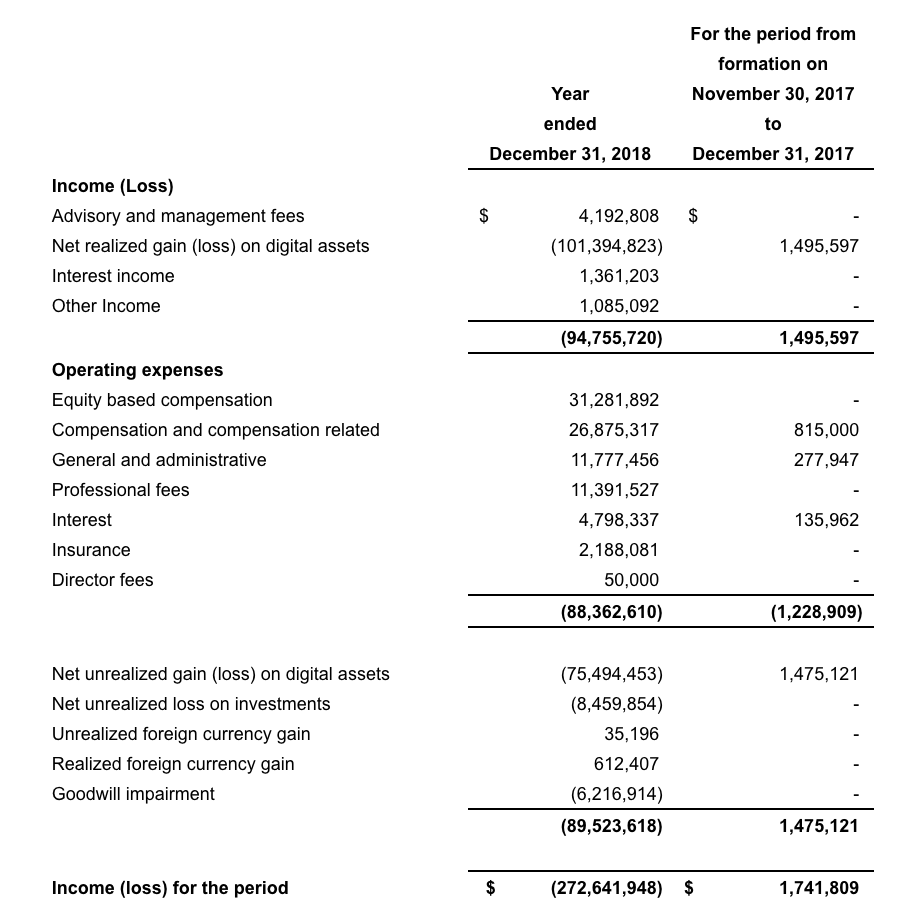
By the end of the year, total realized and unrealized losses for the firm founded by the former Goldman partner and Fortress fund manager, which both invests in cryptocurrencies, as well as blockchain-focused startups, had ballooned to $272.7 million, an ignominious start for the company’s first full year of operations.

Novo

Mike Novogratz

As of Dec. 31, Galaxy had $249.1 million in digital assets and investments, down from $323 million at the end of September, the company said in a statement.

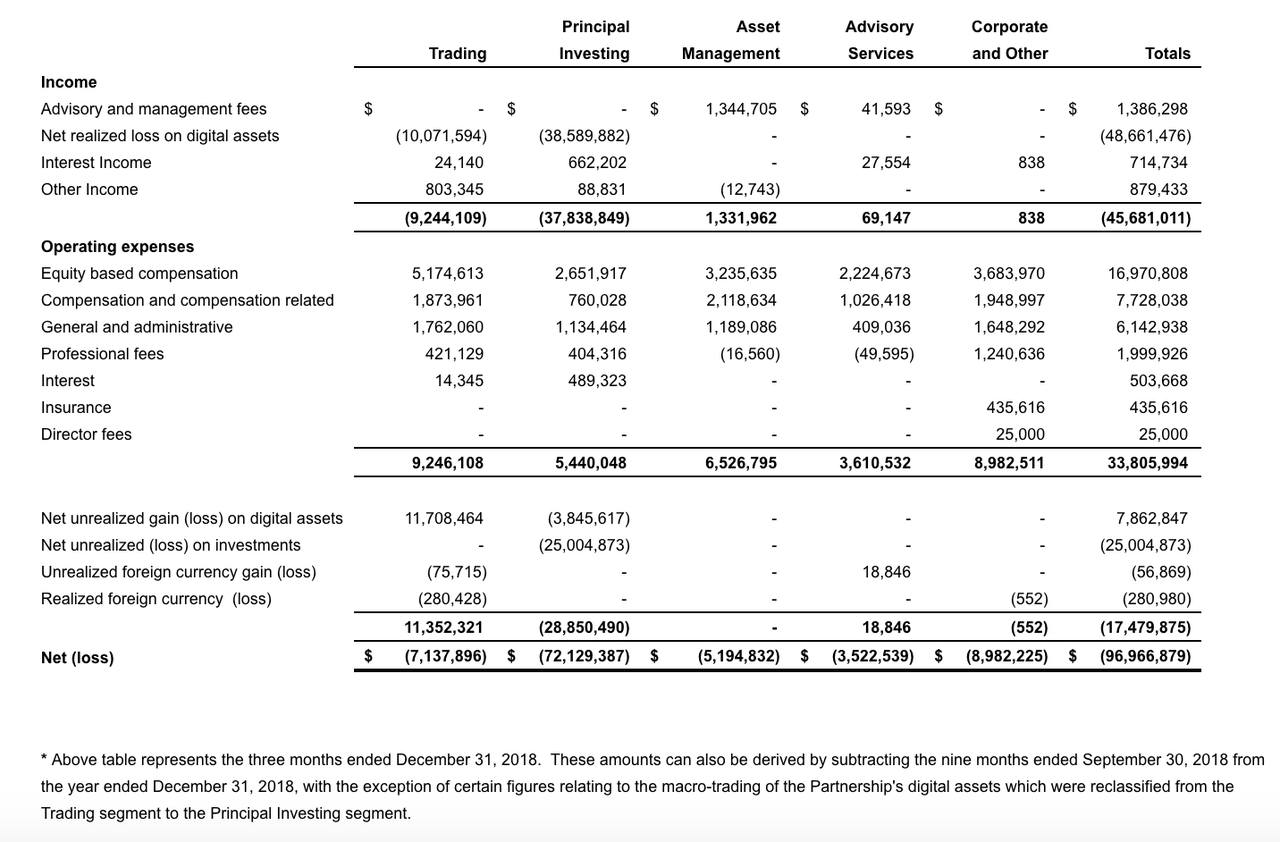
The additional losses in Q4 were primarily a result of a net realized loss of $48.7 million on the firm’s digital assets (as the firm’s trading arm trimmed some of its losing positions) and a $25 million unrealized loss on its investments.

Charts

For the full year, the firm’s total losses on its crypto holdings amounted to $177 million, with nearly $100 million more lost on operating expenses and investment writedowns.

Galaxy

But Novogratz is pressing forward. In the statement, he touted eight new investments closed in the fourth quarter, and upped its investment in three existing startups.

Novogratz said things had already started to turn around in 2019, as crypto prices have rallied off their lows. In particular, bitcoin has held above $5,000.

“While 2018 was a challenging year for the industry, I am pleased with the ways in which our team navigated difficult market dynamics, and believe we are well positioned to scale our business strategically over time. We have used our capitalized position to both identify and invest in a number of unique opportunities, while also continuing to build an institutional-quality platform,” Novogratz said in a statement.

“The first few months of 2019 have yielded a notable increase in activity across our business lines. We are already benefiting from both the strong foundation we laid in 2018 as well as the year-to-date rally in digital asset markets. We expect to continue to build upon this positive momentum through the remainder of 2019 and beyond.”

Since the start of 2019, the company said its Galaxy Benchmark Crypto Index Fund, a passively managed index fund which tracks the Bloomberg Galaxy Crypto Index, has generated inflows and was up about 19% so far this year.

via ZeroHedge News http://bit.ly/2GRc3fF Tyler Durden

Grassley to Trump: End the Tariffs or We’ll Kill Your NAFTA Rewrite

There’s only one way for President Donald Trump to get his much-touted rewrite of the North American Free Trade Agreement (NAFTA) through Congress: End the tariffs.

That’s the blunt message that Sen. Chuck Grassley (R–Iowa) delivers in an op-ed that ran in Sunday’s Wall Street Journal. Grassley’s opinion matters more than most, given that he is chairman of the powerful Senate Finance Committee, which would likely have to give its approval to Trump’s United States-Canada-Mexico Agreement (USMCA) before it could face an up-or-down vote from the full Senate.

Congress must approve the USMCA before it can take effect, but Grassley says it will not do that until the Trump administration lifts tariffs on steel and aluminum imports from Canada and Mexico. “These levies are a tax on Americans, and they jeopardize USMCA’s prospects of passage in the Mexican Congress, Canadian Parliament and U.S. Congress,” he writes. “Canadian and Mexican trade officials may be more delicate in their language, but they’re diplomats. I’m not. If these tariffs aren’t lifted, USMCA is dead. There is no appetite in Congress to debate USMCA with these tariffs in place.”

Grassley is concerned not only about the tariffs’ effects on American businesses—many of which face higher prices due to the administration’s import taxes—but about the retaliatory tariffs placed on U.S. goods by Canada and Mexico, which have hit American farmers.

“Jobs, wages and communities are hurt every day these tariffs continue—as I hear directly from Iowans,” he writes. “It’s time for the tariffs to go.”

Rewriting NAFTA has been a priority for Trump since the start of his presidential campaign. In his State of the Union address this year, Trump called for Congress to replace “the catastrophe known as NAFTA”—though in reality, the USMCA is only a modest overhaul.

As Congress returns from recess this week, it is putting the squeeze on Trump’s USMCA plans. While some Republicans remain skeptical of the USMCA because it creates higher barriers for tariff-free trade of cars and car parts, many Democrats are seeking changes to the USMCA that will beef up enforcement mechanisms. Sens. Sherrod Brown (D–Ohio) and Ron Wyden (D–Ore.) have proposed stricter audit rules that would give the U.S. the ability to reinstate tariffs on certain goods if Mexican factories are found to be skirting USMCA rules about wages and other labor standards.

With Democrats preparing to fight, Trump can hardly afford to lose support from Republicans too.

Grassley’s message to Trump is exactly the kind of binary, transactional negotiating tactic that the president seems to prefer. But the substance of Grassley’s op-ed is not exactly new. Congress—and outside interest groups—have been signalling to the White House for months that lifting the tariffs would be an essential condition for passing the USMCA. In November, shortly after Trump finalized the USMCA in a meeting with Canadian Prime Minister Justin Trudeau and then–Mexican President Enrique Peña Nieto, I reported that the steel and aluminum tariffs were a major stumbling block for getting the deal through Congress.

Since then, Trump has given no indication that he’s willing to withdraw the tariffs on Canadian and Mexican metals. The ball now appears to be in the president’s court.

from Latest – Reason.com http://bit.ly/2GSegHP
via IFTTT

Grassley to Trump: End the Tariffs or We’ll Kill Your NAFTA Rewrite

There’s only one way for President Donald Trump to get his much-touted rewrite of the North American Free Trade Agreement (NAFTA) through Congress: End the tariffs.

That’s the blunt message that Sen. Chuck Grassley (R–Iowa) delivers in an op-ed that ran in Sunday’s Wall Street Journal. Grassley’s opinion matters more than most, given that he is chairman of the powerful Senate Finance Committee, which would likely have to give its approval to Trump’s United States-Canada-Mexico Agreement (USMCA) before it could face an up-or-down vote from the full Senate.

Congress must approve the USMCA before it can take effect, but Grassley says it will not do that until the Trump administration lifts tariffs on steel and aluminum imports from Canada and Mexico. “These levies are a tax on Americans, and they jeopardize USMCA’s prospects of passage in the Mexican Congress, Canadian Parliament and U.S. Congress,” he writes. “Canadian and Mexican trade officials may be more delicate in their language, but they’re diplomats. I’m not. If these tariffs aren’t lifted, USMCA is dead. There is no appetite in Congress to debate USMCA with these tariffs in place.”

Grassley is concerned not only about the tariffs’ effects on American businesses—many of which face higher prices due to the administration’s import taxes—but about the retaliatory tariffs placed on U.S. goods by Canada and Mexico, which have hit American farmers.

“Jobs, wages and communities are hurt every day these tariffs continue—as I hear directly from Iowans,” he writes. “It’s time for the tariffs to go.”

Rewriting NAFTA has been a priority for Trump since the start of his presidential campaign. In his State of the Union address this year, Trump called for Congress to replace “the catastrophe known as NAFTA”—though in reality, the USMCA is only a modest overhaul.

As Congress returns from recess this week, it is putting the squeeze on Trump’s USMCA plans. While some Republicans remain skeptical of the USMCA because it creates higher barriers for tariff-free trade of cars and car parts, many Democrats are seeking changes to the USMCA that will beef up enforcement mechanisms. Sens. Sherrod Brown (D–Ohio) and Ron Wyden (D–Ore.) have proposed stricter audit rules that would give the U.S. the ability to reinstate tariffs on certain goods if Mexican factories are found to be skirting USMCA rules about wages and other labor standards.

With Democrats preparing to fight, Trump can hardly afford to lose support from Republicans too.

Grassley’s message to Trump is exactly the kind of binary, transactional negotiating tactic that the president seems to prefer. But the substance of Grassley’s op-ed is not exactly new. Congress—and outside interest groups—have been signalling to the White House for months that lifting the tariffs would be an essential condition for passing the USMCA. In November, shortly after Trump finalized the USMCA in a meeting with Canadian Prime Minister Justin Trudeau and then–Mexican President Enrique Peña Nieto, I reported that the steel and aluminum tariffs were a major stumbling block for getting the deal through Congress.

Since then, Trump has given no indication that he’s willing to withdraw the tariffs on Canadian and Mexican metals. The ball now appears to be in the president’s court.

from Latest – Reason.com http://bit.ly/2GSegHP
via IFTTT

DiGenova Destroys Media’s “Reckless” Promotion Of Trump Tower Meeting As Crime

Leading up to the Mueller report, one of the long-promised “gotchas” peddled by the anti-Trump media is that that Donald Trump Jr. would be indicted over a June 9, 2016 meeting in Trump Tower with Russian representatives who promised negative information on Hillary Clinton. 

Keep in mind, the Russian attorney who sought the discussion – Natalia Veselnitskaya – met with Fusion GPS co-founder Glenn Simpson before and after the Trump Tower meeting. Fusion was hired by the Clinton campaign and the DNC to produce the now-infamous “Steele Dossier.” 

Also keep in mind that Trump Jr. reportedly shut down the meeting when it was obviously not going to bear fruit. 

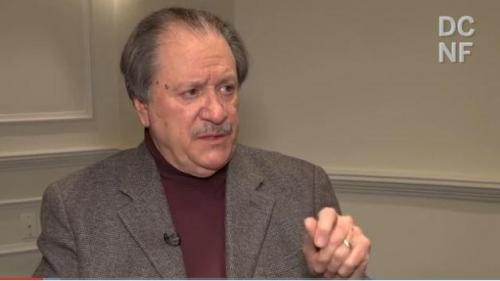
Obvious setups aside, former US Attorney Joe diGenova has penned an Op-Ed for Fox News excoriating the media for ‘recklessly’ promoting an untested falsehood; that the meeting was illegal in the first place. 

Joseph diGenova via Fox News

Don Jr. and the Trump Tower meeting — What happens when fake news collides with zero intent

The reporting on Donald Trump, Jr.’s treatment in the Mueller report has been woefully inaccurate.

The president’s eldest son, an outspoken and unapologetic conservative, is a favorite punching bag of the left. For more than two years, liberal journalists and shrieking “#resistance” activists have salivated over the thought of seeing Don Jr. carted off in handcuffs.

To their dismay, there is only one crucial takeaway from the Mueller report’s conclusions about the utterly inconsequential “Trump Tower meeting” between Don Jr., several Russians, and others: neither Don Jr. nor anyone else involved in the meeting was charged with any crime.

The reasons are clear. The entire theory about what was potentially illegal about the meeting was speculative and untested. What’s more, even if it were illegal, the report concluded that Don Jr. didn’t have the “willful” intent to break the law that would be necessary to make it a crime.

In their disappointment, Don Jr.’s detractors have latched on to a new theory: that he was simply “too stupid” to be charged with a crime because he didn’t know that his conduct was illegal.

They hang this blatant misconstruction on these words from the report: “the Office did not obtain admissible evidence likely to meet the government’s burden to prove beyond a reasonable doubt that these individuals acted ‘willfully,’ i.e. with general knowledge of the illegality of their conduct.”

That’s not just some minor technicality, absent which Robert Mueller’s prosecutors would have had Don Jr. in shackles while revelers in cat-eared pink hats danced in the streets. It’s a central element of the offense they were investigating, and they decided to clear Don Jr. because without it there is no crime.

One often-used definition of “willful” intent states that it “requires proof beyond a reasonable doubt that the defendant knew his or her conduct was unlawful and intended to do something that the law forbids; that the defendant acted with a purpose to disobey or disregard the law.”

In essence, in order to be charged with conspiring to cheat, you have to have been actually meaning to cheat. That’s the law. Without intent, there is no crime. And Mueller’s team, even his hand-picked Democrat attack dog Andrew Weissmann, knew they didn’t have evidence to convince a jury that Don Jr. meant to circumvent election laws when he typed “I love it” in response to a tangentially-related British publicist’s suggestion the Russian government might have “information that would incriminate Hillary.” Don Jr. even voluntarily released his email correspondence related to that meeting.

But even if there were the requisite intent, the Mueller report still exonerates Don Jr., stating that “the government would likely encounter difficulty proving beyond a reasonable doubt that the value of the promised information exceeded the threshold for a criminal violation.”

Did you catch that?

For the English speakers among you, let me translate that from Weissmann-speak: “This ‘crime’ we thought up as a way to nail Don Jr. is so speculative and unprecedented, we don’t think there’s a court in the land that would let this fly.”

The entire notion of a criminal conspiracy is predicated on the idea that the federal election law’s ban on campaigns taking “contributions” or “things of value” from foreign nationals also applies to “dirt” on opposing candidates.

That’s hardly an established interpretation of the law. In fact, no one has ever been convicted of something similar. If “dirt” is a “thing of value” for campaign finance purposes, that is a dangerously radical innovation with huge potential First Amendment implications.

Personally, I think it’s a completely untenable interpretation, but don’t take my word it. Mueller and his team considered it, as well — and then rejected it as too “difficult to prove” in their report.

I wonder how many of the journalists calling Don Jr. stupid were so certain about this far-fetched legal theory. I further wonder how many of them felt the same way when foreign national Christopher Steele handed the Hillary Clinton campaign a whole dossier of “dirt” on President Trump — at a hefty, agreed-upon price, no less.

The whole thing is pure “#resistance” fantasy.

It was reckless for the media to promote the Trump Tower meeting as a crime, and it was irresponsible for Mueller’s report to discuss the matter using language that allows people who hate Don Jr. to continue in that delusion.

CLICK HERE TO READ MORE FROM JOE DIGENOVA

via ZeroHedge News http://bit.ly/2WdyzET Tyler Durden

Florida Bill Would Ban Cities From Requiring Developers to Build Affordable Housing

In many state capitols and city halls, politicians debate how much affordable housing developers should be required to build. Not so in the Florida legislature, where a rapidly advancing bill would prohibit cities from mandating that new private housing projects include any percentage of rent-restricted units at all.

This past Thursday, Florida’s Republican-controlled House passed HB 7103 by a commanding, mostly party-line vote. The bill is now working its way through the state Senate’s committee process.

The bill would ban cities from adopting “inclusionary zoning” ordinances. These laws require that developers rent out a certain percentage of new housing units at affordable rates to tenants earning less than a city’s median income. (“Affordable” in this context usually means that the monthly rent is no more than 30 percent of a tenant’s median income.)

These mandates are often used by cities and states trying to grapple with increasingly high housing costs. Proponents argue that they ensure that lower-income residents see the benefits of new construction without having to ask taxpayers to fund fully public housing projects. Critics counter that shifting the costs of providing affordable housing onto developers will make some housing projects uneconomical, reducing the overall supply of new housing and driving up prices in the long run.

“When you start having mandates and [the] state setting price controls, you create all kinds of distortions in the market,” the bill’s sponsor, state Rep. Jason Fischer (R–Jacksonville), explains to radio station WJCT.

The literature on inclusionary zoning ordinances is mixed. A 2004 study from the Reason Foundation (which publishes this website) looked at the effects of inclusionary zoning ordinances adopted in California’s Bay Area, finding that they produced few new affordable units while driving up costs for builders and homeowners alike.

“By restricting the supply of new homes and driving up the price of both newly constructed market-rate homes and the existing stock of homes, inclusionary zoning makes housing less affordable,” the report concludes.

Some subsequent research has been less critical of these zoning policies, concluding that they produce affordable units without deterring the overall construction of new housing. All of these studies, both pro and con, have been limited by how much variation exists between different localities’ individual affordability mandates. One city might require 20 percent of units be reserved for tenants making 80 percent of the area’s median income, while another mandates that 10 percent be rented at affordable rates to residents making less than 50 percent. One city might require developers to build affordable units on-site, while another allow those units to be build elsewhere, or let developers to pay a fee that funds public housing projects.

Making things even more complicated, the zoning requirements on the books are often not the requirements developers are held to, as local governments often either reduce or increase the amount of mandated affordable units on a project-by-project basis.

Big-picture debates aside, it’s not hard to find individual examples of projects stalling after being slapped with impossibly high affordability requirements.

In addition to the ban on these mandates, Fischer’s bill limits local governments’ ability to impose impact fees on new development. It also sets strict timelines for localities to review and approve construction permits. The bill would still allow density bonus programs, whereby developers voluntarily offer to include affordable units in exchange for waivers on local height and density limits.

All said, these come across as sensible measures that will reduce local governments’ power to pile additional costs or delays onto new housing construction.

The bill does not target underlying zoning codes that dictate what kind of housing can be built where. That makes it the polar opposite of a major housing bill in California, SB 50, which hacks away at some local zoning controls on building apartment buildings while also imposing new inclusionary zoning requirements.

Both approaches leave a lot of development restrictions untouched. If both pass, they’ll serve as interesting experiments in how states experiencing staggeringly high housing costs can kickstart new construction.

from Latest – Reason.com http://bit.ly/2GTqnVe
via IFTTT

Florida Bill Would Ban Cities From Requiring Developers to Build Affordable Housing

In many state capitols and city halls, politicians debate how much affordable housing developers should be required to build. Not so in the Florida legislature, where a rapidly advancing bill would prohibit cities from mandating that new private housing projects include any percentage of rent-restricted units at all.

This past Thursday, Florida’s Republican-controlled House passed HB 7103 by a commanding, mostly party-line vote. The bill is now working its way through the state Senate’s committee process.

The bill would ban cities from adopting “inclusionary zoning” ordinances. These laws require that developers rent out a certain percentage of new housing units at affordable rates to tenants earning less than a city’s median income. (“Affordable” in this context usually means that the monthly rent is no more than 30 percent of a tenant’s median income.)

These mandates are often used by cities and states trying to grapple with increasingly high housing costs. Proponents argue that they ensure that lower-income residents see the benefits of new construction without having to ask taxpayers to fund fully public housing projects. Critics counter that shifting the costs of providing affordable housing onto developers will make some housing projects uneconomical, reducing the overall supply of new housing and driving up prices in the long run.

“When you start having mandates and [the] state setting price controls, you create all kinds of distortions in the market,” the bill’s sponsor, state Rep. Jason Fischer (R–Jacksonville), explains to radio station WJCT.

The literature on inclusionary zoning ordinances is mixed. A 2004 study from the Reason Foundation (which publishes this website) looked at the effects of inclusionary zoning ordinances adopted in California’s Bay Area, finding that they produced few new affordable units while driving up costs for builders and homeowners alike.

“By restricting the supply of new homes and driving up the price of both newly constructed market-rate homes and the existing stock of homes, inclusionary zoning makes housing less affordable,” the report concludes.

Some subsequent research has been less critical of these zoning policies, concluding that they produce affordable units without deterring the overall construction of new housing. All of these studies, both pro and con, have been limited by how much variation exists between different localities’ individual affordability mandates. One city might require 20 percent of units be reserved for tenants making 80 percent of the area’s median income, while another mandates that 10 percent be rented at affordable rates to residents making less than 50 percent. One city might require developers to build affordable units on-site, while another allow those units to be build elsewhere, or let developers to pay a fee that funds public housing projects.

Making things even more complicated, the zoning requirements on the books are often not the requirements developers are held to, as local governments often either reduce or increase the amount of mandated affordable units on a project-by-project basis.

Big-picture debates aside, it’s not hard to find individual examples of projects stalling after being slapped with impossibly high affordability requirements.

In addition to the ban on these mandates, Fischer’s bill limits local governments’ ability to impose impact fees on new development. It also sets strict timelines for localities to review and approve construction permits. The bill would still allow density bonus programs, whereby developers voluntarily offer to include affordable units in exchange for waivers on local height and density limits.

All said, these come across as sensible measures that will reduce local governments’ power to pile additional costs or delays onto new housing construction.

The bill does not target underlying zoning codes that dictate what kind of housing can be built where. That makes it the polar opposite of a major housing bill in California, SB 50, which hacks away at some local zoning controls on building apartment buildings while also imposing new inclusionary zoning requirements.

Both approaches leave a lot of development restrictions untouched. If both pass, they’ll serve as interesting experiments in how states experiencing staggeringly high housing costs can kickstart new construction.

from Latest – Reason.com http://bit.ly/2GTqnVe
via IFTTT

Two US Warships Sail Through Taiwan Strait In Dare To Beijing

With US-China trade talks set to resume this week amid what flashing red headlines, Larry Kudlow and Donald Trump’s twitter account remind us every day, if not hour, is a sense of “optimism” about an imminent deal, on Sunday the US navy reminded Beijing to stick to the script (one in which Trump supposedly comes off as a negotiating giant), when it two warships through the hotly contested Taiwan Strait as the Pentagon increases the frequency of movement through the strategic waterway despite vocal and often time angry opposition from China.

While the voyage risks further raising tensions with China – at an especially sensitive time for trade negotiations – it will also be viewed by Taiwan as a sign of support from the Trump administration amid growing friction between Taipei and Beijing.

According to Reuters, the two destroyers were the William P. Lawrence and Stethem.

The guided-missile destroyer USS Stethem. Photo: Reuters

“The ships’ transit through the Taiwan Strait demonstrates the U.S. commitment to a free and open Indo-Pacific,” Commander Clay Doss, a spokesman for the U.S. Navy’s Seventh Fleet, said in a statement. The 112-mile-wide Taiwan Strait separates Taiwan from China. Winking at China, Doss also said there were no unsafe or unprofessional interactions with other countries’ vessels during the transit. Beijing may beg to differ.

Despite an alleged convergence of view on trade between Beijing and DC., Taiwan remains one of a growing number of flashpoints in the U.S.-China relationship, which also include a trade war, U.S. sanctions, the future of Huawei and 5G and China’s increasingly muscular military posture in the South China Sea, where the United States also conducts freedom-of-navigation patrols to remind China that the US will never cede implicit control of the world’s most important naval area.

Commenting on the transit, Taiwan’s Ministry of Defense said the US ships had sailed north through the strait. “U.S. ships freely passing through the Taiwan Strait is part of the mission of carrying out the Indo-Pacific strategy,” it said in a statement. Taiwan’s armed forces monitored the transit and nothing out of the ordinary happened, the ministry said.

Beijing was far less enthusiastic: China’s foreign ministry spokesman Geng Shuang said China had paid close attention to the sailing and had expressed concern to the United States. “The Taiwan issue is the most important and sensitive issue in Sino-U.S. relations,” he told a daily news briefing.

While the United States has no formal ties with Taiwan, it is bound by law to help provide the island with the means to defend itself and is its main source of arms. More importantly, just like Saudi Arabia, Taiwan is one of the biggest clients of US weapons. The Pentagon says Washington has sold Taipei more than $15 billion in weaponry since 2010.

China has been ramping up pressure to assert its sovereignty over the island, which it considers a wayward province of “one China” and sacred Chinese territory.

It said a recent Taiwan Strait passage by a French warship, first reported by Reuters on Wednesday, was illegal. China’s Geng added that China hoped that France could ensure such an incident did not happen again.

As Reuters notes, Beijing’s concerns about Taiwan are likely to factor into Chinese defense spending this year, following a stern New Year’s speech from President Xi Jinping in which he threatened to attack Taiwan should it not accept Chinese rule.

To that end, last month, Beijing unveiled a target of 7.5 percent rise in defense spending for 2019, a slower rate than last year but still outpacing its economic growth target. In response to US moves in the region, China has repeatedly sent military aircraft and ships to circle Taiwan on exercises in the past few years and worked to isolate it internationally, whittling down its few remaining diplomatic allies.

via ZeroHedge News http://bit.ly/2voOiVV Tyler Durden