While today’s Dallas Fed manufacturing activity index dipped to 2 from 6.9 in March, missing expectations of a rebound to 10, and the lowest print since January, among the generally downcast respondents comments was the following mini-essay written by a small business respondent in the “miscellaneous manufacturing” space, which revealed what may be the most gushing praise of the Trump economy yet. Presented below without further comment:
When reviewing our financial performance over the last few years, the outlook for the company has significantly improved, in large part due to the change in taxes. During the Obama administration, our effective total-taxes-paid rate was over 70 percent, and now under the Trump administration, our effective total-taxes-paid rate is about 50 percent.
This has allowed us to hire more people, increase compensation, pay larger bonuses, purchase more manufacturing equipment and make more investments.
For those people who say that lower taxes do not help small and growing businesses, they are completely mistaken. Small and fast-growing businesses need as much after-tax profits for expansion and investments as possible to continue to be successful.
If you want the private sector to expand and hire more people, it’s critical we have sufficient after-tax money to reinvest and justify putting more time and effort in our businesses.
The fastest way to make people give up is seeing all their hard work and the results of their efforts redirected to wasteful and often counterproductive government spending and programs.
via ZeroHedge News http://bit.ly/2V4Gc42 Tyler Durden
Online trading firm E*Trade Financial Group is preparing to offer cryptocurrency trading on its platform, sources familiar with the matter told Bloomberg on April 26.
E*Trade will reportedly begin by offering bitcoin (BTC) and ether (ETH) after which it will add other cryptocurrencies.
As one of the largest online trading platforms, E*Trade offering cryptocurrency trading could represent a significant step forward for cryptocurrency adoption. Per the firm’s annual report filed with the United States Securities and Exchange Commission (SEC) on Dec. 31, 2018, E*Trade had 4.9 million brokerage accounts and a total margin receivables balance of $9.6 billion. The firm’s total assets are over $65 billion.
Should E*Trade offer cryptocurrency trading, it would join other online securities trading platforms like Robinhood, which have also stepped into the cryptocurrency space. In May 2018, Robinhood briefly overtook E*Trade in the number of trading accounts on the platform. At that time, Robinhood co-founder Baiju Bhatt said:
“Crypto has certainly added to our growth. In the next couple of years, I think you’ll see Robinhood looking like a full-service consumer finance company.”
Some analysts have recently said that cryptocurrency represents a sound long-term investment for institutional investors. Cambridge Associates, which specializes in pension and endowment consultancy, wrote:
“Despite the challenges, we believe that it is worthwhile for investors to begin exploring this area today with an eye toward the long term. Though these investments entail a high degree of risk, some may very well upend the digital world.’’
via ZeroHedge News http://bit.ly/2vqNRu6 Tyler Durden
it may seem morbid, if not grotesque, to discuss the Fed cutting rates on the day when the S&P just hit a new all time high, but as a result of the previously discussed US bank liquidity and dollar shortage thesis, now also espoused by JPMorgan, and the coincident “funding-squeeze” dynamic, which as we have shown over the past week has expressed itself via the much-discussed “Fed Funds (Effective) trading through IOER” phenomenon…
… this is precisely the topic of the latest note from Nomura’s Charlie McElligott who writes this morning that with the Fed increasingly concerned about what even the big banks admit is a funding shortage in the US banking system (ironically enough, with over $1.4 trillion in excess reserves still sloshing in the system), Powell may have no choice but to cut rates aggressively, slash the IOER rate – perhaps as soon as this week – and eventually resume QE.
As if to validate McElligott’s point, amid increasing buzz of an imminent rate cut, the dollar keeps rising, and instead of tracking rate cut odds, which are now back to cycle highs, is instead tracking the excess EFF over IOER tick for tick as the clearest indicator of what is now perceived as a widespread liquidity shortage, and in doing so is escalating the recent turmoil across EMFX, as the US Dollar breaks out to fresh highs despite Friday’s worse than expected (below the surface) GDP print.
As discussed over the weekend, McElligott reminds readers that there is now “again a mounting belief in the market for a Fed “technical” IOER cut at some point into the Summer” – or even this week according to Morgan Stanley – as a necessity to “buy time” into still-tightening/shrinking excess reserves (especially since the Fed seemingly has been slow to move on a ”standing repo facility” alternative) prior to the Fed again expanding the balance sheet to add reserves again in the Fall via what the Nomura strategist calls the commencement of “QE Lite” (MBS reinvestments into USTs, most likely T-Bills to shorten the portfolio’s WAM and further steepen curve as an additional side benefit).
Additionally, with today’s core PCE Deflator data coming in even weaker than expected, and dropping to just 1.6% Y/Y, the lowest print since 2017, the pressure will be on Powell to be even more dovish at this week’s FOMC meeting grows according to McElligott, “especially ahead of the June Fed research conference in Chicago, focused on inflation and likely to advocate a “run labor hot” policy.”
So despite a growing number of banks warning that the one thing that can break the market’s relentless levitation is a return to curve steepening, McElligott once again pounds the table on Steepeners (via curve caps), something he has been doing since last Summer, especially since the case “now only grows stronger as when the Fed does indeed “go,” they’ll go large – think 50bps out of the gates, and likely sooner than most expect, as they now have three cut “justifications”:
cycle “insurance” (EVERYBODY talking the ’95-’96 weakening price-pressure analog, then again in ’98 on ‘external’ factors EM- and LTCM-)
“reflation”-seeking policy rethink, and
near-term Dollar funding dynamics as banking system reserves continue to shrink prior to the re-expansion of the BS in 4Q19
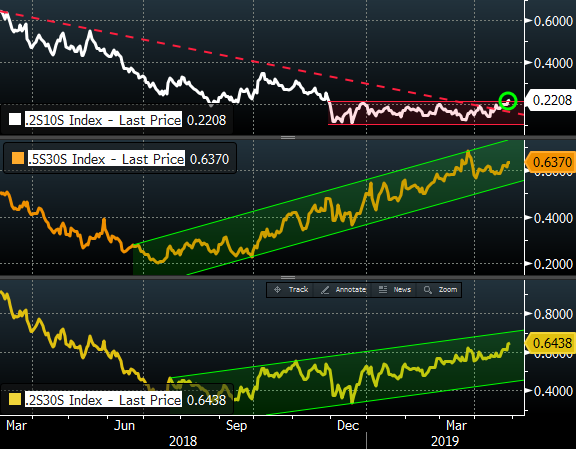
So how to trade an imminent rate cut, potentially as large as 50bps? As McElligott discussed last week, and echoing what Deutsche Bank’s Aleksandar Kocic said over the weekend, the 2s10s is likely then the better “trade location” now…
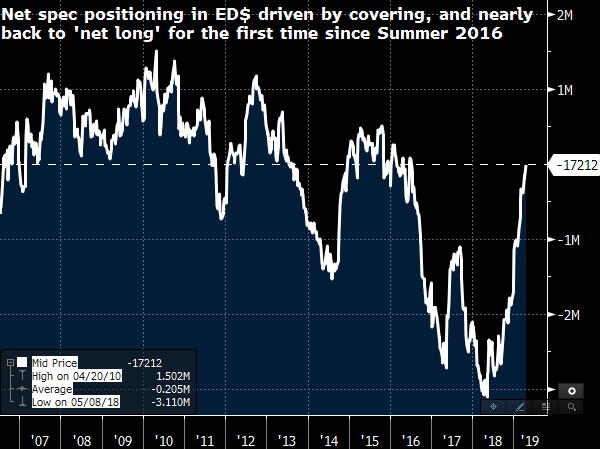
… as it has lagged the initially preferred expressions (5s30s, 2s30s which began steepening-out 2H18)—however simple ED$ Longs (Greens & Reds) / options “Upside” expressions continue to make sense…
… with Call Spreads offering attractive leverage.
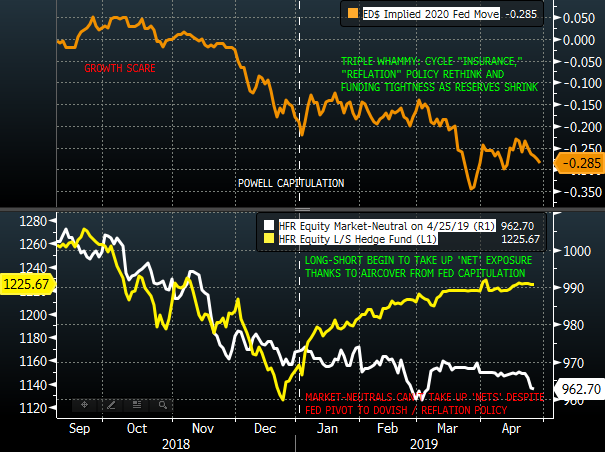
Finally, and totally unrelated, McElligott points out the following “bonus chart” showing that market neutral hedge fund performance has been abysmal so far in 2019 as MNs can’t run enough “net” to capture the dovish Fed capitulation and rate-cut bets relative to long-shorts.
via ZeroHedge News http://bit.ly/2vuj3sl Tyler Durden
it may seem morbid, if not grotesque, to discuss the Fed cutting rates on the day when the S&P just hit a new all time high, but as a result of the previously discussed US bank liquidity and dollar shortage thesis, now also espoused by JPMorgan, and the coincident “funding-squeeze” dynamic, which as we have shown over the past week has expressed itself via the much-discussed “Fed Funds (Effective) trading through IOER” phenomenon…
… this is precisely the topic of the latest note from Nomura’s Charlie McElligott who writes this morning that with the Fed increasingly concerned about what even the big banks admit is a funding shortage in the US banking system (ironically enough, with over $1.4 trillion in excess reserves still sloshing in the system), Powell may have no choice but to cut rates aggressively, slash the IOER rate – perhaps as soon as this week – and eventually resume QE.
As if to validate McElligott’s point, amid increasing buzz of an imminent rate cut, the dollar keeps rising, and instead of tracking rate cut odds, which are now back to cycle highs, is instead tracking the excess EFF over IOER tick for tick as the clearest indicator of what is now perceived as a widespread liquidity shortage, and in doing so is escalating the recent turmoil across EMFX, as the US Dollar breaks out to fresh highs despite Friday’s worse than expected (below the surface) GDP print.
As discussed over the weekend, McElligott reminds readers that there is now “again a mounting belief in the market for a Fed “technical” IOER cut at some point into the Summer” – or even this week according to Morgan Stanley – as a necessity to “buy time” into still-tightening/shrinking excess reserves (especially since the Fed seemingly has been slow to move on a ”standing repo facility” alternative) prior to the Fed again expanding the balance sheet to add reserves again in the Fall via what the Nomura strategist calls the commencement of “QE Lite” (MBS reinvestments into USTs, most likely T-Bills to shorten the portfolio’s WAM and further steepen curve as an additional side benefit).
Additionally, with today’s core PCE Deflator data coming in even weaker than expected, and dropping to just 1.6% Y/Y, the lowest print since 2017, the pressure will be on Powell to be even more dovish at this week’s FOMC meeting grows according to McElligott, “especially ahead of the June Fed research conference in Chicago, focused on inflation and likely to advocate a “run labor hot” policy.”
So despite a growing number of banks warning that the one thing that can break the market’s relentless levitation is a return to curve steepening, McElligott once again pounds the table on Steepeners (via curve caps), something he has been doing since last Summer, especially since the case “now only grows stronger as when the Fed does indeed “go,” they’ll go large – think 50bps out of the gates, and likely sooner than most expect, as they now have three cut “justifications”:
cycle “insurance” (EVERYBODY talking the ’95-’96 weakening price-pressure analog, then again in ’98 on ‘external’ factors EM- and LTCM-)
“reflation”-seeking policy rethink, and
near-term Dollar funding dynamics as banking system reserves continue to shrink prior to the re-expansion of the BS in 4Q19
So how to trade an imminent rate cut, potentially as large as 50bps? As McElligott discussed last week, and echoing what Deutsche Bank’s Aleksandar Kocic said over the weekend, the 2s10s is likely then the better “trade location” now…
… as it has lagged the initially preferred expressions (5s30s, 2s30s which began steepening-out 2H18)—however simple ED$ Longs (Greens & Reds) / options “Upside” expressions continue to make sense…
… with Call Spreads offering attractive leverage.
Finally, and totally unrelated, McElligott points out the following “bonus chart” showing that market neutral hedge fund performance has been abysmal so far in 2019 as MNs can’t run enough “net” to capture the dovish Fed capitulation and rate-cut bets relative to long-shorts.
via ZeroHedge News http://bit.ly/2vuj3sl Tyler Durden
The elite are very “tolerant” of the homeless until they start showing up in their own neighborhoods. Even though the mainstream media keeps telling us that the U.S. economy is “booming”, the number of Americans living on the streets continues to grow very rapidly, and this is particularly true in our major west coast cities. More than half a million Americans will sleep on the streets of our cities tonight, and they need help, care and shelter. Sadly, as economic conditions deteriorate that number is likely to double or even triple. Of course many among the elite are all in favor of doing something for the homeless, as long as they don’t have to be anywhere around them.
For example, let’s talk about what is going on in Los Angeles. No city on the west coast has a bigger problem with homelessness than L.A. does, and many in the homeless population enjoy camping out on the beautiful beaches in the L.A. area at night.
But of course many of the elite that paid millions of dollars for beachfront property are not too thrilled about this. Sex Pistols frontman Johnny Rotten was a key symbol of anti-establishment rebellion in the 1970s, but now he is freaking out because homeless people are making life very difficult for him and his wife in Venice Beach, and what he recently told Newsweek’s Paula Froelich is making headlines all over the nation…
He told her the homeless situation in his swanky LA neighborhood is so bad that thieves are tearing the bars from the windows of his multimillion-dollar home, lobbing bricks, setting up unsightly tent cities and littering the beach with syringes.
“A couple of weeks ago I had a problem,” the former punk prince opined. “They came over the gate and put their tent inside, right in front of the front door. It’s like . . . the audacity. And if you complain, what are you? Oh, one of the establishment elite? No, I’m a bloke that’s worked hard for his money and I expect to be able to use my own front door.”
It is more than just a little bit ironic that a man that used drugs, sex and rock and roll to shoot to global fame now sounds like a tired old crank that just wants to get the hippies off of his front lawn.
Rotten added of the punks: “They’re aggressive, and because there’s an awful lot of them together they’re gang-y. And the heroin spikes . . . You can’t take anyone to the beach because there’s jabs just waiting for young kids to put their feet in — and poo all over the sand.”
Well, Johnny might as well become accustomed to his new neighbors, because the situation is only going to get worse as our national homelessness crisis intensifies.
In Los Angeles, the number of homeless people that have died has risen 76 percentover the past five years, and this has happened during supposedly “good economic times”.
So how bad will things get when the economy really starts going downhill?
Up the coast in San Fransisco, some wealthy residents are fighting tooth and nail to keep a proposed homeless shelter out of their wealthy neighborhood. The following comes from CBS News…
Some San Francisco residents are turning to crowdfunding to raise money to fight a proposed homeless shelter in their wealthy neighborhood. As of Monday morning, the effort had raised over $80,000 of its $100,000 goal.
Calling itself “Safe Embarcadero for All,” the organizer is appealing to residents of South Beach, Rincon Hill, Bayside Village, East Cut and Mission Bay, saying the money will be directed to a legal fund to pay for efforts to fight the homeless shelter. San Francisco Mayor London Breed has sponsored legislation to fast-track the building of the Navigation Center, which would house 200 homeless people a stone’s throw from Google’s San Francisco offices and Gap’s headquarters.
San Francisco officials are debating if they should continue a needle exchange program that has left city streets littered with hazardous waste.
We have made an uncomfortable observation on social media: Thousands of needles are scattered on city streets, most likely came the Department of Public Health’s needle exchange program.
San Francisco Board of Supervisors expects to approve a seven-year extension of the exchange program, could cost taxpayers a whopping $26 million.
Overall, the city handed out 5.8 million free syringes in 2018, and a large number of those were simply thrown on to the streets when addicts were done using them.
Up in Seattle, neighborhood after neighborhood has been taken over by homeless encampments, and many residents are saying enough is enough…
In the past two weeks, Seattle Is Dying has garnered 38,000 shares on Facebook and nearly 2 million views on YouTube. The report has clearly resonated with anxious, fearful, and increasingly angry Seattle residents. Exhausted by a decade of rising disorder and property crime—now two-and-a-half times higher than Los Angeles’s and four times higher than New York City’s—Seattle voters may have reached the point of “compassion fatigue.” According to the Seattle Times, 53 percent of Seattle voters now support a “zero-tolerance policy” on homeless encampments; 62 percent believe that the problem is getting worse because the city “wastes money by being inefficient” and “is not accountable for how the money is spent,” and that “too many resources are spent on the wrong approaches to the problem.” The city council insists that new tax revenues are necessary, including a head tax on large employers, but only 7 percent of Seattle voters think that the city is “not spending enough to really solve the problem.” For a famously progressive city, this is a remarkable shift in public opinion.
With all of the money that they have, you would think that the major cities on the west coast would be showing the rest of the nation how to deal with homelessness, but instead things continue to get worse with each passing year.
And of course what we have seen so far is just the beginning. During the next recession, the homelessness crisis will be far, far worse than it is today.
America should not have more than half a million people living in the streets, but we do, and those in power do not seem to have any solutions.
via ZeroHedge News http://bit.ly/2GLLwPT Tyler Durden
So now college should be free in the same way K–12 education is. That’s what most (though not all) of the Democratic presidential candidates are saying, with Massachusetts Sen. Elizabeth Warren offering the most-detailed plan to make tuition at public universities free, forgiving “95 percent” of existing student debt, and increasing the amount of money for Pell grants and historically black colleges and universities. Ironically, the push for “free” college is coming at a time when a historically high percentage—about 70 percent—of recent high-school graduates are already enrolling in college. College has somehow become so unaffordable and remote that more and more people are attending.
“This is the kind of big, structural change we need to make sure our kids have opportunity in this country,” says Warren in a video she posted at Twitter. But just like Bernie Sanders’s routine and misleading invocation of “people with $300,000 in student debt,” Warren’s plan doesn’t just misrepresent the impact of student loans on the individual level and the historically high availability of access to higher education; it’s one more step toward an America where the people who benefit from something get somebody else to pay for it. Above and beyond any financial considerations, that’s a bad attitude to inculcate.
Warren would pay for her plan with an “Ultra-Millionaire Tax” on the 75,000 richest households in America, which she says would raise $2.75 trillion over a decade. As Peter Suderman has noted, “European countries that have imposed wealth taxes have largely given up on them; of the dozen OECD nations that had wealth taxes in 1990, just four still have the tax on the books.” Warren also keeps promising to spend her new revenue on all sorts of things, to a degree that there isn’t enough money to cover her growing list of giveaways.
Warren’s plan is of a piece with progressive Democrats pushing for more and more goods and services to be provided by the government regardless of citizens’ ability to cover their own costs. From a financial perspective, this sort of reflex is flatly unsustainable in a country that has already run up a $22 trillion tab and whose rising debt service will cost more than Medicaid next year and more than military spending in 2023. But there’s also a moral argument to be made here: Why shouldn’t we expect people who can pay for their own education, health care, and retirement to do so? And why shouldn’t we expect people who benefit from something to fund all or most of their activity?
I’m calling for universal free college and the cancellation of student loan debt for more than 95% of Americans. This is the kind of big, structural change we need to make sure our kids have opportunity in this country. pic.twitter.com/KERw3APDMo
When it comes to college, high-school grads are enrolling at historically high rates, a sign that they have access to higher education. Using three-year moving averages (which smooth out minor fluctuations) the National Center for Education Services (NCES) reports that a record-high level 69.5 percent of “recent high-school completers” are enrolled in college. In 1975, the first year for which data is presented, the figure was 49.1 percent. In 1980, it was 50.8 percent. Warren can rhapsodize about how much cheaper college tuition used to be, but the reality is that far higher percentages of people are attending college than ever before. In fact, according to NCES, a record high level of students from low-income households are attending college right out of a high school. The three-year moving average for low-income students in 2016, the latest year for which data is presented, was an unprecedented 67.1 percent—more than double the figure in 1980.
And despite claims that “we’re crushing an entire generation with student-loan debt,” the typical undergrad borrower is doing fine. About 70 percent of the Class of 2018 graduated with some debt, and their median monthly payment is $222. The overall amount of student debt is gigantic—about $1.5 trillion—but when you break it down to what the typical borrower is actually on the hook for, the picture changes dramatically.
If college students have skin in their own game, they’ll think more seriously about going to college in the first place and be more motivated to be serious and to finish. Also, one reason why tuition hikes have outpaced the general rate of inflation is that government-guaranteed student loans have helped to goose the costs. Meanwhile, the returns to a college degree remain immense even if they have flattened a bit in recent years. In a 2016 paper for the Federal Reserve Bank of San Francisco, Robert G. Valletta found that in 1980, the average worker with a high school degree made $16.33 per hour while the average worker with a college degree made $22.85. In 2015, the high school grad made $17.98 per hour while the college grad averaged $30.93. (All those figures are in 2015 dollars.) While studies of the effect of college on take-home pay vary, all show large gains and lower unemployment rates. If you’re going to make as much as a million extra dollars over your working lifetime by getting a B.A., you should be the one footing the bill.
There’s nothing wrong with asking people who benefit from something to shoulder all or part of the costs. Our national finances are falling apart largely because we keep insisting that all benefits be universal and that nobody pay their own way when it comes to big-ticket items such as health care, education, and retirement. One result in those areas are markets that don’t function as efficiently as they would otherwise. Another is a pervasive belief that we can always pass the costs of our choices onto other people. Our government is trying to be all things to all people It would be better to let it focus on helping people who can’t help themselves, and let the rest of us get on our with our own lives.
from Latest – Reason.com http://bit.ly/2W8KKTu
via IFTTT
So now college should be free in the same way K–12 education is. That’s what most (though not all) of the Democratic presidential candidates are saying, with Massachusetts Sen. Elizabeth Warren offering the most-detailed plan to make tuition at public universities free, forgiving “95 percent” of existing student debt, and increasing the amount of money for Pell grants and historically black colleges and universities. Ironically, the push for “free” college is coming at a time when a historically high percentage—about 70 percent—of recent high-school graduates are already enrolling in college. College has somehow become so unaffordable and remote that more and more people are attending.
“This is the kind of big, structural change we need to make sure our kids have opportunity in this country,” says Warren in a video she posted at Twitter. But just like Bernie Sanders’s routine and misleading invocation of “people with $300,000 in student debt,” Warren’s plan doesn’t just misrepresent the impact of student loans on the individual level and the historically high availability of access to higher education; it’s one more step toward an America where the people who benefit from something get somebody else to pay for it. Above and beyond any financial considerations, that’s a bad attitude to inculcate.
Warren would pay for her plan with an “Ultra-Millionaire Tax” on the 75,000 richest households in America, which she says would raise $2.75 trillion over a decade. As Peter Suderman has noted, “European countries that have imposed wealth taxes have largely given up on them; of the dozen OECD nations that had wealth taxes in 1990, just four still have the tax on the books.” Warren also keeps promising to spend her new revenue on all sorts of things, to a degree that there isn’t enough money to cover her growing list of giveaways.
Warren’s plan is of a piece with progressive Democrats pushing for more and more goods and services to be provided by the government regardless of citizens’ ability to cover their own costs. From a financial perspective, this sort of reflex is flatly unsustainable in a country that has already run up a $22 trillion tab and whose rising debt service will cost more than Medicaid next year and more than military spending in 2023. But there’s also a moral argument to be made here: Why shouldn’t we expect people who can pay for their own education, health care, and retirement to do so? And why shouldn’t we expect people who benefit from something to fund all or most of their activity?
I’m calling for universal free college and the cancellation of student loan debt for more than 95% of Americans. This is the kind of big, structural change we need to make sure our kids have opportunity in this country. pic.twitter.com/KERw3APDMo
When it comes to college, high-school grads are enrolling at historically high rates, a sign that they have access to higher education. Using three-year moving averages (which smooth out minor fluctuations) the National Center for Education Services (NCES) reports that a record-high level 69.5 percent of “recent high-school completers” are enrolled in college. In 1975, the first year for which data is presented, the figure was 49.1 percent. In 1980, it was 50.8 percent. Warren can rhapsodize about how much cheaper college tuition used to be, but the reality is that far higher percentages of people are attending college than ever before. In fact, according to NCES, a record high level of students from low-income households are attending college right out of a high school. The three-year moving average for low-income students in 2016, the latest year for which data is presented, was an unprecedented 67.1 percent—more than double the figure in 1980.
And despite claims that “we’re crushing an entire generation with student-loan debt,” the typical undergrad borrower is doing fine. About 70 percent of the Class of 2018 graduated with some debt, and their median monthly payment is $222. The overall amount of student debt is gigantic—about $1.5 trillion—but when you break it down to what the typical borrower is actually on the hook for, the picture changes dramatically.
If college students have skin in their own game, they’ll think more seriously about going to college in the first place and be more motivated to be serious and to finish. Also, one reason why tuition hikes have outpaced the general rate of inflation is that government-guaranteed student loans have helped to goose the costs. Meanwhile, the returns to a college degree remain immense even if they have flattened a bit in recent years. In a 2016 paper for the Federal Reserve Bank of San Francisco, Robert G. Valletta found that in 1980, the average worker with a high school degree made $16.33 per hour while the average worker with a college degree made $22.85. In 2015, the high school grad made $17.98 per hour while the college grad averaged $30.93. (All those figures are in 2015 dollars.) While studies of the effect of college on take-home pay vary, all show large gains and lower unemployment rates. If you’re going to make as much as a million extra dollars over your working lifetime by getting a B.A., you should be the one footing the bill.
There’s nothing wrong with asking people who benefit from something to shoulder all or part of the costs. Our national finances are falling apart largely because we keep insisting that all benefits be universal and that nobody pay their own way when it comes to big-ticket items such as health care, education, and retirement. One result in those areas are markets that don’t function as efficiently as they would otherwise. Another is a pervasive belief that we can always pass the costs of our choices onto other people. Our government is trying to be all things to all people It would be better to let it focus on helping people who can’t help themselves, and let the rest of us get on our with our own lives.
from Latest – Reason.com http://bit.ly/2W8KKTu
via IFTTT
Next fall, the Supreme Court is scheduled to hear oral argument in County of Maui v. Hawaii Wildlife Fund, a major environmental case concerning the scope of the Clean Water Act. Depending on how the Court handles the case, Maui could easily be one of the most significant environmental cases of the past decade, but only if it does not settle before argument.
The issue in Maui is “whether the Clean Water Act requires a permit when pollutants originate from a point source but are conveyed to navigable waters by a nonpoint source, such as groundwater.” Put in lay terms, the question is whether the County of Maui was required to get a CWA permit for injecting pollutants into groundwater if some of those pollutants could eventually reach “waters of the United States.” According to the Hawaii Wildlife Fund, when groundwater acts as a conduit of pollutants that were discharged by a point source, a permit should be required. According to the County of Maui, no CWA permit should be required because the CWA does not regulate groundwater and does not require a permit for nonpoint source pollution.
The U.S. Court of Appeals for the Ninth Circuit accepted the Hawaii Wildlife Fund’s argument, thereby requiring the County of Maui to obtain CWA permits for the continued operation of underground injection control wells at its wasterwater treatment plants. Other courts to consider this question, such as the U.S. Court of Appeals for the Sixth Circuit, have disagreed. The resulting circuit split made this case an obvious candidate for certiorari, and the outcome could have far-reaching consequences. In Hawaii alone there are over 6,000 UIC wells and 21,000 septic systems that could be subject to CWA permit requirements if the Ninth Circuit’s position is upheld.
While the County of Maui would prefer not to have to obtain permits for its wastewater treatment plant UIC wells, some local political leaders are also wary of pushing an aggressive anti-regulatory argument in the Supreme Court. According to local press reports, Maui is considering whether to settle the case before it is heard by the Court.
If Maui is settled, it would end the case and prevent the Court from issuing an opinion in the case. This would delay, though not deny, the Supreme Court’s ability to resolve the underlying question. The existence of other cases addressing this question means that, in all likelihood, it would only be a matter of time before the groundwater-conduit question returns to the Court. Settling the case would, however, eliminate an important, high-profile case from what is shaping up to be a quite significant Supreme Court term.
(Thanks to Jesse Richardson for the pointer.)
from Latest – Reason.com http://bit.ly/2GRgMy8
via IFTTT
Next fall, the Supreme Court is scheduled to hear oral argument in County of Maui v. Hawaii Wildlife Fund, a major environmental case concerning the scope of the Clean Water Act. Depending on how the Court handles the case, Maui could easily be one of the most significant environmental cases of the past decade, but only if it does not settle before argument.
The issue in Maui is “whether the Clean Water Act requires a permit when pollutants originate from a point source but are conveyed to navigable waters by a nonpoint source, such as groundwater.” Put in lay terms, the question is whether the County of Maui was required to get a CWA permit for injecting pollutants into groundwater if some of those pollutants could eventually reach “waters of the United States.” According to the Hawaii Wildlife Fund, when groundwater acts as a conduit of pollutants that were discharged by a point source, a permit should be required. According to the County of Maui, no CWA permit should be required because the CWA does not regulate groundwater and does not require a permit for nonpoint source pollution.
The U.S. Court of Appeals for the Ninth Circuit accepted the Hawaii Wildlife Fund’s argument, thereby requiring the County of Maui to obtain CWA permits for the continued operation of underground injection control wells at its wasterwater treatment plants. Other courts to consider this question, such as the U.S. Court of Appeals for the Sixth Circuit, have disagreed. The resulting circuit split made this case an obvious candidate for certiorari, and the outcome could have far-reaching consequences. In Hawaii alone there are over 6,000 UIC wells and 21,000 septic systems that could be subject to CWA permit requirements if the Ninth Circuit’s position is upheld.
While the County of Maui would prefer not to have to obtain permits for its wastewater treatment plant UIC wells, some local political leaders are also wary of pushing an aggressive anti-regulatory argument in the Supreme Court. According to local press reports, Maui is considering whether to settle the case before it is heard by the Court.
If Maui is settled, it would end the case and prevent the Court from issuing an opinion in the case. This would delay, though not deny, the Supreme Court’s ability to resolve the underlying question. The existence of other cases addressing this question means that, in all likelihood, it would only be a matter of time before the groundwater-conduit question returns to the Court. Settling the case would, however, eliminate an important, high-profile case from what is shaping up to be a quite significant Supreme Court term.
(Thanks to Jesse Richardson for the pointer.)
from Latest – Reason.com http://bit.ly/2GRgMy8
via IFTTT
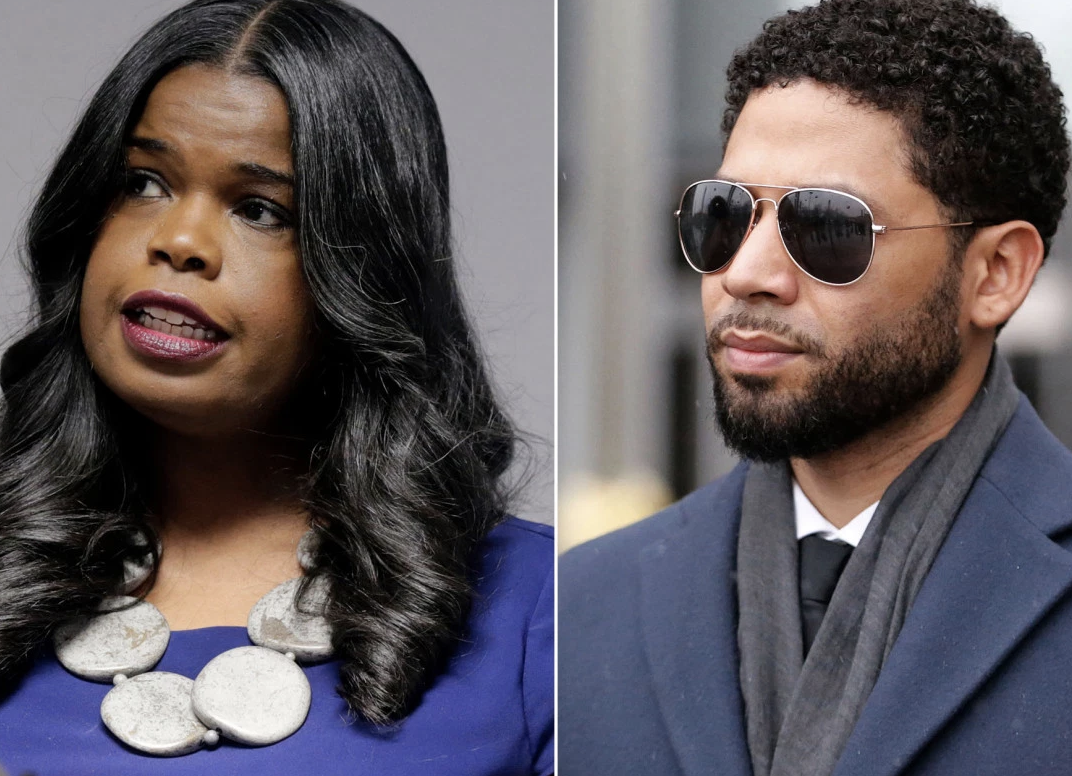
Following a wave of departures from her office and an intensifying inspector general investigation into her handling of the Jussie Smollett case, where she dropped a 16-count felony indictment against the actor after he allegedly faked his own hate crime, one retired judge is turning up the heat on Kim Foxx, Chicago’s state’s attorney.
According to the Chicago Sun-Times, Foxx has been subpoenaed by ex-appellate Judge Sheila O’Brien to appear at a hearing over her handling of the case. The judge is pushing for the appointment of a federal prosecutor.
O’Brien has also subpoenaed Foxx’s top deputy Joseph Magats; she also filed a document requesting that Smollett – who was accused of staging the attack for personal gain – appear at the hearing.
She alleged that Foxx’s handling of the case was “plagued with irregularity.”
“Foxx’s conflict in this matter is beyond dispute,” O’Brien argued, adding that Foxx should have sought appointment of a special prosecutor. “Instead, Foxx misled the public into believing that Smollett’s case was handled like any other prosecution and without influence.”
However, Foxx didn’t disclose that she had been in communication with a “family friend” of the Smolletts, former Michelle Obama chief of staff Tina Tchen.
In her subpoena, the former judge asked that Foxx and Magats produce all the original documents in the case to prove “that they have not been altered or destroyed and will not be destroyed throughout this case.”
Smollett, who is black and openly gay, told Chicago police that he was attacked in late January in Streeterville, the city neighborhood where he lived, as two white men yelled racist and homophobic slurs at him, then poured bleach on him and tied a noose around his neck.
But after weeks where media figures spoke out about the racist culture inspired by Trump that had led to the attacks, the narrative started to unravel. After several inconsistencies – including the fact that video cameras showed two Nigerian brothers purportedly ‘attacking’ Smollett (Smollett had said his attackers were white), and the discovery of a check written by Smollett to the two brothers – surfaced, police eventually charged filed a smattering of charges against Smollett. Police said he staged the attack and filed a false report. Then, at a surprise hearing March 26, all charges were dropped. Foxx had recused herself from the case after allegations of improper influence surfaced, but the allegations that she improperly influenced the case have persisted.
via ZeroHedge News http://bit.ly/2LboZRG Tyler Durden