Columbia College Theater Students Feel Unsafe About White Students Getting Parts Written for Palestinians After None Tried Out

The theater department of Columbia College in Chicago attempted to stage a production of “HOME/LAND,” which is about the experience of Palestinian and Latino immigrants in America. But no students of Palestinian descent tried out for the play, and so white actors were cast in these roles.

That was just one of the terrible injustices visited upon the minority community by the play’s director, Catherine Slade, according to aggrieved students who told the campus newspaper, “It got to a place where nobody felt safe.” Yes, their very safety was affected by the director’s habit of “being aggressive and speaking badly” about the cast.

Perhaps Slade—a black woman, theater professor, and vocal coach—was critical of the cast members because they were insubordinate and easily offended, quickly bringing their issues with her to the Mosaic Theater Collective, Asian Student Organization, Black Student Union, and Muslim Student Association.

“There was no trying to collaborate with us,” one actress, Sophia Alonzo, said of Slade. “There was no trying to see if [she was] doing the right thing. It almost felt like we were just being used as pawns. It’s hard because these are real stories to our families and our background that were [not treated as] valid.”

It sounds to me like these students objected to being directed at all. They also objected to white actors reciting their lines in Spanish and were offended by Slade’s suggestion that several white members of the cast could pass as Latin or Palestinian.

The paper has more:

The Chronicle contacted Slade on Saturday, April 20 and requested an interview, to which she initially agreed. On Monday, April 23, the News Office intervened and eventually denied interviews with Slade, Theater Department Interm Chair Peter Carpenter and Diversity, Equity and Inclusion Scholar-in-Residence for the Theater Department Khalid Long. After repeated requests for a statement, the News Office supplied one Friday, April 26, in the evening shortly before The Chronicle’s deadline.

“The Theatre Department is committed to providing students with opportunities to perform in diverse theatre productions,” the statement read. “The ‘HOME/LAND’ script called for Latinx, Palestinian and Caucasian characters. All students who auditioned were cast in the production. However, not all of the students who auditioned were of the same race and/or ethnicity as the characters identified in the script. Indeed, no Palestinian students auditioned for the play, and as such, non-Palestinian actors were assigned to those roles. Several Latinx students who initially auditioned for the production didn’t pursue participation.”

Recall that for the modern intersectional left, race is a fundamental, immutable building block of identity. This puts the craft of acting in a tough spot—any attempt to depict or portray people of other races is essentially forbidden. My forthcoming book, Panic Attack: Young Radicals in the Age of Trump (pre-order here), contains several examples of theater professors giving up in frustration after their student actors and actresses object to playing anyone different from themselves and revolt against negative feedback, which triggers their mental health issues.

Hat tip: The College Fix

from Latest – Reason.com http://bit.ly/2V8BgLx
via IFTTT
It Took Good Samaritans 2 Hours and $150 To Paint a Crosswalk That D.C. Ignored for 6 Months

Two hundred seventy days. That’s how long the District Department of Transportation (DDOT) of Washington, D.C., said it might take to get around to painting a single crosswalk.

They weren’t kidding. Ronald Thompson of Anacostia told WTTG he made a formal request for the crosswalk to be painted back in October. For months, nothing happened. Then, on Easter Sunday, a pedestrian, 31-year-old Abdul Seck, was hit and killed by a car at an intersection just blocks away.

So Thompson decided he didn’t want to wait anymore. At a vigil for Seck, Thompson met Michael Kaercher, who agreed that road safety was a big issue. “These kids I see, these parents, these grandparents walking their kids to school, they do not have a safe accommodation here,” Thompson told WTTG. This past Sunday, the two men took it upon themselves to do what DDOT wouldn’t, city approval be damned

Kaercher was the one who did the actual painting. “It was such an obvious project that I could do safely, without posing any significant risk to myself and no risk at all to other parties,” he told WTOP. And it’s not like the job required painting expertise or a significant commitment of time and resources. “The most painting I’ve ever done before was my dining room wall,” Kaercher added.

All told, it took about two hours and required $150 worth of supplies.

Amazingly, Kaercher may have been breaking the law. Around the country, it’s generally illegal for residents to paint crosswalks or install traffic signage on public roads. It’s not clear whether DDOT will take action, as the agency declined to answer WTTG’s questions regarding the legality of Thompson and Kaercher’s actions.

“Of all the things to possibly get arrested or fined for, helping to make people’s lives a little bit safer and a little bit less stressful? I’m fine with that,” Kaercher told WTTG.

Now, DDOT did have an explanation for why they hadn’t painted the crosswalk in the months since Thompson made his request. Per a statement provided to WTTG:

The general pavement marking service level agreement is 270 days for turnaround due to marking installation being very weather dependent. The conditions for installation generally only occur from March to November. The agency often installs markings well before the 270 day turn-around time and we are evaluating whether the SLA should be changed. Mr. Thompson’s service request came in at the end of the 2018 pavement marking season. DDOT has his request in cue and expects it to be installed shortly. DDOT has received 417 service requests for pavement markings in 2019 and closed 141 of them. Our safety team will be investigating the location to see if additional markings, signage and speed humps are needed in the area.

This is yet another example of private citizens taking it upon themselves to do what the government is incapable of. It’s not always the government’s fault. As a resident of the D.C. metro area, I know firsthand that the weather can get nasty, and I assume painting a crosswalk in the dead of winter isn’t exactly fun.

The problem is that we expect the government to fix these problems in the first place. Yet time and again, private citizens have shown they’re much more adept at this type of thing. Consider the masked anarchists who took to the streets of Portland in 2017 to patch up potholes. (Amazingly, a transportation bureau spokesperson suggested they might be breaking the law.) And in 2018, Domino’s answered the age-old question: Who builds roads in a libertarian society? The pizza chain helped fix roads in numerous states around the country. It was the perfect solution, as Reason‘s Christian Britschgi noted at the time:

Roads exist to service people’s transportation needs, whether that’s getting to and from work, schlepping freight between cities, or, yes, delivering freshly cooked pizza. Aligning the funding of roads with the purposes they’re used for would make infrastructure more responsive to the end user.

Just last month, I wrote about Monte Scott, a 12-year-old Michigan boy who used a garbage can full of dirt to fill at least 15 potholes near his family’s home last week. Scott told the Muskegon Times he’d wanted to fill potholes for months, and finally did so following a half-day at school. “People complain and complain, and the city never fills them up,” he said. “And I feel horrible because they never do it. They should fix the streets.”

If there’s one takeaway from these stories, it’s that while local governments may struggle to ensure the roads are safe, private citizens are getting real results.

from Latest – Reason.com http://bit.ly/2GLewqK
via IFTTT

Chicago’s High Frequency Trading War Rages As Yet Another Microwave Tower Pops Up

The ongoing high-frequency-trading-tower-war that we reported on about a month ago has turned the page onto its next chapter, according to Bloomberg. Aurora, Illinois is one of the closest places that high frequency traders can get to the $63 billion CME Group exchange, where futures and derivatives on commodities and US treasuries trade, making it a mecca for HFTs seeking to frontrun slower orderflow.

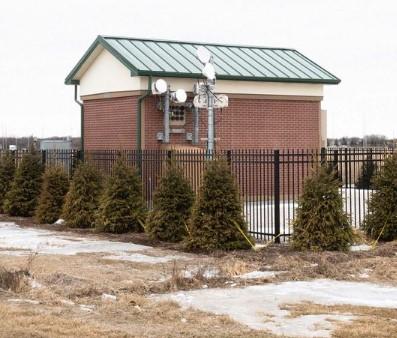
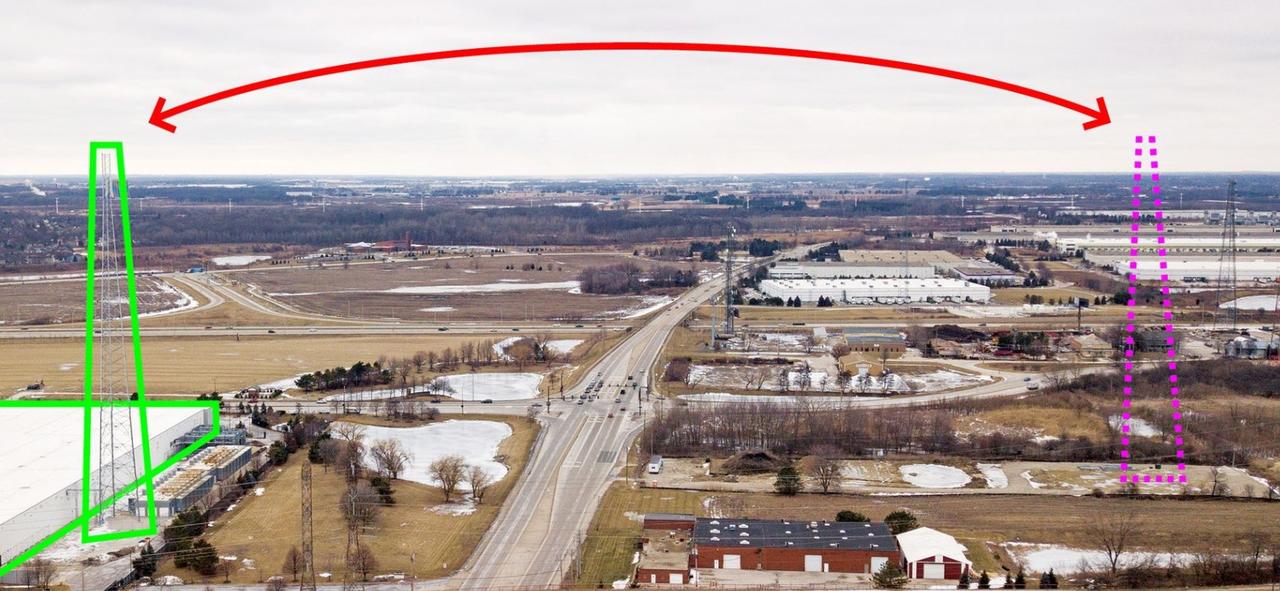
We reported last month about an ongoing fight between two companies in Illinois to get their towers the closest to the CME Group in order to shave milliseconds off their transaction times – and to be able to sell space on their towers to other tenants looking to get as close as possible to the exchange. The latest move in that competition has come from Scientel Solutions LLC, who has assembled a 195 foot tower across the street from CyrusOne Inc, allegedly obstructing CyrusOne’s tower. 

When we last reported, Scientel’s development site was only 2.6 mostly vacant acres that housed only a trailer, a portable toilet, and a pile of metal poles. That has changed, and Scientel’s tower is now up and running. 

CyrusOne said previously that Scientel’s tower would block its own “line of sight” to downstream microwave dishes from its already existing tower, and interfere with its communication to and from the CME data center.

CyrusOne Inc. had previously tried to stop the Scientel tower from happening in January 2018 by suing Scientel and the city of Aurora, Illinois, which had approved the project. CyrusOne’s tower went up last year and sits just feet from the data center that
houses CME Group Inc.’s derivatives exchange. 

The point of CyrusOne’s tower, to begin with, was to end the “war” and put all players seeking access to the CME Group in the same position – literally and figuratively. CyrusOne, which owns the CME Center, decided last year that it would finally end the scramble for real-estate by putting up the 350 foot tall wireless tower that would allow anybody to rent space on it. It’s closer than any trading firm could get to the center and targeted putting everybody “on equal footing”… in exchange for a very generous fee to CyrusOne, of course.

Scientel President Nelson Santos told Bloomberg this week that none of the antennas on the Scientel structure are currently being used for trading, but that “will change at some point”. Even better is the fact that the Scientel tower will connect wirelessly to CME by beaming signals to the CyrusOne tower. Santos didn’t disclose his customers due to NDA and what he called “competitive reasons”.

Meanwhile, CyrusOne’s tower has started to bud. Despite being put up last year, it was without an antenna until several weeks ago, when the first antenna was attached. There has been activity on the pole, with people climbing the tower this week and last, indicating that the project is progressing. 

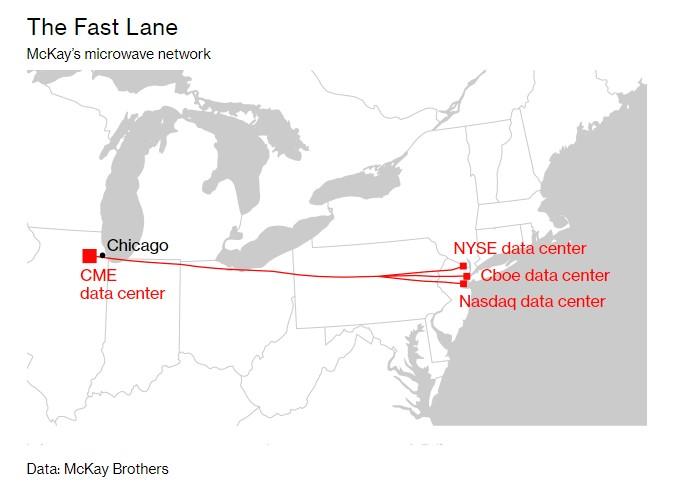
FCC records list Jefferson Microwave LLC, New Line Networks LLC and Webline Holdings LLC as three entities that are licensed to operate from the tower. Jefferson is part of Oakland-based McKay Brothers, New Line Networks is a joint venture of Chicago’s Jump Trading LLC and New York-based Virtu Financial Inc. and Webline is DRW Holdings LLC of Chicago.

Actually being a nanosecond faster is just as important, hence all of the fuss: microwave networks rely on line-of-sight transmissions as microwaves need to be able to “see” the dish they are communicating with. Because of the Earth’s curvature, the signal must be relayed from towers that are spaced apart generally every couple of miles. Companies like McKay say that they can process a trade from Aurora to Carteret, location of the Nasdaq data center, or Carteret to Aurora, in 4 milliseconds.

Back in March 2016, when it appeared that HFTs are starting to cannibalize one another, the CME sold its data center building for $131 million. The local government thought it had the issue squared away when it required CyrusOne to lease space to traders on its tower at “fair market rates”. Scientel’s tower popping up seems to be just more proof that government intervention is often useless. In this case, in fact, it looks as though it may have even stoked the fire hotter. 

via ZeroHedge News http://bit.ly/2ZJqf1M Tyler Durden

It Took Good Samaritans 2 Hours and $150 To Paint a Crosswalk That D.C. Ignored for 6 Months

Two hundred seventy days. That’s how long the District Department of Transportation (DDOT) of Washington, D.C., said it might take to get around to painting a single crosswalk.

They weren’t kidding. Ronald Thompson of Anacostia told WTTG he made a formal request for the crosswalk to be painted back in October. For months, nothing happened. Then, on Easter Sunday, a pedestrian, 31-year-old Abdul Seck, was hit and killed by a car at an intersection just blocks away.

So Thompson decided he didn’t want to wait anymore. At a vigil for Seck, Thompson met Michael Kaercher, who agreed that road safety was a big issue. “These kids I see, these parents, these grandparents walking their kids to school, they do not have a safe accommodation here,” Thompson told WTTG. This past Sunday, the two men took it upon themselves to do what DDOT wouldn’t, city approval be damned

Kaercher was the one who did the actual painting. “It was such an obvious project that I could do safely, without posing any significant risk to myself and no risk at all to other parties,” he told WTOP. And it’s not like the job required painting expertise or a significant commitment of time and resources. “The most painting I’ve ever done before was my dining room wall,” Kaercher added.

All told, it took about two hours and required $150 worth of supplies.

Amazingly, Kaercher may have been breaking the law. Around the country, it’s generally illegal for residents to paint crosswalks or install traffic signage on public roads. It’s not clear whether DDOT will take action, as the agency declined to answer WTTG’s questions regarding the legality of Thompson and Kaercher’s actions.

“Of all the things to possibly get arrested or fined for, helping to make people’s lives a little bit safer and a little bit less stressful? I’m fine with that,” Kaercher told WTTG.

Now, DDOT did have an explanation for why they hadn’t painted the crosswalk in the months since Thompson made his request. Per a statement provided to WTTG:

The general pavement marking service level agreement is 270 days for turnaround due to marking installation being very weather dependent. The conditions for installation generally only occur from March to November. The agency often installs markings well before the 270 day turn-around time and we are evaluating whether the SLA should be changed. Mr. Thompson’s service request came in at the end of the 2018 pavement marking season. DDOT has his request in cue and expects it to be installed shortly. DDOT has received 417 service requests for pavement markings in 2019 and closed 141 of them. Our safety team will be investigating the location to see if additional markings, signage and speed humps are needed in the area.

This is yet another example of private citizens taking it upon themselves to do what the government is incapable of. It’s not always the government’s fault. As a resident of the D.C. metro area, I know firsthand that the weather can get nasty, and I assume painting a crosswalk in the dead of winter isn’t exactly fun.

The problem is that we expect the government to fix these problems in the first place. Yet time and again, private citizens have shown they’re much more adept at this type of thing. Consider the masked anarchists who took to the streets of Portland in 2017 to patch up potholes. (Amazingly, a transportation bureau spokesperson suggested they might be breaking the law.) And in 2018, Domino’s answered the age-old question: Who builds roads in a libertarian society? The pizza chain helped fix roads in numerous states around the country. It was the perfect solution, as Reason‘s Christian Britschgi noted at the time:

Roads exist to service people’s transportation needs, whether that’s getting to and from work, schlepping freight between cities, or, yes, delivering freshly cooked pizza. Aligning the funding of roads with the purposes they’re used for would make infrastructure more responsive to the end user.

Just last month, I wrote about Monte Scott, a 12-year-old Michigan boy who used a garbage can full of dirt to fill at least 15 potholes near his family’s home last week. Scott told the Muskegon Times he’d wanted to fill potholes for months, and finally did so following a half-day at school. “People complain and complain, and the city never fills them up,” he said. “And I feel horrible because they never do it. They should fix the streets.”

If there’s one takeaway from these stories, it’s that while local governments may struggle to ensure the roads are safe, private citizens are getting real results.

from Latest – Reason.com http://bit.ly/2GLewqK
via IFTTT

Finding Law

My long-in-the-works article Finding Law has now been published online in the California Law Review. The article takes on about a century’s worth of legal prejudices, nowadays associated with the Supreme Court’s decision in Erie Railroad Co. v. Tompkins. Instead, it defends a view of unwritten law as something that can be found by the legal system, rather than only being made by judges.

From the abstract:

That the judge’s task is to find the law, not to make it, was once a commonplace of our legal culture. Today, decades after Erie, the idea of a common law discovered by judges is commonly dismissed—as a “fallacy,” an “illusion,” a “brooding omnipresence in the sky.” That dismissive view is wrong. Expecting judges to find unwritten law is no childish fiction of the benighted past, but a real and plausible option for a modern legal system.

This Article seeks to restore the respectability of finding law, in part by responding to two criticisms made by Erie and its progeny. The first, “positive” criticism is that law has to come from somewhere: judges can’t discover norms that no one ever made. But this claim blinks reality. We routinely identify and apply social norms that no one deliberately made, including norms of fashion, etiquette, or natural language. Law is no different. Judges might declare a customary law the same way copy editors and dictionary authors declare standard English—with a certain kind of reliability, but with no power to revise at will.

The second, “realist” criticism is that law leaves too many questions open: when judges can’t find the law, they have to make it instead. But uncertain cases force judges to make decisions, not to make law. Different societies can give different roles to precedent (and to judges). And judicial decisions can have many different kinds of legal force—as law of the circuit, law of the case, and so on—without altering the underlying law on which they’re based.

This Article claims only that it’s plausible for a legal system to have its judges find law. It doesn’t try to identify legal systems that actually do this in practice. Yet too many discussions of judge-made law, including the famous passages in Erie, rest on the false premise that judge-made law is inevitable—that judges simply can’t do otherwise. In fact, judges can do otherwise: they can act as the law’s servants rather than its masters. The fact that they can forces us to confront the question of whether they should—and, indeed, whether the Erie doctrine itself can outlive its mistaken premises. Finding law is no fallacy or illusion; the brooding omnipresence broods on.

And from the conclusion:

This change in attitude toward the common law seems to be rooted in a giant intellectual mistake. According to [Larry] Kramer, the removal of limitations on judicial lawmaking “results not from doctrinal changes, but from changes in our beliefs about the nature of law and the lawmaking process.” It’s only because “[w]e have come to see that even the fundamental principles of the common law were ‘made’ by judges” that “the ‘natural’ limits of pre-modern common law disappear, and the potential for making common law becomes as broad as we are willing to let judges go.” Surely the judicial process could have used some demystification; surely the history of the common law, under Lord Mansfield as well as others, is replete with examples of judges playing fast and loose with unwritten law. But the real motive force here seems to be a simple error about the nature of law: that it’s a “fallacy” or “illusion” to suppose “that there is this outside thing to be found.” And such errors, once made, don’t restrict themselves to unwritten law: cavalier judicial attitudes toward the common law have seeped into statutory and constitutional arguments as well.

Again, nothing in this Article addresses the actual norms of actual legal systems—whether in Blackstone’s England, New York State, or the United States as a whole. Maybe today’s legal norms really do empower judges, federal or state, to trade in their black robes for superheroes’ capes, or to play “junior-varsity Congress” with unwritten law. But in light of Holmes’s own reticence, it’s important to remember that this is not the only possible approach; that history and legal theory do offer alternatives; that different polities can choose, through their own constitutional systems, the powers they want their judges to enjoy. To make this choice, we need to restore, at least at the level of possibility, the consensus that such a choice exists. …

More on the specifics of the argument later this week.

from Latest – Reason.com http://bit.ly/2GV2sVd
via IFTTT

Finding Law

My long-in-the-works article Finding Law has now been published online in the California Law Review. The article takes on about a century’s worth of legal prejudices, nowadays associated with the Supreme Court’s decision in Erie Railroad Co. v. Tompkins. Instead, it defends a view of unwritten law as something that can be found by the legal system, rather than only being made by judges.

From the abstract:

That the judge’s task is to find the law, not to make it, was once a commonplace of our legal culture. Today, decades after Erie, the idea of a common law discovered by judges is commonly dismissed—as a “fallacy,” an “illusion,” a “brooding omnipresence in the sky.” That dismissive view is wrong. Expecting judges to find unwritten law is no childish fiction of the benighted past, but a real and plausible option for a modern legal system.

This Article seeks to restore the respectability of finding law, in part by responding to two criticisms made by Erie and its progeny. The first, “positive” criticism is that law has to come from somewhere: judges can’t discover norms that no one ever made. But this claim blinks reality. We routinely identify and apply social norms that no one deliberately made, including norms of fashion, etiquette, or natural language. Law is no different. Judges might declare a customary law the same way copy editors and dictionary authors declare standard English—with a certain kind of reliability, but with no power to revise at will.

The second, “realist” criticism is that law leaves too many questions open: when judges can’t find the law, they have to make it instead. But uncertain cases force judges to make decisions, not to make law. Different societies can give different roles to precedent (and to judges). And judicial decisions can have many different kinds of legal force—as law of the circuit, law of the case, and so on—without altering the underlying law on which they’re based.

This Article claims only that it’s plausible for a legal system to have its judges find law. It doesn’t try to identify legal systems that actually do this in practice. Yet too many discussions of judge-made law, including the famous passages in Erie, rest on the false premise that judge-made law is inevitable—that judges simply can’t do otherwise. In fact, judges can do otherwise: they can act as the law’s servants rather than its masters. The fact that they can forces us to confront the question of whether they should—and, indeed, whether the Erie doctrine itself can outlive its mistaken premises. Finding law is no fallacy or illusion; the brooding omnipresence broods on.

And from the conclusion:

This change in attitude toward the common law seems to be rooted in a giant intellectual mistake. According to [Larry] Kramer, the removal of limitations on judicial lawmaking “results not from doctrinal changes, but from changes in our beliefs about the nature of law and the lawmaking process.” It’s only because “[w]e have come to see that even the fundamental principles of the common law were ‘made’ by judges” that “the ‘natural’ limits of pre-modern common law disappear, and the potential for making common law becomes as broad as we are willing to let judges go.” Surely the judicial process could have used some demystification; surely the history of the common law, under Lord Mansfield as well as others, is replete with examples of judges playing fast and loose with unwritten law. But the real motive force here seems to be a simple error about the nature of law: that it’s a “fallacy” or “illusion” to suppose “that there is this outside thing to be found.” And such errors, once made, don’t restrict themselves to unwritten law: cavalier judicial attitudes toward the common law have seeped into statutory and constitutional arguments as well.

Again, nothing in this Article addresses the actual norms of actual legal systems—whether in Blackstone’s England, New York State, or the United States as a whole. Maybe today’s legal norms really do empower judges, federal or state, to trade in their black robes for superheroes’ capes, or to play “junior-varsity Congress” with unwritten law. But in light of Holmes’s own reticence, it’s important to remember that this is not the only possible approach; that history and legal theory do offer alternatives; that different polities can choose, through their own constitutional systems, the powers they want their judges to enjoy. To make this choice, we need to restore, at least at the level of possibility, the consensus that such a choice exists. …

More on the specifics of the argument later this week.

from Latest – Reason.com http://bit.ly/2GV2sVd
via IFTTT

Stossel: Inequality Myths

Politicians and reporters often rail about “the rich getting richer and the poor getting poorer.”

But as John Stossel explains, it’s not true.

In fact, the incomes of poor and middle-income Americans are up 32 percent since the government began keeping track several decades ago.

Yes, that increase is adjusted for inflation.

Another misleading claim, says Stossel, is the idea that the U.S. “no longer has economic mobility.”

But a paper in The Quarterly Journal of Economics found that most people born to the richest fifth of Americans fall out of that bracket within 20 years (Table 2). Likewise, most born to the poorest fifth climb to a higher quintile. Some climb all the way to the top.

Another claim is that inequality itself is a huge problem.

New York City Mayor Bill de Blasio warns: “There’s inequality in this country right now that is threatening to tear us apart.”

Stossel says that it might tear us apart—but only if people come to believe that all inequality is evil.

But it isn’t, he says. It’s just part of life. Some people are better singers than others. The best athletes are just physically different.

Society doesn’t try to equalize those things—or many others—for good reason.

Former investment banker Carol Roth tell Stossel, “I have two kidneys. There are people out there who need one, don’t have one that functions. Should the government be able to take my kidney because somebody else needs it?”

“There’s inequality in everything,” she adds. “There’s inequality in free time. There’s inequality in parents. I don’t have any parents or grandparents. Life is unfair…unfair is a feature. It’s not a bug.”

Subscribe to our YouTube channel.
Like us on Facebook.
Follow us on Twitter.
Subscribe to our podcast at iTunes.

The views expressed in this video are solely those of John Stossel; his independent production company, Stossel Productions; and the people he interviews. The claims and opinions set forth in the video and accompanying text are not necessarily those of Reason.

from Latest – Reason.com http://bit.ly/2DFn41P
via IFTTT

Consumer Confidence Spikes As Labor Market Sentiment Approaches Record High

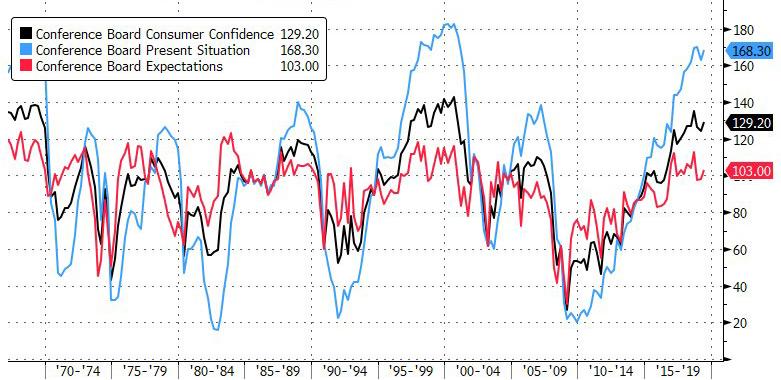
Following several disappointing economic reports, including a continued slump in nationwide home prices and a crash in the Chicago PMI, we got a modest sliver of good news when the Conference Board reported that April Consumer Confidence rebounded from 124.2 to 129.2, a sharp beat to the 126.8 expected.

Both estimates of current conditions and economic outlooks improved: the Present Situation Index – based on consumers’ assessment of current business and labor market conditions – increased, from 163.0 to 168.3. The Expectations Index – based on consumers’ short-term outlook for income, business and labor market conditions – increased from 98.3 last month to 103.0 this month.

Consumers’ assessment of current conditions improved in April. Those stating business conditions are “good” increased from 34.7 percent to 37.3 percent, while those saying business conditions are “bad” decreased from 12.4 percent to 11.7 percent.

Consumers’ short-term outlook also improved in April. The percentage of consumers expecting business conditions will be better six months from now increased from 17.2 percent to 19.9 percent, while those expecting business conditions will worsen declined from 10.0 percent to 9.1 percent.

Commenting on the report, Lynn Franco, Senior Director of Economic Indicators at The Conference Board said that “Consumer Confidence partially rebounded in April, following March’s decline, but still remains below levels seen last Fall.” Franco noted that “the Present Situation Index, which had decreased sharply last month, improved in April, as did consumers’ short-term outlook. Overall, consumers expect the economy to continue growing at a solid pace into the summer months. These strong confidence levels should continue to support consumer spending in the near-term.”

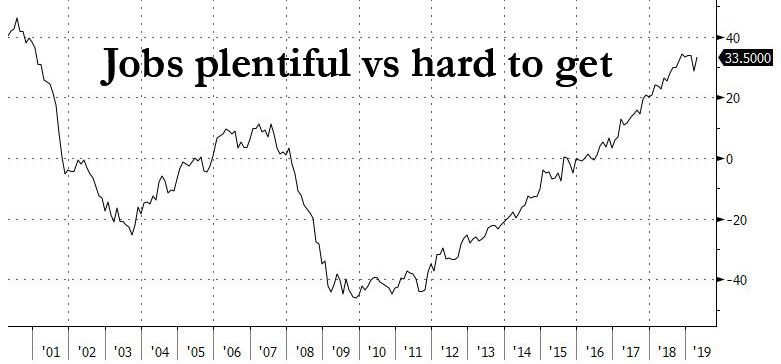
And with the payrolls report due out in just three days, many were keeping an eye on the reports’ measure of consumer sentimenta bout the labor market as indicated by the “jobs plentiful vs hard to get” indexes: here the respondents’ assessment of the labor market was also far more upbeat, with those stating jobs are “plentiful” increased from 42.5%to 46.8%, while those claiming jobs are “hard to get” decreased from 13.8% to 13.3%. As a result, the difference between the two series rose to 33.5, just shy of the highest print this cycle, and approaching levels last seen just before the dot com bubble burst.

via ZeroHedge News http://bit.ly/2GXeygN Tyler Durden

Stossel: Inequality Myths

Politicians and reporters often rail about “the rich getting richer and the poor getting poorer.”

But as John Stossel explains, it’s not true.

In fact, the incomes of poor and middle-income Americans are up 32 percent since the government began keeping track several decades ago.

Yes, that increase is adjusted for inflation.

Another misleading claim, says Stossel, is the idea that the U.S. “no longer has economic mobility.”

But a paper in The Quarterly Journal of Economics found that most people born to the richest fifth of Americans fall out of that bracket within 20 years (Table 2). Likewise, most born to the poorest fifth climb to a higher quintile. Some climb all the way to the top.

Another claim is that inequality itself is a huge problem.

New York City Mayor Bill de Blasio warns: “There’s inequality in this country right now that is threatening to tear us apart.”

Stossel says that it might tear us apart—but only if people come to believe that all inequality is evil.

But it isn’t, he says. It’s just part of life. Some people are better singers than others. The best athletes are just physically different.

Society doesn’t try to equalize those things—or many others—for good reason.

Former investment banker Carol Roth tell Stossel, “I have two kidneys. There are people out there who need one, don’t have one that functions. Should the government be able to take my kidney because somebody else needs it?”

“There’s inequality in everything,” she adds. “There’s inequality in free time. There’s inequality in parents. I don’t have any parents or grandparents. Life is unfair…unfair is a feature. It’s not a bug.”

Subscribe to our YouTube channel.
Like us on Facebook.
Follow us on Twitter.
Subscribe to our podcast at iTunes.

The views expressed in this video are solely those of John Stossel; his independent production company, Stossel Productions; and the people he interviews. The claims and opinions set forth in the video and accompanying text are not necessarily those of Reason.

from Latest – Reason.com http://bit.ly/2DFn41P
via IFTTT

Buchanan: Biden Exposed The Left’s New ‘Old’ Strategy For Beating Trump

Authored by Pat Buchanan via The Unz Review,

As he debated with himself whether to enter the race for the 2020 Democratic nomination, Joe Biden knew he had a problem.

As a senator from Delaware in the ’70s, he had bashed busing to achieve racial balance in public schools as stupid and racist.

As chairman of Senate Judiciary in the hearings on the nomination of Clarence Thomas in 1991, Biden had been dismissive of the charges by Anita Hill that the future justice had sexually harassed her.

In 1994, Biden had steered to passage a tough anti-crime bill that led to a dramatic increase in the prison population.

Crime went down as U.S. prisons filled up, but Biden’s bill came to be seen by many African Americans as discriminatory.

What to do? Acting on the adage that your best defense is a good offense, Biden decided to tear into President Donald Trump — for giving aid and comfort to white racists.

His announcement video began with footage of the 2017 white supremacist rally in Charlottesville, highlighting Trump’s remark, after the brawl that left a female protester dead, that there were “very fine people on both sides.”

“With those words,” said Biden, “the president of the United States assigned a moral equivalence between those spreading hate and those with the courage to stand against it. And in that moment, I realized that the threat to this nation was unlike any I had seen in my lifetime.”

Cut it out, Joe. This is just not credible. Even he cannot believe Trump had in mind the neo-Nazis and Klansman chanting, “Jews will not replace us!” when Trump said there were “fine people” on both sides.

If this were truly a road-to-Damascus moment for Biden, calling forth a new resolve to remove so morally obtuse a resident of the Oval Office, why did he have to agonize so long before getting in the race?

And was Charlottesville, a riot involving Klansmen, neo-Nazis and radicals, really a “threat to this nation” unlike any Biden had seen in a lifetime that covers the Cuban missile crisis, Vietnam, the riots in 100 cities after Martin Luther King’s assassination and Sept. 11?

Even the anti-Trump media seemed skeptical. Their first interviews after Biden’s announcement were not about Charlottesville but why it took so long to call Anita Hill to apologize.

Yet there is an unstated message in the Biden video. It is this:

With the economy firing on all eight cylinders, and the drive for impeachment losing steam, a new strategy is emerging — to take Trump down by stuffing him in a box with white supremacists.

The strategy is not original. It was tried, but backfired on Hillary Clinton when she called Trump supporters “deplorables … racist, sexist, homophobic, xenophobic, Islamophobic … bigots.”

This didn’t sit well with some white folks in Wisconsin, Michigan and Middle Pennsylvania.

Yet the never-Trumpers seem to think it could work this time.

After Saturday’s attack on the Passover service in Poway, California, which took a woman’s life, Trump denounced the atrocity, expressed his condolences, called Rabbi Yisroel Goldstein, who had been wounded, and consoled him for 15 minutes.

“Nevertheless,” wrote The Washington Post Monday in a front-page headline, “President’s words push race to fore of campaign.”

“The rise of white nationalist violence during Trump’s tenure is emerging as an issue,” said the Post, because Trump “previously played down the threat posed by white nationalism (and) … also has a long history of anti-Muslim remarks.”

The article should be taken seriously. For the Post is not only an enemy of Trump but a powerful institutional ally of the left. And during presidential campaigns, it doubles as an oppo research and attack arm of the Democratic Party.

“Violence, Hate Crimes Emerge as 2020 Issues” declared the inside headline on the Post story. The Post is not talking about customary crimes of violence in America or D.C. — robbery, rape, assault, battery, murder — a disproportionate share of which are committed by minorities of color.

The crimes that interest the Post are those committed by white males against minorities, which can be used to flesh out the picture of America that preexists in the mind of the left, if not in the real world.

Yet it does appear that issues of race, tribe and identity are becoming an obsession in our politics. This weekend, The New York Times faced charges of anti-Semitism for a cartoon of a blind Trump in a skullcap being led by a seeing-eye dog with the face of “Bibi” Netanyahu, who had a Star of David on his collar.

Recoiling under fire, the Times pulled the cartoon and apologized.

On Monday, Rev. Al Sharpton met with “Mayor Pete” Buttigieg. Subject of discussion: Reparations for slavery, which ended more than a century before the mayor was born.

“All is race,” wrote Disraeli in his novel “Tancred.” “There is no other truth.”

via ZeroHedge News http://bit.ly/2GL7xhB Tyler Durden