Boeing Changes Its Story, Admits ‘Software Glitch’ Disabled Critical Alerts On 737 MAX

In a clarification that only created more confusion, Boeing said Monday that an alert intended to notify pilots when the plane might be receiving erroneous data from one of the 737 MAX 8’s ‘angle of attack’ sensors wasn’t disabled intentionally, as WSJ reported on Sunday, but that the feature had been disabled because of a previously undisclosed software glitch.

What’s confusing is that Boeing had confirmed WSJ’s story that the aerospace company had neglected to tell the FAA and Southwest, the biggest customer for the 737 MAX 8, that the alert feature had been disabled because it had been made a new ‘optional’ safety feature. The alerts would have warned pilots that the plane’s MCAS system might be about to misfire.
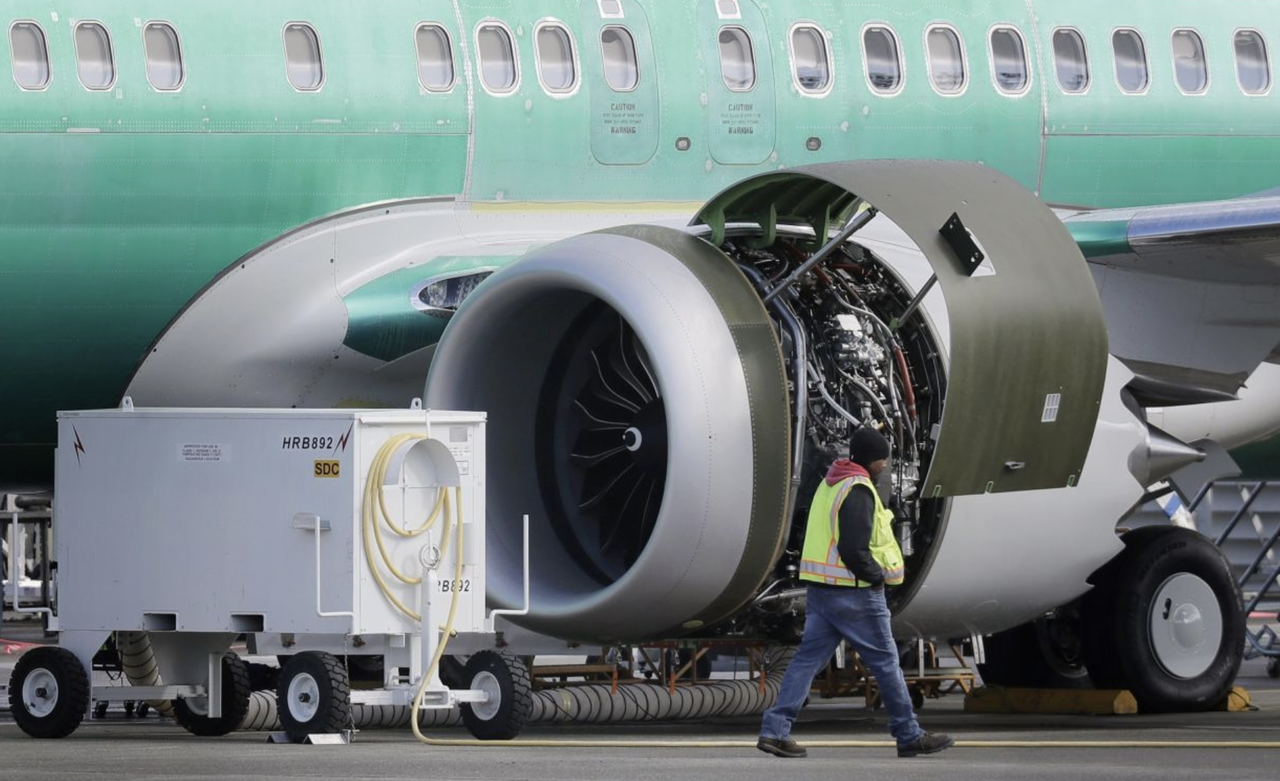
Boeing

However, the airline appears to have changed its story, offering little clarification as to why. During Boeing’s shareholder meeting in Chicago on Monday, CEO Dennis Muilenburg repeated the company’s claim that the alerts were a ‘non-essential’ feature, however, given the fact that the misfire of Boeing’s MCAS system (which Muilenburg also insisted wasn’t an ‘anti-stall’ system, as it has been regularly described in media reports, but instead characterized it as a safety system) is widely suspected to have caused the crashes of Lion Air and an Ethiopian Airlines flights that together killed nearly 350 people makes this claim difficult to believe.

The company said that it didn’t intentionally deactivate the alerts, and that they had only been disabled because of the software issue.

Boeing is now saying that its engineers, as well as safety regulators at the FAA, either missed or overlooked the software glitch that rendered these alerts inoperable, presumably even on planes where the extra safety features had been paid for. The alerts had been standard on earlier models.

The Monday statement suggests Boeing engineers and management, as well as U.S. air-safety regulators, either missed or overlooked one more software design problem when the model was certified two years ago. Before Monday, neither Boeing nor the Federal Aviation Administration had disclosed that an additional software glitch—rather than an intentional plan by the plane maker—rendered so-called angle of attack alerts inoperable on most MAX aircraft. The alerts warn pilots when there is a disagreement between two separate sensors measuring the angle of a plane’s nose.

Boeing’s disclosure comes as the plane maker scrambles to win FAA and international approval of a software fix for MCAS, making it less potent and less likely to misfire. In addition to the challenges already facing the MAX fleet, revelations of the additional software difficulties are likely to be scrutinized by airlines, passengers and regulators world-wide as Boeing strives to restore their trust and return the MAX fleet to service.

The alerts, intended to tell cockpit crews if sensors are transmitting errant data, had been standard on earlier 737 models. Officials at airlines around the globe, including Southwest Airlines Co., the largest 737 MAX customer, assumed the alerts remained standard until details emerged in the wake of the Lion Air crash. At that point, the industry and FAA inspectors monitoring Southwest realized the alerts hadn’t operated on most MAX aircraft, including Southwest jets.

Ultimately, Boeing’s admission of this glitch could make winning FAA approval to allow the planes to return to the skies even more difficult, and it’s also bound to make international regulators more wary of Boeing’s updated flight software, which the company has said is being designed to make MCAS less powerful, and more quickly identify when a plane’s sensors are feeding it erroneous data.

Despite the bad news, which could further weigh on new 737 orders by prolonging the grounding, Boeing shares traded slightly higher on Tuesday, and remained up on the year.

via ZeroHedge News http://bit.ly/2DFfmo6 Tyler Durden
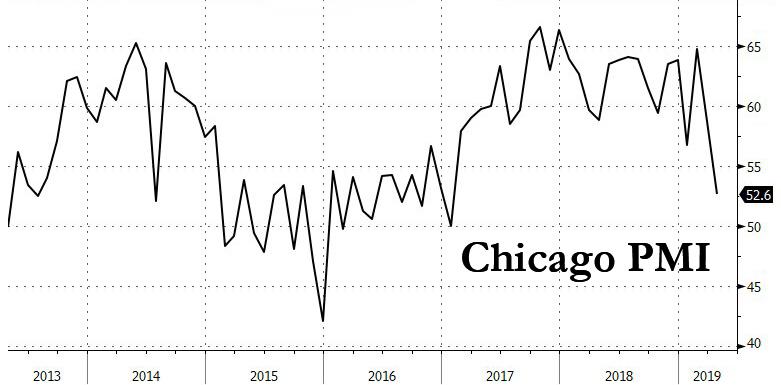
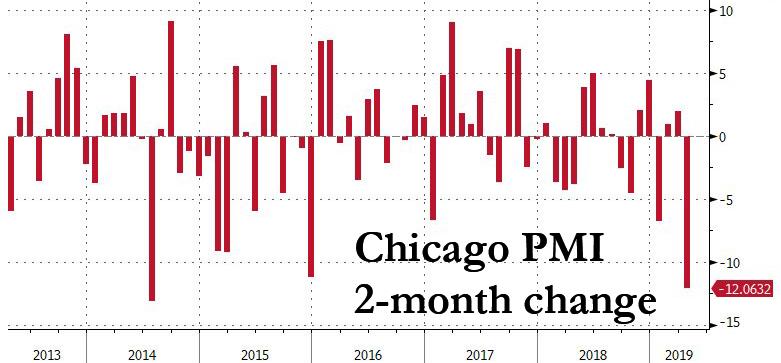
Chicago PMI Crashes, Biggest 2-Month Drop In Five Years

Was that it for the global economic recovery?

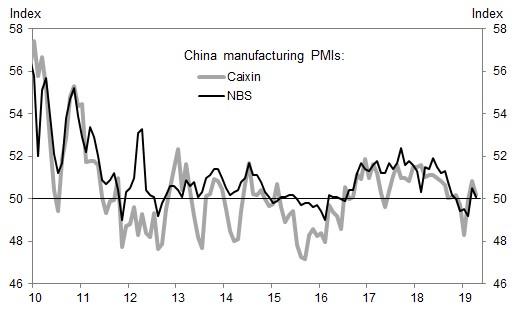
Just hours after China reported disappointing PMI data across the board, with both manufacturing and services surveys posting a drop to levels just above contraction…

… the latest Chicago PMI confirmed that the slowdown is accelerating in the US, as the index tumbled to 52.6 from 58.7, and sharply below the 58.5 estimate. It was also the lowest print since January 2017.

The details:

  • Forecast range 56 – 62 from 25 economists surveyed
  • Business barometer rose at a slower pace, signaling expansion
  • Prices paid rose at a slower pace, signaling expansion
  • New orders rose at a slower pace, signaling expansion
  • Employment rose at a slower pace, signaling expansion
  • Inventories fell at a slower pace, signaling contraction
  • Supplier deliveries rose at a slower pace, signaling expansion
  • Production rose at a slower pace, signaling expansion
  • Order backlogs rose and the direction reversed, signaling expansion

More notably, the two-month plunge in the PMI was breathaking and after printing at 64.7 in February, the index has plunged 12.1 points in the past two months, its biggest drop since mid-2014.

And with all that, it now appears that China’s gargantuan credit injection which was 40% greater than a year earlier, has now been exhausted and the credit impulse tailwind is over.

via ZeroHedge News http://bit.ly/2GUiC17 Tyler Durden

Blackwater Founder Calling For 5,000 Mercenaries To Topple Maduro

As if the past months of US push for regime change in Venezuela with officials like Elliott Abrams of Iran-Contra conviction infamy at the helm wasn’t bizarre enough, things just got weirder, as Erik Prince has apparently been pitching a plan around Washington to privatize US coup efforts using his latest Blackwater inspired mercenary empire

According to Reuters, Prince — the brother of billionaire Education Secretary Betsy DeVos who has over the past years since selling his mired-in-controversy Blackwater group (now Academi) revived his mercenary empire in China in the form of Frontier Services Group (FSG) intends to “deploy a private army to help topple Venezuela’s socialist president, Nicholas Maduro”.

Prior file photo of Prince during Congressional committee hearing, via Getty/NPR

Price has reportedly sought access to Trump administration officials to whom he’s attempting to pitch the whole operation, said to involve some 5,000 soldiers-for-hire to be used by opposition leader Juan Guaido, according to multiple sources who spoke to Reuters. The controversial private security CEO has sought investments from both Trump supporters and wealthy Venezuelan exiles, and reportedly held meetings over the plan as recently as mid-April. 

Neither the White House nor Guaido opposition representatives have confirmed they were entertaining such a plan, with the latter denying altogether that Guado’s team had even spoken with Prince or FSG reps. 

Reuters’ sources described some of the details of the proposed Venezuela coup plan as follows:

The two sources with direct knowledge of Prince’s pitch said it calls for starting with intelligence operations and later deploying 4,000 to 5,000 soldiers-for-hire from Colombia and other Latin American nations to conduct combat and stabilization operations.

Perhaps the most interesting detail to be revealed is the need for a triggering event that could set a final bid for coup over the top, after a number of small attempts failed to gain enough momentum in the past months. 

Reuters’ sources described what Prince called a “dynamic event”:

One of Prince’s key arguments, one source said, is that Venezuela needs what Prince calls a “dynamic event” to break the stalemate that has existed since January, when Guaido – the head of Venezuela’s National Assembly – declared Maduro’s 2018 re-election illegitimate and invoked the constitution to assume the interim presidency.

In 2017, Prince is known to have lobbied the Trump administration for using private contractors to stabilize the Middle East.

He’s made headlines last year after pitching an idea to privatize the wars in Afghanistan and Syria to Trump administration officials, which has reportedly met with little progress, though there were some indicators Trump could be open to the idea.

Iraq-style mercenary occupation of Venezuela? Erik Prince hopes so… 

Image source: “Silent Professionals” blog

To the shock and surprise of many, a subsidiary of his Hong Kong-based Frontier Services Group has been allowed to operate in Iraq, showing up in the southern city of Basra,  after both Prince and Blackwater were formally barred by Iraq’s government from ever entering the country again following the 2007 Nisour Square massacre.

As for Venezuela, things look to slowly destabilize further as continued total economic collapse fuels an ongoing humanitarian emergency, and on news of more armed uprisings by military defectors backing Guaido come out of Caracas. 

via ZeroHedge News http://bit.ly/2Weatdh Tyler Durden

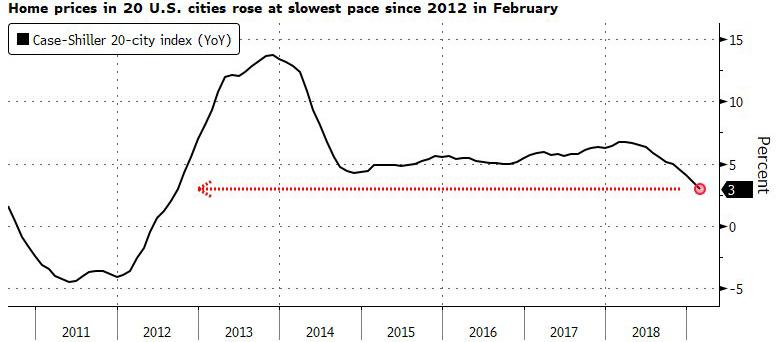
US Home Price Growth Slowst Since 2012

The slowdown in the US housing market is, well, accelerating.

Following last month’s disastrous starts and permits data, the Case Shiller’s home price index was expected to show growth continuing to slow. and it did, considerably worse than expected.

Case-Shiller’s 20-City Composite grew at just 3.00% YoY in January (just above the 2.95% YoY expectation but sharply below March’s 3.51% YoY print). This is the weakest annual growth since September 2012, decelerating for an 11th month in January as buyers held out for more affordable properties. At the national leve, home prices grew at just a 4% rate, the smallest gain since 2012.

“The pace of increases for home prices continues to slow,” said David Blitzer, chairman of the S&P index committee. “Prices generally rose faster in inland cities than on either the coasts or the Great Lakes.”

Some more details:

  • As has been the case for much of the past decade, all 20 cities in the index showed year-over-year gains, led by a 9.7% increase in Las Vegas and 6.7 percent in Phoenix.
  • Increases have slowed considerably over the past year in California, with San Francisco, San Diego and Los Angeles all recording annual gains of below 2 percent. Seattle, another previously hot city, showed an advance of just 2.8 percent.
  • Prices in 17 cities rose from the prior month on a seasonally adjusted basis, led by Tampa.

What is odd is that despite alleged wage gains and lower interest rates and borrowing costs, buyers have still been holding out for more affordable properties.

That said, as Bloomberg notes, price gains may pick up in the coming months amid signs of strength in demand as the latest new home sales report showed the fastest increase since 2017, while applications for loans to buy homes recently hit the highest weekly level in almost nine years.

Meanwhile, keep an eye on pending home sales later on Tuesday for a better sense of momentum in the housing market in the first half of the year. Analysts project contract signings rose for the second time in three months.

via ZeroHedge News http://bit.ly/2UPXUTF Tyler Durden

Joe Biden Courts Blue Collar Voters, Says ‘I Am a Union Man’: Reason Roundup

Former Vice President Joe Biden kicked off his campaign with a bid to recapture blue collar union workers Monday.

“I make no apologies,” Biden told his audience at the Teamsters Hall in Pittsburgh. “I am a union man.”

He thanked United Steelworkers, the American Federation of Teachers, the Service Employees International Union, and the International Association of Fire Fighters for attending.

It’s obvious that if he were to win the primary, Biden’s general election strategy would revolve around winning Pennsylvania, Wisconsin, and Michigan—three states where Trump’s unique appeal to certain rank-and-file union members essentially won him the election. On Twitter, the president countered that “dues crazy union leadership” may be in the tank for the Democrats, but “the members love Trump.”

Biden is currently enjoying a popularity surge among the voters he needs to win the primary. A new poll has him at 36 percent. Bernie Sanders is at 22 percent, followed by Elizabeth Warren at 9 percent and Pete Buttigieg at 8 percent. According to Morning Consult:

Biden’s popularity has stayed steady, even amid a string of unflattering news stories in recent months, including his physical contact with women and a resurfaced debate over his handling of the 1991 Supreme Court confirmation hearings involving Anita Hill and Clarence Thomas when he was chairman of the Senate Judiciary Committee.

Any concerns that those stories may dampen his support with women and black women is not yet borne out by the data. If anything, Biden’s advantage over the field relies heavily on edges with those groups: Among women overall, Biden jumped 8 points in the last week, to 38 percent — driven by a 7-point bump with white women (to 36 percent) and a 10-point jump with black women, to 47 percent.

Free Minds

Amelie Wen Zhao has decided to move forward with publication of her debut novel Blood Heir after all. Previously, she had canceled its release because several reviewers in the young adult literary community had branded it racist.

When these accusations first emerged several weeks ago, they struck both New York magazine’s Jesse Singal and Vulture‘s Kat Rosenfield as ill-founded. Zhao’s book concerns a fictional princess with magic powers, and is inspired by the tragedy of Anastasia Romanov. Zhao, an Asian immigrant, includes Russian themes, and a significant part of Blood Heir deals with forced labor. But some “sensitivity reviewers” decided that Zhao was really writing about American chattel slavery, having culturally appropriated this aspect of African history. “Racist ass writers, like Amélie Wen Zhao, who literally take Black narratives and force it into Russia when that shit NEVER happened in history—you’re going to be held accountable,” one early reviewer promised.

This is a wildly off-base criticism, of course. Slavery is not some unique phenomenon that only occurred in the American South; virtually every human society since the dawn of civilization has grappled with slavery—including Russia, where serfdom was not abolished until 1861.

In any case, it’s good that Zhao has decided to publish the book, although she has apparently revised it to be more pleasing to the hyper-woke, according to The New York Times:

After Zhao decided she wanted to release the book, she and her publisher sought feedback from scholars and sensitivity readers in an effort to resolve any ambiguity around the type of indentured labor depicted. They had academics from different multicultural backgrounds, as well as one who studies human trafficking in Asia, evaluate the text, and Zhao added new material and made changes based on their comments. They had additional sensitivity readers vet the book for racial and other stereotypes.

It’s unclear whether such efforts will mollify Zhao’s critics, or if the release of “Blood Heir” this fall will ignite another cycle of outrage — a backlash to the backlash to the backlash. There’s also the risk that the controversy will dampen enthusiasm for the book among readers and booksellers.

But Zhao and her publisher seem more excited than wary that readers will have a chance to evaluate the book for themselves.

“We ultimately think our Y.A. readers are very smart,” Marino said. “They can read what they want to read and use their critical thinking skills to work through it.”

In all likelihood, most readers would have been perfectly satisfied with the book in its original form. Callout culture’s squeakiest wheels make a lot of noise but are few in number.

FREE MARKETS

Burger King is bringing its Impossible Whopper—a hamburger made from 0 percent meat—to all locations nationwide after a successful test launch in St. Louis, Missouri. According to Vox:

The plan for nationwide distribution is further evidence of plant-based meat going mainstream — a huge deal for those who want to see meat alternatives replace actual meat because of concerns over animal cruelty or climate change. If this keeps scaling up, it could help save hundreds of thousands of animals from suffering on factory farms, and it could fight global warming by reducing the number of methane-producing cattle. It could also combat other problems related to our factory-farming system, like antibiotic resistance.

Burger King’s announcement caps a month of incredible growth for the alternative meat movement. Earlier this month, Del Taco announced it’s partnering with Beyond Meat to offer new meatless tacos. And Qdoba announced that all 730 of its locations will offer Impossible Foods’ plant-based meat alternative.

QUICK HITS

  • Deputy Attorney General Rod Rosenstein has resigned.
  • A sexual assault accusation against Democratic presidential candidate Pete Buttigieg now appears to be a hoax cooked up by far-right political operatives Jacob Wohl and Jack Burkman. Wohl is suspected of perpetrating a similar hoax against Special Counsel Robert Mueller.
  • Former Alaskan Sen. Mike Gravel is running for the 2020 Democratic presidential nomination. Gravel was a Democrat while in office, though he briefly joined the Libertarian Party.
  • Financial disputes between National Rifle Association leadership have finally spilled out into the open.
  • Can’t get Game of Thrones‘ underwhelming big battle off your mind? Here’s a must-read: “Cersei Lannister Is Smarter Than All These Morons”

from Latest – Reason.com http://bit.ly/2vsLerJ
via IFTTT

19 Historical Oil Disruptions, And How No.20 Will Shock Markets

Authored by Philip Verleger via Oilprice.com,

Albert Einstein once wrote that “the definition of insanity is doing the same thing over and over again and expecting different results.” Were he alive today, he would be repeating the line to anyone who would listen, especially the reporters on cable news channels such as CNBC. He might add that the world’s policymakers always approach oil market disruptions in the same way: predicting there will be no impact on prices.

Einstein would then point out that the policymakers are consistently wrong. A hefty price boost has followed every disruption.

The world has experienced nineteen oil market disruptions over the last forty years. In a paper published in March 2018, I chronicled these events and noted that the maximum price increase was predictable. Last Monday, Secretary of State Mike Pompeo initiated the twentieth disruption. The consequences are projected here.

Start, though, with the energy policy insanity. In each of the disruptions since 1973, I have noted the following regarding government officials.

State Department representatives always say something like “the US Department of State remains in contact with our partners to reduce the risk of supply disruptions. There is sufficient oil supply in the global markets that countries can access.”

OPEC officials always spout some version of “the oil market remains well-supplied, with the recent price driven by geopolitics, not fundamentals.”

Nothing has changed. Last week Reuters offered this quote from the State Department’s Brian Hook, the person running the Iran sanctions program:

“There’s roughly a million barrels per day (bpd) of Iranian crude (exports) left, and there is plenty of supply in the market to ease that transition and maintain stable prices,” said Brian Hook, U.S. Special Representative for Iran and Senior Policy Advisor to the Secretary of State, speaking in a call with reporters.

Meanwhile, Saudi energy minister Khalid al-Falih told Financial Times that Saudi Arabia would not boost production immediately, adding that “the market is ‘well supplied’ and inventories continue to rise despite the sanctions against Iran’s oil exports.”

Mark Twain is thought to have said that “history does not repeat, but it rhymes.” In this case, it repeats. Policymakers have learned nothing in forty years.

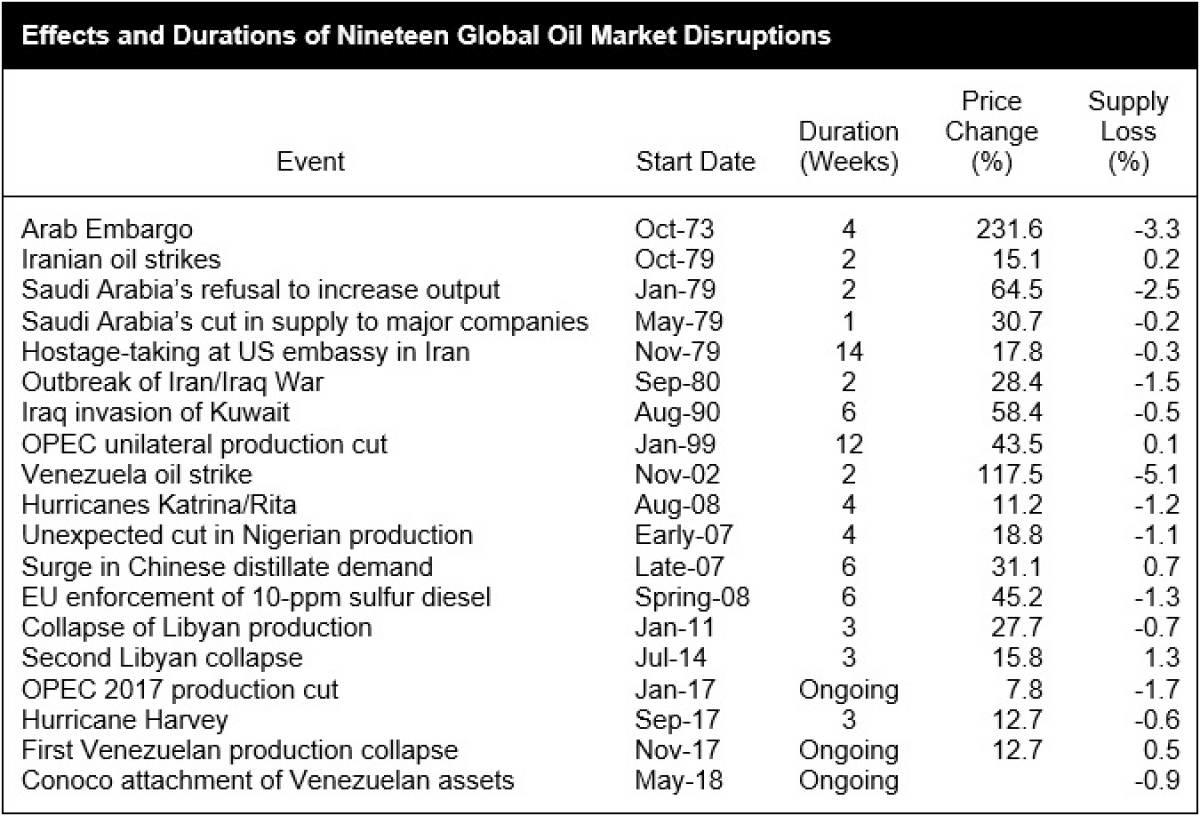
The table below lists the nineteen market disruptions. I prepared it in 2018 at a time when Conoco had just used an award of $2 billion granted against Venezuela to seize the latter’s assets in Curacao and when production in Nigeria suffered a disruption. For each event listed, the table shows the start date, the duration, the maximum price increase associated with it, and the percentage loss in supply.

(Click to enlarge)

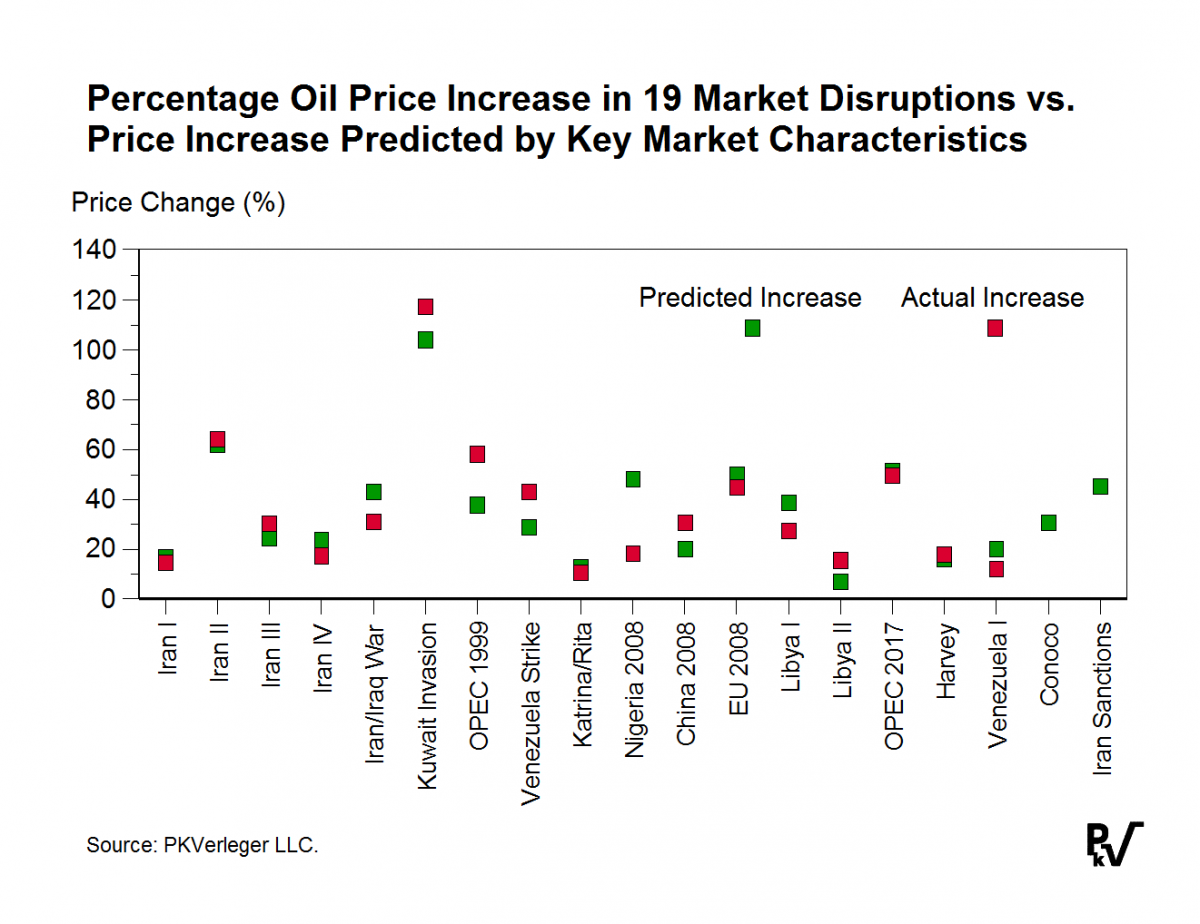
I took these data and developed a model that predicted the price increase associated with seventeen of the nineteen disruptions, excluding the Arab Embargo and the Conoco attachment of Iranian assets. The model explained seventy percent of the price variation. The graph below compares the actual and predicted price changes for each disruption.

(Click to enlarge)

I note here that I based this model on results published in 1982 in Oil Markets in Turmoil, a book I wrote while teaching at Yale. The volume provides a quantitative approach to evaluating oil market disruptions.

The findings from the model indicate that the current disruption will likely cause prices to increase sixty-six percent at their peak. Roughly speaking, Brent will rise to between $114 and $126 per barrel.

This conclusion results from my calculation that the present episode will take roughly two percent of supply from the market.

The reduction will come from falling Venezuelan production, which is also subject to US sanctions, the declining Iranian exports, and a modest cut in Libyan exports.

The latest issue of The Economist warns that “the risk of an oil price shock is increasing.” The editors are correct.

Thinking of the Einstein quote above, I end by paraphrasing the title of a great book by Carmen Reinhart and Kenneth Rogoff: “This time will not be different.”

via ZeroHedge News http://bit.ly/2GSVHmG Tyler Durden

Joe Biden Courts Blue Collar Voters, Says ‘I Am a Union Man’: Reason Roundup

Former Vice President Joe Biden kicked off his campaign with a bid to recapture blue collar union workers Monday.

“I make no apologies,” Biden told his audience at the Teamsters Hall in Pittsburgh. “I am a union man.”

He thanked United Steelworkers, the American Federation of Teachers, the Service Employees International Union, and the International Association of Fire Fighters for attending.

It’s obvious that if he were to win the primary, Biden’s general election strategy would revolve around winning Pennsylvania, Wisconsin, and Michigan—three states where Trump’s unique appeal to certain rank-and-file union members essentially won him the election. On Twitter, the president countered that “dues crazy union leadership” may be in the tank for the Democrats, but “the members love Trump.”

Biden is currently enjoying a popularity surge among the voters he needs to win the primary. A new poll has him at 36 percent. Bernie Sanders is at 22 percent, followed by Elizabeth Warren at 9 percent and Pete Buttigieg at 8 percent. According to Morning Consult:

Biden’s popularity has stayed steady, even amid a string of unflattering news stories in recent months, including his physical contact with women and a resurfaced debate over his handling of the 1991 Supreme Court confirmation hearings involving Anita Hill and Clarence Thomas when he was chairman of the Senate Judiciary Committee.

Any concerns that those stories may dampen his support with women and black women is not yet borne out by the data. If anything, Biden’s advantage over the field relies heavily on edges with those groups: Among women overall, Biden jumped 8 points in the last week, to 38 percent — driven by a 7-point bump with white women (to 36 percent) and a 10-point jump with black women, to 47 percent.

Free Minds

Amelie Wen Zhao has decided to move forward with publication of her debut novel Blood Heir after all. Previously, she had canceled its release because several reviewers in the young adult literary community had branded it racist.

When these accusations first emerged several weeks ago, they struck both New York magazine’s Jesse Singal and Vulture‘s Kat Rosenfield as ill-founded. Zhao’s book concerns a fictional princess with magic powers, and is inspired by the tragedy of Anastasia Romanov. Zhao, an Asian immigrant, includes Russian themes, and a significant part of Blood Heir deals with forced labor. But some “sensitivity reviewers” decided that Zhao was really writing about American chattel slavery, having culturally appropriated this aspect of African history. “Racist ass writers, like Amélie Wen Zhao, who literally take Black narratives and force it into Russia when that shit NEVER happened in history—you’re going to be held accountable,” one early reviewer promised.

This is a wildly off-base criticism, of course. Slavery is not some unique phenomenon that only occurred in the American South; virtually every human society since the dawn of civilization has grappled with slavery—including Russia, where serfdom was not abolished until 1861.

In any case, it’s good that Zhao has decided to publish the book, although she has apparently revised it to be more pleasing to the hyper-woke, according to The New York Times:

After Zhao decided she wanted to release the book, she and her publisher sought feedback from scholars and sensitivity readers in an effort to resolve any ambiguity around the type of indentured labor depicted. They had academics from different multicultural backgrounds, as well as one who studies human trafficking in Asia, evaluate the text, and Zhao added new material and made changes based on their comments. They had additional sensitivity readers vet the book for racial and other stereotypes.

It’s unclear whether such efforts will mollify Zhao’s critics, or if the release of “Blood Heir” this fall will ignite another cycle of outrage — a backlash to the backlash to the backlash. There’s also the risk that the controversy will dampen enthusiasm for the book among readers and booksellers.

But Zhao and her publisher seem more excited than wary that readers will have a chance to evaluate the book for themselves.

“We ultimately think our Y.A. readers are very smart,” Marino said. “They can read what they want to read and use their critical thinking skills to work through it.”

In all likelihood, most readers would have been perfectly satisfied with the book in its original form. Callout culture’s squeakiest wheels make a lot of noise but are few in number.

FREE MARKETS

Burger King is bringing its Impossible Whopper—a hamburger made from 0 percent meat—to all locations nationwide after a successful test launch in St. Louis, Missouri. According to Vox:

The plan for nationwide distribution is further evidence of plant-based meat going mainstream — a huge deal for those who want to see meat alternatives replace actual meat because of concerns over animal cruelty or climate change. If this keeps scaling up, it could help save hundreds of thousands of animals from suffering on factory farms, and it could fight global warming by reducing the number of methane-producing cattle. It could also combat other problems related to our factory-farming system, like antibiotic resistance.

Burger King’s announcement caps a month of incredible growth for the alternative meat movement. Earlier this month, Del Taco announced it’s partnering with Beyond Meat to offer new meatless tacos. And Qdoba announced that all 730 of its locations will offer Impossible Foods’ plant-based meat alternative.

QUICK HITS

  • Deputy Attorney General Rod Rosenstein has resigned.
  • A sexual assault accusation against Democratic presidential candidate Pete Buttigieg now appears to be a hoax cooked up by far-right political operatives Jacob Wohl and Jack Burkman. Wohl is suspected of perpetrating a similar hoax against Special Counsel Robert Mueller.
  • Former Alaskan Sen. Mike Gravel is running for the 2020 Democratic presidential nomination. Gravel was a Democrat while in office, though he briefly joined the Libertarian Party.
  • Financial disputes between National Rifle Association leadership have finally spilled out into the open.
  • Can’t get Game of Thrones‘ underwhelming big battle off your mind? Here’s a must-read: “Cersei Lannister Is Smarter Than All These Morons”

from Latest – Reason.com http://bit.ly/2vsLerJ
via IFTTT

Original US-China Tariffs Now Major Obstacle In Trade Talks

Futures dipped after the Wall Street Journal reported that punitive tariffs exchanged between China and the United States are now posing a major obstacle in ongoing trade talks between the two nations. 

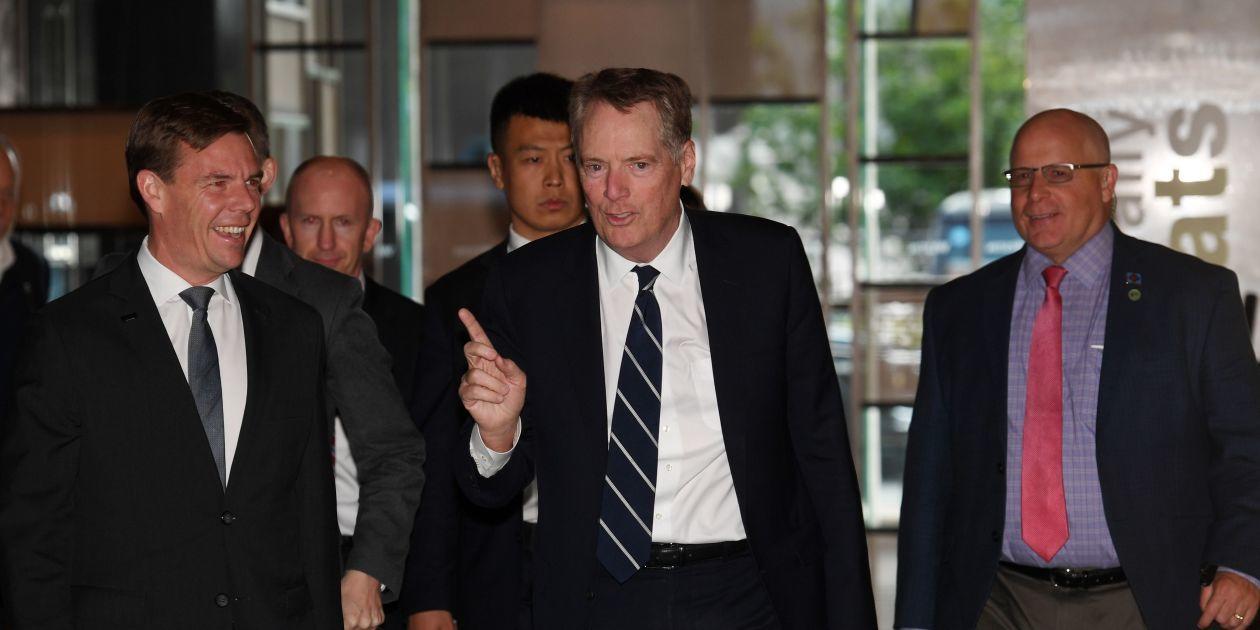
US Trade Representative Robert Lighthizer and Treasury Secretary Steven Mnuchin resume high-level talks with China on Tuesday – which will be followed next week by their counterparts traveling to Washington next week for another round of talks which officials and business groups say could result in a deal. 

That said, “how and whether to remove the tariffs the two governments imposed in the earliest phases of the dispute are now at the forefront of the talks,” according to the Journal, citing people briefed on the negotiations. 

At issue is how much of the tariffs the U.S. levied on $250 billion of Chinese goods will be removed, according to the people. The U.S. wants to leave some in place as a tool to enforce the agreement while Chinese negotiators see those tariffs as an affront, and negotiators have batted the issue back and forth for at least a month. –Wall Street Journal

“The tariffs are the leverage to move the deal past the finish line,” said Jake Parker, Vice President of the US-China Business Council in Beijing. “It’s natural the details of drawdown timelines would be among the last items negotiated.”

U.S. Trade Representative Robert Lighthizer, center, arrives at a Beijing hotel Tuesday ahead of the latest round of U.S.-China trade talks. PHOTO: GREG BAKER/AGENCE FRANCE-PRESSE/GETTY IMAGES

Aside from Tariffs, the negotiators are trying to find solutions in other areas – such as persuading Beijing to expand access to China’s cloud computing market and agricultural markets, according to business and farm groups. 


Neither Mr. Lighthizer nor Mr. Mnuchin would comment on specifics as they walked past reporters after arriving in Beijing. Mr. Mnuchin said that the focus of this week’s talks is “broad” and that “we’ve made a lot of progress.”

On Monday Mr. Mnuchin told Fox News that the enforcement mechanism still “needs a little bit of fine tuning” and that “if we get to a completed agreement, it will have real enforcement provisions.” –Wall Street Journal

According to people familiar with Beijing, their primary concern is that the US continues to insist on imposing tariffs, while preventing China from retaliating in order to make sure Beijing fulfills commitments in a trade deal.  

“Beijing absolutely doesn’t want to give in on this,” said one WSJ source, who noted that the tariffs would be an embarrassment for leadership and a tough sell to Chinese businesses and domestic counterparts. Investors are also taking note. 

“The U.S. has already hurt the confidence of the Chinese people,” by initiating a trade war, and should eliminate tariffs immediately upon inking a deal, according to Mei Xinyu – a senior researcher at the Chinese Academy of International Trade and Economic Cooperation – a think tank affiliated with the Commerce Ministry. 

“Bringing back tariffs would break any trust even further.” 

via ZeroHedge News http://bit.ly/2LeBSL4 Tyler Durden

With Gun Ban Not Working, Politicians In Britain Now Want To Ban Knives Nationwide

If ever we needed proof of the expression that “guns don’t kill people, people kill people” look no further than Britain, where families may have to start practicing cutting their steak and bread at dinner with a spoon. This is, of course, because Britain’s politicians have now made the absurdly ridiculous move to call for the banning of what Reason magazine called “the most useful tool ever invented” – the knife.

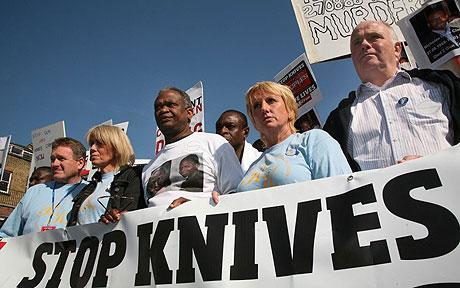
Reason reported this morning that British politicians have “declared war on knives” and are moving swiftly to try and ban them, since gun laws aren’t working to help stop crime altogether:

Having failed to disarm criminals with gun controls that they defy, British politicians are now turning their attention to implementing something new and different: knife control. Because criminals will be much more respectful of knife laws than of those targeted at firearms, I guess.

“No excuses: there is never a reason to carry a knife. Anyone who does will be caught, and they will feel the full force of the law,” London’s Mayor Sadiq Khan tweeted on April 8.

Not to be outdone, his predecessor, Boris Johnson, currently Foreign Secretary, called for increased use of stop-and-search powers by police. “You have got to stop them, you have got to search them and you have got to take the knives out of their possession.”

Poundland (the British equivalent of a dollar store) announced last week that it will no longer sell kitchen knives in any of its 850 stores. Similar stores are being slapped with fines for selling knives to minors.

The insanity disguised as regulation continues to get worse:

British politicians propose banning home delivery of knives and police promote street-corner bins for the surrender of knives while also conducting stings against knife vendors. Their goal is to “target not only those who carry and use knives, but also the supply, access and importation of weapons.”

It all sounds all so familiar, doesn’t it? And yet so utterly pointless. If British authorities have been unable to block criminals’ access to firearms—mechanical devices that require some basic mechanical skill to manufacture, or at least a 3D printer—how are they going to cut off the flow of knives, which require nothing more than a piece of hard material that can take an edge?

There are also practical downsides to discouraging the public from possessing knives—one of the oldest and most useful tools ever invented. Poundland, after all, isn’t dropping the sale of combat blades; the company’s move applies specifically to the tools people use to make their meals. The law looks much more likely to inconvenience peaceful people planning to carve a roast than to put off thugs who, push comes to shove, can find a way to sharpen a piece of rebar against a rock.

This nonsense comes in the wake of a growing number of stabbings since Britain outlawed guns altogether. While Britain can now boast, as Piers Morgan famously did in his interview with Alex Jones, that they were only about 30 gun murders in Britain in the year prior, British politicians failed to notice that crime continues to happen, just through different means. It became clear when Britain’s crime stats were put up against those of gun toting New Yorkers. From Reason:

A flurry of recent headlines reveal that London now has a higher murder rate than New York City, a metropolis of nearly identical population and one long considered more vulnerable to crime. “London police investigated more murders than their New York counterparts did over the last two months,” Reuters reported earlier this month. “In the latest bloodshed, a 17-year-old girl died on Monday after she was found with gunshot wounds in Tottenham, north London, a day after a man was fatally stabbed in south London.”

Commentators note that this may be a blip and that New York City’s murder rate for 2017 stood at more than double that for London. In fact, London’s murder rate really hasn’t risen much—instead, New York’s has dropped dramatically. But that still represents a big shift. In her 2002 Guns and Violence: The English Experience, historian Joyce Lee Malcolm noted that “New York City’s homicide rate has been at least five times higher than London’s for two hundred years. For most of that time, there were no serious firearm restrictions in either city.”

New Yorkers didn’t need firearms to exceed the bloodlust of their trans-Atlantic rivals. Even if you removed crimes committed with guns from the comparison, “New Yorkers still managed to outstab and outkick Liverpudlians by a multiple of 3 and Londoners by a multiple of 5.6″ over those two centuries,” wrote the late Eric H. Monkkonen in Murder in New York City, published in 2000.

We detailed this asinine knife ban in a series of articles we’ve been writing, the latest of which came on April 10. 

Shortly after London Mayor Sadiq Kahn’s city-wide ban on knivesThe Express had reported  that one of Scotland’s leading doctors has called for a ban on “killer” kitchen knives.

Dr John Crichton, the new chairman of the Royal College of Psychiatrists in Scotland, wants the sale of pointed kitchen knives to be banned to help reduce the number of fatal stabbings.

Dr Crichton, who took on the role of chairman in June this year, is championing a switch to so-called “R”-bladed knives, which have rounded points and are far less effective as weapons.

As The Express detailed, he said that research shows many attacks, particularly in households where there has been a history of violence, involve kitchen knives because they are so easily accessible. Dr Crichton believes a switch from sharp-pointed, long-bladed knives to the new design could save lives.

 “This is a public health measure and public health measures are always about society deciding on a self-imposed restriction for the public good.”

As ridiculous as the idea of the knife ban sounds, it hasn’t stopped its advocates from beating the drum even harder over recent weeks. However, let us tell you how this is going to work out, for those that don’t already know. We think that politicians will be shocked to find that similar circumstances take place with the knife ban as they did with the gun ban. Criminals will find a different method to commit violent crimes and those who don’t obey the law to begin with certainly won’t be deterred by more regulation.

However, if you’re a law abiding citizen in Britain preparing dinner for 10 from scratch at your house, you may find things a little more inconvenient in the comfort of your own home. Thanks politicians and regulators!

via ZeroHedge News http://bit.ly/2LsbrSj Tyler Durden

Berkshire Pledges $10B To Help Occidental Buy Anadarko

One stock analyst revealed on Monday that flight tracking data showed Occidental Petroleum’s corporate jet had flown to Omaha over the weekend, prompting them to speculate that Oxy might be trying to bring Warren Buffett into the deal to help finance its takeover of Anadarko Petroleum.

Buffett

As it so happens, that assessment was absolutely spot on.

According to CNBC, a day after Anadarko said it was leaning toward Oxy’s higher bid, Buffett has confirmed that Berkshire is getting involved in the bidding war between Oxy and Chevron. Berkshire has committed to invest $10 billion in Occidental Petroleum contingent on the company completing the takeover of Anadarko.

Buffett’s backing will undoubtedly strengthen Oxy’s hand as its squares off with the much larger Chevron, which could still up its offer for Anadarko. With Buffett backing Oxy, it’s more likely that Chevron will walk away from the deal with the $1 billion breakup fee it would be owed by Anadarko. Though Chevron still has the financial heft to see the deal through if it commits to doing so.

Here’s how the deal is structured (Per CNBC):

  • Berkshire will receive 100,000 shares of cumulative perpetual preferred stock with a value of $100,000 a share.
  • The conglomerate also gets a warrant to purchase up to 80 million shares of Occidental at an exercise price of $62.50 a share.
  • The preferred stock will accrue dividends at 8% annually.

Oxy CEO Vicki Hollub, who had pledged to sell off some $15 billion in assets to help finance the acquisition, said she was “thrilled” to have Buffett on board.

Berkshire’s involvement in the deal will undoubtedly be widely discussed at Berkshire’s annual shareholder meeting this weekend.

via ZeroHedge News http://bit.ly/2XROngU Tyler Durden